High Energy Physics - Theory · arXiv:1308.2084 v4 · submitted 9 Aug 2013 · 34 references
Universal scaling properties of extremal cohesive holographic phases
The paper says
“We show that strongly-coupled, translation-invariant holographic IR phases at finite density can be classified according to the scaling behaviour of the metric, the electric potential and the electric flux introducing four critical exponents, independently of the details of the setup.”
more of the abstract
Solutions fall into two classes, depending on whether they break relativistic symmetry or not. The critical exponents determine key properties of these phases, like thermodynamic stability, the (ir)relevant deformations around them, the low-frequency scaling of the optical conductivity and the nature of the spectrum for electric perturbations. We also study the scaling behaviour of the electric flux through bulk minimal surfaces using the Hartnoll-Radicevic order parameter, and characterize the deviation from the Ryu-Takayanagi prescription in terms of the critical exponents.
from the abstract
Pith says
Machine review · deepseek-v4.1-flash · 14 Nov 2026 · what was read was not recorded · not checked by a person
Reviewed in 2026 with later literature in view.
It can be wrong. Challenge this review or reply to it.
Holds up, with conditions. A solid reference paper on the four-exponent template for cohesive holographic IR phases; the constant-scalar branch is asserted rather than computed for the deformation and conductivity sectors, which is worth a referee note but not a rejection. This line is wrong
2 major objections · 12 minor
How often objections from reviews like this one are right: not yet measured
Not checked: figures, code, what the 34 references say.
The paper says, at Section 2.4 and footnote 6
The review did not quote this passage.
Pith says: Objection 1 of 2 · major
The deformation analysis is carried out only for the runaway-scalar solutions. Footnote 6 explicitly states that the amplitude-substitution trick used to extend the background solutions to the constant-scalar (extremum) case 'does not work for the deformations, which have to be worked out from scratch', and those deformations are never worked out.
more of objection 1
The abstract nonetheless claims that the exponents determine 'the (ir)relevant deformations around them' 'independently of the details of the setup'. The paper should either extend the deformation analysis to the constant-scalar case or scope the abstract and introduction to the runaway-scalar subclass.
The paper says, at Sections 3.1 and 3.2
The review did not quote this passage.
Pith says: Objection 2 of 2 · major
The conductivity analysis evaluates the Schroedinger potential (3.7) only on the runaway solutions (2.17) and (2.25). The constant-scalar Lifshitz cohesive sub-class (theta = 0, zeta = xi = -d) that the introduction highlights as a distinct cohesive phase is not subjected to the conductivity analysis.
more of objection 2
For that sub-class, the mass term W/(Z D C^{(d-2)/2}) in (3.7) is not obviously of the form V0/r_tilde^2 (for d = 2 it shifts V0; for d > 2 it is not a pure 1/r_tilde^2 term), so the quoted exponent (3.26) is not established there. The paper should either extend the conductivity analysis to the constant-scalar case or explicitly restrict the claim to the runaway-scalar subclass.
12 minor objections
The paper says, at Section 3.3, Eq. (3.29)
Pith says: minor objection 1 of 12
The generic formula Re(sigma) ~ omega^{2 - 2/z - zeta/z} is explicitly labeled a conjecture ('we conjecture', 'although such phases remain to be discovered'). The abstract's claim that the exponents determine the conductivity should be scoped accordingly, so that the conjecture is not read as a derived result.
The paper says, at Section 3.2, Eq. (3.23)
Pith says: minor objection 2 of 12
The text states that the flux term 2(zeta - xi - 1)^2 Q^2 r_tilde^{zeta - theta} is 'subleading (since zeta != theta - 2)'. This is imprecise: the flux term is subleading only if zeta < theta - 2, which is indeed the case in both branches of the parameter space (2.38), but the parenthetical should say so explicitly.
show 10 more
The paper says, at Section 4, Eq. (4.17)
Pith says: minor objection 3 of 12
In the second line, the exponent of rho_0 contains zeta while the exponent of L contains xi; this appears to be a typo (zeta should be xi). Please correct.
The paper says, at Section 4, Eq. (4.18)
Pith says: minor objection 4 of 12
The condition 'd_theta <= 0' contradicts the earlier requirement d_theta >= 0 stated before (4.5). Please check and correct.
The paper says, at Section 4, after Eq. (4.16)
Pith says: minor objection 5 of 12
The phrase 'the dominant (area) term is at most linear at large L, where it grows like a volume law' is confusing, since A_Gamma ~ L^{1 - d_theta} is sublinear for d_theta > 0. Please clarify what is meant by 'volume law' here.
The paper says, at Section 2.4.2
Pith says: minor objection 6 of 12
The parameter space '2 < theta < 4, (1/2)(theta - 4) < xi < 0, z < 0' includes z < 0, which is unusual for a dynamical exponent. Please discuss the physical interpretation or correct if this is a typo.
The paper says, at Section 3.3
Pith says: minor objection 7 of 12
The claim that the exponent in (3.26) is always positive under the Null Energy Condition and thermodynamic stability is stated but not shown. A brief derivation would help the reader.
The paper says, at Section 2.4.1
Pith says: minor objection 8 of 12
The rescaling (z, theta, zeta, xi) -> (2/d)(z, theta, zeta, xi), beta -> (d/2) beta that is claimed to give the generic-d deformation exponents from the d = 2 results is stated without proof. A check for the universal modes beta_0 = 0 and beta_u = d + z - theta would reassure the reader.
The paper says, at Section 2.2.1
Pith says: minor objection 9 of 12
The locally critical limit (2.18) with theta = 0 requires W0 < 0, which the author flags as 'in tension with the interpretation of W0 as a charge squared'. A brief discussion of the physical interpretation would help.
The paper says, at Section 2.4.3
Pith says: minor objection 10 of 12
The parameter space is described as 'a bit too lengthy to write'. Providing it in an appendix would help reproducibility.
The paper says, at Section 2.1.2
Pith says: minor objection 11 of 12
The expansion (2.11) assumes mu_loc >> m, and the paper says 'We will check in retrospect in which parameter space this approximation is valid.' A brief summary of the retrospective check would help.
The paper says, at Section 2.3.2
Pith says: minor objection 12 of 12
The exact solution with theta = 3 is discarded as 'pathological' because its static radial perturbations are logarithmic. A brief explanation of why this is problematic would help.
What would settle it
Compute the Schroedinger potential (3.7) explicitly on the constant-scalar Lifshitz cohesive solution (theta=0, zeta=xi=-d, W0 != 0, as in [25,26]), keeping the mass term W/(Z D C^{(d-2)/2}). Check whether it still takes the form V0-tilde/r-tilde^2 with V0-tilde given by (3.13) at theta=0, or whether the constant mass term shifts V0-tilde. If V0-tilde shifts, the exponent in (3.26) changes for this sub-class and the abstract's universality claim needs an explicit qualifier restricting it to the runaway branch.
from the skeptic's reading
How the review went
4 readings by deepseek-v4.1-flash · 14 Nov 2026
- Reader holds up, with conditions
- Skeptic agrees
- Editor wrote the verdict above
- Referee minor revision: 2 major objections, 12 minor
Not run on this paper: the simulated authors' defence.
Pith did not check this review's objections against the paper.
The review in full
The review in brief, machine-written
Goutéraux has written the reference paper for his program: a four-exponent template (z, θ, ξ, ζ) for translation-invariant cohesive holographic IR phases, with ξ and ζ the new ingredients. The classification is real and useful. There are explicit solutions in three models (massive vector, electron star, Chern-Simons), generalized to arbitrary d for the massive vector case, and a clean split into z≠1 with ζ=θ−d and z=1 with ζ independent. The deformation analysis is the most interesting part: pairs sum to dθ+z except when the current is irrelevant and cannot be switched off (electron stars) or couples to a magnetic field via Chern-Simons, where the sum is shifted by ζ. That is a structural result worth having. The conductivity computation is standard matching, and the z=1 result Re σ ~ ω−ζ is clean. The general-ζ formula (3.29) is explicitly a conjecture and no phase realizes it; the paper says so, which is the right way to handle it. Where it is soft: the constant-scalar (extremum) branch. The paper says the amplitude-substitution trick works for backgrounds but 'does not work for the deformations, which have to be worked out from scratch' (footnote 6), and section 2 says it will only treat the runaway case explicitly. The deformation and conductivity sectors are then never computed for the constant-scalar Lifshitz cohesive sub-class (θ=0, ζ=ξ=−d, W0≠0) that the introduction itself lists. The stress-test's specific worry — that the mass term in (3.7) is not subleading there and could shift Ṽ0 away from (3.13) — is plausible and worth a referee asking about, though I cannot confirm it fails without doing the calculation. The classification claim (4.1) survives because θ=0 is a special case of the ansatz; what is asserted rather than shown is the downstream claim that the exponents fix the deformation spectrum and conductivity for that branch. The abstract does not carry that qualification, though the body does. Section 4's ξ < −dθ case is also left open — the paper says the IR alone cannot decide whether the minimal surface reaches the boundary. That is an honest limitation, not a flaw. Who it is for: anyone working on hyperscaling violation, cohesive versus fractionalized phases, or nonlocal probes of holographic IR geometry. It is a catalogue plus a template, and it will be cited. Recommendation: send it out. The gaps are acknowledged and narrow; a referee should press on the constant-scalar branch and on whether (3.29) has any realization.
The strongest objection
The abstract (abstract:s0) claims the four exponents determine 'the (ir)relevant deformations around them' and 'the low-frequency scaling of the optical conductivity' universally. The demonstration, however, is narrower than that. Section 2 states that the amplitude-substitution trick used to extend the background solutions to the constant-scalar (extremum) case 'does not work for the deformations, which have to be worked out from scratch' (text after Eq. 2.1, footnote 6). Those deformations are never worked out for the constant-scalar case. Section 3 likewise evaluates the Schroedinger potential (3.7) only on the runaway solutions (2.17) and (2.25); the constant-scalar Lifshitz cohesive solutions (theta=0, zeta=xi=-d, W0 != 0, from [25,26]) that the introduction explicitly lists as a distinct cohesive sub-class are never subjected to the conductivity analysis. This matters concretely because the mass term W/(Z D C^{(d-2)/2}) in (3.7) is constant for a constant scalar and can shift V0-tilde away from the value (3.13) that yields the quoted exponent (3.26). If it does, the claimed universal conductivity scaling fails for exactly the sub-class the paper uses to motivate the zeta=xi=-d identification. The bare parameterization (4.1) does cover the constant-scalar case (theta=0 is a special case of the metric ansatz), so the classification claim survives; what is not established is the downstream claim that the exponents determine the deformation spectrum and conductivity for that branch. The paper is honest that the deformation trick fails, but the abstract does not carry that qualification.
The reader's weakest_assumption correctly identifies the constant-scalar extension as the least secure point, and the verdict of CONDITIONAL is appropriate. I agree with that read and would only sharpen where the gap bites: it is not the background parameterization (4.1), which does cover theta=0 as a special case, but the deformation and conductivity sectors, where the paper itself says the amplitude-substitution shortcut fails and never supplies the from-scratch computation. The rest of the paper holds up under scrutiny. The conductivity algebra is internally consistent: expanding (3.13) gives V0-tilde + 1/4 = (d_theta - 2 + 3z)^2/(4z^2), hence 2nu - 1 = |3 - 2/z + d_theta/z| - 1, matching (3.14); the z=1 case gives 2nu - 1 = |1 - zeta| - 1, matching (3.16); and the conjectured interpolation (3.29) reduces correctly to both limits. The two-class dichotomy (z != 1 with zeta = theta - d, versus z = 1 with zeta independent) is satisfied by every exhibited solution, and the paper is explicit that the generic-zeta formula is a conjecture with no realizing phase. The anomalous deformation sums (1 - zeta for electron stars, 2 + zeta - theta for Chern-Simons) are flagged and interpreted rather than hidden. The minimal-surface existence question for xi < -d_theta in Section 4 is acknowledged. None of these is a circularity or soundness problem; the cited prior work is published. The one genuine soft spot is the scope of the 'determine key properties' claim relative to what is actually computed, and that is a bounded, checkable gap rather than a flaw in the classification itself. Hence UNCHANGED: the reader's CONDITIONAL stands, with the constant-scalar deformation/conductivity sector named as the specific item a reader should treat as unverified.
The referee's report
The parameterization is a useful organizing principle for the IR landscape of holographic finite-density phases, and the explicit solutions (many of them new) are a valuable addition to the literature. The conductivity scalings Re(sigma) ~ omega^{2 - 2/z + d_theta/z} and Re(sigma) ~ omega^{-zeta} are clean, universal results that should be widely cited. The analysis of the deformed entanglement entropy sharpens the distinction between cohesive and fractionalised phases and identifies the cohesion exponent xi as the controlling parameter. The paper is technically substantial and largely self-contained.
Pith's reading of the paper (a machine's summary, not the authors')
Holographic models of strongly coupled matter at finite density end, at low temperature, in an infrared geometry that controls the whole low-energy physics. This paper argues that a very broad family of such infrared phases — the ones that keep translation invariance and hold their electric charge in bulk fields rather than behind a horizon (called cohesive phases) — can all be written in one template. The template has a metric with two exponents, $z$ (how time scales relative to space) and $θ$ (how the metric departs from scale invariance), plus an electric potential $A_t$ and an electric flux that introduce two more, the conduction exponent $ζ$ and the cohesion exponent $ξ$. The payoff is that these four numbers, read off from the Lagrangian couplings, then predict whether the phase is thermodynamically stable, what dimensions the operators dual to radial deformations have, how the optical conductivity scales at low frequency, and how a proposed flux-based order parameter scales with subsystem size.
What carries the argument. The load-bearing device is the four-exponent template itself, together with the two-regime split it induces. Whether the current dual to the electric potential is relevant or irrelevant in the infrared decides everything: relevant gives $z≠1$ and $ζ=θ-d$; irrelevant gives $z=1$ and a free $ζ$. The author then tests the template by three separate calculations. First, static purely radial deformations around each solution, which come in pairs whose exponents should sum to $d_θ+z$ on dimensional grounds — and do, except in two cases where the electric potential cannot be switched off (electron stars) or couples to a magnetic field through Chern-Simons, where the sums are shifted to $1-ζ$ and $2+ζ-θ$ respectively. Second, the fluctuation equation for the transverse vector mode, recast as a one-dimensional Schrödinger problem with potential $V∼V_0/ř^2$, whose Hankel-function solution gives the conductivity power. Third, the Hartnoll-Radicevic deformed entanglement entropy $S_λ = A_Γ/4G_N + λΦ_Γ$, minimized for a strip, where the cohesion exponent decides whether the area term or the flux term dominates at large $L$.
Core claim. The claim is that cohesive, translation-invariant infrared phases admit a universal parameterization: $ds^2 = r^{2θ/d}(L^2 dr^2 + dx_{(d)}^2/r^2 - dt^2/r^{2z})$, $A = Q r^{ζ-ξ-z}dt$, and $∫Z(φ)⋆F ∼ r^{ξ}$. The author exhibits large families of solutions of this form in three unrelated settings — a massive vector field, a Thomas-Fermi fluid of bulk fermions (electron stars), and a Chern-Simons term mixing two gauge fields — and shows that the four exponents are fixed by the Lagrangian parameters in each case. Solutions split into two classes: non-relativistic ones with $z≠1$, where the conduction exponent is pinned to $ζ=θ-d$; and relativistic ones with $z=1$, where $ζ$ becomes independent of the other exponents. The same exponents then control the low-frequency conductivity, $Re(σ)∼ω^{2-2/z+d_θ/z}$ for $z≠1$ and $Re(σ)∼ω^{-ζ}$ for $z=1$, with a conjectured unified form $Re(σ)∼ω^{2-2/z-ζ/z}$ for generic $z$ and $ζ$ — a relation the author notes remains to be tested because such phases have not yet been found.
The premise it rests on. The universality claim rests on assuming the infrared geometry always takes the hyperscaling-violating form with a logarithmically running scalar and purely exponential asymptotic couplings; the constant-scalar case is asserted to work by a one-line appeal rather than shown with an explicit solution or a deformation analysis.
If the paper is right (Pith's inferences, not the authors')
Given a candidate infrared geometry, reading off $z$, $θ$, $ξ$ and $ζ$ is enough to predict the low-frequency optical conductivity without solving the full fluctuation problem numerically.
The cohesion exponent $ξ$ becomes a sharp diagnostic: for $ξ≤-d_θ$ the deformed entanglement entropy scales like the Ryu-Takayanagi area law, while for $ξ>-d_θ$ the flux term dominates and the minimal surface departs from the Ryu-Takayanagi prescription.
The pair-sum rule $β_+ + β_- = d_θ + z$ for radial deformations offers a consistency check on any proposed infrared solution, with the electron-star and Chern-Simons cases flagged as the places where it fails and by how much.
Thermodynamic stability plus the null energy condition force the conductivity exponent positive, so the real part of the conductivity vanishes at zero frequency and the electric spectrum is gapless in the stable region.
Setting $ξ=0$ recovers fractionalized phases with flux from a charged horizon, so the same template covers both cohesive and fractionalized phases and gives a common language for transitions between them.
If the template holds beyond the exponential-coupling, running-scalar case, it suggests the four exponents are the right coordinate system for mapping holographic phase diagrams — a flow could be labelled by where it lands in $(z,θ,ξ,ζ)$ space rather than by which Lagrangian it came from.
The conjectured unified conductivity law $Re(σ)∼ω^{2-2/z-ζ/z}$ is a concrete target: finding any solution with $z≠1$ and $ζ≠θ-d$ would either confirm it or break the identification of $ζ$ as the quantity that controls transport.
The failure of the pair-sum rule in the electron-star and Chern-Simons cases hints that 'anomalous' operator dimensions are a signature of a background that cannot be made neutral, which could be turned into a diagnostic distinguishing genuinely neutral infrared backgrounds from ones merely dressed by a subleading charge density.
The proposal that $S_λ$ might equal the entanglement entropy of only the $U(1)$-charged degrees of freedom is left as an open conjecture; if true it would give a boundary-side definition of cohesion that does not require knowing the bulk geometry.
Check this review
Pith stored no record of this review's passes and took no fingerprint of it. Reviews made by code from 13 Nov 2026 on carry both.
How often reviews like this one are right
Reviews like this one: written by deepseek-v4.1-flash, where what was read was not recorded.
How often objections from reviews like this one are right: not yet measured
Reviews by people
This review was written by a machine. No person has reviewed this paper on Pith yet. A scientist listed on Pith can review it for a fee, and their review is published here whatever it concludes.
The paper
Abstract
We show that strongly-coupled, translation-invariant holographic IR phases at finite density can be classified according to the scaling behaviour of the metric, the electric potential and the electric flux introducing four critical exponents, independently of the details of the setup. Solutions fall into two classes, depending on whether they break relativistic symmetry or not. The critical exponents determine key properties of these phases, like thermodynamic stability, the (ir)relevant deformations around them, the low-frequency scaling of the optical conductivity and the nature of the spectrum for electric perturbations. We also study the scaling behaviour of the electric flux through bulk minimal surfaces using the Hartnoll-Radicevic order parameter, and characterize the deviation from the Ryu-Takayanagi prescription in terms of the critical exponents.
The paper's own sentences, arranged, kept beside the review and separate from it. Each label is drawn from a closed vocabulary; the number beside it is the probability the classifier gave that label. No sentence in this record was written by a model.
abstract compiled · 2026-09-23
The authors' main claim, as the classifier picked it out 1.00
“We show that strongly-coupled, translation-invariant holographic IR phases at finite density can be classified according to the scaling behaviour of the metric, the electric potential and the electric flux introducing four critical exponents, independently of the details of the setup.”
How the main claim is stated: asserted 1.00
What the abstract itself states, as probabilities: claims first 0.04 · states limitation 0.10 · human participants 0.01 · controlled comparison 0.05 · randomized assignment 0.01 · states quantitative result 0.23 · compares with prior results 0.39 · mentions code or data availability 0.02
The abstract, sentence by sentence
This table labels the abstract only (arXiv listing abstract v4). The number is the probability the classifier gave the label.
| Sentence | Role | The authors' own work | States the main conclusion | Strength |
|---|---|---|---|---|
| We show that strongly-coupled, translation-invariant holographic IR phases at finite density can be classified according to the scaling behaviour of the metric, the electric potential and the electric flux introducing four critical exponents, independently of the details of the setup. | contribution 0.63 | 0.94 | 0.83 | asserted 1.00 |
| Solutions fall into two classes, depending on whether they break relativistic symmetry or not. | result 0.99 | 0.74 | 0.10 | asserted 1.00 |
| The critical exponents determine key properties of these phases, like thermodynamic stability, the (ir)relevant deformations around them, the low-frequency scaling of the optical conductivity and the nature of the spectrum for electric perturbations. | interpretation 0.69 | 0.70 | 0.19 | asserted 1.00 |
| We also study the scaling behaviour of the electric flux through bulk minimal surfaces using the Hartnoll-Radicevic order parameter, and characterize the deviation from the Ryu-Takayanagi prescription in terms of the critical exponents. | contribution 0.96 | 0.93 | 0.08 | asserted 1.00 |
What kind of paper the classifier reports this is: theoretical result 1.00 · evidence from proof or derivation 0.97
What was examined, and what was not
Sources read
- arXiv listing abstract v4
Not examined
- full text
- figures and tables
- references and citing sentences
- relations to other papers
Levels run
- P abstract
Not run
- S sections
- T body sentences
- C citations
- R cross-paper relations
How the labels were made
Compiled by classifier-1.13-20260917 via OpenRouter, question bank abstract-p1-20260923, 2026-09-23: 1 request, 3,751 input tokens, $0.0002 reported.
Every quoted sentence on this record is the authors'. Every label is from Pith's closed vocabulary, with the probability shown beside it. This record as JSON
Figures (2)
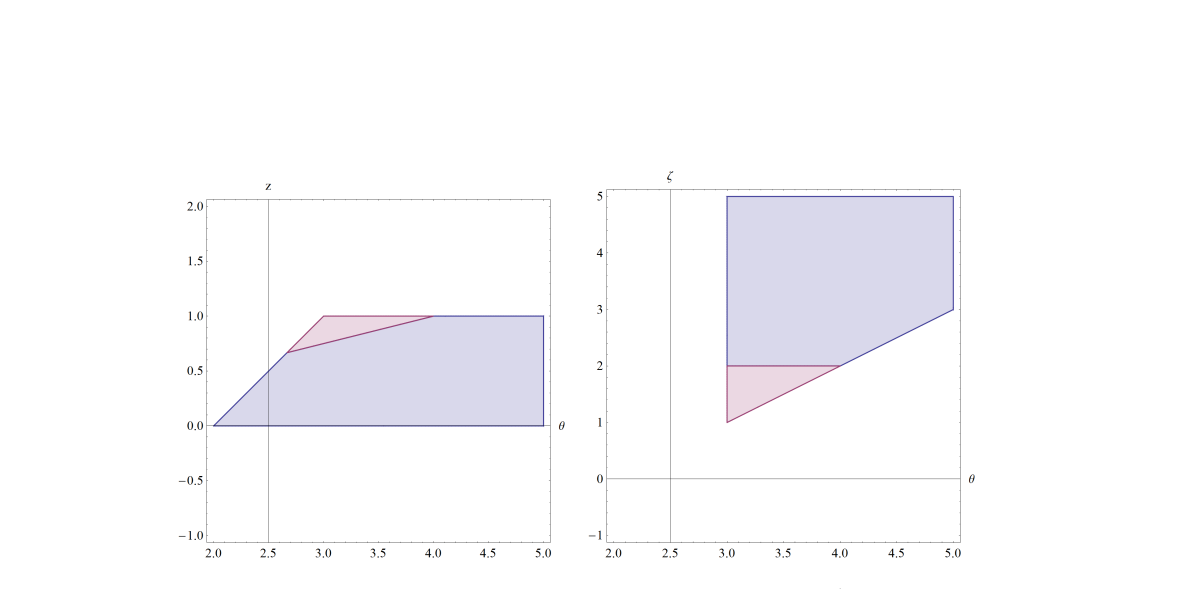

Figures are the authors', reproduced from the paper.
References (34)
- [1] S. A. Hartnoll, “Horizons, holography and condensed matter,” in Black Holes in Higher Dimensions, Edited by: Gary T. Horowitz, Cambridge University Press, on Pith
- [2] N. Iqbal, H. Liu and M. Mezei, “Lectures on holographic non-Fermi liquids and quantum phase transitions,” [ArXiv:1110.3814][hep-th] on PithPith's reviewarXiv
- [3] C. Charmousis, B. Gout´ eraux, B. S. Kim, E. Kiritsis, R. Meyer, “Effective Holographic Theories for low-temperature condensed matter systems,” JHEP 1011 (2010) 151. [ArXiv:1005.4690][hep-th] on PithPith's reviewarXiv
- [4] S. A. Hartnoll, C. P. Herzog and G. T. Horowitz, “Building a Holographic Superconductor,” Phys. Rev. Lett. 101 (2008) 031601 [ArXiv:0803.3295][hep-th]; “Holographic Superconductors,” JHEP 0812 (2008) 015 [ArXiv:0810.1563][hep-th] on PithPith's reviewarXiv
- [5] B. Gout´ eraux and E. Kiritsis,“Generalized Holographic Quantum Criticality at Finite Density,” JHEP 1112 (2011) 036 [ArXiv:1107.2116][hep-th] on PithPith's reviewarXiv
- [6] B. Gout´ eraux and E. Kiritsis, JHEP 1304 (2013) 053 [ArXiv:1212.2625][hep-th] on PithPith's reviewarXiv
- [7] L. Huijse, S. Sachdev and B. Swingle, “Hidden Fermi surfaces in compressible states of gauge-gravity duality,” Phys. Rev. B 85 (2012) 035121 [ArXiv:1112.0573][cond-mat.str-el] on PithPith's reviewarXiv
- [8] S. Harrison, S. Kachru and H. Wang, “Resolving Lifshitz Horizons,” [ArXiv:1202.6635][hep-th]. J. Bhattacharya, S. Cremonini and A. Sinkovics, “On the IR completion of geometries with hyperscaling violation,” JHEP 1302 (2013) 147 [ArXiv:1208.1752][hep-th]. N. Kundu, P. Narayan,... on PithPith's reviewarXiv
- [9] N. Ogawa, T. Takayanagi and T. Ugajin, “Holographic Fermi Surfaces and Entanglement Entropy,” JHEP 1201 (2012) 125 [ArXiv:1111.1023][hep-th] on PithPith's reviewarXiv
- [10] X. Dong, S. Harrison, S. Kachru, G. Torroba and H. Wang, “Aspects of holography for theories with hyperscaling violation,” JHEP 1206, 041 (2012) [ArXiv:1201.1905][hep-th] on PithPith's reviewarXiv
- [11] S. A. Hartnoll and E. Shaghoulian, “Spectral weight in holographic scaling geometries,” JHEP 1207 (2012) 078 [ArXiv:1203.4236][hep-th]. A. Donos and S. A. Hartnoll, “Universal linear in temperature resistivity from black hole superradiance,” Phys. Rev. D 86 (2012) 124046 [ArXi... on PithPith's reviewarXiv
- [12] M. Edalati and J. F. Pedraza, “Aspects of Current Correlators in Holographic Theories with Hyperscaling Violation,” Phys. Rev. D 88 (2013) 086004, [ArXiv:1307.0808][hep-th] on PithPith's reviewarXiv
- [13] S. Ryu and T. Takayanagi, “Holographic derivation of entanglement entropy from AdS/CFT,” Phys. Rev. Lett. 96 (2006) 181602 [ArXiv:hep-th/0603001]; “Aspects of Holographic Entanglement Entropy,” JHEP 0608 (2006) 045 [ArXiv:hep-th/0605073] on PithPith's reviewarXiv
- [14] N. Iqbal, H. Liu and M. Mezei, “Semi-local quantum liquids,” JHEP 1204 (2012) 086 [ArXiv:1105.4621][hep-th] on PithPith's reviewarXiv
- [15] E. Witten, “Anti-de Sitter space, thermal phase transition, and confinement in gauge theories,” Adv. Theor. Math. Phys. 2 (1998) 505 [ArXiv:hep-th/9803131] on PithPith's reviewarXiv
- [16] S. A. Hartnoll and L. Huijse, “Fractionalization of holographic Fermi surfaces,” Class. Quant. Grav. 29 (2012) 194001 [ArXiv:1111.2606][hep-th] on PithPith's reviewarXiv
- [17] A. Adam, B. Crampton, J. Sonner and B. Withers, “Bosonic Fractionalisation Transitions,” JHEP 1301 (2013) 127 [ArXiv:1208.3199][hep-th] on PithPith's reviewarXiv
- [18] S. A. Hartnoll and D. Radicevic, “Holographic order parameter for charge fractionalization,” Phys. Rev. D 86 (2012) 066001 [ArXiv:1205.5291][hep-th] on PithPith's reviewarXiv
- [19] V. E. Hubeny, “Extremal surfaces as bulk probes in AdS/CFT,” JHEP 1207 (2012) 093 [ArXiv:1203.1044][hep-th]. B. Czech, J. L. Karczmarek, F. Nogueira and M. Van Raamsdonk, “The Gravity Dual of a Density Matrix,” Class. Quant. Grav. 29 (2012) 155009 [ArXiv:1204.1330][hep-th]. V.... on PithPith's reviewarXiv
- [20] A. Donos and J. P. Gauntlett, “Holographic striped phases,” JHEP 1108 (2011) 140 [ArXiv:1106.2004][hep-th] on PithPith's reviewarXiv
show 14 more
- [21] A. Donos, J. P. Gauntlett, J. Sonner and B. Withers, “Competing orders in M-theory: superfluids, stripes and metamagnetism,” JHEP 1303 (2013) 108 [ArXiv:1212.0871][hep-th] on PithPith's reviewarXiv
- [22] A. Donos, “Striped phases from holography,” JHEP 1305 (2013) 059, [ArXiv:1303.7211][hep-th] on PithPith's reviewarXiv
- [23] B. Withers, “Black branes dual to striped phases,” Class. Quant. Grav. 30 (2013) 155025, [ArXiv:1304.0129][hep-th] on PithPith's reviewarXiv
- [24] S. A. Hartnoll, J. Polchinski, E. Silverstein and D. Tong, “Towards strange metallic holography,” JHEP 1004 (2010) 120 [ArXiv:0912.1061][hep-th]. S. A. Hartnoll and A. Tavanfar, “Electron stars for holographic metallic criticality,” Phys. Rev. D 83 (2011) 046003 [ArXiv:1008.28... on PithPith's reviewarXiv
- [25] S. Kachru, X. Liu and M. Mulligan, “Gravity Duals of Lifshitz-like Fixed Points,” Phys. Rev. D 78 (2008) 106005 [ArXiv:0808.1725][hep-th] on PithPith's reviewarXiv
- [26] M. Taylor, “Non-relativistic holography,” [ArXiv:0812.0530][hep-th] on PithPith's reviewarXiv
- [27] K. Goldstein, S. Kachru, S. Prakash and S. P. Trivedi, “Holography of Charged Dilaton Black Holes,” JHEP 1008 (2010) 078 [ArXiv:0911.3586][hep-th] on PithPith's reviewarXiv
- [28] S. S. Gubser and A. Nellore, “Ground states of holographic superconductors,” Phys. Rev. D 80 (2009) 105007 [ArXiv:0908.1972][hep-th] on PithPith's reviewarXiv
- [29] G. T. Horowitz and M. M. Roberts, “Zero Temperature Limit of Holographic Superconductors,” JHEP 0911 (2009) 015 [ArXiv:0908.3677][hep-th] on PithPith's reviewarXiv
- [30] N. Iizuka, S. Kachru, N. Kundu, P. Narayan, N. Sircar, S. P. Trivedi and H. Wang, “Extremal Horizons with Reduced Symmetry: Hyperscaling Violation, Stripes, and a Classification for the Homogeneous Case,” JHEP 1303 (2013) 126 [ArXiv:1212.1948][hep-th] on PithPith's reviewarXiv
- [31] J. Gath, J. Hartong, N. A. Obers and R. Monteiro, “Holographic Models for Theories with Hyperscaling Violation,” JHEP 1304 (2013) 159 [ArXiv:1212.3263][hep-th] on PithPith's reviewarXiv
- [32] A. Donos and S. A. Hartnoll, “Interaction-driven localization in holography,” Nature Phys. 9 (2013) 649 [ArXiv:1212.2998][hep-th] on PithPith's reviewarXiv
- [33] S. A. Hartnoll and P. Kovtun, “Hall conductivity from dyonic black holes,” Phys. Rev. D 76 (2007) 066001 [ArXiv:0704.1160][hep-th]. M. Edalati, J. I. Jottar and R. G. Leigh, “Transport Coefficients at Zero Temperature from Extremal Black Holes,” JHEP 1001 (2010) 018 [ArXiv:0910.... on PithPith's reviewarXiv
- [2012] [ArXiv:1106.4324][hep-th] on PithPith's reviewarXiv
Cited by 18 Pith papers
Reviewed papers on Pith that cite this one. The full citation record
- Slow relaxation and diffusion in holographic quantum critical phases hep-th · Aug 2018
- Thermal diffusivity and chaos in metals without quasiparticles hep-th · May 2017
- Charge diffusion and the butterfly effect in striped holographic matter hep-th · Aug 2016
- Universal Charge Diffusion and the Butterfly Effect hep-th · Mar 2016
- On Holographic Insulators and Supersolids hep-th · Mar 2015
- Scaling theory of the cuprate strange metals cond-mat.str-el · Jan 2015
- Holographic Metals and Insulators with Helical Symmetry hep-th · Jun 2014
- Inhomogeneity simplified hep-th · Jun 2014
- DC Conductivities from Non-Relativistic Scaling Geometries with Momentum Dissipation hep-th · Aug 2016
- Universal Diffusion in Incoherent Black Holes hep-th · Apr 2016
- Chasing the cuprates with dilatonic dyons hep-th · Mar 2016
- DC and Hall conductivity in holographic massive Einstein-Maxwell-Dilaton gravity hep-th · Apr 2015
- Charge transport in holography with momentum dissipation hep-th · Jan 2014
- Linear and quadratic in temperature resistivity from holography hep-th · Jun 2016
- Incoherent transport in clean quantum critical metals hep-th · Jul 2015
- Conductivities for Hyperscaling Violating Geometries hep-th · May 2014
- Holographic quantum matter hep-th · Dec 2016
- Lifshitz holography hep-th · Dec 2015
How the literature uses it
26 arXiv papers cite this in 63 sentences
Papers citing it · 50 sentences without a confident label
Builds on it 1 paper
-
In Appendix [ref], we extend this analysis to include groundstates which feature hyperscaling violation [ref] as well as cases with novel superfluid actions.[An analytic top-down solution featuring hyperscaling violation in the normal state can be found in [ref] .] $$
Non-vanishing normal density in cold holographic superfluids · Introduction and results · 0.94
Uses its method or tool 2 papers
-
Our approach closely follows [ref] , and we consider perturbations of both the background gauge field and the metric.
Spectral weight in Chern-Simons theory with symmetry breaking · Einstein-Maxwell-Chern-Simons · 0.99
-
The method to compute the radial deformations and the identification of the IR scaling dimensions is described in detail in [ref] .
Spectral weight and spatially modulated instabilities in holographic superfluids · Einstein-Maxwell-dilaton with massive vector · 0.96
Compares with it 2 papers
-
Note that in the previous class of solutions ([ref]), $β_-=0$ and the charge density dimension is marginal [ref] (see also the discussion in [ref] ).
Intermediate scalings in holographic RG flows and conductivities · Intermediate Scaling Regime and Solutions · 0.84
-
Finally we also note that, in Lifshitz backgrounds with hyperscaling violation, the DC conductivity for small frequencies shows a similar power law behavior [ref] .
Conductivity and entanglement entropy of high dimensional holographic superconductors · Low frequencies · 0.88
Cites it as support 1 paper
-
This is a consequence of imposing a number of consistency conditions – ensuring that the Null Energy Condition holds, that the specific heat is positive and the electric flux is monotonic – as well as requiring the existence of appropriate irrelevant deformations about the intermediate geometries [ref] .
Intermediate scalings in holographic RG flows and conductivities · Numerical plots of conductivity · 0.97
Cites it as background 6 papers
-
We begin by describing the properties of the holographic QCPs of [ref] from a perspective that will prove very useful for understanding the results in the remainder of the paper.
Impact of irrelevant deformations on thermodynamics and transport in holographic quantum critical states · Holographic QCPs · 0.92
-
More recently, progress has been made in addressing different scalings between Hall angle and resistivity by holography [ref] .
DC and Hall conductivity in holographic massive Einstein-Maxwell-Dilaton gravity · Introduction · 0.80
-
Scaling solutions arising in the class of theories ([ref]) have been studied in detail in [ref] [Some algorithms for constructing the holographic dictionary with UV hyperscaling (violating) asymptotics in Einstein-Proca-Dilaton theories were recently developed in [ref] .
Intermediate scalings in holographic RG flows and conductivities · Intermediate Scaling Regime and Solutions · 0.95
Challenges and discussion
Disagree with the review, or know something it missed? Leave a comment, or challenge this review formally: a challenge becomes a permanent entry in this paper's record, and its decision is published here.
Come back by email
A short list of the week's newly reviewed papers. Nothing is sent until you confirm from your inbox, and every email has a link that stops it. No account.
No comments yet.
Sign in to comment