Toxic Memes: A Survey of Computational Perspectives on the Detection and Explanation of Meme Toxicities
Pith reviewed 2026-05-23 23:46 UTC · model grok-4.3
The pith
A new taxonomy organizes meme toxicity around target, intent, and conveyance tactics.
A machine-rendered reading of the paper's core claim, the machinery that carries it, and where it could break.
Core claim
After applying PRISMA to locate papers, the authors introduce a taxonomy for categorizing meme toxicity types and identify three content-based dimensions under automatic study—target, intent, and conveyance tactics—while developing a framework that illustrates the relationships between these dimensions and meme toxicities; they also document the shift of computational tasks toward nuanced comprehension of toxicity and the rising use of large language models for both detection and generation.
What carries the argument
The new taxonomy for categorizing meme toxicity types together with the framework that links the three dimensions of target, intent, and conveyance tactics to observed toxicities.
If this is right
- Computational tasks expand beyond binary toxic versus non-toxic classification toward nuanced comprehension of toxicity.
- Enhanced cross-modal reasoning and integration of expert and cultural knowledge become necessary for effective systems.
- Automatic explanation of detected toxicities emerges as a required capability.
- Dedicated methods are needed to handle meme toxicity in low-resource languages.
- Large language models are applied both to detect and to generate toxic memes.
Where Pith is reading between the lines
- The three-dimension framework could be tested by re-annotating existing meme datasets and checking consistency of labels across the dimensions.
- Platforms using automated moderation might adopt the taxonomy to produce more granular removal or warning decisions.
- The documented rise in generative AI for toxic memes points to a need for separate safeguards against synthetic content.
- The taxonomy offers a possible bridge between computational work and studies of visual misinformation in other media.
Load-bearing premise
The PRISMA search and inclusion criteria applied to literature through early 2024 captured a representative set of content-based computational works on toxic memes.
What would settle it
Discovery of multiple papers on content-based toxic meme analysis from 2023 or earlier that match the stated inclusion criteria yet were not counted among the 158 works.
Figures


read the original abstract
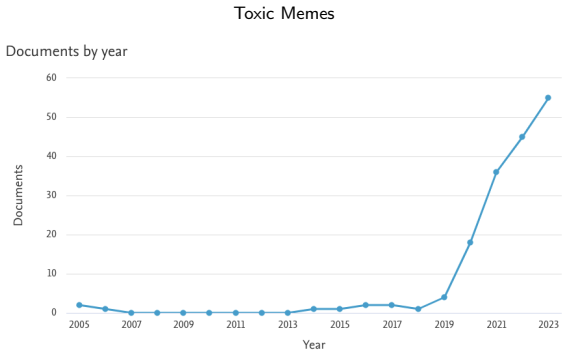
Internet memes, channels for humor, social commentary, and cultural expression, are increasingly used to spread toxic messages. Studies on the computational analyses of toxic memes have significantly grown over the past five years, and the only three surveys on computational toxic meme analysis cover only work published until 2022, leading to inconsistent terminology and unexplored trends. Our work fills this gap by surveying content-based computational perspectives on toxic memes, and reviewing key developments until early 2024. Employing the PRISMA methodology, we systematically extend the previously considered papers, achieving a threefold result. First, we survey 119 new papers, analyzing 158 computational works focused on content-based toxic meme analysis. We identify over 30 datasets used in toxic meme analysis and examine their labeling systems. Second, after observing the existence of unclear definitions of meme toxicity in computational works, we introduce a new taxonomy for categorizing meme toxicity types. We also note an expansion in computational tasks beyond the simple binary classification of memes as toxic or non-toxic, indicating a shift towards achieving a nuanced comprehension of toxicity. Third, we identify three content-based dimensions of meme toxicity under automatic study: target, intent, and conveyance tactics. We develop a framework illustrating the relationships between these dimensions and meme toxicities. The survey analyzes key challenges and recent trends, such as enhanced cross-modal reasoning, integrating expert and cultural knowledge, the demand for automatic toxicity explanations, and handling meme toxicity in low-resource languages. Also, it notes the rising use of Large Language Models (LLMs) and generative AI for detecting and generating toxic memes. Finally, it proposes pathways for advancing toxic meme detection and interpretation.
Editorial analysis
A structured set of objections, weighed in public.
Referee Report
Summary. The manuscript is a systematic literature survey employing the PRISMA methodology to review content-based computational work on toxic memes through early 2024. It extends prior surveys by incorporating 119 new papers (158 works total), enumerates over 30 datasets and their labeling systems, introduces a new taxonomy for meme toxicity types motivated by observed definitional inconsistencies, identifies three content-based dimensions (target, intent, conveyance tactics) with an accompanying framework, and discusses challenges, trends including LLM usage, and future research pathways.
Significance. If the coverage is representative, the survey supplies a timely consolidation of the field since the 2022 cutoff of earlier reviews, supplies a taxonomy and three-dimension framework that can reduce terminological inconsistency, and flags actionable trends such as cross-modal reasoning, expert knowledge integration, automatic explanation generation, and LLM applications. These elements, together with the explicit dataset enumeration, position the work as a useful reference for standardizing and advancing computational meme toxicity research.
minor comments (4)
- [Abstract] The abstract states that the work achieves a 'threefold result' yet enumerates the contributions in a way that blends dataset analysis with the survey count; a clearer three-bullet structure would improve readability.
- [Datasets section] The discussion of 'over 30 datasets' would be substantially more usable if accompanied by a summary table that records dataset size, label granularity, public availability, and the toxicity dimensions each covers.
- [Framework figure] The framework diagram illustrating relationships among target, intent, and conveyance tactics would benefit from explicit visual cues (arrows, color coding, or call-outs) that link each dimension to concrete toxicity categories discussed in the taxonomy.
- [Methods / PRISMA protocol] The PRISMA protocol description would allow readers to assess completeness if the exact search strings, Boolean operators, and the complete list of queried databases were supplied, even if only in an appendix.
Simulated Author's Rebuttal
We thank the referee for the positive and accurate summary of our PRISMA-based survey, the assessment of its significance in consolidating recent work, and the recommendation for minor revision. No major comments were provided in the report.
Circularity Check
No significant circularity; minor self-citation possible but non-load-bearing
full rationale
This is a systematic literature survey employing PRISMA to review 158 computational works on toxic memes through early 2024, extending three prior surveys. The central contributions—a new taxonomy for toxicity types and a three-dimension framework (target, intent, conveyance tactics)—are derived directly from patterns observed across the reviewed papers rather than from any equations, fitted parameters, or self-referential definitions. No derivation chain reduces to its own inputs by construction, and any potential self-citation of the authors' prior work is not load-bearing for the taxonomy or framework. The survey remains self-contained against external benchmarks of literature coverage.
Axiom & Free-Parameter Ledger
axioms (1)
- domain assumption PRISMA methodology provides an appropriate and reproducible way to select and synthesize computational papers on toxic memes
Reference graph
Works this paper leans on
-
[1]
Dawkins, The Selfish Gene, new ed., Oxford University Press, 1989
R. Dawkins, The Selfish Gene, new ed., Oxford University Press, 1989
work page 1989
-
[2]
Dennet, Dangerous memes - a ted talk, Youtube, 2007
D. Dennet, Dangerous memes - a ted talk, Youtube, 2007. URL:https://www.youtube.com/watch?v=KzGjEkp772s
work page 2007
-
[3]
C. Koutlis, M. Schinas, S. Papadopoulos, Memetector: Enforcing deep focus for meme detection, International Journal of Multimedia Information Retrieval 12 (2023) 11
work page 2023
-
[4]
S. Peeters, M. Tuters, T. Willaert, D. De Zeeuw, On the vernacular language games of an antagonistic online subculture, Frontiers in big Data 4 (2021) 718368
work page 2021
-
[5]
C. Arkenbout, Political meme toolkit: leftist dutch meme makers share their trade secrets, in: Critical meme reader II: memetic tacticality, Institute of Network Cultures, 2022, pp. 20–31
work page 2022
-
[6]
A. Wagener, Semiotic excess in memes: From postdigital creativity to social violence, Internet Pragmatics 6 (2023) 239–258
work page 2023
-
[7]
D. Kiela, H. Firooz, A. Mohan, V. Goswami, A. Singh, C. Fitzpatrick, P. Bull, G. Lipstein, T. Nelli, R. Zhu, N. Muennighoff, R. Velioglu, J. Rose, P. Lippe, N. Holla, S. Chandra, S. Rajamanickam, G. Antoniou, E. Shutova, H. Yannakoudakis, V. Sandulescu, U. Ozertem, P. Pantel, L. Specia, D. Parikh, The hateful memes challenge: Competition report, in: Proce...
work page 2020
-
[8]
H. Kirk, Y. Jun, P. Rauba, G. Wachtel, R. Li, X. Bai, N. Broestl, M. Doff-Sotta, A. Shtedritski, Y. Asano, Memes in the wild: Assessing the generalizability of the hateful memes challenge dataset, in: Proceedings of WOAH 2021 - 5th Workshop on Online Abuse and Harms, volume 26, 2021
work page 2021
- [9]
- [10]
- [11]
-
[12]
C. Yang, F. Zhu, J. Han, S. Hu, Invariant meets specific: A scalable harmful memes detection framework, MM 2023 - Proceedings of the 31st ACM International Conference on Multimedia 4788 (2023)
work page 2023
- [13]
-
[14]
R. Jain, K. Maity, P. Jha, S. Saha, Generative models vs discriminative models: Which performs better in detecting cyberbullying in memes?, in: Proceedings of the International Joint Conference on Neural Networks, 2023. doi:10.1109/ijcnn54540.2023.10191363
- [15]
-
[16]
C.Sharma,D.Bhageria,W.Scott,S.Pykl,A.Das,T. Chakraborty,V.Pulabaigari,B.Gamback, Semeval-2020 task8:Memotionanalysis–the visuo-lingual metaphor!, arXiv preprint arXiv:2008.03781 (2020) 759–773
-
[18]
A. Williams, M. Dupuis, I don’t always spread disinformation on the web, but when i do i like to use memes: An examination of memes in the spread of disinformation, in: Proceedings of the 11th International Multi-Conferences on Complexity, Informatics and Cybernetics: IMCIC, 2020, pp. 165–172
work page 2020
-
[19]
D. Dimitrov, B. B. Ali, S. Shaar, F. Alam, F. Silvestri, H. Firooz, G. D. S. Martino, Detecting propaganda techniques in memes, arXiv preprint arXiv:2109.08013 (2021) 6603–6617
-
[20]
M. Abdullah, D. Abujaber, A. Al-Qarqaz, R. Abbott, M. Hadzikadic, Combating propaganda texts using transfer learning, IAES International Journal of Artificial Intelligence 12 (2023) 956–965
work page 2023
-
[21]
D. Rodríguez, P. Nakov, V. Dankers, E. Shutova, Paper bullets: Modeling propaganda with the help of metaphor, European Chapter of the Association for Computational Linguistics, Findings of EACL 2023 (2023) 472–489
work page 2023
-
[22]
M. G. Shridara, D. Hládek, M. Pleva, R. Haluška, Identification of trolling in memes using convolutional neural networks, in: 2023 33rd International Conference Radioelektronika (RADIOELEKTRONIKA), IEEE, 2023, pp. 1–6
work page 2023
-
[23]
S.Suryawanshi,B.R.Chakravarthi,M.Arcan,P.Buitelaar, Trollswithopinion:Ataxonomyanddatasetforpredictingdomain-specificopinion manipulation in troll memes, Multimedia Tools and Applications 82 (2023) 9137–9171
work page 2023
- [24]
-
[25]
G. Mazambani, M. A. Carlson, S. Reysen, C. F. Hempelmann, Impact of status and meme content on the spread of memes in virtual communities, Human Technology: An Interdisciplinary Journal on Humans in ICT Environments 11 (2015) 148–164
work page 2015
-
[26]
Netanya, The Dangers of Memes — netanyataitague, https://medium.com/@netanyataitague/ the-dangers-of-memes-b1bb67e10083 , 2019. [Accessed 17-04-2024]
work page 2019
-
[27]
M. Vang, Is Meme Culture Problematic - The Current — thecurrentmsu.com, https://thecurrentmsu.com/2021/08/07/ is-meme-culture-problematic/, 2021. [Accessed 17-04-2024]
work page 2021
-
[28]
K. Rojas, The Toxicity of Online Meme Culture: When Is It Too Far? — studybreaks.com,https://studybreaks.com/thoughts/ meme-culture-2/, 2022. [Accessed 17-04-2024]
work page 2022
-
[29]
Z. D. Roberts, How the ‘Free Helicopter Rides’ Meme Went Viral — progressive.org,https://progressive.org/magazine/ how-the-free-helicopter-rides-meme-went-viral-roberts-20230907/ , 2023. [Accessed 17-04-2024]
work page 2023
-
[30]
F. J. A. Serna, Los memes como simbolos del discurso de odio: La influencia del humor gráfico en la libertad de expresión y la política, VISUAL REVIEW. International Visual Culture Review/Revista Internacional de Cultura Visual 16 (2024) 241–253
work page 2024
-
[31]
L. Needham, How the toxic went mainstream — pursuit.unimelb.edu.au, https://pursuit.unimelb.edu.au/articles/ how-the-toxic-went-mainstream , 2019. [Accessed 17-04-2024]
work page 2019
-
[32]
K. M. Duchscherer, J. F. Dovidio, When memes are mean: Appraisals of and objections to stereotypic memes, Translational Issues in Psychological Science 2 (2016) 335–345
work page 2016
-
[33]
P. M. Bennet, Who Moderates the Social Media Giants? A Call to End Outsourcing, Technical Report, NYU STERN, Center for Business and Human Rights, 2020
work page 2020
-
[34]
N. Nondo, Facing disturbing content daily, online moderators in africa want better protections and a fair wage, CBC Radio (2023)
work page 2023
-
[35]
Perrigo, Inside facebook’s african sweatshop, Time (2022)
B. Perrigo, Inside facebook’s african sweatshop, Time (2022)
work page 2022
-
[36]
N. Rowe, "it’s destroyed me completely": Kenyan moderators decry toll of training of ai models, The Guardian (2023)
work page 2023
-
[37]
Mbagathi, In africa, taking on viral hate, Open Society Foundations (2023)
N. Mbagathi, In africa, taking on viral hate, Open Society Foundations (2023)
work page 2023
- [38]
-
[39]
P. C. d. Q. Hermida, E. M. D. Santos, Detecting hate speech in memes: a review, Artificial Intelligence Review 56 (2023) 1–19
work page 2023
-
[40]
S. Zannettou, T. Caulfield, J. Blackburn, E. De Cristofaro, M. Sirivianos, G. Stringhini, G. Suarez-Tangil, On the origins of memes by means of fringe web communities, in: Proceedings of the internet measurement conference 2018, 2018, pp. 188–202
work page 2018
-
[41]
T. Chakraborty, S. Masud, Nipping in the bud: detection, diffusion and mitigation of hate speech on social media, ACM SIGWEB Newsletter 2022 (2022) 1–9
work page 2022
- [42]
-
[43]
Solon, Richard dawkins on the internet’s hijacking of the word ‘meme’, Wired UK 20 (2013)
O. Solon, Richard dawkins on the internet’s hijacking of the word ‘meme’, Wired UK 20 (2013)
work page 2013
-
[44]
Shifman, Memes in Digital Culture, MIT Press Essential Knowledge Series, MIT Press, 2013
L. Shifman, Memes in Digital Culture, MIT Press Essential Knowledge Series, MIT Press, 2013
work page 2013
-
[45]
M. Dynel, The life of covid-19 mask memes: a diachronic study of the pandemic memescape, Comunicar 30 (2022) 73–85. DS Martinez Pandiani et al.:Preprint submitted to Elsevier Page 32 of 39 Toxic Memes
work page 2022
- [46]
-
[47]
L.Xie,A.Natsev,J.R.Kender,M.Hill,J.R.Smith, Visualmemesinsocialmedia:trackingreal-worldnewsinyoutubevideos, in:Proceedings of the 19th ACM international conference on Multimedia, 2011, pp. 53–62
work page 2011
-
[48]
Y. Du, M. A. Masood, K. Joseph, Understanding visual memes: An empirical analysis of text superimposed on memes shared on twitter, in: Proceedings of the International AAAI Conference on Web and Social Media, volume 14, Aaai, 2020, pp. 153–164
work page 2020
-
[49]
S. Pramanick, D. Dimitrov, R. Mukherjee, S. Sharma, M. S. Akhtar, P. Nakov, T. Chakraborty, Detecting harmful memes and their targets, arXiv preprint arXiv:2110.00413 (2021)
- [50]
- [51]
-
[52]
V. Sherratt, K. Pimbblet, N. Dethlefs, Multi-channel convolutional neural network for precise meme classification, in: Proceedings of the 2023 ACM International Conference on Multimedia Retrieval, 2023, pp. 190–198
work page 2023
- [53]
-
[54]
B. Kostadinovska-Stojchevska, E. Shalevska, Internet memes and their socio-linguistic features, European journal of literature, language and linguistics studies 2 (2018)
work page 2018
-
[55]
N. Lapidot-Lefler, A. Barak, Effects of anonymity, invisibility, and lack of eye-contact on toxic online disinhibition, Computers in human behavior 28 (2012) 434–443
work page 2012
-
[56]
D. Gordeev, V. Potapov, Toxicity in texts and images on the internet, in: International Conference on Speech and Computer, Springer, 2020, pp. 156–165
work page 2020
- [57]
-
[58]
N. Carlisle, Toxicity, memes and raids - Power of Zero — powerof0.org,https://powerof0.org/toxicity-memes-and-raids/, 2022. [Accessed 17-04-2024]
work page 2022
- [59]
- [60]
-
[61]
Understanding Abuse: A Typology of Abusive Language Detection Subtasks
Z. Waseem, T. Davidson, D. Warmsley, I. Weber, Understanding abuse: A typology of abusive language detection subtasks, arXiv preprint arXiv:1705.09899 (2017)
work page internal anchor Pith review Pith/arXiv arXiv 2017
-
[62]
M.Wiegand,M.Siegel,J.Ruppenhofer, Overviewofthegermeval2018sharedtaskontheidentificationofoffensivelanguage, in:Proceedings of GermEval 2018, 14th Conference on Natural Language Processing (KONVENS 2018), Austrian Academy of Sciences, 2019, pp. 1 – 10. URL: https://nbn-resolving.org/urn:nbn:de:bsz:mh39-84935
work page 2018
-
[63]
SemEval-2019 Task 6: Identifying and Categorizing Offensive Language in Social Media (OffensEval)
M. Zampieri, S. Malmasi, P. Nakov, S. Rosenthal, N. Farra, R. Kumar, Semeval-2019 task 6: Identifying and categorizing offensive language in social media (offenseval), arXiv preprint arXiv:1903.08983 (2019)
work page internal anchor Pith review Pith/arXiv arXiv 2019
- [64]
- [65]
-
[66]
T. Davidson, D. Warmsley, M. Macy, I. Weber, Automated hate speech detection and the problem of offensive language, in: Proceedings of the international AAAI conference on web and social media, volume 11, 2017, pp. 512–515
work page 2017
-
[67]
F.E.Ayo,O.Folorunso,F.T.Ibharalu,I.A.Osinuga, Machinelearningtechniquesforhatespeechclassificationoftwitterdata:State-of-the-art, future challenges and research directions, Computer Science Review 38 (2020) 100311
work page 2020
-
[68]
F. Alkomah, X. Ma, A literature review of textual hate speech detection methods and datasets, Information 13 (2022) 273
work page 2022
-
[69]
A. Chhabra, D. K. Vishwakarma, A literature survey on multimodal and multilingual automatic hate speech identification, Multimedia Systems 29 (2023) 1203–1230
work page 2023
-
[70]
P. Fortuna, J. Soler, L. Wanner, Toxic, hateful, offensive or abusive? what are we really classifying? an empirical analysis of hate speech datasets, in: Proceedings of the Twelfth Language Resources and Evaluation Conference, 2020, pp. 6786–6794
work page 2020
-
[71]
M. Yankoski, W. Scheirer, T. Weninger, Meme warfare: Ai countermeasures to disinformation should focus on popular, not perfect, fakes, Bulletin of the atomic scientists 77 (2021) 119–123
work page 2021
- [72]
- [73]
- [74]
- [75]
-
[76]
Anjum, R. Katarya, Hate speech, toxicity detection in online social media: a recent survey of state of the art and opportunities, International Journal of Information Security 23 (2024) 577–608
work page 2024
-
[77]
B. Lewandowska-Tomaszczyk, A. Bączkowska, C. Liebeskind, G. Valunaite O., S. Žitnik, An integrated explicit and implicit offensive language taxonomy, Lodz Papers in Pragmatics 19 (2023) 7–48
work page 2023
-
[78]
T. Garg, S. Masud, T. Suresh, T. Chakraborty, Handling bias in toxic speech detection: A survey, ACM Computing Surveys 55 (2023) 1–32. DS Martinez Pandiani et al.:Preprint submitted to Elsevier Page 33 of 39 Toxic Memes
work page 2023
- [79]
- [80]
- [81]
discussion (0)
Sign in with ORCID, Apple, or X to comment. Anyone can read and Pith papers without signing in.