The Impact of Bars, Spirals and Bulge-Size on Gas-Phase Metallicity Gradients in MaNGA Galaxies
Pith reviewed 2026-05-23 03:13 UTC · model grok-4.3
The pith
At fixed galaxy mass, spiral galaxies show steeper gas-phase metallicity gradients than non-spirals, while larger bulges raise overall metallicity and flatten those gradients.
A machine-rendered reading of the paper's core claim, the machinery that carries it, and where it could break.
Core claim
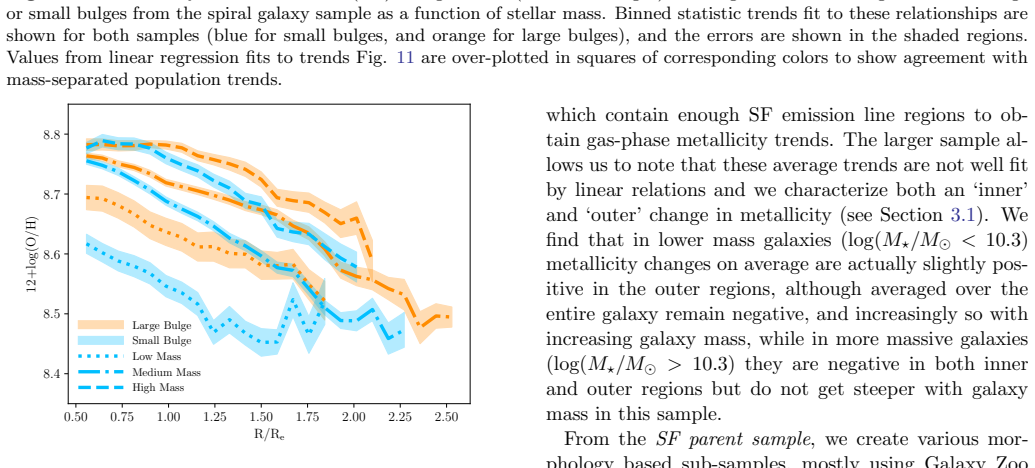
Holding galaxy mass fixed, the presence of spiral structure correlates with steeper gas-phase metallicity gradients; spiral galaxies with larger bulges show both higher gas-phase metallicities and shallower gradients; barred and unbarred spirals display no difference in azimuthally averaged radial gradients; and tight versus loosely wound spirals show no difference in gradient steepness, though looser spirals have lower average metallicities.
What carries the argument
Azimuthally averaged radial gas-phase metallicity gradients derived from MaNGA emission-line data, compared against Galaxy Zoo morphological indicators for spiral presence, bar presence, bulge size, and spiral winding tightness.
If this is right
- Spiral structure at fixed mass produces steeper metallicity gradients, consistent with spirals driving radial gas flows or limiting mixing.
- Larger bulges in spirals increase central gas-phase metallicity while reducing the radial gradient.
- Large-scale bars produce no measurable change in azimuthally averaged metallicity gradients compared with unbarred spirals.
- Spiral arm winding tightness does not affect gradient steepness but loosely wound spirals maintain lower average metallicities at fixed mass.
Where Pith is reading between the lines
- Bulge growth may stabilize disks enough to reduce the efficiency of radial gas transport that would otherwise steepen gradients.
- The absence of a bar signature suggests that any bar-driven radial mixing is either weak or compensated by other processes when averaged over the full disk.
- If the mass-fixed spiral effect holds in simulations, it would require models to tie spiral arm formation directly to the radial redistribution of recently enriched gas.
Load-bearing premise
Galaxy Zoo visual classifications accurately capture the presence and properties of spirals, bars, and bulges without systematic misclassification that tracks with mass or metallicity, and the emission-line metallicity measurements contain no calibration errors that could produce spurious morphology correlations.
What would settle it
Repeating the analysis with an independent set of morphological classifications or a different metallicity calibration method on the same MaNGA sample and finding that the correlation between spiral presence and gradient steepness disappears would falsify the central result.
Figures




read the original abstract
As galaxies evolve over time, the orbits of their constituent stars are expected to change in size and shape, moving stars away from their birth radius. Radial gas flows are also expected. Spiral arms and bars in galaxies are predicted to help drive this radial relocation, which may be possible to trace observationally via a flattening of metallicity gradients. We use data from the Mapping Nearby Galaxies at Apache Point Observatory (MaNGA) survey, part of the fourth phase of the Sloan Digital Sky Surveys (SDSS-IV), to look for correlations of the steepness of gas-phase metallicity gradients with various galaxy morphological features (e.g. presence and pitch angle of spiral arms, presence of a large scale bar, bulge size). We select from MaNGA a sample of star forming galaxies for which gas phase metallicity trends can be measured, and use morphologies from Galaxy Zoo. We observe that at fixed galaxy mass (1) the presence of spiral structure correlates with steeper gas phase metallicity gradients; (2) spiral galaxies with larger bulges have both higher gas-phase metallicities and shallower gradients; (3) there is no observable difference with azimuthally averaged radial gradients between barred and unbarred spirals and (4) there is no observable difference in gradient between tight and loosely wound spirals, but looser wound spirals have lower average gas-phase metallicity values at fixed mass. We discuss the possible implications of these observational results.
Editorial analysis
A structured set of objections, weighed in public.
Referee Report
Summary. The manuscript uses MaNGA emission-line data and Galaxy Zoo morphological classifications to study correlations between bars, spiral structure, bulge size, and gas-phase metallicity gradients in star-forming galaxies. At fixed stellar mass, it reports four main results: (1) spirals show steeper gradients than non-spirals; (2) spirals with larger bulges exhibit higher average metallicities and shallower gradients; (3) barred and unbarred spirals show no difference in azimuthally averaged gradients; (4) tight and loose spirals show no gradient difference but loose spirals have lower average metallicities.
Significance. If the reported correlations hold after detailed checks on classification accuracy and measurement systematics, the results supply empirical constraints on how internal structures influence radial gas flows and chemical evolution. The reliance on public survey data supports reproducibility and allows direct comparison with simulations of stellar migration.
minor comments (4)
- The abstract states the four results but provides no sample sizes, mass-bin widths, or uncertainty estimates; these quantitative details should be added to the abstract or highlighted in the first paragraph of the results section to allow readers to assess the strength of the correlations immediately.
- Section describing the metallicity gradient fitting procedure should explicitly state the radial range used, the minimum number of spaxels required per galaxy, and how uncertainties from the emission-line calibration are propagated into the gradient slope.
- The text should clarify whether the mass-matching procedure between morphological subsamples accounts for the full stellar-mass distribution or only the mean, and whether a Kolmogorov-Smirnov test or similar was applied to confirm the mass distributions are statistically indistinguishable.
- Figure captions for the gradient vs. morphology panels should include the number of galaxies in each morphological category and the Spearman rank correlation coefficient with its significance to make the visual trends quantitatively interpretable.
Simulated Author's Rebuttal
We thank the referee for the positive assessment of our manuscript and the recommendation for minor revision. The provided summary accurately captures the main results. No specific major comments were listed in the report, so we have no point-by-point responses at this time. We will address any minor points or suggestions during revision.
Circularity Check
No significant circularity: purely observational correlations
full rationale
The paper reports direct observational trends between Galaxy Zoo morphologies and MaNGA-derived gas-phase metallicity gradients at fixed stellar mass. No equations, derivations, fitted parameters renamed as predictions, or self-citation chains appear in the provided text. All results are stated as measured correlations from public survey data, with no internal reduction of outputs to inputs by construction. This matches the default expectation for non-circular observational studies.
Axiom & Free-Parameter Ledger
axioms (2)
- domain assumption Gas-phase metallicities and their radial gradients can be reliably extracted from MaNGA emission-line spectra using established calibrations.
- domain assumption Galaxy Zoo volunteer classifications provide sufficiently accurate morphological labels for bars, spirals, pitch angle, and bulge size in the selected sample.
Reference graph
Works this paper leans on
-
[1]
Abdurro’uf, Accetta, K., Aerts, C., et al. 2022, ApJS, 259, 35, doi: 10.3847/1538-4365/ac4414 Argudo-Fern´ andez, M., Verley, S., Bergond, G., et al. 2015, A&A, 578, A110, doi: 10.1051/0004-6361/201526016 Astropy Collaboration, Robitaille, T. P., Tollerud, E. J., et al. 2013, A&A, 558, A33, doi: 10.1051/0004-6361/201322068 Astropy Collaboration, Price-Whe...
-
[2]
1992, MNRAS, 259, 345, doi: 10.1093/mnras/259.2.345
Athanassoula, E. 1992, MNRAS, 259, 345, doi: 10.1093/mnras/259.2.345
-
[3]
Baldwin, J. A., Phillips, M. M., & Terlevich, R. 1981, PASP, 93, 5, doi: 10.1086/130766
-
[4]
1967, ApJ, 150, 461, doi: 10.1086/149349
Barbanis, B., & Woltjer, L. 1967, ApJ, 150, 461, doi: 10.1086/149349
-
[5]
Barrera-Ballesteros, J. K., S´ anchez, S. F., Espinosa-Ponce, C., et al. 2023, RMxAA, 59, 213, doi: 10.22201/ia.01851101p.2023.59.02.06
-
[6]
2017, MNRAS, 469, 151, doi: 10.1093/mnras/stx789
Belfiore, F., Maiolino, R., Tremonti, C., et al. 2017, MNRAS, 469, 151, doi: 10.1093/mnras/stx789
-
[7]
Bellardini, M. A., Wetzel, A., Loebman, S. R., et al. 2021, MNRAS, 505, 4586, doi: 10.1093/mnras/stab1606
-
[8]
2011, AJ, 142, 31, doi: 10.1088/0004-6256/142/1/31
Price-Whelan, A. 2011, AJ, 142, 31, doi: 10.1088/0004-6256/142/1/31
-
[9]
Blanton, M. R., Bershady, M. A., Abolfathi, B., et al. 2017, AJ, 154, 28, doi: 10.3847/1538-3881/aa7567
-
[10]
2023, MNRAS, 520, 4301, doi: 10.1093/mnras/stad277
Boardman, N., Wild, V., Heckman, T., et al. 2023, MNRAS, 520, 4301, doi: 10.1093/mnras/stad277
-
[11]
Boardman, N. F., Zasowski, G., Newman, J. A., et al. 2021, MNRAS, 501, 948, doi: 10.1093/mnras/staa3785
-
[12]
1999, MNRAS, 307, 857, doi: 10.1046/j.1365-8711.1999.02699.x 21
Boissier, S., & Prantzos, N. 1999, MNRAS, 307, 857, doi: 10.1046/j.1365-8711.1999.02699.x 21
-
[13]
2023, MNRAS, 523, 1565, doi: 10.1093/mnras/stad1503
Buck, T., Obreja, A., Ratcliffe, B., et al. 2023, MNRAS, 523, 1565, doi: 10.1093/mnras/stad1503
-
[14]
Bundy, K., Bershady, M. A., Law, D. R., et al. 2015, ApJ, 798, 7, doi: 10.1088/0004-637X/798/1/7
work page internal anchor Pith review doi:10.1088/0004-637x/798/1/7 2015
-
[15]
Bustamante, S., Sparre, M., Springel, V., & Grand, R. J. J. 2018, MNRAS, 479, 3381, doi: 10.1093/mnras/sty1692
-
[16]
Carlberg, R. G., & Sellwood, J. A. 1985, ApJ, 292, 79, doi: 10.1086/163134
-
[17]
Casteels, K. R. V., Bamford, S. P., Skibba, R. A., et al. 2013, MNRAS, 429, 1051, doi: 10.1093/mnras/sts391
-
[18]
Chen, Q.-H., Grasha, K., Battisti, A. J., et al. 2023, MNRAS, 519, 4801, doi: 10.1093/mnras/stac3790
-
[19]
H., S´ anchez-Gallego, J., et al
Cherinka, B., Andrews, B. H., S´ anchez-Gallego, J., et al. 2019, AJ, 158, 74, doi: 10.3847/1538-3881/ab2634
-
[20]
Conroy, C., Gunn, J. E., & White, M. 2009, ApJ, 699, 486, doi: 10.1088/0004-637X/699/1/486
work page internal anchor Pith review doi:10.1088/0004-637x/699/1/486 2009
-
[21]
Croom, S. M., Lawrence, J. S., Bland-Hawthorn, J., et al. 2012, MNRAS, 421, 872, doi: 10.1111/j.1365-2966.2011.20365.x
-
[22]
2019, ApJ, 882, 111, doi: 10.3847/1538-4357/ab341a
Kawaguchi, C., & Loebman, S. 2019, ApJ, 882, 111, doi: 10.3847/1538-4357/ab341a
-
[23]
Daniel, K. J., & Wyse, R. F. G. 2015, MNRAS, 447, 3576, doi: 10.1093/mnras/stu2683 Di Matteo, P., Combes, F., Melchior, A. L., & Semelin, B. 2007, A&A, 468, 61, doi: 10.1051/0004-6361:20066959
-
[24]
Drory, N., MacDonald, N., Bershady, M. A., et al. 2015, AJ, 149, 77, doi: 10.1088/0004-6256/149/2/77
-
[25]
Ferguson, A. M. N., Gallagher, J. S., & Wyse, R. F. G. 1998, AJ, 116, 673, doi: 10.1086/300456
-
[26]
Filion, C., McClure, R. L., Weinberg, M. D., D’Onghia, E., & Daniel, K. J. 2023, MNRAS, 524, 276, doi: 10.1093/mnras/stad1832
-
[27]
Fitzpatrick, E. L., & Massa, D. 2007, ApJ, 663, 320, doi: 10.1086/518158
-
[28]
2016, MNRAS, 462, L41, doi: 10.1093/mnrasl/slw120
Fragkoudi, F., Athanassoula, E., & Bosma, A. 2016, MNRAS, 462, L41, doi: 10.1093/mnrasl/slw120
-
[29]
Franchetto, A., Mingozzi, M., Poggianti, B. M., et al. 2021, ApJ, 923, 28, doi: 10.3847/1538-4357/ac2510
-
[30]
2019, MNRAS, 488, L6, doi: 10.1093/mnrasl/slz085
Fraser-McKelvie, A., Merrifield, M., Arag´ on-Salamanca, A., et al. 2019, MNRAS, 488, L6, doi: 10.1093/mnrasl/slz085
-
[31]
Gunn, J. E., Siegmund, W. A., Mannery, E. J., et al. 2006, AJ, 131, 2332, doi: 10.1086/500975
-
[32]
Hart, R. E., Bamford, S. P., Willett, K. W., et al. 2016, MNRAS, 461, 3663, doi: 10.1093/mnras/stw1588
-
[33]
Hart, R. E., Bamford, S. P., Hayes, W. B., et al. 2017, MNRAS, 472, 2263, doi: 10.1093/mnras/stx2137
-
[34]
2023, MNRAS, 525, 3318, doi: 10.1093/mnras/stad1244
Hawkins, K. 2023, MNRAS, 525, 3318, doi: 10.1093/mnras/stad1244
-
[35]
Iles, E. J., Pettitt, A. R., Okamoto, T., & Kawata, D. 2023, MNRAS, doi: 10.1093/mnras/stad3377
-
[36]
F., Jogee, S., Kewley, L., et al
Kaplan, K. F., Jogee, S., Kewley, L., et al. 2016, MNRAS, 462, 1642, doi: 10.1093/mnras/stw1422
-
[37]
Kauffmann, G., Heckman, T. M., Tremonti, C., et al. 2003, MNRAS, 346, 1055, doi: 10.1111/j.1365-2966.2003.07154.x
-
[38]
Kewley, L. J., Groves, B., Kauffmann, G., & Heckman, T. 2006, MNRAS, 372, 961, doi: 10.1111/j.1365-2966.2006.10859.x
-
[39]
Kewley, L. J., Nicholls, D. C., & Sutherland, R. S. 2019, ARA&A, 57, 511, doi: 10.1146/annurev-astro-081817-051832
-
[40]
Larson, R. B. 1974, MNRAS, 169, 229, doi: 10.1093/mnras/169.2.229 —. 1976, MNRAS, 176, 31, doi: 10.1093/mnras/176.1.31
-
[41]
2008, Monthly Notices of the Royal Astronomical Society, 387, 1755, 10.1111/j.1365-2966.2008.13382.x
Lintott, C. J., Schawinski, K., Slosar, A., et al. 2008, MNRAS, 389, 1179, doi: 10.1111/j.1365-2966.2008.13689.x
-
[42]
2023, MNRAS, 526, 1022, doi: 10.1093/mnras/stad2732
Lu, S., Zhu, K., Cappellari, M., et al. 2023, MNRAS, 526, 1022, doi: 10.1093/mnras/stad2732
-
[43]
A., Saintonge, A., Catinella, B., et al
Lutz, K. A., Saintonge, A., Catinella, B., et al. 2021, A&A, 649, A39, doi: 10.1051/0004-6361/202038961
-
[44]
Lynden-Bell, D., & Kalnajs, A. J. 1972, MNRAS, 157, 1, doi: 10.1093/mnras/157.1.1
-
[45]
J., Jameson , A., van Straten , W., et al
Gnerucci, A. 2010, MNRAS, 408, 2115, doi: 10.1111/j.1365-2966.2010.17291.x
-
[46]
1994, ApJ, 424, 599, doi: 10.1086/173917
Martin, P., & Roy, J.-R. 1994, ApJ, 424, 599, doi: 10.1086/173917
-
[47]
J., Jameson , A., van Straten , W., et al
Masters, K. L., Nichol, R. C., Hoyle, B., et al. 2011, MNRAS, 411, 2026, doi: 10.1111/j.1365-2966.2010.17834.x
-
[48]
Masters, K. L., Lintott, C. J., Hart, R. E., et al. 2019, MNRAS, 487, 1808, doi: 10.1093/mnras/stz1153
-
[49]
1989, MNRAS, 239, 885, doi: 10.1093/mnras/239.3.885
Matteucci, F., & Francois, P. 1989, MNRAS, 239, 885, doi: 10.1093/mnras/239.3.885
-
[50]
Mengistu, P., & Masters, K. L. 2023, Research Notes of the American Astronomical Society, 7, 35, doi: 10.3847/2515-5172/acc032
-
[51]
2008, MNRAS, 386, L82, doi: 10.1111/j.1745-3933.2008.00466.x
Tissera, P. 2008, MNRAS, 386, L82, doi: 10.1111/j.1745-3933.2008.00466.x
-
[52]
Momcheva, I. G., Lee, J. C., Ly, C., et al. 2013, AJ, 145, 47, doi: 10.1088/0004-6256/145/2/47
-
[53]
Montuori, M., Di Matteo, P., Lehnert, M. D., Combes, F., & Semelin, B. 2010, A&A, 518, A56, doi: 10.1051/0004-6361/201014304 22
-
[54]
Moran, S. M., Heckman, T. M., Kauffmann, G., et al. 2012, ApJ, 745, 66, doi: 10.1088/0004-637X/745/1/66
-
[55]
Nair, P. B., & Abraham, R. G. 2010, ApJL, 714, L260, doi: 10.1088/2041-8205/714/2/L260
-
[56]
Nedkova, K. V., Rafelski, M., Teplitz, H. I., et al. 2024, ApJ, 970, 188, doi: 10.3847/1538-4357/ad4ede
-
[57]
2021, MNRAS, 508, 4844, doi: 10.1093/mnras/stab2868
Neumann, J., Thomas, D., Maraston, C., et al. 2021, MNRAS, 508, 4844, doi: 10.1093/mnras/stab2868
-
[58]
E., Burkhart, B., Wetzel, A., et al
Orr, M. E., Burkhart, B., Wetzel, A., et al. 2022, arXiv e-prints, arXiv:2209.14159. https://arxiv.org/abs/2209.14159
-
[59]
Pagel, B. E. J., Edmunds, M. G., Blackwell, D. E., Chun, M. S., & Smith, G. 1979, MNRAS, 189, 95, doi: 10.1093/mnras/189.1.95
-
[60]
2021, MNRAS, 502, 5508, doi: 10.1093/mnras/stab449
Parikh, T., Thomas, D., Maraston, C., et al. 2021, MNRAS, 502, 5508, doi: 10.1093/mnras/stab449
-
[61]
Perez, J., Michel-Dansac, L., & Tissera, P. B. 2011, MNRAS, 417, 580, doi: 10.1111/j.1365-2966.2011.19300.x P´ erez-Montero, E., Garc´ ıa-Benito, R., V´ ılchez, J. M., et al. 2016, A&A, 595, A62, doi: 10.1051/0004-6361/201628601
-
[62]
Pettini, M., & Pagel, B. E. J. 2004, MNRAS, 348, L59, doi: 10.1111/j.1365-2966.2004.07591.x
-
[63]
2016, MNRAS, 455, 2308, doi: 10.1093/mnras/stv2397
Pezzulli, G., & Fraternali, F. 2016, MNRAS, 455, 2308, doi: 10.1093/mnras/stv2397
-
[64]
Pilyugin, L. S., & Tautvaiˇ sien˙ e, G. 2024, A&A, 682, A41, doi: 10.1051/0004-6361/202347032
-
[65]
Rupke, D. S. N., Kewley, L. J., & Chien, L. H. 2010, ApJ, 723, 1255, doi: 10.1088/0004-637X/723/2/1255 S´ anchez, S. F., Kennicutt, R. C., Gil de Paz, A., et al. 2012, A&A, 538, A8, doi: 10.1051/0004-6361/201117353 S´ anchez, S. F., Rosales-Ortega, F. F., Iglesias-P´ aramo, J., et al. 2014, A&A, 563, A49, doi: 10.1051/0004-6361/201322343 S´ anchez, S. F.,...
work page internal anchor Pith review Pith/arXiv arXiv doi:10.1088/0004-637x/723/2/1255 2010
-
[66]
L., Tremonti, C., Pace, Z., et al
Schaefer, A. L., Tremonti, C., Pace, Z., et al. 2019, ApJ, 884, 156, doi: 10.3847/1538-4357/ab43ca Sch¨ onrich, R., & Binney, J. 2009, MNRAS, 396, 203, doi: 10.1111/j.1365-2966.2009.14750.x
-
[67]
2021, MNRAS, 507, 2468, doi: 10.1093/mnras/stab2339
Poetrodjojo, H. 2021, MNRAS, 507, 2468, doi: 10.1093/mnras/stab2339
-
[68]
Scudder, J. M., Khelil, A., & Ordower, J. Z. 2025, MNRAS, 536, 2149, doi: 10.1093/mnras/stae2719
-
[69]
Sellwood, J. A., & Binney, J. J. 2002, MNRAS, 336, 785, doi: 10.1046/j.1365-8711.2002.05806.x
-
[70]
Sellwood, J. A., & Masters, K. L. 2022, ARA&A, 60, doi: 10.1146/annurev-astro-052920-104505
-
[71]
Shaver, P. A., McGee, R. X., Newton, L. M., Danks, A. C., & Pottasch, S. R. 1983, MNRAS, 204, 53, doi: 10.1093/mnras/204.1.53
-
[72]
Smee, S. A., Gunn, J. E., Uomoto, A., et al. 2013, AJ, 146, 32, doi: 10.1088/0004-6256/146/2/32
-
[73]
1953, ApJ, 118, 106, doi: 10.1086/145730
Spitzer, Lyman, J., & Schwarzschild, M. 1953, ApJ, 118, 106, doi: 10.1086/145730
-
[74]
Steigman, G. 2007, Annual Review of Nuclear and Particle Science, 57, 463, doi: 10.1146/annurev.nucl.56.080805.140437
-
[75]
Strauss, M. A., Weinberg, D. H., Lupton, R. H., et al. 2002, AJ, 124, 1810, doi: 10.1086/342343
-
[76]
Tremonti, C. A., Heckman, T. M., Kauffmann, G., et al. 2004, ApJ, 613, 898, doi: 10.1086/423264 van Zee, L., Salzer, J. J., Haynes, M. P., O’Donoghue, A. A., & Balonek, T. J. 1998, AJ, 116, 2805, doi: 10.1086/300647
work page internal anchor Pith review doi:10.1086/423264 2004
-
[77]
Vila-Costas, M. B., & Edmunds, M. G. 1992, MNRAS, 259, 121, doi: 10.1093/mnras/259.1.121
-
[78]
A., Bundy, K., Diamond-Stanic, A
Wake, D. A., Bundy, K., Diamond-Stanic, A. M., et al. 2017, AJ, 154, 86, doi: 10.3847/1538-3881/aa7ecc
-
[79]
2023, MNRAS, 526, 4768, doi: 10.1093/mnras/stad2919
Walmsley, M., G´ eron, T., Kruk, S., et al. 2023, MNRAS, 526, 4768, doi: 10.1093/mnras/stad2919
- [80]
discussion (0)
Sign in with ORCID, Apple, or X to comment. Anyone can read and Pith papers without signing in.