REVIEW 3 major objections 6 minor 49 references
CRAFT: Cultural Russian-Oriented Dataset Adaptation for Focused Text-to-Image Generation
T0 review · 3 major / 6 minor · reviewed 2026-08-15 · deepseek-v4-flash
Pith's one-line read Finetuning a text-to-image model on a curated Russian cultural dataset raises its generation quality in that domain and makes it competitive with DALL-E 3.
desk verdict The dataset and data-engineering pipeline are the real contribution; the evaluation is too in-domain and under-powered to back the general cultural-awareness claim. read the letter →
The pith
A machine-rendered reading of the paper's core claim, the machinery that carries it, and where it could break.
The reading
What carries the argument
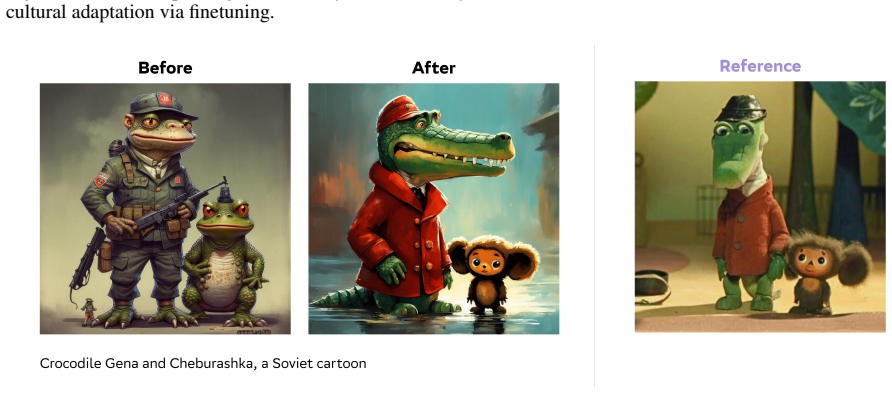
The mechanism is the CRAFT pipeline, a dataset-construction and finetuning loop rather than a new model architecture. It begins with a 17-category taxonomy of the Russian cultural code and manually selected entity lists with Russian-language web queries; proceeds through manual filtering according to explicit rules about cultural belonging and image quality; replaces automatic captions with human-written detailed captions that name characters, titles, and proper nouns; duplicates the resulting roughly 200,000 text-image pairs fifty times; and finetunes Kandinsky 3.1 in two stages, first at $768 \times 768$ and then at mixed resolutions with $768^2 \le W \times H \le 1024^2$. The duplicated data and human captioning are what carry the argument: they are the components whose absence is shown to produce unsatisfactory generations.
What would settle it
Take the finetuned model and a set of Russian cultural prompts whose entities were deliberately excluded from the 17-category entity lists (or names of entities appearing in no training image), have independent native speakers judge generations against baseline models, and check whether the win rate persists. If the advantage disappears on unseen entities while remaining on seen ones, the paper's claim of improved cultural awareness is really a claim of memorization.
Extended reading notes
Core claim
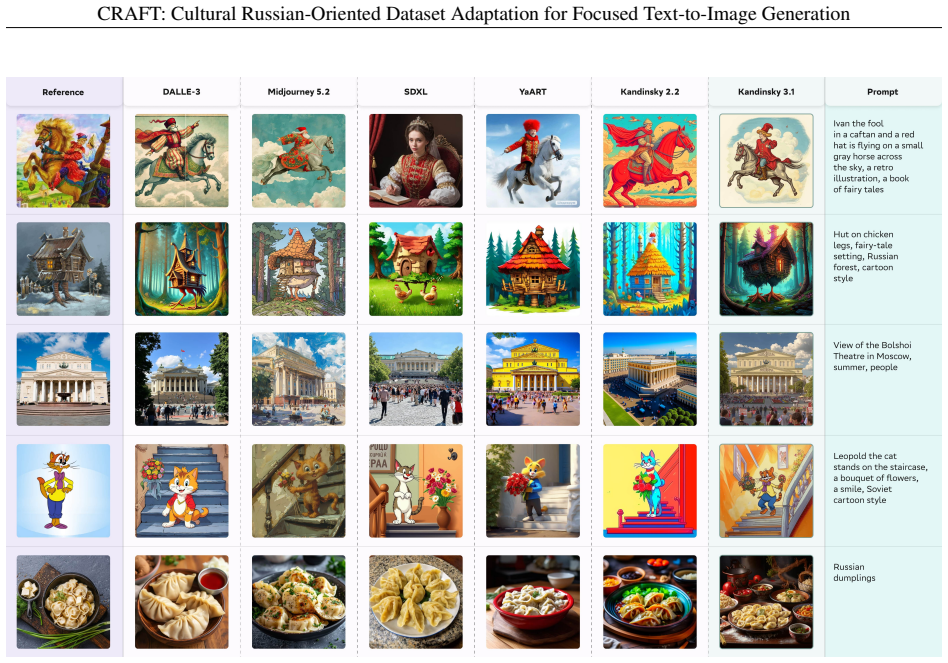
The central claim is that cultural awareness in a text-to-image model is not fixed at pretraining: it can be installed by finetuning on a small, deliberately constructed dataset of the target culture. The paper operationalizes Russian cultural code as seventeen visual categories (literature, art, film, cuisine, household objects, and the like), populates them with roughly eight thousand manually selected entities, and shows that the quality of automatic captions from LLaVa-NeXT is insufficient because it misses proper names and cultural references; human-written captions are required. After finetuning Kandinsky 3.1 on the curated dataset, human evaluators rate its generations of Russian cultural concepts above those of four popular general and Russian models and on par with DALL-E 3, with the difference described as small and category-dependent.
Load-bearing premise
The load-bearing assumption is that the 120 evaluation prompts accurately represent Russian cultural knowledge in general, even though they were constructed from the same seventeen categories and roughly the same entity lists that define the training data; if the test only re-asks what the model was finetuned on, the measured improvement shows memorization rather than broad cultural awareness.
Editorial extensions
If this is right
- The finetuned Kandinsky 3.1 beats Kandinsky 2.2, Midjourney 5.2, SDXL, and YaART on Russian cultural prompts in human evaluation, so model scale alone is not the cure for cultural blindness.
- The same dataset-construction recipe, category analysis, manual entity selection, filtering, human captioning, duplication, and two-stage finetuning, can be applied to any under-represented culture.
- Automatic captioning models that miss proper names and cultural references are a bottleneck; producing faithful cultural image-text pairs requires human captioning.
- Because the dataset is about two hundred thousand pairs duplicated fifty times, the effective training signal for rare entities is concentrated, suggesting that data duplication is a workable proxy for entity balancing.
Reading between the lines
- A natural stress test would be to evaluate the finetuned model on Russian cultural prompts built independently of the seventeen training categories; that would separate general cultural competence from memorization of the curated entities.
- Because the paper reports no results outside the Russian cultural domain, a fair extension would measure whether finetuning preserves the model's general and international generation quality.
- The relative contribution of human captions versus duplicated training data is not isolated; finetuning a control model on filtered but automatically captioned pairs would quantify that split.
- If the recipe transfers, the limiting factor for other cultures would be the construction of the category and entity taxonomies themselves, since different cultures encode their visual identity in different symbolic systems.
Signed reviews
Editorial analysis
A structured set of objections, weighed in public.
Referee Report
Summary. The paper addresses the lack of cultural awareness in text-to-image generation models, focusing on Russian culture. The authors propose a methodology, CRAFT, for collecting and processing a culturally oriented dataset: they manually define 17 cultural categories and about 8,000 entities, collect and filter internet images, replace automatic captions with human-written captions, and fine-tune Kandinsky 3.1 on the resulting roughly 200,000 image-text pairs (duplicated 50x, 500k training steps). Evaluation is a side-by-side human study on 120 self-constructed prompts, comparing the fine-tuned model against DALL-E 3, Midjourney 5.2, SDXL, YaART, and Kandinsky 2.2. The authors report that their model significantly outperforms all but DALL-E 3, where results are competitive, and conclude that the proposed dataset adaptation increases Russian cultural awareness.
Significance. If the central claim holds, the paper makes a useful contribution: it demonstrates a concrete data-engineering recipe (entity lists, human filtering, human captioning, fine-tuning) for closing cultural knowledge gaps in text-to-image models, a problem that is increasingly recognized as important. The dataset itself, with manual entity selection and quality filtering, is a potential resource for the community. The paper also clearly identifies failure modes such as entity imbalance and translation issues. However, the strength of the central claim is currently limited by the evaluation design: the test prompts appear to be drawn from the same categories and entity lists used to build the training set, and the paper reports no statistical support for the 'significantly outperforms' wording. The improvement could partly reflect memorization of the duplicated training data rather than a general increase in cultural awareness. These issues are addressable, so the work is a credible candidate for publication after substantial revision.
major comments (3)
- [Section 5 (Evaluation) vs. Section 4.1 (Entities Determination)] The 120 evaluation prompts are described as 'reflecting the features of the Russian cultural code,' but the paper never states that these prompts are disjoint from the 17 categories and entity lists used to construct the training dataset. Since Section 4.1 explains that entities were manually compiled per category and Table 1 gives examples, the natural reading is that the test set re-samples the same entities already seen during fine-tuning. In that case, high scores partly measure the model's ability to reproduce memorized entity-image associations, not its general cultural awareness. The manuscript must either provide explicit evidence of disjointness (e.g., a held-out set of entities and categories never used in training) or report results separately on held-out entities. This is essential because the abstract and conclusion claim increased 'awareness of Russian culture,' not just improved performance on training-domain concepts.
- [Section 5 (Human evaluation results, Figure 6)] The claim that 'Kandinsky 3.1 significantly outperforms' the baselines is not backed by any statistical analysis. The paper reports no confidence intervals, no significance tests, no number of pairwise comparisons per model pair, no variance across prompts or raters, and no inter-annotator agreement. The 12 raters are not described as independent or blind to model identity. Without these, the word 'significantly' is unsupported, and the reported percentages cannot be distinguished from noise. Please add per-pair counts, a significance test (e.g., bootstrap or Wilcoxon), rater agreement statistics, and a description of the rating protocol.
- [Section 4.4 (Data Duplication & Model Finetuning)] Fine-tuning for 500,000 steps on a dataset duplicated 50 times creates a strong prior toward memorizing the training captions. The paper does not evaluate whether the improvement transfers to entities not in the training set, to paraphrased prompts, or to compositional prompts that combine known entities in new ways. A simple regularization comparison (e.g., fewer steps, less duplication, or early stopping on a held-out set) or a held-out entity evaluation would substantially strengthen the claim that the method improves cultural awareness rather than overfitting to the curated list.
minor comments (6)
- [Section 4.2 (Data Processing)] The sentence 'Each estimator got acquainted with negative and positive examples' appears to use 'estimator' where 'annotator' or 'reviewer' is meant; please correct this wording.
- [Section 4.3 (Captioning)] The model name is written as 'LLaVa-Next' in the text and Table 2; the standard spelling is 'LLaVA-NeXT' (as in reference [44]). Please make the spelling consistent.
- [Sections 3.1 and 5] The Russian model is called 'YandexART' in Section 3.1 and 'YaART' in Section 5; unify the name and match it to reference [4].
- [Section 5] The 120 test prompts are not included in the paper or an appendix, which prevents replication and makes it impossible for readers to assess overlap with the training entities. The authors should release the prompt set, ideally with a per-category breakdown.
- [Figure 6] The figure lacks axis labels and a description of what the percentages denote (e.g., fraction of wins, preferences, or average scores). Please add a caption and axis labels so the reader can interpret the results without guesswork.
- [Section 8 (Later update)] The 'Later update' section is unusual in a research paper and reads more like an editorial note. If this appears in the published version, it should be removed or folded into the related work or conclusion, with the benchmark reference [49] cited where relevant.
Circularity Check
Evaluation prompts appear to be drawn from the same cultural-code entity lists used to build the training set, so the reported gain partly measures memorization of the finetuning data.
-
fitted input called prediction
[Section 4.1 (Entities Determination & Data Collection) and Section 5 (Evaluation)]
"For each category of Russian culture from the list we have defined, we have compiled a table of the most popular entities. ... Thus, we manually selected about 8 thousand entities. ... we collected our own set of 120 prompts, reflecting the features of the Russian cultural code."
The 17 categories and manually selected entity lists in Section 4.1 define both the training captions and, by the paper's own wording, the 120 test prompts 'reflecting the features of the Russian cultural code.' The paper never states that the prompts are disjoint from the training entities or drawn from held-out concepts. Since the finetuned model was trained on roughly 200k pairs covering those entities (duplicated 50x for 500k steps), high evaluation scores can be achieved by reproducing learned entity-image associations. The claimed improvement in cultural awareness is therefore measured on the same domain that was used to fit the model, making the headline result partially circular by construction rather than a test of generalization to unseen Russian-culture concepts.
full rationale
The derivation chain is otherwise self-contained: the dataset collection and captioning methodology are described independently, and the comparison includes external baselines (DALL-E 3, Midjourney, SDXL, YaART), so the self-citations to Kandinsky are not load-bearing in a circular way. The forward reference to the authors' later benchmark (Section 8, [49]) is not used as evidence for the current claims. The principal circularity is the evaluation design: the test prompts appear to sample the same 17 categories and entity lists that generated the training data, with no held-out entities and no statement of disjointness. Confidence intervals, inter-annotator agreement, and blind rating are also absent, which compounds the risk that the side-by-side scores reflect memorization of the 50x-duplicated finetuning set. These facts justify a partial-circularity score of 6 rather than a higher score, because the paper does contribute an independent dataset-construction procedure and the qualitative before/after figures are not purely definitional.
Assumptions & free parameters
free parameters (5)
- Number of cultural categories =
17
- Number of entities =
about 8,000
- Dataset duplication factor =
50
- Caption max output tokens =
512
- Finetuning steps =
500,000
assumptions (4)
- domain assumption The 17 listed categories together constitute the Russian cultural code for visual generation.
- domain assumption Human-authored captions are superior to automatic captions for finetuning.
- domain assumption Side-by-side human preference with 12 raters on 120 prompts is a valid measure of cultural awareness.
- ad hoc to paper Improvements measured on the self-constructed prompt set generalize to unlisted cultural entities.
Cite this review
Pith. "Pith review of CRAFT: Cultural Russian-Oriented Dataset Adaptation for Focused Text-to-Image Generation." pith.science (2026). https://pith.science/paper/X64UGYWM
@misc{pith2026250504851,
  author       = {Pith},
  title        = {Pith review of: CRAFT: Cultural Russian-Oriented Dataset Adaptation for Focused Text-to-Image Generation},
  year         = {2026},
  howpublished = {\url{https://pith.science/paper/X64UGYWM}},
  note         = {Machine review of arXiv:2505.04851}
}
read the original abstract
Despite the fact that popular text-to-image generation models cope well with international and general cultural queries, they have a significant knowledge gap regarding individual cultures. This is due to the content of existing large training datasets collected on the Internet, which are predominantly based on Western European or American popular culture. Meanwhile, the lack of cultural adaptation of the model can lead to incorrect results, a decrease in the generation quality, and the spread of stereotypes and offensive content. In an effort to address this issue, we examine the concept of cultural code and recognize the critical importance of its understanding by modern image generation models, an issue that has not been sufficiently addressed in the research community to date. We propose the methodology for collecting and processing the data necessary to form a dataset based on the cultural code, in particular the Russian one. We explore how the collected data affects the quality of generations in the national domain and analyze the effectiveness of our approach using the Kandinsky 3.1 text-to-image model. Human evaluation results demonstrate an increase in the level of awareness of Russian culture in the model.
Figures


Figures from the paper (9 more)



Reference graph
Works this paper leans on
-
[1]
Improving image generation with better captions, 2023
James Betker, Gabriel Goh, Li Jing, Tim Brooks, Jianfeng Wang, Linjie Li, Long Ouyang, Juntang Zhuang, Joyce Lee, Yufei Guo, Wesam Manassra, Prafulla Dhariwa, Casey Chu, Yunxin Jiao, and Aditya Ramesh. Improving image generation with better captions, 2023
work page 2023
- [2]
-
[3]
Sdxl: Improving latent diffusion models for high-resolution image synthesis, 2023
Dustin Podell, Zion English, Kyle Lacey, Andreas Blattmann, Tim Dockhorn, Jonas Müller, Joe Penna, and Robin Rombach. Sdxl: Improving latent diffusion models for high-resolution image synthesis, 2023
2023
-
[4]
Yaart: Yet another art rendering technology, 2024
Sergey Kastryulin, Artem Konev, Alexander Shishenya, Eugene Lyapustin, Artem Khurshudov, Alexander Tselousov, Nikita Vinokurov, Denis Kuznedelev, Alexander Markovich, Grigoriy Livshits, Alexey Kirillov, Anastasiia Tabisheva, Liubov Chubarova, Marina Kaminskaia, Alexander Ustyuzhanin, Artemii Shvetsov, Daniil Shlenskii, Valerii Startsev, Dmitrii Kornilov, ...
work page 2024
-
[5]
Kandinsky: an improved text-to- image synthesis with image prior and latent diffusion, 2023
Anton Razzhigaev, Arseniy Shakhmatov, Anastasia Maltseva, Vladimir Arkhipkin, Igor Pavlov, Ilya Ryabov, Angelina Kuts, Alexander Panchenko, Andrey Kuznetsov, and Denis Dimitrov. Kandinsky: an improved text-to- image synthesis with image prior and latent diffusion, 2023
work page 2023
-
[6]
Kandinsky 3.0 technical report, 2024
Vladimir Arkhipkin, Andrei Filatov, Viacheslav Vasilev, Anastasia Maltseva, Said Azizov, Igor Pavlov, Julia Agafonova, Andrey Kuznetsov, and Denis Dimitrov. Kandinsky 3.0 technical report, 2024
work page 2024
-
[7]
Kandinsky 3: Text-to-image synthesis for multifunctional generative framework
Arkhipkin Vladimir, Viacheslav Vasilev, Andrei Filatov, Igor Pavlov, Julia Agafonova, Nikolai Gerasimenko, Anna Averchenkova, Evelina Mironova, Bukashkin Anton, Konstantin Kulikov, Andrey Kuznetsov, and Denis 10 CRAFT: Cultural Russian-Oriented Dataset Adaptation for Focused Text-to-Image Generation Dimitrov. Kandinsky 3: Text-to-image synthesis for multi...
work page 2024
-
[8]
Laion-5b: An open large-scale dataset for training next generation image-text models
Christoph Schuhmann, Romain Beaumont, Richard Vencu, Cade Gordon, Ross Wightman, Mehdi Cherti, Theo Coombes, Aarush Katta, Clayton Mullis, Mitchell Wortsman, Patrick Schramowski, Srivatsa Kundurthy, Katherine Crowson, Ludwig Schmidt, Robert Kaczmarczyk, and Jenia Jitsev. Laion-5b: An open large-scale dataset for training next generation image-text models....
work page 2022
Show all 49 references
-
[9]
Lawrence Zitnick
Tsung-Yi Lin, Michael Maire, Serge Belongie, James Hays, Pietro Perona, Deva Ramanan, Piotr Dollár, and C. Lawrence Zitnick. Microsoft coco: Common objects in context. In David Fleet, Tomas Pajdla, Bernt Schiele, and Tinne Tuytelaars, editors,Computer Vision – ECCV 2014, pages...
2014
-
[10]
Shreya Shankar, Yoni Halpern, Eric Breck, James Atwood, Jimbo Wilson, and D. Sculley. No classification without representation: Assessing geodiversity issues in open data sets for the developing world, 2017
2017
-
[11]
Does object recognition work for everyone?, 2019
Terrance DeVries, Ishan Misra, Changhan Wang, and Laurens van der Maaten. Does object recognition work for everyone?, 2019
2019
-
[12]
Pinpointing why object recognition performance degrades across income levels and geographies, 2023
Laura Gustafson, Megan Richards, Melissa Hall, Caner Hazirbas, Diane Bouchacourt, and Mark Ibrahim. Pinpointing why object recognition performance degrades across income levels and geographies, 2023
2023
-
[13]
Improving language understanding by generative pre-training, 2018
Alec Radford and Karthik Narasimhan. Improving language understanding by generative pre-training, 2018
2018
-
[14]
Training generative adversarial networks with limited data, 2020
Tero Karras, Miika Aittala, Janne Hellsten, Samuli Laine, Jaakko Lehtinen, and Timo Aila. Training generative adversarial networks with limited data, 2020
2020
-
[15]
Glide: Towards photorealistic image generation and editing with text-guided diffusion models, 2022
Alex Nichol, Prafulla Dhariwal, Aditya Ramesh, Pranav Shyam, Pamela Mishkin, Bob McGrew, Ilya Sutskever, and Mark Chen. Glide: Towards photorealistic image generation and editing with text-guided diffusion models, 2022
2022
-
[16]
Emu: Enhancing image generation models using photogenic needles in a haystack, 2023
Xiaoliang Dai, Ji Hou, Chih-Yao Ma, Sam Tsai, Jialiang Wang, Rui Wang, Peizhao Zhang, Simon Vandenhende, Xiaofang Wang, Abhimanyu Dubey, Matthew Yu, Abhishek Kadian, Filip Radenovic, Dhruv Mahajan, Kunpeng Li, Yue Zhao, Vladan Petrovic, Mitesh Kumar Singh, Simran Motwani, Yi W...
2023
-
[17]
Minigpt-4: Enhancing vision-language understanding with advanced large language models, 2023
Deyao Zhu, Jun Chen, Xiaoqian Shen, Xiang Li, and Mohamed Elhoseiny. Minigpt-4: Enhancing vision-language understanding with advanced large language models, 2023
2023
-
[18]
Domain adaptation: Challenges, methods, datasets, and applications
Peeyush Singhal, Rahee Walambe, Sheela Ramanna, and Ketan Kotecha. Domain adaptation: Challenges, methods, datasets, and applications. IEEE Access, 11:6973–7020, 2023
2023
-
[19]
Ai alignment: A comprehensive survey, 2024
Jiaming Ji, Tianyi Qiu, Boyuan Chen, Borong Zhang, Hantao Lou, Kaile Wang, Yawen Duan, Zhonghao He, Jiayi Zhou, Zhaowei Zhang, Fanzhi Zeng, Kwan Yee Ng, Juntao Dai, Xuehai Pan, Aidan O’Gara, Yingshan Lei, Hua Xu, Brian Tse, Jie Fu, Stephen McAleer, Yaodong Yang, Yizhou Wang, S...
2024
-
[20]
Copal-id: Indonesian language reasoning with local culture and nuances
Haryo Akbarianto Wibowo, Erland Hilman Fuadi, Made Nindyatama Nityasya, Radityo Eko Prasojo, and Alham Fikri Aji. Copal-id: Indonesian language reasoning with local culture and nuances. arXiv preprint arXiv:2311.01012, 2023
2023 arXiv
-
[21]
Cultural Adaptation of Recipes
Yong Cao, Yova Kementchedjhieva, Ruixiang Cui, Antonia Karamolegkou, Li Zhou, Megan Dare, Lucia Donatelli, and Daniel Hershcovich. Cultural Adaptation of Recipes. Transactions of the Association for Computational Linguistics, 12:80–99, 01 2024
2024
-
[22]
Adapting entities across languages and cultures
Denis Peskov, Viktor Hangya, Jordan Boyd-Graber, and Alexander Fraser. Adapting entities across languages and cultures. In Marie-Francine Moens, Xuanjing Huang, Lucia Specia, and Scott Wen-tau Yih, editors, Findings of the Association for Computational Linguistics: EMNLP 2021 ...
2021
-
[23]
Cross-cultural transfer learning for Chinese offensive language detection
Li Zhou, Laura Cabello, Yong Cao, and Daniel Hershcovich. Cross-cultural transfer learning for Chinese offensive language detection. In Sunipa Dev, Vinodkumar Prabhakaran, David Adelani, Dirk Hovy, and Luciana Benotti, editors, Proceedings of the First Workshop on Cross-Cultur...
2023
-
[24]
Cultural compass: Predicting transfer learning success in offensive language detection with cultural features
Li Zhou, Antonia Karamolegkou, Wenyu Chen, and Daniel Hershcovich. Cultural compass: Predicting transfer learning success in offensive language detection with cultural features. In Houda Bouamor, Juan Pino, and Kalika Bali, editors, Findings of the Association for Computationa...
2023
-
[25]
Model-agnostic meta-learning for multilingual hate speech detection
Md Rabiul Awal, Roy Ka-Wei Lee, Eshaan Tanwar, Tanmay Garg, and Tanmoy Chakraborty. Model-agnostic meta-learning for multilingual hate speech detection. IEEE Transactions on Computational Social Systems , 11(1):1086–1095, 2024
2024
-
[26]
Challenges and strategies in cross-cultural NLP
Daniel Hershcovich, Stella Frank, Heather Lent, Miryam de Lhoneux, Mostafa Abdou, Stephanie Brandl, Emanuele Bugliarello, Laura Cabello Piqueras, Ilias Chalkidis, Ruixiang Cui, Constanza Fierro, Katerina Mar- gatina, Phillip Rust, and Anders Søgaard. Challenges and strategies ...
2022
-
[27]
Bridging cultural nuances in dialogue agents through cultural value surveys
Yong Cao, Min Chen, and Daniel Hershcovich. Bridging cultural nuances in dialogue agents through cultural value surveys. In Yvette Graham and Matthew Purver, editors,Findings of the Association for Computational Linguistics: EACL 2024, pages 929–945, St. Julian’s, Malta, March...
2024
-
[28]
Viscounth: A large-scale multilingual visual question answering dataset for cultural heritage
Federico Becattini, Pietro Bongini, Luana Bulla, Alberto Del Bimbo, Ludovica Marinucci, Misael Mongiovì, and Valentina Presutti. Viscounth: A large-scale multilingual visual question answering dataset for cultural heritage. ACM Trans. Multimedia Comput. Commun. Appl., 19(6), jul 2023
2023
-
[29]
From local concepts to universals: Evaluating the multicultural understanding of vision-language models, 2024
Mehar Bhatia, Sahithya Ravi, Aditya Chinchure, Eunjeong Hwang, and Vered Shwartz. From local concepts to universals: Evaluating the multicultural understanding of vision-language models, 2024
2024
-
[30]
Situating the social issues of image generation models in the model life cycle: a sociotechnical approach
Amelia Katirai, Noa Garcia, Kazuki Ide, Yuta Nakashima, and Atsuo Kishimoto. Situating the social issues of image generation models in the model life cycle: a sociotechnical approach. AI and Ethics, July 2024
2024
-
[31]
Implicit stereotypes in pre-trained classifiers
Nassim Dehouche. Implicit stereotypes in pre-trained classifiers. IEEE Access, 9:167936–167947, 2021
2021
-
[32]
Social biases through the text-to-image generation lens
Ranjita Naik and Besmira Nushi. Social biases through the text-to-image generation lens. In Proceedings of the 2023 AAAI/ACM Conference on AI, Ethics, and Society, AIES ’23, page 786–808, New York, NY , USA, 2023. Association for Computing Machinery
2023
-
[33]
Large language model as attributed training data generator: A tale of diversity and bias
Yue Yu, Yuchen Zhuang, Jieyu Zhang, Yu Meng, Alexander J Ratner, Ranjay Krishna, Jiaming Shen, and Chao Zhang. Large language model as attributed training data generator: A tale of diversity and bias. In A. Oh, T. Naumann, A. Globerson, K. Saenko, M. Hardt, and S. Levine, edit...
2023
-
[34]
The dark side of dataset scaling: Evaluating racial classification in multimodal models
Abeba Birhane, Sepehr Dehdashtian, Vinay Prabhu, and Vishnu Boddeti. The dark side of dataset scaling: Evaluating racial classification in multimodal models. In Proceedings of the 2024 ACM Conference on Fairness, Accountability, and Transparency, FAccT ’24, page 1229–1244, New...
2024
-
[35]
Precisedebias: An automatic prompt engineering approach for generative ai to mitigate image demographic biases
Colton Clemmer, Junhua Ding, and Yunhe Feng. Precisedebias: An automatic prompt engineering approach for generative ai to mitigate image demographic biases. In Proceedings of the IEEE/CVF Winter Conference on Applications of Computer Vision (WACV), pages 8596–8605, January 2024
2024
-
[36]
A prompt array keeps the bias away: Debiasing vision-language models with adversarial learning
Hugo Berg, Siobhan Hall, Yash Bhalgat, Hannah Kirk, Aleksandar Shtedritski, and Max Bain. A prompt array keeps the bias away: Debiasing vision-language models with adversarial learning. In Yulan He, Heng Ji, Sujian Li, Yang Liu, and Chua-Hui Chang, editors, Proceedings of the ...
2022
-
[37]
Exploiting cultural biases via homoglyphs in text-to-image synthesis
Lukas Struppek, Dom Hintersdorf, Felix Friedrich, Manuel br, Patrick Schramowski, and Kristian Kersting. Exploiting cultural biases via homoglyphs in text-to-image synthesis. J. Artif. Int. Res., 78, jan 2024
2024
-
[38]
Codes and cultural analysis
John Corner. Codes and cultural analysis. Media, Culture & Society, 2(1), 1980
1980
-
[39]
Literature and the russian cultural code at the beginning of the 21st century
Mikhail Goloubkov. Literature and the russian cultural code at the beginning of the 21st century. Journal of Eurasian Studies, 4(1):107–113, 2013. 20 Years of the Collapse of the Fomer Soviet Union
2013
-
[40]
The icon and axe: An interpretative history of Russian culture
James Billington. The icon and axe: An interpretative history of Russian culture. Vintage, 2010
2010
-
[41]
Natasha’s dance: A cultural history of Russia
Orlando Figes. Natasha’s dance: A cultural history of Russia. Macmillan, 2002
2002
-
[42]
Russian popular culture: Entertainment and society since 1900
Richard Stites. Russian popular culture: Entertainment and society since 1900 . Cambridge University Press, 1992. 12 CRAFT: Cultural Russian-Oriented Dataset Adaptation for Focused Text-to-Image Generation
1900
-
[43]
Russian cultural scripts: The theory of cultural scripts and its applications
Anna Wierzbicka. Russian cultural scripts: The theory of cultural scripts and its applications. Ethos, 30(4):401– 432, 2002
2002
-
[44]
Improved baselines with visual instruction tuning, 2023
Haotian Liu, Chunyuan Li, Yuheng Li, and Yong Jae Lee. Improved baselines with visual instruction tuning, 2023
2023
-
[45]
Retrieval-augmented generation for knowledge-intensive nlp tasks
Patrick Lewis, Ethan Perez, Aleksandra Piktus, Fabio Petroni, Vladimir Karpukhin, Naman Goyal, Heinrich Küttler, Mike Lewis, Wen-tau Yih, Tim Rocktäschel, Sebastian Riedel, and Douwe Kiela. Retrieval-augmented generation for knowledge-intensive nlp tasks. In H. Larochelle, M. ...
2020
-
[46]
Retrieval-augmented generation for ai-generated content: A survey, 2024
Penghao Zhao, Hailin Zhang, Qinhan Yu, Zhengren Wang, Yunteng Geng, Fangcheng Fu, Ling Yang, Wentao Zhang, Jie Jiang, and Bin Cui. Retrieval-augmented generation for ai-generated content: A survey, 2024
2024
-
[47]
Fusionframes: Efficient architectural aspects for text-to-video generation pipeline, 2023
Vladimir Arkhipkin, Zein Shaheen, Viacheslav Vasilev, Elizaveta Dakhova, Andrey Kuznetsov, and Denis Dimitrov. Fusionframes: Efficient architectural aspects for text-to-video generation pipeline, 2023
2023
-
[48]
Improveyourvideos: Architectural improvements for text-to-video generation pipeline
Vladimir Arkhipkin, Zein Shaheen, Viacheslav Vasilev, Elizaveta Dakhova, Konstantin Sobolev, Andrey Kuznetsov, and Denis Dimitrov. Improveyourvideos: Architectural improvements for text-to-video generation pipeline. IEEE Access, 13:1986–2003, 2025
1986
-
[49]
RusCode: Russian cultural code benchmark for text-to-image generation
Viacheslav Vasilev, Julia Agafonova, Nikolai Gerasimenko, Alexander Kapitanov, Polina Mikhailova, Evelina Mironova, and Denis Dimitrov. RusCode: Russian cultural code benchmark for text-to-image generation. In Luis Chiruzzo, Alan Ritter, and Lu Wang, editors, Findings of the A...
2025
Reviewed August 15, 2026 · model on record in the stance chip above.
Discussion (0). Continue with ORCID to comment.