REVIEW 3 major objections 6 minor 56 references
Identifying and Understanding Cross-Class Features in Adversarial Training
T0 review · 3 major / 6 minor · reviewed 2026-08-07 · deepseek-v4-flash
Pith's one-line read This paper claims that during adversarial training, models learn features shared across classes up to their most robust checkpoint, then progressively abandon those features, and that this abandonment is the mechanism behind robust…
desk verdict A plausible and well-theorized mechanism for robust overfitting, but the empirical measure (CAS) is unvalidated and plausibly confounded; the core hypothesis needs a control experiment before it should be taken as established. read the letter →
The pith
A machine-rendered reading of the paper's core claim, the machinery that carries it, and where it could break.
The reading
What carries the argument
The central object is the class attribution vector $A_i(x) = g(x) \odot W[i]$, the elementwise product of the feature extractor's output with the $i$-th row of the linear classifier, which attributes each feature's contribution to class $i$'s logit. The paper averages these vectors over adversarial test examples within each class, computes the cosine-similarity matrix $C[i,j]$, and defines CAS as the sum of the positive off-diagonal entries; high CAS means the model uses more features shared between classes. The theoretical side rests on a three-class linear model with class-specific features $x_E \sim N(\mu, \sigma^2)$ and cross-class features $x_C$, weights $w_1$ (class-specific) and $w_2$ (shared), an $\ell_\infty$ perturbation bound $\epsilon$, and a hinge-style robust loss, which simplifies to a quadratic objective in $(w_1,w_2)$. That simplification is what allows the proofs of Theorem 1 ($w_2$ vanishes for large $\epsilon$), Theorem 2 (larger $w_2$ improves robust classification), and Theorem 3/Corollary 1 (label smoothing keeps $w_2$ positive for a wider $\epsilon$ range).
What would settle it
Train two models with identical data and architecture, but add a regularizer that keeps CAS fixed at the best-checkpoint level in one model and forces CAS down in the other; if the model with pinned CAS still shows the same late-training decline in robust test accuracy, then the forgetting of cross-class features is not the mechanism of robust overfitting, while if the forced-CAS-down model loses robustness early, the causal direction is supported.
Extended reading notes
Core claim
The central claim is a proposed training dynamics for adversarial training: in the early phase the model learns both class-specific and cross-class features, and the use of cross-class features grows up to the best robustness checkpoint; afterward, because cross-class features raise positive logits on other classes and thus keep the robust training loss above zero under one-hot labels, the model progressively discards them and shifts to class-specific features. This abandonment of shared features is presented as the mechanism of robust overfitting, and the success of soft-label training is explained by its ability to keep cross-class information in the labels. Empirically, the paper finds that the CAS score rises to its maximum at the best checkpoint and then drops sharply, that the drop is larger for larger perturbation bounds, that it appears across CIFAR-10, CIFAR-100, Tiny ImageNet, residual and transformer architectures, and $\ell_\infty$ and $\ell_2$ attacks, and that fast adversarial training's catastrophic overfitting coincides with CAS plunging to near zero. Theoretically, in a three-class linear model with independent class-specific and shared features, the paper proves that the shared-feature weight $w_2$ is driven to zero for robust loss with large $\epsilon$ while the class-specific weight $w_1$ survives, that increasing $w_2$ raises the probability of correct robust classification, and that label smoothing preserves a positive $w_2$ over a larger $\epsilon$ range.
Load-bearing premise
The load-bearing premise is that the cosine similarity of class-averaged attribution vectors, CAS, faithfully measures how much a model actually uses features shared across classes, and the paper does not validate this metric against an external ground truth or rule out confounds such as logit scale, prediction confidence, or the choice of adversarial examples used for attribution.
Editorial extensions
If this is right
- Models at their most robust checkpoint use more cross-class features than the final overfitted checkpoint, so interventions that preserve cross-class features (such as knowledge distillation or label smoothing) should raise both peak robust accuracy and end-of-training robustness.
- Because larger perturbation bounds make cross-class features harder to learn and easier to discard, the theory explains why robust overfitting worsens as $\epsilon$ increases up to common values and then diminishes at extremely large $\epsilon$, where few shared features are ever learned.
- Catastrophic overfitting in fast adversarial training and standard robust overfitting share a common signature: a collapse in cross-class feature usage, with CAS dropping to near zero when robust accuracy collapses.
- Standard training uses far fewer cross-class features than adversarial training and shows no late-training CAS decline, so the forgetting mechanism is specific to the one-hot-label robust-loss objective rather than to ordinary training.
- Soft-label methods mitigate robust overfitting specifically because their labels retain cross-class information; accordingly, the CAS gap between best and final checkpoints should be much smaller for knowledge-distilled AT than for vanilla AT.
Reading between the lines
- Editorial extension: if CAS is a valid proxy, the same attribution-similarity lens could explain why fine-tuning a robust model on a new task erodes adversarial robustness—fine-tuning may discard shared features just as late-stage AT does—and a CAS-preserving regularizer during fine-tuning could be tested for robustness retention.
- Editorial extension: the synthetic theory predicts a sharp threshold $\epsilon_0 = (\mu - \sigma/\sqrt{\pi})/2$ where the shared-feature weight $w_2$ switches from positive to zero; sweeping $\epsilon$ while measuring CAS on real models should reveal a corresponding transition, which would distinguish this mechanism from memorization-based accounts of robust overfitting.
- Editorial extension: the paper's own admission that learned features do not always align with human intuition (Appendix D) implies CAS captures functional sharing rather than semantic similarity; a natural check is whether CAS correlates with robustness gains specifically on class pairs that share recognizable parts.
- Editorial extension: the cross-class feature view reframes the robust/non-robust feature decomposition by adding a sharedness axis, suggesting that data augmentation or resampling based on shared-part structure could transfer robustness between similar classes more efficiently than current label-agnostic augmentation.
Editorial analysis
A structured set of objections, weighed in public.
Referee Report
Summary. This paper studies adversarial training (AT) through the lens of class-wise feature attributions. It defines cross-class features as features shared by multiple classes and introduces a Class Attribution Similarity (CAS) metric based on the cosine similarity of class-averaged attribution vectors (Eqs. 6-7). Empirically, the paper reports that CAS rises during the initial phase of AT, peaks near the best robust checkpoint, and then drops as robust overfitting occurs; this pattern is reported across CIFAR-10/CIFAR-100/Tiny-ImageNet, l_infinity and l_2 threat models, and CNN/Transformer architectures. It also reports that knowledge-distillation-based soft-label AT preserves CAS and mitigates robust overfitting. A Gaussian three-class toy model with class-specific and cross-class features supports Theorems 1-3: cross-class features are more sensitive to the robust loss than class-specific features, yet positive cross-class weights improve robust classification, and label smoothing enlarges the perturbation range that admits positive cross-class weights. Extended studies cover large perturbation bounds, fast adversarial training, an instance-wise metric, and standard training.
Significance. If the central claim holds, the paper would offer a unified mechanistic account of robust overfitting and of the benefit of soft labels in AT, with concrete implications for algorithm design. The theoretical section is a genuine strength: the toy model assumptions are explicit, and the proofs of Theorems 1-3 in Appendix E are self-contained and have no fitted parameters. The empirical breadth is also commendable, and the public code release supports reproducibility. However, the central empirical support rests on the CAS metric, whose validity as a measure of genuine shared-feature usage is not established. Because the paper's interpretational claims are built on this metric, the contribution will be fully convincing only after the metric is validated and the confounds identified below are controlled.
major comments (3)
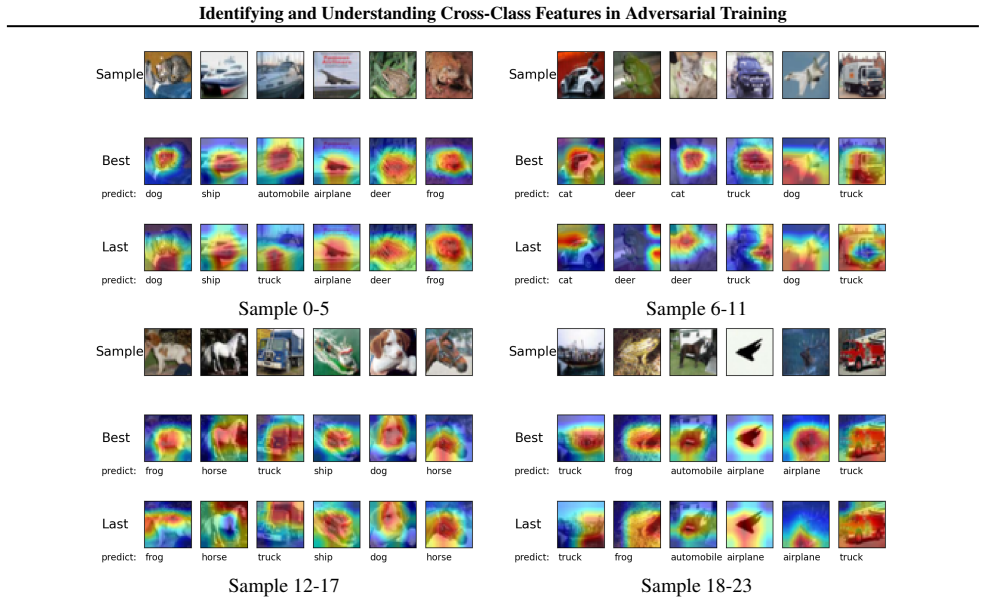
- [§3.1, Eq. (6), Algorithm 1] The CAS metric is the load-bearing instrument for the paper's central empirical claim, but it is not validated against any ground truth. Eq. (6) computes cosine similarity between class-averaged attribution vectors without centering, so any component common to all classes (e.g., a bias in W or a shared background feature) inflates CAS even though such a component is not a discriminative cross-class feature of the kind the theory discusses. In addition, Algorithm 1 averages attributions over all test adversarial examples, including those the model misclassifies; as robust accuracy falls from the best to the last checkpoint, the fraction of misclassified samples in the average increases, and for a misclassified example the attribution with respect to the true class does not reflect the features driving the model's decision. This alone could produce the observed drop in CAS without any change in shared-feature usage. I recommend: (1) centering the attribution vectors before computing the cosine similarity; (2) restricting the computation to correctly classified examples or conditioning on attack success; and (3) validating CAS on the synthetic model of Section 4, where the true cross-class weight w2 is known. Without these controls, the correlation between CAS and robust accuracy does not support the causal story.
- [§4.2, Theorem 2] Theorem 2 shows that, for fixed w1, the probability in Eq. (11) is monotonically increasing in w2 over [0, w1]. This does not by itself establish the paper's statement that "using a positive w2 is always more beneficial for robust classification than simply setting w2 to 0," because the AT solution also adjusts w1 through the regularized objective in Eq. (9). A comparison between the optimizer of the robust loss (which Theorem 1 drives to w2 = 0 for larger epsilon) and a model retaining w2 > 0 requires an analysis of the w1-w2 trade-off under the same regularization. As stated, the theorem is a useful intuition but not a proof that the model minimizing the training objective while keeping w2 > 0 has better robust test accuracy.
- [§4, Theorems 1 and 3] The theoretical results characterize global minimizers of the expected robust loss for different epsilon (and for the smoothed loss), not the trajectory of iterative adversarial training. The central temporal hypothesis--that the model first learns cross-class features and then gradually abandons them--therefore receives only indirect support from these theorems. To connect the toy model to the observed dynamics, the paper would need either a direct analysis of the training trajectory or an empirical test showing that the CAS trajectory of an actual training run tracks the predicted phase transition. As it stands, the theory is consistent with the observation but does not uniquely predict it.
minor comments (6)
- [Appendix E.5] The higher-dimensional extension is asserted with the statement that it "can be easily derived," but the derivation is not provided. Since the main text relies on this extension for the generality of the theoretical claims, either include the proof or explicitly label the extension as a remark rather than a proven result.
- [§3.3 and Appendix A] There are typos: "Notebly" should be "Notably" in Section 3.3, and Algorithm 1 is referred to as "falg" in the first paragraph of Appendix A.
- [§3.3 and Appendix D] Appendix D acknowledges that not all saliency-map examples are clearly interpretable; this caveat should appear in the main text when the saliency evidence is presented, since the current wording in Section 3.3 presents the visualizations as stronger support than the appendix allows.
- [§5.3, Figure 8] The instance-wise metric selects, for each sample, the most similar sample in the other class; this max-based statistic can be sensitive to outliers. Reporting the full distribution or a more robust summary (e.g., median or quantile) would strengthen the claim.
- [Table 1 and Figures 2-6] The central CAS-versus-robust-accuracy comparisons are reported without multiple seeds or confidence intervals; given that the conclusions are empirical and the metric is new, error bars or at least a statement about variance would improve reliability.
- [Figure captions] The color scales differ across figures (e.g., [−0.75, 0.75] in Figure 5 versus [0, 1] in Figure 6); this should be stated consistently in captions so that cross-figure comparisons are not misleading.
Circularity Check
No significant circularity; the theoretical results are parameter-free, and the soft-label prediction is tested against an external method, while remaining concerns about the CAS metric are measurement-validity issues rather than derivation circularity.
full rationale
The empirical backbone of the paper is a new metric (CAS, Eqs. 6-7) rather than a fitted parameter, and the central theoretical claims are proved in a self-contained synthetic model (Sec. 4) with explicit assumptions (Eq. 8, sigma<sqrt(pi)mu, epsilon<mu/2). Theorem 1 and Theorem 2 derive the sensitivity and usefulness of w_2 directly from the robust loss, not from the empirical CAS data; Theorem 3 and Corollary 1 derive the label-smoothing effect from the loss expression. The soft-label prediction is validated against an external method, knowledge distillation (Fig. 3 and Eq. 3), so it is not a renamed fit. The self-citations (Bai et al. 2021a; Wang et al. 2024; Wei et al. 2023) support background observations or the interpretation that similar attribution vectors indicate shared features; they are not used as a uniqueness theorem and do not reduce any derivation to a self-citation. The acknowledged limitation in Appendix D that saliency maps are not universally interpretable is a validity caveat, not evidence that a prediction is equivalent to an input. Concerns about whether CAS is confounded by the changing mix of misclassified adversarial examples or by the uncentered cosine similarity are measurement-validity questions that the paper does not fully control, but under the hard rules they do not constitute circularity because no equation or fitted value is shown to reduce to its own input by construction.
Assumptions & free parameters
assumptions (5)
- domain assumption The synthetic data follows the Gaussian model in Eq. 8 with sigma < sqrt(pi) mu.
- ad hoc to paper The adversarial loss in Eq. 10, a margin-based max-over-other-classes difference, represents the training objective.
- domain assumption Class-averaged attribution vectors and their cosine similarity (Eqs. 5-6) measure the usage of cross-class features.
- standard math The classifier takes the linear form f = W g with a feature extractor g and linear layer W (Eq. 4).
- ad hoc to paper Symmetric weights and label smoothing with beta < 1/3 capture knowledge distillation.
invented entities (1)
-
Cross-class features (as an explanatory category)
independent evidence
Cite this review
Pith. "Pith review of Identifying and Understanding Cross-Class Features in Adversarial Training." pith.science (2026). https://pith.science/paper/HYCJ7HKP
@misc{pith2026250605032,
  author       = {Pith},
  title        = {Pith review of: Identifying and Understanding Cross-Class Features in Adversarial Training},
  year         = {2026},
  howpublished = {\url{https://pith.science/paper/HYCJ7HKP}},
  note         = {Machine review of arXiv:2506.05032}
}
read the original abstract
Adversarial training (AT) has been considered one of the most effective methods for making deep neural networks robust against adversarial attacks, while the training mechanisms and dynamics of AT remain open research problems. In this paper, we present a novel perspective on studying AT through the lens of class-wise feature attribution. Specifically, we identify the impact of a key family of features on AT that are shared by multiple classes, which we call cross-class features. These features are typically useful for robust classification, which we offer theoretical evidence to illustrate through a synthetic data model. Through systematic studies across multiple model architectures and settings, we find that during the initial stage of AT, the model tends to learn more cross-class features until the best robustness checkpoint. As AT further squeezes the training robust loss and causes robust overfitting, the model tends to make decisions based on more class-specific features. Based on these discoveries, we further provide a unified view of two existing properties of AT, including the advantage of soft-label training and robust overfitting. Overall, these insights refine the current understanding of AT mechanisms and provide new perspectives on studying them. Our code is available at https://github.com/PKU-ML/Cross-Class-Features-AT.
Figures


Figures from the paper (8 more)


Reference graph
Works this paper leans on
-
[1]
write newline
" write newline "" before.all 'output.state := FUNCTION n.dashify 't := "" t empty not t #1 #1 substring "-" = t #1 #2 substring "--" = not "--" * t #2 global.max substring 't := t #1 #1 substring "-" = "-" * t #2 global.max substring 't := while if t #1 #1 substring * t #2 global.max substring 't := if while FUNCTION format.date year duplicate empty "emp...
-
[2]
Andriushchenko, M. and Flammarion, N. Understanding and improving fast adversarial training. NeurIPS, 2020
work page 2020
-
[3]
Obfuscated gradients give a false sense of security: Circumventing defenses to adversarial examples
Athalye, A., Carlini, N., and Wagner, D. Obfuscated gradients give a false sense of security: Circumventing defenses to adversarial examples. In ICML, 2018
work page 2018
-
[4]
Clustering effect of adversarial robust models
Bai, Y., Yan, X., Jiang, Y., Xia, S.-T., and Wang, Y. Clustering effect of adversarial robust models. In NeurIPS, 2021 a
work page 2021
-
[5]
Improving adversarial robustness via channel-wise activation suppressing
Bai, Y., Zeng, Y., Jiang, Y., Xia, S.-T., Ma, X., and Wang, Y. Improving adversarial robustness via channel-wise activation suppressing. In ICLR, 2021 b
work page 2021
-
[6]
Robust classification via a single diffusion model
Chen, H., Dong, Y., Wang, Z., Yang, X., Duan, C., Su, H., and Zhu, J. Robust classification via a single diffusion model. In ICML, 2024
work page 2024
-
[7]
Robust overfitting may be mitigated by properly learned smoothening
Chen, T., Zhang, Z., Liu, S., Chang, S., and Wang, Z. Robust overfitting may be mitigated by properly learned smoothening. In ICLR, 2021
work page 2021
-
[8]
Cat: Customized adversarial training for improved robustness
Cheng, M., Lei, Q., Chen, P.-Y., Dhillon, I., and Hsieh, C.-J. Cat: Customized adversarial training for improved robustness. In IJCAI, 2022
work page 2022
Show all 56 references
-
[9]
M., Rosenfeld, E., and Kolter, J
Cohen, J. M., Rosenfeld, E., and Kolter, J. Z. Certified adversarial robustness via randomized smoothing. In ICML, 2019
2019
-
[10]
Label noise in adversarial training: A novel perspective to study robust overfitting
Dong, C., Liu, L., and Shang, J. Label noise in adversarial training: A novel perspective to study robust overfitting. In Oh, A. H., Agarwal, A., Belgrave, D., and Cho, K. (eds.), NeurIPS, 2022 a
2022
-
[11]
Exploring memorization in adversarial training
Dong, Y., Xu, K., Yang, X., Pang, T., Deng, Z., Su, H., and Zhu, J. Exploring memorization in adversarial training. In ICLR, 2022 b
2022
-
[12]
On the role of discrete tokenization in visual representation learning
Du, T., Wang, Y., and Wang, Y. On the role of discrete tokenization in visual representation learning. arXiv preprint arXiv:2407.09087, 2024
2024 arXiv
-
[14]
A., and Mann, T
Gowal, S., Rebuffi, S.-A., Wiles, O., Stimberg, F., Calian, D. A., and Mann, T. A. Improving robustness using generated data. In NeurIPS, 2021
2021
-
[15]
Contranorm: A contrastive learning perspective on oversmoothing and beyond
Guo, X., Wang, Y., Du, T., and Wang, Y. Contranorm: A contrastive learning perspective on oversmoothing and beyond. arXiv preprint arXiv:2303.06562, 2023
2023 arXiv
-
[16]
Identity mappings in deep residual networks
He, K., Zhang, X., Ren, S., and Sun, J. Identity mappings in deep residual networks. In ECCV, 2016
2016
-
[17]
Distilling the knowledge in a neural network
Hinton, G., Vinyals, O., and Dean, J. Distilling the knowledge in a neural network. arXiv preprint arXiv:1503.02531, 2015
2015 arXiv
-
[18]
Boosting accuracy and robustness of student models via adaptive adversarial distillation
Huang, B., Chen, M., Wang, Y., Lu, J., Cheng, M., and Wang, W. Boosting accuracy and robustness of student models via adaptive adversarial distillation. In CVPR, 2023
2023
-
[19]
M., Gu, Q., Bailey, J., and Ma, X
Huang, H., Wang, Y., Erfani, S. M., Gu, Q., Bailey, J., and Ma, X. Exploring architectural ingredients of adversarially robust deep neural networks. In NeurIPS, 2021
2021
-
[20]
Adversarial examples are not bugs, they are features
Ilyas, A., Santurkar, S., Tsipras, D., Engstrom, L., Tran, B., and Madry, A. Adversarial examples are not bugs, they are features. In NeruIPS, 2019
2019
-
[21]
Fantastic generalization measures and where to find them
Jiang, Y., Neyshabur, B., Mobahi, H., Krishnan, D., and Bengio, S. Fantastic generalization measures and where to find them. In ICLR, 2020
2020
-
[22]
Understanding catastrophic overfitting in single-step adversarial training
Kim, H., Lee, W., and Lee, J. Understanding catastrophic overfitting in single-step adversarial training. In AAAI, 2021
2021
-
[23]
Learning multiple layers of features from tiny images
Krizhevsky, A., Hinton, G., et al. Learning multiple layers of features from tiny images. 2009
2009
-
[24]
and Aila, T
Laine, S. and Aila, T. Temporal ensembling for semi-supervised learning. In ICLR, 2017
2017
-
[25]
Adversarial examples are not real features
Li, A., Wang, Y., Guo, Y., and Wang, Y. Adversarial examples are not real features. In NeurIPS, 2023
2023
-
[26]
and Li, Y
Li, B. and Li, Y. Adversarial training can provably improve robustness: Theoretical analysis of feature learning process under structured data. In Mathematics of Modern Machine Learning Workshop at NeurIPS 2024., 2024
2024
-
[27]
and Spratling, M
Li, L. and Spratling, M. Data augmentation alone can improve adversarial training. ICLR, 2023
2023
-
[28]
Towards deep learning models resistant to adversarial attacks
Madry, A., Makelov, A., Schmidt, L., Tsipras, D., and Vladu, A. Towards deep learning models resistant to adversarial attacks. In ICLR, 2018
2018
-
[29]
mnmoustafa, M. A. Tiny imagenet, 2017. URL https://kaggle.com/competitions/tiny-imagenet
2017
-
[30]
When adversarial training meets vision transformers: Recipes from training to architecture
Mo, Y., Wu, D., Wang, Y., Guo, Y., and Wang, Y. When adversarial training meets vision transformers: Recipes from training to architecture. In NeurIPS, 2022
2022
-
[31]
Bag of tricks for adversarial training
Pang, T., Yang, X., Dong, Y., Su, H., and Zhu, J. Bag of tricks for adversarial training. In ICLR, 2021
2021
-
[32]
Distillation as a defense to adversarial perturbations against deep neural networks
Papernot, N., McDaniel, P., Wu, X., Jha, S., and Swami, A. Distillation as a defense to adversarial perturbations against deep neural networks. In SP, 2016
2016
-
[33]
A., Stimberg, F., Wiles, O., and Mann, T
Rebuffi, S.-A., Gowal, S., Calian, D. A., Stimberg, F., Wiles, O., and Mann, T. A. Data augmentation can improve robustness. In NeurIPS, 2021
2021
-
[34]
Overfitting in adversarially robust deep learning
Rice, L., Wong, E., and Kolter, Z. Overfitting in adversarially robust deep learning. In ICML, 2020
2020
-
[35]
R., Cogswell, M., Das, A., Vedantam, R., Parikh, D., and Batra, D
Selvaraju, R. R., Cogswell, M., Das, A., Vedantam, R., Parikh, D., and Batra, D. Grad-cam: Visual explanations from deep networks via gradient-based localization. In ICCV, 2017
2017
-
[36]
A., Xu, Z., Dickerson, J., Studer, C., Davis, L
Shafahi, A., Najibi, M., Ghiasi, M. A., Xu, Z., Dickerson, J., Studer, C., Davis, L. S., Taylor, G., and Goldstein, T. Adversarial training for free! NeurIPS, 32, 2019
2019
-
[37]
Training data-efficient image transformers & distillation through attention
Touvron, H., Cord, M., Douze, M., Massa, F., Sablayrolles, A., and J \'e gou, H. Training data-efficient image transformers & distillation through attention. In ICML, 2021
2021
-
[38]
Robustness may be at odds with accuracy
Tsipras, D., Santurkar, S., Engstrom, L., Turner, A., and Madry, A. Robustness may be at odds with accuracy. In ICLR, 2019
2019
-
[39]
and Wang, Y
Wang, H. and Wang, Y. Self-ensemble adversarial training for improved robustness. In ICLR, 2022
2022
-
[40]
On the convergence and robustness of adversarial training
Wang, Y., Ma, X., Bailey, J., Yi, J., Zhou, B., and Gu, Q. On the convergence and robustness of adversarial training. In ICML, 2019
2019
-
[41]
Improving adversarial robustness requires revisiting misclassified examples
Wang, Y., Zou, D., Yi, J., Bailey, J., Ma, X., and Gu, Q. Improving adversarial robustness requires revisiting misclassified examples. In ICLR, 2020
2020
-
[42]
Balance, imbalance, and rebalance: Understanding robust overfitting from a minimax game perspective
Wang, Y., Li, L., Yang, J., Lin, Z., and Wang, Y. Balance, imbalance, and rebalance: Understanding robust overfitting from a minimax game perspective. In NeurIPS, 2024
2024
-
[43]
Better diffusion models further improve adversarial training
Wang, Z., Pang, T., Du, C., Lin, M., Liu, W., and Yan, S. Better diffusion models further improve adversarial training. In ICML, 2023
2023
-
[44]
Cfa: Class-wise calibrated fair adversarial training
Wei, Z., Wang, Y., Guo, Y., and Wang, Y. Cfa: Class-wise calibrated fair adversarial training. In CVPR, 2023
2023
-
[45]
Wong, E., Rice, L., and Kolter, J. Z. Fast is better than free: Revisiting adversarial training. In ICLR, 2020
2020
-
[46]
Adversarial weight perturbation helps robust generalization
Wu, D., Xia, S.-T., and Wang, Y. Adversarial weight perturbation helps robust generalization. In NeurIPS, 2020
2020
-
[47]
Annealing self-distillation rectification improves adversarial training
Wu, Y.-Y., Wang, H.-J., and Chen, S.-T. Annealing self-distillation rectification improves adversarial training. In ICLR, 2024
2024
-
[48]
Robust weight perturbation for adversarial training
Yu, C., Han, B., Gong, M., Shen, L., Ge, S., Du, B., and Liu, T. Robust weight perturbation for adversarial training. In IJCAI, 2022 a
2022
-
[49]
Understanding robust overfitting of adversarial training and beyond
Yu, C., Han, B., Shen, L., Yu, J., Gong, C., Gong, M., and Liu, T. Understanding robust overfitting of adversarial training and beyond. In ICML, 2022 b
2022
-
[50]
Revisiting adversarial robustness distillation from the perspective of robust fairness
Yue, X., Mou, N., Wang, Q., and Zhao, L. Revisiting adversarial robustness distillation from the perspective of robust fairness. In NeurIPS, 2023
2023
-
[51]
Theoretically principled trade-off between robustness and accuracy
Zhang, H., Yu, Y., Jiao, J., Xing, E., El Ghaoui, L., and Jordan, M. Theoretically principled trade-off between robustness and accuracy. In ICML, 2019
2019
-
[52]
On the duality between sharpness-aware minimization and adversarial training
Zhang, Y., He, H., Zhu, J., Chen, H., Wang, Y., and Wei, Z. On the duality between sharpness-aware minimization and adversarial training. In ICML, 2024
2024
-
[53]
Reliable adversarial distillation with unreliable teachers
Zhu, J., Yao, J., Han, B., Zhang, J., Liu, T., Niu, G., Zhou, J., Xu, J., and Yang, H. Reliable adversarial distillation with unreliable teachers. In ICML, 2022
2022
-
[54]
Revisiting adversarial robustness distillation: Robust soft labels make student better
Zi, B., Zhao, S., Ma, X., and Jiang, Y.-G. Revisiting adversarial robustness distillation: Robust soft labels make student better. In ICCV, 2021
2021
-
[55]
@esa (Ref
\@ifxundefined[1] #1\@undefined \@firstoftwo \@secondoftwo \@ifnum[1] #1 \@firstoftwo \@secondoftwo \@ifx[1] #1 \@firstoftwo \@secondoftwo [2] @ #1 \@temptokena #2 #1 @ \@temptokena \@ifclassloaded agu2001 natbib The agu2001 class already includes natbib coding, so you should ...
-
[56]
\@lbibitem[] @bibitem@first@sw\@secondoftwo \@lbibitem[#1]#2 \@extra@b@citeb \@ifundefined br@#2\@extra@b@citeb \@namedef br@#2 \@nameuse br@#2\@extra@b@citeb \@ifundefined b@#2\@extra@b@citeb @num @parse #2 @tmp #1 NAT@b@open@#2 NAT@b@shut@#2 \@ifnum @merge>\@ne @bibitem@firs...
-
[57]
Notations Let N( , ) be the normal distribution with mean and variance ^2
@open @close @open @close and [1] URL: #1 \@ifundefined chapter * \@mkboth \@ifxundefined @sectionbib * \@mkboth * \@mkboth\@gobbletwo \@ifclassloaded amsart * \@ifclassloaded amsbook * \@ifxundefined @heading @heading NAT@ctr thebibliography [1] @ \@biblabel @NAT@ctr \@bibset...
2023 arXiv
Reviewed August 7, 2026 · model on record in the stance chip above.
Discussion (0). Sign in to comment.