REVIEW 3 major objections 3 minor 83 references
A Novel Multi-layer Task-centric and Data Quality Framework for Autonomous Driving
T0 review · 3 major / 3 minor · reviewed 2026-08-15 · deepseek-v4-flash
Pith's one-line read Removing redundant camera views can match or beat full AV training data
desk verdict The Vase Framework is a useful conceptual map for AV data quality, but the case study's central empirical claim is confounded: the BCS rule removes truncated boxes, which is label-quality filtering, not pure redundancy removal. read the letter →
The pith
A machine-rendered reading of the paper's core claim, the machinery that carries it, and where it could break.
The reading
What carries the argument
The central object is the five-layer Vase Framework, which connects a data layer (multisource, multimodal sensor input), a data quality layer (dimensions such as completeness, consistency, and redundancy), a task layer (here, object detection), an application layer, and a goal layer (accuracy, latency, efficiency). The argument's load is carried by two pruning mechanisms. For camera redundancy, the Bounding Box Completeness Score compares the visible clipped area of a duplicated box with its full area; when the gap between the most and least complete boxes in a redundant group exceeds a threshold $\tau_{BCS}$, the less complete box is discarded. For LiDAR redundancy, a redundancy ratio counts how many fused 3D detections also appear in LiDAR-only detection, and pruning removes all boxes whose centroid lies within a distance $T_{dist}$. These rules turn the abstract notion of redundancy into an executable data-selection policy, and the remaining loops of the framework feed detection metrics back to adjust quality thresholds.
What would settle it
Train YOLOv8 on three equal-size subsets of the overlapping camera data: BCS-pruned, randomly pruned, and pruned only of boxes clipped at image boundaries. If random or boundary-only pruning matches the BCS-pruned mAP50, then the completeness score is not acting as a redundancy remover.
Extended reading notes
Core claim
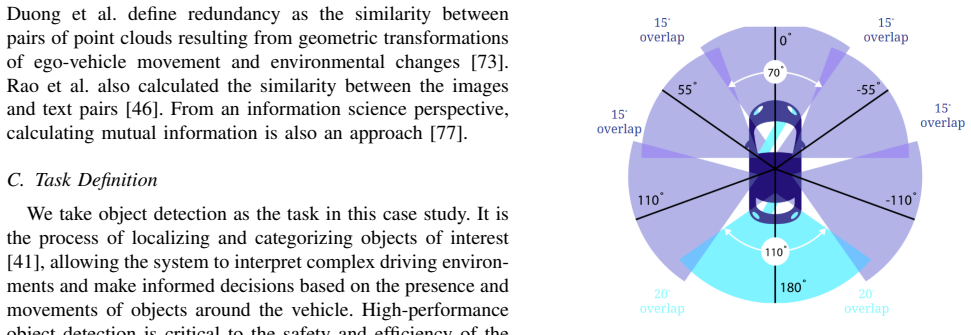
On its own terms, the paper's discovery is that data quality, measured per task, behaves like a first-class engineering quantity in autonomous driving pipelines. Concretely, the study claims that partially removing redundancy from multi-view camera images improves rather than degrades YOLOv8 object detection: for the six overlapping camera pairs in nuScenes, training on datasets with redundancy removed by a Bounding Box Completeness Score threshold reaches the same or higher mAP50 than training on the full data. For multimodal data, the paper claims that high cross-modal redundancy between image and LiDAR is concentrated at close range, with a reported T-test p-value of $1.17\times10^{-76}$, and that removing close-range LiDAR boxes through a distance threshold preserves detection outcomes while reducing processed points. Together these results are offered as evidence that a task-centric data quality framework can guide redundancy removal without sacrificing task performance.
Load-bearing premise
The load-bearing premise is that the mAP50 changes come from removing redundancy itself, since the pruning rules also delete lower-quality (clipped or close-range) boxes; if the gains are actually a label-quality effect, the redundancy conclusion weakens.
Editorial extensions
If this is right
- Per-task data pruning becomes a safe default: for object detection on overlapping camera views, removing redundant instances need not cost accuracy and can improve mAP50.
- Storage and compute budgets can shrink: smaller training sets and fewer LiDAR points to process yield efficiency gains while keeping detection performance stable.
- The BCS rule preserves the approximate distribution of instances across camera pairs, which suggests that redundancy removal can keep inter-sensor representation balanced.
- Close-range LiDAR returns are a redundancy hotspot in image-LiDAR fusion, and distance-based pruning targets exactly that hotspot.
- The framework's feedback loop gives a principled way to tune quality thresholds: relax redundancy tolerance if task metrics drop, tighten it when efficiency matters.
Reading between the lines
- My inference: the reported gains may be driven more by label quality than by redundancy, because the BCS rule preferentially removes boxes clipped at image boundaries; a comparison against random pruning or cleaning only clipped boxes would isolate the cause.
- The distance-based LiDAR pruning suggests a testable extension: replace the fixed $T_{dist}$ with a learned or per-scene threshold that adapts to object density, and check whether the redundancy hotspots move.
- Cross-modal redundancy concentrated near the ego vehicle implies that sensor-fusion weighting could be spatially adaptive, for example by downweighting close-range LiDAR where cameras already see well.
- The same BCS machinery could be applied to temporal redundancy across consecutive frames, where object persistence creates similar duplicate-information patterns.
Signed reviews
Editorial analysis
A structured set of objections, weighed in public.
Referee Report
Summary. The paper proposes a five-layer task-centric data quality (DQ) framework for autonomous driving, called the Vase Framework, whose layers are Data, Data Quality, Task, Application, and Goal. The framework is intended to map DQ dimensions and metrics to task requirements and performance objectives. As a case study, the authors examine redundancy in nuScenes-mini camera images: they identify overlapping fields of view among six cameras, define a Bounding Box Completeness Score (BCS), prune lower-BCS boxes in overlapping detections, and train YOLOv8 on the pruned datasets. They also analyze image-LiDAR redundancy, report that close-range boxes are more cross-modally redundant, and prune near-range LiDAR boxes. The central empirical claim is that partially removing redundancy from multisource image data can improve or maintain YOLOv8 detection performance, so that a less redundant training dataset can match or surpass the full dataset.
Significance. If the central claim were established, the paper would support task-centric data curation for AV perception: redundancy evaluation could guide pruning decisions that reduce training cost without sacrificing accuracy. The paper's strengths are its clear conceptual framework, the use of a public dataset, qualitative illustrations of overlapping fields of view, and an anonymized public code link. The framework and the open research questions are useful structuring contributions. However, the empirical evidence for the load-bearing causal claim is currently weak: the pruning rule conflates redundancy with annotation completeness, the experiments lack controlled baselines and statistical confidence, and the LiDAR pruning threshold is derived post hoc from the same data. These issues need to be addressed before the claimed empirical conclusion can be accepted.
major comments (3)
- [Section III-D-2(d), Eqs. (1)-(2), and Section III-D-4, Fig. 8] The BCS-based pruning rule conflates redundancy removal with label-quality filtering. Because BCS is the fraction of the full bounding box visible after clipping to image boundaries, the rule in Eq. (2) preferentially removes boxes truncated at image edges, i.e., lower-quality annotations, not necessarily redundant information. The observed mAP50 improvement in Fig. 8 could therefore be entirely a label-cleaning effect: the model is trained on fewer ambiguous clipped boxes. The Discussion in Section III-E concedes this when it describes the mechanism as "removing lower-quality duplicates." To support the claim that redundancy is the manipulated variable, the authors must compare against random pruning at matched removal rates and against a cleaning-only baseline that removes low-BCS boxes outside overlapping regions. Without these baselines, the abstract's claim that "partially removing redundancy ... could improve YOLOv8 object detection task performance" is not established.
- [Section III-D-1, Section III-D-4, and Fig. 8] The empirical support for the central claim is a single-run mAP50 experiment on nuScenes-mini (10 scenes, 404 frames, 1,401 images), with no error bars, no repeated seeds, and no explicit train/test split description. The pruning thresholds tau_BCS are swept from 0.0 to 1.0 and the mAP50 values are compared on the same dataset from which the thresholds were selected, introducing selection bias and making it impossible to know whether the reported gains are robust. The conclusion in Section III-D-4 that "a less redundant training dataset can achieve or even surpass the performance level of using the full training dataset" requires repeated trials, confidence intervals, and a held-out evaluation protocol. As reported, the conclusion is not statistically supported.
- [Section III-D-3, Eqs. (3)-(5), and Section III-D-4, Figs. 9-11] The LiDAR pruning rule is derived post hoc from the same data it is evaluated on. The t-test showing high cross-modal redundancy for close objects (p-value=1.17e-76) is used to justify removing all boxes within distance Tdist, but Tdist is selected on the basis of the observed statistics rather than an a priori hypothesis. Furthermore, the paper does not report a quantitative detection metric for the pruned LiDAR experiments: Fig. 11 appears to show removed boxes and a qualitative statement that detections are "unaffected," but no mAP, recall, or precision numbers are provided for the pruned setting. The redundancy ratio RR in Eq. (3) is computed as agreement between LiDAR-only detections and fusion detections, which is a detection-agreement measure rather than a direct data-redundancy measure and is not validated against ground truth. The claim that close-range LiDAR data is redundant and can be pruned without harming task performance is therefore not yet demonstrated.
minor comments (3)
- [Abstract and Section I] The abstract contains a grammatical issue: "The proposed framework aims to mapping DQ" should read "aims to map DQ." The paper also uses inconsistent spacing in "A Vs" throughout.
- [Section III-A and Section V] The paper says the full nuScenes dataset has 1,000 scenes but the case study uses nuScenes-mini with 10 scenes; the conclusion should explicitly state that the empirical results are a pilot study and should not be generalized, especially in the abstract and contribution list.
- [Section III-D-4, Fig. 8] The description of the threshold sweep says thresholds are set from 0.0 to 1.0 with a 0.2 interval, but it is not stated whether each threshold value is evaluated once or multiple times, nor how the different camera pairs' pruned datasets are combined for training. Clarifying the training and evaluation protocol and showing per-run variability would help.
Circularity Check
No significant circularity: the mAP50 results are independent empirical measurements, and the author self-citations are not load-bearing.
full rationale
The paper's central empirical claim is that a less redundant training dataset can match or surpass the full dataset for YOLOv8 object detection. That claim is supported by measured mAP50 values on nuScenes-mini, which are external outcomes of training runs, not algebraic consequences of the pruning equations. Equations (1)-(2) define the BCS pruning rule and Equations (3)-(6) define redundancy ratio, distance-based pruning, and lost ratio, but none of these equations force the reported mAP50 result; the performance numbers come from independent detector evaluation. The BCS threshold tau_BCS and the LiDAR distance threshold Tdist are swept or chosen post hoc on the same dataset, and the paper draws conclusions from those sweeps. This is a statistical validity concern (threshold fitting without held-out validation) rather than circularity, because the conclusion is an observed outcome, not a prediction forced by the construction. The paper's own Discussion concedes that BCS removes 'lower-quality duplicates,' which indicates a possible label-quality confound, but that is a correctness risk, not a circular derivation. The only author self-citations are to prior work for background claims (e.g., refs [9] and [30]) and are not load-bearing for the framework or the empirical results. Accordingly, no step reduces by construction to its own inputs, and the circularity score is low.
Assumptions & free parameters
free parameters (3)
- tau_BCS =
swept 0.0 to 1.0
- Tdist =
swept meters; chosen based on statistical results
- theta (IoU threshold for redundancy ratio) =
not specified in text
assumptions (4)
- domain assumption Overlapping fields of view between camera pairs identify redundant instances.
- ad hoc to paper Removing instances with lower BCS reduces redundancy without harming information content.
- ad hoc to paper LiDAR points close to the ego vehicle are redundant with camera data and can be pruned.
- domain assumption YOLOv8 performance on nuScenes-mini is representative of AV object detection behavior.
Cite this review
Pith. "Pith review of A Novel Multi-layer Task-centric and Data Quality Framework for Autonomous Driving." pith.science (2026). https://pith.science/paper/A4QMSIK6
@misc{pith2026250617346,
  author       = {Pith},
  title        = {Pith review of: A Novel Multi-layer Task-centric and Data Quality Framework for Autonomous Driving},
  year         = {2026},
  howpublished = {\url{https://pith.science/paper/A4QMSIK6}},
  note         = {Machine review of arXiv:2506.17346}
}
read the original abstract
The next-generation autonomous vehicles (AVs), embedded with frequent real-time decision-making, will rely heavily on a large volume of multisource and multimodal data. In real-world settings, the data quality (DQ) of different sources and modalities usually varies due to unexpected environmental factors or sensor issues. However, both researchers and practitioners in the AV field overwhelmingly concentrate on models/algorithms while undervaluing the DQ. To fulfill the needs of the next-generation AVs with guarantees of functionality, efficiency, and trustworthiness, this paper proposes a novel task-centric and data quality vase framework which consists of five layers: data layer, DQ layer, task layer, application layer, and goal layer. The proposed framework aims to map DQ with task requirements and performance goals. To illustrate, a case study investigating redundancy on the nuScenes dataset proves that partially removing redundancy on multisource image data could improve YOLOv8 object detection task performance. Analysis on multimodal data of image and LiDAR further presents existing redundancy DQ issues. This paper opens up a range of critical but unexplored challenges at the intersection of DQ, task orchestration, and performance-oriented system development in AVs. It is expected to guide the AV community toward building more adaptive, explainable, and resilient AVs that respond intelligently to dynamic environments and heterogeneous data streams. Code, data, and implementation details are publicly available at: https://anonymous.4open.science/r/dq4av-framework/README.md.
Figures


Figures from the paper (7 more)


Reference graph
Works this paper leans on
-
[1]
Explanations in autonomous driving: A survey,
D. Omeiza, H. Webb, M. Jirotka, and L. Kunze, “Explanations in autonomous driving: A survey,” IEEE Transactions on Intelligent Trans- portation Systems, vol. 23, no. 8, pp. 10 142–10 162, 2021
2021
-
[2]
Advances in autonomous vehicle testing: The state of the art and future outlook on driving datasets simulators and proving grounds,
A. Guo, J. Huang, C. Lv, L. Chen, F.-Y . Wang et al. , “Advances in autonomous vehicle testing: The state of the art and future outlook on driving datasets simulators and proving grounds,” Authorea Preprints, 2024
2024
-
[3]
Autonomous vehicles: A critical review (2004-2024) and a vision for the future,
H. Liu, Z. Cao, X. Yan, S. Feng, and Q. Lu, “Autonomous vehicles: A critical review (2004-2024) and a vision for the future,” TechRxiv techrxiv.174857767.78237989/v1, 2025
-
[5]
Collaborative perception in autonomous driving: Methods, datasets, and challenges,
Y . Han, H. Zhang, H. Li, Y . Jin, C. Lang, and Y . Li, “Collaborative perception in autonomous driving: Methods, datasets, and challenges,” IEEE Intelligent Transportation Systems Magazine , vol. 15, no. 6, pp. 131–151, 2023
2023
-
[6]
End-to-end autonomous driving: Challenges and frontiers,
L. Chen, P. Wu, K. Chitta, B. Jaeger, A. Geiger, and H. Li, “End-to-end autonomous driving: Challenges and frontiers,” IEEE Transactions on Pattern Analysis and Machine Intelligence , vol. 46, no. 12, pp. 10 164– 10 183, 2024
work page 2024
-
[7]
Aide: An automatic data engine for object detection in autonomous driving,
M. Liang, J.-C. Su, S. Schulter, S. Garg, S. Zhao, Y . Wu, and M. Chandraker, “Aide: An automatic data engine for object detection in autonomous driving,” in Proceedings of the IEEE/CVF Conference on Computer Vision and Pattern Recognition (CVPR) , June 2024, pp. 14 695–14 706
work page 2024
-
[8]
Open-sourced data ecosystem in autonomous driving: the present and future,
H. Li, Y . Li, H. Wang, J. Zeng, H. Xu, P. Cai, L. Chen, J. Yan, F. Xu, L. Xiong et al., “Open-sourced data ecosystem in autonomous driving: the present and future,” arXiv preprint arXiv:2312.03408 , 2023
arXiv 2023
-
[9]
Data evaluation and enhancement for quality improvement of machine learning,
H. Chen, J. Chen, and J. Ding, “Data evaluation and enhancement for quality improvement of machine learning,” IEEE Transactions on Reliability, vol. 70, no. 2, pp. 831–847, 2021
work page 2021
Show all 83 references
-
[10]
“everyone wants to do the model work, not the data work
N. Sambasivan, S. Kapania, H. Highfill, D. Akrong, P. Paritosh, and L. M. Aroyo, ““everyone wants to do the model work, not the data work”: Data cascades in high-stakes ai,” in proceedings of the 2021 CHI Conference on Human Factors in Computing Systems , 2021, pp. 1–15
2021
-
[11]
Garbage in, garbage out? do machine learning application papers in so- cial computing report where human-labeled training data comes from?
R. S. Geiger, K. Yu, Y . Yang, M. Dai, J. Qiu, R. Tang, and J. Huang, “Garbage in, garbage out? do machine learning application papers in so- cial computing report where human-labeled training data comes from?” in Proceedings of the 2020 Conference on Fairness, Accountability,...
2020
-
[12]
Data-centric evolution in autonomous driving: A comprehensive survey of big data system, data mining, and closed-loop technologies,
L. Li, W. Shao, W. Dong, Y . Tian, Q. Zhang, K. Yang, and W. Zhang, “Data-centric evolution in autonomous driving: A comprehensive survey of big data system, data mining, and closed-loop technologies,” arXiv preprint arXiv:2401.12888, 2024
2024 arXiv
-
[13]
Traffic context aware data augmentation for rare object detection in autonomous driving,
N. Li, F. Song, Y . Zhang, P. Liang, and E. Cheng, “Traffic context aware data augmentation for rare object detection in autonomous driving,” in 2022 international conference on robotics and automation (ICRA) . IEEE, 2022, pp. 4548–4554
2022
-
[14]
A systematic review of data quality in cps and iot for industry 4.0,
A. Goknil, P. Nguyen, S. Sen, D. Politaki, H. Niavis, K. J. Pedersen, A. Suyuthi, A. Anand, and A. Ziegenbein, “A systematic review of data quality in cps and iot for industry 4.0,”ACM Computing Surveys, vol. 55, no. 14s, pp. 1–38, 2023
2023
-
[15]
An analysis of data quality requirements for machine learning development pipelines frameworks,
S. Rangineni, “An analysis of data quality requirements for machine learning development pipelines frameworks,” International Journal of Computer Trends and Technology, vol. 71, no. 9, pp. 16–27, 2023
2023
-
[16]
A survey of data quality requirements that matter in ml development pipelines,
M. Priestley, F. O’donnell, and E. Simperl, “A survey of data quality requirements that matter in ml development pipelines,” J. Data and Information Quality, vol. 15, no. 2, Jun. 2023
2023
-
[17]
The metric-framework for assessing data quality for trustworthy ai in medicine: a systematic review,
D. Schwabe, K. Becker, M. Seyferth, A. Klaß, and T. Schaeffter, “The metric-framework for assessing data quality for trustworthy ai in medicine: a systematic review,” NPJ Digital Medicine , vol. 7, no. 1, p. 203, 2024
2024
-
[18]
Enhancing machine learning performance through intelligent data quality assessment: An unsupervised data-centric framework,
M. Rahal, B. S. Ahmed, G. Szabados, T. Fornstedt, and J. Samuels- son, “Enhancing machine learning performance through intelligent data quality assessment: An unsupervised data-centric framework,” Heliyon, 2025
2025
-
[19]
A survey on autonomous driving datasets: 11 Statistics, annotation quality, and a future outlook,
M. Liu, E. Yurtsever, J. Fossaert, X. Zhou, W. Zimmer, Y . Cui, B. L. Zagar, and A. C. Knoll, “A survey on autonomous driving datasets: 11 Statistics, annotation quality, and a future outlook,” IEEE Transactions on Intelligent Vehicles, 2024
2024
-
[20]
Scalability in perception for autonomous driving: Waymo open dataset,
P. Sun, H. Kretzschmar, X. Dotiwalla, A. Chouard, V . Patnaik, P. Tsui, J. Guo, Y . Zhou, Y . Chai, B. Caine et al. , “Scalability in perception for autonomous driving: Waymo open dataset,” in Proceedings of the IEEE/CVF conference on computer vision and pattern recognition, 2...
2020
-
[21]
nuscenes: A multimodal dataset for autonomous driving,
H. Caesar, V . Bankiti, A. H. Lang, S. V ora, V . E. Liong, Q. Xu, A. Krishnan, Y . Pan, G. Baldan, and O. Beijbom, “nuscenes: A multimodal dataset for autonomous driving,” in Proceedings of the IEEE/CVF conference on computer vision and pattern recognition, 2020, pp. 11 621–11 631
2020
-
[22]
Vision meets robotics: The kitti dataset,
A. Geiger, P. Lenz, C. Stiller, and R. Urtasun, “Vision meets robotics: The kitti dataset,” The international journal of robotics research, vol. 32, no. 11, pp. 1231–1237, 2013
2013
-
[23]
Zenseact open dataset: A large-scale and diverse multimodal dataset for autonomous driving,
M. Alibeigi, W. Ljungbergh, A. Tonderski, G. Hess, A. Lilja, C. Lind- str¨om, D. Motorniuk, J. Fu, J. Widahl, and C. Petersson, “Zenseact open dataset: A large-scale and diverse multimodal dataset for autonomous driving,” in Proceedings of the IEEE/CVF International Conference...
2023
-
[24]
Surfelgan: Synthesizing realistic sensor data for autonomous driving,
Z. Yang, Y . Chai, D. Anguelov, Y . Zhou, P. Sun, D. Erhan, S. Rafferty, and H. Kretzschmar, “Surfelgan: Synthesizing realistic sensor data for autonomous driving,” in Proceedings of the IEEE/CVF Conference on Computer Vision and Pattern Recognition , 2020, pp. 11 118–11 127
2020
-
[25]
Driving with llms: Fusing object- level vector modality for explainable autonomous driving,
L. Chen, O. Sinavski, J. H ¨unermann, A. Karnsund, A. J. Willmott, D. Birch, D. Maund, and J. Shotton, “Driving with llms: Fusing object- level vector modality for explainable autonomous driving,” in2024 IEEE International Conference on Robotics and Automation (ICRA) . IEEE, 2...
2024
-
[26]
Drivegpt4: Interpretable end-to-end autonomous driving via large language model,
Z. Xu, Y . Zhang, E. Xie, Z. Zhao, Y . Guo, K.-Y . K. Wong, Z. Li, and H. Zhao, “Drivegpt4: Interpretable end-to-end autonomous driving via large language model,” IEEE Robotics and Automation Letters , 2024
2024
-
[27]
A comprehensive review of yolo architectures in computer vision: From yolov1 to yolov8 and yolo-nas,
J. Terven, D.-M. C ´ordova-Esparza, and J.-A. Romero-Gonz ´alez, “A comprehensive review of yolo architectures in computer vision: From yolov1 to yolov8 and yolo-nas,” Machine learning and knowledge extraction, vol. 5, no. 4, pp. 1680–1716, 2023
2023
-
[28]
Automatic pruning and quality as- surance of object detection datasets for autonomous driving,
K. Kim, V . Kakani, and H. Kim, “Automatic pruning and quality as- surance of object detection datasets for autonomous driving,” Preprints, 2025
2025
-
[29]
Research on the architecture of internet of things,
M. Wu, T.-J. Lu, F.-Y . Ling, J. Sun, and H.-Y . Du, “Research on the architecture of internet of things,” in 2010 3rd international conference on advanced computer theory and engineering (ICACTE), vol. 5. IEEE, 2010, pp. V5–484
2010
-
[30]
End-to-end multi-view fusion for 3d object detection in lidar point clouds,
Y . Zhou, P. Sun, Y . Zhang, D. Anguelov, J. Gao, T. Ouyang, J. Guo, J. Ngiam, and V . Vasudevan, “End-to-end multi-view fusion for 3d object detection in lidar point clouds,” in Conference on Robot Learning. PMLR, 2020, pp. 923–932
2020
-
[31]
Sensor data validation and driving safety in autonomous driving systems,
J. Zhang, “Sensor data validation and driving safety in autonomous driving systems,” arXiv preprint arXiv:2203.16130 , 2022
2022 arXiv
-
[32]
Apollocar3d: A large 3d car instance understanding benchmark for autonomous driving,
X. Song, P. Wang, D. Zhou, R. Zhu, C. Guan, Y . Dai, H. Su, H. Li, and R. Yang, “Apollocar3d: A large 3d car instance understanding benchmark for autonomous driving,” in Proceedings of the IEEE/CVF Conference on Computer Vision and Pattern Recognition , 2019, pp. 5452–5462
2019
-
[33]
Eliminating cross-modal conflicts in bev space for lidar-camera 3d object detection,
J. Fu, C. Gao, Z. Wang, L. Yang, X. Wang, B. Mu, and S. Liu, “Eliminating cross-modal conflicts in bev space for lidar-camera 3d object detection,” in 2024 IEEE International Conference on Robotics and Automation (ICRA) . IEEE, 2024, pp. 16 381–16 387
2024
-
[34]
Deep multimodal data fusion,
F. Zhao, C. Zhang, and B. Geng, “Deep multimodal data fusion,” ACM computing surveys, vol. 56, no. 9, pp. 1–36, 2024
2024
-
[35]
Deepin- teraction++: Multi-modality interaction for autonomous driving,
Z. Yang, N. Song, W. Li, X. Zhu, L. Zhang, and P. H. Torr, “Deepin- teraction++: Multi-modality interaction for autonomous driving,” arXiv preprint arXiv:2408.05075, 2024
2024 arXiv
-
[36]
Night time vehicle detection and tracking by fusing vehicle parts from multiple cameras,
X. Zhang, B. Story, and D. Rajan, “Night time vehicle detection and tracking by fusing vehicle parts from multiple cameras,” IEEE Transactions on Intelligent Transportation Systems , vol. 23, no. 7, pp. 8136–8156, 2022
2022
-
[37]
Cola: Coarse-label multi- source lidar semantic segmentation for autonomous driving,
J. Sanchez, J.-E. Deschaud, and F. Goulette, “Cola: Coarse-label multi- source lidar semantic segmentation for autonomous driving,” IEEE Transactions on Robotics , 2025
2025
-
[38]
Object detection in adverse weather for autonomous vehicles based on sensor fusion and incremental learning,
H. Su, H. Gao, X. Wang, X. Fang, Q. Liu, G. Huang, X. Li, and Q. Cao, “Object detection in adverse weather for autonomous vehicles based on sensor fusion and incremental learning,” IEEE Transactions on Instrumentation and Measurement , 2024
2024
-
[39]
Fault diagnosis of the autonomous driving perception system based on information fusion,
W. Hou, W. Li, and P. Li, “Fault diagnosis of the autonomous driving perception system based on information fusion,” Sensors, vol. 23, no. 11, p. 5110, 2023
2023
-
[40]
Performance and challenges of 3d object detection methods in complex scenes for autonomous driving,
K. Wang, T. Zhou, X. Li, and F. Ren, “Performance and challenges of 3d object detection methods in complex scenes for autonomous driving,” IEEE Transactions on Intelligent Vehicles, vol. 8, no. 2, pp. 1699–1716, 2023
2023
-
[41]
Multi-modal 3d object detection in autonomous driving: a survey,
Y . Wang, Q. Mao, H. Zhu, J. Deng, Y . Zhang, J. Ji, H. Li, and Y . Zhang, “Multi-modal 3d object detection in autonomous driving: a survey,” International Journal of Computer Vision , vol. 131, no. 8, pp. 2122– 2152, 2023
2023
-
[42]
A survey on deep learning approaches for data integration in autonomous driving system,
X. Zhu, L. Wang, C. Zhou, X. Cao, Y . Gong, and L. Chen, “A survey on deep learning approaches for data integration in autonomous driving system,” arXiv preprint arXiv:2306.11740 , 2023
2023 arXiv
-
[43]
Multimodal fusion on low-quality data: A comprehensive survey,
Q. Zhang, Y . Wei, Z. Han, H. Fu, X. Peng, C. Deng, Q. Hu, C. Xu, J. Wen, D. Hu et al. , “Multimodal fusion on low-quality data: A comprehensive survey,” arXiv preprint arXiv:2404.18947 , 2024
2024 arXiv
-
[44]
A survey on missing data in machine learning,
T. Emmanuel, T. Maupong, D. Mpoeleng, T. Semong, B. Mphago, and O. Tabona, “A survey on missing data in machine learning,” Journal of Big data, vol. 8, pp. 1–37, 2021
2021
-
[45]
Light the night: A multi-condition diffusion framework for unpaired low-light enhancement in autonomous driving,
J. Li, B. Li, Z. Tu, X. Liu, Q. Guo, F. Juefei-Xu, R. Xu, and H. Yu, “Light the night: A multi-condition diffusion framework for unpaired low-light enhancement in autonomous driving,” in Proceedings of the IEEE/CVF Conference on Computer Vision and Pattern Recognition , 2024, ...
2024
-
[46]
Quality and relevance metrics for selection of multimodal pretraining data,
R. Rao, S. Rao, E. Nouri, D. Dey, A. Celikyilmaz, and B. Dolan, “Quality and relevance metrics for selection of multimodal pretraining data,” in Proceedings of the IEEE/CVF Conference on Computer Vision and Pattern Recognition Workshops, 2020, pp. 956–957
2020
-
[47]
Identifying and managing data quality requirements: a design science study in the field of auto- mated driving,
S. K. Pradhan, H.-M. Heyn, and E. Knauss, “Identifying and managing data quality requirements: a design science study in the field of auto- mated driving,” Software Quality Journal , vol. 32, no. 2, pp. 313–360, 2024
2024
-
[48]
Multi-modal data-efficient 3d scene understanding for au- tonomous driving,
L. Kong, X. Xu, J. Ren, W. Zhang, L. Pan, K. Chen, W. T. Ooi, and Z. Liu, “Multi-modal data-efficient 3d scene understanding for au- tonomous driving,” IEEE Transactions on Pattern Analysis and Machine Intelligence, 2025
2025
-
[49]
Temporal consistency checks to detect lidar spoofing attacks on autonomous vehicle perception,
C. You, Z. Hau, and S. Demetriou, “Temporal consistency checks to detect lidar spoofing attacks on autonomous vehicle perception,” in Proceedings of the 1st Workshop on Security and Privacy for Mobile AI, 2021, pp. 13–18
2021
-
[50]
Temporal consistent 3d lidar representation learning for semantic perception in autonomous driving,
L. Nunes, L. Wiesmann, R. Marcuzzi, X. Chen, J. Behley, and C. Stach- niss, “Temporal consistent 3d lidar representation learning for semantic perception in autonomous driving,” in Proceedings of the IEEE/CVF Conference on Computer Vision and Pattern Recognition (CVPR) , June ...
2023
-
[51]
Impact of raindrops on camera-based detection in software-defined vehicles,
Y . Luo, D. Xu, G. Zhou, Y . Sun, and S. Lu, “Impact of raindrops on camera-based detection in software-defined vehicles,” in 2024 IEEE International Conference on Mobility, Operations, Services and Tech- nologies (MOST). IEEE, 2024, pp. 193–205
2024
-
[52]
A review of the impact of rain on camera-based perception in automated driving systems,
T. Brophy, D. Mullins, A. Parsi, J. Horgan, E. Ward, P. Denny, C. Eising, B. Deegan, M. Glavin, and E. Jones, “A review of the impact of rain on camera-based perception in automated driving systems,” IEEE Access , vol. 11, pp. 67 040–67 057, 2023
2023
-
[53]
Survey: Exploiting data redundancy for optimization of deep learning,
J.-A. Chen, W. Niu, B. Ren, Y . Wang, and X. Shen, “Survey: Exploiting data redundancy for optimization of deep learning,” ACM Computing Surveys, vol. 55, no. 10, pp. 1–38, 2023
2023
-
[54]
Reducing redundancy in maps without lowering accuracy: A geometric feature fusion approach for simultaneous localization and mapping,
F. Li, C. Fu, D. Sun, H. Marzbani, and M. Hu, “Reducing redundancy in maps without lowering accuracy: A geometric feature fusion approach for simultaneous localization and mapping,”ISPRS International Journal of Geo-Information, vol. 12, no. 6, p. 235, 2023
2023
-
[55]
Temporal-channel transformer for 3d lidar-based video object detection for autonomous driving,
Z. Yuan, X. Song, L. Bai, Z. Wang, and W. Ouyang, “Temporal-channel transformer for 3d lidar-based video object detection for autonomous driving,” IEEE Transactions on Circuits and Systems for Video Technol- ogy, vol. 32, no. 4, pp. 2068–2078, 2021
2021
-
[56]
Image-guided outdoor lidar perception quality assessment for autonomous driving,
C. Zhang and A. Eskandarian, “Image-guided outdoor lidar perception quality assessment for autonomous driving,” IEEE Transactions on Intelligent Vehicles, 2024
2024
-
[57]
Age of information, latency, and reliability in intelligent vehicular networks,
C. Guo, X. Wang, L. Liang, and G. Y . Li, “Age of information, latency, and reliability in intelligent vehicular networks,” IEEE Network, vol. 37, no. 6, pp. 109–116, 2023
2023
-
[58]
Timeliness in autonomous driving: Hype or reality?
T. Wu and W. Shi, “Timeliness in autonomous driving: Hype or reality?” IEEE Internet Computing , vol. 28, no. 5, pp. 75–84, 2024. 12
2024
-
[59]
An advanced lidar point cloud sequence coding scheme for autonomous driving,
X. Sun, S. Wang, M. Wang, S. S. Cheng, and M. Liu, “An advanced lidar point cloud sequence coding scheme for autonomous driving,” in Proceedings of the 28th ACM International Conference on Multimedia , 2020, pp. 2793–2801
2020
-
[60]
Multi-target detection based on multi-sensor redundancy and dynamic weight distribution for driverless cars,
Q. Liu, W. Zhou, Y . Zhang, and X. Fei, “Multi-target detection based on multi-sensor redundancy and dynamic weight distribution for driverless cars,” in 2021 International Conference on Communications, Informa- tion System and Computer Engineering (CISCE) , 2021, pp. 229–234
2021
-
[61]
3d object detection for autonomous driving: A survey,
R. Qian, X. Lai, and X. Li, “3d object detection for autonomous driving: A survey,” Pattern Recognition, vol. 130, p. 108796, 2022
2022
-
[62]
Ada3d : Exploiting the spatial redundancy with adaptive inference for efficient 3d object detection,
T. Zhao, X. Ning, K. Hong, Z. Qiu, P. Lu, Y . Zhao, L. Zhang, L. Zhou, G. Dai, H. Yang, and Y . Wang, “Ada3d : Exploiting the spatial redundancy with adaptive inference for efficient 3d object detection,” in Proceedings of the IEEE/CVF International Conference on Computer Visi...
2023
-
[63]
A task- driven scene-aware lidar point cloud coding framework for autonomous vehicles,
X. Sun, M. Wang, J. Du, Y . Sun, S. S. Cheng, and W. Xie, “A task- driven scene-aware lidar point cloud coding framework for autonomous vehicles,” IEEE Transactions on Industrial Informatics , vol. 19, no. 8, pp. 8731–8742, 2023
2023
-
[64]
Dm3d: Distortion-minimized weight pruning for lossless 3d object detection,
K. Xu, Q. Feng, H. Chen, Z. Wang, X. Geng, X. Yang, M. Wu, X. Li, and W. Lin, “Dm3d: Distortion-minimized weight pruning for lossless 3d object detection,” arXiv preprint arXiv:2407.02098 , 2024
2024 arXiv
-
[65]
Beyond accuracy: What data quality means to data consumers,
R. Y . Wang and D. M. Strong, “Beyond accuracy: What data quality means to data consumers,” Journal of management information systems, vol. 12, no. 4, pp. 5–33, 1996
1996
-
[66]
Planning-oriented autonomous driving,
Y . Hu, J. Yang, L. Chen, K. Li, C. Sima, X. Zhu, S. Chai, S. Du, T. Lin, W. Wanget al., “Planning-oriented autonomous driving,” in Proceedings of the IEEE/CVF conference on computer vision and pattern recognition, 2023, pp. 17 853–17 862
2023
-
[67]
Genad: Generative end-to- end autonomous driving,
W. Zheng, R. Song, X. Guo, and L. Chen, “Genad: Generative end-to- end autonomous driving,” arXiv preprint arXiv:2402.11502 , 2024
2024 arXiv
-
[68]
Bench2drive: Towards multi-ability benchmarking of closed-loop end-to-end autonomous driv- ing,
X. Jia, Z. Yang, Q. Li, Z. Zhang, and J. Yan, “Bench2drive: Towards multi-ability benchmarking of closed-loop end-to-end autonomous driv- ing,” arXiv preprint arXiv:2406.03877 , 2024
2024 arXiv
-
[69]
The impacts of connected autonomous vehicles on mixed traffic flow: A comprehensive review,
Y . Pan, Y . Wu, L. Xu, C. Xia, and D. L. Olson, “The impacts of connected autonomous vehicles on mixed traffic flow: A comprehensive review,”Physica A: Statistical Mechanics and its Applications , vol. 635, p. 129454, 2024
2024
-
[70]
Pylot: A modular platform for exploring latency-accuracy tradeoffs in autonomous vehicles,
I. Gog, S. Kalra, P. Schafhalter, M. A. Wright, J. E. Gonzalez, and I. Stoica, “Pylot: A modular platform for exploring latency-accuracy tradeoffs in autonomous vehicles,” in 2021 IEEE International Confer- ence on Robotics and Automation (ICRA) , 2021, pp. 8806–8813
2021
-
[71]
Low-latency edge video analytics for on-road perception of autonomous ground vehicles,
J. Lin, P. Yang, N. Zhang, F. Lyu, X. Chen, and L. Yu, “Low-latency edge video analytics for on-road perception of autonomous ground vehicles,” IEEE Transactions on Industrial Informatics , vol. 19, no. 2, pp. 1512– 1523, 2023
2023
-
[72]
Exploring inherent sensor redundancy for automotive anomaly detection,
T. He, L. Zhang, F. Kong, and A. Salekin, “Exploring inherent sensor redundancy for automotive anomaly detection,” in 2020 57th ACM/IEEE Design Automation Conference (DAC) , 2020, pp. 1–6
2020
-
[73]
Active learning with data augmentation under small vs large dataset regimes for semantic-kitti dataset,
N. P. A. Duong, A. Almin, L. Lemari ´e, and B. R. Kiran, “Active learning with data augmentation under small vs large dataset regimes for semantic-kitti dataset,” in International Joint Conference on Computer Vision, Imaging and Computer Graphics. Springer, 2022, pp. 268–280
2022
-
[74]
Extending contrastive learning to unsu- pervised redundancy identification,
J. Ju, H. Jung, and J. Kim, “Extending contrastive learning to unsu- pervised redundancy identification,” Applied Sciences, vol. 12, no. 4, p. 2201, 2022
2022
-
[75]
Crossprune: Cooperative pruning for camera–lidar fused perception models of autonomous driving,
Y . Lu, B. Jiang, N. Liu, Y . Li, J. Chen, Y . Zhang, and Z. Wan, “Crossprune: Cooperative pruning for camera–lidar fused perception models of autonomous driving,” Knowledge-Based Systems , vol. 289, p. 111522, 2024
2024
-
[76]
Quality assessment of image dataset for autonomous driving,
X. Li, Y . Zhang, Y . Shi, H. Zhu, J. Hu, and L. Peng, “Quality assessment of image dataset for autonomous driving,” in 2023 IEEE International Conference on Imaging Systems and Techniques (IST) . IEEE, 2023, pp. 1–6
2023
-
[77]
Mutual information analysis in multimodal learning systems,
H. Hadizadeh, S. F. Yeganli, B. Rashidi, and I. V . Baji ´c, “Mutual information analysis in multimodal learning systems,” in 2024 IEEE 7th International Conference on Multimedia Information Processing and Retrieval (MIPR). IEEE, 2024, pp. 390–395
2024
-
[78]
V oxelnet: End-to-end learning for point cloud based 3d object detection,
Y . Zhou and O. Tuzel, “V oxelnet: End-to-end learning for point cloud based 3d object detection,” in Proceedings of the IEEE conference on computer vision and pattern recognition , 2018, pp. 4490–4499
2018
-
[79]
Pointnet: Deep learning on point sets for 3d classification and segmentation,
C. R. Qi, H. Su, K. Mo, and L. J. Guibas, “Pointnet: Deep learning on point sets for 3d classification and segmentation,” in Proceedings of the IEEE conference on computer vision and pattern recognition , 2017, pp. 652–660
2017
-
[80]
Exploring plain vision transformer backbones for object detection,
Y . Li, H. Mao, R. Girshick, and K. He, “Exploring plain vision transformer backbones for object detection,” in European conference on computer vision . Springer, 2022, pp. 280–296
2022
-
[81]
Bevfusion: Multi-task multi-sensor fusion with unified bird’s-eye view representation,
Z. Liu, H. Tang, A. Amini, X. Yang, H. Mao, D. L. Rus, and S. Han, “Bevfusion: Multi-task multi-sensor fusion with unified bird’s-eye view representation,” in 2023 IEEE international conference on robotics and automation (ICRA). IEEE, 2023, pp. 2774–2781
2023
-
[82]
Nuscenes dataset in kitti format,
A. Song, “Nuscenes dataset in kitti format,” Jan
-
[83]
Timkie/yolo-lidar-fusion: Lidar-camera fusion for 3d object detection in autonomous driving systems,
T. Kieffer, “Timkie/yolo-lidar-fusion: Lidar-camera fusion for 3d object detection in autonomous driving systems,” Aug 2024. [Online]. Available: https://github.com/TimKie/YOLO-LiDAR-Fusion 13
2024
-
[2025]
Available: https://www.kaggle.com/datasets/alohasong/ nuscenes-dataset-in-kitti-format
[Online]. Available: https://www.kaggle.com/datasets/alohasong/ nuscenes-dataset-in-kitti-format
Reviewed August 15, 2026 · model on record in the stance chip above.
Discussion (0). Continue with ORCID to comment.