Theoretical Detailed Analyses for DC readout and a Fabri-P\'erot gravitational-wave detector
Pith reviewed 2026-05-18 22:12 UTC · model grok-4.3
The pith
In DC readout for a Fabry-Pérot gravitational-wave detector, shot noise does not fall with rising laser power because classical radiation pressure from the carrier leaks to the output port.
A machine-rendered reading of the paper's core claim, the machinery that carries it, and where it could break.
Core claim
Using the Heisenberg equations of motion for the mirrors together with the quantum electrodynamics of the laser fields, the stationary noise spectral density is obtained. In the derived spectrum the high-frequency shot-noise term remains independent of injected laser power. This independence arises because classical radiation-pressure forces generated by the carrier field leak through to the output port; since the carrier is used as the local reference in the DC scheme, these forces appear as a constant offset that displaces the mirrors from the exact equilibrium point required for ideal cancellation.
What carries the argument
Leakage of classical radiation-pressure forces from the carrier field to the output port, which shifts the pendulum equilibrium and prevents the expected power-dependent reduction of shot noise in the DC readout scheme.
If this is right
- Tuning the interferometer so that the mirrors sit exactly at their radiation-pressure-shifted equilibrium positions restores the ideal reduction of shot noise with laser power.
- Any residual offset from equilibrium produces a shot-noise floor that no longer improves with higher power.
- The maximum mirror displacement from equilibrium that still allows near-ideal performance can be calculated from the incomplete-tuning analysis.
Where Pith is reading between the lines
- Current gravitational-wave detectors that rely on DC readout may need auxiliary control loops to keep the mirrors at the radiation-pressure-adjusted equilibrium if they are to reach the theoretical shot-noise limit.
- The same leakage effect could appear in any interferometer that uses a strong carrier as both reference and signal carrier.
Load-bearing premise
The initial conditions of the mirrors' motion remain concentrated around the pendulum's fundamental frequency and do not contribute to the frequency band of interest.
What would settle it
Measure the high-frequency shot-noise contribution in an actual DC-readout Fabry-Pérot interferometer while deliberately detuning the operating point away from the equilibrium position; if the noise level stays constant with increasing laser power, the leakage mechanism is confirmed.
Figures


read the original abstract
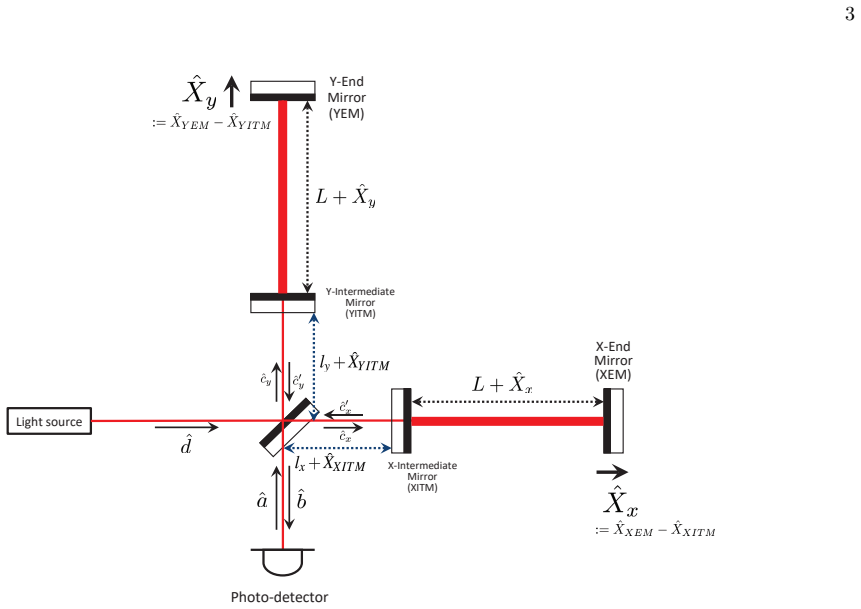
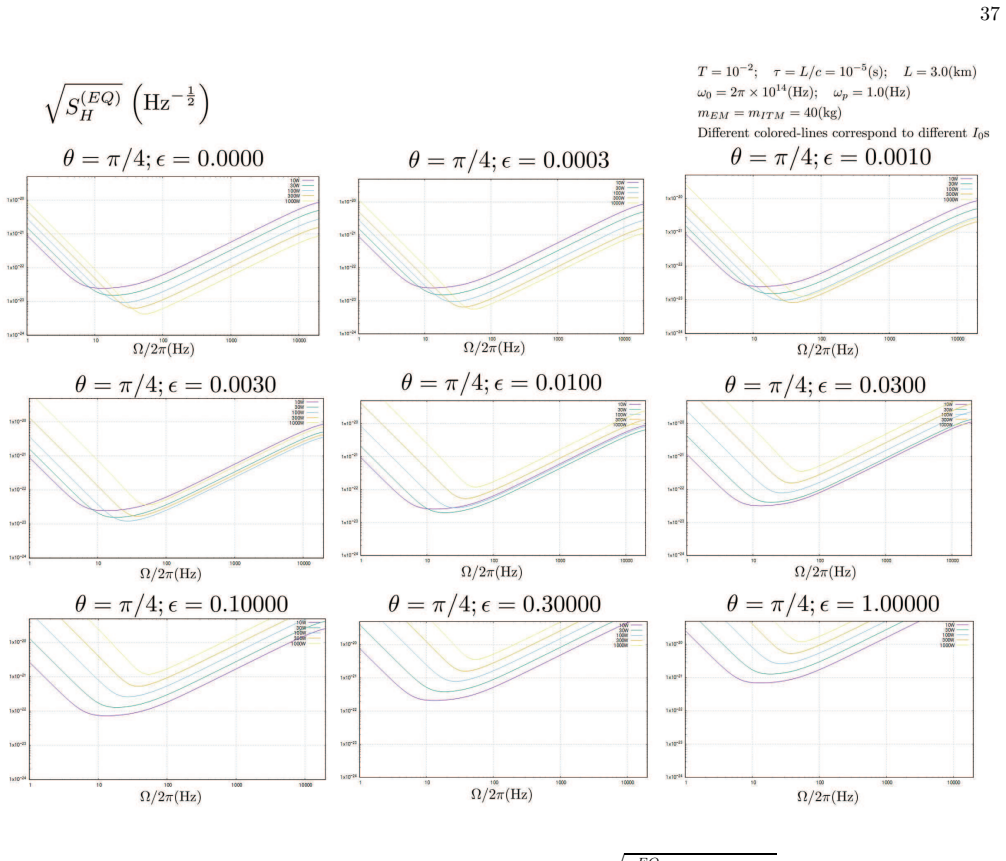
The quantum expectation value and the stationary noise spectral density for a Fabry-P'erot gravitational-wave detector with a DC readout scheme are discussed in detail only through the quantum electrodynamics of lasers and the Heisenberg equations of mirrors' motion. We demonstrate that the initial conditions of the mirrors' motion concentrate around the fundamental frequency of the pendulum and are not related to the frequency range of our interest. Although, in the ideal case, there is consensus that the shot-noise contribution from the laser to the high-frequency range of the signal-referred noise spectral density decreases as the injected laser power increases, our derived noise spectral density shows that the shot-noise contribution does not decrease. This is due to leakage of classical radiation pressure forces from the carrier field to the output port, and the carrier field is used as the reference in the DC readout scheme. Since classical radiation pressure acts as a constant force, it shifts the pendulum's equilibrium point of the mirrors' motion. To recover the ideal case, we must consider adjusting the interferometer's tuning point to place the mirrors at their equilibrium positions. We investigate the case where the equilibrium tuning is incomplete and show that the behavior of the above shot noise is due to this incompleteness. We also discuss the maximum deviation of the mirror displacements from the equilibrium point during incomplete tuning to recover a near-ideal case.
Editorial analysis
A structured set of objections, weighed in public.
Referee Report
Summary. The manuscript derives the quantum expectation value and stationary noise spectral density for a Fabry-Pérot gravitational-wave detector with DC readout using quantum electrodynamics and the Heisenberg equations of mirror motion. It shows that mirror initial conditions concentrate around the pendulum frequency and are unrelated to the GW band of interest. The central claim is that, contrary to the ideal-case consensus, the shot-noise contribution to the high-frequency signal-referred noise spectral density does not decrease with increasing laser power; this is attributed to leakage of classical radiation pressure forces from the carrier field to the output port when equilibrium tuning is incomplete. The paper discusses recovery of near-ideal behavior by adjusting the tuning point and quantifies maximum mirror deviations under incomplete tuning.
Significance. If the result is correct, it would indicate that incomplete tuning in DC readout schemes can eliminate the expected 1/sqrt(P) improvement in shot noise, with direct implications for noise budgeting and tuning tolerances in current and future gravitational-wave detectors. The first-principles QED-plus-Heisenberg approach and the explicit treatment of incomplete-tuning deviations are strengths that could make the work useful for detector modeling if the frequency-domain mechanism is clarified.
major comments (2)
- [section presenting the derived noise spectral density] The manuscript asserts that the derived noise spectral density shows shot noise failing to decrease with power due to carrier leakage, yet the explicit NSD expression and the algebraic steps converting the constant classical force into a high-frequency contribution are not isolated. A static force F_class ~ P produces only a static displacement x_0 = F_class/k_pendulum and a δ(f) term; it is unclear how this modifies the shot-noise scaling at frequencies ≫ pendulum resonance without altering the GW signal transfer function or the effective carrier amplitude at the dark port.
- [section on initial conditions of mirrors' motion] The claim that initial conditions concentrate around the pendulum frequency and are independent of the GW frequency range is stated as a result of the Heisenberg equations, but the explicit solution, boundary conditions, or frequency-domain filtering that demonstrates this independence is not shown. This assumption is load-bearing for separating the classical leakage effect from the quantum fluctuation spectrum of interest.
minor comments (2)
- [Title] Title: 'Fabri-Pérrot' is misspelled; the standard term is 'Fabry-Pérot'.
- [Abstract] The abstract refers to 'our derived noise spectral density' without an equation number; adding a reference to the relevant equation would improve traceability.
Simulated Author's Rebuttal
We thank the referee for the careful and constructive review of our manuscript. The comments identify points where additional explicit derivations and clarifications would strengthen the presentation. We respond to each major comment below and will incorporate the requested details in a revised version.
read point-by-point responses
-
Referee: [section presenting the derived noise spectral density] The manuscript asserts that the derived noise spectral density shows shot noise failing to decrease with power due to carrier leakage, yet the explicit NSD expression and the algebraic steps converting the constant classical force into a high-frequency contribution are not isolated. A static force F_class ~ P produces only a static displacement x_0 = F_class/k_pendulum and a δ(f) term; it is unclear how this modifies the shot-noise scaling at frequencies ≫ pendulum resonance without altering the GW signal transfer function or the effective carrier amplitude at the dark port.
Authors: We agree that the explicit NSD expression and the algebraic steps linking the classical force to the high-frequency noise were not isolated with sufficient clarity. The radiation-pressure force shifts the mirror equilibrium; when the interferometer is not retuned to this new position, a residual carrier leaks to the output port. This leakage alters the local oscillator amplitude at the dark port in a power-dependent manner, producing an additive noise term whose scaling cancels the usual 1/sqrt(P) improvement in shot noise at GW frequencies. The static displacement itself contributes only a DC term, but the resulting detuning modifies the readout quadrature without changing the GW signal transfer function. In the revised manuscript we will add a dedicated subsection that isolates the full NSD expression, shows the algebraic conversion from the constant force to the high-frequency contribution, and explicitly demonstrates the frequency-domain mechanism through the altered carrier amplitude. revision: yes
-
Referee: [section on initial conditions of mirrors' motion] The claim that initial conditions concentrate around the pendulum frequency and are independent of the GW frequency range is stated as a result of the Heisenberg equations, but the explicit solution, boundary conditions, or frequency-domain filtering that demonstrates this independence is not shown. This assumption is load-bearing for separating the classical leakage effect from the quantum fluctuation spectrum of interest.
Authors: The referee correctly notes that the explicit solution of the Heisenberg equations and the demonstration of frequency independence were not displayed. Solving the mirror equations with initial conditions corresponding to the ground (or thermal) state at t = 0 yields a displacement spectrum whose power is concentrated near the pendulum resonance; the mechanical susceptibility suppresses contributions at frequencies well above resonance. Consequently, the initial-condition transients do not affect the GW band. In the revision we will insert the explicit time-domain solution, state the boundary conditions, and show the frequency-domain filtering that isolates the quantum noise spectrum from the classical leakage term. revision: yes
Circularity Check
Derivation from QED and Heisenberg equations is self-contained with no circular reduction
full rationale
The paper explicitly starts from quantum electrodynamics of lasers combined with the Heisenberg equations for mirror motion to obtain both the quantum expectation value and the stationary noise spectral density. The statement that initial conditions concentrate around the pendulum frequency is derived as a direct consequence of those equations and is not introduced as a fitted parameter or ansatz tuned to the target high-frequency spectrum. The subsequent analysis of shot-noise behavior under incomplete equilibrium tuning follows from the same first-principles model without any self-definitional loop, fitted-input renaming, or load-bearing self-citation. No step reduces the claimed NSD result to an input by construction; the derivation therefore remains independent of the final noise expressions.
Axiom & Free-Parameter Ledger
axioms (1)
- domain assumption Initial conditions of the mirrors' motion concentrate around the fundamental frequency of the pendulum and are not related to the frequency range of interest
Lean theorems connected to this paper
-
IndisputableMonolith/Cost/FunctionalEquation.leanwashburn_uniqueness_aczel unclear?
unclearRelation between the paper passage and the cited Recognition theorem.
our derived noise spectral density shows that the shot-noise contribution does not decrease. This is due to leakage of classical radiation pressure forces from the carrier field to the output port
-
IndisputableMonolith/Foundation/RealityFromDistinction.leanreality_from_one_distinction unclear?
unclearRelation between the paper passage and the cited Recognition theorem.
Heisenberg equations of motion for a forced harmonic oscillator
What do these tags mean?
- matches
- The paper's claim is directly supported by a theorem in the formal canon.
- supports
- The theorem supports part of the paper's argument, but the paper may add assumptions or extra steps.
- extends
- The paper goes beyond the formal theorem; the theorem is a base layer rather than the whole result.
- uses
- The paper appears to rely on the theorem as machinery.
- contradicts
- The paper's claim conflicts with a theorem or certificate in the canon.
- unclear
- Pith found a possible connection, but the passage is too broad, indirect, or ambiguous to say the theorem truly supports the claim.
Reference graph
Works this paper leans on
-
[1]
B. P. Abbott et al. (LIGO Scientific and Virgo Collabo- rations), Phys. Rev. Lett. 116 (2016), 061102
work page 2016
-
[2]
LIGO Scientific collaboration home page (LIGO Scien- 51 tific Collaboration, 2025) https://ligo.org (accessed on 3 August 2025)
work page 2025
-
[3]
2025 https://www.virgo-gw.eu (accessed on 3 August 2025)
Virgo. 2025 https://www.virgo-gw.eu (accessed on 3 August 2025)
work page 2025
-
[4]
2025 https://www.icrr.u-tokyo.ac.jp/gr/ GWPOHPe/index-e.html (accessed on 3 August 2025)
KAGRA. 2025 https://www.icrr.u-tokyo.ac.jp/gr/ GWPOHPe/index-e.html (accessed on 3 August 2025)
work page 2025
-
[5]
2025 https://www.ligo-india.in (ac- cessed on 3 August 2025)
LIGO INDIA. 2025 https://www.ligo-india.in (ac- cessed on 3 August 2025)
work page 2025
-
[6]
2025 https://www.et-gw.eu (ac- cessed on 3 August 2025)
Einstein Telescope. 2025 https://www.et-gw.eu (ac- cessed on 3 August 2025)
work page 2025
-
[7]
Cosmic Explorer. 2025. https://cosmicexplorer.org (accessed on 3 August 2025)
work page 2025
-
[8]
H. J. Kimble, Y. Levin, A. B. Matsko, K. S. Thorne, and S. P. Vyatchanin, Phys. Rev. D 65 (2001), 022002
work page 2001
-
[9]
Exploring Macroscopic Quantum Mechanics in Optomechanical Devices
H. Miao, “Exploring Macroscopic Quantum Mechanics in Optomechanical Devices”, PhD. thesis, The University of Western Australia, 2010
work page 2010
- [10]
- [11]
- [12]
- [13]
-
[14]
Erhart et al., Nature physics, 8 (2012) 185-189
J. Erhart et al., Nature physics, 8 (2012) 185-189
work page 2012
-
[15]
L. A. Rozema et al., Phys. Rev. Lett. 109 (2012), 100404
work page 2012
- [16]
-
[17]
Mathematical foundations of quantum mechanics: New edition
J. von Neumann, “Mathematical foundations of quantum mechanics: New edition.” Princeton university press, 2018
work page 2018
-
[18]
H. M. Wiseman and G. J. Milburn, Quantum Measure- ment and Control , (Cambridge University Press, 2010)
work page 2010
- [19]
-
[20]
R. J. Glauber, Phys. Rev. 130 (1963), 2529; 131 (1963), 2766
work page 1963
-
[21]
K. Nakamura and M. -K. Fujimoto, arXiv:1709.01697 [gr- qc]; arXiv:1711.03713 [gr-qc]
work page internal anchor Pith review Pith/arXiv arXiv
- [22]
- [23]
- [24]
-
[25]
C. W. Misner, T. S. Thorne, and J. A. Wheeler, Gravi- tation (Freeman, San Francisco, 1973)
work page 1973
-
[26]
More precisely, from the Heisenberg equation of mirror s’ motion which is discussed in Sec. V, D† d ˆZdif (2ω 0 ± Ω) Dd and D† d ˆZcom(2ω 0 ± Ω) Dd includes D† d ˆZdif (Ω) Dd and D† d ˆZcom(Ω) Dd, respectively. However, these terms have the factor 1 /ω 2 0 in their coefficients as inertia effects of the mirror. Since we consider the situation ω 0 is suffi- cie...
-
[27]
J. J. Sakurai, Modern Quantum Mechanics , edited by S. F. Tuan (Benjamin/Cummings, New York, 1985)
work page 1985
-
[28]
[29], we had introduced the frequency- independent offset θ
In Ref. [29], we had introduced the frequency- independent offset θ. The introduction of the frequency- independent offset θ will be no problem when we con- centrate only on the central frequency ω 0 in the inter- ferometer. However, in the actual gravitational-wave de- tectors, we employ the sideband picture to describe the quantum noise in the interferome...
- [29]
-
[30]
B. L. Schumaker and C. M. Caves, Phys. Rev. A 31 (1985), 3068
work page 1985
-
[31]
B. L. Schumaker and C. M. Caves, Phys. Rev. A 31 (1985), 3093
work page 1985
- [32]
-
[33]
A. Rai, G. S. Agarwai, Phys. Rev. A 78 (2008), 013831
work page 2008
-
[34]
Heisenberg, € Uber den anschaulichen Inhalt der quantentheoretischen Kinematik und Mechanik, Z
W. Heisenberg, € Uber den anschaulichen Inhalt der quantentheoretischen Kinematik und Mechanik, Z. Phys. 43 (1927) 172–198
work page 1927
discussion (0)
Sign in with ORCID, Apple, or X to comment. Anyone can read and Pith papers without signing in.