REVIEW 3 major objections 4 minor 59 references
Reward-guided decoding lets users dial an MLLM's object precision against recall at inference time, cutting hallucinations about 70%.
Reviewed by Pith at T0; open to challenge. T0 means a machine referee read the full paper against a public rubric. the ladder, T0–T4 →
MRGD guides MLLM decoding with a learned hallucination reward and a detector-based recall reward, allowing users to trade off object precision, recall, and test-time compute while reducing object hallucinations on CHAIR and AMBER.
T0 review reviewed 2026-08-05 challenge →
load-bearing objection A genuinely useful inference-time control method for MLLMs, but the headline comparisons need stronger evaluation hygiene before the claims are fully trusted. the 3 major comments →
Controlling Multimodal LLMs via Reward-guided Decoding
The pith
A machine-rendered reading of the paper's core claim, the machinery that carries it, and where it could break.
The reading
Core claim
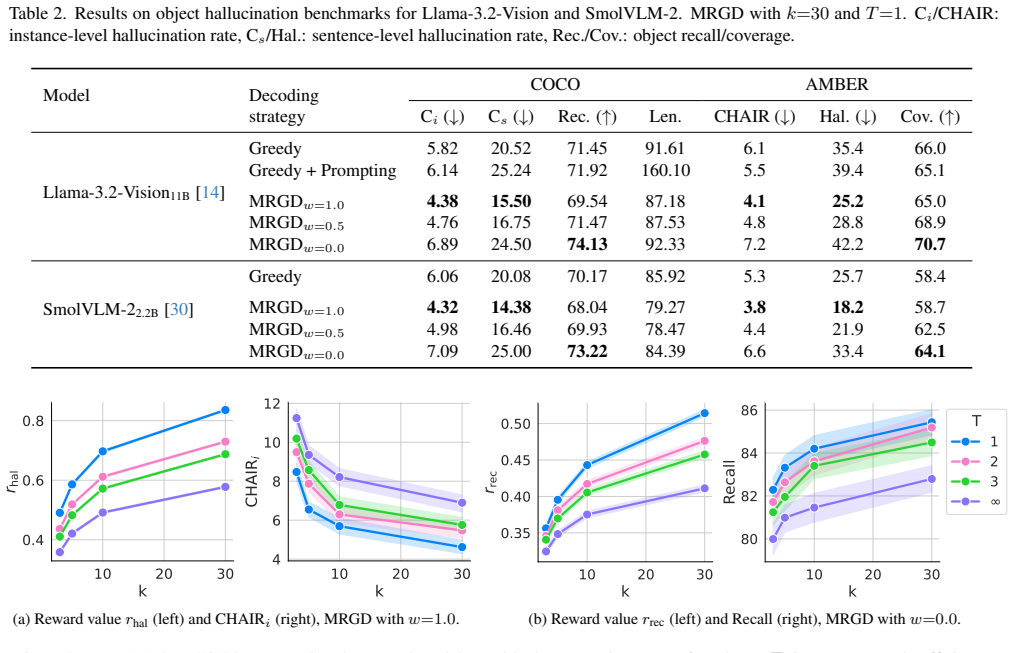
The central discovery is that MLLM decoding can be made controllable on the fly through multimodal reward-guided decoding (MRGD), and that this controllability exposes an inherent precision/recall trade-off in the base models. MRGD samples $k$ candidate sentence-level completions from the current partial response and keeps the one maximizing $s(x_v,x_q,y)=w\,r_{\mathrm{hal}}(x_v,x_q,y)+(1-w)\,r_{\mathrm{rec}}(x_v,x_q,y)$, repeating until the end-of-sentence token. $r_{\mathrm{hal}}$ is a PaliGemma-based reward model trained with a Bradley-Terry preference loss plus regression targets on a mix of LLaVA-RLHF, RLHF-V, POVID, and repurposed SugarCrepe data; $r_{\mathrm{rec}}$ counts, via object
What carries the argument
The load-bearing mechanism is the weighted reward score $s = w\,r_{\mathrm{hal}} + (1-w)\,r_{\mathrm{rec}}$, used as the selection criterion in an iterative sentence-level search: every $T$ sentences, $k$ candidate continuations are sampled from the base MLLM and the one with the largest $s$ is appended to the context. The weight $w$ is the precision/recall dial; $k$ and $T$ are the compute/grounding dials. The search turns an off-the-shelf MLLM into an optimizer of a user-specified reward without changing its weights.
Load-bearing premise
The reward model trained on complete preferred/rejected caption pairs can also assign trustworthy scores to partial sentence prefixes, so selecting the best prefix every $T$ sentences actually improves the final caption.
What would settle it
Take a held-out set of images with ground-truth object annotations and a base MLLM not used in the paper; run MRGD with $w=1$ and increasing $k$, and compare the chosen partial responses' $r_{\mathrm{hal}}$ scores with the hallucination rate of the finished captions. If ordering partial candidates by $r_{\mathrm{hal}}$ does not predict which final caption has fewer hallucinated objects, the sentence-level guidance is not the cause of the reported reductions.
If this is right
- A user can set the operating point per query: precision-first ($w$ near 1), recall-first ($w$ near 0), or balanced, with no retraining.
- The same reward models apply to base MLLMs they were not trained with, making MRGD a plug-in inference-time alignment layer on top of instruction-tuned and RLHF-tuned models.
- Because evaluating partial responses every $T$ sentences is more sample-efficient than best-of-$k$ over full responses, modest test-time budgets can buy most of the grounding gain.
- MRGD combines with prompting and fine-tuning rather than replacing them, so existing hallucination mitigations remain usable underneath.
- The observed precision/recall curve indicates an inherent trade-off in current MLLMs; more compute (larger $k$) shifts the whole curve toward the ideal operating point.
Where Pith is reading between the lines
- Editorial inference: if sentence-level reward scoring is reliable, the same search recipe should extend to other hallucination axes—attributes, counts, spatial relations—by training one reward model per axis and weighting them in the same $w$ dial.
- Editorial inference: the method's ceiling is set by $r_{\mathrm{hal}}$'s ability to score partial prefixes; a reward model trained specifically on truncated responses, or a value head trained on prefixes, would likely reduce the gap the paper acknowledges in Section 3.2.
- Editorial inference: since $r_{\mathrm{rec}}$ is assembled from off-the-shelf components, its detector's vocabulary and POS-tagger errors bound recall estimates; a more precise detector or a caption-aware reference set should sharpen the $w=0$ operating point.
- Editorial inference: a testable extension is to run MRGD on discriminative hallucination tasks such as visual questioning, where the reward would have to judge answers rather than captions; the paper leaves this open in its limitations and future work.
Editorial analysis
A structured set of objections, weighed in public.
Referee Report
Summary. The paper introduces MRGD, a reward-guided decoding method for multimodal LLMs. Two reward models are built: rhal, a PaliGemma-based reward model trained with Bradley-Terry and MSE losses on preference data from LLaVA-RLHF, RLHF-V, POVID, and a repurposed SugarCrepe split, and rrec, composed from OWLv2, Sentence-BERT, and NLTK to estimate object recall. At inference, candidate sentence-level completions are sampled and selected by maximizing w·rhal + (1−w)·rrec, giving a precision/recall control knob (w) and a compute/grounding knob (k, T). Experiments on CHAIR and AMBER for LLaVA-1.5, Llama-3.2-Vision, and SmolVLM-2 report substantial hallucination reductions, e.g., CHAIR_i on COCO dropping from 15.05 to 4.53 at w=1, with controllability across w and improved performance over CGD and several fine-tuning baselines.
Significance. If the empirical claims hold, the method is a practically valuable, training-free-at-inference mechanism for adapting existing MLLMs: it provides two user-controllable trade-offs (precision vs. recall, and compute vs. grounding) and transfers reward models across three architecturally different base MLLMs without retraining. The paper is also careful in several respects: it evaluates rhal on held-out VLFeedback data, ablates the preference-data mix and reward-model components, reports latency, and includes qualitative examples. These strengths make the central idea worth pursuing. However, the headline comparative claims are currently supported by an insufficiently specified hyperparameter-selection procedure and by a potential train/evaluation image overlap, so the quantitative results need additional validation before they can be accepted as stated.
major comments (3)
- [§4.3, Table 1] The MRGD rows are reported as 'the best performing variant w.r.t. the number of samples k, the reward evaluation period T, and the temperature t,' but no validation procedure is described. The central comparison—e.g., the ~70% CHAIR_i reduction from 15.05 to 4.53—therefore conflates method performance with test-set hyperparameter selection. Since k and T are core controllability parameters, the authors should either report a single fixed configuration used for all rows (e.g., k=30, T=1, t=1.0, as in Table 2 and Figure 2) or provide a validation-based selection protocol and report the chosen values for every w and benchmark.
- [§3.1.1, §4.1, Tables 1–2] rhal is trained on 7.5k SugarCrepe examples, and SugarCrepe is constructed from COCO images; the evaluation benchmarks CHAIR and AMBER are also COCO-based. The paper does not report any overlap analysis or disjoint split between rhal's training images and the evaluation images. If overlapping images appear, rhal can memorize object–caption associations and inflate exactly the hallucination reductions used to support the main claim. This is a load-bearing concern, not a minor one: please quantify the overlap and rerun the main comparisons with any overlapping examples removed, or evaluate on a held-out COCO split not used in any rhal training set.
- [§3.2, Algorithm 1, Figure 2] rhal is trained on complete chosen/rejected responses, but MRGD with T=1 scores partial sentence-level completions. The paper acknowledges this issue in §3.2 but provides no empirical check that the reward model's ranking quality transfers to incomplete prefixes; the reported VLFeedback accuracy (67.68%) is measured on complete responses. Since the compute-efficiency claim (T=1 being more sample-efficient than rejection sampling) depends directly on this transfer, please add a partial-prefix validation — e.g., rank accuracy on truncated held-out responses as a function of sentence index — or compare T=1 against T=∞ at matched total sample counts.
minor comments (4)
- [§4.1, §4.7, Table 3] The naming of the preference datasets is inconsistent: the paper alternately uses 'RLAIF-V' and 'RLHF-V' (Refs. [50] and [49]). Please unify the names and ensure Table 3's 'RLAIF-V' rows are unambiguous.
- [§3.1.1, Eq. (2)] The notation in Eq. (2) drops the dependence on x_v and x_q that is explicit in Eq. (1). Also, the parenthetical in the MSE terms is slightly awkward; consider rewriting for clarity.
- [Appendix 6.4] The claim that 'CGD can be viewed as a particular instance of MRGD' is instructive, but CGD's SigLIP scores are normalized across candidates while rhal scores are trained to a [0,1] scale; the comparison would benefit from a one-sentence discussion of whether normalization affects the combined score in Eq. (4).
- [Figure 2] The left and right panels use different y-axis scales and the marker for T=∞ (rejection sampling) is not shown; adding explicit markers and a legend for T values would improve readability.
Circularity Check
No significant circularity: MRGD's reward models are trained/composed from external components and benchmark gains are measured, not constructed.
full rationale
The paper's derivation chain is not circular. The central decoding score is s(x_v,x_q,y) = w·r_hal(x_v,x_q,y) + (1−w)·r_rec(x_v,x_q,y) (Eq. 4), and decoding selects the completion maximizing this score among sampled candidates. r_hal is trained with the Bradley-Terry plus MSE objective (Eqs. 1–2) on external preference data (LLaVA-RLHF, RLHF-V, POVID, repurposed SugarCrepe), not on CHAIR/AMBER or on the benchmark metrics. r_rec (Eq. 3) is composed from off-the-shelf OWLv2, Sentence-BERT, and NLTK with a fixed threshold τ=0.5; no parameter is fitted to the evaluation benchmarks. The headline reductions in CHAIR_i, CHAIR_s, Hal., and gains in Rec./Cov. are empirically measured outcomes of this decoding procedure, not identities that follow from the definition of the rewards. The ablations (Table 3) further show the method is robust to changing the backbone, detector, threshold, and data mix, which would not be expected if the result were forced by construction. There is no load-bearing self-citation: the only self-reference (Bordes et al., ref. [5], co-authored by O. Mañas) is a general survey citation in the introduction and is not used to justify any methodological choice, uniqueness claim, or ansatz. The skeptical concern about possible overlap between SugarCrepe training images and COCO-based CHAIR/AMBER evaluation is a legitimate data-contamination / validity risk, but it is not a circularity in the derivation; no equation reduces to its own inputs, and no fitted parameter is relabeled as a prediction. Accordingly, the circularity score is 0.
Axiom & Free-Parameter Ledger
free parameters (5)
- guidance weight w =
user-chosen in [0,1]; w* about 0.25 for COCO, 1.0 for AMBER
- search breadth k =
{3, 5, 10, 30}; k=30 for main tables
- evaluation period T =
1 (main), 2, 3
- similarity threshold tau =
0.5; ablated to 0.2 and 0.9
- sampling temperature t =
1.0 for LLaVA-1.5, 0.2 for Llama-3.2-Vision and SmolVLM-2
axioms (6)
- domain assumption Preference pairs (y+, y-) in LLaVA-RLHF, RLHF-V, POVID, and repurposed SugarCrepe faithfully identify less hallucinated captions.
- standard math Bradley-Terry model of preferences is an appropriate objective for a scalar hallucination reward.
- domain assumption OWLv2 detections form an adequate reference object set for recall estimation.
- domain assumption POS tagging plus Sentence-BERT similarity with threshold tau=0.5 identifies object mentions in captions.
- ad hoc to paper Reward models trained on complete responses provide reliable scores for sentence-level partial responses when evaluated every T sentences.
- domain assumption Sampling from the base MLLM at temperature t produces candidate completions among which higher-reward completions exist.
Cite this review
Pith. "Pith review of Controlling Multimodal LLMs via Reward-guided Decoding." pith.science (2026). https://pith.science/paper/IRVHYJEG
@misc{pith2026250811616,
  author       = {Pith},
  title        = {Pith review of: Controlling Multimodal LLMs via Reward-guided Decoding},
  year         = {2026},
  howpublished = {\url{https://pith.science/paper/IRVHYJEG}},
  note         = {Machine review of arXiv:2508.11616}
}
read the original abstract
As Multimodal Large Language Models (MLLMs) gain widespread applicability, it is becoming increasingly desirable to adapt them for diverse user needs. In this paper, we study the adaptation of MLLMs through controlled decoding. To achieve this, we introduce the first method for reward-guided decoding of MLLMs and demonstrate its application in improving their visual grounding. Our method involves building reward models for visual grounding and using them to guide the MLLM's decoding process. Concretely, we build two separate reward models to independently control the degree of object precision and recall in the model's output. Our approach enables on-the-fly controllability of an MLLM's inference process in two ways: first, by giving control over the relative importance of each reward function during decoding, allowing a user to dynamically trade off object precision for recall in image captioning tasks; second, by giving control over the breadth of the search during decoding, allowing the user to control the trade-off between the amount of test-time compute and the degree of visual grounding. We evaluate our method on standard object hallucination benchmarks, showing that it provides significant controllability over MLLM inference, while consistently outperforming existing hallucination mitigation methods.
Figures



Reference graph
Works this paper leans on
-
[1]
Josh Achiam, Steven Adler, Sandhini Agarwal, Lama Ah- mad, Ilge Akkaya, Florencia Leoni Aleman, Diogo Almeida, Janko Altenschmidt, Sam Altman, Shyamal Anadkat, et al. Gpt-4 technical report. arXiv preprint arXiv:2303.08774 ,
-
[2]
Understand- ing alignment in multimodal llms: A comprehensive study
Elmira Amirloo, Jean-Philippe Fauconnier, Christoph Roes- mann, Christian Kerl, Rinu Boney, Yusu Qian, Zirui Wang, Afshin Dehghan, Yinfei Yang, Zhe Gan, et al. Understand- ing alignment in multimodal llms: A comprehensive study. arXiv preprint arXiv:2407.02477, 2024. 2
Pith/arXiv arXiv 2024
-
[3]
Hallucination of multimodal large language models: A survey
Zechen Bai, Pichao Wang, Tianjun Xiao, Tong He, Zongbo Han, Zheng Zhang, and Mike Zheng Shou. Hallucination of multimodal large language models: A survey. arXiv preprint arXiv:2404.18930, 2024. 1 9
Pith/arXiv arXiv 2024
-
[4]
Paligemma: A versatile 3b vlm for trans- fer
Lucas Beyer, Andreas Steiner, Andr ´e Susano Pinto, Alexan- der Kolesnikov, Xiao Wang, Daniel Salz, Maxim Neumann, Ibrahim Alabdulmohsin, Michael Tschannen, Emanuele Bugliarello, et al. Paligemma: A versatile 3b vlm for trans- fer. arXiv preprint arXiv:2407.07726, 2024. 3
Pith/arXiv arXiv 2024
-
[5]
An introduction to vision-language modeling
Florian Bordes, Richard Yuanzhe Pang, Anurag Ajay, Alexander C Li, Adrien Bardes, Suzanne Petryk, Oscar Ma˜nas, Zhiqiu Lin, Anas Mahmoud, Bargav Jayaraman, et al. An introduction to vision-language modeling. arXiv preprint arXiv:2405.17247, 2024. 1
Pith/arXiv arXiv 2024
-
[6]
Rank analysis of incomplete block designs: I
Ralph Allan Bradley and Milton E Terry. Rank analysis of incomplete block designs: I. the method of paired compar- isons. Biometrika, 39(3/4):324–345, 1952. 3
work page 1952
-
[7]
Large language monkeys: Scaling inference compute with repeated sampling
Bradley Brown, Jordan Juravsky, Ryan Ehrlich, Ronald Clark, Quoc V Le, Christopher R ´e, and Azalia Mirhoseini. Large language monkeys: Scaling inference compute with repeated sampling. arXiv preprint arXiv:2407.21787, 2024. 2, 4
Pith/arXiv arXiv 2024
-
[8]
Language models are few-shot learners
Tom B Brown. Language models are few-shot learners. arXiv preprint arXiv:2005.14165, 2020. 1
Pith/arXiv arXiv 2005
-
[9]
The (r) evolution of multi- modal large language models: A survey
Davide Caffagni, Federico Cocchi, Luca Barsellotti, Nicholas Moratelli, Sara Sarto, Lorenzo Baraldi, Marcella Cornia, and Rita Cucchiara. The (r) evolution of multi- modal large language models: A survey. arXiv preprint arXiv:2402.12451, 2024. 1
arXiv 2024
-
[10]
End-to- end object detection with transformers
Nicolas Carion, Francisco Massa, Gabriel Synnaeve, Nicolas Usunier, Alexander Kirillov, and Sergey Zagoruyko. End-to- end object detection with transformers. In European confer- ence on computer vision, pages 213–229. Springer, 2020. 8
work page 2020
-
[11]
Plug and play language models: A simple approach to controlled text generation
Sumanth Dathathri, Andrea Madotto, Janice Lan, Jane Hung, Eric Frank, Piero Molino, Jason Yosinski, and Rosanne Liu. Plug and play language models: A simple approach to controlled text generation. In International Conference on Learning Representations, 2020. 2
work page 2020
-
[12]
Ailin Deng, Zhirui Chen, and Bryan Hooi. Seeing is believing: Mitigating hallucination in large vision- language models via clip-guided decoding. arXiv preprint arXiv:2402.15300, 2024. 2, 5, 1
Pith/arXiv arXiv 2024
-
[13]
Reward-augmented decod- ing: Efficient controlled text generation with a unidirectional reward model
Haikang Deng and Colin Raffel. Reward-augmented decod- ing: Efficient controlled text generation with a unidirectional reward model. In Proceedings of the 2023 Conference on Empirical Methods in Natural Language Processing , pages 11781–11791, 2023. 1, 2
work page 2023
-
[14]
Abhimanyu Dubey, Abhinav Jauhri, Abhinav Pandey, Ab- hishek Kadian, Ahmad Al-Dahle, Aiesha Letman, Akhil Mathur, Alan Schelten, Amy Yang, Angela Fan, et al. The llama 3 herd of models. arXiv preprint arXiv:2407.21783 ,
-
[15]
Multi-modal hal- lucination control by visual information grounding
Alessandro Favero, Luca Zancato, Matthew Trager, Sid- dharth Choudhary, Pramuditha Perera, Alessandro Achille, Ashwin Swaminathan, and Stefano Soatto. Multi-modal hal- lucination control by visual information grounding. In Pro- ceedings of the IEEE/CVF Conference on Computer Vision and Pattern Recognition, pages 14303–14312, 2024. 2
work page 2024
-
[16]
Value augmented sampling for language model alignment and personalization
Seungwook Han, Idan Shenfeld, Akash Srivastava, Yoon Kim, and Pulkit Agrawal. Value augmented sampling for language model alignment and personalization. arXiv preprint arXiv:2405.06639, 2024. 2
Pith/arXiv arXiv 2024
-
[17]
Sugarcrepe: Fixing hackable benchmarks for vision-language compositionality
Cheng-Yu Hsieh, Jieyu Zhang, Zixian Ma, Aniruddha Kem- bhavi, and Ranjay Krishna. Sugarcrepe: Fixing hackable benchmarks for vision-language compositionality. Advances in neural information processing systems, 36, 2024. 4
work page 2024
-
[18]
Lora: Low- rank adaptation of large language models
Edward J Hu, Phillip Wallis, Zeyuan Allen-Zhu, Yuanzhi Li, Shean Wang, Lu Wang, Weizhu Chen, et al. Lora: Low- rank adaptation of large language models. In International Conference on Learning Representations, 2022. 4
work page 2022
-
[19]
Args: Alignment as reward-guided search
Maxim Khanov, Jirayu Burapacheep, and Yixuan Li. Args: Alignment as reward-guided search. In The Twelfth Inter- national Conference on Learning Representations, 2024. 1, 2
work page 2024
-
[20]
Rewardbench: Evaluating reward models for language modeling
Nathan Lambert, Valentina Pyatkin, Jacob Morrison, LJ Miranda, Bill Yuchen Lin, Khyathi Chandu, Nouha Dziri, Sachin Kumar, Tom Zick, Yejin Choi, et al. Rewardbench: Evaluating reward models for language modeling. arXiv preprint arXiv:2403.13787, 2024. 5
Pith/arXiv arXiv 2024
-
[21]
Sicong Leng, Hang Zhang, Guanzheng Chen, Xin Li, Shijian Lu, Chunyan Miao, and Lidong Bing. Mitigating object hal- lucinations in large vision-language models through visual contrastive decoding. In Proceedings of the IEEE/CVF Con- ference on Computer Vision and Pattern Recognition, pages 13872–13882, 2024. 2, 5, 6, 1
work page 2024
-
[22]
Sequential monte carlo steering of large lan- guage models using probabilistic programs
Alexander K Lew, Tan Zhi-Xuan, Gabriel Grand, and Vikash Mansinghka. Sequential monte carlo steering of large lan- guage models using probabilistic programs. In ICML 2023 Workshop: Sampling and Optimization in Discrete Space ,
work page 2023
-
[23]
Cascade reward sampling for efficient decoding-time align- ment
Bolian Li, Yifan Wang, Ananth Grama, and Ruqi Zhang. Cascade reward sampling for efficient decoding-time align- ment. In ICML 2024 Next Generation of AI Safety Workshop,
work page 2024
-
[24]
Vlfeedback: A large-scale ai feedback dataset for large vision-language models alignment
Lei Li, Zhihui Xie, Mukai Li, Shunian Chen, Peiyi Wang, Liang Chen, Yazheng Yang, Benyou Wang, Lingpeng Kong, and Qi Liu. Vlfeedback: A large-scale ai feedback dataset for large vision-language models alignment. In Proceedings of the 2024 Conference on Empirical Methods in Natural Lan- guage Processing, pages 6227–6246, 2024. 4
work page 2024
-
[25]
Evaluating object hallucination in large vision-language models
Yifan Li, Yifan Du, Kun Zhou, Jinpeng Wang, Wayne Xin Zhao, and Ji-Rong Wen. Evaluating object hallucination in large vision-language models. In Proceedings of the 2023 Conference on Empirical Methods in Natural Language Pro- cessing, pages 292–305, 2023. 9
work page 2023
-
[26]
Mitigating hallucination in large multi-modal models via robust instruction tuning
Fuxiao Liu, Kevin Lin, Linjie Li, Jianfeng Wang, Yaser Ya- coob, and Lijuan Wang. Mitigating hallucination in large multi-modal models via robust instruction tuning. In The Twelfth International Conference on Learning Representa- tions, 2024. 1, 2
work page 2024
-
[27]
Improved baselines with visual instruction tuning
Haotian Liu, Chunyuan Li, Yuheng Li, and Yong Jae Lee. Improved baselines with visual instruction tuning. In Pro- ceedings of the IEEE/CVF Conference on Computer Vision and Pattern Recognition, pages 26296–26306, 2024. 4, 5
work page 2024
-
[28]
Jiacheng Liu, Andrew Cohen, Ramakanth Pasunuru, Yejin Choi, Hannaneh Hajishirzi, and Asli Celikyilmaz. Don’t throw away your value model! generating more preferable text with value-guided monte-carlo tree search decoding. In First Conference on Language Modeling, 2024. 2 10
work page 2024
-
[29]
Investigating and mitigating object hallucinations in pretrained vision-language (clip) models
Yufang Liu, Tao Ji, Changzhi Sun, Yuanbin Wu, and Aimin Zhou. Investigating and mitigating object hallucinations in pretrained vision-language (clip) models. In Proceedings of the 2024 Conference on Empirical Methods in Natural Lan- guage Processing, pages 18288–18301, 2024. 2, 5
work page 2024
-
[30]
Smolvlm: Redefining small and efficient multimodal models
Andr ´es Marafioti, Orr Zohar, Miquel Farr ´e, Merve Noyan, Elie Bakouch, Pedro Cuenca, Cyril Zakka, Loubna Ben Allal, Anton Lozhkov, Nouamane Tazi, Vaibhav Srivastav, Joshua Lochner, Hugo Larcher, Mathieu Morlon, Lewis Tun- stall, Leandro von Werra, and Thomas Wolf. Smolvlm: Redefining small and efficient multimodal models. arXiv preprint arXiv:2504.0529...
Pith/arXiv arXiv 2025
-
[31]
Scaling open-vocabulary object detection
Matthias Minderer, Alexey Gritsenko, and Neil Houlsby. Scaling open-vocabulary object detection. Advances in Neu- ral Information Processing Systems, 36, 2024. 4
work page 2024
-
[32]
Controlled decod- ing from language models
Sidharth Mudgal, Jong Lee, Harish Ganapathy, YaGuang Li, Tao Wang, Yanping Huang, Zhifeng Chen, Heng-Tze Cheng, Michael Collins, Trevor Strohman, et al. Controlled decod- ing from language models. In Forty-first International Con- ference on Machine Learning, 2024. 1, 2
work page 2024
-
[33]
Training language models to follow instructions with human feedback
Long Ouyang, Jeffrey Wu, Xu Jiang, Diogo Almeida, Car- roll Wainwright, Pamela Mishkin, Chong Zhang, Sandhini Agarwal, Katarina Slama, Alex Ray, et al. Training language models to follow instructions with human feedback. Ad- vances in neural information processing systems, 35:27730– 27744, 2022. 3
work page 2022
-
[34]
Learning transferable visual models from natural language supervi- sion
Alec Radford, Jong Wook Kim, Chris Hallacy, Aditya Ramesh, Gabriel Goh, Sandhini Agarwal, Girish Sastry, Amanda Askell, Pamela Mishkin, Jack Clark, et al. Learning transferable visual models from natural language supervi- sion. In International conference on machine learning, pages 8748–8763. PMLR, 2021. 3
2021
-
[35]
Direct preference optimization: Your language model is secretly a reward model
Rafael Rafailov, Archit Sharma, Eric Mitchell, Christo- pher D Manning, Stefano Ermon, and Chelsea Finn. Direct preference optimization: Your language model is secretly a reward model. Advances in Neural Information Processing Systems, 36, 2024. 6
work page 2024
-
[36]
A critical look at to- kenwise reward-guided text generation
Ahmad Rashid, Ruotian Wu, Julia Grosse, Agustinus Kristiadi, and Pascal Poupart. A critical look at to- kenwise reward-guided text generation. arXiv preprint arXiv:2406.07780, 2024. 2
-
[37]
Sentence-bert: Sentence embeddings using siamese bert-networks
Nils Reimers and Iryna Gurevych. Sentence-bert: Sentence embeddings using siamese bert-networks. In Proceedings of the 2019 Conference on Empirical Methods in Natural Lan- guage Processing. Association for Computational Linguis- tics, 2019. 4
work page 2019
-
[38]
Object hallucination in image cap- tioning
Anna Rohrbach, Lisa Anne Hendricks, Kaylee Burns, Trevor Darrell, and Kate Saenko. Object hallucination in image cap- tioning. In Proceedings of the 2018 Conference on Empirical Methods in Natural Language Processing, pages 4035–4045,
work page 2018
-
[39]
Mitigating object hallucination via data augmented contrastive tuning
Pritam Sarkar, Sayna Ebrahimi, Ali Etemad, Ahmad Beirami, Sercan ¨O Arık, and Tomas Pfister. Mitigating object hallucination via data augmented contrastive tuning. arXiv preprint arXiv:2405.18654, 2024. 2, 5, 1
Pith/arXiv arXiv 2024
-
[40]
Scaling llm test-time compute optimally can be more effective than scaling model parameters
Charlie Snell, Jaehoon Lee, Kelvin Xu, and Aviral Ku- mar. Scaling llm test-time compute optimally can be more effective than scaling model parameters. arXiv preprint arXiv:2408.03314, 2024. 1, 2, 4
Pith/arXiv arXiv 2024
-
[41]
Paligemma 2: A family of versatile vlms for transfer
Andreas Steiner, Andr ´e Susano Pinto, Michael Tschannen, Daniel Keysers, Xiao Wang, Yonatan Bitton, Alexey Grit- senko, Matthias Minderer, Anthony Sherbondy, Shangbang Long, et al. Paligemma 2: A family of versatile vlms for transfer. arXiv preprint arXiv:2412.03555, 2024. 8
Pith/arXiv arXiv 2024
-
[42]
Aligning large multi- modal models with factually augmented rlhf
Zhiqing Sun, Sheng Shen, Shengcao Cao, Haotian Liu, Chunyuan Li, Yikang Shen, Chuang Gan, Liang-Yan Gui, Yu-Xiong Wang, Yiming Yang, et al. Aligning large multi- modal models with factually augmented rlhf. arXiv preprint arXiv:2309.14525, 2023. 1, 2, 4, 5, 7
Pith/arXiv arXiv 2023
-
[43]
Gemini: a family of highly capable multimodal models
Gemini Team, Rohan Anil, Sebastian Borgeaud, Yonghui Wu, Jean-Baptiste Alayrac, Jiahui Yu, Radu Soricut, Johan Schalkwyk, Andrew M Dai, Anja Hauth, et al. Gemini: a family of highly capable multimodal models. arXiv preprint arXiv:2312.11805, 2023. 1
Pith/arXiv arXiv 2023
-
[44]
Contrastive Region Guidance: Improving Grounding in Vision-Language Models without Training
David Wan, Jaemin Cho, Elias Stengel-Eskin, and Mohit Bansal. Contrastive region guidance: Improving grounding in vision-language models without training. arXiv preprint arXiv:2403.02325, 2024. 2
work page internal anchor Pith review Pith/arXiv arXiv 2024
-
[45]
mdpo: Conditional preference optimization for multimodal large language mod- els
Fei Wang, Wenxuan Zhou, James Y Huang, Nan Xu, Sheng Zhang, Hoifung Poon, and Muhao Chen. mdpo: Conditional preference optimization for multimodal large language mod- els. arXiv preprint arXiv:2406.11839, 2024. 2, 5
Pith/arXiv arXiv 2024
-
[46]
An llm-free multi-dimensional benchmark for mllms hallu- cination evaluation
Junyang Wang, Yuhang Wang, Guohai Xu, Jing Zhang, Yukai Gu, Haitao Jia, Ming Yan, Ji Zhang, and Jitao Sang. An llm-free multi-dimensional benchmark for mllms hallu- cination evaluation. arXiv preprint arXiv:2311.07397, 2023. 4, 1
Pith/arXiv arXiv 2023
-
[47]
Fudge: Controlled text genera- tion with future discriminators
Kevin Yang and Dan Klein. Fudge: Controlled text genera- tion with future discriminators. In Proceedings of the 2021 Conference of the North American Chapter of the Associa- tion for Computational Linguistics: Human Language Tech- nologies, pages 3511–3535, 2021. 2
work page 2021
-
[48]
Woodpecker: Hallucination correction for multimodal large language models
Shukang Yin, Chaoyou Fu, Sirui Zhao, Tong Xu, Hao Wang, Dianbo Sui, Yunhang Shen, Ke Li, Xing Sun, and Enhong Chen. Woodpecker: Hallucination correction for multimodal large language models. arXiv preprint arXiv:2310.16045 ,
-
[49]
Tianyu Yu, Yuan Yao, Haoye Zhang, Taiwen He, Yifeng Han, Ganqu Cui, Jinyi Hu, Zhiyuan Liu, Hai-Tao Zheng, Maosong Sun, et al. Rlhf-v: Towards trustworthy mllms via behavior alignment from fine-grained correctional hu- man feedback. In Proceedings of the IEEE/CVF Conference on Computer Vision and Pattern Recognition, pages 13807– 13816, 2024. 1, 2, 4, 7
work page 2024
-
[50]
Rlaif-v: Aligning mllms through open-source ai feedback for super gpt-4v trustworthiness
Tianyu Yu, Haoye Zhang, Yuan Yao, Yunkai Dang, Da Chen, Xiaoman Lu, Ganqu Cui, Taiwen He, Zhiyuan Liu, Tat-Seng Chua, et al. Rlaif-v: Aligning mllms through open-source ai feedback for super gpt-4v trustworthiness. arXiv preprint arXiv:2405.17220, 2024. 2, 7
arXiv 2024
-
[51]
Less is more: Mitigat- ing multimodal hallucination from an eos decision perspec- tive
Zihao Yue, Liang Zhang, and Qin Jin. Less is more: Mitigat- ing multimodal hallucination from an eos decision perspec- tive. arXiv preprint arXiv:2402.14545, 2024. 5, 1
Pith/arXiv arXiv 2024
-
[52]
Ce Zhang, Zifu Wan, Zhehan Kan, Martin Q Ma, Si- mon Stepputtis, Deva Ramanan, Russ Salakhutdinov, Louis- 11 Philippe Morency, Katia Sycara, and Yaqi Xie. Self- correcting decoding with generative feedback for mitigat- ing hallucinations in large vision-language models. arXiv preprint arXiv:2502.06130, 2025. 2
Pith/arXiv arXiv 2025
-
[53]
Multimodal chain-of-thought reasoning in language models
Zhuosheng Zhang, Aston Zhang, Mu Li, George Karypis, Alex Smola, et al. Multimodal chain-of-thought reasoning in language models. Transactions on Machine Learning Re- search, 2024. 1, 2
work page 2024
-
[54]
Mitigating object hallucination in large vision- language models via classifier-free guidance
Linxi Zhao, Yihe Deng, Weitong Zhang, and Quanquan Gu. Mitigating object hallucination in large vision- language models via classifier-free guidance. arXiv preprint arXiv:2402.08680, 2024. 2
Pith/arXiv arXiv 2024
-
[55]
Zhiyuan Zhao, Bin Wang, Linke Ouyang, Xiaoyi Dong, Ji- aqi Wang, and Conghui He. Beyond hallucinations: Enhanc- ing lvlms through hallucination-aware direct preference op- timization. arXiv preprint arXiv:2311.16839 , 2023. 2, 5, 1
Pith/arXiv arXiv 2023
-
[56]
Aligning modalities in vision large lan- guage models via preference fine-tuning
Yiyang Zhou, Chenhang Cui, Rafael Rafailov, Chelsea Finn, and Huaxiu Yao. Aligning modalities in vision large lan- guage models via preference fine-tuning. In ICLR 2024 Workshop on Reliable and Responsible Foundation Models,
work page 2024
-
[57]
Analyzing and mitigating object hallucination in large vision-language models
Yiyang Zhou, Chenhang Cui, Jaehong Yoon, Linjun Zhang, Zhun Deng, Chelsea Finn, Mohit Bansal, and Huaxiu Yao. Analyzing and mitigating object hallucination in large vision-language models. In The Twelfth International Con- ference on Learning Representations, 2024. 2
work page 2024
-
[58]
Calibrated self-rewarding vision language models
Yiyang Zhou, Zhiyuan Fan, Dongjie Cheng, Sihan Yang, Zhaorun Chen, Chenhang Cui, Xiyao Wang, Yun Li, Linjun Zhang, and Huaxiu Yao. Calibrated self-rewarding vision language models. arXiv preprint arXiv:2405.14622 , 2024. 2, 5 12 Controlling Multimodal LLMs via Reward-guided Decoding Supplementary Material
Pith/arXiv arXiv 2024
-
[59]
Experiments 6.1. Details on evaluation metrics We evaluate object precision and recall with standard metrics from the corresponding benchmarks, defined as follows. CHAIRi (Ci) [38], CHAIR [46]. Measure the frac- tion of hallucinated objects in the generated captions. Ci/CHAIR = |{hallucinated objects}| |{all mentioned objects}| CHAIRs (Cs) [38], Hal. [46]...
This paper was first reviewed by deepseek-v4-flash on August 5, 2026.
discussion (0)
Sign in with ORCID, Apple, or X to comment. Anyone can read and Pith papers without signing in.