Dark Matter and the Early Formation of Supermassive Black Holes
Pith reviewed 2026-05-18 22:06 UTC · model grok-4.3
The pith
Clustered dark matter allows small black hole seeds to reach over 10 million solar masses by redshift 10 in nuclear star clusters.
A machine-rendered reading of the paper's core claim, the machinery that carries it, and where it could break.
Core claim
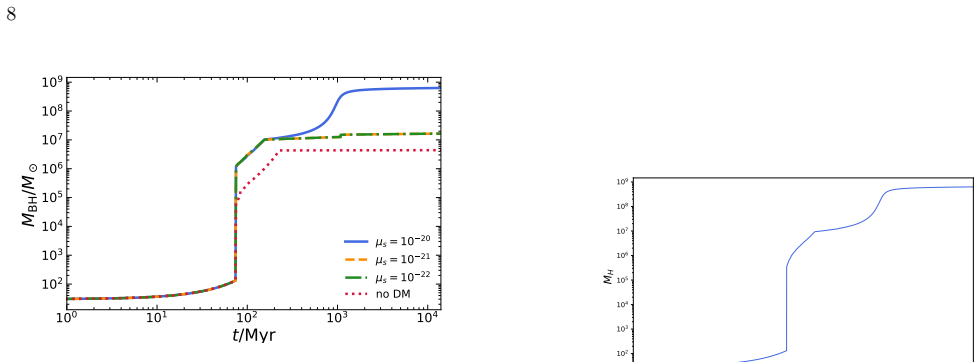
In models where dark matter clustering occurs, possibly by self-interaction, the capture of dark matter by a growing supermassive black hole allows a small seed stellar-remnant black hole to reach more than 10^7 solar masses by redshift 10 in the core of dense nuclear star clusters. This remains true for either cold dark matter or ultralight dark matter with mass around 10^{-22} eV. In contrast, when the dark matter follows the standard NFW profile from cosmological simulations, its contribution to black hole growth is insignificant.
What carries the argument
Capture of collisionless dark matter by the growing black hole when the dark matter is allowed to cluster beyond the standard NFW profile inside nuclear star clusters.
If this is right
- A stellar-remnant seed black hole can reach supermassive size by redshift 10 even when gas accretion and mergers are limited to Eddington rates and tidal disruption events.
- The dark matter contribution becomes important only when clustering occurs beyond what standard cosmological simulations produce.
- The same growth pathway works for ultralight dark matter, where the de Broglie wavelength exceeds the initial size of the nuclear star cluster and produces distinct capture behavior.
Where Pith is reading between the lines
- If self-interacting dark matter is required to explain early black hole growth, it could also alter predictions for galaxy core densities and satellite galaxy counts at lower redshifts.
- Future observations of black hole masses and host galaxy properties at redshift 10 could distinguish between clustered and standard dark matter profiles.
Load-bearing premise
Dark matter can cluster enough, possibly through self-interactions, for the growing black hole to capture a significant amount of it.
What would settle it
A direct measurement of the dark matter density profile in the centers of galaxies at redshift around 10 that closely follows the NFW shape with no extra central clustering would show the dark matter contribution remains negligible.
Figures




read the original abstract
We investigate the growth of supermassive black holes (SMBHs) at high redshift ($z \ge 10$) from a combination of dark matter capture, black-hole mergers, and gas accretion. It has previously been shown that SMBHs can form by $z \approx 10$ via black-hole mergers, Eddington-limited Bondi gas accretion and tidal disruption events with stars within dense nuclear clusters. Here, we examine the degree to which the capture of collisionless dark matter by a growing SMBH may also contribute. We first consider models deduced from cosmological simulations of galaxy formation and central BH formation. We show that in the case that the dense nuclear star cluster forms by cooling and collapse of gas, while the DM remains in a standard NFW profile, the contribution from cold dark matter accretion is insignificant. However, we suggest models for which dark matter clustering can occur (possibly by self interaction). We show that such clustering may affect SMBH growth. In such cases, a small seed stellar-remnant black hole can more easily reach $> 10^7$ M$_{\odot}$ by $z = 10$ in the core of dense nuclear star clusters. This remains true for either cold dark matter or ultralight dark matter with the observationally inferred mass of $\sim 10^{-22}$ eV. We highlight the unique possible evolution of ULDM capture by the growing SMBH due to the fact that the ULDM de Broglie wavelength exceeds the initial nuclear star cluster half-mass radius.
Editorial analysis
A structured set of objections, weighed in public.
Referee Report
Summary. The manuscript investigates the contribution of dark matter capture to the growth of supermassive black holes at high redshifts (z ≥ 10) within dense nuclear star clusters, in conjunction with black hole mergers and gas accretion. It concludes that while standard Navarro-Frenk-White (NFW) dark matter profiles yield insignificant contributions, proposed models allowing for dark matter clustering (possibly through self-interactions) enable stellar-remnant seed black holes to reach masses exceeding 10^7 solar masses by z=10. This result is asserted to apply to both cold dark matter and ultralight dark matter with masses around 10^{-22} eV, noting unique aspects of ULDM capture due to its de Broglie wavelength surpassing the nuclear star cluster half-mass radius.
Significance. Should the clustering scenarios prove physically realizable, the paper offers a potential additional pathway for explaining the existence of massive black holes at early cosmic times, complementing existing models based on mergers and accretion. The discussion of ultralight dark matter introduces an interesting distinction in capture dynamics that could be explored further in future work.
major comments (2)
- [Abstract] Abstract: The central claim that growth to >10^7 M⊙ by z=10 'remains true' for ULDM with m∼10^{-22} eV is not supported by any quantitative capture-rate estimates or density-profile calculations; the noted de Broglie wavelength exceeding the NSC half-mass radius is highlighted but not shown to permit (rather than suppress) net capture relative to the clustered CDM case.
- [Clustering models] Clustering models: The suggestion that dark matter clustering 'can occur (possibly by self interaction)' is introduced as an ad-hoc modeling choice without derivation, simulation outputs, or specific density-enhancement factors; this assumption is load-bearing for the claim that DM capture becomes significant enough to ease SMBH growth beyond the NFW case.
minor comments (1)
- [Abstract] Abstract: Add citations to the specific cosmological simulations used to establish the 'insignificant' NFW contribution for direct comparison.
Simulated Author's Rebuttal
We thank the referee for the careful reading and constructive comments on our manuscript. We address each major comment below and indicate the revisions we will make to strengthen the presentation and support for our claims.
read point-by-point responses
-
Referee: [Abstract] Abstract: The central claim that growth to >10^7 M⊙ by z=10 'remains true' for ULDM with m∼10^{-22} eV is not supported by any quantitative capture-rate estimates or density-profile calculations; the noted de Broglie wavelength exceeding the NSC half-mass radius is highlighted but not shown to permit (rather than suppress) net capture relative to the clustered CDM case.
Authors: We agree that the ULDM discussion in the current manuscript is qualitative. The text notes the de Broglie wavelength exceeding the initial NSC half-mass radius as leading to a unique possible evolution for capture, distinct from point-particle CDM. This is intended to indicate that wave-like behavior in a clustered environment does not suppress but permits net capture sufficient for the growth claim to hold. To address the concern, we will revise the abstract for precision and add a short quantitative discussion in the main text, including order-of-magnitude capture-rate estimates based on the wave nature of ULDM relative to the clustered CDM case. revision: yes
-
Referee: [Clustering models] Clustering models: The suggestion that dark matter clustering 'can occur (possibly by self interaction)' is introduced as an ad-hoc modeling choice without derivation, simulation outputs, or specific density-enhancement factors; this assumption is load-bearing for the claim that DM capture becomes significant enough to ease SMBH growth beyond the NFW case.
Authors: The clustering scenarios are presented as motivated suggestions rather than results derived within this work. We note that self-interacting dark matter has been proposed in the literature to produce denser central profiles than NFW. We will expand the relevant section to include specific references to SIDM studies, state the density-enhancement factors adopted in our calculations, and clarify that these models are exploratory to illustrate the potential impact of clustering on SMBH growth. revision: yes
Circularity Check
No significant circularity in derivation chain
full rationale
The paper begins from external cosmological simulation models to establish baseline NFW profiles, explicitly notes that these yield insignificant DM capture, then conditionally explores suggested clustering scenarios (possibly via self-interaction) as alternative inputs. The resulting growth statements to >10^7 M⊙ by z=10 are presented as outcomes under those alternative assumptions rather than predictions derived from or equivalent to the inputs themselves. The ULDM section highlights a qualitative difference arising from the de Broglie wavelength exceeding the NSC half-mass radius but does not reduce any capture-rate equation to a self-defined or fitted parameter that forces the conclusion. No self-citation load-bearing steps, uniqueness theorems, or ansatzes imported from prior author work appear in the load-bearing chain. The overall analysis is therefore a set of model-dependent explorations whose central claims retain independent content from the stated assumptions.
Axiom & Free-Parameter Ledger
free parameters (1)
- dark matter clustering model
axioms (2)
- domain assumption Dense nuclear star cluster forms by cooling and collapse of gas while DM remains in a standard NFW profile
- ad hoc to paper Dark matter clustering can occur possibly by self-interaction
Lean theorems connected to this paper
-
IndisputableMonolith/Foundation/AlexanderDuality.leanalexander_duality_circle_linking unclear?
unclearRelation between the paper passage and the cited Recognition theorem.
We show that a small seed stellar-remnant black hole can more easily reach >10^7 M⊙ by z=10 in the core of dense nuclear star clusters when dark matter is included. This remains true for either cold dark matter or ultralight dark matter if the mass of the ULDM particle is ≳10^{-20} eV.
-
IndisputableMonolith/Cost/FunctionalEquation.leanwashburn_uniqueness_aczel unclear?
unclearRelation between the paper passage and the cited Recognition theorem.
Accretion of CDM onto a centrally growing Schwarzschild black hole... σ_capt = 4π R_s² / (v_DM/c)²
What do these tags mean?
- matches
- The paper's claim is directly supported by a theorem in the formal canon.
- supports
- The theorem supports part of the paper's argument, but the paper may add assumptions or extra steps.
- extends
- The paper goes beyond the formal theorem; the theorem is a base layer rather than the whole result.
- uses
- The paper appears to rely on the theorem as machinery.
- contradicts
- The paper's claim conflicts with a theorem or certificate in the canon.
- unclear
- Pith found a possible connection, but the passage is too broad, indirect, or ambiguous to say the theorem truly supports the claim.
Reference graph
Works this paper leans on
-
[1]
L., Khochfar, S., & Paardekooper, J.-P
Agarwal, B., Dalla Vecchia, C., Johnson, J. L., Khochfar, S., & Paardekooper, J.-P. 2014, Monthly Notices of the Royal Astronomical Society, 443, 648–657, doi: 10.1093/mnras/stu1112
-
[2]
2014, Monthly Notices of the Royal Astronomical Society, 442, 1265–1285, doi: 10.1093/mnras/stu899 9
Baumgardt, H. 2014, Monthly Notices of the Royal Astronomical Society, 442, 1265–1285, doi: 10.1093/mnras/stu899 9
-
[3]
2013, The Astrophysical Journal, 763, 62, doi: 10.1088/0004-637X/763/1/62
Antonini, F. 2013, ApJ, 763, 62, doi: 10.1088/0004-637X/763/1/62
-
[4]
2020, Monthly Notices of the Royal Astronomical Society, 492, 2936–2954, doi: 10.1093/mnras/stz3584
Antonini, F., & Gieles, M. 2020, Monthly Notices of the Royal Astronomical Society, 492, 2936–2954, doi: 10.1093/mnras/stz3584
-
[5]
Begelman, M. C., Volonteri, M., & Rees, M. J. 2006, MNRAS, 370, 289, doi: 10.1111/j.1365-2966.2006.10467.x
-
[6]
2017, Monthly Notices of the Royal Astronomical Society, 469, 295–313, doi: 10.1093/mnras/stx845
Biernacki, P., Teyssier, R., & Bleuler, A. 2017, Monthly Notices of the Royal Astronomical Society, 469, 295–313, doi: 10.1093/mnras/stx845
-
[7]
2023, Journal of High Energy Physics, 2023, 193, doi: 10.1007/JHEP11(2023)193
Bucciotti, B., & Trincherini, E. 2023, Journal of High Energy Physics, 2023, 193, doi: 10.1007/JHEP11(2023)193
-
[8]
B., Coleman Miller, M., & Bellovary, J
Davies, M. B., Coleman Miller, M., & Bellovary, J. M. 2011, The Astrophysical Journal, 740, L42, doi: 10.1088/2041-8205/740/2/l42
-
[9]
Devecchi, B., Volonteri, M., Colpi, M., & Haardt, F. 2010, Mon. Not. Roy. Astron. Soc., 409, 1057, doi: 10.1111/j.1365-2966.2010.17363.x
-
[10]
2025, arXiv e-prints, arXiv:2506.02937, doi: 10.48550/arXiv.2506.02937
Feng, C., Tang, Y., & Wu, Y.-L. 2025, arXiv e-prints, arXiv:2506.02937, doi: 10.48550/arXiv.2506.02937
-
[11]
Ferrer, F., Medeiros da Rosa, A., & Will, C. M. 2017, Phys. Rev. D, 96, 083014, doi: 10.1103/PhysRevD.96.083014
-
[12]
2016, PhRvD, 93, 124066, doi: 10.1103/PhysRevD.93.124066
Gerosa, D., & Kesden, M. 2016, PhRvD, 93, 124066, doi: 10.1103/PhysRevD.93.124066
-
[13]
Gieles, M., Heggie, D. C., & Zhao, H. 2011, MNRAS, 413, 2509, doi: 10.1111/j.1365-2966.2011.18320.x
-
[14]
Gondolo, P., & Silk, J. 1999, Phys. Rev. Lett., 83, 1719, doi: 10.1103/PhysRevLett.83.1719
-
[15]
and Labbe, Ivo and Goulding, Andy D
Greene, J. E., Labbe, I., Goulding, A. D., et al. 2024, ApJ, 964, 39, doi: 10.3847/1538-4357/ad1e5f H´ enon, M. 1961, Annales d’Astrophysique, Vol. 24, p. 369, 24, 369 —. 1965, Annales d’Astrophysique, Vol. 28, p. 62, 28, 62
-
[16]
Hills, J. G. 1980, ApJ, 235, 986, doi: 10.1086/157703 Juodˇ zbalis, I., Maiolino, R., Baker, W. M., et al. 2024, Nature, 636, 594–597, doi: 10.1038/s41586-024-08210-5
-
[17]
Klypin, A., Zhao, H., & Somerville, R. S. 2002, ApJ, 573, 597, doi: 10.1086/340656
-
[18]
Kritos, K., Beckmann, R. S., Silk, J., et al. 2024a, arXiv e-prints, arXiv:2412.15334, doi: 10.48550/arXiv.2412.15334
-
[19]
2024b, MNRAS, 531, 133, doi: 10.1093/mnras/stae1145
Kritos, K., Berti, E., & Silk, J. 2024b, MNRAS, 531, 133, doi: 10.1093/mnras/stae1145
-
[20]
Kroupa, P. 2002, Science, 295, 82, doi: 10.1126/science.1067524
-
[21]
Latif, M. A., Whalen, D. J., Khochfar, S., Herrington, N. P., & Woods, T. E. 2022, Nature, 607, 48–51, doi: 10.1038/s41586-022-04813-y
-
[22]
Vergara, M. C. 2025, A&A, 694, A42, doi: 10.1051/0004-6361/202451672
-
[23]
2024, A&A, 691, A145, doi: 10.1051/0004-6361/202347640
Maiolino, R., Scholtz, J., Curtis-Lake, E., et al. 2024, Astronomy & Astrophysics, 691, A145, doi: 10.1051/0004-6361/202347640
-
[24]
A black hole in a near-pristine galaxy 700 million years after the Big Bang
Maiolino, R., Uebler, H., D’Eugenio, F., et al. 2025, arXiv e-prints, arXiv:2505.22567. https://arxiv.org/abs/2505.22567
work page internal anchor Pith review Pith/arXiv arXiv 2025
-
[25]
Marsh, D. J. E., & Pop, A.-R. 2015, MNRAS, 451, 2479, doi: 10.1093/mnras/stv1050
-
[26]
Morscher, M., Pattabiraman, B., Rodriguez, C., Rasio, F. A., & Umbreit, S. 2015, ApJ, 800, 9, doi: 10.1088/0004-637X/800/1/9
-
[27]
Natarajan, P., Pacucci, F., Ricarte, A., et al. 2024, ApJL, 960, L1, doi: 10.3847/2041-8213/ad0e76
-
[28]
Navarro, J. F. 2001, arXiv e-prints, astro, doi: 10.48550/arXiv.astro-ph/0110680
work page internal anchor Pith review Pith/arXiv arXiv doi:10.48550/arxiv.astro-ph/0110680 2001
-
[29]
Nelson, D., Pillepich, A., Springel, V., et al. 2019, Monthly Notices of the Royal Astronomical Society, 490, 3234–3261, doi: 10.1093/mnras/stz2306
work page internal anchor Pith review doi:10.1093/mnras/stz2306 2019
-
[30]
2020, The Astronomy and Astrophysics Review, 28, 4, doi: 10.1007/s00159-020-00125-0
Neumayer, N., Seth, A., & B¨ oker, T. 2020, A&A Rv, 28, 4, doi: 10.1007/s00159-020-00125-0
-
[31]
2024, Monthly Notices of the Royal Astronomical Society, 530, 1732, doi: 10.1093/mnras/stae851
Piana, O., Pu, H.-Y., & Wu, K. 2024, Monthly Notices of the Royal Astronomical Society, 530, 1732, doi: 10.1093/mnras/stae851
-
[32]
Monthly Notices of the Royal Astronomical Society , volume =
Pillepich, A., Nelson, D., Springel, V., et al. 2019, MNRAS, 490, 3196, doi: 10.1093/mnras/stz2338 Planck Collaboration, Ade, P. A. R., Aghanim, N., et al. 2016, A&A, 594, A13, doi: 10.1051/0004-6361/201525830 Portegies Zwart, S. F., & McMillan, S. L. W. 2002, ApJ, 576, 899, doi: 10.1086/341798 Spitzer Jr, L. 1969, Astrophysical Journal, vol. 158, p. L139...
-
[33]
2014, ApJ, 792, 32, doi: 10.1088/0004-637X/792/1/32
Susa, H., Hasegawa, K., & Tominaga, N. 2014, The Astrophysical Journal, 792, 32, doi: 10.1088/0004-637x/792/1/32
-
[34]
2024, arXiv e-prints, arXiv:2412.14248, doi: 10.48550/arXiv.2412.14248
Trinca, A., Valiante, R., Schneider, R., et al. 2024, arXiv e-prints, arXiv:2412.14248, doi: 10.48550/arXiv.2412.14248
-
[35]
Turner, M. S. 1991, Physica Scripta, 1991, 167, doi: 10.1088/0031-8949/1991/T36/018
-
[36]
Vanzella, E., Claeyssens, A., Welch, B., et al. 2023, The Astrophysical Journal, 945, 53, doi: 10.3847/1538-4357/acb59a
-
[37]
Volonteri, M., Lodato, G., & Natarajan, P. 2008, Monthly Notices of the Royal Astronomical Society, 383, 1079, doi: 10.1111/j.1365-2966.2007.12589.x
-
[38]
Simulating galaxy formation with black hole driven thermal and kinetic feedback
Weinberger, R., Springel, V., Hernquist, L., et al. 2017, MNRAS, 465, 3291, doi: 10.1093/mnras/stw2944 10
work page internal anchor Pith review doi:10.1093/mnras/stw2944 2017
-
[39]
Xu, H., Wise, J. H., & Norman, M. L. 2013, The Astrophysical Journal, 773, 83, doi: 10.1088/0004-637X/773/2/83
discussion (0)
Sign in with ORCID, Apple, or X to comment. Anyone can read and Pith papers without signing in.