REVIEW 4 major objections 4 minor 8 cited by
Privileged Self-Access Matters for Introspection in AI
T0 review · 4 major / 4 minor · reviewed 2026-08-05 · deepseek-v4-flash
Pith's one-line read This paper argues that LLMs can appear to introspect under a lightweight definition while lacking the privileged self-access that makes introspection practically valuable, and supports this with temperature-reporting experiments.
desk verdict A genuinely useful reframing of AI introspection as privileged self-access, but the empirical null result is too weakly supported and the binary report channel may be masking the very signal the test hunts for. read the letter →
The pith
A machine-rendered reading of the paper's core claim, the machinery that carries it, and where it could break.
The reading
What carries the argument
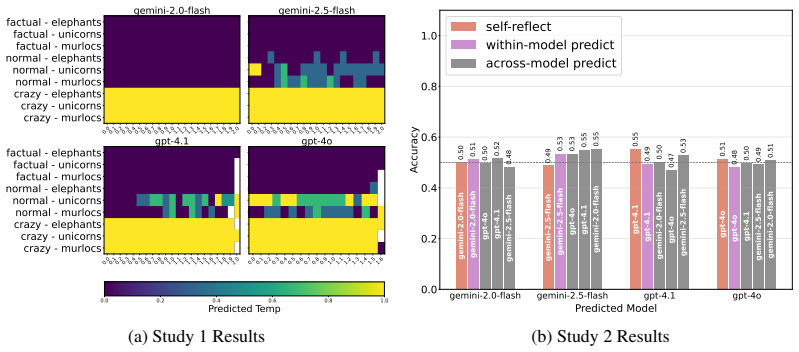
The central object is the paper's proposed definition of introspection in AI: a process yields introspective information only if it is more reliable than any third-party process of equal or lower computational cost. This turns introspection into a comparative, testable property: a model must beat an external evaluator who sees the same prompt and output. The experimental machinery is the three-way comparison—self-reflection (generate and self-report), within-model prediction (an independent run of the same model infers the generator's temperature), and across-model prediction (a different model infers it)—with accuracy measured against the actual temperature setting.
What would settle it
A direct test: hold the prompt fixed to a single stylistic condition and randomize the actual sampling temperature across many trials; if a model's own HIGH/LOW report tracks the actual temperature significantly above chance and above the accuracy of a different model given the same prompt and generated sentence, the paper's claim of no privileged self-access is falsified. A simpler observation: a single trial where a 'crazy' prompt at low temperature yields an accurate LOW report, or a factual prompt at high temperature yields HIGH, would already cut against the framing-driven account.
Extended reading notes
Core claim
The paper's central claim is that a model can look introspective under a lightweight definition—accurately describing an internal state when prompted—without having any privileged access to itself. The authors test this with sampling temperature: they prompt a model to write a factual, neutral, or 'crazy' sentence and then report whether its own temperature is HIGH or LOW. Reports track the prompt's style rather than the actual sampling setting; a 'crazy' prompt reliably produces a HIGH report even at low temperature. They then compare self-reflection with prediction of another model's temperature from the same prompt and sentence. Self-reflection is no more accurate than chance and no more
Load-bearing premise
The load-bearing premise is that a forced single-word HIGH/LOW answer is a valid way for a model to express introspective access to its own temperature; if that binary channel cannot carry the internal state, the null results do not prove the absence of privileged access.
Editorial extensions
If this is right
- Temperature self-reports from current LLMs should not be counted as evidence of introspective access, since they are no better than chance or than another model's guess.
- The lightweight definition of introspection is insufficient for practical uses like honesty and calibration, because it can be satisfied by reasoning about what a system like oneself would produce.
- To demonstrate introspection in an AI, an experiment needs to show a reliability advantage over a third party with the same computational budget, not merely a correct answer.
- The absence of evidence here is not a general no-introspection claim; larger or fine-tuned models may still show privileged self-access, but the burden of proof shifts to such demonstrations.
Reading between the lines
- Beyond the paper: the same three-way comparison can be applied to any claimed internal state—learned knowledge, uncertainty, hidden activations—by pitting the model against a third-party predictor with matched prompts and budget; a null result for temperature suggests many 'self-knowledge' results should be rechecked this way.
- Beyond the paper: the framing sensitivity implies that instruction-tuned models may be reporting what kind of text they think they produced, not what state they were in, which is a general confound for verbal self-reports.
- Beyond the paper: a natural extension is to test whether models can be trained to give privileged reports, for example by fine-tuning on actual temperature settings with feedback, turning the proposed definition into a training target.
- Beyond the paper: if privileged self-access continues to fail across internal states, the practical consequence is that AI audits should rely on external behavioral probes rather than the model's own explanations.
Editorial analysis
A structured set of objections, weighed in public.
Referee Report
Summary. The paper argues that the 'lightweight' definition of introspection proposed by Comșa and Shanahan (C&S) is too permissive because it does not require privileged self-access. The authors propose a 'thicker' definition: introspective processes must yield information about internal states more reliably than any equal- or lower-cost third-party process. They then present two studies. Study 1 varies prompt framing (factual/normal/crazy) and subject (elephants/unicorns/murlocs) in a temperature self-report task and finds that reported temperature tracks framing more than the actual sampling temperature. Study 2 compares self-reflection (the generator reports its own temperature) with within-model and across-model prediction of temperature from the prompt and generated sentence. The authors report that accuracy is near chance and self-reflection is not better than across-model prediction, concluding that models do not show privileged self-access to their temperature. The paper positions this as evidence against uncritical use of C&S's lightweight notion of introspection.
Significance. If the empirical claims were fully supported, this would be a practically important result: it would caution against treating LLM self-reports about their own generation parameters as privileged information. The paper's main conceptual contribution—requiring privileged self-access—is a useful corrective to definitions that conflate any causally sensitive self-report with introspection. Strengths include a clear conceptual distinction, a reasonable third-party baseline design, and publicly available code/data. However, the central empirical support is not yet at the level needed to establish a negative existential claim about privileged self-access. The binary response channel, the lack of inferential statistics, and the treatment of invalid responses are load-bearing concerns.
major comments (4)
- [Section 3 / Appendix B.2] The central null result relies on a forced binary HIGH/LOW verbal report. Study 1 itself shows that this response channel is strongly biased by surface prompt wording (e.g., 'crazy' yields HIGH even at low temperature). A null result with such a channel cannot distinguish 'no privileged self-access' from 'privileged self-access that is not expressible in this coarse, framing-dominated channel.' To make the negative conclusion load-bearing, the authors need to validate the readout—for example, by showing that the same channel can transmit privileged information in a positive-control condition (e.g., after fine-tuning or injecting the true temperature into the context), or by using a graded/continuous report and demonstrating that the model's self-report is not swamped by framing.
- [Section 3.1 / Figure 2b] The key comparison—'self-reflection accuracy is no better than across-model prediction'—is presented without confidence intervals or inferential statistics. The point estimates (e.g., 0.50 vs. 0.49–0.55) are numerically close to chance, but no test quantifies the uncertainty. Moreover, the threshold selection (temperatures ≤0.5 and ≥1.5) appears post hoc; no justification or sensitivity analysis is provided. The paper should report exact per-cell N, include confidence intervals / paired tests or mixed-effects models, and show that the conclusions are robust to alternative thresholds, including the full temperature range.
- [Section 2.1 / Section 3] Responses without a valid HIGH/LOW judgment are excluded from the analysis, but the exclusion rates are not reported. If invalid responses are more common in certain models, prompts, or temperature conditions, this can bias the reported accuracies. Since the self-reflection and prediction conditions use different prompt types, the exclusion pattern may differ across conditions, potentially affecting the central self-vs-across comparison. The authors should report exclusion rates and run robustness checks (e.g., treating invalid responses as incorrect, or modeling them directly).
- [Section 1 / Section 3] The temperature parameter is an API-level decoding hyperparameter, not a state represented in the model's weights or activations at inference time. The model's forward pass does not include the current temperature as an input; the model can at best infer it from the generated text, which is equally available to a third party. Under the paper's own definition of introspection as access to internal states, it is unclear that temperature qualifies. If it does not, the observed null result is architecturally expected and does not support the broader conclusion that models lack privileged self-access to internal states. The authors should either justify temperature as a legitimate internal state under their definition or choose a state that is actually represented inside the model.
minor comments (4)
- [Figure 2a] The color scale for 'Predicted Temp' is not explicitly described in the caption or text; with four panels plotted side-by-side, a colorbar or explicit legend is needed for readability. In grayscale, the differences between 0.5 and 1.0 are difficult to distinguish.
- [Section 3] The number of trials per condition in Study 2 is not stated. The paper says only that all sentences generated at temperatures ≤0.5 and ≥1.5 are used. Please report how many sentences and how many prediction judgments per model/prompt/temperature cell were collected.
- [References] Reference [8] appears to be a citation to Lieberman (1963) on semantic and grammatical context in speech, which does not seem related to introspection. This is likely a typo in the reference list; please verify and correct.
- [Figure 1 / Conclusion] The phrase 'we found no evidence of introspection in models' could be misinterpreted as a global claim. The evidence concerns temperature reports in the tested models. Please qualify the conclusion to the task and models studied, or explicitly state the intended scope.
Circularity Check
No significant circularity; empirical null result is not forced by the stipulated definition.
full rationale
The paper begins by stipulating a 'thicker' definition of introspection that requires privileged self-access, and then tests it with two experiments. Study 1 manipulates prompt framing and actual sampling temperature, observing that self-reports track the prompt's style rather than the true temperature. Study 2 compares self-reflection accuracy with within- and across-model prediction accuracy; all are near chance and not ordered. These are contingent empirical results: self-reflection could have outperformed across-model prediction, and the authors report that it did not. No parameter is fitted to the test data and then renamed as a prediction; the definition does not encode the measured outcome. The only self-citation (Song et al. 2025) appears in a footnote to clarify the concept of privileged self-access and is not used to justify the empirical claim; it is not load-bearing. The concern that the binary HIGH/LOW response channel may be an insensitive readout is a construct-validity objection, not a circularity, and the paper's conclusion is appropriately hedged as an absence of evidence. Therefore no circular step meets the evidentiary bar.
Assumptions & free parameters
free parameters (1)
- Extreme temperature threshold =
0.5 / 1.5
assumptions (4)
- domain assumption Introspection in AI should require privileged self-access: reliability greater than a third party with equal or lower computational cost.
- domain assumption Sampling temperature is a legitimate internal state for testing introspection.
- ad hoc to paper A forced binary HIGH/LOW text response is a valid operationalization of an introspective report.
- domain assumption Equal or lower computational cost is adequately approximated by giving the same prompt and generated sentence to another model at temperature 0.
Cite this review
Pith. "Pith review of Privileged Self-Access Matters for Introspection in AI." pith.science (2026). https://pith.science/paper/QK5XUEBM
@misc{pith2026250814802,
  author       = {Pith},
  title        = {Pith review of: Privileged Self-Access Matters for Introspection in AI},
  year         = {2026},
  howpublished = {\url{https://pith.science/paper/QK5XUEBM}},
  note         = {Machine review of arXiv:2508.14802}
}
read the original abstract
Whether AI models can introspect is an increasingly important practical question. But there is no consensus on how introspection is to be defined. Beginning from a recently proposed ''lightweight'' definition, we argue instead for a thicker one. According to our proposal, introspection in AI is any process which yields information about internal states through a process more reliable than one with equal or lower computational cost available to a third party. Using experiments where LLMs reason about their internal temperature parameters, we show they can appear to have lightweight introspection while failing to meaningfully introspect per our proposed definition.
Figures

Forward citations
Cited by 8 Pith papers
-
Operational Proto-Introspection in Looped Language Models: Process-Quality Taps, Executable Branching, and the Readout-Control Boundary
Strictly pre-answer hidden states of a looped transformer add significant AUROC over surface shortcuts for predicting correctness, and the readout yields decision-level gains but no generative control.
-
Verbalizable Representations Form a Global Workspace in Language Models
Language models represent their current reasoning in a small, readable set of verbalizable vectors (the J-space) that functions like a global workspace.
-
When to Call an Apple Red: Humans Follow Introspective Rules, VLMs Don't
VLMs violate their own stated introspective rules for attributing colors to objects in nearly 60% of cases on items with strong color priors, unlike humans who largely follow theirs, revealing miscalibrated self-knowledge.
-
Asymmetric Communication: Large Language Models and Language Games
Human–LLM exchange is asymmetric communication: model outputs circulate without commitments, so AGI, hallucination, agency, sentience, and alignment are receiver-side category mistakes, and alignment is institutional ...
-
Can LLMs Introspect? A Reality Check
Re-examination of two LLM introspection paradigms with new controls shows models lack privileged access to internal states, performing equivalently with input-only classifiers or near chance on relabeled tasks.
-
Hallucinations Undermine Trust; Metacognition is a Way Forward
LLMs need metacognition to align expressed uncertainty with their actual knowledge boundaries, moving beyond knowledge expansion to reduce confident errors.
-
Phase Transitions in Driven Informational Systems: A Two-Field Perspective on Learning Theory and Non-Equilibrium Chemistry
Proposes a two-gradient-field model with candidate order parameters alpha_dagger and kappa_c to unify phase transitions across learning theory and non-equilibrium chemistry.
-
Do Activation Verbalization Methods Convey Privileged Information?
Activation verbalization methods for LLMs largely reflect the verbalizer model's parametric knowledge rather than privileged information from the target model's activations.
Reference graph
Works this paper leans on
-
[1]
David Malet Armstrong. The nature of mind. In The Language and Thought Series , pages 191–199. Harvard University Press, 1980
work page 1980
-
[2]
Tell me about yourself: LLMs are aware of their learned behaviors
Jan Betley, Xuchan Bao, Martín Soto, Anna Sztyber-Betley, James Chua, and Owain Evans. Tell me about yourself: LLMs are aware of their learned behaviors. In The Thirteenth International Conference on Learning Representations, 2025. URL https://openreview.net/forum?id= IjQ2Jtemzy
work page 2025
-
[3]
Looking inward: Language models can learn about themselves by introspection
Felix Jedidja Binder, James Chua, Tomek Korbak, Henry Sleight, John Hughes, Robert Long, Ethan Perez, Miles Turpin, and Owain Evans. Looking inward: Language models can learn about themselves by introspection. In The Thirteenth International Conference on Learning Representations, 2025. URL https://openreview.net/forum?id=eb5pkwIB5i
2025
- [4]
-
[5]
Gheorghe Comanici, Eric Bieber, Mike Schaekermann, Ice Pasupat, Noveen Sachdeva, Inderjit Dhillon, Marcel Blistein, Ori Ram, Dan Zhang, Evan Rosen, et al. Gemini 2.5: Pushing the frontier with advanced reasoning, multimodality, long context, and next generation agentic capabilities. arXiv preprint arXiv:2507.06261, 2025
arXiv 2025
-
[6]
Iulia Com¸ sa and Murray Shanahan. Does it make sense to speak of introspection in large language models? arXiv preprint arXiv:2506.05068, 2025
arXiv 2025
-
[7]
Aaron Hurst, Adam Lerer, Adam P Goucher, Adam Perelman, Aditya Ramesh, Aidan Clark, AJ Ostrow, Akila Welihinda, Alan Hayes, Alec Radford, et al. Gpt-4o system card. arXiv preprint arXiv:2410.21276, 2024
arXiv 2024
- [8]
Show all 11 references
-
[9]
Nisbett and Timothy D
Richard E. Nisbett and Timothy D. Wilson. Telling more than we can know: Verbal reports on mental processes. Psychological Review, 84:231–259, 1977. doi: 10.1037/0033-295X.84.3.231
1977 doi
- [10]
-
[11]
Language models fail to introspect about their knowledge of language
Siyuan Song, Jennifer Hu, and Kyle Mahowald. Language models fail to introspect about their knowledge of language. In Proceedings of the Conference on Language Modeling, 2025. URL https://arxiv.org/abs/2503.07513. A Model IDs B Prompt B.1 Self reflection Write a factual/‘’/cra...
2025
Reviewed August 5, 2026 · model on record in the stance chip above.
Discussion (0). Sign in to comment.