A Vision-Based Shared-Control Teleoperation Scheme for Controlling the Robotic Arm of a Four-Legged Robot
Pith reviewed 2026-05-18 21:45 UTC · model grok-4.3
The pith
A camera and machine learning model translate human wrist movements into safe commands for a quadruped robot's arm.
A machine-rendered reading of the paper's core claim, the machinery that carries it, and where it could break.
Core claim
The authors propose and implement a vision-based shared-control teleoperation scheme that uses an external camera and a machine learning model to detect the operator's wrist position, maps those positions into real-time robotic arm commands, and employs a trajectory planner to avoid collisions with obstacles and the arm itself, with successful validation on the physical quadruped robot.
What carries the argument
Vision-based pose estimation pipeline that uses an external camera and machine learning model to detect wrist position and maps it to arm commands, combined with a trajectory planner that enforces collision-free paths.
Load-bearing premise
The machine learning model will keep detecting the wrist position accurately across different lighting, distances, and backgrounds while the planner stops or redirects the arm before any collision occurs.
What would settle it
Run a session in which the operator moves their wrist to command the arm toward a visible obstacle and record whether the arm stops short or the pose tracker loses the wrist under normal room lighting changes.
Figures


read the original abstract
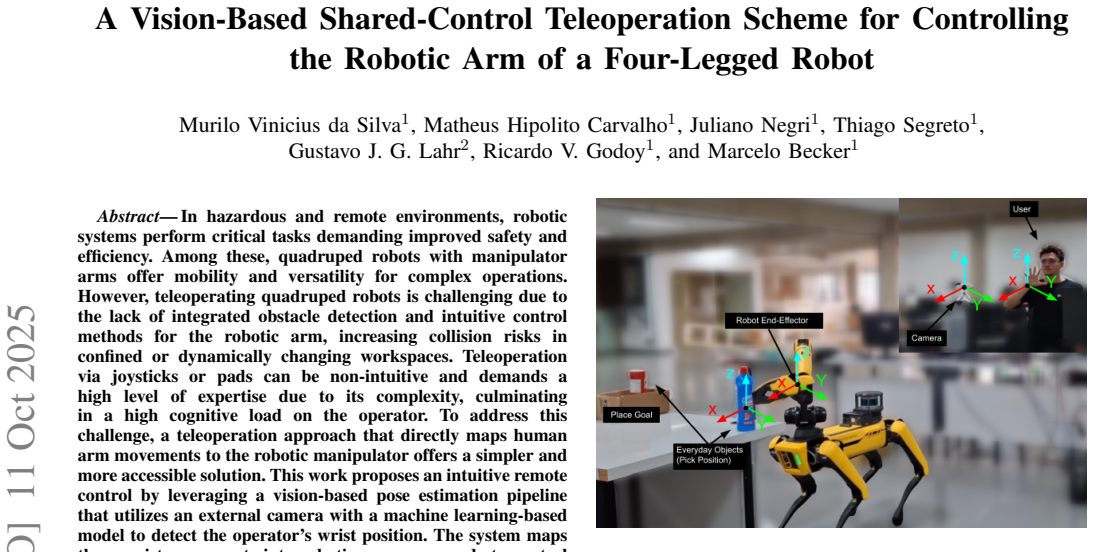
In hazardous and remote environments, robotic systems perform critical tasks demanding improved safety and efficiency. Among these, quadruped robots with manipulator arms offer mobility and versatility for complex operations. However, teleoperating quadruped robots is challenging due to the lack of integrated obstacle detection and intuitive control methods for the robotic arm, increasing collision risks in confined or dynamically changing workspaces. Teleoperation via joysticks or pads can be non-intuitive and demands a high level of expertise due to its complexity, culminating in a high cognitive load on the operator. To address this challenge, a teleoperation approach that directly maps human arm movements to the robotic manipulator offers a simpler and more accessible solution. This work proposes an intuitive remote control by leveraging a vision-based pose estimation pipeline that utilizes an external camera with a machine learning-based model to detect the operator's wrist position. The system maps these wrist movements into robotic arm commands to control the robot's arm in real-time. A trajectory planner ensures safe teleoperation by detecting and preventing collisions with both obstacles and the robotic arm itself. The system was validated on the real robot, demonstrating robust performance in real-time control. This teleoperation approach provides a cost-effective solution for industrial applications where safety, precision, and ease of use are paramount, ensuring reliable and intuitive robotic control in high-risk environments.
Editorial analysis
A structured set of objections, weighed in public.
Referee Report
Summary. The paper proposes a vision-based shared-control teleoperation system for the robotic arm mounted on a quadruped robot. An external camera and machine-learning model detect the operator's wrist position in real time; these positions are mapped to manipulator commands. A trajectory planner detects and avoids collisions with obstacles and the arm itself. The abstract states that the system was validated on the physical robot and exhibited robust real-time performance, offering a cost-effective, intuitive alternative to joystick-based control for hazardous environments.
Significance. If the validation claims were supported by quantitative evidence, the work would provide a practical, low-cost teleoperation interface that reduces operator cognitive load while improving safety through integrated collision avoidance. The combination of off-the-shelf ML pose estimation with standard planning is straightforward and potentially reproducible, but the current manuscript supplies no metrics that would allow readers to assess accuracy, latency, or reliability relative to prior teleoperation schemes.
major comments (2)
- [Abstract] Abstract: The statement that 'the system was validated on the real robot, demonstrating robust performance in real-time control' is unsupported by any quantitative results. No wrist-position RMSE, detection-rate statistics under varying lighting or poses, end-to-end latency figures, collision-avoidance success/failure counts, or test conditions (dynamic obstacles, lighting changes) are reported. This absence directly undermines the central claim that the pipeline enables reliable shared-control teleoperation.
- [Validation / Experiments] Validation / Experiments section (inferred from abstract claims): The trajectory planner is asserted to 'ensure safe teleoperation by detecting and preventing collisions,' yet no description of the planner's algorithm, collision-checking method, or empirical failure modes is supplied. Without these details or accompanying performance data, it is impossible to evaluate whether the planner reliably prevents self-collisions or obstacle contacts in the claimed operating regime.
minor comments (2)
- [Abstract] The abstract and introduction repeatedly use the term 'robust performance' without defining the term or providing the metrics that would substantiate it.
- [Introduction] No comparison is drawn to existing vision-based or shared-control teleoperation methods for manipulators on mobile bases; a brief related-work paragraph would help situate the contribution.
Simulated Author's Rebuttal
We thank the referee for the constructive and detailed feedback. We address each major comment below and outline the revisions we will make to strengthen the manuscript.
read point-by-point responses
-
Referee: [Abstract] Abstract: The statement that 'the system was validated on the real robot, demonstrating robust performance in real-time control' is unsupported by any quantitative results. No wrist-position RMSE, detection-rate statistics under varying lighting or poses, end-to-end latency figures, collision-avoidance success/failure counts, or test conditions (dynamic obstacles, lighting changes) are reported. This absence directly undermines the central claim that the pipeline enables reliable shared-control teleoperation.
Authors: We agree that the abstract claim of robust real-time performance would be stronger with explicit quantitative support. The current manuscript presents the validation primarily through qualitative description of physical-robot tests. In the revised version we will qualify the abstract statement and add a concise summary of key metrics (end-to-end latency, wrist-detection accuracy across lighting/pose variations, and collision-avoidance success rates) drawn from our existing experimental recordings. These numbers will also be presented with test-condition details in an expanded Experiments section. revision: yes
-
Referee: [Validation / Experiments] Validation / Experiments section (inferred from abstract claims): The trajectory planner is asserted to 'ensure safe teleoperation by detecting and preventing collisions,' yet no description of the planner's algorithm, collision-checking method, or empirical failure modes is supplied. Without these details or accompanying performance data, it is impossible to evaluate whether the planner reliably prevents self-collisions or obstacle contacts in the claimed operating regime.
Authors: We acknowledge that the trajectory planner receives only a high-level mention. We will revise the manuscript to include a dedicated subsection describing the planner algorithm, the collision-checking implementation (including how self-collisions and external obstacles are handled), and quantitative results on success/failure rates together with observed failure modes under dynamic-obstacle and self-collision test scenarios. revision: yes
Circularity Check
No significant circularity; system description relies on external ML and planning components
full rationale
The paper presents a descriptive system architecture for vision-based teleoperation of a quadruped's robotic arm, using an external camera with a machine-learning pose estimator to detect wrist position, direct mapping to arm commands, and a trajectory planner for collision avoidance. Validation is claimed via real-robot testing with 'robust performance,' but this is an empirical assertion rather than a mathematical derivation or self-referential prediction. No equations, parameter-fitting steps presented as predictions, self-citations that bear the central load, or ansatzes smuggled through prior work are present in the abstract or described content. The approach draws on standard external techniques without reducing any claimed result to its own inputs by construction, making the derivation chain self-contained against external benchmarks.
Axiom & Free-Parameter Ledger
Reference graph
Works this paper leans on
-
[1]
Automation and robotics in the context of industry 4.0: the shift to collaborative robots,
R. Galin and R. Meshcheryakov, “Automation and robotics in the context of industry 4.0: the shift to collaborative robots,” inIOP Conference Series: Materials Science and Engineering, vol. 537, no. 3. IOP Publishing, 2019, p. 032073
work page 2019
-
[2]
Anymal - a highly mobile and dynamic quadrupedal robot,
M. Hutter, C. Gehring, D. Jud, A. Lauber, C. D. Bellicoso, V . Tsounis, J. Hwangbo, K. Bodie, P. Fankhauser, M. Bloesch, R. Diethelm, S. Bachmann, A. Melzer, and M. Hoepflinger, “Anymal - a highly mobile and dynamic quadrupedal robot,” in2016 IEEE/RSJ Interna- tional Conference on Intelligent Robots and Systems (IROS), 2016
work page 2016
-
[3]
Emergency response by robots to fukushima-daiichi accident: summary and lessons learned,
S. Kawatsuma, M. Fukushima, and T. Okada, “Emergency response by robots to fukushima-daiichi accident: summary and lessons learned,” Industrial Robot: An International Journal, 2012
work page 2012
-
[4]
Rescue robots for the urban earthquake environment,
F. Li, S. Hou, C. Bu, and B. Qu, “Rescue robots for the urban earthquake environment,”Disaster Medicine and Public Health Pre- paredness, vol. 17, p. e181, 2023
work page 2023
-
[5]
The darpa robotics challenge finals: Results and perspectives,
E. Krotkov, M. Diftler, R. Ambrose, A. Deguet, B. Pires, M. De- Donato, Z. Kazi, and W. Kim, “The darpa robotics challenge finals: Results and perspectives,”Journal of Field Robotics, 2017
work page 2017
-
[6]
Ad- vancing teleoperation for legged manipulation with wearable motion capture,
C. Zhou, Y . Wan, C. Peers, A. M. Delfaki, and D. Kanoulas, “Ad- vancing teleoperation for legged manipulation with wearable motion capture,”Frontiers in Robotics and AI, 2024
work page 2024
-
[7]
D. Dall’AlBa and F. Boriero, “Towards an intuitive industrial teaching interface for collaborative robots: gamepad teleoperation vs. kines- thetic teaching,”The International Journal of Advanced Manufactur- ing Technology, vol. 138, no. 3, pp. 1505–1522, 2025
work page 2025
-
[8]
Assistive robotic manipulation through shared autonomy and a body-machine interface,
S. Jain, A. Farshchiansadegh, A. Broad, F. Abdollahi, F. Mussa- Ivaldi, and B. Argall, “Assistive robotic manipulation through shared autonomy and a body-machine interface,” in2015 IEEE International Conference on Rehabilitation Robotics (ICORR), 2015, pp. 526–531
work page 2015
-
[9]
Enabling always-available input with muscle-computer interfaces,
T. S. Saponas, D. S. Tan, D. Morris, R. Balakrishnan, J. Turner, and J. A. Landay, “Enabling always-available input with muscle-computer interfaces,” inProceedings of the 22nd annual ACM symposium on User interface software and technology, 2009, pp. 167–176
work page 2009
-
[10]
A. Mohammadi, C. Wang, T. Yu, Y . Tan, P. Choong, and D. Oetomo, “An information-rich and highly wearable soft sensor system based on displacement myography for practical hand gesture interfaces,”IEEE Journal of Biomedical and Health Informatics, 2025
work page 2025
-
[11]
Intuitive human- robot-environment interaction with emg signals: A review,
D. Xiong, D. Zhang, Y . Chu, Y . Zhao, and X. Zhao, “Intuitive human- robot-environment interaction with emg signals: A review,”IEEE/CAA Journal of Automatica Sinica, vol. 11, no. 5, pp. 1075–1091, 2024
work page 2024
-
[12]
Multimodal fusion of emg and vision for human grasp intent inference in prosthetic hand control,
M. Zandigohar, M. Han, M. Sharif, S. Y . G ¨unay, M. P. Fur- manek, M. Yarossi, P. Bonato, C. Onal, T. Padır, D. Erdo ˘gmus ¸, and G. Schirner, “Multimodal fusion of emg and vision for human grasp intent inference in prosthetic hand control,”Frontiers in Robotics and AI, vol. 11, 2024
work page 2024
-
[13]
R. V . Godoy, B. Guan, A. Dwivedi, and M. Liarokapis, “An affor- dances and electromyography based telemanipulation framework for control of robotic arm-hand systems,” in2023 IEEE/RSJ International Conference on Intelligent Robots and Systems (IROS). IEEE, 2023
work page 2023
-
[14]
Single- shot monocular rgb-d imaging using uneven double refraction,
A. Meuleman, S.-H. Baek, F. Heide, and M. H. Kim, “Single- shot monocular rgb-d imaging using uneven double refraction,” in Proceedings of the IEEE/CVF Conference on Computer Vision and Pattern Recognition (CVPR), 2020, pp. 11 335–11 344
work page 2020
-
[15]
Cameras in slam: Comparison between monocular, stereo and rgbd slam,
M. Kwon, “Cameras in slam: Comparison between monocular, stereo and rgbd slam,”Online Article, 2023, accessed: 2025-06-06. [Online]. Available: https://www.mingukwon.com/posts/cameras-in-slam/
work page 2023
-
[16]
Dis- ambiguating monocular depth estimation with a single transient,
M. Nishimura, D. B. Lindell, C. Metzler, and G. Wetzstein, “Dis- ambiguating monocular depth estimation with a single transient,” in Computer Vision – ECCV 2020, A. Vedaldi, H. Bischof, T. Brox, and J.-M. Frahm, Eds. Springer International Publishing, 2020
work page 2020
-
[17]
Review of monocular depth estimation methods,
Z. Zhang, Y . Zhang, Y . Li, and L. Wu, “Review of monocular depth estimation methods,”Journal of Electronic Imaging, p. 020901, 2025
work page 2025
-
[18]
D4d: An rgbd diffusion model to boost monocular depth estimation,
L. Papa, P. Russo, and I. Amerini, “D4d: An rgbd diffusion model to boost monocular depth estimation,”IEEE Transactions on Circuits and Systems for Video Technology, no. 10, 2024
work page 2024
-
[19]
Semi- autonomous robot teleoperation with obstacle avoidance via model predictive control,
M. Rubagotti, T. Taunyazov, B. Omarali, and A. Shintemirov, “Semi- autonomous robot teleoperation with obstacle avoidance via model predictive control,”IEEE Robotics and Automation Letters, 2019
work page 2019
-
[20]
D. Min, H. Yoon, and D. Lee, “A semi-autonomous telemanipulation order-picking control based on estimating operator intent for box- stacking storage environments,”Sensors, vol. 25, no. 4, p. 1217, 2025
work page 2025
-
[21]
Aberration-robust monocular passive depth sensing using a meta-imaging camera,
Z. Cao, N. Li, L. Zhu, J. Wu, Q. Dai, and H. Qiao, “Aberration-robust monocular passive depth sensing using a meta-imaging camera,”Light: Science & Applications, vol. 13, no. 1, p. 236, 2024
work page 2024
-
[22]
ROS: an open-source Robot Operating System,
M. Quigley, K. Conley, B. P. Gerkey, J. Faust, T. Foote, J. Leibs, R. Wheeler, and A. Y . Ng, “ROS: an open-source Robot Operating System,” inICRA Workshop on Open Source Software, 2009
work page 2009
-
[23]
Google, “Mediapipe,” https://google.github.io/mediapipe/, 2024, ac- cessed: 2025-06-06
work page 2024
-
[24]
Automatic generation and detection of highly reliable fiducial markers under occlusion,
S. Garrido-Jurado, R. Mu ˜noz-Salinas, F. J. Madrid-Cuevas, and M. J. Mar´ın-Jim´enez, “Automatic generation and detection of highly reliable fiducial markers under occlusion,”Pattern Recognition, 2014
work page 2014
-
[25]
Aruco: A minimal library for augmented reality applications based on opencv,
R. Munoz-Salinas, S. Garrido-Jurado, F. J. Madrid-Cuevas, and M. J. Mar´ın-Jim´enez, “Aruco: A minimal library for augmented reality applications based on opencv,”2012 21st International Conference on Real-Time Image Processing, 2012
work page 2012
-
[26]
Spot SDK: Software development kit for the spot robot,
Boston Dynamics, “Spot SDK: Software development kit for the spot robot,” https://github.com/boston-dynamics/spot-sdk, 2025, accessed: 2025-05-31
work page 2025
-
[27]
Moveit: An open-source robot motion planning framework,
I. A. Sucan, S. Chitta, E. G. Jones, M. J. Zabriskie, V . A. Prisacariu, M. Arguedas, M. Lautman, D. Coleman, A. McEvoy, R. Haschke, M. Ferguson, and S. Edwards, “Moveit: An open-source robot motion planning framework,”IEEE Robotics & Automation Magazine, 2022
work page 2022
-
[28]
Ultralytics, “Yolo by ultralytics,” https://github.com/ultralytics/ ultralytics, 2023, accessed: 2025-06-06
work page 2023
-
[29]
B. Guan, R. V . Godoy, F. Sanches, A. Dwivedi, and M. Liarokapis, “On semi-autonomous robotic telemanipulation employing electromyog- raphy based motion decoding and potential fields,” inIEEE/RSJ International Conference on Intelligent Robots and Systems (IROS), 2023
work page 2023
discussion (0)
Sign in with ORCID, Apple, or X to comment. Anyone can read and Pith papers without signing in.