REVIEW 4 major objections 4 minor 50 references
Augmenting code with minimal label-flipping counterfactual pairs makes a GNN-based vulnerability detector far more robust and its explanations align with semantically relevant statements.
Reviewed by Pith at T0; open to challenge. T0 means a machine referee read the full paper against a public rubric. the ladder, T0–T4 →
LLM-generated counterfactual code pairs with flipped vulnerability labels, used to train a GNN, sharply improve CWE-20 detection and attribution on the released CWE-20-CFA benchmark.
T0 review reviewed 2026-08-05 challenge →
load-bearing objection The headline gains are close to the trivial ceiling set by the test-set confound, so the central robustness claim is not supported as written. the 4 major comments →
VISION: Robust and Interpretable Code Vulnerability Detection Leveraging Counterfactual Augmentation
The pith
A machine-rendered reading of the paper's core claim, the machinery that carries it, and where it could break.
The reading
Core claim
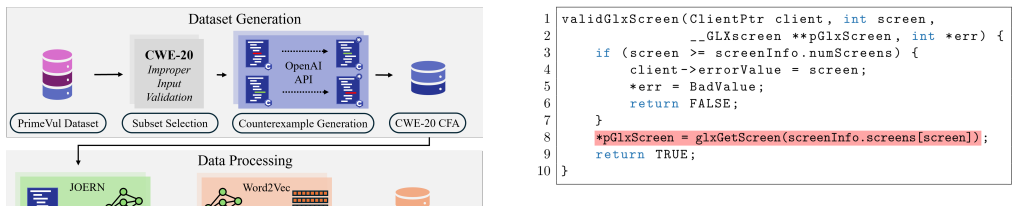
The paper's central claim is that a graph neural network trained on original code samples paired with counterfactual versions—functions minimally edited so their vulnerability label flips—stops relying on spurious correlations and starts encoding the semantic difference between safe and unsafe handling of input. The authors build VISION around a GNN code classifier fed with code property graphs; a large language model produces the counterfactual rewrites, and training is done on balanced original/counterfactual pairs. On the CWE-20 (Improper Input Validation) subset, they report overall accuracy rising from 51.8% to 97.8%, pairwise contrast accuracy from 4.5% to 95.8%, and worst-group accura
What carries the argument
The load-bearing object is the counterfactual pair: an original function and a minimally edited version with the opposite vulnerability label. The pair is converted to a code property graph—a unified graph of syntax, control flow, and data dependencies—so that the model sees two nearly identical graphs that differ exactly where the vulnerability semantics change. Paired training on these examples forces the classifier to make fine-grained distinctions; the paper finds a roughly 50/50 mixture of original and generated counterfactual examples is the operating point where accuracy, pairwise contrast, and worst-group accuracy are all high. A post-hoc subgraph explainer then marks which code stat
Load-bearing premise
The result collapses if the 'minimally edited label-flipping' counterfactuals are not actually minimal and semantically valid, because then the model could be learning to recognize the LLM's editing style instead of real vulnerability semantics; the paper removes unvalidated samples but does not describe how validation was done, and concedes in Section 5 that generated counterfactuals 'may occasionally introduce unrealistic or noisy modifications.'
What would settle it
Use a held-out set of counterfactuals created by a different method or verified by human experts; if pairwise contrast accuracy and worst-group accuracy drop sharply relative to the same-pipeline test set, the gains are attributable to test-set artifacts rather than to semantic learning. A second falsifier is to train a small classifier to tell original from counterfactual functions: if it can do so with high accuracy, the augmentation carries a surface signature the GNN could exploit.
If this is right
- Balanced counterfactual augmentation can take a vulnerability detector from near-random pairwise discrimination to roughly 96% contrast accuracy, implying the model is picking up label-flipping edits rather than class-level heuristics.
- Worst-group accuracy above 85% implies the learned representations are not brittle on hard subgroups of the data, addressing a failure mode of imbalanced vulnerability benchmarks.
- The released balanced dataset gives the community a benchmark on which future augmentation and explanation methods can be compared.
- The attribution metrics give a way to test whether a model's explanations are consistent within a class and distinct between classes, not just whether predictions are correct.
- The interactive visualization makes counterfactual explanations inspectable by a human analyst, which is relevant for actual use in security workflows.
Where Pith is reading between the lines
- The same paired-contrast training signal could plausibly be applied to other code-understanding tasks where the goal is to detect a semantic flip, such as bug localization or API misuse, but this is a conjecture beyond the paper's CWE-20 evaluation.
- Because the counterfactuals in the test set are produced by the same LLM pipeline used for training, the reported absolute numbers should be read as upper bounds until independent or human-verified counterfactuals confirm them.
- The node-dependency metric may be reusable as a general probe for spurious dependencies in graph neural network explanations, even outside source code.
- If the effect replicates across other CWEs and languages, the result would suggest that synthetic minimal edits can substitute for expensive manual clean-label data in robustness training; the paper leaves that replication open.
Editorial analysis
A structured set of objections, weighed in public.
Referee Report
Summary. The paper proposes VISION, a framework for GNN-based CWE-20 vulnerability detection that augments a PrimeVul-derived training set with LLM-generated counterfactual code pairs, trains a Devign-style GNN on paired examples, and uses Illuminati plus a visualization module for attribution. The reported contributions are a new balanced counterfactual benchmark CWE-20-CFA (27,556 functions), large gains in accuracy (51.8%→97.8%), pairwise contrast accuracy (4.5%→95.8%), worst-group accuracy (0.7%→85.5%), and new attribution metrics (intra-class variance, inter-class distance, node-score dependency). The central claim is causal: counterfactual augmentation, rather than class balancing or generation artifacts, mitigates spurious correlations and yields robust, interpretable detection.
Significance. If the causal claim were established, the paper would offer a practical, scalable way to improve vulnerability detectors and a useful new benchmark. The code and benchmark are publicly released, and the sweep over original/counterfactual training ratios is a sensible experimental design. However, the evaluation as presented confounds vulnerability semantics with the original-vs-counterfactual source of each sample, so the headline numbers cannot be interpreted as evidence of learning CWE-20 semantics. The interpretability claims likewise are not validated against ground truth. The potential significance is real, but the current evidence does not support it.
major comments (4)
- [Section 4, Table 1 and 'Dataset Splitting and Augmentation Strategy'] The evaluation is confounded by the near-perfect correlation between class label and data source. In CWE-20-CFA, 13,349 of 13,778 vulnerable functions are counterfactuals (96.9%) and 13,349 of 13,778 benign functions are originals (96.9%). Since each test ID contributes both its original and its counterfactual, a trivial source-detection rule—counterfactual→vulnerable, original→benign—achieves ≈96.9% overall accuracy and ≈96.9% pairwise contrast on the fixed test set. The headline results (97.8% accuracy; 95.79% P-C) are essentially at this ceiling. The paper never reports accuracy on original-only held-out functions or source-stratified test performance, so the central claim that the model learned CWE-20 semantics rather than LLM-generation style is not supported by the reported numbers.
- [Section 3 'Counterfactual Generation and Augmentation' and Section 5 'Conclusions and Future Work'] Counterfactual validity is load-bearing, but the validation procedure is asserted, not described. The text says samples whose counterfactuals 'could not be reliably created or validated' were removed, without specifying the reliability or validation protocol. Section 5 concedes that LLM-generated counterfactuals 'may occasionally introduce unrealistic or noisy modifications' and defers formal verification to future work. Without a concrete validation protocol or a control experiment (e.g., random LLM perturbations using the same generation pipeline), one cannot rule out that the model is detecting generation artifacts. This is exactly the kind of shortcut that would produce the near-ceiling results.
- [Section 4 'Worst-Group Accuracy'] The subgroup definition is circular with respect to the model being evaluated. WGA is computed by K-means clustering the trained model's own graph embeddings, so the worst group is an artifact of the model's representation, not an externally defined spurious attribute. The authors' own observation that WGA2 'almost perfectly separates the two ground-truth classes' confirms that WGA2 essentially tracks class-level accuracy. In the presence of the source–label confound, high WGA values do not provide independent evidence that spurious correlations have been mitigated.
- [Section 4 'Intra-Class Attribution Variance, Inter-Class Attribution Distance, Node Score Dependency'] These metrics are proposed as measures of explanation quality, but no evidence links them to the correctness of explanations. There is no human study, no alignment with ground-truth vulnerable statements, and no comparison with an established explanation-quality metric. The qualitative claim in Figure 8 is based on a single function and is not a systematic evaluation. As with the predictive metrics, the attribution metrics are computed on a test set where label and source are confounded, so they may simply reflect the same generated-vs-original shortcut.
minor comments (4)
- [Figure 5 and Section 4 'Dataset Splitting and Augmentation Strategy'] The composition of the training splits is hard to follow. The text says examples are 'independently upsampled per class and data source as needed,' but no actual counts are given. A table with exact split sizes would improve reproducibility.
- [Section 4] All reported numbers appear to be single-run point estimates. Given the strong claims, standard deviations across random seeds (and ideally multiple dataset splits) should be reported.
- [Section 3] Typographical issues: 'Improper Input V alidation' contains a stray space. Several references also have artifacts such as 'Y .' in author initials.
- [Abstract and Section 4 'Pair-Wise Accuracy'] The abstract's 'pairwise contrast accuracy' is not explicitly tied to P-C from Table 3. The formal definition appears later, but the abstract should be consistent with the exact metric.
Circularity Check
CWE-20-CFA confounds label with counterfactual source: 96.9% of vulnerable test samples are LLM-generated counterfactuals and 96.9% of benign test samples are originals, so the reported gains can be achieved by detecting generation source rather than CWE-20 semantics; WGA is also defined from the model's own embeddings.
specific steps
-
self definitional
[Table 1; Section 4, 'Dataset Splitting and Augmentation Strategy']
"CWE-20 CFA 13,778 13,778 27,556 ... Original 13,349 429 13,778 ... Counterfactual 429 13,349 13,778 ... The test set contains both versions of each function, ensuring perfect class balance and mirrored pairings."
In the balanced CWE-20-CFA set, 13,349/13,778 (96.9%) of vulnerable samples are counterfactuals and 13,349/13,778 of benign samples are originals. Since the fixed test set preserves every original–counterfactual pair, the target label is almost perfectly aligned with the binary feature 'is LLM-generated'. A model that labels counterfactuals vulnerable and originals benign attains ~96.9% test accuracy and ~96.9% pair-correct contrast by construction. The reported 97.8% accuracy and 95.8% P-C are therefore consistent with a shortcut on generation source, not with learning CWE-20 semantics; no original-only or counterfactual-only evaluation is reported to rule this out.
-
other
[Section 4, 'Worst-Group Accuracy']
"Since no explicit spurious attributes are available, we adopt an unsupervised approach to define these subgroups. First, we extract latent code embeddings from the trained model and apply K-means clustering to identify groups of structurally or stylistically similar functions."
WGA is proposed as a robustness metric for spurious correlations, but the subgroups are defined by K-means on the trained model's own embeddings. The model being evaluated therefore determines the groups against which it is evaluated; high WGA can reflect label/source separation in the model's embedding space rather than robustness to independently defined spurious structure. This makes the metric self-referential and unable to independently support the claim of spuriousness mitigation.
full rationale
The principal reported gains—overall accuracy 51.8→97.8, P-C 4.5→95.8, WGA 0.7→85.5—are computed on a test set whose labels are nearly perfectly confounded with whether a sample is an original or an LLM-generated counterfactual. From Table 1, 96.9% of vulnerable functions are counterfactuals and 96.9% of benign functions are originals; the test set is constructed to preserve original–counterfactual pairs. Hence a trivial source detector attains ~96.9% accuracy and P-C, close to the reported numbers, so the headline 'prediction' is equivalent to a dataset-construction artifact. The paper does not report original-only or counterfactual-only accuracy, and its only 'validation' of counterfactuals is an unexplained removal step. The WGA metric is additionally self-referential because subgroups are K-means clusters of the trained model's own embeddings. The proposed attribution metrics are internal and unvalidated but not themselves circular. No load-bearing self-citation chain appears: citations to prior work by the authors (e.g., Dutta et al. 2022; Halder et al. 2024) are for definitions and background, not for the uniqueness of the method. Overall, the central claim of semantic robustness is not established independently of the augmentation pipeline; it partially reduces to source detection by construction. Score 6 rather than higher because a small fraction of original vulnerable and counterfactual benign samples exist, so the method could in principle learn real semantics; however, the reported evidence does not separate that from the source shortcut.
Axiom & Free-Parameter Ledger
free parameters (6)
- K-means cluster count k for WGA =
swept 2 through 7
- WGA group size threshold =
1% of total data
- Counterfactual filtering criteria =
unspecified
- LLM prompt template and decoding settings =
not stated
- Training split composition sweep =
10% increments from 100/0 to 0/100
- Devign and Word2Vec hyperparameters =
not stated in text
axioms (6)
- ad hoc to paper Each LLM-generated counterfactual is a valid, label-flipping minimal edit of its source function
- domain assumption PrimeVul labels for CWE-20 are accurate enough for benchmarking
- ad hoc to paper K-means clusters on the trained model's embeddings approximate the true spurious subgroups
- ad hoc to paper The proposed attribution metrics measure explanation quality
- domain assumption Joern-produced CPGs and the Illuminati explainer behave as documented
- ad hoc to paper Counterfactual generation artifacts do not provide a shortcut exploitable on the test set
invented entities (4)
-
Intra-class attribution variance metric
no independent evidence
-
Inter-class attribution distance metric
no independent evidence
-
Node score dependency metric
no independent evidence
-
CWE-20-CFA benchmark
independent evidence
Cite this review
Pith. "Pith review of VISION: Robust and Interpretable Code Vulnerability Detection Leveraging Counterfactual Augmentation." pith.science (2026). https://pith.science/paper/RV6I6OGR
@misc{pith2026250818933,
  author       = {Pith},
  title        = {Pith review of: VISION: Robust and Interpretable Code Vulnerability Detection Leveraging Counterfactual Augmentation},
  year         = {2026},
  howpublished = {\url{https://pith.science/paper/RV6I6OGR}},
  note         = {Machine review of arXiv:2508.18933}
}
read the original abstract
Automated detection of vulnerabilities in source code is an essential cybersecurity challenge, underpinning trust in digital systems and services. Graph Neural Networks (GNNs) have emerged as a promising approach as they can learn structural and logical code relationships in a data-driven manner. However, their performance is severely constrained by training data imbalances and label noise. GNNs often learn 'spurious' correlations from superficial code similarities, producing detectors that fail to generalize well to unseen real-world data. In this work, we propose a unified framework for robust and interpretable vulnerability detection, called VISION, to mitigate spurious correlations by systematically augmenting a counterfactual training dataset. Counterfactuals are samples with minimal semantic modifications but opposite labels. Our framework includes: (i) generating counterfactuals by prompting a Large Language Model (LLM); (ii) targeted GNN training on paired code examples with opposite labels; and (iii) graph-based interpretability to identify the crucial code statements relevant for vulnerability predictions while ignoring spurious ones. We find that VISION reduces spurious learning and enables more robust, generalizable detection, improving overall accuracy (from 51.8% to 97.8%), pairwise contrast accuracy (from 4.5% to 95.8%), and worst-group accuracy (from 0.7% to 85.5%) on the Common Weakness Enumeration (CWE)-20 vulnerability. We further demonstrate gains using proposed metrics: intra-class attribution variance, inter-class attribution distance, and node score dependency. We also release CWE-20-CFA, a benchmark of 27,556 functions (real and counterfactual) from the high-impact CWE-20 category. Finally, VISION advances transparent and trustworthy AI-based cybersecurity systems through interactive visualization for human-in-the-loop analysis.
Figures


Reference graph
Works this paper leans on
-
[1]
, " * write output.state after.block = add.period write newline
ENTRY address archivePrefix author booktitle chapter edition editor eid eprint howpublished institution isbn journal key month note number organization pages publisher school series title type volume year label extra.label sort.label short.list INTEGERS output.state before.all mid.sentence after.sentence after.block FUNCTION init.state.consts #0 'before.a...
-
[2]
write newline
" write newline "" before.all 'output.state := FUNCTION n.dashify 't := "" t empty not t #1 #1 substring "-" = t #1 #2 substring "--" = not "--" * t #2 global.max substring 't := t #1 #1 substring "-" = "-" * t #2 global.max substring 't := while if t #1 #1 substring * t #2 global.max substring 't := if while FUNCTION word.in bbl.in capitalize " " * FUNCT...
-
[3]
Bell, S. J.; and Wang, S. 2024. The Multiple Dimensions of Spuriousness in Machine Learning. arXiv:2411.04696
work page internal anchor Pith review Pith/arXiv arXiv 2024
-
[4]
Chen, Y.; Bian, Y.; Zhou, K.; Xie, B.; Han, B.; and Cheng, J. 2023 a . Does invariant graph learning via environment augmentation learn invariance? Advances in Neural Information Processing Systems, 36: 71486--71519
work page 2023
-
[5]
Chen, Y.; Ding, Z.; Alowain, L.; Chen, X.; and Wagner, D. 2023 b . DiverseVul: A New Vulnerable Source Code Dataset for Deep Learning Based Vulnerability Detection. arXiv:2304.00409
Pith/arXiv arXiv 2023
-
[6]
Chernis, B.; and Verma, R. 2018. Machine Learning Methods for Software Vulnerability Detection. In Proceedings of the Fourth ACM International Workshop on Security and Privacy Analytics, IWSPA '18, 31–39. New York, NY, USA: Association for Computing Machinery. ISBN 9781450356343
work page 2018
-
[7]
Chu, Z.; Wan, Y.; Li, Q.; Wu, Y.; Zhang, H.; Sui, Y.; Xu, G.; and Jin, H. 2024. Graph Neural Networks for Vulnerability Detection: A Counterfactual Explanation. In Proceedings of the 33rd ACM SIGSOFT International Symposium on Software Testing and Analysis, ISSTA ’24, 389–401. ACM
work page 2024
-
[8]
Data Quality for Software Vulnerability Datasets
Croft, R.; Babar, M. A.; and Kholoosi, M. 2023. Data Quality for Software Vulnerability Datasets. arXiv:2301.05456
work page internal anchor Pith review Pith/arXiv arXiv 2023
-
[9]
S.; Nong, Y.; Yang, X.; Wang, S.; and Cai, H
Daneshvar, S. S.; Nong, Y.; Yang, X.; Wang, S.; and Cai, H. 2024. Exploring RAG-based Vulnerability Augmentation with LLMs. arXiv:2408.04125
Pith/arXiv arXiv 2024
-
[10]
Ding, K.; Xu, Z.; Tong, H.; and Liu, H. 2022. Data augmentation for deep graph learning: A survey. ACM SIGKDD Explorations Newsletter, 24(2): 61--77
2022
-
[11]
Ding, Y.; Fu, Y.; Ibrahim, O.; Sitawarin, C.; Chen, X.; Alomair, B.; Wagner, D.; Ray, B.; and Chen, Y. 2024. Vulnerability Detection with Code Language Models: How Far Are We? arXiv:2403.18624
Pith/arXiv arXiv 2024
-
[12]
Dissanayake, P.; and Dutta, S. 2024. Model reconstruction using counterfactual explanations: A perspective from polytope theory. Advances in Neural Information Processing Systems, 37: 83397--83429
work page 2024
-
[13]
Dutta, S.; Long, J.; Mishra, S.; Tilli, C.; and Magazzeni, D. 2022. Robust counterfactual explanations for tree-based ensembles. In International conference on machine learning, 5742--5756. PMLR
work page 2022
-
[14]
Feng, Z.; Guo, D.; Tang, D.; Duan, N.; Feng, X.; Gong, M.; Shou, L.; Qin, B.; Liu, T.; Jiang, D.; and Zhou, M. 2020. CodeBERT: A Pre-Trained Model for Programming and Natural Languages. arXiv:2002.08155
Pith/arXiv arXiv 2020
-
[15]
Ganz, T.; Imgrund, E.; Harterich, M.; and Rieck, K. 2023. CodeGraphSMOTE - Data Augmentation for Vulnerability Discovery. In Data and Applications Security and Privacy XXXVII: 37th Annual IFIP WG 11.3 Conference, DBSec 2023, Sophia-Antipolis, France, July 19–21, 2023, Proceedings, 282–301. Berlin, Heidelberg: Springer-Verlag. ISBN 978-3-031-37585-9
work page 2023
-
[16]
K.; Clement, C.; Drain, D.; Sundaresan, N.; Yin, J.; Jiang, D.; and Zhou, M
Guo, D.; Ren, S.; Lu, S.; Feng, Z.; Tang, D.; Liu, S.; Zhou, L.; Duan, N.; Svyatkovskiy, A.; Fu, S.; Tufano, M.; Deng, S. K.; Clement, C.; Drain, D.; Sundaresan, N.; Yin, J.; Jiang, D.; and Zhou, M. 2021. GraphCodeBERT: Pre-training Code Representations with Data Flow. arXiv:2009.08366
Pith/arXiv arXiv 2021
-
[17]
Guo, Y.; and Bettaieb, S. 2023. An Investigation of Quality Issues in Vulnerability Detection Datasets. In 2023 IEEE European Symposium on Security and Privacy Workshops (EuroS&PW), 29–33. IEEE
work page 2023
-
[18]
Haig, B. D. 2003. What is a spurious correlation? Understanding Statistics: Statistical Issues in Psychology, Education, and the Social Sciences, 2(2): 125--132
work page 2003
- [19]
-
[20]
Hamman, F.; Noorani, E.; Mishra, S.; Magazzeni, D.; and Dutta, S. 2023. Robust Counterfactual Explanations for Neural Networks With Probabilistic Guarantees. In International Conference on Machine Learning, 12351--12367. PMLR
work page 2023
-
[21]
He, H.; Ji, Y.; and Huang, H. H. 2023. Illuminati: Towards Explaining Graph Neural Networks for Cybersecurity Analysis. arXiv:2303.14836
work page internal anchor Pith review Pith/arXiv arXiv 2023
-
[22]
Y.; Arjovsky, M.; Pezeshki, M.; and Lopez-Paz, D
Idrissi, B. Y.; Arjovsky, M.; Pezeshki, M.; and Lopez-Paz, D. 2022. Simple data balancing achieves competitive worst-group-accuracy. arXiv:2110.14503
Pith/arXiv arXiv 2022
-
[23]
Kaushik, D.; Hovy, E.; and Lipton, Z. C. 2020. Learning the Difference that Makes a Difference with Counterfactually-Augmented Data. arXiv:1909.12434
Pith/arXiv arXiv 2020
-
[24]
Kong, K.; Li, G.; Ding, M.; Wu, Z.; Zhu, C.; Ghanem, B.; Taylor, G.; and Goldstein, T. 2022. Robust optimization as data augmentation for large-scale graphs. In Proceedings of the IEEE/CVF conference on computer vision and pattern recognition, 60--69
work page 2022
-
[25]
Li, Y.; Wang, S.; and Nguyen, T. N. 2021. Vulnerability detection with fine-grained interpretations. In Proceedings of the 29th ACM Joint Meeting on European Software Engineering Conference and Symposium on the Foundations of Software Engineering, 292–303. ACM
work page 2021
-
[26]
Liu, G.; Zhao, T.; Xu, J.; Luo, T.; and Jiang, M. 2022 a . Graph rationalization with environment-based augmentations. In Proceedings of the 28th ACM SIGKDD Conference on Knowledge Discovery and Data Mining, 1069--1078
work page 2022
-
[27]
Liu, L.; Li, Z.; Wen, Y.; and Chen, P. 2022 b . Investigating the Impact of Vulnerability Datasets on Deep Learning-Based Vulnerability Detectors. PeerJ Computer Science, 8: e975
work page 2022
-
[28]
Liu, S.; Ma, W.; Wang, J.; Xie, X.; Feng, R.; and Liu, Y. 2024. Enhancing Code Vulnerability Detection via Vulnerability-Preserving Data Augmentation. arXiv:2404.09599
work page internal anchor Pith review Pith/arXiv arXiv 2024
-
[29]
Lundberg, S.; and Lee, S.-I. 2017. A Unified Approach to Interpreting Model Predictions. arXiv:1705.07874
Pith/arXiv arXiv 2017
-
[30]
MITRE . 2022. 2022 CWE Top 25 Most Dangerous Software Weaknesses . https://cwe.mitre.org/top25/archive/2022/2022_cwe_top25.html
work page 2022
-
[31]
MITRE . 2025. CWE-20: Improper Input Validation. https://cwe.mitre.org/data/definitions/20.html. Accessed: 2025-05-23
work page 2025
-
[32]
Neuhaus, S.; Zimmermann, T.; Holler, C.; and Zeller, A. 2007. Predicting vulnerable software components. In Proceedings of the 14th ACM Conference on Computer and Communications Security, CCS '07, 529–540. New York, NY, USA: Association for Computing Machinery. ISBN 9781595937032
work page 2007
-
[33]
Ribeiro, M. T.; Singh, S.; and Guestrin, C. 2016. "Why Should I Trust You?": Explaining the Predictions of Any Classifier. arXiv:1602.04938
Pith/arXiv arXiv 2016
-
[34]
Ross, A.; Marasović, A.; and Peters, M. E. 2021. Explaining NLP Models via Minimal Contrastive Editing (MiCE). arXiv:2012.13985
work page internal anchor Pith review Pith/arXiv arXiv 2021
-
[35]
C.; Hagenbuchner, M.; and Monfardini, G
Scarselli, F.; Gori, M.; Tsoi, A. C.; Hagenbuchner, M.; and Monfardini, G. 2009. The Graph Neural Network Model. IEEE Transactions on Neural Networks, 20(1): 61--80
work page 2009
-
[36]
K.; Mishra, J.; Singh, A.; Govil, R.; Srivastava, G.; and Lin, J
Sharma, D. K.; Mishra, J.; Singh, A.; Govil, R.; Srivastava, G.; and Lin, J. C.-W. 2022. Explainable Artificial Intelligence for Cybersecurity. Computers and Electrical Engineering, 103: 108356
work page 2022
-
[37]
Steinmann, D.; Divo, F.; Kraus, M.; Wüst, A.; Struppek, L.; Friedrich, F.; and Kersting, K. 2024. Navigating Shortcuts, Spurious Correlations, and Confounders: From Origins via Detection to Mitigation. arXiv:2412.05152
Pith/arXiv arXiv 2024
-
[38]
Sultana, S.; Afreen, S.; and Eisty, N. U. 2024. Code Vulnerability Detection: A Comparative Analysis of Emerging Large Language Models. arXiv:2409.10490
work page internal anchor Pith review Pith/arXiv arXiv 2024
-
[39]
Temraz, M.; and Keane, M. T. 2021. Solving the Class Imbalance Problem Using a Counterfactual Method for Data Augmentation. arXiv:2111.03516
work page internal anchor Pith review Pith/arXiv arXiv 2021
-
[40]
Verma, S.; Dickerson, J.; and Hines, K. 2020. Counterfactual explanations for machine learning: A review. arXiv preprint arXiv:2010.10596
Pith/arXiv arXiv 2020
-
[41]
Vu, M. N.; and Thai, M. T. 2020. PGM-Explainer: Probabilistic Graphical Model Explanations for Graph Neural Networks. arXiv:2010.05788
Pith/arXiv arXiv 2020
-
[42]
Wachter, S.; Mittelstadt, B.; and Russell, C. 2018. Counterfactual Explanations without Opening the Black Box: Automated Decisions and the GDPR. arXiv:1711.00399
Pith/arXiv arXiv 2018
-
[43]
Wang, J.; Huang, M.; Nie, Y.; Kuang, X.; Li, X.; and Zhong, W. 2023. Fine-Grained Source Code Vulnerability Detection via Graph Neural Networks
work page 2023
-
[44]
Wu, Y.; Zou, D.; Dou, S.; Yang, W.; Xu, D.; and Jin, H. 2022. VulCNN: An Image-inspired Scalable Vulnerability Detection System. In 2022 IEEE/ACM 44th International Conference on Software Engineering (ICSE), 2365--2376
work page 2022
-
[45]
Yamaguchi, F.; Golde, N.; Arp, D.; and Rieck, K. 2014. Modeling and Discovering Vulnerabilities with Code Property Graphs. In 2014 IEEE Symposium on Security and Privacy, 590--604
work page 2014
-
[46]
Ye, W.; Zheng, G.; Cao, X.; Ma, Y.; and Zhang, A. 2024. Spurious Correlations in Machine Learning: A Survey. arXiv:2402.12715
arXiv 2024
-
[47]
Ying, R.; Bourgeois, D.; You, J.; Zitnik, M.; and Leskovec, J. 2019. GNNExplainer: Generating Explanations for Graph Neural Networks. In NeurIPS
work page 2019
-
[48]
Zhou, X.; Zhang, T.; and Lo, D. 2024. Large Language Model for Vulnerability Detection: Emerging Results and Future Directions. arXiv:2401.15468
Pith/arXiv arXiv 2024
-
[49]
Zhou, Y.; Liu, S.; Siow, J.; Du, X.; and Liu, Y. 2019. Devign: Effective Vulnerability Identification by Learning Comprehensive Program Semantics via Graph Neural Networks. arXiv:1909.03496
Pith/arXiv arXiv 2019
-
[50]
Ziems, N.; and Wu, S. 2021. Security Vulnerability Detection Using Deep Learning Natural Language Processing. arXiv:2105.02388
work page internal anchor Pith review Pith/arXiv arXiv 2021
This paper was first reviewed by deepseek-v4-flash on August 5, 2026.
discussion (0)
Sign in with ORCID, Apple, or X to comment. Anyone can read and Pith papers without signing in.