REVIEW 4 major objections 5 minor 1 cited by
SWIRL turns multi-agent reinforcement learning into a sequence of single-agent RL tasks, updating one agent at a time while freezing the rest.
Reviewed by Pith at T0; open to challenge. T0 means a machine referee read the full paper against a public rubric. the ladder, T0–T4 →
A multi-agent RL workflow that interleaves single-agent updates, applied to mobile GUI control, achieves SOTA zero-shot performance and a +14.8 MATH500 gain.
T0 review reviewed 2026-08-05 challenge →
load-bearing objection Useful empirical recipe for training GUI agent pairs, but the theoretical guarantees are borrowed and don't cover the actual GRPO objective; referee if the numbers reproduce. the 4 major comments →
SWIRL: A Staged Workflow for Interleaved Reinforcement Learning in Mobile GUI Control
The pith
A machine-rendered reading of the paper's core claim, the machinery that carries it, and where it could break.
The reading
Core claim
The paper's discovery is that coordinated multi-agent behavior emerges from strictly alternating single-agent optimization. It defines a round-level interleaved update rule in which a rolling baseline freezes all agents except the one being updated, that agent takes several micro-steps maximizing the surrogate L^i - C D_max_KL, and then the next agent is updated. Each micro-step has a lower bound on the joint return, each round is monotonically improving, and the return sequence converges. The practical instantiation trains a Navigator and an Interactor with a GRPO-style objective combined with online reweighting, and the paper reports that this two-agent system outperforms single-agent and
What carries the argument
Round-level interleaved updating with a rolling baseline: at micro-step (k, i, j), the joint policy is (tau^{-i}_k, pi^i_{k,j}), with agents earlier in the order already updated and agents later still at round k. The per-step objective F = L^i_{Pi}(tau^{-i}, pi^i) - C_{k,i,j} D^{max}_{KL}(pi^i_{k,j}, pi^i) turns every update into a single-agent trust-region problem; because F equals zero at the baseline policy, any maximizer has nonnegative F, and summing over micro-steps gives monotonic round improvement. The practical SWIRL pipeline approximates this surrogate with the GRPO objective, using clipped importance ratios and a KL anchor to a reference policy, and adds online reweighting that di
Load-bearing premise
The implemented GRPO variant (clipped importance ratios plus a KL anchor to a reference policy) is assumed to preserve the ascent direction of the theoretical surrogate L - D_max_KL, so the monotonic improvement and convergence guarantees apply to the algorithm actually trained; the paper asserts this without proof.
What would settle it
Run SWIRL's exact Stage-2 training on a fixed benchmark and record the average reward after every round; if measured return ever decreases across a round (J(pi_{k+1}) < J(pi_k)), the practical monotonic-improvement claim fails. Alternatively, train the same two agents with simultaneous GRPO updates under identical data and hyperparameters; if simultaneous training matches or exceeds SWIRL's final score, the central claim that interleaved single-agent updates are necessary for stable coordination is falsified.
If this is right
- If SWIRL's central claim is correct, multi-agent LVLM training no longer requires keeping all agents resident on one device; only the currently updated agent needs to be loaded, so actor memory stays O(1) in the number of agents.
- Standard single-agent RL frameworks, such as GRPO, can drive cooperative multi-agent training, removing the need for bespoke MARL infrastructure.
- Zero-shot mobile GUI control can be achieved from only 3,500 curated examples by separating planning from execution, beating baselines trained by SFT and RFT on larger or more specialized data.
- The same alternating recipe transfers to mathematical reasoning, improving MATH500 by 14.8 points over MARFT and generalizing to CMATH and GSM8K.
- The theoretical guarantees imply that per-round returns should be non-decreasing, so training progress does not require coordinated joint gradient updates and should scale with more rounds or more agents.
Where Pith is reading between the lines
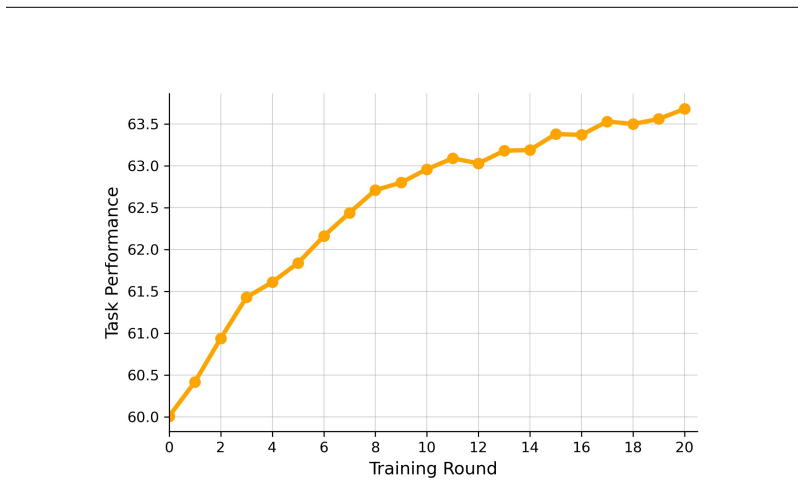
- The monotonic-improvement guarantee is proven for the exact surrogate, not for the clipped GRPO objective used in practice; a natural corollary to test is that actual per-round returns under the implemented SWIRL training are non-decreasing, and the paper does not yet show that curve for every round.
- The ablation showing that online reweighting is necessary for stable improvement suggests part of the reported stability may come from sample filtering rather than interleaving itself; disentangling these two contributions would clarify what carries the result.
- If the interleaving principle generalizes beyond two agents and beyond LVLMs, any MARL setting with heterogeneous actors and fixed update budgets could use the same round-level decomposition, with the active model resident and the others remote.
- The paper's parallel-update ablation hints that the strict sequential order may be relaxable; if confirmed, a Jacobian-style simultaneous update could give efficiency gains without losing the monotonic-round property.
Editorial analysis
A structured set of objections, weighed in public.
Referee Report
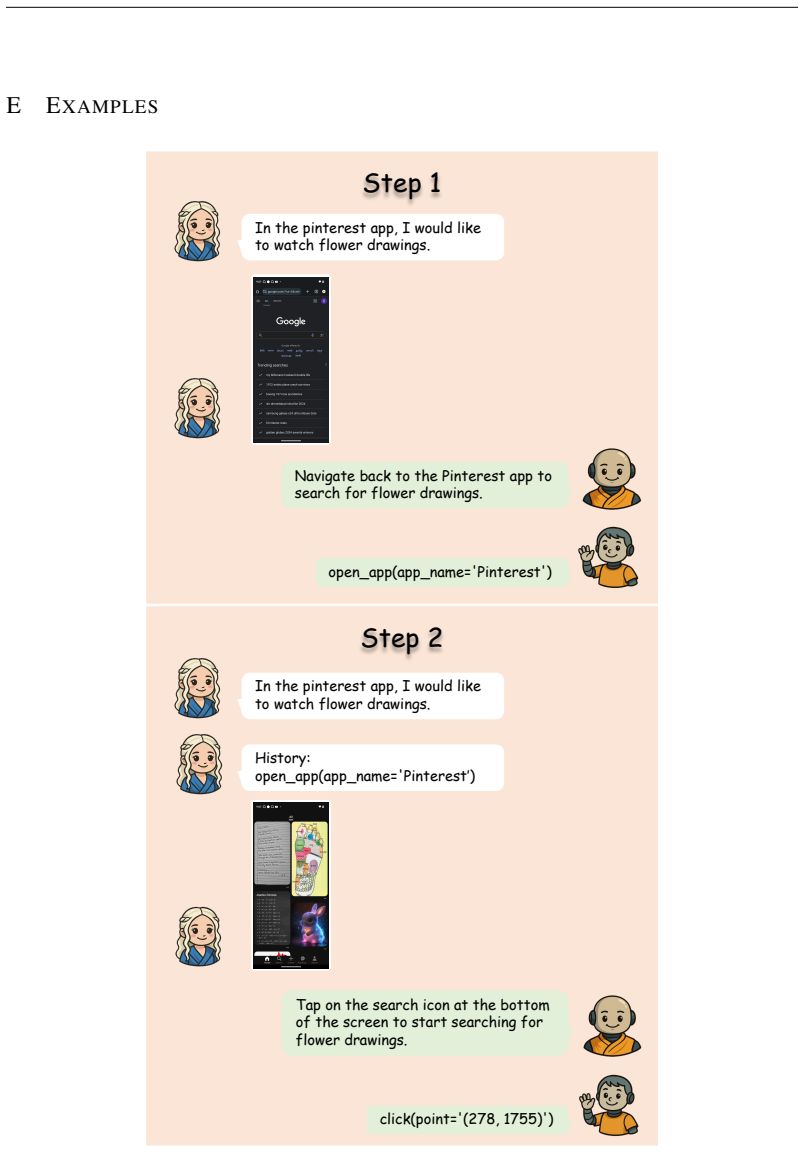
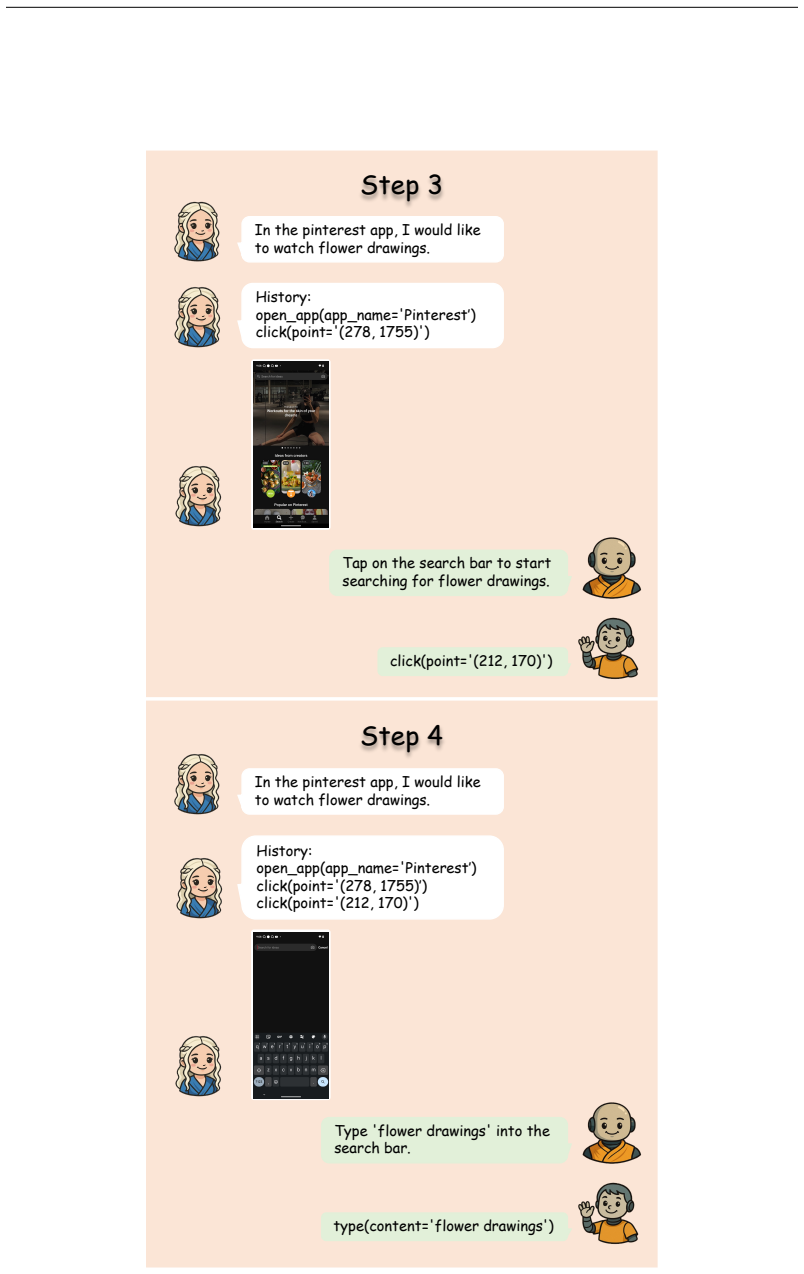
Summary. The paper introduces SWIRL, a staged workflow for interleaved reinforcement learning in multi-agent systems, and applies it to mobile GUI control and mathematical reasoning. The core idea is to replace joint multi-agent policy optimization with round-level alternation: at each stage one agent is trained while its partners are frozen, reducing each update to a single-agent RL problem. The authors claim theoretical guarantees (a per-micro-step lower bound, monotonic improvement across rounds, and convergence of returns) for an idealized interleaved-update algorithm, and then present a practical GRPO-based implementation with a Navigator/Interactor architecture for GUI tasks and a Teacher/Student architecture for math. Empirically, the paper reports state-of-the-art zero-shot GUI results using only 3,500 training samples and a +14.8 improvement over MARFT on MATH500, along with ablations on interleaving, online reweighting, and update order.
Significance. If the claims were fully established, SWIRL would be a practically valuable contribution: it reduces the memory footprint of multi-agent training to O(1) in the number of agents, reuses standard single-agent RL toolchains, and reports strong empirical results on challenging GUI benchmarks. The empirical study is fairly extensive, with multiple benchmarks, ablations, and a transfer experiment to math. However, the paper’s central theoretical selling point is not currently supported for the algorithm that is actually trained. The proofs apply to an exact-argmax scheme with a max-KL penalty, while the implementation optimizes a clipped GRPO objective with a KL anchor; no argument is given that the implemented objective preserves the ascent direction of the theoretical surrogate. Because the practical method is the one evaluated, the theoretical guarantees overclaim what is demonstrated. The computational-resource argument and the empirical results are interesting, but the theory–practice gap is load-bearing and needs to be resolved before the claims as stated are credible.
major comments (4)
- [Sec. 3.1–3.3, Eq. (2)] The theoretical results (Proposition 1, Theorem 1, Corollary 1) are proved for Algorithm 1, where each micro-step is an exact maximizer of F_{k,i,j}(π^i) = L^i − C_{k,i,j} Dmax_KL(π^i_{k,j}, π^i). The implemented Algorithms 2/3 instead maximize the GRPO-style objective in Eq. (2), which uses clipped importance ratios and a KL anchor to a reference policy. Section 3.2 merely asserts that this "preserves the ascent direction" of the theoretical target without proof or a quantitative bound. Clipping saturates outside [1−ε, 1+ε], the KL anchor is to π_ref rather than to the current iterate π^i_{k,j} appearing in Dmax_KL, and the coefficient λ is not set to C_{k,i,j} = 4γε/(1−γ)^2. An update can therefore increase Eq. (2) while decreasing the true surrogate L^i − C Dmax_KL, breaking the F ≥ 0 condition that Theorem 1 requires. The same gap affects Corollary 1. I request either a proof that Eq
- [Tables 2–5 and Sec. 4.1] All reported results are single numbers with no error bars, no multiple seeds, and no significance tests. This matters because several headline comparisons are close (e.g., Table 5: SWIRL 83.5 vs. MARFT 83.0 on CMATH; Table 4: Type 84.62 vs. GUI-R1-3B 83.58). Since the paper stresses stability and consistent improvements, reporting mean±std over at least 3 seeds, or a significance test, is necessary to support the claims. Without this, the +14.8 MATH500 gain is the only large margin that is easy to distinguish from noise.
- [Appendix C.1 and Sec. 3.3 (online reweighting)] The two-stage data selection uses hand-set thresholds: Stage 1 keeps 1,500 samples with average reward in [0.3, 0.4]; Stage 2 keeps 2,000 samples with average reward below 0.6 and variance above 0.175; online reweighting additionally discards samples whose mean reward is outside (0.1, 1) (GUI) or (0.2, 0.8) (math). These thresholds are free hyperparameters and no sensitivity analysis is given. The ablation in Appendix D.1 shows interleaving helps relative to continued warm-up training, which is useful, but the practical contribution of online reweighting could be confounded with the filtering thresholds. Please provide a sensitivity study or at least a clear statement of how robust the reported results are to these thresholds.
- [Appendix A.2 / Theorem 1] The proof of Proposition 1 is a direct application of Lemma 6 of Zhong et al. (2024), and Theorem 1 is then derived by summing per-micro-step inequalities. This is mathematically clean but derivative: the stepwise safety bound and monotonic improvement are not new results beyond the cited HAPPO analysis. Given that the theoretical framework does not cover the implemented GRPO objective, the contribution of Sections 3.1–3.2 is more a re-statement of existing theory than a new guarantee. The paper would be stronger if the theory were either extended to the actual objective or clearly positioned as an idealized motivation.
minor comments (5)
- [Sec. 3.2, Eq. (2)] The token-level indicator I^{(j)}_{k,ℓ} is defined as '1 iff r_{k,ℓ} ∼ π_{θ_j}', but tokens are not independent samples from a single policy; they are drawn from the joint autoregressive process. The notation should be clarified to describe which tokens are generated by which agent module, and how this indicator interacts with the GRPO advantage normalization.
- [Sec. 4.1 and Appendix C.1] The paper does not state the discount factor γ anywhere, although it is central to the theoretical bound. Please report it, and if the implementation uses undiscounted returns (γ = 1), discuss how the theory applies.
- [Appendix D.3] Figure 4 is referenced in the text ('Fig. 4') but no figure appears in the manuscript body. Please include the figure or remove the reference.
- [Sec. 4.4 / Appendix C.3] The math experiments bypass warm-up and directly run Stage 2 on 7,500 MATH samples with 10 rounds and 1 epoch per round. This is different from the GUI setup (warm-up + 20 rounds × 2 epochs), which is fine, but the paper should state whether the same hyperparameters were used for the Teacher/Student and how the difference affects the interpretation of the transferability claim.
- [Sec. 3.3 / Algorithm 2] Algorithm 2 is very sparse; it does not specify the stopping criteria for the inner RL calls, how `RL` relates to Algorithm 3, or how the online reweighting step interacts with the two agents' update budgets. A more explicit pseudocode would improve reproducibility.
Circularity Check
No significant circularity: the central claims are anchored in external prior theory and held-out empirical benchmarks; the theory/implementation gap is a correctness concern, not a circular reduction.
full rationale
Walking the paper's derivation chain, the theoretical core is not circular. Algorithm 1 defines each micro-step as the exact maximizer of F_{k,i,j}(π^i) = L^i − C_{k,i,j} Dmax_KL(π^i_{k,j}, π^i), and Proposition 1 is explicitly imported from Lemma 6 of Zhong et al. (2024), an external prior work, not from the authors' own results. Theorem 1 then follows algebraically from the baseline-zero property F_{k,i,j}(π^i_{k,j}) = 0, and Corollary 1 is a standard bounded-monotone-sequence argument. No fitted parameter is renamed as a prediction: the reward weights (α, β, λ1, λ2) and reweighting thresholds (0.1 < Rx < 1, 0.2 < Rx < 0.8) are hand-set hyperparameters, not derived from the evaluation benchmarks, and the reported metrics are zero-shot on held-out datasets. The paper does contain a real validity gap: Section 3.2 asserts that the GRPO-style objective in Eq. (2) 'preserves the ascent direction of the theoretical target L − Dmax_KL' without proof, and the clip and KL anchor are not the exact max-KL penalty used in Theorem 1. This means the monotonic-improvement guarantee does not demonstrably cover the implemented Alg. 2/3, but that is a theory-implementation mismatch, not an equivalence-by-construction or a self-referential fit. The only self-citations (e.g., GUI Odyssey as an evaluation dataset) are not load-bearing for the derivation and do not make the argument circular.
Axiom & Free-Parameter Ledger
free parameters (4)
- Reward weights alpha, beta, lambda1, lambda2 =
alpha=0.1, beta=0.9, lambda1=0.2, lambda2=0.8
- Online reweighting thresholds =
GUI: 0.1 < Rx < 1; math: 0.2 < Rx < 0.8
- Training data selection ranges =
Stage 1: reward in [0.3, 0.4]; Stage 2: reward < 0.6 and variance > 0.175
- GRPO clipping epsilon and KL anchor coefficient =
not stated in main text
axioms (3)
- standard math Lemma 6 from (Zhong et al., 2024) (HAPPO trust-region bound)
- domain assumption The GRPO clipping and KL anchor preserve the ascent direction of the theoretical surrogate
- domain assumption The reward function Racc = lambda1*Ract + lambda2*Rinfo is a sufficient and well-scaled learning signal for both agents
Cite this review
Pith. "Pith review of SWIRL: A Staged Workflow for Interleaved Reinforcement Learning in Mobile GUI Control." pith.science (2026). https://pith.science/paper/YUGAO2NT
@misc{pith2026250820018,
  author       = {Pith},
  title        = {Pith review of: SWIRL: A Staged Workflow for Interleaved Reinforcement Learning in Mobile GUI Control},
  year         = {2026},
  howpublished = {\url{https://pith.science/paper/YUGAO2NT}},
  note         = {Machine review of arXiv:2508.20018}
}
read the original abstract
The rapid advancement of large vision language models (LVLMs) and agent systems has heightened interest in mobile GUI agents that can reliably translate natural language into interface operations. Existing single-agent approaches, however, remain limited by structural constraints. Although multi-agent systems naturally decouple different competencies, recent progress in multi-agent reinforcement learning (MARL) has often been hindered by inefficiency and remains incompatible with current LVLM architectures. To address these challenges, we introduce SWIRL, a staged workflow for interleaved reinforcement learning designed for multi-agent systems. SWIRL reformulates MARL into a sequence of single-agent reinforcement learning tasks, updating one agent at a time while keeping the others fixed. This formulation enables stable training and promotes efficient coordination across agents. Theoretically, we provide a stepwise safety bound, a cross-round monotonic improvement theorem, and convergence guarantees on return, ensuring robust and principled optimization. In application to mobile GUI control, SWIRL instantiates a Navigator that converts language and screen context into structured plans, and an Interactor that grounds these plans into executable atomic actions. Extensive experiments demonstrate superior performance on both high-level and low-level GUI benchmarks. Beyond GUI tasks, SWIRL also demonstrates strong capability in multi-agent mathematical reasoning, underscoring its potential as a general framework for developing efficient and robust multi-agent systems.
Figures





Forward citations
Cited by 1 Pith paper
-
Trust Region On-Policy Distillation
TrOPD stabilizes on-policy distillation for LLMs with trust-region learning, outlier estimation, and off-policy guidance, outperforming prior OPD methods on reasoning and code benchmarks.
Reference graph
Works this paper leans on
-
[1]
Chain-of-thought reasoning in the wild is not always faithful
Iv \'a n Arcuschin, Jett Janiak, Robert Krzyzanowski, Senthooran Rajamanoharan, Neel Nanda, and Arthur Conmy. Chain-of-thought reasoning in the wild is not always faithful. arXiv preprint arXiv:2503.08679, 2025
Pith/arXiv arXiv 2025
-
[2]
Shuai Bai, Keqin Chen, Xuejing Liu, Jialin Wang, Wenbin Ge, Sibo Song, Kai Dang, Peng Wang, Shijie Wang, Jun Tang, Humen Zhong, Yuanzhi Zhu, Mingkun Yang, Zhaohai Li, Jianqiang Wan, Pengfei Wang, Wei Ding, Zheren Fu, Yiheng Xu, Jiabo Ye, Xi Zhang, Tianbao Xie, Zesen Cheng, Hang Zhang, Zhibo Yang, Haiyang Xu, and Junyang Lin. Qwen2.5-vl technical report. a...
Pith/arXiv arXiv 2025
-
[3]
Distributed optimization and statistical learning via the alternating direction method of multipliers
Stephen Boyd, Neal Parikh, Eric Chu, Borja Peleato, Jonathan Eckstein, et al. Distributed optimization and statistical learning via the alternating direction method of multipliers. Foundations and Trends in Machine learning , 3 0 (1): 0 1--122, 2011
2011
-
[4]
Multi-agent reinforcement learning: A review of challenges and applications
Lorenzo Canese, Gian Carlo Cardarilli, Luca Di Nunzio, Rocco Fazzolari, Daniele Giardino, Marco Re, and Sergio Span \`o . Multi-agent reinforcement learning: A review of challenges and applications. Applied Sciences, 11 0 (11): 0 4948, 2021
2021
-
[5]
Amex: Android multi-annotation expo dataset for mobile gui agents
Yuxiang Chai, Siyuan Huang, Yazhe Niu, Han Xiao, Liang Liu, Dingyu Zhang, Peng Gao, Shuai Ren, and Hongsheng Li. Amex: Android multi-annotation expo dataset for mobile gui agents. arXiv preprint arXiv:2407.17490, 2024
Pith/arXiv arXiv 2024
-
[6]
Guicourse: From general vision language models to versatile gui agents
Wentong Chen, Junbo Cui, Jinyi Hu, Yujia Qin, Junjie Fang, Yue Zhao, Chongyi Wang, Jun Liu, Guirong Chen, Yupeng Huo, et al. Guicourse: From general vision language models to versatile gui agents. arXiv preprint arXiv:2406.11317, 2024
Pith/arXiv arXiv 2024
-
[7]
Multi-agent deep reinforcement learning for large-scale traffic signal control
Tianshu Chu, Jie Wang, Lara Codec \`a , and Zhaojian Li. Multi-agent deep reinforcement learning for large-scale traffic signal control. IEEE transactions on intelligent transportation systems, 21 0 (3): 0 1086--1095, 2019
work page 2019
-
[8]
Sft memorizes, rl generalizes: A comparative study of foundation model post-training
Tianzhe Chu, Yuexiang Zhai, Jihan Yang, Shengbang Tong, Saining Xie, Dale Schuurmans, Quoc V Le, Sergey Levine, and Yi Ma. Sft memorizes, rl generalizes: A comparative study of foundation model post-training. arXiv preprint arXiv:2501.17161, 2025
Pith/arXiv arXiv 2025
-
[9]
Training verifiers to solve math word problems
Karl Cobbe, Vineet Kosaraju, Mohammad Bavarian, Mark Chen, Heewoo Jun, Lukasz Kaiser, Matthias Plappert, Jerry Tworek, Jacob Hilton, Reiichiro Nakano, et al. Training verifiers to solve math word problems. arXiv preprint arXiv:2110.14168, 2021
Pith/arXiv arXiv 2021
-
[10]
Process reinforcement through implicit rewards
Ganqu Cui, Lifan Yuan, Zefan Wang, Hanbin Wang, Wendi Li, Bingxiang He, Yuchen Fan, Tianyu Yu, Qixin Xu, Weize Chen, et al. Process reinforcement through implicit rewards. arXiv preprint arXiv:2502.01456, 2025
Pith/arXiv arXiv 2025
-
[11]
Christian Schroeder De Witt, Tarun Gupta, Denys Makoviichuk, Viktor Makoviychuk, Philip HS Torr, Mingfei Sun, and Shimon Whiteson. Is independent learning all you need in the starcraft multi-agent challenge? arXiv preprint arXiv:2011.09533, 2020
Pith/arXiv arXiv 2011
-
[12]
Improving factuality and reasoning in language models through multiagent debate
Yilun Du, Shuang Li, Antonio Torralba, Joshua B Tenenbaum, and Igor Mordatch. Improving factuality and reasoning in language models through multiagent debate. In Forty-first International Conference on Machine Learning, 2023
2023
-
[13]
Plan-and-act: Improving planning of agents for long-horizon tasks
Lutfi Eren Erdogan, Nicholas Lee, Sehoon Kim, Suhong Moon, Hiroki Furuta, Gopala Anumanchipalli, Kurt Keutzer, and Amir Gholami. Plan-and-act: Improving planning of agents for long-horizon tasks. arXiv preprint arXiv:2503.09572, 2025
Pith/arXiv arXiv 2025
-
[14]
On alternating direction methods of multipliers: a historical perspective
Roland Glowinski. On alternating direction methods of multipliers: a historical perspective. Modeling, simulation and optimization for science and technology, pp.\ 59--82, 2014
work page 2014
-
[15]
Towards Efficient Multi-Agent Learning Systems
Kailash Gogineni, Peng Wei, Tian Lan, and Guru Venkataramani. Towards efficient multi-agent learning systems. arXiv preprint arXiv:2305.13411, 2023
work page internal anchor Pith review Pith/arXiv arXiv 2023
-
[16]
Dong Guo, Faming Wu, Feida Zhu, Fuxing Leng, Guang Shi, Haobin Chen, Haoqi Fan, Jian Wang, Jianyu Jiang, Jiawei Wang, et al. Seed1. 5-vl technical report. arXiv preprint arXiv:2505.07062, 2025
Pith/arXiv arXiv 2025
-
[17]
Llm multi-agent systems: Challenges and open problems
Shanshan Han, Qifan Zhang, Yuhang Yao, Weizhao Jin, and Zhaozhuo Xu. Llm multi-agent systems: Challenges and open problems. arXiv preprint arXiv:2402.03578, 2024
Pith/arXiv arXiv 2024
-
[18]
Measuring mathematical problem solving with the math dataset
Dan Hendrycks, Collin Burns, Saurav Kadavath, Akul Arora, Steven Basart, Eric Tang, Dawn Song, and Jacob Steinhardt. Measuring mathematical problem solving with the math dataset. arXiv preprint arXiv:2103.03874, 2021
Pith/arXiv arXiv 2021
-
[19]
Openrlhf: An easy-to-use, scalable and high-performance rlhf framework
Jian Hu, Xibin Wu, Zilin Zhu, Weixun Wang, Dehao Zhang, Yu Cao, et al. Openrlhf: An easy-to-use, scalable and high-performance rlhf framework. arXiv preprint arXiv:2405.11143, 2024
Pith/arXiv arXiv 2024
-
[20]
Owl: Optimized workforce learning for general multi-agent assistance in real-world task automation
Mengkang Hu, Yuhang Zhou, Wendong Fan, Yuzhou Nie, Bowei Xia, Tao Sun, Ziyu Ye, Zhaoxuan Jin, Yingru Li, Qiguang Chen, et al. Owl: Optimized workforce learning for general multi-agent assistance in real-world task automation. arXiv preprint arXiv:2505.23885, 2025
Pith/arXiv arXiv 2025
-
[21]
Binyuan Hui, Jian Yang, Zeyu Cui, Jiaxi Yang, Dayiheng Liu, Lei Zhang, Tianyu Liu, Jiajun Zhang, Bowen Yu, Keming Lu, et al. Qwen2. 5-coder technical report. arXiv preprint arXiv:2409.12186, 2024
Pith/arXiv arXiv 2024
-
[22]
Raghav Kapoor, Yash Parag Butala, Melisa Russak, Jing Yu Koh, Kiran Kamble, Waseem AlShikh, and Ruslan Salakhutdinov. Omniact: A dataset and benchmark for enabling multimodal generalist autonomous agents for desktop and web. In European Conference on Computer Vision, pp.\ 161--178. Springer, 2024
work page 2024
-
[23]
Os-harm: A benchmark for measuring safety of computer use agents
Thomas Kuntz, Agatha Duzan, Hao Zhao, Francesco Croce, Zico Kolter, Nicolas Flammarion, and Maksym Andriushchenko. Os-harm: A benchmark for measuring safety of computer use agents. arXiv preprint arXiv:2506.14866, 2025
arXiv 2025
-
[24]
Gonzalez, Hao Zhang, and Ion Stoica
Woosuk Kwon, Zhuohan Li, Siyuan Zhuang, Ying Sheng, Lianmin Zheng, Cody Hao Yu, Joseph E. Gonzalez, Hao Zhang, and Ion Stoica. Efficient memory management for large language model serving with pagedattention. In Proceedings of the ACM SIGOPS 29th Symposium on Operating Systems Principles, 2023
2023
-
[25]
Reguide: Data efficient gui grounding via spatial reasoning and search
Hyunseok Lee, Jeonghoon Kim, Beomjun Kim, Jihoon Tack, Chansong Jo, Jaehong Lee, Cheonbok Park, Sookyo In, Jinwoo Shin, and Kang Min Yoo. Reguide: Data efficient gui grounding via spatial reasoning and search. arXiv preprint arXiv:2505.15259, 2025
Pith/arXiv arXiv 2025
-
[26]
Towards better chain-of-thought: A reflection on effectiveness and faithfulness
Jiachun Li, Pengfei Cao, Yubo Chen, Jiexin Xu, Huaijun Li, Xiaojian Jiang, Kang Liu, and Jun Zhao. Towards better chain-of-thought: A reflection on effectiveness and faithfulness. arXiv preprint arXiv:2405.18915, 2024 a
Pith/arXiv arXiv 2024
-
[27]
On the effects of data scale on computer control agents
Wei Li, William Bishop, Alice Li, Chris Rawles, Folawiyo Campbell-Ajala, Divya Tyamagundlu, and Oriana Riva. On the effects of data scale on computer control agents. arXiv preprint arXiv:2406.03679, 2024 b
Pith/arXiv arXiv 2024
-
[28]
Marft: Multi-agent reinforcement fine-tuning
Junwei Liao, Muning Wen, Jun Wang, and Weinan Zhang. Marft: Multi-agent reinforcement fine-tuning. arXiv preprint arXiv:2504.16129, 2025
Pith/arXiv arXiv 2025
-
[29]
Infigui-r1: Advancing multimodal gui agents from reactive actors to deliberative reasoners
Yuhang Liu, Pengxiang Li, Congkai Xie, Xavier Hu, Xiaotian Han, Shengyu Zhang, Hongxia Yang, and Fei Wu. Infigui-r1: Advancing multimodal gui agents from reactive actors to deliberative reasoners. arXiv preprint arXiv:2504.14239, 2025
Pith/arXiv arXiv 2025
-
[30]
Gui odyssey: A comprehensive dataset for cross-app gui navigation on mobile devices
Quanfeng Lu, Wenqi Shao, Zitao Liu, Fanqing Meng, Boxuan Li, Botong Chen, Siyuan Huang, Kaipeng Zhang, Yu Qiao, and Ping Luo. Gui odyssey: A comprehensive dataset for cross-app gui navigation on mobile devices. arXiv preprint arXiv:2406.08451, 2024
Pith/arXiv arXiv 2024
-
[31]
Ui-r1: Enhancing efficient action prediction of gui agents by reinforcement learning
Zhengxi Lu, Yuxiang Chai, Yaxuan Guo, Xi Yin, Liang Liu, Hao Wang, Han Xiao, Shuai Ren, Guanjing Xiong, and Hongsheng Li. Ui-r1: Enhancing efficient action prediction of gui agents by reinforcement learning. arXiv preprint arXiv:2503.21620, 2025
Pith/arXiv arXiv 2025
-
[32]
Gui-r1: A generalist r1-style vision-language action model for gui agents
Run Luo, Lu Wang, Wanwei He, and Xiaobo Xia. Gui-r1: A generalist r1-style vision-language action model for gui agents. arXiv preprint arXiv:2504.10458, 2025
Pith/arXiv arXiv 2025
-
[33]
Mm-eureka: Exploring the frontiers of multimodal reasoning with rule-based reinforcement learning
Fanqing Meng, Lingxiao Du, Zongkai Liu, Zhixiang Zhou, Quanfeng Lu, Daocheng Fu, Tiancheng Han, Botian Shi, Wenhai Wang, Junjun He, Kaipeng Zhang, Ping Luo, Yu Qiao, Qiaosheng Zhang, and Wenqi Shao. Mm-eureka: Exploring the frontiers of multimodal reasoning with rule-based reinforcement learning. arXiv preprint arXiv:2503.07365, 2025
Pith/arXiv arXiv 2025
-
[34]
Fanglin Mo, Junzhe Chen, Haoxuan Zhu, and Xuming Hu. Building a stable planner: An extended finite state machine based planning module for mobile gui agent. arXiv preprint arXiv:2505.14141, 2025
Pith/arXiv arXiv 2025
-
[35]
Screenagent: A vision language model-driven computer control agent
Runliang Niu, Jindong Li, Shiqi Wang, Yali Fu, Xiyu Hu, Xueyuan Leng, He Kong, Yi Chang, and Qi Wang. Screenagent: A vision language model-driven computer control agent. arXiv preprint arXiv:2402.07945, 2024
Pith/arXiv arXiv 2024
-
[36]
OpenAI . Introducing gpt-5. https://openai.com/index/introducing-gpt-5/, 2025. Accessed: August 2025
work page 2025
-
[37]
Ui-tars: Pioneering automated gui interaction with native agents
Yujia Qin, Yining Ye, Junjie Fang, Haoming Wang, Shihao Liang, Shizuo Tian, Junda Zhang, Jiahao Li, Yunxin Li, Shijue Huang, et al. Ui-tars: Pioneering automated gui interaction with native agents. arXiv preprint arXiv:2501.12326, 2025
Pith/arXiv arXiv 2025
-
[38]
Monotonic value function factorisation for deep multi-agent reinforcement learning
Tabish Rashid, Mikayel Samvelyan, Christian Schroeder De Witt, Gregory Farquhar, Jakob Foerster, and Shimon Whiteson. Monotonic value function factorisation for deep multi-agent reinforcement learning. Journal of Machine Learning Research, 21 0 (178): 0 1--51, 2020
2020
-
[39]
Sam 2: Segment anything in images and videos
Nikhila Ravi, Valentin Gabeur, Yuan-Ting Hu, Ronghang Hu, Chaitanya Ryali, Tengyu Ma, Haitham Khedr, Roman R \"a dle, Chloe Rolland, Laura Gustafson, et al. Sam 2: Segment anything in images and videos. arXiv preprint arXiv:2408.00714, 2024
Pith/arXiv arXiv 2024
-
[40]
Android in the wild: A large-scale dataset for android device control
Christopher Rawles, Alice Li, Daniel Rodriguez, Oriana Riva, and Timothy Lillicrap. Android in the wild: A large-scale dataset for android device control. arXiv preprint arXiv:2307.10088, 2023
Pith/arXiv arXiv 2023
-
[41]
Trust region policy optimization
John Schulman, Sergey Levine, Pieter Abbeel, Michael Jordan, and Philipp Moritz. Trust region policy optimization. In International conference on machine learning, pp.\ 1889--1897. PMLR, 2015
2015
-
[42]
Proximal policy optimization algorithms
John Schulman, Filip Wolski, Prafulla Dhariwal, Alec Radford, and Oleg Klimov. Proximal policy optimization algorithms. arXiv preprint arXiv:1707.06347, 2017
Pith/arXiv arXiv 2017
-
[43]
Deepseekmath: Pushing the limits of mathematical reasoning in open language models
Zhihong Shao, Peiyi Wang, Qihao Zhu, Runxin Xu, Junxiao Song, Xiao Bi, Haowei Zhang, Mingchuan Zhang, YK Li, Yang Wu, et al. Deepseekmath: Pushing the limits of mathematical reasoning in open language models. arXiv preprint arXiv:2402.03300, 2024
Pith/arXiv arXiv 2024
-
[44]
Hybridflow: A flexible and efficient rlhf framework
Guangming Sheng, Chi Zhang, Zilingfeng Ye, Xibin Wu, Wang Zhang, Ru Zhang, Yanghua Peng, Haibin Lin, and Chuan Wu. Hybridflow: A flexible and efficient rlhf framework. In Proceedings of the Twentieth European Conference on Computer Systems, pp.\ 1279--1297, 2025
2025
-
[45]
Towards trustworthy gui agents: A survey
Yucheng Shi, Wenhao Yu, Wenlin Yao, Wenhu Chen, and Ninghao Liu. Towards trustworthy gui agents: A survey. arXiv preprint arXiv:2503.23434, 2025
arXiv 2025
-
[46]
Teaching models to balance resisting and accepting persuasion
Elias Stengel-Eskin, Peter Hase, and Mohit Bansal. Teaching models to balance resisting and accepting persuasion. arXiv preprint arXiv:2410.14596, 2024
Pith/arXiv arXiv 2024
-
[47]
Multiagent finetuning: Self improvement with diverse reasoning chains
Vighnesh Subramaniam, Yilun Du, Joshua B Tenenbaum, Antonio Torralba, Shuang Li, and Igor Mordatch. Multiagent finetuning: Self improvement with diverse reasoning chains. arXiv preprint arXiv:2501.05707, 2025
Pith/arXiv arXiv 2025
-
[48]
Value-decomposition networks for cooperative multi-agent learning
Peter Sunehag, Guy Lever, Audrunas Gruslys, Wojciech Marian Czarnecki, Vinicius Zambaldi, Max Jaderberg, Marc Lanctot, Nicolas Sonnerat, Joel Z Leibo, Karl Tuyls, et al. Value-decomposition networks for cooperative multi-agent learning. arXiv preprint arXiv:1706.05296, 2017
Pith/arXiv arXiv 2017
-
[49]
Gui-g ^2 : Gaussian reward modeling for gui grounding
Fei Tang, Zhangxuan Gu, Zhengxi Lu, Xuyang Liu, Shuheng Shen, Changhua Meng, Wen Wang, Wenqi Zhang, Yongliang Shen, Weiming Lu, et al. Gui-g ^2 : Gaussian reward modeling for gui grounding. arXiv preprint arXiv:2507.15846, 2025
Pith/arXiv arXiv 2025
-
[50]
Multi-agent collaboration mechanisms: A survey of llms
Khanh-Tung Tran, Dung Dao, Minh-Duong Nguyen, Quoc-Viet Pham, Barry O'Sullivan, and Hoang D Nguyen. Multi-agent collaboration mechanisms: A survey of llms. arXiv preprint arXiv:2501.06322, 2025
Pith/arXiv arXiv 2025
-
[51]
Language models don't always say what they think: Unfaithful explanations in chain-of-thought prompting
Miles Turpin, Julian Michael, Ethan Perez, and Samuel Bowman. Language models don't always say what they think: Unfaithful explanations in chain-of-thought prompting. Advances in Neural Information Processing Systems, 36: 0 74952--74965, 2023
2023
-
[52]
Gui agents with foundation models: A comprehensive survey
Shuai Wang, Weiwen Liu, Jingxuan Chen, Yuqi Zhou, Weinan Gan, Xingshan Zeng, Yuhan Che, Shuai Yu, Xinlong Hao, Kun Shao, et al. Gui agents with foundation models: A comprehensive survey. arXiv preprint arXiv:2411.04890, 2024
Pith/arXiv arXiv 2024
-
[53]
Model-based multi-agent reinforcement learning: Recent progress and prospects
Xihuai Wang, Zhicheng Zhang, and Weinan Zhang. Model-based multi-agent reinforcement learning: Recent progress and prospects. arXiv preprint arXiv:2203.10603, 2022
Pith/arXiv arXiv 2022
-
[54]
Order Matters: Agent-by-agent Policy Optimization
Xihuai Wang, Zheng Tian, Ziyu Wan, Ying Wen, Jun Wang, and Weinan Zhang. Order matters: Agent-by-agent policy optimization. arXiv preprint arXiv:2302.06205, 2023
work page internal anchor Pith review Pith/arXiv arXiv 2023
-
[55]
Mp-gui: Modality perception with mllms for gui understanding
Ziwei Wang, Weizhi Chen, Leyang Yang, Sheng Zhou, Shengchu Zhao, Hanbei Zhan, Jiongchao Jin, Liangcheng Li, Zirui Shao, and Jiajun Bu. Mp-gui: Modality perception with mllms for gui understanding. In Proceedings of the Computer Vision and Pattern Recognition Conference, pp.\ 29711--29721, 2025
work page 2025
-
[56]
Chain-of-thought prompting elicits reasoning in large language models
Jason Wei, Xuezhi Wang, Dale Schuurmans, Maarten Bosma, Fei Xia, Ed Chi, Quoc V Le, Denny Zhou, et al. Chain-of-thought prompting elicits reasoning in large language models. Advances in neural information processing systems, 35: 0 24824--24837, 2022
2022
-
[57]
Tianwen Wei, Jian Luan, Wei Liu, Shuang Dong, and Bin Wang. Cmath: Can your language model pass chinese elementary school math test? arXiv preprint arXiv:2306.16636, 2023
Pith/arXiv arXiv 2023
-
[58]
Autogen: Enabling next-gen llm applications via multi-agent conversations
Qingyun Wu, Gagan Bansal, Jieyu Zhang, Yiran Wu, Beibin Li, Erkang Zhu, Li Jiang, Xiaoyun Zhang, Shaokun Zhang, Jiale Liu, et al. Autogen: Enabling next-gen llm applications via multi-agent conversations. In First Conference on Language Modeling, 2024 a
2024
-
[59]
Os-atlas: A foundation action model for generalist gui agents
Zhiyong Wu, Zhenyu Wu, Fangzhi Xu, Yian Wang, Qiushi Sun, Chengyou Jia, Kanzhi Cheng, Zichen Ding, Liheng Chen, Paul Pu Liang, et al. Os-atlas: A foundation action model for generalist gui agents. arXiv preprint arXiv:2410.23218, 2024 b
Pith/arXiv arXiv 2024
-
[60]
Towards system 2 reasoning in llms: Learning how to think with meta chain-of-thought
Violet Xiang, Charlie Snell, Kanishk Gandhi, Alon Albalak, Anikait Singh, Chase Blagden, Duy Phung, Rafael Rafailov, Nathan Lile, Dakota Mahan, et al. Towards system 2 reasoning in llms: Learning how to think with meta chain-of-thought. arXiv preprint arXiv:2501.04682, 2025
Pith/arXiv arXiv 2025
-
[61]
Tradingagents: Multi-agents llm financial trading framework
Yijia Xiao, Edward Sun, Di Luo, and Wei Wang. Tradingagents: Multi-agents llm financial trading framework. arXiv preprint arXiv:2412.20138, 2024
Pith/arXiv arXiv 2024
-
[62]
Aguvis: Unified pure vision agents for autonomous gui interaction
Yiheng Xu, Zekun Wang, Junli Wang, Dunjie Lu, Tianbao Xie, Amrita Saha, Doyen Sahoo, Tao Yu, and Caiming Xiong. Aguvis: Unified pure vision agents for autonomous gui interaction. arXiv preprint arXiv:2412.04454, 2024
Pith/arXiv arXiv 2024
-
[63]
A survey of admm variants for distributed optimization: Problems, algorithms and features
Yu Yang, Xiaohong Guan, Qing-Shan Jia, Liang Yu, Bolun Xu, and Costas J Spanos. A survey of admm variants for distributed optimization: Problems, algorithms and features. arXiv preprint arXiv:2208.03700, 2022
Pith/arXiv arXiv 2022
-
[64]
Enhancing visual grounding for gui agents via self-evolutionary reinforcement learning
Xinbin Yuan, Jian Zhang, Kaixin Li, Zhuoxuan Cai, Lujian Yao, Jie Chen, Enguang Wang, Qibin Hou, Jinwei Chen, Peng-Tao Jiang, et al. Enhancing visual grounding for gui agents via self-evolutionary reinforcement learning. arXiv preprint arXiv:2505.12370, 2025
Pith/arXiv arXiv 2025
-
[65]
Android in the zoo: Chain-of-action-thought for gui agents
Jiwen Zhang, Jihao Wu, Yihua Teng, Minghui Liao, Nuo Xu, Xiao Xiao, Zhongyu Wei, and Duyu Tang. Android in the zoo: Chain-of-action-thought for gui agents. arXiv preprint arXiv:2403.02713, 2024
Pith/arXiv arXiv 2024
-
[66]
Does chain-of-thought reasoning help mobile gui agent? an empirical study
Li Zhang, Longxi Gao, and Mengwei Xu. Does chain-of-thought reasoning help mobile gui agent? an empirical study. arXiv preprint arXiv:2503.16788, 2025
Pith/arXiv arXiv 2025
-
[67]
Longagent: scaling language models to 128k context through multi-agent collaboration
Jun Zhao, Can Zu, Hao Xu, Yi Lu, Wei He, Yiwen Ding, Tao Gui, Qi Zhang, and Xuanjing Huang. Longagent: scaling language models to 128k context through multi-agent collaboration. arXiv preprint arXiv:2402.11550, 2024 a
Pith/arXiv arXiv 2024
-
[68]
Sirius: Self-improving multi-agent systems via bootstrapped reasoning
Wanjia Zhao, Mert Yuksekgonul, Shirley Wu, and James Zou. Sirius: Self-improving multi-agent systems via bootstrapped reasoning. arXiv preprint arXiv:2502.04780, 2025
Pith/arXiv arXiv 2025
-
[69]
An Electoral Approach to Diversify LLM-based Multi-Agent Collective Decision-Making
Xiutian Zhao, Ke Wang, and Wei Peng. An electoral approach to diversify llm-based multi-agent collective decision-making. arXiv preprint arXiv:2410.15168, 2024 b
work page internal anchor Pith review Pith/arXiv arXiv 2024
-
[70]
Heterogeneous-agent reinforcement learning
Yifan Zhong, Jakub Grudzien Kuba, Xidong Feng, Siyi Hu, Jiaming Ji, and Yaodong Yang. Heterogeneous-agent reinforcement learning. Journal of Machine Learning Research, 25 0 (32): 0 1--67, 2024
work page 2024
-
[71]
Gui-g1: Understanding r1-zero-like training for visual grounding in gui agents
Yuqi Zhou, Sunhao Dai, Shuai Wang, Kaiwen Zhou, Qinglin Jia, and Jun Xu. Gui-g1: Understanding r1-zero-like training for visual grounding in gui agents. arXiv preprint arXiv:2505.15810, 2025
Pith/arXiv arXiv 2025
-
[72]
Internvl3: Exploring advanced training and test-time recipes for open-source multimodal models
Jinguo Zhu, Weiyun Wang, Zhe Chen, Zhaoyang Liu, Shenglong Ye, Lixin Gu, Hao Tian, Yuchen Duan, Weijie Su, Jie Shao, et al. Internvl3: Exploring advanced training and test-time recipes for open-source multimodal models. arXiv preprint arXiv:2504.10479, 2025
Pith/arXiv arXiv 2025
-
[73]
@esa (Ref
\@ifxundefined[1] #1\@undefined \@firstoftwo \@secondoftwo \@ifnum[1] #1 \@firstoftwo \@secondoftwo \@ifx[1] #1 \@firstoftwo \@secondoftwo [2] @ #1 \@temptokena #2 #1 @ \@temptokena \@ifclassloaded agu2001 natbib The agu2001 class already includes natbib coding, so you should not add it explicitly Type <Return> for now, but then later remove the command n...
-
[74]
\@lbibitem[] @bibitem@first@sw\@secondoftwo \@lbibitem[#1]#2 \@extra@b@citeb \@ifundefined br@#2\@extra@b@citeb \@namedef br@#2 \@nameuse br@#2\@extra@b@citeb \@ifundefined b@#2\@extra@b@citeb @num @parse #2 @tmp #1 NAT@b@open@#2 NAT@b@shut@#2 \@ifnum @merge>\@ne @bibitem@first@sw \@firstoftwo \@ifundefined NAT@b*@#2 \@firstoftwo @num @NAT@ctr \@secondoft...
-
[75]
@open @close @open @close and [1] URL: #1 \@ifundefined chapter * \@mkboth \@ifxundefined @sectionbib * \@mkboth * \@mkboth\@gobbletwo \@ifclassloaded amsart * \@ifclassloaded amsbook * \@ifxundefined @heading @heading NAT@ctr thebibliography [1] @ \@biblabel @NAT@ctr \@bibsetup #1 @NAT@ctr @ @openbib .11em \@plus.33em \@minus.07em 4000 4000 `\.\@m @bibit...
This paper was first reviewed by deepseek-v4-flash on August 5, 2026.
discussion (0)
Sign in with ORCID, Apple, or X to comment. Anyone can read and Pith papers without signing in.