REVIEW 3 major objections 4 minor 1 cited by
Altermagnetic Shastry-Sutherland fullerene networks
T0 review · 3 major / 4 minor · reviewed 2026-08-05 · deepseek-v4-flash
Pith's one-line read A charge-neutral, pure-carbon monolayer built from C40 fullerenes is predicted to be an altermagnet, with fully compensated spins, d-wave band splitting, and strain-tunable quantum phases.
desk verdict A clever design for an all-carbon altermagnet, but the central ground-state claim hinges on one functional; worth refereeing, but needs major revision. read the letter →
The pith
A machine-rendered reading of the paper's core claim, the machinery that carries it, and where it could break.
The reading
What carries the argument
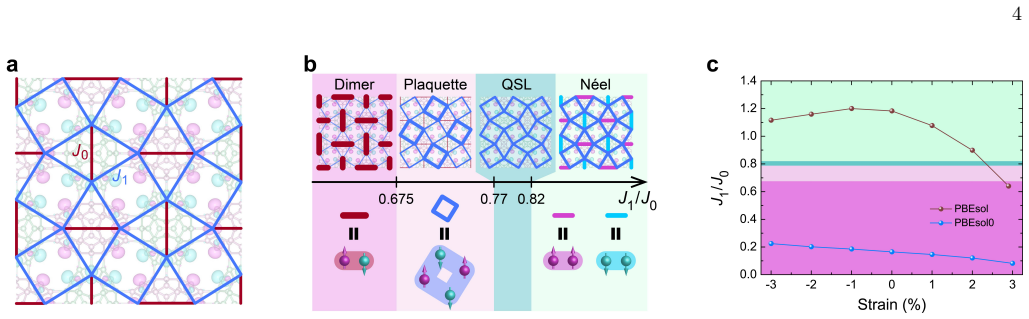
The C40 molecular synthon: its resonance structures give two effective spin-1/2 sites, each delocalized over three atoms in a W-shaped chain. The 2D rutile-like packing of C40 molecules produces a Shastry-Sutherland lattice of effective spins, with intramolecular coupling J0 and intermolecular coupling J1 defined by a weighted average of atomic exchanges. The lattice symmetries—C4 rotations and glide reflections—enforce compensated, alternating spin order, which is the source of the altermagnetic d-wave splitting. The strain-tunable ratio J1/J0 connects the ab initio material to the known Shastry-Sutherland phase diagram.
What would settle it
Measure the spin alignment within a single C40 unit with spin-polarized scanning tunneling microscopy or electron spin resonance: if the two effective moments are antiparallel, the molecule is a singlet and the altermagnetic state is not the ground state; if parallel, the altermagnetic assignment holds. Additionally, angle-resolved photoemission on a monolayer should reveal spin-split bands along M–Γ–M' but degenerate bands along Γ–X–M.
Extended reading notes
Core claim
The central claim is that charge-neutral C40 fullerene monolayers, assembled with C4 rotations and glide reflections, are altermagnets. The resonance structure of each C40 molecule places two unpaired electrons in two W-shaped chains of five carbon atoms, producing two effective spin-1/2 sites per molecule with delocalized moments. Packing these molecules into a closely-packed rutile-like arrangement creates a Shastry-Sutherland lattice of effective spins; the magnetic ground state has the two spins within each C40 unit parallel and spins on neighboring molecules antiparallel, so the net magnetization vanishes, yet glide and rotation symmetries produce spin-split electronic bands with d-wave
Load-bearing premise
The whole phase diagram rests on the reduction of each five-carbon W chain to a single effective spin-1/2 site and the assumption that the full exchange network is captured by two effective couplings J0 and J1; in particular, the reported value J0 = −0.21 meV must be consistent with the stated parallel alignment of the two spins in each C40 unit, but the text gives both without reconciling the sign.
Editorial extensions
If this is right
- A scalable, chemically feasible, pure-carbon material platform for altermagnetism, without heavy elements or net moments.
- The d-wave band splitting and chiral magnons could be used in altermagnetic spintronics and magnonics.
- Moderate strain turns one material into a tunable quantum spin liquid candidate, relevant for topological qubits.
- Because the effective model is the Shastry-Sutherland lattice, the extensive literature on that model can be used to predict experimental signatures.
- The hybrid-functional calculation suggests substrate screening controls which phase is realized, giving another tuning knob.
Reading between the lines
- The reported antiferromagnetic J0 (−0.21 meV) contradicts the stated parallel alignment of the two spins inside one C40 unit; if the sign is taken literally, the intra-unit bond would favor a singlet and destroy the altermagnetic Néel order, so the effective model needs a sign convention consistent with the ab initio spin densities before the phase diagram can be trusted.
- The mapping of each W chain to a single spin-1/2 assumes the strong ferromagnetic couplings inside the chain stay dominant under strain; at large strain those couplings could weaken and the coarse-grained Shastry-Sutherland description could break down, shifting the phase boundaries.
- The same rutile-like packing principle could be applied to other fullerene synthons or endohedral fullerenes to change the J0/J1 ratio and access phases at ambient conditions.
- A direct experimental check of the altermagnetic state could come from spin-polarized tunneling or angle-resolved photoemission on a single monolayer: the spin splitting along the M–Γ–M' direction is a distinctive d-wave signature.
Editorial analysis
A structured set of objections, weighed in public.
Referee Report
Summary. The manuscript proposes 2D rutile-like fullerene networks built from C40 units as a realization of an altermagnetic Shastry-Sutherland lattice. Using PBEsol DFT, the authors find a fully compensated Néel-like altermagnetic state with two effective spin-1/2 centers per C40 unit; the spin-polarized bands exhibit d-wave splitting and the computed magnon spectrum shows chiral splitting without spin-orbit coupling. Exchange couplings extracted through Wannier/TB2J are mapped via Eq. (1) to an effective Shastry-Sutherland model with J0 = -0.21 meV and J1 = -0.25 meV (J1/J0 ≈ 1.18), assigned to the Néel/altermagnetic phase. Under biaxial strain the ratio is reported to decrease and cross quantum-spin-liquid, plaquette, and dimer regimes. A zero-screening hybrid calculation (PBEsol0) instead gives a dimer singlet at all strains, which the authors interpret as a screening-controlled lower bound.
Significance. If the PBEsol result were robust across electronic-structure methods, the paper would offer a valuable design principle: a pure-carbon, charge-neutral fullerene network with altermagnetism, d-wave band splitting, and chiral magnons, together with a strain-tunable spin model. The work has concrete strengths: a transparent symmetry-based construction, explicit spin-density and band-structure evidence, parameter-free extraction of exchange constants from DFT, and magnon chirality calculations that go beyond a bare band-structure claim. The central difficulty is that the predicted altermagnetic ground state is not stable in the zero-screening hybrid limit, which is the relevant limit for a free-standing monolayer, and the claimed quantum-spin-liquid window is not actually computed. The significance is therefore conditional on additional electronic-structure evidence and on reframing of the strain-tuned phase diagram as an extrapolation.
major comments (3)
- [Fig. 3c and Methods (PBEsol0)] The central claim that charge-neutral, pure-carbon C40 networks are intrinsically altermagnetic is not established because the ground state depends on the exchange-correlation functional. PBEsol yields Néel/altermagnetic order for strains between -3% and +2%, but the paper states that 'further unscreened hybrid functional calculations suggest that the dimer phase is stable at all strains between ±3% in the zero-screening limit.' A free-standing monolayer is much closer to the zero-screening limit than to the fully screened PBEsol picture, so the intrinsic ground state of the pure-carbon system may be a nonmagnetic dimer singlet. No screened hybrid (HSE-class) calculation or explicit dielectric-environment model is provided to support the interpolation. The authors should either compute the ground state at a screened hybrid level, include a substrate/environment model, or reformulate the
- [Phase diagram (Fig. 3c and strain discussion)] The claimed strain-induced access to the quantum spin liquid phase is not a computed result. The text says that at 3% strain the system 'passes through both the quantum spin liquid and plaquette phases,' but immediately adds that 'in the quantum spin liquid region, J1 and J0 become ill-defined.' Since J1/J0 is the only quantity used to construct the phase diagram, crossing into the QSL region is an extrapolation from the generic Shastry-Sutherland phase diagram, not a first-principles determination. No spin-liquid diagnostics (e.g., spin correlations, entanglement, gap closure, or frustration measures beyond the exchange couplings themselves) are presented. The abstract's statement that the system 'can be continuously tuned into the frustrated quantum spin liquid phase' should either be supported by many-body calculations on the effective lattice or explicitly labeled as a speculative ex
- [Exchange interactions, Eq. (1)] The reduction to an effective spin-1/2 Shastry-Sutherland model is load-bearing for the phase-diagram claims, but the only validation offered is the energy separation between Jij (>7 meV) and Jij′, Jij″ (≲1 meV). Equation (1) is an ad hoc spin-weighted average rather than a systematic low-energy coarse-graining; it does not demonstrate that the three-site W-chain behaves as a rigid S=1/2 object in the relevant low-energy manifold. The authors should validate the mapping by comparing the ab initio magnon spectrum or the total energies of competing magnetic orders with the predictions of the effective J0-J1 model. Without this validation, the quantitative values J0 = -0.21 meV, J1 = -0.25 meV and the deduced phase boundaries rest on an unproven reduction.
minor comments (4)
- [Abstract] Typo: 'altermagentic' should be 'altermagnetic'.
- [Introduction and Fig. 1 caption] The phrase 'in the absence of neither translational nor inversion symmetry' is grammatically confused; it should be 'in the absence of both translational and inversion symmetry' or 'with neither translational nor inversion symmetry.'
- [Fig. 1d] The description 'spin orientations at time-reversed, opposite momenta on the iso-energy surface are the same (non-time-reversed)' is unclear. Consider rephrasing to 'the spin orientation at k and the spin orientation at -k are not related by time reversal; instead they are symmetric under the combination of time reversal and a lattice symmetry.'
- [References] Ref. 14 contains a garbled author name ('K. Uhl í Vision Res.ová'), and Ref. 51 has an incomplete arXiv field ('arXiv: , 2504.02037').
Circularity Check
No significant circularity; the derivation chain is self-contained.
full rationale
The paper's central claim (altermagnetic ground state in C40 fullerene networks) is computed directly from first-principles DFT: spin densities, band structures, magnon dispersions, and exchange parameters are all outputs of this paper, not imported from prior work. The effective spin-1/2 mapping is justified by the computed 1 µB moment per W-shaped chain and the dominant ferromagnetic Jij, and the resulting J0/J1 ratio is compared against the external Shastry-Sutherland phase diagram (refs 23–29, 37), an independent benchmark. No fitted parameter is renamed as a prediction; strain tuning is obtained by recomputing exchange interactions from DFT at each strain. The same-group citations (refs 41–43, 91) are background or methodology and are not load-bearing for the altermagnetism claim. The PBEsol0 dimer-phase result reported by the authors is a robustness/correctness concern about functional choice, not a circular inference, so it does not raise the circularity score.
Assumptions & free parameters
assumptions (5)
- domain assumption The resonance structures of the C40 W-shaped chains leave exactly one unpaired electron per chain, giving 2 μB per C40.
- domain assumption The three magnetic carbons in a W chain form a rigid effective spin-1/2 unit.
- domain assumption Exchange constants from TB2J in the collinear DFT state define the Heisenberg Hamiltonian used for the phase diagram and magnons.
- domain assumption The published Shastry-Sutherland phase diagram applies to the effective J0/J1 model.
- domain assumption PBEsol is adequate for the magnetic ground state and exchange parameters.
Cite this review
Pith. "Pith review of Altermagnetic Shastry-Sutherland fullerene networks." pith.science (2026). https://pith.science/paper/AMCOG66O
@misc{pith2026250821056,
  author       = {Pith},
  title        = {Pith review of: Altermagnetic Shastry-Sutherland fullerene networks},
  year         = {2026},
  howpublished = {\url{https://pith.science/paper/AMCOG66O}},
  note         = {Machine review of arXiv:2508.21056}
}
abstract
The interplay between quantum magnetism and many-body physics is of fundamental importance in condensed matter physics. %Magnetic exchange interactions in frustrated lattices give rise to rich phase diagrams. Molecular building blocks provide a versatile platform for exploring the exotic quantum phases arising from complex orderings in frustrated lattices. Here we demonstrate a showcase system based on altermagnetic Shastry-Sutherland fullerene networks, which can be constructed from a C$_{40}$ molecular synthon with two effective spin-1/2 sites due to the resonance structures. The charge-neutral, pure-carbon systems exhibit an altermagnetic ground state with fully compensated spins arranged in alternating C$_{40}$ units in a 2D rutile-like lattice, leading to $d$-wave splitting of the spin-polarised electronic band structure and strong chiral-split magnons. We report a rich phase diagram including altermagentic, quantum spin liquid, plaquette, and dimer phases, which can be accessed via moderate strains. Our findings open a new avenue for exploring quantum many-body physics based on scalable, chemically-feasible, molecular quantum materials.
Figures


Forward citations
Cited by 1 Pith paper
-
Designing Antiferromagnetic Spin-1/2 Chains in Janus Fullerene Nanoribbons
Adding extra C60 cages to one edge of a fullerene nanoribbon is predicted to create unpaired electrons and an antiferromagnetic spin-1/2 chain, according to first-principles calculations.
Reference graph
Works this paper leans on
-
[1]
author author J.H.P. \ Colpa ,\ title title Diagonalization of the quadratic boson hamiltonian , \ 10.1016/0378-4371(78)90160-7 journal journal Physica A: Statistical Mechanics and its Applications \ volume 93 ,\ pages 327--353 ( year 1978 ) NoStop
-
[2]
author author T. Holstein \ and\ author H. Primakoff ,\ title title Field dependence of the intrinsic domain magnetization of a ferromagnet , \ 10.1103/PhysRev.58.1098 journal journal Phys. Rev. \ volume 58 ,\ pages 1098--1113 ( year 1940 ) NoStop
-
[3]
author author Andrey \ Rybakov , author Carla \ Boix-Constant , author Diego \ Alba Venero , author Herre S. J. \ van der Zant , author Samuel \ Ma \ n as-Valero , \ and\ author Eugenio \ Coronado ,\ title title Probing short-range correlations in the van der waals magnet crsbr by small-angle neutron scattering , \ 10.1002/smsc.202400244 journal journal S...
-
[4]
\ 10.1002/adma.202415774 journal journal Adv
author author Carla \ Boix-Constant , author Andrey \ Rybakov , author Clara \ Miranda-P \'e rez , author Gabriel \ Mart \'i nez-Carracedo , author Jaime \ Ferrer , author Samuel \ Ma \ n as-Valero , \ and\ author Eugenio \ Coronado ,\ title title Programmable magnetic hysteresis in orthogonally-twisted 2d crsbr magnets via stacking engineering. \ 10.1002...
-
[5]
author author Andres \ Tellez-Mora , author Xu He , author Eric \ Bousquet , author Ludger \ Wirtz , \ and\ author Aldo H. \ Romero ,\ title title Systematic determination of a material's magnetic ground state from first principles , \ 10.1038/s41524-024-01202-z journal journal npj Computational Materials \ volume 10 ,\ pages 20 ( year 2024 ) NoStop
Reviewed August 5, 2026 · model on record in the stance chip above.
Discussion (0). Continue with ORCID to comment.