REVIEW 4 major objections 6 minor 2 cited by
Musculoskeletal simulation of limb movement biomechanics in Drosophila melanogaster
T0 review · 4 major / 6 minor · reviewed 2026-08-04 · deepseek-v4-flash
Pith's one-line read This paper introduces the first 3D, data-driven musculoskeletal model of Drosophila legs, built from X-ray anatomy and Hill-type muscles, and uses it to replay walking and grooming while predicting muscle synergies.
desk verdict Genuinely useful fly-leg muscle model, but the synergy claims are circular—send to review, expect revision. read the letter →
The pith
A machine-rendered reading of the paper's core claim, the machinery that carries it, and where it could break.
The reading
What carries the argument
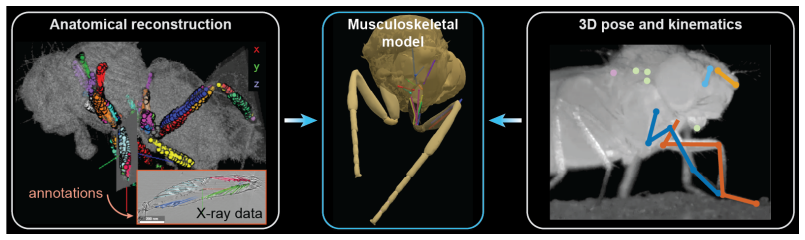
The central object is a Hill-type muscle-tendon unit: a contractile element for active force, a parallel elastic element for passive stiffness, and a series elastic element for tendon behavior, simplified with rigid tendons. Anatomical parameters such as attachment points, fiber paths, optimal fiber length, and tendon slack length come from X-ray reconstructions; physiological parameters such as maximum isometric force and contraction velocity are tuned by a multi-objective genetic algorithm in a static-optimization/forward-dynamics loop. Static optimization converts measured joint angles into muscle activations, and non-negative matrix factorization reduces those activations to a small set
What would settle it
Directly measure maximum isometric force and contraction velocity in fly leg muscles and check whether the optimized values fall inside the measured ranges; if they fall outside, the predicted synergies are fitting artifacts. Alternatively, record leg muscle activity during walking and grooming and test whether three primitives explain over 90% of the variance with the predicted weights.
Extended reading notes
Core claim
The central claim: anatomically grounded Hill-type muscles, not joint torques, can drive a simulated fly to recapitulate measured limb kinematics. X-ray scans supply attachment points, fiber paths, lengths, and cross-sectional areas; genetic optimization tunes force, velocity, and related parameters against walking and grooming. Static optimization plus forward dynamics replays both behaviors, and three synergy primitives explain over 90% of activation variance. In the other simulation environment, policies learn fastest with joint damping and stiffness, showing passive mechanics helps muscle-driven control. The paper claims this is the first muscle-actuated Drosophila leg model bridging neu
Load-bearing premise
The muscle parameters were tuned to fit only two recorded behaviors without direct measurement of muscle force or contraction speed, so the predicted activations may describe the fitted model rather than the fly.
Editorial extensions
If this is right
- Fly motor control can be studied as a closed muscle-actuated loop, linking neural activity to limb movement in an organism with a fully mapped nervous system.
- The predicted three muscle primitives for walking and grooming give concrete, testable targets for calcium imaging or electrophysiological recording from leg muscles.
- Passive joint stiffness and damping can be treated as design priors in musculoskeletal simulators and legged robots, speeding policy learning.
- The reconstruction and optimization pipeline can be extended to mid- and hindlegs, and to other insect species, once suitable X-ray datasets exist.
- Because muscle actuation constrains policies to physically plausible movements, the same architecture should reduce the simulation-to-reality gap for embodied agents.
Reading between the lines
- Since parameters were fitted on only two behaviors without direct physiological measurement, the predicted activations should be read as model-generated hypotheses until validated by direct muscle recording.
- The three-primitive result may reflect the low-dimensional structure imposed by static optimization and NMF rather than an actual neural modularity, so it is a prediction about muscle coordination, not yet about circuit organization.
- A natural next step is to couple the model to connectomic premotor circuits, testing whether identified descending and local neurons can produce the predicted synergy weights.
- Varying passive joint properties during parameter optimization, not just during policy learning, could reveal whether biomechanics shapes which muscle parameters are identifiable from behavior.
Editorial analysis
A structured set of objections, weighed in public.
Referee Report
Summary. The paper introduces a 3D, data-driven musculoskeletal model of Drosophila front legs, implemented in both OpenSim and MuJoCo. Hill-type muscle-tendon units are reconstructed from X-ray anatomical data and include 15 MTUs per foreleg spanning seven degrees of freedom across three joints. Unknown muscle parameters (maximum isometric force, maximum contraction velocity, optimal fiber length, tendon slack length, muscle path offsets) are optimized with NSGA-II by running static-optimization/forward-dynamics loops against measured antennal-grooming and locomotion kinematics. The authors then use static optimization on the same model and reference kinematics to estimate muscle activations, apply NMF to extract three muscle synergies per behavior, and train PPO policies in MuJoCo to examine how passive joint stiffness and damping affect imitation learning. The central claims are that the model is the first anatomically grounded Drosophila leg muscle model, that its simulated activities predict experimentally testable muscle synergies, and that passive joint properties facilitate muscle-driven control learning.
Significance. If the model and its parameter estimates are trustworthy, this is a potentially valuable community resource: it provides a muscle-actuated interface between Drosophila motor circuits and measured leg kinematics, with implementations in two widely used engines. The anatomical reconstruction from X-ray data and the moment-arm sanity checks are genuine strengths, as is the explicit optimization pipeline. However, the load-bearing biological inference—the muscle-synergy predictions in §4.1—is currently derived from the same optimized model and the same reference kinematics used to fit the model, and no independent physiological validation is provided. The paper would be strengthened substantially by sensitivity and robustness analyses, held-out behavior tests, and/or comparison with in vivo recordings. As written, the synergy results are plausible but not yet independent predictions about Drosophila motor control.
major comments (4)
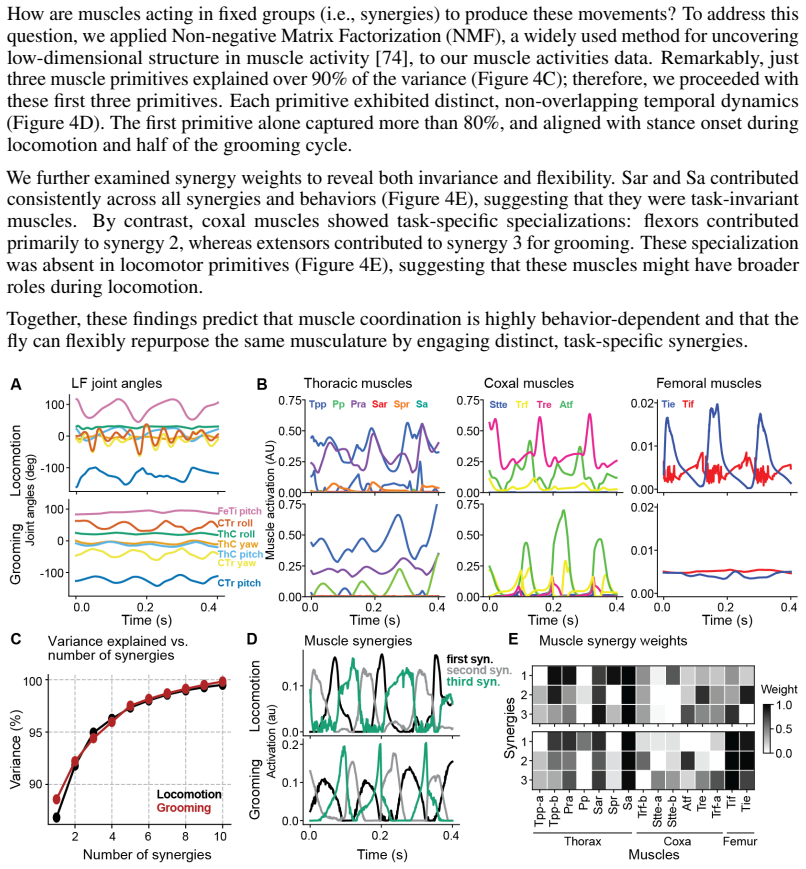
- [§4.1 and §3.2] The synergy analysis is not independent of the parameter-fitting procedure. Muscle parameters are optimized in §3.2 to reproduce the same locomotion and grooming joint-angle trajectories that are later used in §4.1 as inputs to static optimization for muscle activations. The resulting NMF primitives in Fig. 4C–E therefore depend on both the fitted parameter set and the implicit static-optimization cost (e.g., minimizing activation), rather than emerging from unconstrained biological data. The paper should quantify sensitivity: (i) compute synergies from the top-10 NSGA-II parameter sets and report stability of primitive structure and weights; (ii) vary the static-optimization objective (e.g., minimize squared activation, linear activation, or force) and show whether the three-synergy conclusion persists; (iii) test on a held-out behavior not used for fitting. Without these, the claim tha
- [§4.1 and §6] The locomotion synergy result is compromised by the acknowledged omission of contact forces. During stance, ground-reaction forces are major contributors to leg joint torques, and muscle activations estimated without any body–environment contact model may not reflect the demands of real walking. The paper itself states in §6 that 'without modeling external forces, muscle activation patterns may not accurately reflect the demands of untethered behaviors such as locomotion.' This limitation directly affects the stance-phase activation patterns in Fig. 4B and the locomotion synergies in Fig. 4D–E. The authors should either add a contact model or explicitly restrict the walking synergy claims to unloaded, kinematic-replay conditions.
- [§3.2, Fig. S5] Parameter identifiability is not established. Each MTU has 6–9 optimized parameters, and with 15 MTUs driving 7 DoFs, the optimization problem is strongly underdetermined. The paper reports that the top-10 parameter sets produce similar kinematic fits (Fig. 3C), but Fig. S5 shows broad distributions of optimized values, and the authors do not examine whether the top-10 sets produce similar muscle-level forces and activations. The moment-arm validation in Fig. 3D confirms sign and dominant contributors, not magnitude or force-sharing. Without a sensitivity analysis linking parameter uncertainty to activation predictions, the muscle-level results in §4.1 cannot be considered robust.
- [§4.1 and §6] No independent physiological validation of the predicted muscle activations is provided. The manuscript lists in vivo muscle imaging as future work (§6), but currently the activation traces in Fig. 4B are purely model outputs. If any published Drosophila leg EMG, calcium imaging, or motor-neuron recording data exist for walking or grooming, even a qualitative comparison would substantially increase confidence. In the absence of such data, the paper should consistently describe the synergy results as model predictions contingent on unmeasured physiological parameters, not as established muscle-coordination patterns.
minor comments (6)
- [§3.1] Typo: 'acquired using using synchrotron radiation µCT' should be 'acquired using synchrotron radiation µCT'.
- [§4.1] Grammar: 'These specialization was absent' should be 'This specialization was absent'.
- [§6] Grammar: 'thereby improving the predictive power' should be 'thereby improve the predictive power' to match the preceding infinitive.
- [Title/Abstract] The title contains 'inDrosophila' without a space. Please fix.
- [§4.2 / Fig. 5D] Statistical details are sparse: report exact p-values or effect sizes for the Mann-Whitney U tests, and state the number of seeds per condition (5 per Fig. 5C). The claim that stiffness+damping is 'fastest' should be supported by a clearer quantitative comparison, especially since final kinematics are 'qualitatively indistinguishable'.
- [A.5] The cap on optimal fiber length at 95% of total length is not explained. Does this prevent physiologically plausible fiber excursions? A brief justification would help.
Circularity Check
Muscle-synergy predictions are extracted from the same fitted model and the same reference kinematics used to tune the model, so the central behavioral prediction partially reduces to the optimization's own outputs.
-
fitted input called prediction
[Section 3.2 (Muscle model construction and optimization) -> Section 4.1 (Muscle synergies during walking and grooming)]
"Because experimental data are limited, initial parameters may not faithfully reflect biological reality. Therefore, we refined parameters through optimization in OpenSim. For each candidate parameter set proposed by the optimizer, static optimization (SO) inferred muscle activations from reference joint angles, and forward dynamics (FD) simulated joint trajectories based on those activations."
The muscle parameters (Fmax, vmax, fiber lengths, attachment points) are optimized so that SO-FD reproduces the measured locomotion and grooming joint angles. In Section 4.1 the same two recorded behaviors are then replayed: "Using OpenSim's static optimization, we estimated joint torques, muscle forces, and activations from our musculoskeletal model for both behaviors." The activation time series fed to NMF are therefore produced by (a) the parameter set that NSGA-II fit to those exact trajectories and (b) an unmeasured optimization criterion (e.g., minimal activation) for the redundant 15-MTU/7-DoF actuation problem. The paper concedes in Section 6 that "key properties such as the maximum isometric forces and contraction velocities were not directly measured but instead were estimated an
full rationale
The active-imitation-learning experiment (Section 4.2) is largely non-circular: it compares model variants under fixed reference kinematics and reports comparative learning speeds, so the conclusion that damping and stiffness facilitate learning has independent content. The anatomical construction and moment-arm validation also rest on imaging and known functional roles rather than on the fitted synergy claim. However, the paper's headline biological prediction -- "Simulations of muscle activity across diverse walking and grooming behaviors predict coordinated muscle synergies" -- is partially circular in the precise sense of fitted-input-called-prediction. The same locomotion and grooming joint-angle datasets are used twice: first as the target for NSGA-II optimization of unmeasured muscle physiology (Section 3.2), and then as the input to static optimization whose resulting activation patterns are decomposed by NMF into synergies (Section 4.1). No independent muscle-activity recordings, held-out behaviors, or variation of the static-optimization cost are used to show that the synergy structure is a property of the fly rather than of the fitted parameter set and optimizer objective. The paper's own limitations section explicitly states that maximum isometric forces and contraction velocities "were not directly measured but instead were estimated and optimized." This does not make the model useless, but it lowers the epistemic status of the synergy prediction from a first-principles result to a model-based inference that is in part a function of the fitting procedure. No load-bearing circularity arises from the authors' citation of their own NeuroMechFly platform, since that is prior code/software support rather than a theorem invoked to forbid alternatives.
Assumptions & free parameters
free parameters (5)
- Per-MTU maximum isometric force scale =
0.3 to 3 (NSGA-II range)
- Per-MTU maximum contraction velocity scale =
0.4 to 2.4
- Per-MTU optimal fiber length scale =
0.8 to 1.2
- Per-MTU tendon slack length scale =
0.8 to 1.2
- Muscle path insertion offsets =
5-10 micrometers around annotated points
assumptions (7)
- domain assumption Hill-type muscle model with Millard 2013 force-length, force-velocity, and damping relationships applies to Drosophila leg muscles.
- domain assumption Rigid tendons and zero pennation angle adequately capture fly muscle mechanics.
- ad hoc to paper OpenSim default muscle curves approximate Drosophila physiology.
- domain assumption One or two representative MTUs per muscle group capture group function.
- domain assumption Specific tension of 28 mN/mm2 is appropriate for leg muscles.
- domain assumption Static optimization can estimate physiologically meaningful muscle activations without ground truth.
- domain assumption Excluding tibia muscles, trochanter muscles, and contact forces does not invalidate the front-leg joint predictions.
Cite this review
Pith. "Pith review of Musculoskeletal simulation of limb movement biomechanics in Drosophila melanogaster." pith.science (2026). https://pith.science/paper/IZA27OUR
@misc{pith2026250906426,
  author       = {Pith},
  title        = {Pith review of: Musculoskeletal simulation of limb movement biomechanics in Drosophila melanogaster},
  year         = {2026},
  howpublished = {\url{https://pith.science/paper/IZA27OUR}},
  note         = {Machine review of arXiv:2509.06426}
}
read the original abstract
Computational models are critical to advance our understanding of how neural, biomechanical, and physical systems interact to orchestrate animal behaviors. Despite the availability of near-complete reconstructions of the Drosophila melanogaster central nervous system, musculature, and exoskeleton, anatomically and physically grounded models of fly leg muscles are still missing. These models provide an indispensable bridge between motor neuron activity and joint movements. Here, we introduce the first 3D, data-driven musculoskeletal model of Drosophila legs, implemented in both OpenSim and MuJoCo simulation environments. Our model incorporates a Hill-type muscle representation based on high-resolution X-ray scans from multiple fixed specimens. We present a pipeline for constructing muscle models using morphological imaging data and for optimizing unknown muscle parameters specific to the fly. We then combine our musculoskeletal models with detailed 3D pose estimation data from behaving flies to achieve muscle-actuated behavioral replay in OpenSim. Simulations of muscle activity across diverse walking and grooming behaviors predict coordinated muscle synergies that can be tested experimentally. Furthermore, by training imitation learning policies in MuJoCo, we test the effect of different passive joint properties on learning speed and find that damping and stiffness facilitate learning. Overall, our model enables the investigation of motor control in an experimentally tractable model organism, providing insights into how biomechanics contribute to generation of complex limb movements. Moreover, our model can be used to control embodied artificial agents to generate naturalistic and compliant locomotion in simulated environments.
Figures


Figures from the paper (2 more)

Forward citations
Cited by 2 Pith papers
-
The embodied brain: Bridging the brain, body, and behavior with biorealistic neuromechanical models
Neuromechanical digital twins embed neural controllers in simulated bodies to infer unmeasurable biophysical variables, generate testable hypotheses via perturbations, and bridge neuroscience with robotics and machine...
-
The embodied brain: Bridging the brain, body, and behavior with biorealistic neuromechanical models
Neuromechanical digital twins—simulated bodies with artificial neural controllers—are maturing into tools that can infer unmeasurable physiological variables, test hypotheses, and link neuroscience with robotics and r...
Reference graph
Works this paper leans on
-
[1]
Neuromechanical simulation
Donald H Edwards. Neuromechanical simulation. Frontiers in behavioral neuroscience, 4: 0 40, 2010
2010
-
[2]
Computational modeling of spinal locomotor circuitry in the age of molecular genetics
Jessica Ausborn, Natalia A Shevtsova, and Simon M Danner. Computational modeling of spinal locomotor circuitry in the age of molecular genetics. International Journal of Molecular Sciences, 22 0 (13): 0 6835, 2021
work page 2021
-
[3]
Yongi Kim, Shinya Aoi, Soichiro Fujiki, Simon M Danner, Sergey N Markin, Jessica Ausborn, Ilya A Rybak, Dai Yanagihara, Kei Senda, and Kazuo Tsuchiya. Contribution of afferent feedback to adaptive hindlimb walking in cats: A neuromusculoskeletal modeling study. Frontiers in Bioengineering and Biotechnology, 10, 2022
work page 2022
-
[4]
Opensim: open-source software to create and analyze dynamic simulations of movement
Scott L Delp, Frank C Anderson, Allison S Arnold, Peter Loan, Ayman Habib, Chand T John, Eran Guendelman, and Darryl G Thelen. Opensim: open-source software to create and analyze dynamic simulations of movement. IEEE transactions on biomedical engineering, 54 0 (11): 0 1940--1950, 2007
work page 1940
-
[5]
The neuromechanics of animal locomotion: From biology to robotics and back
Pavan Ramdya and Auke Jan Ijspeert. The neuromechanics of animal locomotion: From biology to robotics and back. Science Robotics, 8 0 (78): 0 eadg0279, 2023
work page 2023
-
[6]
Flexible muscle-based locomotion for bipedal creatures
Thomas Geijtenbeek, Michiel Van De Panne, and A Frank Van Der Stappen. Flexible muscle-based locomotion for bipedal creatures. ACM Transactions on Graphics (TOG), 32 0 (6): 0 1--11, 2013
work page 2013
-
[7]
Dexterous manipulation and control with volumetric muscles
Seunghwan Lee, Ri Yu, Jungnam Park, Mridul Aanjaneya, Eftychios Sifakis, and Jehee Lee. Dexterous manipulation and control with volumetric muscles. ACM Transactions on Graphics (TOG), 37 0 (4): 0 1--13, 2018 a
work page 2018
-
[8]
Optimizing locomotion controllers using biologically-based actuators and objectives
Jack M Wang, Samuel R Hamner, Scott L Delp, and Vladlen Koltun. Optimizing locomotion controllers using biologically-based actuators and objectives. ACM Transactions on Graphics (TOG), 31 0 (4): 0 1--11, 2012
work page 2012
Show all 81 references
-
[9]
A virtual rodent predicts the structure of neural activity across behaviors
Diego Aldarondo, Josh Merel, Jesse D Marshall, Leonard Hasenclever, Ugne Klibaite, Amanda Gellis, Yuval Tassa, Greg Wayne, Matthew Botvinick, and Bence P \"O lveczky. A virtual rodent predicts the structure of neural activity across behaviors. Nature, pages 1--3, 2024
2024
-
[10]
Neuromechfly v2: simulating embodied sensorimotor control in adult drosophila
Sibo Wang-Chen, Victor Alfred Stimpfling, Thomas Ka Chung Lam, Pembe Gizem Özdil, Louise Genoud, Femke Hurtak, and Pavan Ramdya. Neuromechfly v2: simulating embodied sensorimotor control in adult drosophila. Nature Methods, pages 1--10, 2024
2024
-
[11]
100 years of drosophila research and its impact on vertebrate neuroscience: a history lesson for the future
Hugo J Bellen, Chao Tong, and Hiroshi Tsuda. 100 years of drosophila research and its impact on vertebrate neuroscience: a history lesson for the future. Nature Reviews Neuroscience, 11 0 (7): 0 514--522, 2010
2010
-
[12]
Genetic transformation of drosophila with transposable element vectors
Gerald M Rubin and Allan C Spradling. Genetic transformation of drosophila with transposable element vectors. Science, 218 0 (4570): 0 348--353, 1982
1982
-
[13]
Neuronal wiring diagram of an adult brain
Sven Dorkenwald, Arie Matsliah, Amy R Sterling, Philipp Schlegel, Szi-Chieh Yu, Claire E McKellar, Albert Lin, Marta Costa, Katharina Eichler, Yijie Yin, et al. Neuronal wiring diagram of an adult brain. Nature, 634 0 (8032): 0 124--138, 2024
2024
-
[14]
Phelps, David Grant Colburn Hildebrand, Brett J
Jasper S. Phelps, David Grant Colburn Hildebrand, Brett J. Graham, Aaron T. Kuan, Logan A. Thomas, Tri M. Nguyen, Julia Buhmann, Anthony W. Azevedo, Anne Sustar, Sweta Agrawal, Mingguan Liu, Brendan L. Shanny, Jan Funke, John C. Tuthill, and Wei-Chung Allen Lee. Reconstruction...
2021 doi
-
[15]
Fast near-whole--brain imaging in adult drosophila during responses to stimuli and behavior
Sophie Aimon, Takeo Katsuki, Tongqiu Jia, Logan Grosenick, Michael Broxton, Karl Deisseroth, Terrence J Sejnowski, and Ralph J Greenspan. Fast near-whole--brain imaging in adult drosophila during responses to stimuli and behavior. PLoS biology, 17 0 (2): 0 e2006732, 2019
2019
-
[16]
Descending control of motor sequences in drosophila
Julie H Simpson. Descending control of motor sequences in drosophila. Current opinion in neurobiology, 84: 0 102822, 2024
2024
-
[17]
Imaging neural activity in the ventral nerve cord of behaving adult Drosophila
Chin-Lin Chen, Laura Hermans, Meera C Viswanathan, Denis Fortun, Florian Aymanns, Michael Unser, Anthony Cammarato, Michael H Dickinson, and Pavan Ramdya. Imaging neural activity in the ventral nerve cord of behaving adult Drosophila . Nature communications, 9 0 (1), 2018
2018
-
[18]
Deciphering drosophila female innate behaviors
M \'a rcia M Aranha and Maria Lu \' sa Vasconcelos. Deciphering drosophila female innate behaviors. Current opinion in neurobiology, 52: 0 139--148, 2018
2018
-
[19]
Centralized brain networks underlie body part coordination during grooming
Pembe Gizem \"O zdil, Jonathan Arreguit, Clara Scherrer, Auke Ijspeert, and Pavan Ramdya. Centralized brain networks underlie body part coordination during grooming. bioRxiv, 2024 a . doi:10.1101/2024.12.17.628844
2024 doi
-
[20]
Whole-body physics simulation of fruit fly locomotion
Roman Vaxenburg, Igor Siwanowicz, Josh Merel, Alice A Robie, Carmen Morrow, Guido Novati, Zinovia Stefanidi, Gert-Jan Both, Gwyneth M Card, Michael B Reiser, et al. Whole-body physics simulation of fruit fly locomotion. Nature, pages 1--3, 2025
2025
-
[21]
NeuroMechFly , a neuromechanical model of adult Drosophila melanogaster
Victor Lobato-Rios, Shravan Tata Ramalingasetty, Pembe Gizem Özdil, Jonathan Arreguit, Auke Jan Ijspeert, and Pavan Ramdya. NeuroMechFly , a neuromechanical model of adult Drosophila melanogaster. Nature Methods, 19 0 (5): 0 620--627, May 2022. ISSN 1548-7105. doi:10.1038/s415...
2022 doi
-
[22]
Connectomic reconstruction of a female drosophila ventral nerve cord
Anthony Azevedo, Ellen Lesser, Jasper S Phelps, Brandon Mark, Leila Elabbady, Sumiya Kuroda, Anne Sustar, Anthony Moussa, Avinash Khandelwal, Chris J Dallmann, et al. Connectomic reconstruction of a female drosophila ventral nerve cord. Nature, pages 1--9, 2024
2024
-
[23]
Synaptic architecture of leg and wing premotor control networks in drosophila
Ellen Lesser, Anthony W Azevedo, Jasper S Phelps, Leila Elabbady, Andrew Cook, Durafshan Sakeena Syed, Brandon Mark, Sumiya Kuroda, Anne Sustar, Anthony Moussa, et al. Synaptic architecture of leg and wing premotor control networks in drosophila. Nature, 631 0 (8020): 0 369--377, 2024
2024
-
[24]
Dinges, Alexander S
Gesa F. Dinges, Alexander S. Chockley, Till Bockemühl, Kei Ito, Alexander Blanke, and Ansgar Büschges. Location and arrangement of campaniform sensilla in Drosophila melanogaster. Journal of Comparative Neurology, 529 0 (4): 0 905--925, 2021. ISSN 1096-9861. doi:10.1002/cne.24987
2021 doi
-
[25]
Myosuite--a contact-rich simulation suite for musculoskeletal motor control
Vittorio Caggiano, Huawei Wang, Guillaume Durandau, Massimo Sartori, and Vikash Kumar. Myosuite--a contact-rich simulation suite for musculoskeletal motor control. arXiv preprint arXiv:2205.13600, 2022
2022 arXiv
-
[26]
Grey, Sehoon Ha, Tobias Kunz, Sumit Jain, Yuting Ye, Siddhartha S
Jeongseok Lee, Michael X. Grey, Sehoon Ha, Tobias Kunz, Sumit Jain, Yuting Ye, Siddhartha S. Srinivasa, Mike Stilman, and C Karen Liu. Dart: Dynamic animation and robotics toolkit. The Journal of Open Source Software, 3 0 (22): 0 500, 2018 b
2018
-
[27]
The hyfydy simulation software
Thomas Geijtenbeek. The hyfydy simulation software. 2021
2021
-
[28]
Deep reinforcement learning for modeling human locomotion control in neuromechanical simulation
Seungmoon Song, ukasz Kidzi \'n ski, Xue Bin Peng, Carmichael Ong, Jennifer Hicks, Sergey Levine, Christopher G Atkeson, and Scott L Delp. Deep reinforcement learning for modeling human locomotion control in neuromechanical simulation. Journal of neuroengineering and rehabilit...
2021
-
[29]
Myochallenge 2023: Towards human-level dexterity and agility
Vittorio Caggiano, Guillaume Durandau, Huiyi Wang, Chun Kwang Tan, Pierre Schumacher, Huawei Wang, Alberto Silvio Chiappa, Alessandro Marin Vargas, Alexander Mathis, Jungdam Won, et al. Myochallenge 2023: Towards human-level dexterity and agility. 2024
2023
-
[30]
A review of musculoskeletal modelling of human locomotion
Adam D Sylvester, Steven G Lautzenheiser, and Patricia Ann Kramer. A review of musculoskeletal modelling of human locomotion. Interface Focus, 11 0 (5): 0 20200060, 2021
2021
-
[31]
Opensim: Simulating musculoskeletal dynamics and neuromuscular control to study human and animal movement
Ajay Seth, Jennifer L Hicks, Thomas K Uchida, Ayman Habib, Christopher L Dembia, James J Dunne, Carmichael F Ong, Matthew S DeMers, Apoorva Rajagopal, Matthew Millard, et al. Opensim: Simulating musculoskeletal dynamics and neuromuscular control to study human and animal movem...
2018
-
[32]
A dynamic simulation of musculoskeletal function in the mouse hindlimb during trotting locomotion
James P Charles, Ornella Cappellari, and John R Hutchinson. A dynamic simulation of musculoskeletal function in the mouse hindlimb during trotting locomotion. Frontiers in Bioengineering and Biotechnology, 6: 0 61, 2018
2018
-
[33]
Danner, Jonathan Arreguit, Sergey N
Shravan Tata Ramalingasetty, Simon M. Danner, Jonathan Arreguit, Sergey N. Markin, Dimitri Rodarie, Claudia Kathe, Gregoire Courtine, Ilya A. Rybak, and Auke Jan Ijspeert. A Whole - Body Musculoskeletal Model of the Mouse . IEEE Access, 9: 0 163861--163881, 2021. ISSN 2169-353...
2021
-
[34]
A novel biomechanical model of the proximal mouse forelimb predicts muscle activity in optimal control simulations of reaching movements
Jesse I Gilmer, Susan K Coltman, Geraldine Cuenu, John R Hutchinson, Daniel Huber, Abigail L Person, and Mazen Al Borno. A novel biomechanical model of the proximal mouse forelimb predicts muscle activity in optimal control simulations of reaching movements. Journal of Neuroph...
2025
-
[35]
Neuro-musculoskeletal modeling reveals muscle-level neural dynamics of adaptive learning in sensorimotor cortex
Travis DeWolf, Steffen Schneider, Paul Soubiran, Adrian Roggenbach, and Mackenzie Weygandt Mathis. Neuro-musculoskeletal modeling reveals muscle-level neural dynamics of adaptive learning in sensorimotor cortex. bioRxiv, pages 2024--09, 2024
2024
-
[36]
Development of an anatomically based whole-body musculoskeletal model of the japanese macaque (macaca fuscata)
Naomichi Ogihara, Haruyuki Makishima, Shinya Aoi, Yasuhiro Sugimoto, Kazuo Tsuchiya, and Masato Nakatsukasa. Development of an anatomically based whole-body musculoskeletal model of the japanese macaque (macaca fuscata). American Journal of Physical Anthropology: The Official ...
2009
-
[37]
Computational model of a primate arm: from hand position to joint angles, joint torques and muscle forces
Sherwin S Chan and Daniel W Moran. Computational model of a primate arm: from hand position to joint angles, joint torques and muscle forces. Journal of neural engineering, 3 0 (4): 0 327, 2006
2006
-
[38]
Muscle-driven predictive physics simulations of quadrupedal locomotion in the horse
Pasha A van Bijlert, Thomas Geijtenbeek, Ineke H Smit, Anne S Schulp, and Karl T Bates. Muscle-driven predictive physics simulations of quadrupedal locomotion in the horse. Integrative and Comparative Biology, 64 0 (3): 0 694--714, 2024
2024
-
[39]
Inferring muscle functional roles of the ostrich pelvic limb during walking and running using computer optimization
Jeffery W Rankin, Jonas Rubenson, and John R Hutchinson. Inferring muscle functional roles of the ostrich pelvic limb during walking and running using computer optimization. Journal of the Royal Society Interface, 13 0 (118): 0 20160035, 2016
2016
-
[40]
Ostrichrl: A musculoskeletal ostrich simulation to study bio-mechanical locomotion
Vittorio La Barbera, Fabio Pardo, Yuval Tassa, Monica Daley, Christopher Richards, Petar Kormushev, and John Hutchinson. Ostrichrl: A musculoskeletal ostrich simulation to study bio-mechanical locomotion. arXiv preprint arXiv:2112.06061, 2021
2021 arXiv
-
[41]
An integrative data-driven model simulating c
Mengdi Zhao, Ning Wang, Xinrui Jiang, Xiaoyang Ma, Haixin Ma, Gan He, Kai Du, Lei Ma, and Tiejun Huang. An integrative data-driven model simulating c. elegans brain, body and environment interactions. Nature Computational Science, 4 0 (12): 0 978--990, 2024
2024
-
[42]
A Neuro-Musculo-Skeletal Model for Insects With Data-driven Optimization
Shihui Guo, Juncong Lin, Toni Wöhrl, and Minghong Liao. A Neuro-Musculo-Skeletal Model for Insects With Data-driven Optimization . Scientific reports, 8 0 (1): 0 1--11, 2018
2018
-
[43]
Farms: Framework for animal and robot modeling and simulation
Jonathan Arreguit, Shravan Tata Ramalingasetty, and Auke Ijspeert. Farms: Framework for animal and robot modeling and simulation. bioRxiv, 2023
2023
-
[44]
The neural origin of muscle synergies
Emilio Bizzi and Vincent CK Cheung. The neural origin of muscle synergies. Frontiers in computational neuroscience, 7: 0 51, 2013
2013
-
[45]
Neuromechanics of muscle synergies for posture and movement
Lena H Ting and J Lucas McKay. Neuromechanics of muscle synergies for posture and movement. Current opinion in neurobiology, 17 0 (6): 0 622--628, 2007
2007
-
[46]
Muscle synergies are consistent across level and uphill treadmill running
Akira Saito, Aya Tomita, Ryosuke Ando, Kohei Watanabe, and Hiroshi Akima. Muscle synergies are consistent across level and uphill treadmill running. Scientific reports, 8 0 (1): 0 5979, 2018
2018
-
[47]
Matrix factorization algorithms for the identification of muscle synergies: evaluation on simulated and experimental data sets
Matthew C Tresch, Vincent CK Cheung, and Andrea d'Avella. Matrix factorization algorithms for the identification of muscle synergies: evaluation on simulated and experimental data sets. Journal of neurophysiology, 95 0 (4): 0 2199--2212, 2006
2006
-
[48]
Dual dimensionality reduction reveals independent encoding of motor features in a muscle synergy for insect flight control
Simon Sponberg, Thomas L Daniel, and Adrienne L Fairhall. Dual dimensionality reduction reveals independent encoding of motor features in a muscle synergy for insect flight control. PLoS computational biology, 11 0 (4): 0 e1004168, 2015
2015
-
[49]
The effects of motor modularity on performance, learning and generalizability in upper-extremity reaching: a computational analysis
Mazen Al Borno, Jennifer L Hicks, and Scott L Delp. The effects of motor modularity on performance, learning and generalizability in upper-extremity reaching: a computational analysis. Journal of the Royal Society Interface, 17 0 (167): 0 20200011, 2020
2020
-
[50]
Sar: Generalization of physiological agility and dexterity via synergistic action representation
Cameron Berg, Vittorio Caggiano, and Vikash Kumar. Sar: Generalization of physiological agility and dexterity via synergistic action representation. Autonomous Robots, 48 0 (8): 0 28, 2024
2024
-
[51]
Bidaye, Till Bockemühl, and Ansgar Büschges
Salil S. Bidaye, Till Bockemühl, and Ansgar Büschges. Six-legged walking in insects: how CPGs , peripheral feedback, and descending signals generate coordinated and adaptive motor rhythms. Journal of Neurophysiology, 119 0 (2): 0 459--475, 2018. ISSN 0022-3077, 1522-1598. doi:...
2018
-
[52]
Force dynamics and synergist muscle activation in stick insects: the effects of using joint torques as mechanical stimuli
Sasha N Zill, Chris J Dallmann, Ansgar Bueschges, Sumaiya Chaudhry, and Josef Schmitz. Force dynamics and synergist muscle activation in stick insects: the effects of using joint torques as mechanical stimuli. Journal of neurophysiology, 120 0 (4): 0 1807--1823, 2018
2018
-
[53]
Inhibitory circuits coordinate leg movements during drosophila grooming
Durafshan Sakeena Syed, Primoz Ravbar, and Julie H Simpson. Inhibitory circuits coordinate leg movements during drosophila grooming. bioRxiv, pages 2024--06, 2024
2024
-
[54]
u hl, and Ansgar B \
Moritz Haustein, Alexander Blanke, Till Bockem \"u hl, and Ansgar B \"u schges. A leg model based on anatomical landmarks to study 3d joint kinematics of walking in drosophila melanogaster. Frontiers in Bioengineering and Biotechnology, 12: 0 1357598, 2024
2024
-
[55]
Coordinated development of muscles and tendons of the Drosophila leg
Cédric Soler, Malgorzata Daczewska, Jean Philippe Da Ponte, Bernard Dastugue, and Krzysztof Jagla. Coordinated development of muscles and tendons of the Drosophila leg . Development, 131 0 (24): 0 6041--6051, 2004
2004
-
[56]
Mechanical analysis of drosophila indirect flight and jump muscles
Douglas M Swank. Mechanical analysis of drosophila indirect flight and jump muscles. Methods, 56 0 (1): 0 69--77, 2012
2012
-
[57]
Passive joint forces are tuned to limb use in insects and drive movements without motor activity
Jan M Ache and Thomas Matheson. Passive joint forces are tuned to limb use in insects and drive movements without motor activity. Current Biology, 23 0 (15): 0 1418--1426, 2013
2013
-
[58]
Dense neuronal reconstruction through X-ray holographic nano-tomography
Aaron T Kuan, Jasper S Phelps, Logan A Thomas, Tri M Nguyen, Julie Han, Chiao-Lin Chen, Anthony W Azevedo, John C Tuthill, Jan Funke, Peter Cloetens, et al. Dense neuronal reconstruction through X-ray holographic nano-tomography . Nature neuroscience, 2020
2020
-
[59]
A size principle for recruitment of drosophila leg motor neurons
Anthony W Azevedo, Evyn S Dickinson, Pralaksha Gurung, Lalanti Venkatasubramanian, Richard S Mann, and John C Tuthill. A size principle for recruitment of drosophila leg motor neurons. Elife, 9: 0 e56754, 2020
2020
-
[60]
The heat of shortening and the dynamic constants of muscle
Archibald Vivian Hill. The heat of shortening and the dynamic constants of muscle. Proceedings of the Royal Society of London. Series B-Biological Sciences, 126 0 (843): 0 136--195, 1938
1938
-
[61]
Flexing computational muscle: modeling and simulation of musculotendon dynamics
Matthew Millard, Thomas Uchida, Ajay Seth, and Scott L Delp. Flexing computational muscle: modeling and simulation of musculotendon dynamics. Journal of biomechanical engineering, 135 0 (2): 0 021005, 2013
2013
-
[62]
The mechanical properties of drosophila jump muscle expressing wild-type and embryonic myosin isoforms
Catherine C Eldred, Dimitre R Simeonov, Ryan A Koppes, Chaoxing Yang, David T Corr, and Douglas M Swank. The mechanical properties of drosophila jump muscle expressing wild-type and embryonic myosin isoforms. Biophysical journal, 98 0 (7): 0 1218--1226, 2010
2010
-
[63]
Cury, Taiga Abe, Venkatesh N
Alexander Mathis, Pranav Mamidanna, Kevin M. Cury, Taiga Abe, Venkatesh N. Murthy, Mackenzie Weygandt Mathis, and Matthias Bethge. DeepLabCut : markerless pose estimation of user-defined body parts with deep learning. Nature Neuroscience, 21 0 (9): 0 1281--1289, 2018. ISSN 109...
2018 doi
-
[64]
Rupp, Evyn S
Pierre Karashchuk, Katie L. Rupp, Evyn S. Dickinson, Sarah Walling-Bell, Elischa Sanders, Eiman Azim, Bingni W. Brunton, and John C. Tuthill. Anipose: A toolkit for robust markerless 3D pose estimation. Cell Reports, 36 0 (13): 0 109730, 2021. ISSN 22111247. doi:10.1016/j.celr...
2021
-
[66]
Physics-based motion capture imitation with deep reinforcement learning
Nuttapong Chentanez, Matthias M \"u ller, Miles Macklin, Viktor Makoviychuk, and Stefan Jeschke. Physics-based motion capture imitation with deep reinforcement learning. In Proceedings of the 11th ACM SIGGRAPH Conference on Motion, Interaction and Games, pages 1--10, 2018
2018
-
[67]
Deepmimic: example-guided deep reinforcement learning of physics-based character skills
Xue Bin Peng, Pieter Abbeel, Sergey Levine, and Michiel van de Panne. Deepmimic: example-guided deep reinforcement learning of physics-based character skills. ACM Transactions on Graphics, 37 0 (4): 0 1–14, July 2018. ISSN 1557-7368. doi:10.1145/3197517.3201311. URL http://dx....
2018
-
[68]
Learning human behaviors from motion capture by adversarial imitation
Josh Merel, Yuval Tassa, Dhruva TB, Sriram Srinivasan, Jay Lemmon, Ziyu Wang, Greg Wayne, and Nicolas Heess. Learning human behaviors from motion capture by adversarial imitation. arXiv preprint arXiv:1707.02201, 2017
2017 arXiv
-
[69]
Learning agile robotic locomotion skills by imitating animals
Xue Bin Peng, Erwin Coumans, Tingnan Zhang, Tsang-Wei Lee, Jie Tan, and Sergey Levine. Learning agile robotic locomotion skills by imitating animals. arXiv preprint arXiv:2004.00784, 2020
2004 arXiv
-
[70]
C o M ic: Complementary task learning; mimicry for reusable skills
Leonard Hasenclever, Fabio Pardo, Raia Hadsell, Nicolas Heess, and Josh Merel. C o M ic: Complementary task learning; mimicry for reusable skills. In Hal Daumé III and Aarti Singh, editors, Proceedings of the 37th International Conference on Machine Learning, volume 119 of Pro...
2020
-
[71]
MuJoCo : A physics engine for model-based control
Emanuel Todorov, Tom Erez, and Yuval Tassa. MuJoCo : A physics engine for model-based control. In 2012 IEEE / RSJ International Conference on Intelligent Robots and Systems , pages 5026--5033, 2012. doi:10.1109/IROS.2012.6386109. ISSN: 2153-0866
2012
-
[72]
dm\_control: Software and tasks for continuous control
Saran Tunyasuvunakool, Alistair Muldal, Yotam Doron, Siqi Liu, Steven Bohez, Josh Merel, Tom Erez, Timothy Lillicrap, Nicolas Heess, and Yuval Tassa. dm\_control: Software and tasks for continuous control. Software Impacts, 6: 0 100022, 2020
2020
-
[73]
Proximal policy optimization algorithms, 2017
John Schulman, Filip Wolski, Prafulla Dhariwal, Alec Radford, and Oleg Klimov. Proximal policy optimization algorithms, 2017
2017
-
[74]
Non-negative matrix factorisation is the most appropriate method for extraction of muscle synergies in walking and running
Mohammad Fazle Rabbi, Claudio Pizzolato, David G Lloyd, Chris P Carty, Daniel Devaprakash, and Laura E Diamond. Non-negative matrix factorisation is the most appropriate method for extraction of muscle synergies in walking and running. Scientific reports, 10 0 (1): 0 8266, 2020
2020
-
[75]
Eskofier, Anne D
Iris Wechsler, Alexander Wolf, Julian Shanbhag, Sigrid Leyendecker, Bjoern M. Eskofier, Anne D. Koelewijn, Sandro Wartzack, and J\" o rg Miehling. Bridging the sim2real gap. investigating deviations between experimental motion measurements and musculoskeletal simulation result...
2024
-
[76]
Machine learning reveals the control mechanics of an insect wing hinge
Johan M Melis, Igor Siwanowicz, and Michael H Dickinson. Machine learning reveals the control mechanics of an insect wing hinge. Nature, pages 1--9, 2024
2024
-
[77]
SeqIKPy : a python package for inverse kinematics in insects, 2024
Pembe Gizem \"O zdil, Auke Ijspeert, and Pavan Ramdya. SeqIKPy : a python package for inverse kinematics in insects, 2024. URL https://doi.org/10.5281/zenodo.12601317
2024 doi
-
[78]
Hill-type computational models of muscle-tendon actuators: a systematic review
Arnault H Caillet, Andrew TM Phillips, Christopher Carty, Dario Farina, and Luca Modenese. Hill-type computational models of muscle-tendon actuators: a systematic review. bioRxiv, pages 2022--10, 2022
2022
-
[79]
Dynamic simulation of insect walking
\"O rjan Ekeberg, Marcus Blümel, and Ansgar Büschges. Dynamic simulation of insect walking. Arthropod Structure & Development, 33 0 (3): 0 287--300, July 2004. ISSN 1467-8039. doi:10.1016/j.asd.2004.05.002
2004 doi
-
[80]
Positive force feedback in bouncing gaits? Proceedings of the Royal Society of London
Hartmut Geyer, Andre Seyfarth, and Reinhard Blickhan. Positive force feedback in bouncing gaits? Proceedings of the Royal Society of London. Series B: Biological Sciences, 270 0 (1529): 0 2173--2183, 2003
2003
-
[81]
A muscle-reflex model that encodes principles of legged mechanics produces human walking dynamics and muscle activities
Hartmut Geyer and Hugh Herr. A muscle-reflex model that encodes principles of legged mechanics produces human walking dynamics and muscle activities . IEEE Transactions on neural systems and rehabilitation engineering, 18 0 (3): 0 263--273, 2010
2010
-
[82]
A fast and elitist multiobjective genetic algorithm: NSGA-II
Kalyanmoy Deb, Amrit Pratap, Sameer Agarwal, and TAMT Meyarivan. A fast and elitist multiobjective genetic algorithm: NSGA-II . IEEE transactions on evolutionary computation, 6 0 (2): 0 182--197, 2002
2002
Reviewed August 4, 2026 · model on record in the stance chip above.
Discussion (0). Sign in to comment.