REVIEW 4 major objections 4 minor 7 cited by
DreamNav claims that egocentric-only, trajectory-planning zero-shot navigation with imagined future narration outperforms all panoramic and odometry-aided baselines on R2R-CE Val-Unseen.
Reviewed by Pith at T0; open to challenge. T0 means a machine referee read the full paper against a public rubric. the ladder, T0–T4 →
T0 review · deepseek-v4-flash
2026-08-04 16:55 UTC pith:3T7KD7VT
load-bearing objection The strongest zero-shot egocentric VLN claim needs a cleaner evaluation protocol before it's convincing; the system design is plausible and worth a referee. the 4 major comments →
DreamNav: A Trajectory-Based Imaginative Framework for Zero-Shot Vision-and-Language Navigation
The pith
A machine-rendered reading of the paper's core claim, the machinery that carries it, and where it could break.
Core claim
The central discovery claimed is that, within the zero-shot VLN-CE setting, a purely egocentric agent that plans over whole trajectories and actively imagines their futures can outperform both panoramic-sensing methods and egocentric methods that use odometry. The reported numbers on R2R-CE Val-Unseen are success rate 32.79% and SPL 28.95%, compared with 31.00% SR and 24.00% SPL for the strongest panoramic method, and 25.30% SR and 10.80% SPL for the odometry-aided egocentric baseline. In real-world trials, DreamNav succeeds in 12 of 20 tasks versus 6 of 20 for an open-source zero-shot baseline and 3 of 20 for a supervised egocentric baseline. The authors attribute the gains to three compone
What carries the argument
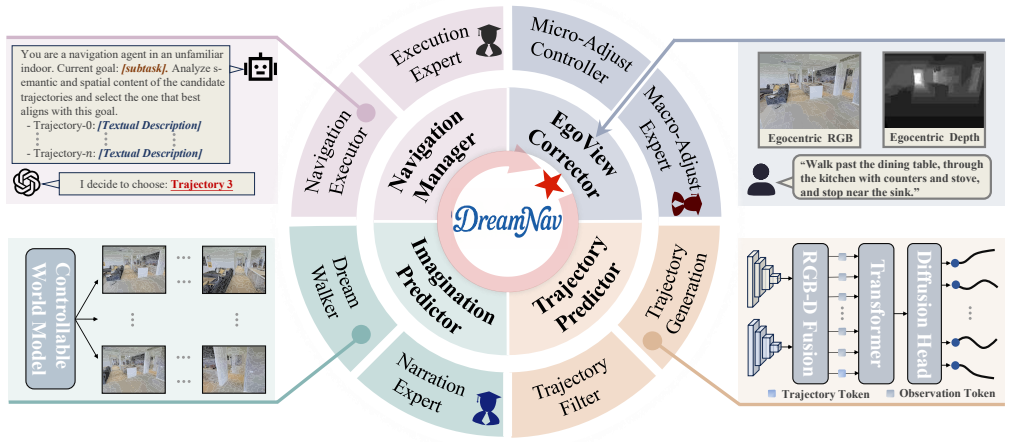
The load-bearing mechanism is a closed loop of generation, imagination, and selection. A two-stage EgoView Corrector (a macro rotation expert plus a micro walkability-gated controller) keeps the egocentric camera aligned with the instruction. A diffusion-policy Trajectory Predictor samples 24-waypoint candidate paths and picks a diverse subset by farthest-first selection. The Imagination Predictor then feeds each candidate trajectory into a controllable world model that synthesizes egocentric future frames, and a narration model converts those frames into task-focused textual descriptions. Finally, the Navigator ranks the descriptions against the current subtask, while an Execution Expert tr
Load-bearing premise
The load-bearing premise is that the controllable world model generates coherent, geometrically faithful egocentric rollouts in unseen environments, and that the narration of those rollouts conveys enough task-relevant semantics to rank candidate trajectories correctly; if the imagined frames are mostly hallucination, the Navigator is effectively choosing on noise.
What would settle it
On R2R-CE Val-Unseen, replace the Imagination Predictor's output with (a) paraphrased random text and (b) ground-truth frames rendered from the simulator along each candidate trajectory, keeping everything else fixed. If random-text ranking matches DreamNav's SR, the gains are not from imagination; if ground-truth-frame ranking substantially exceeds it, the world model's fidelity is the limiting factor.
If this is right
- Egocentric-only sensing is sufficient for competitive zero-shot VLN-CE, removing the need for panoramic capture or multi-sensor rigs at deployment.
- Trajectory-level action selection aligns better with instruction semantics than point-level waypoint prediction, yielding higher SR and SPL.
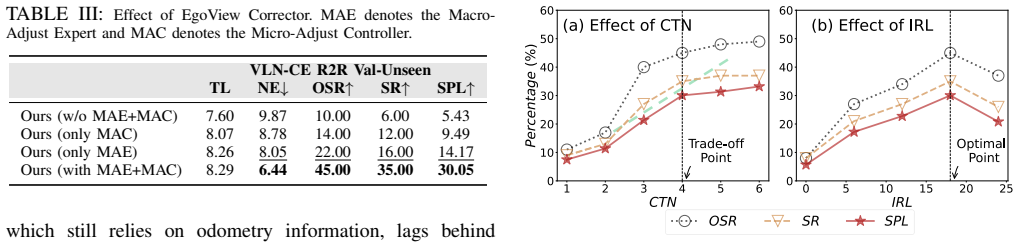
- Imagination helps: increasing imagined rollout length improves decisions up to a point (IRL=18), after which accumulated noise degrades performance.
- The system transfers to a real robot, with 12/20 task successes versus 6/20 for a leading open-source zero-shot baseline.
- Navigation error remains higher than panoramic methods, an acknowledged cost of losing global context.
Where Pith is reading between the lines
- The authors do not isolate how much of the gain comes from trajectory-level planning versus imagination; a clean test would keep the Navigator but rank trajectories using only path geometry plus the current view, without narrated rollouts.
- If synthesized rollouts are partly hallucinated yet still help, the implication is that semantic plausibility matters more than geometric truth for instruction ranking; that could be tested by swapping the world model for a text-only 'imagine the scene' prompt.
- The same trajectory-to-text imagination loop could extend to other long-horizon embodied tasks, such as object search or mobile manipulation, where a language model ranks candidate motion plans by narrated futures.
- The IRL=18 optimum hints that uncertainty accumulates with rollout length; an adaptive horizon that truncates imagination when predicted confidence drops might improve on the fixed length.
Editorial analysis
A structured set of objections, weighed in public.
Referee Report
Summary. DreamNav proposes a zero-shot Vision-and-Language Navigation in Continuous Environments (VLN-CE) system that uses only monocular egocentric RGB-D input. The framework combines four modules: an EgoView Corrector that reduces orientation errors via a pretrained expert and a FastSAM-based micro-adjust controller; a Trajectory Predictor that generates candidate trajectories with a diffusion policy and prunes them via farthest-first selection; an Imagination Predictor that uses a controllable world model (Stable Virtual Camera) and Qwen-VL to produce textual descriptions of imagined rollouts; and a Navigation Manager implemented with GPT-4o that selects among trajectories and monitors subtask progress. The authors report state-of-the-art zero-shot results on R2R-CE Val-Unseen (Table I) and on a 20-trial real-world benchmark (Table II), claiming that trajectory-level planning and active imagination enable egocentric-only navigation to surpass panoramic and odometry-assisted baselines.
Significance. If the results hold, the paper makes a useful contribution: it shows that egocentric-only zero-shot VLN-CE is feasible and can outperform methods that rely on panoramic sensing or odometry, which would lower sensor cost and broaden deployability. The idea of converting imagined visual rollouts into textual narratives for an LLM-based navigator is also practically interesting and avoids the cost of passing raw generated frames to a vision-language model. The modular architecture is clearly described, and the component ablations (Table III, Figure 5) show large effects for the EgoView Corrector and for the choice of imagination rollout length. However, the empirical evidence is currently undermined by the evaluation protocol: hyperparameters are selected on a subset of the same Val-Unseen episodes used for the headline numbers, and no variance estimates are provided. The central SOTA claim therefore needs a stricter, held-out evaluation before it can be accepted.
major comments (4)
- [Sec. IV-A, Sec. IV-D, Fig. 5, Table I] The hyperparameters CTN=4 and IRL=18 are selected using ablations on 100 randomly chosen episodes from the Val-Unseen split, and the same split is then used for the final comparisons in Table I. This leaks evaluation information into model selection and can inflate the reported gains. The authors should either tune on a separate split (e.g., Val-Seen or a held-out portion of Val-Unseen) and report results only on the untouched episodes, or clearly show that the selected values are insensitive to the tuning split. As written, the headline 'surpasses all panoramic-based methods' claim is not supported by a clean evaluation protocol.
- [Table I and Sec. IV-B] No variance or confidence intervals are reported anywhere, despite the pipeline containing stochastic diffusion rollouts, GPT-4o and Qwen-VL API calls, and randomly selected evaluation episodes. The reported improvements over InstructNav are small (1.79% SR, 4.95% SPL); without error bars or multiple-seed results, these gaps may be within run-to-run variability. The authors should report at least bootstrap confidence intervals over episodes or multiple independent runs, especially for the CA-Nav comparison where the claimed gain is 7.49% SR and 18.15% SPL.
- [Sec. IV-C, Table II] The real-world evaluation consists of only 20 trials total. The claim that DreamNav 'surpasses Open-Nav by 30%' is based on 12/20 versus 6/20 successes; with this sample size, a few episode outcomes would change the conclusion. The paper should either provide more trials, report per-scene variability, or use a statistical test. As presented, the real-world superiority claim is not robustly supported.
- [Sec. III-D, Eq. (8), Fig. 5(b)] The Imagination Predictor is a core contribution, but its validity rests on the assumption that Stable Virtual Camera produces geometrically faithful visual rollouts and that Qwen-VL's narrated descriptions are semantically informative for trajectory ranking. The only direct evidence is the IRL=0 no-imagination ablation in Fig. 5(b), which is limited to 100 episodes and is part of the test-set tuning issue raised above. The paper would benefit from a sanity check of the imagined frames against ground-truth observations (or an analysis of failure cases), and from reporting the IRL=0 baseline on the full Val-Unseen split to show that imagination helps beyond the tuning subset.
minor comments (4)
- [Eq. (3)] The encoder names appear reversed: the text says RGB is encoded by f_DEP-ViT and depth by f_RGB-ViT, which is likely a typo. Please swap the names so that RGB uses the RGB ViT and depth uses the DepthAnything ViT.
- [Sec. IV-B] The sentence 'the OSR metrics are directly associated with TL' is not fully justified. OSR depends on whether any point along the path is within the success threshold, which is related to path length but not determined by TL alone. Please rephrase or provide a citation.
- [Fig. 5] The ablation curves in Fig. 5 show SR/SPL versus CTN and IRL, but the exact numerical values are not visible. Including a small table or axis labels with actual numbers would make the choice of CTN=4 and IRL=18 more transparent.
- [Table II] The baseline name 'Navid' should be capitalized consistently as 'NAViD' to match the reference.
Circularity Check
No circular derivation: DreamNav's pipeline uses external pretrained components and hand-designed procedures; no fitted parameter is renamed as a prediction and no self-citation chain forces the result.
full rationale
The derivation chain is a pipeline of external pretrained models and hand-designed procedures: Eq. (1)-(2) are thresholded mask gates; Eq. (3)-(5) are a pretrained diffusion policy conditioned on RGB-D; Eq. (6)-(7) are farthest-first geometric selection; Eq. (8) is a conditioned generative rollout. None of these outputs is defined in terms of the headline SR/SPL, and no parameter is fitted to the benchmark and then reported as a prediction. The only internal parameter choices, CTN=4 and IRL=18, are selected using 100 Val-Unseen episodes (Sec. IV-D, Fig. 5) and then applied to the full Val-Unseen table; this is a statistical evaluation-protocol concern (possible selection bias, no error bars), not a circular derivation, because the final success counts are not algebraically determined by those choices. The no-imagination ablation (IRL=0) in Fig. 5(b) and the EgoView Corrector ablations in Table III provide internal checks of the contribution of the novel modules. The paper's stated limitation of higher NE due to missing global egocentric context (Sec. IV-B) is a performance caveat, not a circular step. There are no load-bearing self-citations: all cited modules are external components, and no 'uniqueness theorem' is used to forbid alternatives.
Axiom & Free-Parameter Ledger
free parameters (4)
- Micro-Adjust threshold theta =
0.1
- Candidate Trajectory Number (CTN) =
4
- Imagination Rollout Length (IRL) =
18
- Rotation amounts and max corrections =
30 degrees / 90 degrees, max 2/3 turns
axioms (5)
- domain assumption Stable Virtual Camera's pretrained world model produces coherent egocentric frames for unseen indoor trajectories when conditioned on pose sequences (Eq. 8).
- domain assumption NavDP diffusion policy's trajectory predictions transfer from its training environments to zero-shot VLN-CE instructions and scenes.
- domain assumption Walkable-area mask occupancy is a reliable proxy for heading misalignment (Eq. 1).
- domain assumption LLM/VLM judges (GPT-4o, Qwen-VL) can reason reliably over egocentric images and imagined narratives with only the provided prompts.
- domain assumption Farthest-first trajectory selection preserves the semantically distinct branches of the diffusion output.
read the original abstract
Vision-and-Language Navigation in Continuous Environments (VLN-CE), which links language instructions to perception and control in the real world, is a core capability of embodied robots. Recently, large-scale pretrained foundation models have been leveraged as shared priors for perception, reasoning, and action, enabling zero-shot VLN without task-specific training. However, existing zero-shot VLN methods depend on costly perception and passive scene understanding, collapsing control to point-level choices. As a result, they are expensive to deploy, misaligned in action semantics, and short-sighted in planning. To address these issues, we present DreamNav that focuses on the following three aspects: (1) for reducing sensory cost, our EgoView Corrector aligns viewpoints and stabilizes egocentric perception; (2) instead of point-level actions, our Trajectory Predictor favors global trajectory-level planning to better align with instruction semantics; and (3) to enable anticipatory and long-horizon planning, we propose an Imagination Predictor to endow the agent with proactive thinking capability. On VLN-CE and real-world tests, DreamNav sets a new zero-shot state-of-the-art (SOTA), outperforming the strongest egocentric baseline with extra information by up to 7.49\% and 18.15\% in terms of SR and SPL metrics. To our knowledge, this is the first zero-shot VLN method to unify trajectory-level planning and active imagination while using only egocentric inputs.
Figures



Forward citations
Cited by 7 Pith papers
-
Beyond Waypoints: A Trajectory-Centric Waypointing Paradigm for Vision-Language Navigation
The paper introduces a Trajectory Waypoint paradigm with a TSDF-guided diffusion policy and trajectory-enhanced navigator that achieves better performance on VLN-CE benchmarks by ensuring waypoint reachability and pla...
-
Bridging the 2D-3D Gap: A Hierarchical Semantic-Geometric Map for Vision Language Navigation
HSGM structures 3D geometry and semantics into a multi-level map that lets VLMs perform high-level planning in zero-shot VLN, achieving SOTA on R2R-CE and RxR-CE.
-
GA-VLN: Geometry-Aware BEV Representation for Efficient Vision-Language Navigation
GA-VLN builds a geometry-aware BEV representation from RGB-D inputs plus 3D foundation model features to deliver state-of-the-art vision-language navigation using only navigation data.
-
Human Cognition in Machines: A Unified Perspective of World Models
The paper introduces a unified framework for world models that fully incorporates all cognitive functions from Cognitive Architecture Theory, highlights under-researched areas in motivation and meta-cognition, and pro...
-
What Limits Vision-and-Language Navigation ?
StereoNav reaches new benchmark highs on R2R-CE and RxR-CE and improves real-robot reliability by supplying persistent target-location priors and stereo-derived geometry that stay stable under lighting changes and blur.
-
LightZeroNav: Zero-Shot Vision Language Navigation in Continuous Environments Based on Lightweight VLMs
LightZeroNav decomposes zero-shot VLN-CE into modules that reduce input redundancy, improve progress tracking from noisy memory, and separate action execution from stage transitions, allowing an 8B VLM to match GPT-4o...
-
Towards Dual-Brain Minimal Sufficient Representation for Vision-Language Navigation
A CP-decomposed, instruction-conditioned latent bottleneck (CompactNav) improves VLN-CE success rate by about 2% over prior state of the art on two benchmarks.
Reference graph
Works this paper leans on
-
[1]
Beyond the nav-graph: Vision and language navigation in continuous environ- ments,
J. Krantz, E. Wijmans, A. Majumdar, D. Batra, and S. Lee, “Beyond the nav-graph: Vision and language navigation in continuous environ- ments,” inEuropean Conference on Computer Vision (ECCV), 2020, pp. 104–120
2020
-
[2]
Vision-and-language navigation: Interpreting visually-grounded navigation instructions in real environments,
P. Anderson, Q. Wu, D. Teney, J. Bruce, M. Johnson, N. S ¨underhauf, I. Reid, S. Gould, and A. van den Hengel, “Vision-and-language navigation: Interpreting visually-grounded navigation instructions in real environments,” inIEEE Conference on Computer Vision and Pattern Recognition (CVPR), 2018, pp. 3674–3683
2018
-
[3]
Vision- and-language navigation: A survey of tasks, methods, and future directions,
J. Gu, E. Stefani, Q. Wu, J. Thomason, and X. E. Wang, “Vision- and-language navigation: A survey of tasks, methods, and future directions,” inAnnual Meeting of the Association for Computational Linguistics (ACL), 2022
2022
-
[4]
Vln-r1: Vision- language navigation via reinforcement fine-tuning,
Z. Qi, Z. Zhang, Y . Yu, J. Wang, and H. Zhao, “Vln-r1: Vision- language navigation via reinforcement fine-tuning,”arXiv preprint arXiv:2506.17221, 2025
Pith/arXiv arXiv 2025
-
[5]
Navid: Video-based vlm plans the next step for vision-and-language navigation,
J. Zhang, K. Wang, R. Xu, G. Zhou, Y . Hong, X. Fang, Q. Wu, Z. Zhang, and H. Wang, “Navid: Video-based vlm plans the next step for vision-and-language navigation,” inRobotics: Science and Systems (RSS), 2024
2024
-
[6]
Uni-navid: A video-based vision-language- action model for unifying embodied navigation tasks,
J. Zhang, K. Wang, S. Wang, M. Li, H. Liu, S. Wei, Z. Wang, Z. Zhang, and H. Wang, “Uni-navid: A video-based vision-language- action model for unifying embodied navigation tasks,” inRobotics: Science and Systems (RSS), 2024
2024
-
[7]
Mp5: A multi-modal open-ended embodied system in minecraft via active perception,
Y . Qin, E. Zhou, Q. Liu, Z. Yin, L. Sheng, R. Zhang, Y . Qiao, and J. Shao, “Mp5: A multi-modal open-ended embodied system in minecraft via active perception,” inIEEE Conference on Computer Vision and Pattern Recognition (CVPR), 2024, pp. 16 307–16 316
2024
-
[8]
Navgpt: Explicit reasoning in vision- and-language navigation with large language models,
G. Zhou, Y . Hong, and Q. Wu, “Navgpt: Explicit reasoning in vision- and-language navigation with large language models,”arXiv preprint arXiv:2305.16986, 2023
Pith/arXiv arXiv 2023
-
[9]
Mapgpt: Map-guided prompting with adaptive path planning for vision-and-language navigation,
J. Chen, B. Lin, R. Xu, Z. Chai, X. Liang, and K.-Y . K. Wong, “Mapgpt: Map-guided prompting with adaptive path planning for vision-and-language navigation,” inAnnual Meeting of the Association for Computational Linguistics (ACL), 2024
2024
-
[10]
Open-nav: Exploring zero-shot vision-and-language navigation in continuous environment with open-source llms,
Y . Qiao, W. Lyu, H. Wang, Z. Wang, Z. Li, Y . Zhang, M. Tan, and Q. Wu, “Open-nav: Exploring zero-shot vision-and-language navigation in continuous environment with open-source llms,” inIEEE International Conference on Robotics and Automation (ICRA), 2025
2025
-
[11]
X. Shi, Z. Li, W. Lyu, J. Xia, F. Dayoub, Y . Qiao, and Q. Wu, “Smart- way: Enhanced waypoint prediction and backtracking for zero-shot vision-and-language navigation,”arXiv preprint arXiv:2503.10069, 2025
Pith/arXiv arXiv 2025
-
[12]
Instructnav: Zero-shot system for generic instruction navigation in unexplored environment,
Y . Long, W. Cai, H. Wang, G. Zhan, and H. Dong, “Instructnav: Zero-shot system for generic instruction navigation in unexplored environment,”arXiv preprint arXiv:2406.04882, 2024
Pith/arXiv arXiv 2024
-
[13]
View invariant learning for vision-language navigation in continuous environments,
J. Q. Sun, X. Xing, H. Weng, C. M. Yeum, and M. Crowley, “View invariant learning for vision-language navigation in continuous environments,”arXiv preprint arXiv:2507.08831, 2025
arXiv 2025
-
[14]
Mc-gpt: Empowering vision-and- language navigation with memory map and reasoning chains,
Z. Zhan, L. Yu, S. Yu, and G. Tan, “Mc-gpt: Empowering vision-and- language navigation with memory map and reasoning chains,”arXiv preprint arXiv:2405.10620, 2024
Pith/arXiv arXiv 2024
-
[15]
Constraint-aware zero-shot vision-language navigation in continuous environments,
K. Chen, D. An, Y . Huang, R. Xu, Y . Su, Y . Ling, I. Reid, and L. Wang, “Constraint-aware zero-shot vision-language navigation in continuous environments,”arXiv preprint arXiv:2412.10137, 2024
Pith/arXiv arXiv 2024
-
[16]
Bridging the gap between learning in discrete and continuous environments for vision-and- language navigation,
Y . Hong, Z. Wang, Q. Wu, and S. Gould, “Bridging the gap between learning in discrete and continuous environments for vision-and- language navigation,” inIEEE Conference on Computer Vision and Pattern Recognition (CVPR), 2022, pp. 15 439–15 449
2022
-
[17]
Path- dreamer: A world model for indoor navigation,
J. Y . Koh, H. Lee, Y . Yang, J. Baldridge, and P. Anderson, “Path- dreamer: A world model for indoor navigation,” inIEEE International Conference on Computer Vision (ICCV), 2021, pp. 14 738–14 748
2021
-
[18]
Dreamwalker: Mental planning for continuous vision-language navigation,
H. Wang, W. Liang, L. V . Gool, and W. Wang, “Dreamwalker: Mental planning for continuous vision-language navigation,” inIEEE Inter- national Conference on Computer Vision (ICCV), 2023, pp. 10 873– 10 883
2023
-
[19]
A. Bar, G. Zhou, D. Tran, T. Darrell, and Y . LeCun, “Navigation world models,”arXiv preprint arXiv:2412.03572, 2024
Pith/arXiv arXiv 2024
-
[20]
Imagine before go: Self-supervised generative map for object goal navigation,
S. Zhang, X. Yu, X. Song, X. Wang, and S. Jiang, “Imagine before go: Self-supervised generative map for object goal navigation,” inIEEE Conference on Computer Vision and Pattern Recognition (CVPR), 2024, pp. 16 414–16 425
2024
-
[21]
Peanut: Predicting and navigating to unseen targets,
A. J. Zhai and S. Wang, “Peanut: Predicting and navigating to unseen targets,” inIEEE International Conference on Computer Vision (ICCV), 2023, pp. 10 926–10 935
2023
-
[22]
Unitedvln: Generalizable gaussian splatting for continuous vision-language navigation,
G. Dai, J. Zhao, Y . Chen, Y . Qin, H. Zhao, G. Xie, Y . Yao, X. Shu, and X. Li, “Unitedvln: Generalizable gaussian splatting for continuous vision-language navigation,”arXiv preprint arXiv:2411.16053, 2024
Pith/arXiv arXiv 2024
-
[23]
Looka- head exploration with neural radiance representation for continuous vision-language navigation,
Z. Wang, X. Li, J. Yang, Y . Liu, J. Hu, M. Jiang, and S. Jiang, “Looka- head exploration with neural radiance representation for continuous vision-language navigation,” inIEEE Conference on Computer Vision and Pattern Recognition (CVPR), 2024, pp. 13 753–13 762
2024
-
[24]
J. Achiam, S. Adler, S. Agarwal, L. Ahmad, I. Akkaya, F. L. Aleman, D. Almeida, J. Altenschmidt, S. Altman, S. Anadkat,et al., “Gpt-4 technical report,”arXiv preprint arXiv:2303.08774, 2023
Pith/arXiv arXiv 2023
-
[25]
X. Zhao, W. Ding, Y . An, Y . Du, T. Yu, M. Li, M. Tang, and J. Wang, “Fast segment anything,”arXiv preprint arXiv:2306.12156, 2023
Pith/arXiv arXiv 2023
-
[26]
Diffusion policy: Visuomotor policy learning via action diffusion,
C. Chi, S. Feng, Y . Du, Z. Xu, E. Cousineau, B. Burchfiel, and S. Song, “Diffusion policy: Visuomotor policy learning via action diffusion,” in Robotics: Science and Systems (RSS), 2023
2023
-
[27]
Diffusionvla: Scaling robot founda- tion models via unified diffusion and autoregression,
J. Wen, M. Zhu, Y . Zhu, Z. Tang, J. Li, Z. Zhou, C. Li, X. Liu, Y . Peng, C. Shen, and F. Feng, “Diffusionvla: Scaling robot founda- tion models via unified diffusion and autoregression,”arXiv preprint arXiv:2412.03293, 2025
Pith/arXiv arXiv 2025
-
[28]
Nomad: Goal masked diffusion policies for navigation and exploration,
A. Sridhar, D. Shah, C. Glossop, and S. Levine, “Nomad: Goal masked diffusion policies for navigation and exploration,”arXiv preprint arXiv:2310.07896, 2023
Pith/arXiv arXiv 2023
-
[29]
Ldp: A local diffusion planner for efficient robot navigation and collision avoidance,
W. Yu, J. Peng, H. Yang, J. Zhang, Y . Duan, J. Ji, and Y . Zhang, “Ldp: A local diffusion planner for efficient robot navigation and collision avoidance,”arXiv preprint arXiv:2407.01950, 2024
Pith/arXiv arXiv 2024
-
[30]
Navdp: Learning sim-to-real navigation dif- fusion policy with privileged information guidance,
W. Cai, J. Peng, Y . Yang, Y . Zhang, M. Wei, H. Wang, Y . Chen, T. Wang, and J. Pang, “Navdp: Learning sim-to-real navigation dif- fusion policy with privileged information guidance,”arXiv preprint arXiv:2505.08712, 2025
arXiv 2025
-
[31]
Depth anything: Unleashing the power of large-scale unlabeled data,
L. Yang, B. Kang, Z. Huang, X. Xu, J. Feng, and H. Zhao, “Depth anything: Unleashing the power of large-scale unlabeled data,” inIEEE Conference on Computer Vision and Pattern Recognition (CVPR), 2024
2024
-
[32]
U-net: Convolu- tional networks for biomedical image segmentation,
O. Ronneberger, P. Fischer, and T. Brox, “U-net: Convolu- tional networks for biomedical image segmentation,”arXiv preprint arXiv:1505.04597, 2015
Pith/arXiv arXiv 2015
-
[33]
Denoising diffusion probabilistic models,
J. Ho, A. Jain, and P. Abbeel, “Denoising diffusion probabilistic models,”arXiv preprint arXiv:2006.11239, 2020
Pith/arXiv arXiv 2006
-
[34]
Clustering to minimize the maximum intercluster distance,
T. F. Gonzalez, “Clustering to minimize the maximum intercluster distance,”Theoretical Computer Science, vol. 38, pp. 293–306, 1985
1985
-
[35]
Stable virtual camera: Generative view synthesis with diffusion models,
J. Zhou, H. Gao, V . V oleti, A. Vasishta, C.-H. Yao, M. Boss, P. Torr, C. Rupprecht, and V . Jampani, “Stable virtual camera: Generative view synthesis with diffusion models,”arXiv preprint arXiv:2503.14489, 2025
Pith/arXiv arXiv 2025
-
[36]
Habitat: A platform for embodied ai research,
M. Savva, A. Kadian, O. Maksymets, Y . Zhao, E. Wijmans, B. Jain, J. Straub, J. Liu, V . Koltun, J. Malik, D. Parikh, and D. Batra, “Habitat: A platform for embodied ai research,” inIEEE International Conference on Computer Vision (ICCV), 2019
2019
-
[37]
Discuss before moving: Visual language navigation via multi-expert discussions,
Y . Long, X. Li, W. Cai, and H. Dong, “Discuss before moving: Visual language navigation via multi-expert discussions,” inIEEE International Conference on Robotics and Automation (ICRA), 2023, pp. 17 380–17 387
2023
-
[38]
A. Hurst, A. Lerer, A. P. Goucher, A. Perelman, A. Ramesh, A. Clark, A. Ostrow, A. Welihinda, A. Hayes, A. Radford,et al., “Gpt-4o system card,”arXiv preprint arXiv:2410.21276, 2024
Pith/arXiv arXiv 2024
-
[39]
S. Bai, K. Chen, X. Liu, J. Wang, W. Ge, S. Song, K. Dang, P. Wang, S. Wang, J. Tang,et al., “Qwen2.5-vl technical report,”arXiv preprint arXiv:2502.13923, 2025
Pith/arXiv arXiv 2025
discussion (0)
Sign in with ORCID, Apple, or X to comment. Anyone can read and Pith papers without signing in.