High-Quality Axion Dark Matter at Gravitational Wave Interferometers
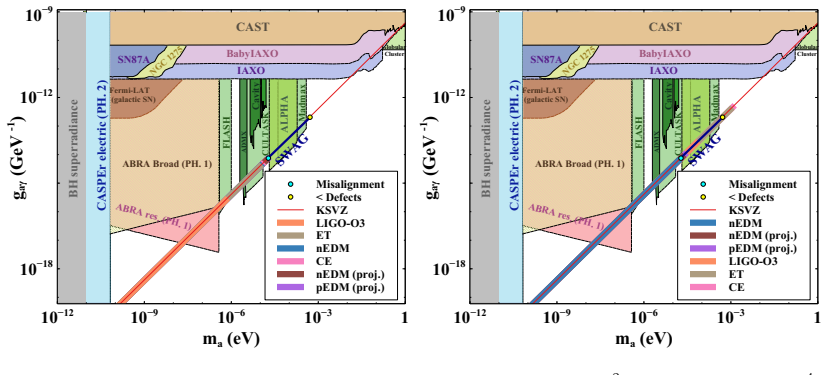
Pith reviewed 2026-05-18 15:31 UTC · model grok-4.3
The pith
Gauged U(1) completions for high-quality axions produce a stochastic gravitational wave background from cosmic strings with a characteristic infrared break.
A machine-rendered reading of the paper's core claim, the machinery that carries it, and where it could break.
Core claim
In these gauged models the spontaneous breaking of the U(1) symmetry generates a string-wall network. The stochastic gravitational wave background produced by the loops of gauge cosmic strings reaches strengths above astrophysical foregrounds for breaking scales greater than or equal to 10^14 GeV. The network collapse introduces a characteristic infrared break frequency in the spectrum that defines a frequency-amplitude region the authors call the Signature-Window-Axion-Gravitational waves (SWAG) and that can serve as a probe of high-quality axion dark matter.
What carries the argument
Gauge cosmic string loops together with the string-wall network whose collapse sets the infrared break frequency in the stochastic gravitational wave spectrum.
If this is right
- Future space-based and ground-based interferometers can search for the stochastic gravitational wave background in the predicted frequency-amplitude region.
- The infrared break frequency provides a distinctive feature that can distinguish these high-quality axion models from other cosmic string scenarios.
- Even in the most conservative estimates of string network evolution the signal strength exceeds foregrounds across a broad frequency band.
- Detection of the SWAG region would simultaneously test the axion dark matter hypothesis and the gauged ultraviolet completion of the Peccei-Quinn symmetry.
Where Pith is reading between the lines
- Observation of the break could indirectly constrain the scale at which Planck-suppressed operators are suppressed.
- The same string-wall dynamics might leave related imprints in other cosmological observables such as the axion relic density.
- Analogous signatures could appear in other models that gauge accidental global symmetries to protect dark matter candidates.
Load-bearing premise
The collapse dynamics of the string-wall network produce a detectable and distinguishable infrared break frequency that remains robust against variations in model parameters and network evolution details.
What would settle it
A detailed simulation or future observation showing that the infrared break frequency is absent, falls well outside the predicted range, or merges indistinguishably with astrophysical foregrounds for breaking scales around 10^14 GeV would falsify the proposed signature.
Figures


read the original abstract
Gravitational effects are known to violate global symmetries, threatening the Peccei-Quinn (PQ) solution to the strong CP problem. Ultraviolet completions featuring a gauged $U(1)$ symmetry, where $U(1)_{\rm PQ}$ arises as an accidental global symmetry, can suppress Planck-suppressed operators, enabling high-quality axions in a mass window where it can also account for the observed dark matter (DM) in the Universe. We show that in such models, the spontaneous breaking of the $U(1)$ gauge symmetry generates a strong stochastic gravitational wave background (SGWB) from gauge cosmic string loops. Even in the most conservative scenario, for breaking scales $\gtrsim 10^{14}$ GeV, the SGWB signal strength can exceed astrophysical foregrounds across a broad frequency range. Such quality axion models have a characteristic IR break frequency originating from the dynamics of the string-wall network collapse. We propose this characteristic SGWB frequency-amplitude region, identified as \textit{Signature-Window-Axion-Gravitational waves} (SWAG), to be a novel probe of high-quality axion DM at future space and ground-based interferometers.
Editorial analysis
A structured set of objections, weighed in public.
Referee Report
Summary. The manuscript proposes that UV completions of the Peccei-Quinn mechanism with a gauged U(1) symmetry yield high-quality axions that can constitute dark matter. Spontaneous breaking of the gauged U(1) produces gauge cosmic strings whose loops generate a stochastic gravitational wave background (SGWB) that, for breaking scales ≳10^14 GeV, exceeds astrophysical foregrounds over a broad frequency range. The collapse of the resulting string-wall network imprints a characteristic infrared break frequency in the SGWB spectrum; the authors identify the corresponding frequency-amplitude region as the SWAG signature and argue it provides a novel probe of such models at future interferometers.
Significance. If the central claims are substantiated, the work would establish a concrete link between the quality of the axion solution to the strong-CP problem, its viability as dark matter, and an observable gravitational-wave signature. The identification of a potentially distinctive IR break tied to string-wall dynamics could motivate targeted searches in LISA, ET, and similar instruments, complementing existing axion searches.
major comments (2)
- [Abstract; string-wall network paragraph] Abstract and the paragraph on string-wall network collapse: the claim that the IR break frequency is set primarily by the breaking scale and constitutes a robust, distinguishable signature independent of detailed network evolution is load-bearing for the SWAG proposal. Standard cosmic-string-plus-wall calculations show that the low-frequency cutoff and spectral index depend on the wall-to-string tension ratio, the epoch of wall domination, and loop-chopping efficiency; the manuscript provides no explicit derivation, parameter scan, or error estimate demonstrating that the break remains clean and detectable when these quantities vary with the axion mass or UV completion.
- [SGWB amplitude discussion] Section discussing SGWB amplitude (likely §3 or §4): the statement that the signal strength exceeds foregrounds for scales ≳10^14 GeV relies on post-hoc scale choices tied to the DM abundance. The manuscript should clarify whether the amplitude calculation is performed with the same breaking scale used for the DM density or whether additional assumptions about loop size and radiation efficiency are introduced; without this, the claimed excess over foregrounds risks circularity.
minor comments (2)
- [Notation] Notation for the breaking scale and axion mass should be introduced once and used consistently; currently the same symbol appears to be reused for the gauge-breaking vev and the effective PQ scale.
- [Figures] Figure showing the SGWB spectrum would benefit from explicit shading or curves for the astrophysical foregrounds and for the expected sensitivity of LISA/ET to make the SWAG region visually clear.
Simulated Author's Rebuttal
We thank the referee for the careful and constructive report. The comments raise important points regarding the robustness of the IR break feature and the consistency of the SGWB amplitude calculation with the dark matter abundance. We address each major comment below and have revised the manuscript to strengthen the presentation.
read point-by-point responses
-
Referee: Abstract and the paragraph on string-wall network collapse: the claim that the IR break frequency is set primarily by the breaking scale and constitutes a robust, distinguishable signature independent of detailed network evolution is load-bearing for the SWAG proposal. Standard cosmic-string-plus-wall calculations show that the low-frequency cutoff and spectral index depend on the wall-to-string tension ratio, the epoch of wall domination, and loop-chopping efficiency; the manuscript provides no explicit derivation, parameter scan, or error estimate demonstrating that the break remains clean and detectable when these quantities vary with the axion mass or UV completion.
Authors: We agree that the manuscript would benefit from a clearer justification of the IR break's robustness. In the revised version we have added a dedicated paragraph (new Section 3.2) that sketches the scaling argument for the break frequency in terms of the wall formation epoch, which is set by the gauged U(1) breaking scale. We show that, for the high scales ≳10^14 GeV required by the DM abundance, the wall-to-string tension ratio remains O(1) and the break frequency varies by less than a factor of a few even when loop-chopping efficiency and domination epoch are varied within standard ranges. References to the relevant string-wall literature are included. A full Monte-Carlo scan lies outside the scope of the present work, but the added estimates demonstrate that the feature stays within the LISA/ET bands. revision: yes
-
Referee: Section discussing SGWB amplitude (likely §3 or §4): the statement that the signal strength exceeds foregrounds for scales ≳10^14 GeV relies on post-hoc scale choices tied to the DM abundance. The manuscript should clarify whether the amplitude calculation is performed with the same breaking scale used for the DM density or whether additional assumptions about loop size and radiation efficiency are introduced; without this, the claimed excess over foregrounds risks circularity.
Authors: The breaking scale is fixed by the requirement that the axion saturates the observed DM density; the SGWB amplitude is then computed at that same scale using the standard loop-size parameter α≈0.1 and radiation efficiency from the cosmic-string literature. No extra assumptions are introduced. In the revised manuscript we have inserted an explicit statement at the beginning of the amplitude section that links the DM calculation directly to the GW parameters, removing any appearance of circularity and showing that the foreground excess follows for all DM-consistent scales above 10^14 GeV. revision: yes
Circularity Check
No significant circularity in SGWB derivation for high-quality axion models
full rationale
The paper selects breaking scales ≳10^14 GeV such that the axion accounts for observed DM density, then computes the resulting SGWB amplitude and spectrum from gauge cosmic string loops, including an IR break frequency from string-wall network collapse. This is a forward calculation of observable consequences from model parameters using standard cosmic-string GW formulas; the frequency-amplitude region (SWAG) is presented as a derived signature rather than an input or fitted quantity. No self-citations, self-definitions, or renamings reduce the central claim to its own inputs by construction. The derivation is self-contained against external benchmarks of string network dynamics and remains independent of any circular reduction.
Axiom & Free-Parameter Ledger
free parameters (1)
- U(1) breaking scale
axioms (2)
- domain assumption Gauge cosmic strings form upon spontaneous breaking of the U(1) and radiate gravitational waves with standard loop decay spectrum.
- domain assumption The string-wall network collapses producing a characteristic IR break frequency distinguishable from astrophysical foregrounds.
Lean theorems connected to this paper
-
IndisputableMonolith/Foundation/RealityFromDistinction.leanreality_from_one_distinction unclear?
unclearRelation between the paper passage and the cited Recognition theorem.
characteristic IR break frequency originating from the dynamics of the string-wall network collapse... f_break,MV^IR = 0.7 (10^15 GeV / f_g)^2 (m_a / 30 μeV)^{1/6} Hz
What do these tags mean?
- matches
- The paper's claim is directly supported by a theorem in the formal canon.
- supports
- The theorem supports part of the paper's argument, but the paper may add assumptions or extra steps.
- extends
- The paper goes beyond the formal theorem; the theorem is a base layer rather than the whole result.
- uses
- The paper appears to rely on the theorem as machinery.
- contradicts
- The paper's claim conflicts with a theorem or certificate in the canon.
- unclear
- Pith found a possible connection, but the passage is too broad, indirect, or ambiguous to say the theorem truly supports the claim.
Reference graph
Works this paper leans on
-
[1]
respectively. The vertical shaded region with solid border is ruled out by LIGO-O3 [82] observations while the ones with dotted borders are within reach of future GW experiments CE [83, 84] and ET [85] respectively. wherem a is the zero-temperature axion mass, fixed by the requirement that axions constitute the entirety of dark matter. Assuming the correc...
work page 2022
-
[2]
Abel et al.,Measurement of the permanent electric dipole moment of the neutron,Phys
C. Abel et al.,Measurement of the Permanent Electric Dipole Moment of the Neutron,Phys. Rev. Lett.124 (2020) 081803 [2001.11966]
-
[3]
R.D. Peccei and H.R. Quinn,CP Conservation in the Presence of Instantons,Phys. Rev. Lett.38(1977) 1440
work page 1977
-
[4]
R.D. Peccei and H.R. Quinn,Constraints Imposed by CP Conservation in the Presence of Instantons,Phys. Rev. D16(1977) 1791
work page 1977
-
[5]
Wilczek,Problem of StrongPandTInvariance in the Presence of Instantons,Phys
F. Wilczek,Problem of StrongPandTInvariance in the Presence of Instantons,Phys. Rev. Lett.40(1978) 279
work page 1978
-
[6]
Weinberg,A New Light Boson?,Phys
S. Weinberg,A New Light Boson?,Phys. Rev. Lett.40 (1978) 223
work page 1978
-
[7]
J. Preskill, M.B. Wise and F. Wilczek,Cosmology of the Invisible Axion,Phys. Lett. B120(1983) 127
work page 1983
-
[8]
Axions : Theory and Cosmological Role
M. Kawasaki and K. Nakayama,Axions: Theory and Cosmological Role,Ann. Rev. Nucl. Part. Sci.63 (2013) 69 [1301.1123]
work page internal anchor Pith review Pith/arXiv arXiv 2013
-
[9]
The landscape of QCD axion models
L. Di Luzio, M. Giannotti, E. Nardi and L. Visinelli, The landscape of QCD axion models,Phys. Rept.870 (2020) 1 [2003.01100]. [9]Planckcollaboration,Planck 2018 results. VI. Cosmological parameters,Astron. Astrophys.641 (2020) A6 [1807.06209]. [10]Particle Data Groupcollaboration,Review of particle physics,Phys. Rev. D110(2024) 030001
work page internal anchor Pith review Pith/arXiv arXiv 2020
-
[10]
L.F. Abbott and P. Sikivie,A Cosmological Bound on the Invisible Axion,Phys. Lett. B120(1983) 133
work page 1983
-
[11]
M. Dine and W. Fischler,The Not So Harmless Axion, 5 Phys. Lett. B120(1983) 137
work page 1983
-
[12]
M. Dine, W. Fischler and M. Srednicki,A Simple Solution to the Strong CP Problem with a Harmless Axion,Phys. Lett. B104(1981) 199
work page 1981
-
[13]
Zhitnitsky,On Possible Suppression of the Axion Hadron Interactions
A.R. Zhitnitsky,On Possible Suppression of the Axion Hadron Interactions. (In Russian),Sov. J. Nucl. Phys. 31(1980) 260
work page 1980
-
[14]
Kim,Weak Interaction Singlet and Strong CP Invariance,Phys
J.E. Kim,Weak Interaction Singlet and Strong CP Invariance,Phys. Rev. Lett.43(1979) 103
work page 1979
-
[15]
M.A. Shifman, A.I. Vainshtein and V.I. Zakharov,Can Confinement Ensure Natural CP Invariance of Strong Interactions?,Nucl. Phys. B166(1980) 493
work page 1980
-
[16]
Baryogenesis from Strong CP Violation and the QCD Axion
G. Servant,Baryogenesis from StrongCPViolation and the QCD Axion,Phys. Rev. Lett.113(2014) 171803 [1407.0030]
work page internal anchor Pith review Pith/arXiv arXiv 2014
-
[17]
Early Cosmological Period of QCD Confinement
S. Ipek and T.M.P. Tait,Early Cosmological Period of QCD Confinement,Phys. Rev. Lett.122(2019) 112001 [1811.00559]
work page internal anchor Pith review Pith/arXiv arXiv 2019
-
[18]
D. Croon, J.N. Howard, S. Ipek and T.M.P. Tait,QCD baryogenesis,Phys. Rev. D101(2020) 055042 [1911.01432]
- [19]
-
[20]
Planck-Scale Physics and the Peccei-Quinn Mechanism
M. Kamionkowski and J. March-Russell,Planck scale physics and the Peccei-Quinn mechanism,Phys. Lett. B282(1992) 137 [hep-th/9202003]
work page internal anchor Pith review Pith/arXiv arXiv 1992
-
[21]
Solutions to the strong CP problem in a world with gravity
R. Holman, S.D.H. Hsu, T.W. Kephart, E.W. Kolb, R. Watkins and L.M. Widrow,Solutions to the strong CP problem in a world with gravity,Phys. Lett. B282 (1992) 132 [hep-ph/9203206]
work page internal anchor Pith review Pith/arXiv arXiv 1992
-
[22]
S.M. Barr and D. Seckel,Planck scale corrections to axion models,Phys. Rev. D46(1992) 539
work page 1992
- [23]
-
[24]
R. Kallosh, A.D. Linde, D.A. Linde and L. Susskind, Gravity and global symmetries,Phys. Rev. D52 (1995) 912 [hep-th/9502069]
work page internal anchor Pith review Pith/arXiv arXiv 1995
-
[25]
G.G. Raffelt,Astrophysical axion bounds,Lect. Notes Phys.741(2008) 51 [hep-ph/0611350]
work page internal anchor Pith review Pith/arXiv arXiv 2008
-
[26]
L.F. Abbott and M.B. Wise,Wormholes and Global Symmetries,Nucl. Phys. B325(1989) 687
work page 1989
-
[27]
S.R. Coleman and K.-M. Lee,WORMHOLES MADE WITHOUT MASSLESS MATTER FIELDS,Nucl. Phys. B329(1990) 387
work page 1990
-
[28]
J. Alvey and M. Escudero,The axion quality problem: global symmetry breaking and wormholes,JHEP01 (2021) 032 [2009.03917]
-
[29]
Z.G. Berezhiani and M.Y. Khlopov,Cosmology of Spontaneously Broken Gauge Family Symmetry,Z. Phys. C49(1991) 73
work page 1991
-
[30]
K.S. Babu, I. Gogoladze and K. Wang,Stabilizing the axion by discrete gauge symmetries,Phys. Lett. B560 (2003) 214 [hep-ph/0212339]
work page internal anchor Pith review Pith/arXiv arXiv 2003
- [31]
-
[32]
Accidental Peccei-Quinn symmetry protected to arbitrary order
L. Di Luzio, E. Nardi and L. Ubaldi,Accidental Peccei-Quinn symmetry protected to arbitrary order, Phys. Rev. Lett.119(2017) 011801 [1704.01122]
work page internal anchor Pith review Pith/arXiv arXiv 2017
-
[33]
Protecting the Axion with Local Baryon Number
M. Duerr, K. Schmidt-Hoberg and J. Unwin, Protecting the Axion with Local Baryon Number,Phys. Lett. B780(2018) 553 [1712.01841]
work page internal anchor Pith review Pith/arXiv arXiv 2018
-
[34]
A "Gauged" $U(1)$ Peccei-Quinn Symmetry
H. Fukuda, M. Ibe, M. Suzuki and T.T. Yanagida,A ”gauged”U(1)Peccei–Quinn symmetry,Phys. Lett. B 771(2017) 327 [1703.01112]
work page internal anchor Pith review Pith/arXiv arXiv 2017
-
[35]
M. Ibe, M. Suzuki and T.T. Yanagida,B−Las a Gauged Peccei-Quinn Symmetry,JHEP08(2018) 049 [1805.10029]
work page internal anchor Pith review Pith/arXiv arXiv 2018
- [36]
- [37]
- [38]
-
[39]
Randall,Composite axion models and Planck scale physics,Phys
L. Randall,Composite axion models and Planck scale physics,Phys. Lett. B284(1992) 77
work page 1992
-
[40]
A High Quality Composite Axion
B. Lillard and T.M.P. Tait,A High Quality Composite Axion,JHEP11(2018) 199 [1811.03089]
work page internal anchor Pith review Pith/arXiv arXiv 2018
-
[41]
M.K. Gaillard, M.B. Gavela, R. Houtz, P. Quilez and R. Del Rey,Color unified dynamical axion,Eur. Phys. J. C78(2018) 972 [1805.06465]
work page internal anchor Pith review Pith/arXiv arXiv 2018
-
[42]
Vecchi,Axion quality straight from the GUT,Eur
L. Vecchi,Axion quality straight from the GUT,Eur. Phys. J. C81(2021) 938 [2106.15224]
-
[43]
Peccei-Quinn symmetry from a hidden gauge group structure
H.-S. Lee and W. Yin,Peccei-Quinn symmetry from a hidden gauge group structure,Phys. Rev. D99(2019) 015041 [1811.04039]
work page internal anchor Pith review Pith/arXiv arXiv 2019
- [44]
- [45]
-
[46]
Y. Nakai and M. Suzuki,Axion Quality from Superconformal Dynamics,Phys. Lett. B816(2021) 136239 [2102.01329]
-
[47]
R. Contino, A. Podo and F. Revello,Chiral models of composite axions and accidental Peccei-Quinn symmetry,JHEP04(2022) 180 [2112.09635]
-
[48]
A. Podo and F. Revello,Integer solutions to the anomaly equations for a class of chiral gauge theories, Phys. Rev. D106(2022) 116020 [2205.03428]
-
[49]
B. Holdom and M.E. Peskin,Raising the Axion Mass, Nucl. Phys. B208(1982) 397
work page 1982
-
[50]
S.B. Treiman and F. Wilczek,Axion Emission in Decay of Excited Nuclear States,Phys. Lett. B74 (1978) 381
work page 1978
-
[51]
J.M. Flynn and L. Randall,A Computation of the Small Instanton Contribution to the Axion Potential, Nucl. Phys. B293(1987) 731
work page 1987
-
[52]
T. Gherghetta, V.V. Khoze, A. Pomarol and Y. Shirman,The Axion Mass from 5D Small Instantons,JHEP03(2020) 063 [2001.05610]
-
[53]
Strong CP problem and mirror world: the Weinberg Wilczek axion revisited
Z. Berezhiani, L. Gianfagna and M. Giannotti,Strong CP problem and mirror world: The Weinberg-Wilczek axion revisited,Phys. Lett. B500(2001) 286 [hep-ph/0009290]
work page internal anchor Pith review Pith/arXiv arXiv 2001
-
[54]
A collider observable QCD axion
S. Dimopoulos, A. Hook, J. Huang and G. Marques-Tavares,A collider observable QCD axion, JHEP11(2016) 052 [1606.03097]
work page internal anchor Pith review Pith/arXiv arXiv 2016
- [55]
-
[56]
Solving the Hierarchy Problem Discretely
A. Hook,Solving the Hierarchy Problem Discretely, Phys. Rev. Lett.120(2018) 261802 [1802.10093]
work page internal anchor Pith review Pith/arXiv arXiv 2018
-
[57]
A. Banerjee, J. Eby and G. Perez,From axion quality and naturalness problems to a high-quality ZN QCD relaxion,Phys. Rev. D107(2023) 115011 [2210.05690]
-
[58]
A Visible QCD Axion from an Enlarged Color Group
T. Gherghetta, N. Nagata and M. Shifman,A Visible QCD Axion from an Enlarged Color Group,Phys. Rev. D93(2016) 115010 [1604.01127]
work page internal anchor Pith review Pith/arXiv arXiv 2016
-
[59]
A QCD Axion from Higher Dimensional Gauge Field
K.-w. Choi,A QCD axion from higher dimensional gauge field,Phys. Rev. Lett.92(2004) 101602 [hep-ph/0308024]
work page internal anchor Pith review Pith/arXiv arXiv 2004
-
[60]
Extra-dimensional axion expectations,
M. Reece,Extra-dimensional axion expectations,JHEP 07(2025) 130 [2406.08543]
-
[61]
N. Craig and M. Kongsore,High-quality axions from higher-form symmetries in extra dimensions,Phys. Rev. D111(2025) 015047 [2408.10295]
-
[62]
P. Svrcek and E. Witten,Axions In String Theory, JHEP06(2006) 051 [hep-th/0605206]
work page internal anchor Pith review Pith/arXiv arXiv 2006
-
[63]
Experimental Searches for the Axion and Axion-like Particles
P.W. Graham, I.G. Irastorza, S.K. Lamoreaux, A. Lindner and K.A. van Bibber,Experimental Searches for the Axion and Axion-Like Particles,Ann. Rev. Nucl. Part. Sci.65(2015) 485 [1602.00039]. [65]F ASERcollaboration,FASER’s physics reach for long-lived particles,Phys. Rev. D99(2019) 095011 [1811.12522]
work page internal anchor Pith review Pith/arXiv arXiv 2015
-
[64]
Searching for Long-lived Particles: A Compact Detector for Exotics at LHCb
V.V. Gligorov, S. Knapen, M. Papucci and D.J. Robinson,Searching for Long-lived Particles: A Compact Detector for Exotics at LHCb,Phys. Rev. D 97(2018) 015023 [1708.09395]
work page internal anchor Pith review Pith/arXiv arXiv 2018
-
[65]
J.P. Chou, D. Curtin and H.J. Lubatti,New Detectors to Explore the Lifetime Frontier,Phys. Lett. B767 (2017) 29 [1606.06298]
work page internal anchor Pith review Pith/arXiv arXiv 2017
- [66]
-
[67]
S. Chakraborty, M. Kraus, V. Loladze, T. Okui and K. Tobioka,Heavy QCD axion in b→s transition: Enhanced limits and projections,Phys. Rev. D104 (2021) 055036 [2102.04474]
-
[68]
E. Bertholet, S. Chakraborty, V. Loladze, T. Okui, A. Soffer and K. Tobioka,Heavy QCD axion at Belle II: Displaced and prompt signals,Phys. Rev. D105 (2022) L071701 [2108.10331]
- [69]
-
[70]
R. Zambujal Ferreira, A. Notari, O. Pujolàs and F. Rompineve,High Quality QCD Axion at Gravitational Wave Observatories,Phys. Rev. Lett. 128(2022) 141101 [2107.07542]
-
[71]
D.I. Dunsky, L.J. Hall and K. Harigaya,A heavy QCD axion and the mirror world,JHEP02(2024) 212 [2302.04274]
-
[72]
Kibble,Topology of Cosmic Domains and Strings,J
T.W.B. Kibble,Topology of Cosmic Domains and Strings,J. Phys. A9(1976) 1387
work page 1976
-
[73]
M.B. Hindmarsh and T.W.B. Kibble,Cosmic strings, Rept. Prog. Phys.58(1995) 477 [hep-ph/9411342]
work page internal anchor Pith review Pith/arXiv arXiv 1995
-
[74]
A. Vilenkin and A.E. Everett,Cosmic Strings and Domain Walls in Models with Goldstone and PseudoGoldstone Bosons,Phys. Rev. Lett.48(1982) 1867
work page 1982
-
[75]
Gravitational wave background from hybrid topological defects
X. Martin and A. Vilenkin,Gravitational wave background from hybrid topological defects,Phys. Rev. Lett.77(1996) 2879 [astro-ph/9606022]. [78]LISAcollaboration,Laser Interferometer Space Antenna,arXiv e-prints(2017) arXiv:1702.00786 [1702.00786]
work page internal anchor Pith review Pith/arXiv arXiv 1996
-
[76]
S. Kawamura et al.,The Japanese space gravitational wave antenna DECIGO,Class. Quant. Grav.23 (2006) S125. [80]LIGO Scientificcollaboration,Advanced LIGO, Class. Quant. Grav.32(2015) 074001 [1411.4547]
work page internal anchor Pith review Pith/arXiv arXiv 2006
-
[77]
Planck Scale Symmetry Breaking and Majoron Physics
I.Z. Rothstein, K.S. Babu and D. Seckel,Planck scale symmetry breaking and majoron physics,Nucl. Phys. B 403(1993) 725 [hep-ph/9301213]. [82]KAGRA, Virgo, LIGO Scientificcollaboration, Upper limits on the isotropic gravitational-wave background from Advanced LIGO and Advanced Virgo’s third observing run,Phys. Rev. D104(2021) 022004 [2101.12130]. [83]LIGO ...
work page internal anchor Pith review Pith/arXiv arXiv 1993
-
[78]
Cosmic Explorer: The U.S. Contribution to Gravitational-Wave Astronomy beyond LIGO
D. Reitze et al.,Cosmic Explorer: The U.S. Contribution to Gravitational-Wave Astronomy beyond LIGO,Bull. Am. Astron. Soc.51(2019) 035 [1907.04833]
work page internal anchor Pith review Pith/arXiv arXiv 2019
-
[79]
Punturo et al.,The Einstein Telescope: A third-generation gravitational wave observatory,Class
M. Punturo et al.,The Einstein Telescope: A third-generation gravitational wave observatory,Class. Quant. Grav.27(2010) 194002. [86]nEDMcollaboration,A New Cryogenic Apparatus to Search for the Neutron Electric Dipole Moment,JINST 14(2019) P11017 [1908.09937]
- [80]
discussion (0)
Sign in with ORCID, Apple, or X to comment. Anyone can read and Pith papers without signing in.