REVIEW 5 major objections 5 minor 7 cited by
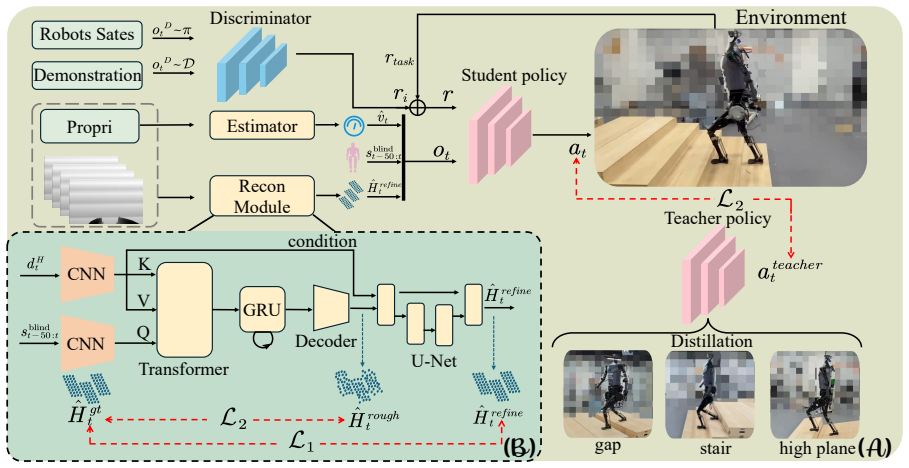
A full-size humanoid can climb stairs, cross gaps, and handle slopes using only a single depth camera, by reconstructing terrain geometry with a cross-attention transformer trained on realistic synthetic depth images.
Reviewed by Pith at T0; open to challenge. T0 means a machine referee read the full paper against a public rubric. the ladder, T0–T4 →
T0 review · deepseek-v4-flash
2026-08-04 10:59 UTC pith:PNPZFIUO
load-bearing objection This is a genuinely useful depth-only perception pipeline for humanoid locomotion, but the headline sim-to-real gains depend on a Kinect noise model that has not been calibrated to the Orbbec camera used on the robot. the 5 major comments →
DPL: Depth-only Perceptive Humanoid Locomotion via Realistic Depth Synthesis and Cross-Attention Terrain Reconstruction
The pith
A machine-rendered reading of the paper's core claim, the machinery that carries it, and where it could break.
Core claim
The central discovery is that structured terrain reasoning can be preserved for a humanoid robot even when the only exteroceptive input is a single noisy depth image. The paper shows that a cross-attention transformer, in which proprioceptive embeddings act as queries and depth features act as keys and values, can reconstruct a local 1m x 1m heightmap at 5cm resolution with mean absolute error of 2.3 to 4.5 cm across terrain types, and that the reconstructed heightmap can drive a blind-backbone locomotion policy through residual gait modulation. The authors attribute the sim-to-real success to a realistic depth synthesis pipeline: ray casting with self-occlusion from the robot's own body, bo
What carries the argument
The key machinery is the multi-modality cross-attention transformer with a conditional U-Net decoder, together with the depth-domain-randomization synthesizer. The transformer takes proprioceptive history (state embeddings) as queries and depth-encoded features as keys and values, so the robot selectively attends to terrain regions relevant to its current gait phase and posture. The conditional U-Net sharpens the rough heightmap using depth latent features. The synthesis pipeline, equations (21)-(25), injects range-dependent axial noise, range-proportional lateral smear, and edge-aware dropout to mimic real depth-camera artifacts, enabling sim-to-real transfer.
Load-bearing premise
The load-bearing premise is that the Kinect-derived noise model in Eqs. (21)-(25) faithfully represents the real Orbbec 355L camera's error characteristics, including range-dependent variance, edge dropout, and missing-data patterns; if the real sensor's noise differs, the end-to-end fine-tuning on synthetic depth will not transfer.
What would settle it
A calibration experiment: record static scenes with the actual Orbbec 355L at known distances and orientations, and compare the measured per-pixel depth error distribution (variance vs range, dropout rate vs edge gradient) against the model's predictions. If the empirical variance grows faster than quadratic or hole patterns differ from the Sobel-edge dropout, the domain-randomization pipeline should fail to close the sim-to-real gap, and the 3.25 cm real-world MAE reported for the full method would degrade toward the no-noise-model baseline.
If this is right
- A humanoid can operate with only a depth camera, eliminating the need for lidar, multiple vision sensors, and external localization for terrain reconstruction.
- The same pretrained blind backbone plus a vision modulator can be fine-tuned end-to-end on synthetic noisy depth, improving robustness to sensor delay and spatial bias.
- Terrain reconstruction can handle occluded regions by using proprioceptive history, inferring gap bottoms that elevation maps miss.
- Low and stable perception delay (~20 ms) makes the perception-action loop fast enough for real-time control, with fewer stumbles in stair traversal.
Where Pith is reading between the lines
- The noise model's hyperparameters are adopted from Kinect calibration studies; the real Orbbec 355L may have different error statistics, so a per-sensor calibration or a sensitivity test across noise parameters would likely validate or further improve the transfer.
- This framework suggests that the depth camera's role is not merely to see terrain but to continuously update a latent terrain representation; it would be interesting to test whether the same architecture transfers to other robot morphologies or to sparse depth sensors like a single-point lidar.
- If depth synthesis is randomized enough, the reconstruction module may need minimal or no real-world depth data for fine-tuning; Table III indicates most of the improvement comes from the noise model, so an ablation that removes the real-world fine-tuning entirely would clarify how much real data is actually required.
Editorial analysis
A structured set of objections, weighed in public.
Referee Report
Summary. This paper proposes DPL, a depth-only perceptive humanoid locomotion framework combining (i) a teacher-student policy with a pretrained blind backbone and a vision-based modulator, (ii) a multi-modality cross-attention transformer that reconstructs a local heightmap from depth images and proprioceptive history, and (iii) a ray-casting plus stochastic-noise depth synthesizer used to fine-tune the policy end-to-end. The authors report simulation reconstruction ablations over seven terrain types (Table II), real-world reconstruction MAEs on a full-sized humanoid with an Orbbec 355L camera (Table III), a perception-latency comparison against an elevation-mapping pipeline (Fig. 6), and a stair-stumble comparison with/without end-to-end fine-tuning (Table IV). The central claim is that this integrated framework enables robust humanoid traversal of stairs, slopes, gaps, and uneven outdoor terrain using only a single depth camera, with over 30% reduction in terrain reconstruction error.
Significance. If validated, the approach would be a meaningful step toward low-latency, single-camera perceptive control for humanoids, offering an alternative to localization-dependent elevation-map pipelines and addressing occluded regions such as gaps. The strengths are the coherent architectural idea (blind-policy prior plus cross-attention reconstruction), the detailed simulation ablations in Table II, the attention to self-occlusion in ray casting, and real-robot experiments on a full-sized humanoid. However, the headline claims—realistic depth synthesis, >30% reconstruction-error reduction, and the benefit of end-to-end fine-tuning—rest on empirical evidence that is currently incomplete, particularly the transferability of a Kinect-derived noise model to the Orbbec sensor and the statistical strength of the real-world comparison. The significance is therefore conditional on stronger sensor calibration and more rigorous real-world evaluation.
major comments (5)
- [§IV.C.2, Eqs. (21)–(25)] The 'realistic depth synthesis' claim rests on a Kinect-derived noise model that is never calibrated to the Orbbec 355L used on the robot. Parameters a, b, c, α, w, ρ, and λ_e are adopted from refs. [22]–[24] without any measurement on the actual sensor, without a comparison of synthetic vs. real depth-image statistics, and without sensitivity analysis over the noise parameters. This is load-bearing because the abstract attributes the sim-to-real gain to this noise model and Table III's w/o-Noise-Model ablation is offered as evidence. The paper should either calibrate the model to the Orbbec or show robustness over a plausible range of noise hyperparameters.
- [§V.C, Table IV] The only quantitative real-world evidence for end-to-end fine-tuning is Table IV: 4/10 vs. 8/10 stumbles, each based on 10 trials. If these are binary trial outcomes, Fisher's exact test gives a two-sided p of approximately 0.17; if they are counts of individual stumble events, no error model or trial protocol is provided. No confidence intervals, definition of 'stumble,' or per-terrain success metrics are reported for slopes, gaps, or uneven surfaces in Fig. 8. Please provide more trials, statistical testing, and explicit success metrics for each terrain.
- [Abstract and §V.B, Table III] The abstract claims 'over 30% reduction in terrain reconstruction error,' but no comparison in the paper yields that exact figure. In Table III, Ours vs. w/o-Noise-Model is a 27.5% reduction (3.25 vs. 4.48 cm), and the average Table II improvement over ResNet-based [6] is only about 5%. Please specify exactly which comparison supports the 30% claim and report the associated baselines.
- [§V.B, Table III] The real-world reconstruction MAE values are presented without describing how the ground-truth heightmap H_t^gt was obtained and registered: which sensor/process defines it, how many frames and terrain types were used, and how the robot frame was aligned to the ground-truth map. Without this information the absolute MAE values are not interpretable, and the comparison with the 'Origin' condition conflates several preprocessing components. This should be specified for the claimed real-world reconstruction improvement.
- [§IV.A and §IV.C] End-to-end fine-tuning with synthetic depth is described only qualitatively. The paper does not specify the fine-tuning loss (whether it includes Eq. (13) or only the policy objective), the proportion of synthesized vs. real depth images, the fine-tuning schedule, or the exact checkpoint used for the 'w/o end-to-end finetune' ablation. Since Table IV is the primary evidence for closing the depth sim-to-real gap, a reproducible description of this procedure is required.
minor comments (5)
- [§I] Typo: 'tranditional' should be 'traditional'.
- [Eq. (17)] The definition of d_c appears with stray commas: '[x, , y, ,1]^T'. Please fix the vector notation.
- [Table II] The ResNet-based row contains corrupted unicode substitution tokens (/uni0000001b/...), making part of that row unreadable. The table needs to be re-rendered.
- [§V.C, Figs. 7–8] The real-world experiments would benefit from quantitative terrain parameters (stair height, slope angle, gap width, platform motion amplitude/frequency) and the number of trials, so the qualitative claims in Fig. 8 can be assessed.
- [Related Work and §II] The relation to the authors' previous works [6], [15], and [20] should be stated more precisely; the method description overlaps substantially with [6], and the novelty relative to that paper is currently described in only two sentences.
Circularity Check
No significant circularity: the reconstruction and locomotion results are validated against independent ground truth; self-citations and the Kinect noise model are not load-bearing inputs.
full rationale
The paper's derivation chain is not circular at any step. In Sec. IV-B, the terrain reconstructor is trained by Eq. (13) against simulator ground-truth heightmaps H_gt, and its real-world accuracy is evaluated against ground-truth terrain (Table III, Fig. 4), so the reported MAE values are independent measurements rather than the training target re-read out. The locomotion policy is trained by PPO/AMP with rewards in Table I and evaluated in physical trials (Table IV, Fig. 8); stumble counts are real trial outcomes. The 'over 30%' reconstruction error reduction is an empirical comparison of ablated training pipelines (Table III), not a quantity fitted into the model. The depth-noise model (Eqs. 21-25) is adopted from external Kinect calibration studies [22]-[24] rather than calibrated to the Orbbec 355L; this is an unvalidated transfer or correctness risk, not circularity, because the parameters are not fitted to the paper's own target outputs. Self-citations [15], [20] provide prior state encoding and reward terms, but the central claims do not reduce to those citations; the system is ablated and tested against external baselines [3], [6] and real terrain. No equation reduces to its input by construction, and no fitted parameter is renamed as a prediction.
Axiom & Free-Parameter Ledger
free parameters (7)
- Depth noise model coefficients a,b,c (Eq. 21) =
not reported
- Lateral noise scale α (Eq. 23) =
not reported
- Axial weighting factor w (Eq. 24) =
not reported
- Maximum dropout ratio ρ and edge-dropout weight λ_e (Eq. 25) =
not reported
- Border crop margin M (Section IV.C.2) =
not reported
- Blind/modulated action blend α (Eq. 7) =
not reported
- Reward weights ω_i (Table I) =
not reported
axioms (5)
- domain assumption Kinect-based depth noise model (Eqs. 21-25) is representative of the Orbbec 355L depth camera used on the real robot.
- domain assumption Ray-cast pinhole camera and rigid-body meshes accurately reproduce the robot's self-occlusion and depth geometry (Eqs. 14-20).
- domain assumption Terrain-specific privileged experts (for stairs, gaps, planes) are effective teachers for the student policy under partial observations.
- domain assumption Ground-truth terrain used for real-world MAE in Table III is accurately measured.
- standard math Standard RL/AMP objectives (Eqs. 1-3) converge and the chosen hyperparameters produce a stable policy.
read the original abstract
Recent advancements in legged robot perceptive locomotion have shown promising progress. However, terrain-aware humanoid locomotion remains largely constrained to two paradigms: depth image-based end-to-end learning and elevation map-based methods. The former suffers from limited training efficiency and a significant sim-to-real gap in depth perception, while the latter depends heavily on multiple vision sensors and localization systems, resulting in latency and reduced robustness. To overcome these challenges, we propose a novel framework that tightly integrates three key components: (1) Terrain-Aware Locomotion Policy with a Blind Backbone, which leverages pre-trained elevation map-based perception to guide reinforcement learning with minimal visual input; (2) Multi-Modality Cross-Attention Transformer, which reconstructs structured terrain representations from noisy depth images; (3) Realistic Depth Images Synthetic Method, which employs self-occlusion-aware ray casting and noise-aware modeling to synthesize realistic depth observations, achieving over 30\% reduction in terrain reconstruction error. This combination enables efficient policy training with limited data and hardware resources, while preserving critical terrain features essential for generalization. We validate our framework on a full-sized humanoid robot, demonstrating agile and adaptive locomotion across diverse and challenging terrains.
Figures


Forward citations
Cited by 7 Pith papers
-
TAGA: Terrain-aware Active Gaze Learning for Generalizable Agile Humanoid Locomotion
TAGA learns terrain-aware active gaze behaviors for humanoid robots via RL alone, enabling generalizable locomotion with 1.2m real-world gap traversal.
-
Perceptive Humanoid Parkour: Chaining Dynamic Human Skills via Motion Matching
A modular system uses motion matching to compose long-horizon human skill chains, trains RL experts, and distills them into a depth-based policy that lets a Unitree G1 humanoid autonomously climb, vault, and roll over...
-
MARCH: Model-Assisted Reinforcement Learning for the Perceptive Control of Humanoids over Sparse Footholds
MARCH combines simplified-model trajectory generation with CLF-guided teacher RL and vision-policy distillation to enable stable humanoid locomotion over sparse terrain with better sample efficiency than pure model-fr...
-
VAIC: Vision-Guided Humanoid Agile Object Interaction Control via Decoupled Commands
VAIC distills a teacher policy into a vision-and-proprioception student policy using recurrent adaptation and decoupled commands, enabling diverse real-robot tasks like box carrying and skateboarding that outperform b...
-
Global-Local Attention Decomposition for Terrain Encoding in Humanoid Perceptive Locomotion
GLAD decomposes terrain encoding via coarse-to-fine attention on elevation maps to separate broad awareness from precise foothold selection in perceptive humanoid locomotion.
-
SSR: Scaling Surefooted and Symmetric Humanoid Traversal to the Open World
SSR is an end-to-end vision-based framework for humanoid traversal that learns imagined foothold guidance, equivariant latent-space symmetry augmentation, and terrain-specific multi-discriminator motion priors to enab...
-
Now You See That: Learning End-to-End Humanoid Locomotion from Raw Pixels
An end-to-end policy learns robust humanoid locomotion directly from noisy depth images via high-fidelity sensor simulation, vision-aware distillation from privileged maps, and terrain-specific multi-critic reward shaping.
Reference graph
Works this paper leans on
-
[1]
Z. Zhuang, Z. Fu, J. Wang, C. Atkeson, S. Schwertfeger, C. Finn, and H. Zhao, “Robot parkour learning,”arXiv preprint arXiv:2309.05665, 2023
Pith/arXiv arXiv 2023
-
[2]
Z. Zhuang, S. Yao, and H. Zhao, “Humanoid parkour learning,”arXiv preprint arXiv:2406.10759, 2024
Pith/arXiv arXiv 2024
-
[3]
Walking with terrain reconstruction: Learning to traverse risky sparse footholds,
R. Yu, Q. Wang, Y . Wang, Z. Wang, J. Wu, and Q. Zhu, “Walking with terrain reconstruction: Learning to traverse risky sparse footholds,” arXiv preprint arXiv:2409.15692, 2024
Pith/arXiv arXiv 2024
-
[4]
Pie: Parkour with implicit-explicit learning framework for legged robots,
S. Luo, S. Li, R. Yu, Z. Wang, J. Wu, and Q. Zhu, “Pie: Parkour with implicit-explicit learning framework for legged robots,”IEEE Robotics and Automation Letters, 2024
2024
-
[5]
N. Rudin, J. He, J. Aurand, and M. Hutter, “Parkour in the wild: Learn- ing a general and extensible agile locomotion policy using multi-expert distillation and rl fine-tuning,”arXiv preprint arXiv:2505.11164, 2025
Pith/arXiv arXiv 2025
-
[6]
Learning vision-based bipedal locomotion for challenging terrain,
H. Duan, B. Pandit, M. S. Gadde, B. Van Marum, J. Dao, C. Kim, and A. Fern, “Learning vision-based bipedal locomotion for challenging terrain,” in2024 IEEE International Conference on Robotics and Automation (ICRA). IEEE, 2024, pp. 56–62
2024
-
[7]
Attention-based map encoding for learning generalized legged loco- motion,
J. He, C. Zhang, F. Jenelten, R. Grandia, M. B ¨acher, and M. Hutter, “Attention-based map encoding for learning generalized legged loco- motion,”Science Robotics, vol. 10, no. 105, p. eadv3604, 2025
2025
-
[8]
Visual imitation en- ables contextual humanoid control,
A. Allshire, H. Choi, J. Zhang, D. McAllister, A. Zhang, C. M. Kim, T. Darrell, P. Abbeel, J. Malik, and A. Kanazawa, “Visual imitation en- ables contextual humanoid control,”arXiv preprint arXiv:2505.03729, 2025
Pith/arXiv arXiv 2025
-
[9]
Learning perceptive humanoid locomotion over challenging terrain,
W. Sun, B. Cao, L. Chen, Y . Su, Y . Liu, Z. Xie, and H. Liu, “Learning perceptive humanoid locomotion over challenging terrain,” arXiv preprint arXiv:2503.00692, 2025
Pith/arXiv arXiv 2025
-
[10]
Learning humanoid locomotion with perceptive internal model,
J. Long, J. Ren, M. Shi, Z. Wang, T. Huang, P. Luo, and J. Pang, “Learning humanoid locomotion with perceptive internal model,” in 2025 IEEE International Conference on Robotics and Automation (ICRA). IEEE, 2025, pp. 9997–10 003
2025
-
[11]
Beamdojo: Learning agile humanoid locomotion on sparse footholds,
H. Wang, Z. Wang, J. Ren, Q. Ben, T. Huang, W. Zhang, and J. Pang, “Beamdojo: Learning agile humanoid locomotion on sparse footholds,”arXiv preprint arXiv:2502.10363, 2025
Pith/arXiv arXiv 2025
-
[12]
Vision-guided quadrupedal locomotion in the wild with multi-modal delay randomization,
C. S. Imai, M. Zhang, Y . Zhang, M. Kierebi ´nski, R. Yang, Y . Qin, and X. Wang, “Vision-guided quadrupedal locomotion in the wild with multi-modal delay randomization,” in2022 IEEE/RSJ international conference on intelligent robots and systems (IROS). IEEE, 2022, pp. 5556–5563
2022
-
[13]
Learning vision-guided quadrupedal locomotion end-to-end with cross-modal transformers,
R. Yang, M. Zhang, N. Hansen, H. Xu, and X. Wang, “Learning vision-guided quadrupedal locomotion end-to-end with cross-modal transformers,”arXiv preprint arXiv:2107.03996, 2021
Pith/arXiv arXiv 2021
-
[14]
Extreme parkour with legged robots,
X. Cheng, K. Shi, A. Agarwal, and D. Pathak, “Extreme parkour with legged robots,” in2024 IEEE International Conference on Robotics and Automation (ICRA). IEEE, 2024, pp. 11 443–11 450
2024
-
[15]
Q. Zhang, G. Han, J. Sun, W. Zhao, C. Sun, J. Cao, J. Wang, Y . Guo, and R. Xu, “Distillation-ppo: A novel two-stage reinforcement learning framework for humanoid robot perceptive locomotion,”arXiv preprint arXiv:2503.08299, 2025
Pith/arXiv arXiv 2025
-
[16]
Anymal parkour: Learning agile navigation for quadrupedal robots,
D. Hoeller, N. Rudin, D. Sako, and M. Hutter, “Anymal parkour: Learning agile navigation for quadrupedal robots,”Science Robotics, vol. 9, no. 88, p. eadi7566, 2024
2024
-
[17]
Neural scene representation for locomotion on structured terrain,
D. Hoeller, N. Rudin, C. Choy, A. Anandkumar, and M. Hutter, “Neural scene representation for locomotion on structured terrain,” IEEE Robotics and Automation Letters, vol. 7, no. 4, pp. 8667–8674, 2022
2022
-
[18]
Learning autonomous and safe quadruped traversal of complex terrains using multi-layer elevation maps,
Y . Chen, J. Ma, Z. Luo, Y . Han, Y . Dong, B. Xu, and P. Lu, “Learning autonomous and safe quadruped traversal of complex terrains using multi-layer elevation maps,”IEEE Robotics and Automation Letters, 2025
2025
-
[19]
Amp: Adversarial motion priors for stylized physics-based character con- trol,
X. B. Peng, Z. Ma, P. Abbeel, S. Levine, and A. Kanazawa, “Amp: Adversarial motion priors for stylized physics-based character con- trol,”ACM Transactions on Graphics (ToG), vol. 40, no. 4, pp. 1–20, 2021
2021
-
[20]
Whole-body humanoid robot locomotion with human reference,
Q. Zhang, P. Cui, D. Yan, J. Sun, Y . Duan, A. Zhang, and R. Xu, “Whole-body humanoid robot locomotion with human reference,” arXiv preprint arXiv:2402.18294, 2024
Pith/arXiv arXiv 2024
-
[21]
Proximal policy optimization algorithms,
J. Schulman, F. Wolski, P. Dhariwal, A. Radford, and O. Klimov, “Proximal policy optimization algorithms,”arXiv preprint arXiv:1707.06347, 2017
Pith/arXiv arXiv 2017
-
[22]
Modeling kinect sensor noise for improved 3d reconstruction and tracking,
C. V . Nguyen, S. Izadi, and D. Lovell, “Modeling kinect sensor noise for improved 3d reconstruction and tracking,” in2012 second interna- tional conference on 3D imaging, modeling, processing, visualization & transmission. IEEE, 2012, pp. 524–530
2012
-
[23]
Accuracy and resolution of kinect depth data for indoor mapping applications,
K. Khoshelham and S. O. Elberink, “Accuracy and resolution of kinect depth data for indoor mapping applications,”sensors, vol. 12, no. 2, pp. 1437–1454, 2012
2012
-
[24]
Characterizations of noise in kinect depth images: A review,
T. Mallick, P. P. Das, and A. K. Majumdar, “Characterizations of noise in kinect depth images: A review,”IEEE Sensors journal, vol. 14, no. 6, pp. 1731–1740, 2014
2014
-
[25]
Isaac gym: High performance gpu-based physics simulation for robot learning,
V . Makoviychuk, L. Wawrzyniak, Y . Guo, M. Lu, K. Storey, M. Mack- lin, D. Hoeller, N. Rudin, A. Allshire, A. Handa,et al., “Isaac gym: High performance gpu-based physics simulation for robot learning,” arXiv preprint arXiv:2108.10470, 2021
Pith/arXiv arXiv 2021
-
[26]
Elevation mapping for locomotion and navigation using gpu,
T. Miki, L. Wellhausen, R. Grandia, F. Jenelten, T. Homberger, and M. Hutter, “Elevation mapping for locomotion and navigation using gpu,” in2022 IEEE/RSJ International Conference on Intelligent Robots and Systems (IROS). IEEE, 2022, pp. 2273–2280
2022
discussion (0)
Sign in with ORCID, Apple, or X to comment. Anyone can read and Pith papers without signing in.