REVIEW 4 major objections 4 minor 1 cited by
A single pretrained sequence model can, in-context, produce calibrated uncertainties and greedily acquire the most informative features, matching or beating task-specific baselines on tabular benchmarks.
Reviewed by Pith at T0; open to challenge. T0 means a machine referee read the full paper against a public rubric. the ladder, T0–T4 →
T0 review · deepseek-v4-flash
2026-08-04 09:53 UTC pith:FZLPFCSD
load-bearing objection A solid meta-AFA proposal with a real capability claim, held back by the usual prior-transfer problem and some missing empirical hygiene. the 4 major comments →
Learning-To-Measure: In-Context Active Feature Acquisition
The pith
A machine-rendered reading of the paper's core claim, the machinery that carries it, and where it could break.
Core claim
L2M claims that two abilities can be learned once and reused across tasks. First, a modified transformer trained autoregressively on synthetic tasks (Gaussian-process priors for regression, Bayesian-neural-network priors for classification) approximates the posterior predictive p(Y^(q)|X^(q)_t, Z_1:m) for partially observed queries conditioned on a context of historical samples; under missing-at-random, exclusion-restriction, and positivity assumptions (Theorem 3.4), the conditional-mutual-information estimand is identified from the retrospectively missing data as I(Y; X_j | X_t, R_j=1). Second, a policy head trained with a Gumbel-Softmax relaxation of the acquisition decision minimizes a su
What carries the argument
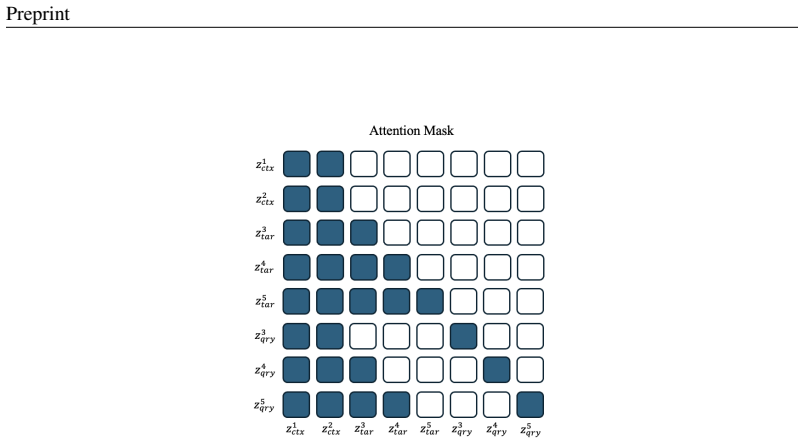
The load-bearing mechanism is the sequence model used as amortized Bayesian inference: a transformer stripped of positional embeddings and given a custom attention mask that enforces context invariance and target equivariance, so it treats the task as exchangeable data rather than a fixed-length vector. It is pretrained on hand-specified synthetic task priors (randomized-kernel GPs, BNN label generators with random informative-feature subsets), then a policy head is trained with straight-through Gumbel-Softmax to minimize one-step predictive loss. The identity that carries the argument is that under cross-entropy, the expected one-step loss at a Bayes-optimal predictor equals the expected co
Load-bearing premise
The argument rests on the premise that a sequence model pretrained on hand-specified synthetic task priors yields calibrated posterior predictive distributions on unseen real tasks under arbitrary missingness; the paper's own experiments show this premise can fail, with performance on real tasks mixed and gains over random acquisition marginal when the pretraining prior is misaligned.
What would settle it
Retrain a faithful copy of L2M on the paper's synthetic priors, then evaluate it on a real task whose missingness is not missing at random (missingness depends on an unobserved confounder) or whose label function is far from the BNN prior, comparing greedy CMI acquisition against random acquisition. If predictive coverage on held-out queries falls well below nominal (e.g., empirical coverage below 80% at nominal 90%) or greedy selection fails to beat random in average log loss, the calibration premise that Theorem 4.2 inherits is violated in exactly the regime the paper targets.
If this is right
- A single pretrained L2M model can be deployed on a new task with no gradient updates, producing both final predictions and a full acquisition sequence for any budgeted number of features.
- The greedy CMI policy is recovered from a tractable surrogate, so practitioners need no explicit mutual-information estimator or latent-variable generative model.
- Reliable uncertainty persists at late acquisition steps where retrospective missingness thins joint coverage, the regime where task-specific MLPs degrade.
- The largest empirical gains appear under short contexts and high missingness rates — the scarce-label regime common in clinical data.
- On some real tasks the adaptive strategy offers only marginal gains over random acquisition, which the paper attributes to misalignment between the pretraining task prior and the real task distribution.
Where Pith is reading between the lines
- Beyond the paper: if the calibration premise transfers beyond tabular and GP/BNN-style tasks, the same sequence-model-plus-greedy-policy recipe should apply to any sequential information-acquisition problem that can be serialized — experimental design, triage, diagnostic test ordering — a scope the paper does not test.
- Beyond the paper: a concrete stress test suggested by the paper's own caveats — pretrain on a mixture of diverse priors and measure calibration on out-of-distribution real tasks; the paper's results imply prior alignment, not architecture, is the binding constraint.
- Beyond the paper: Assumption A.5 (conditional independence across queries) and the MAR identification theorem together imply the equivalence should break under query dependence or missing-not-at-random mechanisms; characterizing how gracefully the policy degrades there is an open question the paper explicitly defers.
- Beyond the paper: the model's reported posterior could double as a diagnostic for positivity/MAR violation — when reported uncertainty is miscalibrated relative to empirical frequency, that discrepancy is itself information about the missingness mechanism, an idea the paper flags as future work.
Editorial analysis
A structured set of objections, weighed in public.
Referee Report
Summary. The paper formalizes the meta active feature acquisition (meta-AFA) problem and proposes L2M, a two-stage method: a transformer-based sequence model is pretrained on synthetic task priors to produce posterior predictive distributions for partially observed queries, and a policy head is trained to greedily select features by minimizing a one-step-ahead log-loss surrogate, allegedly recovering conditional-mutual-information-optimal acquisitions. The theoretical results include an identification theorem for CMI under MAR/exclusion/positivity (Thm. 3.4) and a surrogate-optimality theorem (Thm. 4.2) showing that joint minimization of the sequence loss yields Bayes-optimal prediction and step-wise greedy-CMI acquisition. Experiments cover GP regression, BNN-synthetic classification, and real tabular tasks (Metabric, MiniBooNE, MIMIC-IV, MNIST) against task-specific greedy and RL baselines.
Significance. If the theoretical and empirical claims hold, the paper would contribute a general, in-context AFA method that avoids per-task retraining, building on recent ICL-as-Bayesian-inference results. The theoretical result connecting a tractable log-loss objective to greedy CMI acquisition is a useful extension of Covert et al. (2023) to the sequence-modeling and missing-data setting. The paper is transparent about its assumptions and limitations, and provides a code link. However, the central theoretical result is conditional on strong premises, and the empirical evidence for real-label tasks is mixed by the paper's own admission, so the broad 'matches or surpasses' claim is not fully supported as written.
major comments (4)
- [Section 3.1, Eq. (3), Appendix A.1] The identification theorem appears to conflate two different conditional mutual information quantities. The proof's final expression is sum p(Y,X_j|X_t,R_j=1) log[p(Y,X_j|X_t,R_j=1)/(p(Y|X_t)p(X_j|X_t,R_j=1))], whose denominator is p(Y|X_t). The standard conditional MI within the R_j=1 subpopulation, I(Y;X_j|X_t,R_j=1), has denominator p(Y|X_t,R_j=1). The stated MAR/exclusion assumptions do not imply R_j ⊥ Y | X_t, so these quantities are not equal in general. If the RHS of Eq. (3) is intended to be the nonstandard expression derived in the proof, the notation must be defined explicitly. As written, the theorem statement is misleading and the identification result is not established.
- [Section 5; Appendix A.6.1; Figure 3] The central empirical claim is stronger than the evidence. The paper states 'Our adaptive strategies offer only marginal gains over random acquisition on some real datasets' (Section 5) and 'The performance on real tasks is mixed' (A.6.1), yet the abstract claims L2M 'matches or surpasses task-specific baselines' broadly. More importantly, calibration—the mechanism behind both the uncertainty reports and the CMI-greedy policy—is only directly evaluated on synthetic GP tasks (Figure 3 coverage plots). For real-label tasks, only NLL/Brier are reported; these do not isolate calibration from sharpness. Since Theorem 4.2 requires exact posterior-predictive recovery, the real-task results do not establish the premise of the theory.
- [Algorithm 2 vs. Algorithm 3] Algorithm 2 updates the state by sampling a random feature index (line 9) rather than using the policy's own sampled action (line 7) to advance the state. This creates a mismatch between the training-time state distribution (random acquisitions) and the deployment distribution (greedy policy rollouts, Algorithm 3). The per-state optimality argument in Theorem 4.2 holds only for states in the training support; the paper does not justify that the random-acquisition distribution provides sufficient coverage of the states induced by the learned policy. This may partly explain the marginal gains over random acquisition observed on several real datasets.
- [Assumption A.5; Appendix A.4.1] Assumption A.5, conditional independence across queries given context and per-query inputs, is load-bearing for Theorem 4.2's Bayes-optimality conclusion. If queries are dependent given Z_{1:m} and X_t, the minimizer of Eq. (5) is not the true joint conditional, so the CMI-greedy conclusion is relative to a misspecified target. The paper does not discuss the plausibility or consequences of violating A.5. Additionally, the implemented architecture is said to 'approximate' the invariances in Definitions A.6 and A.7; since Theorem 4.2 assumes exact recovery, the theory does not directly certify the actual model used in the experiments.
minor comments (4)
- [Section 5] Several grammatical issues: 'MIMIC-IV demonstrate' should be 'MIMIC-IV demonstrates'; 'Time-invaryiant' typo in Section 2. Please proofread.
- [Section 3.1, Definition 4.1] The meaning of R_j for a query sample at test time is not explicit. Clarify whether the blocked policy uses the retrospective availability mask from the training distribution or the actual query's availability, and how the query's initial observation set is defined.
- [Experiments, Figure 4] Some panels in Figure 4 appear to show different numbers of features (e.g., MNIST up to 18) with no indication of how the budget is chosen. Please state the budget or the stopping rule for each dataset.
- [Appendix A.5.2] The BNN prior description says 'For each batch' without specifying whether a batch is a task or a mini-batch; clarify to avoid ambiguity.
Circularity Check
No significant circularity: Theorem 4.2 is an explicitly attributed mathematical equivalence, and the empirical claims are benchmark-tested with limitations acknowledged.
full rationale
The paper's central formal result, Theorem 4.2, connects two independently defined objects: the CMI objective in Eq. 4 and the sequence loss L in Eq. 5. The appendix proof (A.3) is a standard derivation: under cross-entropy, the Bayes-optimal predictor matches the true conditional, and then the policy objective is linear over the simplex, so its minimizer places mass on the argmax-CMI action. This is a theorem with a supplied proof, not a parameter fitted to a target and then reported as a prediction; the paper also explicitly credits Covert et al. (2023, Prop. 2). The empirical uncertainty-calibration claims are tested on held-out GP/Matern tasks (Fig. 3), and the paper honestly reports that real-task acquisition gains are sometimes marginal (Sec. 5; A.6.1), so the broad 'matches or surpasses' claim is a benchmark assertion rather than a circular derivation. The ICL-as-Bayesian-inference citations (Nguyen & Grover 2022; Ye & Namkoong 2024; Mittal et al. 2025) are used as background for using sequence models, not as a uniqueness theorem that forces the present results; the two self-citations are not load-bearing in the derivation chain. No circular step was found.
Axiom & Free-Parameter Ledger
free parameters (8)
- GP prior lengthscale range =
[0.1, 5.0]
- GP prior output scale range =
[0.5, 2.0]
- GP observation noise =
σ_ε = 2×10⁻²
- BNN prior hidden dimension =
H = 8
- BNN prior cluster count range =
1-3
- BNN label prevalence range =
[0.05, 0.95]
- Max missingness probability =
≤0.5
- Policy Gumbel temperature =
τ = 0.1
axioms (6)
- domain assumption Missing at Random (Assumption 3.1): R_j ⊥⊥ X_j(1) | X_t
- domain assumption Exclusion restriction (Assumption 3.2): R_j ⊥⊥ Y | X_j(1), X_t
- domain assumption Positivity (Assumption 3.3): p(R_j=1|X_t=x_t) > 0
- ad hoc to paper Conditional independence across queries (Assumption A.5)
- domain assumption Sequence models trained autoregressively with context/target invariances recover posterior predictive distributions
- standard math Cross-entropy Bayes optimality (Lemma A.3): conditional risk is minimized by the true conditional
read the original abstract
Active feature acquisition (AFA) is a sequential decision-making problem where the goal is to improve model performance for test instances by adaptively selecting which features to acquire. In practice, AFA methods often learn from retrospective data with systematic missingness in the features and limited task-specific labels. Most prior work addresses acquisition for a single predetermined task, limiting scalability. To address this limitation, we formalize the meta-AFA problem, where the goal is to learn acquisition policies across various tasks. We introduce Learning-to-Measure (L2M), which consists of i) reliable uncertainty quantification over unseen tasks, and ii) an uncertainty-guided greedy feature acquisition agent that maximizes conditional mutual information. We demonstrate a sequence-modeling or autoregressive pre-training approach that underpins reliable uncertainty quantification for tasks with arbitrary missingness. L2M operates directly on datasets with retrospective missingness and performs the meta-AFA task in-context, eliminating per-task retraining. Across synthetic and real-world tabular benchmarks, L2M matches or surpasses task-specific baselines, particularly under scarce labels and high missingness.
Figures




Forward citations
Cited by 1 Pith paper
-
Zero-Shot Active Feature Acquisition via LLM-Elicitation
A framework elicits discriminative MRF statistics from an LLM and closes the model via maximum entropy to enable zero-shot active feature acquisition, outperforming baselines on IBD patient data especially for hardest cases.
Reference graph
Works this paper leans on
-
[1]
Medical event data standard (meds): Facilitating machine learning for health
Bert Arnrich, Edward Choi, Jason Alan Fries, Matthew BA McDermott, Jungwoo Oh, Tom Pollard, Nigam Shah, Ethan Steinberg, Michael Wornow, and Robin van de Water. Medical event data standard (meds): Facilitating machine learning for health. In ICLR 2024 Workshop on Learning from Time Series For Health, pp.\ 03--08, 2024
2024
-
[2]
Expected information as expected utility
Jos \'e M Bernardo. Expected information as expected utility. the Annals of Statistics, pp.\ 686--690, 1979
1979
-
[3]
On the opportunities and risks of foundation models
Rishi Bommasani, Drew A Hudson, Ehsan Adeli, Russ Altman, Simran Arora, Sydney von Arx, Michael S Bernstein, Jeannette Bohg, Antoine Bosselut, Emma Brunskill, et al. On the opportunities and risks of foundation models. arXiv preprint arXiv:2108.07258, 2021
Pith/arXiv arXiv 2021
-
[4]
Benefit, harm, and cost-effectiveness associated with magnetic resonance imaging before biopsy in age-based and risk-stratified screening for prostate cancer
Thomas Callender, Mark Emberton, Stephen Morris, Paul DP Pharoah, and Nora Pashayan. Benefit, harm, and cost-effectiveness associated with magnetic resonance imaging before biopsy in age-based and risk-stratified screening for prostate cancer. JAMA Network Open, 4 0 (3): 0 e2037657--e2037657, 2021
2021
-
[5]
Racial differences in laboratory testing as a potential mechanism for bias in ai: A matched cohort analysis in emergency department visits
Trenton Chang, Mark Nuppnau, Ying He, Keith E Kocher, Thomas S Valley, Michael W Sjoding, and Jenna Wiens. Racial differences in laboratory testing as a potential mechanism for bias in ai: A matched cohort analysis in emergency department visits. PLOS Global Public Health, 4 0 (10): 0 e0003555, 2024
2024
-
[6]
Interpretable by design: Learning predictors by composing interpretable queries
Aditya Chattopadhyay, Stewart Slocum, Benjamin D Haeffele, Ren \'e Vidal, and Donald Geman. Interpretable by design: Learning predictors by composing interpretable queries. IEEE Transactions on Pattern Analysis and Machine Intelligence, 45 0 (6): 0 7430--7443, 2022
2022
-
[7]
Variational information pursuit for interpretable predictions
Aditya Chattopadhyay, Kwan Ho Ryan Chan, Benjamin D Haeffele, Donald Geman, and Ren \'e Vidal. Variational information pursuit for interpretable predictions. arXiv preprint arXiv:2302.02876, 2023
Pith/arXiv arXiv 2023
-
[8]
Sequential information maximization: When is greedy near-optimal? In Conference on Learning Theory, pp.\ 338--363
Yuxin Chen, S Hamed Hassani, Amin Karbasi, and Andreas Krause. Sequential information maximization: When is greedy near-optimal? In Conference on Learning Theory, pp.\ 338--363. PMLR, 2015
2015
-
[9]
Learning to maximize mutual information for dynamic feature selection
Ian Connick Covert, Wei Qiu, Mingyu Lu, Na Yoon Kim, Nathan J White, and Su-In Lee. Learning to maximize mutual information for dynamic feature selection. In International Conference on Machine Learning, pp.\ 6424--6447. PMLR, 2023
2023
-
[10]
The genomic and transcriptomic architecture of 2,000 breast tumours reveals novel subgroups
Christina Curtis, Sohrab P Shah, Suet-Feung Chin, Gulisa Turashvili, Oscar M Rueda, Mark J Dunning, Doug Speed, Andy G Lynch, Shamith Samarajiwa, Yinyin Yuan, et al. The genomic and transcriptomic architecture of 2,000 breast tumours reveals novel subgroups. Nature, 486 0 (7403): 0 346--352, 2012
2012
-
[11]
A cost-aware framework for the development of ai models for healthcare applications
Gabriel Erion, Joseph D Janizek, Carly Hudelson, Richard B Utarnachitt, Andrew M McCoy, Michael R Sayre, Nathan J White, and Su-In Lee. A cost-aware framework for the development of ai models for healthcare applications. Nature Biomedical Engineering, 6 0 (12): 0 1384--1398, 2022
2022
-
[12]
Gradient estimation
Michael C Fu. Gradient estimation. Handbooks in operations research and management science, 13: 0 575--616, 2006
2006
-
[13]
Estimating conditional mutual information for dynamic feature selection
Soham Gadgil, Ian Covert, and Su-In Lee. Estimating conditional mutual information for dynamic feature selection. arXiv preprint arXiv:2306.03301, 2023
Pith/arXiv arXiv 2023
-
[14]
Large scale transfer learning for tabular data via language modeling
Josh Gardner, Juan C Perdomo, and Ludwig Schmidt. Large scale transfer learning for tabular data via language modeling. Advances in Neural Information Processing Systems, 37: 0 45155--45205, 2024
2024
-
[15]
Adaptive submodularity: Theory and applications in active learning and stochastic optimization
Daniel Golovin and Andreas Krause. Adaptive submodularity: Theory and applications in active learning and stochastic optimization. Journal of Artificial Intelligence Research, 42: 0 427--486, 2011
2011
-
[16]
Icebreaker: Element-wise efficient information acquisition with a bayesian deep latent gaussian model
Wenbo Gong, Sebastian Tschiatschek, Sebastian Nowozin, Richard E Turner, Jos \'e Miguel Hern \'a ndez-Lobato, and Cheng Zhang. Icebreaker: Element-wise efficient information acquisition with a bayesian deep latent gaussian model. Advances in neural information processing systems, 32, 2019
2019
-
[17]
Classification with costly features using deep reinforcement learning
Jarom \' r Janisch, Tom \'a s Pevn \`y , and Viliam Lis \`y . Classification with costly features using deep reinforcement learning. In Proceedings of the AAAI Conference on Artificial Intelligence, volume 33, pp.\ 3959--3966, 2019
2019
-
[18]
Imputation strategies under clinical presence: Impact on algorithmic fairness
Vincent Jeanselme, Maria De-Arteaga, Zhe Zhang, Jessica Barrett, and Brian Tom. Imputation strategies under clinical presence: Impact on algorithmic fairness. In Machine Learning for Health, pp.\ 12--34. PMLR, 2022
2022
-
[19]
Identifying causal-effect inference failure with uncertainty-aware models
Andrew Jesson, S \"o ren Mindermann, Uri Shalit, and Yarin Gal. Identifying causal-effect inference failure with uncertainty-aware models. Advances in Neural Information Processing Systems, 33: 0 11637--11649, 2020
2020
-
[20]
Mimic-iv, a freely accessible electronic health record dataset
Alistair EW Johnson, Lucas Bulgarelli, Lu Shen, Alvin Gayles, Ayad Shammout, Steven Horng, Tom J Pollard, Sicheng Hao, Benjamin Moody, Brian Gow, et al. Mimic-iv, a freely accessible electronic health record dataset. Scientific data, 10 0 (1): 0 1, 2023
2023
-
[21]
Opportunistic learning: Budgeted cost-sensitive learning from data streams
Mohammad Kachuee, Orpaz Goldstein, Kimmo Karkkainen, Sajad Darabi, and Majid Sarrafzadeh. Opportunistic learning: Budgeted cost-sensitive learning from data streams. arXiv preprint arXiv:1901.00243, 2019
Pith/arXiv arXiv 1901
-
[22]
In-context decision-making from supervised pretraining
Jonathan Lee, Annie Xie, Aldo Pacchiano, Yash Chandak, Chelsea Finn, Ofir Nachum, and Emma Brunskill. In-context decision-making from supervised pretraining. In ICML Workshop on New Frontiers in Learning, Control, and Dynamical Systems, 2023
2023
-
[23]
Active feature acquisition with generative surrogate models
Yang Li and Junier Oliva. Active feature acquisition with generative surrogate models. In International conference on machine learning, pp.\ 6450--6459. PMLR, 2021
2021
-
[24]
Distribution guided active feature acquisition
Yang Li and Junier Oliva. Distribution guided active feature acquisition. arXiv preprint arXiv:2410.03915, 2024
Pith/arXiv arXiv 2024
-
[25]
Licong Lin, Yu Bai, and Song Mei. Transformers as decision makers: Provable in-context reinforcement learning via supervised pretraining. arXiv preprint arXiv:2310.08566, 2023
Pith/arXiv arXiv 2023
-
[26]
Identifiable generative models for missing not at random data imputation
Chao Ma and Cheng Zhang. Identifiable generative models for missing not at random data imputation. Advances in Neural Information Processing Systems, 34: 0 27645--27658, 2021
2021
-
[27]
Eddi: Efficient dynamic discovery of high-value information with partial vae
Chao Ma, Sebastian Tschiatschek, Konstantina Palla, Jos \'e Miguel Hern \'a ndez-Lobato, Sebastian Nowozin, and Cheng Zhang. Eddi: Efficient dynamic discovery of high-value information with partial vae. arXiv preprint arXiv:1809.11142, 2018
Pith/arXiv arXiv 2018
-
[28]
The concrete distribution: A continuous relaxation of discrete random variables
Chris J Maddison, Andriy Mnih, and Yee Whye Teh. The concrete distribution: A continuous relaxation of discrete random variables. arXiv preprint arXiv:1611.00712, 2016
Pith/arXiv arXiv 2016
-
[29]
Architectural and inferential inductive biases for exchangeable sequence modeling
Daksh Mittal, Ang Li, Tzu-Ching Yen, Daniel Guetta, and Hongseok Namkoong. Architectural and inferential inductive biases for exchangeable sequence modeling. arXiv preprint arXiv:2503.01215, 2025
Pith/arXiv arXiv 2025
-
[30]
Transformers can do bayesian inference
Samuel M \"u ller, Noah Hollmann, Sebastian Pineda Arango, Josif Grabocka, and Frank Hutter. Transformers can do bayesian inference. arXiv preprint arXiv:2112.10510, 2021
Pith/arXiv arXiv 2021
-
[31]
Full law identification in graphical models of missing data: Completeness results
Razieh Nabi, Rohit Bhattacharya, and Ilya Shpitser. Full law identification in graphical models of missing data: Completeness results. In International conference on machine learning, pp.\ 7153--7163. PMLR, 2020
2020
-
[32]
Transformer neural processes: Uncertainty-aware meta learning via sequence modeling
Tung Nguyen and Aditya Grover. Transformer neural processes: Uncertainty-aware meta learning via sequence modeling. arXiv preprint arXiv:2207.04179, 2022
Pith/arXiv arXiv 2022
-
[33]
Missing data imputation and acquisition with deep hierarchical models and hamiltonian monte carlo
Ignacio Peis, Chao Ma, and Jos \'e Miguel Hern \'a ndez-Lobato. Missing data imputation and acquisition with deep hierarchical models and hamiltonian monte carlo. Advances in Neural Information Processing Systems, 35: 0 35839--35851, 2022
2022
-
[34]
Boosted decision trees as an alternative to artificial neural networks for particle identification
Byron P Roe, Hai-Jun Yang, Ji Zhu, Yong Liu, Ion Stancu, and Gordon McGregor. Boosted decision trees as an alternative to artificial neural networks for particle identification. Nuclear Instruments and Methods in Physics Research Section A: Accelerators, Spectrometers, Detectors and Associated Equipment, 543 0 (2-3): 0 577--584, 2005
2005
-
[35]
Inference and missing data
Donald B Rubin. Inference and missing data. Biometrika, 63 0 (3): 0 581--592, 1976
1976
-
[36]
Joint active feature acquisition and classification with variable-size set encoding
Hajin Shim, Sung Ju Hwang, and Eunho Yang. Joint active feature acquisition and classification with variable-size set encoding. Advances in neural information processing systems, 31, 2018
2018
-
[37]
Active exploration via autoregressive generation of missing data
Tiffany Tianhui Cai, Hongseok Namkoong, Daniel Russo, and Kelly W Zhang. Active exploration via autoregressive generation of missing data. arXiv e-prints, pp.\ arXiv--2405, 2024
2024
-
[38]
Attention is all you need
Ashish Vaswani, Noam Shazeer, Niki Parmar, Jakob Uszkoreit, Llion Jones, Aidan N Gomez, ukasz Kaiser, and Illia Polosukhin. Attention is all you need. Advances in neural information processing systems, 30, 2017
2017
-
[39]
Evaluation of active feature acquisition methods for time-varying feature settings
Henrik von Kleist, Alireza Zamanian, Ilya Shpitser, and Narges Ahmidi. Evaluation of active feature acquisition methods for time-varying feature settings. arXiv preprint arXiv:2312.01530, 2023 a
Pith/arXiv arXiv 2023
-
[40]
Evaluation of active feature acquisition methods for static feature settings
Henrik von Kleist, Alireza Zamanian, Ilya Shpitser, and Narges Ahmidi. Evaluation of active feature acquisition methods for static feature settings. arXiv preprint arXiv:2312.03619, 2023 b
Pith/arXiv arXiv 2023
-
[41]
Dueling network architectures for deep reinforcement learning
Ziyu Wang, Tom Schaul, Matteo Hessel, Hado Hasselt, Marc Lanctot, and Nando Freitas. Dueling network architectures for deep reinforcement learning. In International conference on machine learning, pp.\ 1995--2003. PMLR, 2016
1995
-
[42]
Simple statistical gradient-following algorithms for connectionist reinforcement learning
Ronald J Williams. Simple statistical gradient-following algorithms for connectionist reinforcement learning. Machine learning, 8 0 (3): 0 229--256, 1992
1992
-
[43]
Exchangeable sequence models quantify uncertainty over latent concepts
Naimeng Ye and Hongseok Namkoong. Exchangeable sequence models quantify uncertainty over latent concepts. arXiv preprint arXiv:2408.03307, 2024
Pith/arXiv arXiv 2024
-
[44]
Odin: Optimal discovery of high-value information using model-based deep reinforcement learning
Sara Zannone, Jos \'e Miguel Hern \'a ndez-Lobato, Cheng Zhang, and Konstantina Palla. Odin: Optimal discovery of high-value information using model-based deep reinforcement learning. In ICML Real-world Sequential Decision Making Workshop, 2019
2019
-
[45]
Access to care improves ehr reliability and clinical risk prediction model performance
Anna Zink, Hongzhou Luan, and Irene Y Chen. Access to care improves ehr reliability and clinical risk prediction model performance. arXiv preprint arXiv:2412.07712, 2024
Pith/arXiv arXiv 2024
-
[46]
write newline
" write newline "" before.all 'output.state := FUNCTION n.dashify 't := "" t empty not t #1 #1 substring "-" = t #1 #2 substring "--" = not "--" * t #2 global.max substring 't := t #1 #1 substring "-" = "-" * t #2 global.max substring 't := while if t #1 #1 substring * t #2 global.max substring 't := if while FUNCTION format.date year duplicate empty "emp...
-
[47]
@esa (Ref
\@ifxundefined[1] #1\@undefined \@firstoftwo \@secondoftwo \@ifnum[1] #1 \@firstoftwo \@secondoftwo \@ifx[1] #1 \@firstoftwo \@secondoftwo [2] @ #1 \@temptokena #2 #1 @ \@temptokena \@ifclassloaded agu2001 natbib The agu2001 class already includes natbib coding, so you should not add it explicitly Type <Return> for now, but then later remove the command n...
-
[48]
\@lbibitem[] @bibitem@first@sw\@secondoftwo \@lbibitem[#1]#2 \@extra@b@citeb \@ifundefined br@#2\@extra@b@citeb \@namedef br@#2 \@nameuse br@#2\@extra@b@citeb \@ifundefined b@#2\@extra@b@citeb @num @parse #2 @tmp #1 NAT@b@open@#2 NAT@b@shut@#2 \@ifnum @merge>\@ne @bibitem@first@sw \@firstoftwo \@ifundefined NAT@b*@#2 \@firstoftwo @num @NAT@ctr \@secondoft...
-
[49]
@open @close @open @close and [1] URL: #1 \@ifundefined chapter * \@mkboth \@ifxundefined @sectionbib * \@mkboth * \@mkboth\@gobbletwo \@ifclassloaded amsart * \@ifclassloaded amsbook * \@ifxundefined @heading @heading NAT@ctr thebibliography [1] @ \@biblabel @NAT@ctr \@bibsetup #1 @NAT@ctr @ @openbib .11em \@plus.33em \@minus.07em 4000 4000 `\.\@m @bibit...
discussion (0)
Sign in with ORCID, Apple, or X to comment. Anyone can read and Pith papers without signing in.