Gravitational Atoms from Topological Stars
Pith reviewed 2026-05-17 22:43 UTC · model grok-4.3
The pith
A massive scalar field forms stable bound states around topological stars, creating genuine gravitational atoms distinct from black holes.
A machine-rendered reading of the paper's core claim, the machinery that carries it, and where it could break.
Core claim
We study the bound states of a massive scalar field around a topological star, and show that these are strictly normal modes. This yields a genuine gravitational atom, sharply distinguishing horizonless objects from black holes. We show that the modes are controlled by the field's Compton wavelength compared to the size of the star. When the Compton wavelength is large, the field forms a cloud with a hydrogen-like spectrum, while in the opposite regime it is localized along timelike trajectories. When the two scales are comparable the spectrum becomes richer, and we characterize it in detail allowing the field to carry electric charge and Kaluza--Klein momentum.
What carries the argument
The ratio of the scalar field's Compton wavelength to the topological star radius, which sets the effective potential and selects between hydrogen-like clouds, localized trajectories, and richer charged or Kaluza-Klein spectra.
If this is right
- For large Compton wavelength the field forms a cloud with a hydrogen-like spectrum.
- For small Compton wavelength the field localizes along timelike trajectories.
- When the scales are comparable the spectrum includes richer modes with electric charge and Kaluza-Klein momentum.
- The normal-mode character sharply distinguishes topological stars from black holes, which support only decaying quasinormal modes.
Where Pith is reading between the lines
- If such stars exist, the bound states could produce long-lived, narrow-line signals in gravitational-wave or electromagnetic observations.
- The same wavelength-to-size comparison may apply to other horizonless geometries and yield analogous atomic spectra.
- Including backreaction in future calculations would test whether the gravitational atom remains stable once the scalar field sources the metric.
Load-bearing premise
The topological star metric is treated as a fixed background with no backreaction from the scalar field.
What would settle it
Finding imaginary frequency components in the scalar field spectrum around a topological star would show the modes are not strictly normal.
Figures


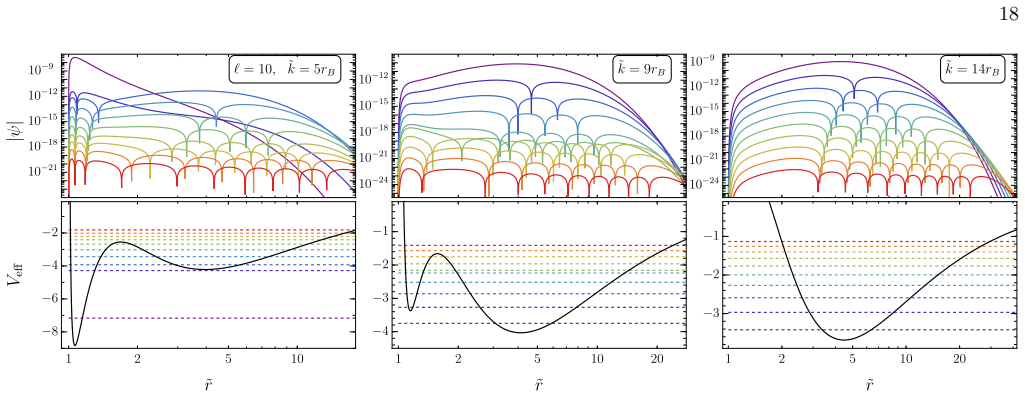

read the original abstract
We study the bound states of a massive scalar field around a topological star, and show that these are strictly normal modes. This yields a genuine gravitational atom, sharply distinguishing horizonless objects from black holes. We show that the modes are controlled by the field's Compton wavelength compared to the size of the star. When the Compton wavelength is large, the field forms a cloud with a hydrogen-like spectrum, while in the opposite regime it is localized along timelike trajectories. When the two scales are comparable the spectrum becomes richer, and we characterize it in detail allowing the field to carry electric charge and Kaluza--Klein momentum.
Editorial analysis
A structured set of objections, weighed in public.
Referee Report
Summary. The paper studies the bound states of a massive scalar field on the fixed background of a topological star. It claims to demonstrate that these states are strictly normal modes with real frequencies, forming a genuine gravitational atom that sharply distinguishes horizonless objects from black holes. The spectrum is analyzed in three regimes determined by the ratio of the field's Compton wavelength to the star size: hydrogen-like clouds for large wavelengths, localization along timelike trajectories for small wavelengths, and a richer spectrum when the scales are comparable. Extensions to electrically charged fields and those with Kaluza-Klein momentum are included.
Significance. If the normal-mode conclusion is robust, the work supplies a concrete, analytically tractable example of discrete real-frequency modes around a horizonless compact object. This offers a clear contrast to the quasinormal-mode spectra of black holes and could inform searches for exotic compact objects via gravitational-wave or scalar-field observations. The regime-dependent characterization, including the hydrogen-like limit, provides an intuitive and potentially falsifiable structure.
major comments (1)
- [Abstract and the derivation of normal modes (around the Klein-Gordon analysis)] The central claim that the modes are 'strictly normal' rests on solving the massive Klein-Gordon equation on the fixed topological-star metric with regularity imposed at the minimal radius and exponential decay at infinity. No estimate of scalar-field backreaction on the metric or solution of the coupled Einstein-scalar system is provided to confirm that the effective potential remains free of horizon-like features that would convert the spectrum into quasinormal modes with nonzero imaginary part. This approximation is load-bearing for the distinction from black holes.
minor comments (1)
- [Section on mode solutions] Clarify in the text how the boundary conditions are numerically or analytically verified to produce purely real frequencies, addressing any potential approximations in the mode extraction.
Simulated Author's Rebuttal
We thank the referee for their careful reading of our manuscript and for the constructive feedback. We address the major comment below.
read point-by-point responses
-
Referee: [Abstract and the derivation of normal modes (around the Klein-Gordon analysis)] The central claim that the modes are 'strictly normal' rests on solving the massive Klein-Gordon equation on the fixed topological-star metric with regularity imposed at the minimal radius and exponential decay at infinity. No estimate of scalar-field backreaction on the metric or solution of the coupled Einstein-scalar system is provided to confirm that the effective potential remains free of horizon-like features that would convert the spectrum into quasinormal modes with nonzero imaginary part. This approximation is load-bearing for the distinction from black holes.
Authors: We thank the referee for raising this point. Our analysis is performed in the test-field (probe) approximation on the fixed topological-star background, which is a regular, horizonless geometry. The massive Klein-Gordon equation is solved subject to regularity at the minimal radius and exponential decay at infinity, yielding a discrete set of real frequencies. This boundary-value problem is of Sturm-Liouville type and therefore admits only real eigenvalues; the absence of a horizon precludes the dissipative boundary conditions responsible for complex quasinormal frequencies in black-hole spacetimes. The same test-field approach is routinely used to study gravitational atoms around black holes, where the resulting spectrum is nevertheless quasinormal. We have added a clarifying paragraph to the discussion section that explicitly states the regime of validity of the linear approximation (small scalar amplitude, backreaction entering only at second order) and notes that a fully coupled Einstein-scalar analysis, while interesting, lies beyond the present scope. revision: partial
Circularity Check
No circularity: normal modes obtained by direct solution of wave equation on fixed background
full rationale
The paper solves the Klein-Gordon equation for a massive scalar on the given topological-star metric, imposing regularity at the minimal radius and exponential decay at infinity to extract discrete real frequencies. These frequencies are presented as strictly normal modes forming a gravitational atom, with the spectrum characterized in different regimes of Compton wavelength versus star size. This computation follows directly from the differential equation and boundary conditions without any fitted parameters renamed as predictions, without self-citation chains supporting the core result, and without ansatze or uniqueness theorems imported from prior author work. The distinction from black holes arises from the horizonless nature of the background metric itself, which is an input rather than a derived output. The fixed-background approximation is an explicit modeling choice whose validity is not claimed to be proven within the derivation.
Axiom & Free-Parameter Ledger
axioms (2)
- domain assumption The topological star is a stable, horizonless solution of the higher-dimensional Einstein equations with the given topology.
- domain assumption The scalar field is a test field with negligible backreaction on the geometry.
Lean theorems connected to this paper
-
IndisputableMonolith/Foundation/AbsoluteFloorClosure.leanreality_from_one_distinction unclear?
unclearRelation between the paper passage and the cited Recognition theorem.
We show that bound modes are strictly normal... ω∈R... conservation laws... E[Φ] ... ωI=0
-
IndisputableMonolith/Cost/FunctionalEquation.leanwashburn_uniqueness_aczel unclear?
unclearRelation between the paper passage and the cited Recognition theorem.
hydrogenic limit... ω_nH ≈ √(μ²+k²)[1−(...)/ (2 n_H²)]
What do these tags mean?
- matches
- The paper's claim is directly supported by a theorem in the formal canon.
- supports
- The theorem supports part of the paper's argument, but the paper may add assumptions or extra steps.
- extends
- The paper goes beyond the formal theorem; the theorem is a base layer rather than the whole result.
- uses
- The paper appears to rely on the theorem as machinery.
- contradicts
- The paper's claim conflicts with a theorem or certificate in the canon.
- unclear
- Pith found a possible connection, but the passage is too broad, indirect, or ambiguous to say the theorem truly supports the claim.
Reference graph
Works this paper leans on
- [1]
- [2]
- [3]
-
[4]
The Formation of Black Holes in General Relativity
D. Christodoulou, in12th Marcel Grossmann Meeting on General Relativity(2008) pp. 24–34, arXiv:0805.3880 [gr-qc]
work page internal anchor Pith review Pith/arXiv arXiv 2008
-
[5]
B. P. Abbottet al.(LIGO Scientific, Virgo), Phys. Rev. Lett.116, 061102 (2016), arXiv:1602.03837 [gr-qc]
work page internal anchor Pith review Pith/arXiv arXiv 2016
-
[6]
R. Abbottet al.(LIGO Scientific, Virgo), Phys. Rev. X 11, 021053 (2021), arXiv:2010.14527 [gr-qc]
work page internal anchor Pith review Pith/arXiv arXiv 2021
-
[7]
First M87 Event Horizon Telescope Results. I. The Shadow of the Supermassive Black Hole
K. Akiyamaet al.(Event Horizon Telescope), Astrophys. J. Lett.875, L1 (2019), arXiv:1906.11238 [astro-ph.GA]
work page internal anchor Pith review Pith/arXiv arXiv 2019
-
[8]
R. Abuteret al.(GRAVITY), Astron. Astrophys.636, L5 (2020), arXiv:2004.07187 [astro-ph.GA]
- [9]
-
[10]
Carballo-Rubioet al., JCAP05, 003 (2025), arXiv:2501.05505 [gr-qc]
R. Carballo-Rubioet al., JCAP05, 003 (2025), arXiv:2501.05505 [gr-qc]
-
[11]
Testing the nature of dark compact objects: a status report
V. Cardoso and P. Pani, Living Rev. Rel.22, 4 (2019), arXiv:1904.05363 [gr-qc]
work page internal anchor Pith review Pith/arXiv arXiv 2019
-
[12]
Black hole spectroscopy: from theory to experiment
E. Bertiet al., (2025), arXiv:2505.23895 [gr-qc]
work page internal anchor Pith review Pith/arXiv arXiv 2025
-
[13]
Bambiet al.(2025) arXiv:2505.09014 [gr-qc]
C. Bambiet al.(2025) arXiv:2505.09014 [gr-qc]
-
[14]
I. Bena, S. Giusto, R. Russo, M. Shigemori, and N. P. Warner, JHEP05, 110 (2015), arXiv:1503.01463 [hep- th]
work page internal anchor Pith review Pith/arXiv arXiv 2015
-
[15]
I. Bena, E. Martinec, D. Turton, and N. P. Warner, JHEP05, 064 (2016), arXiv:1601.05805 [hep-th]
work page internal anchor Pith review Pith/arXiv arXiv 2016
-
[16]
I. Bena, S. Giusto, E. J. Martinec, R. Russo, M. Shige- mori, D. Turton, and N. P. Warner, Phys. Rev. Lett. 117, 201601 (2016), arXiv:1607.03908 [hep-th]
work page internal anchor Pith review Pith/arXiv arXiv 2016
-
[17]
I. Bena, S. Giusto, E. J. Martinec, R. Russo, M. Shige- mori, D. Turton, and N. P. Warner, JHEP02, 014 (2018), arXiv:1711.10474 [hep-th]
work page internal anchor Pith review Pith/arXiv arXiv 2018
-
[18]
N. Čeplak, R. Russo, and M. Shigemori, JHEP03, 095 (2019), arXiv:1812.08761 [hep-th]
work page internal anchor Pith review Pith/arXiv arXiv 2019
-
[19]
Dual geometries for a set of 3-charge microstates
S. Giusto, S. D. Mathur, and A. Saxena, Nucl. Phys. B 701, 357 (2004), arXiv:hep-th/0405017
work page internal anchor Pith review Pith/arXiv arXiv 2004
-
[20]
D1-D5-P microstates at the cap
S. Giusto, O. Lunin, S. D. Mathur, and D. Turton, JHEP02, 050 (2013), arXiv:1211.0306 [hep-th]
work page internal anchor Pith review Pith/arXiv arXiv 2013
-
[21]
AdS3 Holography for 1/4 and 1/8 BPS geometries
S. Giusto, E. Moscato, and R. Russo, JHEP11, 004 (2015), arXiv:1507.00945 [hep-th]
work page internal anchor Pith review Pith/arXiv arXiv 2015
-
[22]
Correlators at large c without information loss
A. Galliani, S. Giusto, E. Moscato, and R. Russo, JHEP 09, 065 (2016), arXiv:1606.01119 [hep-th]
work page internal anchor Pith review Pith/arXiv arXiv 2016
- [23]
- [24]
-
[25]
S. Rawash and D. Turton, JHEP07, 178 (2021), arXiv:2105.13046 [hep-th]
-
[26]
B. Ganchev, S. Giusto, A. Houppe, and R. Russo, Eur. Phys. J. C82, 217 (2022), arXiv:2112.03287 [hep-th]
- [27]
- [28]
- [29]
- [30]
-
[31]
R. Dulac and P. Heidmann, JHEP07, 234 (2024), arXiv:2404.18994 [hep-th]
-
[32]
S. Chakraborty and P. Heidmann, JHEP07, 101 (2025), arXiv:2503.13589 [hep-th]
-
[33]
B. Ganchev, A. Houppe, and N. P. Warner, JHEP11, 028 (2021), arXiv:2107.09677 [hep-th]
-
[34]
B. Ganchev, S. Giusto, A. Houppe, R. Russo, and N. P. Warner, JHEP10, 163 (2023), arXiv:2307.13021 [hep-th]
-
[35]
P. Heidmann, Phys. Rev. D109, 126015 (2024), arXiv:2312.12496 [hep-th]
-
[36]
Houppe, JHEP09, 083 (2024), arXiv:2402.11017 [hep-th]
A. Houppe, JHEP09, 083 (2024), arXiv:2402.11017 [hep-th]
- [37]
-
[38]
M. Bianchi, G. Dibitetto, J. F. Morales, and A. Ruipérez, (2025), arXiv:2504.12235 [hep-th]
-
[39]
P. Heidmann, P. Pani, and J. E. Santos, (2025), arXiv:2510.05200 [hep-th]
- [40]
-
[41]
G. W. Gibbons and N. P. Warner, Class. Quant. Grav. 31, 025016 (2014), arXiv:1305.0957 [hep-th]
work page internal anchor Pith review Pith/arXiv arXiv 2014
-
[42]
Structure of Six-Dimensional Microstate Geometries
P. de Lange, D. R. Mayerson, and B. Vercnocke, JHEP 09, 075 (2015), arXiv:1504.07987 [hep-th]
work page internal anchor Pith review Pith/arXiv arXiv 2015
-
[43]
Is the gravitational-wave ringdown a probe of the event horizon?
V. Cardoso, E. Franzin, and P. Pani, Phys. Rev. Lett. 116, 171101 (2016), [Erratum: Phys.Rev.Lett. 117, 089902 (2016)], arXiv:1602.07309 [gr-qc]
work page internal anchor Pith review Pith/arXiv arXiv 2016
-
[44]
Tests for the existence of horizons through gravitational wave echoes
V. Cardoso and P. Pani, Nature Astron.1, 586 (2017), arXiv:1709.01525 [gr-qc]
work page internal anchor Pith review Pith/arXiv arXiv 2017
-
[45]
P. Heidmann, N. Speeney, E. Berti, and I. Bah, Phys. Rev. D108, 024021 (2023), arXiv:2305.14412 [gr-qc]
-
[46]
M. Bianchi, G. Di Russo, A. Grillo, J. F. Morales, and G. Sudano, JHEP12, 121 (2023), arXiv:2305.15105 [gr- 27 qc]
- [47]
- [48]
- [49]
- [50]
-
[51]
D. Bini and G. Di Russo, Phys. Rev. D112, 064008 (2025), arXiv:2506.14442 [gr-qc]
-
[52]
M. Bianchi, D. Bini, and G. Di Russo, Phys. Rev. D 112, 044008 (2025), arXiv:2506.04876 [gr-qc]
-
[53]
D. Bini and G. Di Russo, Phys. Rev. D112, 024021 (2025), arXiv:2505.13020 [gr-qc]
-
[54]
G. Di Russo, M. Bianchi, and D. Bini, Phys. Rev. D 112, 024002 (2025), arXiv:2502.21040 [gr-qc]
-
[55]
M. Bianchi, D. Bini, and G. Di Russo, Phys. Rev. D 111, 044017 (2025), arXiv:2411.19612 [gr-qc]
-
[56]
D. Pereñiguez and E. Karnickis, (2025), arXiv:2509.12418 [gr-qc]
-
[57]
P. Heidmann, I. Bah, and E. Berti, Phys. Rev. D107, 084042 (2023), arXiv:2212.06837 [gr-qc]
- [58]
-
[59]
T. J. M. Zouros and D. M. Eardley, Annals Phys.118, 139 (1979)
work page 1979
-
[60]
S. L. Detweiler, Phys. Rev. D22, 2323 (1980)
work page 1980
-
[61]
Superradiance -- the 2020 Edition
R. Brito, V. Cardoso, and P. Pani, Lect. Notes Phys. 906, pp.1 (2015), arXiv:1501.06570 [gr-qc]
work page internal anchor Pith review Pith/arXiv arXiv 2015
-
[62]
A. Arvanitaki, S. Dimopoulos, S. Dubovsky, N. Kaloper, and J. March-Russell, Phys. Rev. D81, 123530 (2010), arXiv:0905.4720 [hep-th]
work page internal anchor Pith review Pith/arXiv arXiv 2010
-
[63]
Exploring the String Axiverse with Precision Black Hole Physics
A. Arvanitaki and S. Dubovsky, Phys. Rev. D83, 044026 (2011), arXiv:1004.3558 [hep-th]
work page internal anchor Pith review Pith/arXiv arXiv 2011
-
[64]
P. Pani, V. Cardoso, L. Gualtieri, E. Berti, and A. Ishibashi, Phys. Rev. Lett.109, 131102 (2012), arXiv:1209.0465 [gr-qc]
work page internal anchor Pith review Pith/arXiv arXiv 2012
-
[65]
D. Baumann, H. S. Chia, J. Stout, and L. ter Haar, JCAP12, 006 (2019), arXiv:1908.10370 [gr-qc]
-
[66]
Gravitational radiation from an axion cloud around a black hole: Superradiant phase
H. Yoshino and H. Kodama, PTEP2014, 043E02 (2014), arXiv:1312.2326 [gr-qc]
work page internal anchor Pith review Pith/arXiv arXiv 2014
-
[67]
Black holes as particle detectors: evolution of superradiant instabilities
R. Brito, V. Cardoso, and P. Pani, Class. Quant. Grav. 32, 134001 (2015), arXiv:1411.0686 [gr-qc]
work page internal anchor Pith review Pith/arXiv arXiv 2015
-
[68]
Discovering the QCD Axion with Black Holes and Gravitational Waves
A. Arvanitaki, M. Baryakhtar, and X. Huang, Phys. Rev. D91, 084011 (2015), arXiv:1411.2263 [hep-ph]
work page internal anchor Pith review Pith/arXiv arXiv 2015
-
[69]
J. G. Rosa and T. W. Kephart, Phys. Rev. Lett.120, 231102 (2018), arXiv:1709.06581 [gr-qc]
work page internal anchor Pith review Pith/arXiv arXiv 2018
-
[70]
Electromagnetic emission from axionic clouds and the quenching of superradiant instabilities
T. Ikeda, R. Brito, and V. Cardoso, Phys. Rev. Lett. 122, 081101 (2019), arXiv:1811.04950 [gr-qc]
work page internal anchor Pith review Pith/arXiv arXiv 2019
- [71]
-
[72]
M. C. Ferreira, C. F. B. Macedo, and V. Cardoso, Phys. Rev. D96, 083017 (2017), arXiv:1710.00830 [gr-qc]
work page internal anchor Pith review Pith/arXiv arXiv 2017
- [73]
-
[74]
A. Amorimet al.(GRAVITY), Mon. Not. Roy. Astron. Soc.489, 4606 (2019), arXiv:1908.06681 [astro-ph.GA]
-
[75]
R. Vicente and V. Cardoso, Phys. Rev. D105, 083008 (2022), arXiv:2201.08854 [gr-qc]
- [76]
- [77]
- [78]
- [79]
- [80]
discussion (0)
Sign in with ORCID, Apple, or X to comment. Anyone can read and Pith papers without signing in.