REVIEW 3 major objections 5 minor 39 references
This paper claims that letting diffusion models change the number of atoms in a crystal during generation—via placeholder 'mirage' atoms—improves the quality of generated crystals by up to a factor of 2.5 and yields an 8.2% S.U.N. rate, exc
Reviewed by Pith at T0; open to challenge. T0 means a machine referee read the full paper against a public rubric. the ladder, T0–T4 →
T0 review · deepseek-v4-flash
2026-08-03 21:35 UTC pith:JOZWUU2B
load-bearing objection Mirage infusion is a clean, well-tested trick for variable-size crystal diffusion; the headline S.U.N. comparison is undercut by unmatched training budgets and evaluation pipelines. the 3 major comments →
MiAD: Mirage Atom Diffusion for De Novo Crystal Generation
The pith
A machine-rendered reading of the paper's core claim, the machinery that carries it, and where it could break.
Core claim
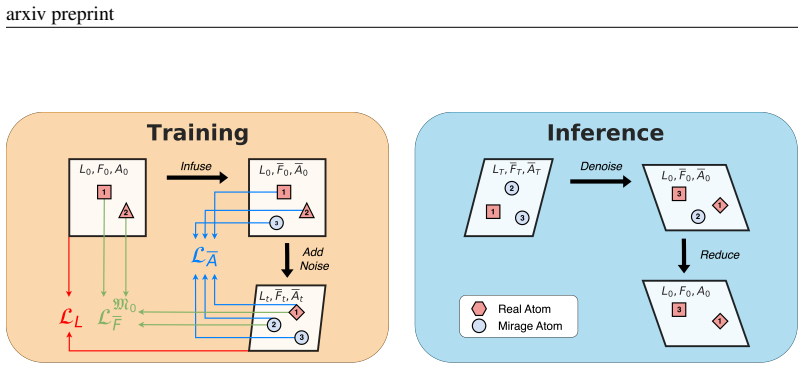
The central claim is that variable-size generation can be achieved within a fixed-size diffusion framework by reinterpreting atom insertion and removal as type transitions. Adding a special atom type '0' (mirage) and infusing crystals to a uniform size Nm, the model learns to jointly denoise lattice, coordinates, and types; the fractional-coordinate loss is masked for mirage atoms, so the model is free to decide their positions while learning when a mirage should become real. During sampling, all crystals start at the same size and the model removes the remaining mirages at the end. The authors show this yields crystals with varying atom counts and a substantially better trade-off between st
What carries the argument
Mirage infusion: an expanded crystal representation where every sample has exactly Nm atoms, with type 0 denoting a placeholder. The mechanism is an extra state in the discrete atom-type diffusion process plus a masking of the coordinate-denoising loss for placeholder atoms; this lets the model treat 'does this atom exist' as a continuous decision inside a standard equivariant denoiser. The same network architecture as the base joint diffusion model is retained, isolating the effect of the infusion.
Load-bearing premise
The headline comparison assumes that the S.U.N. numbers for prior models are measured equivalently; if the longer training (8000 vs 1000 epochs) or the evaluation pipeline (pre-relaxation and DFT thresholds) rather than mirage infusion drives the improvement, the central claim weakens.
What would settle it
Train the same base joint diffusion model without mirage infusion for the same 8000 epochs and evaluate it with exactly the same pre-relaxation and DFT protocol; if its S.U.N. rate matches or exceeds 8.2%, the mirage-infusion explanation is refuted.
If this is right
- Fixed-size diffusion models for crystals are leaving performance on the table; allowing size changes during generation can multiply the S.U.N. rate by up to 2.5.
- The technique transfers without modification to other joint diffusion models that share the same crystal representation and loss factorization.
- MiAD produces S.U.N. crystals across a wide range of atom counts, indicating that the model learns to use the added flexibility rather than collapsing to a single size.
- Design choices matter: uniform initialization of mirage atoms and masking of their coordinate loss are critical; alternatives (center initialization, no masking) markedly reduce quality.
Where Pith is reading between the lines
- If mirage infusion works because it converts discrete size selection into a continuous type decision, the same trick could apply to other generative settings with variable cardinality—for example, populations of particles or point clouds—where a fixed-size latent is inconvenient.
- The masking choice suggests a general principle: when placeholder tokens have no ground-truth position, the model should be allowed to place them freely rather than being trained toward an arbitrary coordinate.
- Because mirage infusion increases the number of atoms the network must process, future work may need to combine it with size-adaptive architectures or hierarchical sampling to keep inference costs manageable.
Editorial analysis
A structured set of objections, weighed in public.
Referee Report
Summary. The paper proposes 'mirage infusion' for crystal diffusion models. A special atom type 0 ('mirage') is introduced, and every training crystal is padded to a fixed number of atoms Nm by adding mirage atoms with uniformly random fractional coordinates. The coordinate denoising loss is masked for mirage atoms, while the lattice and atom-type losses are applied to the expanded structure. At sampling, all crystals start from Nm atoms and the final crystal is obtained by removing atoms whose predicted type is 0. The resulting model MiAD (DiffCSP + mirage infusion) is evaluated on MP-20 against diffusion, flow, and two-stage baselines using the S.U.N. metric under DFT and MLIP stability estimates. The authors claim 8.2% DFT S.U.N., a relative improvement over DiffCSP of up to about 2.5x, and report ablations over Nm, atom-type loss weighting, and design choices for the mirage representation.
Significance. If the claimed improvements survive scrutiny, mirage infusion is a simple, architecture-agnostic mechanism for variable-size generation in crystal diffusion models, with clear potential for transfer to MatterGen, FlowMM, and similar joint diffusion/flow models. The paper is honest about several auxiliary metrics being saturated and focuses on S.U.N., which is a sensible primary metric for de novo discovery. Strengths include a clean formulation, a public code link, informative ablations over Nm and loss scaling, and a comparison against an alternative mirage formulation from the drug-design literature. The main weakness is that the headline comparison is confounded: baseline numbers are imported from earlier papers with different evaluation pipelines, MiAD is trained for 8000 epochs while the DiffCSP baseline used 1000, and key hyperparameters are selected using the same S.U.N. metric on which the final claim is made.
major comments (3)
- [Table 1; §6; Appendix C] The central x2.5 claim is not causally identified. DiffCSP's 3.3% S.U.N. is quoted from Miller et al. (2024), while MiAD is computed with the authors' CHGNet-prerelax + DFT pipeline. Appendix C states that MiAD was trained for 8000 epochs with the learning-rate scheduler removed, whereas the original DiffCSP baseline used 1000 epochs. No DiffCSP run at 8000 epochs under the identical relaxation/DFT protocol is reported. The observed 3.3→8.2 gain and the x2.5 attribution could therefore be due to additional compute or a different prerelaxation/DFT pipeline rather than mirage infusion. The authors should provide a matched DiffCSP baseline: same epochs, same scheduler setting, same CHGNet prerelaxation, same DFT settings, and the same S.U.N. computation.
- [Tables 3-4; §B.1-B.2] The hyperparameters Nm and the atom-type loss coefficient LA are selected by maximizing S.U.N. on the evaluation metric, and the same S.U.N. value is then reported as the final result. This is selection-on-the-metric: the reported 8.2% / 5.5% values are optimistically biased relative to a model chosen without peeking at S.U.N. A held-out evaluation split, a nested model-selection procedure, or at least a report of the selection trajectory is needed. Without this, the claimed optimality of Nm=25 and LA×1.0, and the size of the final advantage over DiffCSP, are not well grounded.
- [Tables 1-5; §6] No error bars, multiple seeds, or repeated sampling are reported for any S.U.N. estimate. Several decisive differences are small: in Table 3, eq-V2 S.U.N. values are 5.3, 5.5, 4.7, 4.6 for Nm=20,25,30,35, and in Table 4, 4.7, 5.5, 5.0 for LA×0.5, ×1.0, ×2.0. Since S.U.N. is a ratio of 10,000 generated crystals and the evaluation pipeline includes stochastic prerelaxation, the differences among the top configurations may be within sampling noise. The authors should report variance over at least a few seeds or bootstrap intervals, especially for the ablation tables that are used to justify the final model choice.
minor comments (5)
- [Algorithm 2] Algorithm 2 samples 'M_T ∼ q(M_T)' and 'Denoise M_{t-1} = q(M_{t-1}|M_t)'. The prior and the learned backward kernel should be p(M_T) and p_θ(M_{t-1}|M_t); q is used for the forward process elsewhere. Please correct the notation.
- [Figures 2-3] The same comparison appears as 'Figure 2' in the main text and 'Figure 3' in Appendix B.4, with slightly different y-axis ranges and metric definitions. The main text says 'see Figure 2' but the figure is reproduced in the appendix. Please consolidate or clearly label the two figures to avoid confusion about which curves correspond to eq-V2 vs CHGNet.
- [Appendix C] The sentence 'Additional experiments confirmed that this modification in the optimization procedure does not influence the quality of the default DiffCSP' is not supported by a table or figure. If the claim is used to argue that the scheduler removal is harmless, the evidence should be shown.
- [Appendix E, Table 6] The caption says 'All results follow the same mirage infusion configuration as for MP-20', but the text states that for Perov-5 and Carbon-24 the configuration uses Nm=N+5 rather than Nm=25. Please state the configuration explicitly in the caption.
- [Appendix F] The statement that crystals with 3,7,11,13,17 atoms 'appear more rarely than others because crystals with these atom counts are underrepresented in the training data' would be more convincing with a histogram of the training-set atom counts overlaid on Figure 4.
Circularity Check
No circular derivation: mirage infusion is an empirical augmentation evaluated with external metrics; confounds are experimental, not circular.
full rationale
MiAD is an empirical method paper, not a derivation from first principles. The proposed technique is defined constructively (extra atom type, expanded fixed-size domain, masked fractional-coordinate loss, reduction operator), and the headline numbers come from external stability pipelines (DFT, CHGNet, eq-V2) and StructureMatcher, not from the model's own training objective. The central ablation in Figure 3 compares MiAD with DiffCSP under the same architecture, giving the improvement claim independent content. No fitted constant is renamed as a prediction: hyperparameters Nm and LA are selected using S.U.N. itself (Appendix B, Tables 3-4), which makes the final 8.2% S.U.N. an in-sample selection result rather than a fully independent test, and the DiffCSP comparison is confounded by unequal training budgets (Appendix C, 8000 vs 1000 epochs, scheduler removed). These are experimental validity concerns, not circular reductions of a derivation. The only overlapping-author citation (WyFormer, Kazeev et al. 2025) is used as a baseline and is not load-bearing for the mirage-infusion argument.
Axiom & Free-Parameter Ledger
free parameters (4)
- Nm (maximum atom count in expanded domain) =
25
- Loss coefficient for atom-type component (LA) =
1.0
- Training epochs =
8000
- Prerelaxation steps for stability evaluation =
1500 (CHGNet) / 100 (eq-V2)
axioms (6)
- standard math Lattice, fractional-coordinate (wrapped normal), and atom-type (D3PM) diffusion objectives from DiffCSP are valid and equivariant.
- domain assumption MP-20 and the Materials Project convex hull adequately represent stable inorganic crystals.
- domain assumption Ehull from DFT (or CHGNet/eq-V2 proxies) is an appropriate stability proxy for S.U.N.
- ad hoc to paper Mirage atoms do not need ground-truth coordinates; masking their coordinate loss yields a valid denoising target.
- ad hoc to paper Uniform initialization of mirage coordinates is a reasonable and valid choice.
- domain assumption StructureMatcher with default parameters defines uniqueness and novelty.
invented entities (1)
-
Mirage atom (type 0)
no independent evidence
read the original abstract
In recent years, diffusion-based models have demonstrated exceptional performance in searching for simultaneously stable, unique, and novel (S.U.N.) crystalline materials. However, most of these models don't have the ability to change the number of atoms in the crystal during the generation process, which limits the variability of model sampling trajectories. In this paper, we demonstrate the severity of this restriction and introduce a simple yet powerful technique, mirage infusion, which enables diffusion models to change the state of the atoms that make up the crystal from existent to non-existent (mirage) and vice versa. We show that this technique improves model quality by up to x2.5 compared to the same model without this modification. The resulting model, Mirage Atom Diffusion (MiAD), is an equivariant joint diffusion model for de novo crystal generation that is capable of altering the number of atoms during the generation process. MiAD achieves an 8.2% S.U.N. rate on the MP-20 dataset, which substantially exceeds existing state-of-the-art approaches. Code: https://github.com/andrey-okhotin/miad.git
Figures


Reference graph
Works this paper leans on
-
[2]
URL https://arxiv.org/abs/ 2107.03006. Luis Barroso-Luque, Muhammed Shuaibi, Xiang Fu, Brandon M Wood, Misko Dzamba, Meng Gao, Ammar Rizvi, C Lawrence Zitnick, and Zachary W Ulissi. Open materials 2024 (omat24) inorganic materials dataset and models. arXiv preprint arXiv:2410.12771,
Pith/arXiv arXiv 2024
-
[3]
atom types prediction. We discovered that the balance among these tasks, espe- cially the influence of the loss component associated with atom types LA (see Section 2.3.1), can Table 3:Ablation study on the number of mirage atoms in MiADWe perform a comparison of various values for Nm within MiAD: 20,25,30,35 . This hyperparameter specifies that crystals ...
2025
-
[4]
Riemannian flow matching on general geometries.arXiv preprint arXiv:2302.03660,
Ricky TQ Chen and Yaron Lipman. Riemannian flow matching on general geometries.arXiv preprint arXiv:2302.03660,
-
[8]
Denoising diffusion probabilistic models
11 arxiv preprint Jonathan Ho, Ajay Jain, and Pieter Abbeel. Denoising diffusion probabilistic models. arXiv preprint arXiv:2006.11239,
Pith/arXiv arXiv 2006
-
[10]
Anubhav Jain, Shyue Ping Ong, Geoffroy Hautier, Wei Chen, William Davidson Richards, Stephen Dacek, Shreyas Cholia, Dan Gunter, David Skinner, Gerbrand Ceder, and Kristin A. Persson. Commentary: The materials project: A materials genome approach to accelerating materials innovation. APL Materials, 1(1):011002, 07 2013a. ISSN 2166-532X. doi: 10.1063/1.4812...
-
[11]
URLhttps://arxiv.org/abs/2503.03965. J. Jumper, R. Evans, and A. Pritzel. Highly accurate protein structure prediction with alphafold,
-
[13]
Filip Ekstr¨om Kelvinius, Oskar B
URL https://arxiv.org/abs/2503.02407. Filip Ekstr¨om Kelvinius, Oskar B. Andersson, Abhijith S. Parackal, Dong Qian, Rickard Armiento, and Fredrik Lindsten. Wyckoffdiff – a generative diffusion model for crystal symmetry,
-
[14]
URLhttps://arxiv.org/abs/2502.06485. Diederik P. Kingma and Jimmy Ba. Adam: A method for stochastic optimization,
-
[16]
URL https: //arxiv.org/abs/2306.15030. Walter Kohn and Lu Jeu Sham. Self-consistent equations including exchange and correlation effects. Physical review, 140(4A):A1133,
-
[18]
Yaron Lipman, Ricky TQ Chen, Heli Ben-Hamu, Maximilian Nickel, and Matt Le
URLhttps://arxiv.org/abs/2502.03638. Yaron Lipman, Ricky TQ Chen, Heli Ben-Hamu, Maximilian Nickel, and Matt Le. Flow matching for generative modeling. arXiv preprint arXiv:2210.02747,
-
[19]
Xiaoshan Luo, Zhenyu Wang, Qingchang Wang, Jian Lv, Lei Wang, Yanchao Wang, and Yanming Ma
URLhttps://arxiv.org/abs/2503.16278. Xiaoshan Luo, Zhenyu Wang, Qingchang Wang, Jian Lv, Lei Wang, Yanchao Wang, and Yanming Ma. Crystalflow: A flow-based generative model for crystalline materials,
-
[20]
URL https: //arxiv.org/abs/2412.11693. Benjamin Kurt Miller, Ricky T. Q. Chen, Anuroop Sriram, and Brandon M Wood. Flowmm: Generating materials with riemannian flow matching,
-
[21]
URL https://arxiv.org/ abs/2406.04713. Tri Minh Nguyen, Sherif Abdulkader Tawfik, Truyen Tran, Sunil Gupta, Santu Rana, and Svetha Venkatesh. Efficient symmetry-aware materials generation via hierarchical generative flow net- works,
-
[22]
URLhttps://arxiv.org/abs/2411.04323. Andrey Okhotin, Dmitry Molchanov, Vladimir Arkhipkin, Grigory Bartosh, Viktor Ohanesian, Aibek Alanov, and Dmitry Vetrov. Star-shaped denoising diffusion probabilistic models,
-
[23]
URL https://arxiv.org/abs/2302.05259. Shyue Ping Ong, William Davidson Richards, Anubhav Jain, Geoffroy Hautier, Michael Kocher, Shreyas Cholia, Dan Gunter, Vincent L Chevrier, Kristin A Persson, and Gerbrand Ceder. Python Materials Genomics (pymatgen): A robust, open-source python library for materials analysis. Computational Materials Science, 68:314–319,
-
[25]
Arne Schneuing, Ilia Igashov, Adrian W
URL https://arxiv.org/abs/2502.03146. Arne Schneuing, Ilia Igashov, Adrian W. Dobbelstein, Thomas Castiglione, Michael M. Bronstein, and Bruno Correia. Multi-domain distribution learning for de novo drug design. In The Thirteenth International Conference on Learning Representations,
-
[27]
URL https://arxiv.org/abs/2410.23405. Wenhao Sun, Stephen T Dacek, Shyue Ping Ong, Geoffroy Hautier, Anubhav Jain, William D Richards, Anthony C Gamst, Kristin A Persson, and Gerbrand Ceder. The thermodynamic scale of inorganic crystalline metastability. Science advances, 2(11):e1600225,
-
[28]
Arash Vahdat, Karsten Kreis, and Jan Kautz
URLhttps://arxiv.org/abs/2302.13971. Arash Vahdat, Karsten Kreis, and Jan Kautz. Score-based generative modeling in latent space. Advances in Neural Information Processing Systems, 34,
-
[29]
Zhisheng Xiao, Karsten Kreis, and Arash Vahdat
URL https://arxiv.org/abs/2502.02016. Zhisheng Xiao, Karsten Kreis, and Arash Vahdat. Tackling the generative learning trilemma with denoising diffusion gans,
-
[30]
Tian Xie, Xiang Fu, Octavian-Eugen Ganea, Regina Barzilay, and Tommi Jaakkola
URLhttps://arxiv.org/abs/2112.07804. Tian Xie, Xiang Fu, Octavian-Eugen Ganea, Regina Barzilay, and Tommi Jaakkola. Crystal diffusion variational autoencoder for periodic material generation,
-
[31]
URL https://arxiv.org/ abs/2110.06197. Sherry Yang, KwangHwan Cho, Amil Merchant, Pieter Abbeel, Dale Schuurmans, Igor Mordatch, and Ekin Dogus Cubuk. Scalable diffusion for materials generation,
-
[32]
URL https:// arxiv.org/abs/2311.09235. Claudio Zeni, Robert Pinsler, Daniel Z ¨ugner, Andrew Fowler, Matthew Horton, Xiang Fu, Sasha Shysheya, Jonathan Crabb ´e, Lixin Sun, Jake Smith, Bichlien Nguyen, Hannes Schulz, Sarah Lewis, Chin-Wei Huang, Ziheng Lu, Yichi Zhou, Han Yang, Hongxia Hao, Jielan Li, Ryota Tomioka, and Tian Xie. MatterGen: a generative m...
-
[33]
URL https://arxiv.org/abs/2312.03687. 14 arxiv preprint A CRYSTAL INVARIANCES A.1 SYMMETRIES OF CRYSTAL STRUCTURE DISTRIBUTION The space of 3D crystal structures is governed by symmetries that impose stringent constraints and play a crucial role in directing the generation process from the distribution p(M). The model, proposed in Jiao et al. (2024a) and ...
-
[34]
Hoogeboom et al
=p θ(x0). Hoogeboom et al. (2022) proposed that invariance can be encapsulated in the diffusion model if we define: Invariant prior distribution:∀g∈G=⇒p(x T ) =p(g·x T )(3) Equivariant transition kernels:∀g∈G=⇒p θ(g·x t−1|g·x t) =pθ(xt−1|xt)(4) q(g·x t|g·x t−1) =q(xt|xt−1)(5) If conditions 3, 4 hold, then the diffusion model pθ(x0) is invariant with respe...
2022
-
[36]
C EXPERIMENTALDETAILS CodeA zip archive containing the raw code for all the experiments is accessible for download through this link
The incorporation of mirage infusion notably enhances both stability and novelty; however, it also extends the time necessary to reach peak performance. C EXPERIMENTALDETAILS CodeA zip archive containing the raw code for all the experiments is accessible for download through this link. DatasetAll experiments were conducted using the MP-20 dataset (Jain et...
2022
-
[37]
The training and sampling procedures can also be conducted on a single GPU, though this will incur increased time costs
required 4 days for the training procedure (8000 epochs) and 2 hours for the sampling procedure (10 000crystals) on 2 GPUs NVIDIA Tesla A100 80 GB with 8 CPU cores AMD EPYC 7702 2-3.35 HHz. The training and sampling procedures can also be conducted on a single GPU, though this will incur increased time costs. D DFTCOMPUTATION DETAILS We use DFT settings f...
2025
-
[38]
The raw total energies computed by DFT were corrected with MaterialsProject2020Compatibility before putting into the PhaseDiagram to obtain the DFT Ehull
version 5.4.4. The raw total energies computed by DFT were corrected with MaterialsProject2020Compatibility before putting into the PhaseDiagram to obtain the DFT Ehull. We used the MP convex hull 2023-02-07-ppd-mp.pkl.gz distributed by matbench-discovery (Riebesell et al.,
2023
-
[39]
E ADDITIONAL METRICS While S.U.N
as the reference hull. E ADDITIONAL METRICS While S.U.N. remains the principal criterion for evaluating modern generative models in de novo crystal generation Miller et al. (2024); Sriram et al. (2024); Joshi et al. (2025), it is instructive to consider additional metrics that are being used in the literature. These include Structure Validity, Composition...
2024
-
[1996]
URLhttps://link.aps.org/doi/10.1103/PhysRevB.54.11169
doi: 10.1103/PhysRevB.54.11169. URLhttps://link.aps.org/doi/10.1103/PhysRevB.54.11169. Daniel Levy, Siba Smarak Panigrahi, S´ekou-Oumar Kaba, Qiang Zhu, Kin Long Kelvin Lee, Mikhail Galkin, Santiago Miret, and Siamak Ravanbakhsh. Symmcd: Symmetry-preserving crystal generation with diffusion models,
-
[2013]
Matbench Discovery–a framework to evaluate machine learning crystal stability predictions
Janosh Riebesell, Rhys EA Goodall, Philipp Benner, Yuan Chiang, Bowen Deng, Alpha A Lee, Anubhav Jain, and Kristin A Persson. Matbench Discovery–a framework to evaluate machine learning crystal stability predictions. arXiv preprint arXiv:2308.14920,
-
[2014]
Fine-tuned language models generate stable inorganic materials as text
Nate Gruver, Anuroop Sriram, Andrea Madotto, Andrew Gordon Wilson, C Lawrence Zitnick, and Zachary Ulissi. Fine-tuned language models generate stable inorganic materials as text. arXiv preprint arXiv:2402.04379,
-
[2015]
Score-based generative modeling through stochastic differential equations
Yang Song, Jascha Sohl-Dickstein, Diederik P Kingma, Abhishek Kumar, Stefano Ermon, and Ben Poole. Score-based generative modeling through stochastic differential equations. arXiv preprint arXiv:2011.13456,
Pith/arXiv arXiv 2011
-
[2017]
Diederik P Kingma and Max Welling
URL https://arxiv.org/abs/1412.6980. Diederik P Kingma and Max Welling. Auto-encoding variational bayes. arXiv preprint arXiv:1312.6114,
-
[2019]
URL https://arxiv.org/ abs/1810.04805. Alex M. Ganose, Hrushikesh Sahasrabuddhe, Mark Asta, Kevin Beck, Tathagata Biswas, Alexander Bonkowski, Joana Bustamante, Xin Chen, Yuan Chiang, Daryl Chrzan, Jacob Clary, Orion Cohen, Christina Ertural, Max Gallant, Janine George, Sophie Gerits, Rhys Goodall, Rishabh Guha, Geoffroy Hautier, Matthew Horton, Aaron Kap...
-
[2021]
Tero Karras, Samuli Laine, and Timo Aila
URLhttps://doi.org/10.1038/s41586-021-03819-2. Tero Karras, Samuli Laine, and Timo Aila. A style-based generator architecture for generative adversarial networks. In Proceedings of the IEEE/CVF conference on computer vision and pattern recognition, pp. 4401–4410,
-
[2022]
Chin-Wei Huang, Milad Aghajohari, Joey Bose, Prakash Panangaden, and Aaron C Courville
URLhttps://arxiv.org/abs/2203.17003. Chin-Wei Huang, Milad Aghajohari, Joey Bose, Prakash Panangaden, and Aaron C Courville. Riemannian diffusion models. Advances in Neural Information Processing Systems, 35:2750– 2761,
-
[2023]
Luis M Antunes, Keith T Butler, and Ricardo Grau-Crespo
URL https: //arxiv.org/abs/2310.04925. Luis M Antunes, Keith T Butler, and Ricardo Grau-Crespo. Crystal structure generation with autoregressive large language modeling. Nature Communications, 15(1):1–16,
-
[2024]
Space group informed transformer for crystalline materials generation
Zhendong Cao, Xiaoshan Luo, Jian Lv, and Lei Wang. Space group informed transformer for crystalline materials generation. arXiv preprint arXiv:2403.15734,
-
[2025]
URL https://arxiv.org/abs/2503.00522. Valentin De Bortoli, Emile Mathieu, Michael Hutchinson, James Thornton, Yee Whye Teh, and Arnaud Doucet. Riemannian score-based generative modeling. arXiv preprint arXiv:2202.02763,
discussion (0)
Sign in with ORCID, Apple, or X to comment. Anyone can read and Pith papers without signing in.