REVIEW 4 major objections 6 minor 22 cited by
RoMa v2 claims a new state-of-the-art for dense feature matching, beating prior matchers such as its predecessor RoMa on accuracy while running 1.7× faster.
Reviewed by Pith at T0; open to challenge. T0 means a machine referee read the full paper against a public rubric. the ladder, T0–T4 →
T0 review · deepseek-v4-flash
2026-08-03 21:18 UTC pith:HRVHDOQJ
load-bearing objection RoMa v2 is a strong, honest dense-matching paper whose headline accuracy claim is partly undercut by training/eval overlap on AerialMegaDepth and MapFree. the 4 major comments →
RoMa v2: Harder Better Faster Denser Feature Matching
The pith
A machine-rendered reading of the paper's core claim, the machinery that carries it, and where it could break.
Core claim
RoMa v2 claims to be the current most accurate dense feature matcher, with reported AUC@5 of 62.8 on MegaDepth-1500 and 33.6 on ScanNet-1500, and lower endpoint errors than RoMa and UFM on all six dense-matching benchmarks (e.g., AerialMegaDepth EPE drops from 25.05 to 4.12). The gains come from a matcher that uses frozen DINOv3 features as the matching backbone, a multi-view transformer with an auxiliary negative-log-likelihood loss to learn multi-view context, and a training mixture that balances wide-baseline and small-baseline datasets. The refinement stage is made faster and more memory-efficient with a custom CUDA kernel, and a per-pixel precision matrix is added as an extra output, wh
What carries the argument
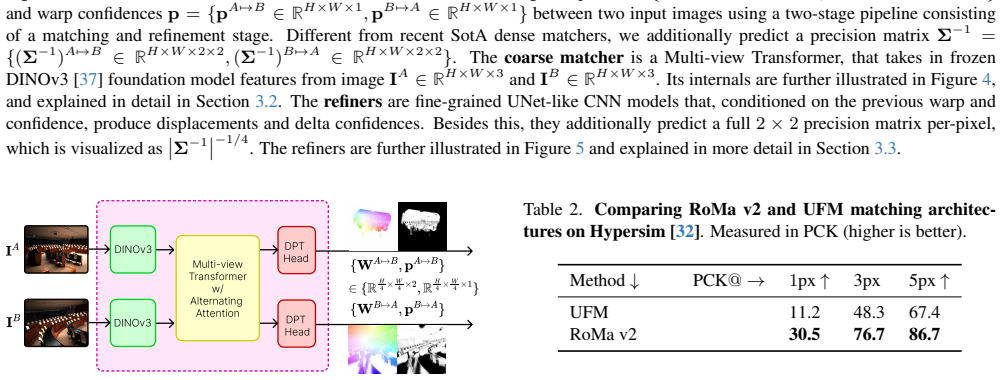
The central mechanism is the two-stage matching-then-refinement pipeline. The coarse matcher tokenizes both images with a frozen DINOv3 ViT-L encoder, then applies a multi-view transformer that alternates between global and frame-wise attention, producing a similarity matrix from which 'match embeddings' are computed and fed to a DPT head that predicts warp and confidence at stride 4. A new auxiliary loss—a dense directional negative log-likelihood over the similarity matrix—replaces the Gaussian-process regression used in RoMa. The refiners are lightweight VGG19-based CNNs at strides 4, 2, 1 that predict residuals, confidence deltas, and, new in this work, a 2×2 precision matrix per pixel v
Load-bearing premise
The load-bearing premise is that the hand-chosen mixture of training datasets (with some datasets weighted 0.01) and the MVS/flow-derived ground truth transfer to the full distribution of real-world matching tasks; neither the mixture weights nor the ground-truth cleanliness is ablated or validated.
What would settle it
One concrete test: hold out a dataset that mixes wide- and small-baseline pairs with a different distribution than the training mix (e.g., indoor handheld video with heavy motion blur and texture-poor walls), and compare RoMa v2 against RoMa and UFM. If the accuracy gap narrows or reverses, the curated training mixture rather than the architecture would be the main driver. A second test: recompute AerialMegaDepth after filtering sky pixels from the ground-truth depth, and see if the reported EPE drop from 25.05 to 4.12 shrinks.
If this is right
- If the accuracy claims hold, RoMa v2 becomes the strongest dense matcher for subpixel correspondence, feeding more reliable matches into SfM, visual localization, and pose estimation.
- The 1.7× speedup and reduced memory (custom CUDA kernel) make dense matching practical at higher resolutions and on resource-constrained hardware.
- The per-pixel precision matrix output gives downstream geometry pipelines a principled way to weight residuals, improving RANSAC and refinement (AUC@1 rises by ~20 points on Hypersim).
- Training on a diverse mixture (including small-baseline and aerial datasets) transfers to fine-grained details and texture-poor regions, as shown qualitatively on FlyingThings3D and NuScenes.
- The matcher's robustness to resolution changes (normalized RoPE, low-frequency position embeddings) means it can be run at varying input sizes without the fixed-resolution restriction of UFM.
Where Pith is reading between the lines
- The hand-tuned training mixture is never ablated, so the paper does not isolate how much of the gain comes from data versus architecture; a controlled study of the mixture weights would test whether the 0.01 weights on driving datasets are load-bearing for the claimed autonomous-driving robustness.
- The ground truth for AerialMegaDepth leaks spurious sky depth (Appendix G), and the model learns to put confidence in sky pixels; evaluating on a corrected version of that benchmark could lower the reported AerialMegaDepth gains.
- The precision-matrix output could be applied beyond matching, e.g., to optical flow or stereo, where per-pixel uncertainty is also needed; the paper only demonstrates it on one geometry-refinement setup.
- On WxBS, RoMa v2 is slightly below RoMa on extreme modality changes (IR-to-RGB), so the 'robust to extreme appearance changes' claim is partial; a matcher that also masters that subset would be a natural next step.
Editorial analysis
A structured set of objections, weighed in public.
Referee Report
Summary. RoMa v2 is a dense feature matching architecture that extends RoMa with a frozen DINOv3 encoder, a multi-view transformer coarse matcher with an auxiliary NLL loss, three lightweight refiners with a custom CUDA kernel for local correlation, and a per-pixel predictive 2x2 precision matrix. Training is decoupled into matcher-then-refiner stages and uses a hand-curated mixture of seven wide-baseline and three small-baseline datasets. The paper reports state-of-the-art results on MegaDepth-1500, ScanNet-1500, six dense matching benchmarks, and a new SatAst benchmark, and shows a 1.7x speedup over RoMa with similar memory. The predictive covariance is demonstrated to improve covariance-weighted refinement on Hypersim.
Significance. The engineering contributions are substantial: the proposed architecture combines the robustness of frozen DINOv3 features with the efficiency of a decoupled two-stage pipeline, and the custom CUDA kernel addresses a real memory bottleneck. The covariance output is a useful novel capability, and the experiments cover a broad set of benchmarks with code release. However, the central claim of being 'significantly more accurate' is currently supported mainly by dense-matching numbers on benchmarks that appear in the training mixture, and the paper itself identifies a ground-truth artifact in AerialMegaDepth that could inflate the reported gains. Until the split overlap is resolved and the artifact is masked out, the magnitude of the claimed accuracy advantage remains uncertain, though the method is likely competitive.
major comments (4)
- [Sec. 3.4 Table 3 / Sec. 4.2 Table 7] Table 3 lists AerialMD and Map-Free in the training mixture with sampling weight 1.0, yet Table 7 reports dense matching EPE on AerialMegaDepth and MapFree. The paper does not state whether the evaluation scenes are excluded from training. If they overlap, the large EPE drops (25.05→4.12 and 8.55→2.03) may reflect in-distribution overfitting rather than generalization. Please report the exact scene splits used for evaluation and, if possible, evaluate on a held-out subset of these datasets. This is load-bearing for the 'significantly more accurate' claim.
- [Appendix G (Bias in AerialMegaDepth)] Appendix G documents spurious sky depth estimates in AerialMegaDepth (Fig. 14) and shows that RoMa v2 sometimes predicts confidence in sky regions (Fig. 13). The text states this 'possibly leaks into the warp estimate of RoMa v2.' This is a direct acknowledgment that the large EPE improvement on AerialMegaDepth (Table 7) may be inflated: RoMa v2's erroneous sky predictions can reduce EPE against a GT that includes sky depth, while RoMa receives large errors for not predicting sky. To support the claim, the authors should recompute dense matching metrics after masking invalid (sky/non-consistent) pixels and report the difference. Without this, the headline 84% relative EPE reduction is not reliable.
- [Sec. 3.4 Table 3 / Fig. 8] The training mixture is a stated contribution (#3), but no ablation isolates its effect. The weights (1.0 for seven datasets, 0.5 for FlyingThings3D, 0.01 for UnrealStereo4k and VKITTI2) are presented without sensitivity analysis, and the claim that VKITTI2 with weight 0.01 improves autonomous-driving robustness is supported only by a single qualitative comparison (Fig. 8). Please provide a systematic ablation, e.g., training with MegaDepth only (RoMa's setting), removing each dataset, or changing weights, to disentangle the contribution of the mixture from the architectural and loss changes. This is necessary to validate the 'curated diverse training distribution' claim and to understand what drives the dense-matching gains.
- [Sec. 4.1-4.2 / Tables 4,5,9] The abstract's 'significantly more accurate' is not consistently supported by the standard pose benchmarks: MegaDepth-1500 AUC@5 improves by only +0.2 (62.8 vs 62.6, Table 4), ScanNet-1500 by +1.8 (33.6 vs 31.8, Table 5), and WxBS mAA@10px drops by 5.4 points (60.8 vs 55.4, Table 9). The claimed significance rests mostly on the dense-matching benchmarks, which are the ones with potential training overlap. The authors should provide confidence intervals or a statistical comparison of the pose results, and discuss the WxBS degradation in more detail (the current explanation of the IR-to-RGB subset is not quantified).
minor comments (6)
- [Sec. 4.1] The statement 'RoMa v2 consistently outperforms all prior matchers on both benchmarks' is too strong on ScanNet, where RoMa v2 (33.6) is equal to MASt3R (33.6) and slightly below VGGT (33.9) in AUC@5; suggest 'matches or outperforms'.
- [Sec. 4.4 / Sec. 5] The WxBS mAA drop from 60.8 to 55.4 is described as 'slightly less robust' in the Limitations; this is a ~9% relative drop, comparable in magnitude to the gain on MegaDepth. Please quantify or revise the wording.
- [Sec. 4.6 / Table 10] The baseline 'w/o Σ^-1' is not fully described; state whether it uses the same refinement without covariance weighting, and specify the RANSAC parameters for reproducibility.
- [Sec. 3.3 / Eq. (6)] The hierarchical summation of precision matrices across strides is not intuitively justified; a brief explanation of why this parameterization is valid would help.
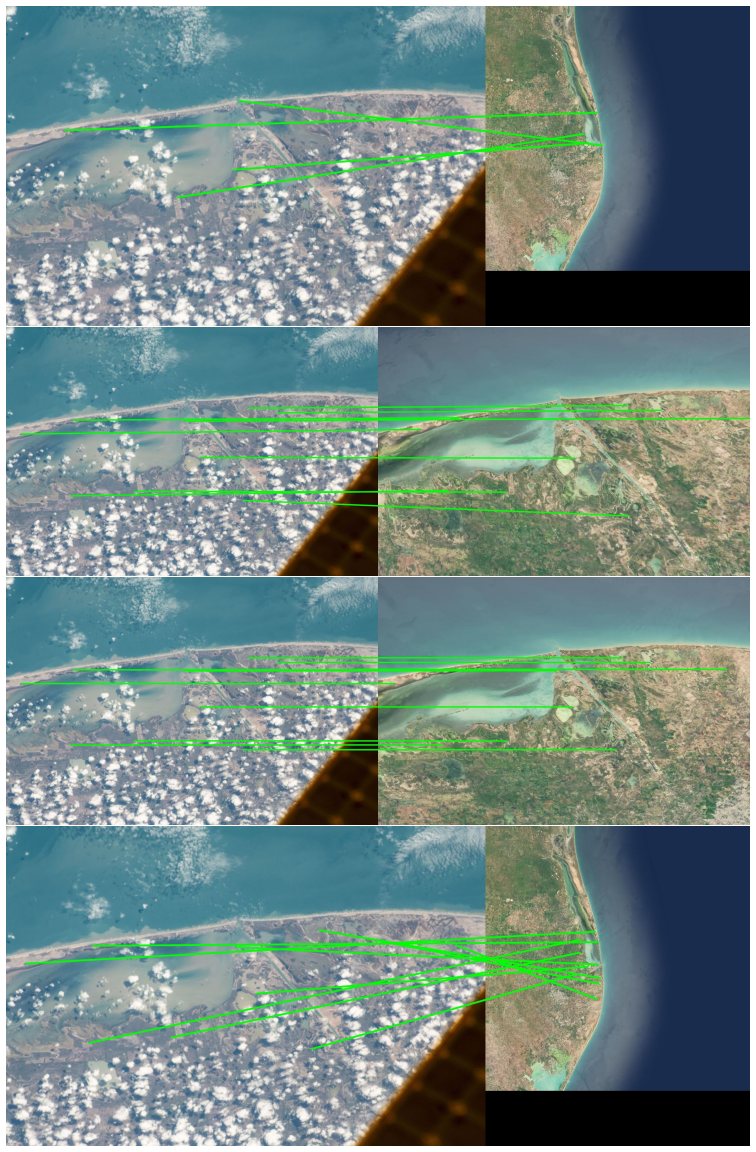
- [Sec. 4.5] The SatAst benchmark uses visually selected pairs and excludes pairs where homography annotation fails; this selection may bias the benchmark. Report the number of excluded pairs and provide the annotation protocol.
- [Throughout] Minor typos/clarity: 'demostrated' in Sec. 1; the sentence in Sec. 3.5 'We find that the approach used in RoMa ... generalizes the best' appears incomplete.
Circularity Check
Partial circularity: headline dense-matching gains on AerialMegaDepth/MapFree are reported on datasets that also appear in the training mixture (weight 1) with no documented held-out split; core ablations and other benchmarks remain independent.
specific steps
-
fitted input called prediction
[Sec. 3.4 Table 3 vs Sec. 4.2 Tables 6–7; App. B/G]
"We train RoMa v2 on a mix of wide and small baseline two-view datasets, a summary of which is presented in Table 3. ... We evaluate dense matching performance in Table 6 and Table 7 on a wide array of datasets ... Table 3 lists AerialMD and Map-Free at weight 1; Table 7 evaluates AerialMegaDepth and MapFree."
The training mixture in Table 3 includes AerialMD and Map-Free with weight 1, and §4.2 reports dense-matching EPE/PCK on AerialMegaDepth and MapFree without stating any held-out evaluation split. These metrics directly mirror the warp quantities minimized by the training losses, so unless the benchmark pairs are disjoint scenes/images—which the paper does not document—the headline gains (e.g., AerialMegaDepth EPE 25.05→4.12, MapFree 8.55→2.03) measure fit to the training label distribution rather than out-of-distribution generalization. App. G even shows the model learned AerialMegaDepth's spurious sky depth, consistent with training/eval sharing the same label noise. The paper does document hold-outs elsewhere (Hypersim, TartanAir), making this omission salient.
full rationale
The paper's derivation chain is mostly an empirical engineering story rather than a formal derivation. The architectural/loss contributions (Secs. 3.2–3.3) are validated by ablations on held-out Hypersim scenes and by comparisons on standard external benchmarks (MegaDepth-1500, ScanNet-1500, WxBS, TA-WB with held-out scenes), so those parts are not circular. The many self-citations to RoMa/DKM/UFM are background methodology, not load-bearing uniqueness claims. The one partial circularity is the dense-matching evaluation: AerialMegaDepth and MapFree appear in the training mixture (Table 3, weight 1) with no documented disjoint split in §4.2, and the EPE/PCK metrics directly mirror the training warp losses; App. G's sky-depth bias confirms the model absorbed the AerialMegaDepth label distribution. If the benchmark pairs are not disjoint, the headline 84% EPE reduction on AerialMegaDepth reduces to in-distribution fit. The SatAst benchmark is author-created and visually selected, which weakens its evidential weight but is not a definitional loop.
Axiom & Free-Parameter Ledger
free parameters (6)
- dataset mixture weights =
MegaDepth 1, AerialMD 1, BlendedMVS 1, Hypersim 1, TartanAir v2 1, MapFree 1, ScanNet++ v2 1, UnrealStereo4k 0.01, VKITT
- EMA decay alpha =
0.999
- precision-loss training threshold =
‖r‖ < 8 px; softplus floor 10⁻⁶
- loss weights =
10⁻² overlap (matcher); 10⁻² overlap + 10⁻³ precision (refiners)
- overlap/GT thresholds =
depth consistency τ=0.05 (Eq. 18); cycle consistency 5·10⁻³ ≈1.6px (Eq. 19); dataset pair overlap thresholds 0.01–0.2
- matching temperature and position-encoding scale =
τ=1/10, ω=1 (fixed, non-learnable)
axioms (5)
- domain assumption MVS/graphics-derived depth maps and flow fields yield correct ground-truth warps and covisibility labels
- domain assumption Frozen DINOv3 features are sufficiently robust that a linear-probe comparison (Table 1) predicts matching robustness
- domain assumption Evaluating on fixed benchmark splits without repeated runs or error bars is representative of model quality
- ad hoc to paper Pairwise Gaussian residuals with a per-pixel 2×2 precision matrix capture the relevant matching uncertainty
- domain assumption The backward covariance can stand in for the forward covariance when computing weighted Sampson errors
invented entities (1)
-
per-pixel predictive precision matrix Σ⁻¹ (covariance output)
independent evidence
read the original abstract
Dense feature matching aims to estimate all correspondences between two images of a 3D scene and has recently been established as the gold standard due to its high accuracy and robustness. However, existing dense matchers still fail or perform poorly for many hard real-world scenarios, and high-precision models are often slow, limiting their applicability. In this paper, we attack these weaknesses on a wide front through a series of systematic improvements that together yield a significantly better model. In particular, we construct a novel matching architecture and loss, which, combined with a curated diverse training distribution, enables our model to solve many complex matching tasks. We further make training faster through a decoupled two-stage matching-then-refinement pipeline, and at the same time, significantly reduce refinement memory usage through a custom CUDA kernel. Finally, we leverage the recent DINOv3 foundation model along with multiple other insights to make the model more robust and unbiased. In our extensive set of experiments, we show that the resulting novel matcher sets a new state-of-the-art, being significantly more accurate than its predecessors. Code is available at https://github.com/Parskatt/romav2
Figures






Forward citations
Cited by 22 Pith papers
-
One Video, One World: Turning Monocular Video into Physical 4D Scenes
OVOW reconstructs instance-level, simulation-ready 4D mesh scenes from monocular video via a four-stage training-free pipeline and introduces a new benchmark for structured Video-to-4D evaluation.
-
REDI-Match: Rotation-Equivariant Distillation for Efficient and Robust Dense Matching
REDI-Match proposes rotation-equivariant distillation to transfer VFM semantics into a strictly equivariant encoder plus an entropy-driven alignment decoder, reporting SOTA accuracy and 1.9x speed on dense matching be...
-
REDI-Match: Rotation-Equivariant Distillation for Efficient and Robust Dense Matching
REDI-Match uses rotation-equivariant distillation to transfer VFM semantics into a strictly equivariant encoder plus an entropy-driven alignment module, claiming SOTA accuracy and 1.9x speed on rotation-heavy benchmarks.
-
Dynamic Inverse Rendering for Enhanced Material-Lighting Decomposition
Hand-held rigid motion yields significantly more accurate albedo and relighting than static multiview capture under the same far-field illumination, both synthetically and on real RGB video.
-
FillGS: Filling Observation Gaps in 4D Gaussian Splatting via Viewpoint-Time Selection and Generative Refinement
FillGS actively selects spatiotemporal virtual viewpoints using rendering sensitivity and motion-aware observation density, then fine-tunes 4D Gaussian Splatting with reliability-masked generated images, improving spa...
-
VidMap: Exploiting Temporal Structure for Video-Based Structure-from-Motion
VidMap recovers more accurate metric poses and calibration from long unconstrained videos than SOTA SLAM and SfM by treating temporal order as first-class and injecting metric depth into global optimization.
-
DGSfM: Depth-Guided Scale-Aware Global Structure-from-Motion
Monocular depth priors turn scale-ambiguous global SfM into a scale-aware pipeline that measurably improves camera pose accuracy on ETH3D and IMC2021.
-
Glob3R: Global Structure-from-Motion with 3D Foundation Models
A frozen Pi3X backbone plus dense warping tracks and keyframe sliding-window global optimization yields more accurate, scalable SfM than feed-forward or classical baselines alone.
-
OrthoTrack: Continuous 6-DoF UAV Trajectory Estimation Anchored in Public Orthophotos
OrthoTrack is a training-free system for continuous metric 6-DoF UAV pose estimation anchored in public orthophotos and surface models, with a new MovingDrone benchmark dataset.
-
OrthoTrack: Continuous 6-DoF UAV Trajectory Estimation Anchored in Public Orthophotos
OrthoTrack is a training-free system for continuous 6-DoF UAV pose estimation anchored in public orthophotos and surface models, with a new MovingDrone benchmark dataset.
-
Unified Motion-Action Modeling for Heterogeneous Robot Learning
UMA treats object motion and robot actions as co-evolving variables under a masked generative objective with hindsight relabeling and contrastive disentanglement to support multi-task pretraining and deployment across...
-
SG2Loc: Sequential Visual Localization on 3D Scene Graphs
A particle-filter sequential localization method that matches per-patch semantic features from images to objects in a compact 3D scene graph via mesh projection and visibility.
-
G2G: Exploiting Intra-Group Geometry for Inter-Group Pose Estimation
G2G attaches three small trainable modules to frozen backbones and reports state-of-the-art inter-group pose accuracy on four datasets spanning simulation, real cross-season, and sim-to-real transfer using only relati...
-
Privacy-Preserving Structureless Visual Localization via Image Obfuscation
Simple image obfuscation enables privacy-preserving structureless visual localization with standard feature matchers and no pipeline changes, achieving state-of-the-art accuracy among privacy methods.
-
LoMa: Local Feature Matching Revisited
Scaling data, model size, and compute for local feature matching produces large performance gains on challenging benchmarks and a new manually annotated HardMatch dataset.
-
LoMa: Local Feature Matching Revisited
Scaling data diversity, model capacity and compute for DeDoDe+LightGlue-style sparse matchers yields large gains and a new hard benchmark HardMatch.
-
TerraSky3D: Multi-View Reconstructions of European Landmarks in 4K
TerraSky3D is a new high-resolution multi-view dataset with 50,000 images in 150 scenes of European landmarks, supplied with poses and depth maps to support 3D reconstruction research.
-
AeroMap3D: Anchoring Monocular UAV 6-DoF Localization to Visual-Geometric-Semantic Map Priors
AeroMap3D combines a scale/yaw adapter, a frozen dense matcher, OSM-filtered DEM lifting, and an EKF to achieve 5.88 m mean 3D localization error over 55 km of UAV flight using only public maps.
-
FreeTimeGS++: Secrets of Dynamic Gaussian Splatting and Their Principles
FreeTimeGS++ improves dynamic scene reconstruction by identifying emergent temporal partitioning and photometric-motion decoupling in 4DGS, then applying targeted techniques for reduced run-to-run variance.
-
FreeTimeGS++: Secrets of Dynamic Gaussian Splatting and Their Principles
Analysis of 4DGS reveals temporal partitioning from Gaussian durations and a photometric-spatiotemporal discrepancy, leading to FreeTimeGS++ with gated marginalization and neural velocity fields for superior stability...
-
FreeTimeGS++: Secrets of Dynamic Gaussian Splatting and Their Principles
FreeTimeGS++ improves 4D Gaussian Splatting by using gated marginalization and neural velocity fields to achieve more stable dynamic scene representations with lower run-to-run variance.
-
Who Handles Orientation? Investigating Invariance in Feature Matching
Learning rotation invariance in descriptors matches the performance of matcher-level invariance but allows earlier invariance, faster matchers, and no loss in upright performance when trained at scale.
Reference graph
Works this paper leans on
-
[1]
Map-free visual relocalization: Metric pose relative to a single image
Eduardo Arnold, Jamie Wynn, Sara Vicente, Guillermo Garcia-Hernando, Aron Monszpart, Victor Prisacariu, Dani- yar Turmukhambetov, and Eric Brachmann. Map-free visual relocalization: Metric pose relative to a single image. InEu- ropean Conf. Computer Vision (ECCV), 2022. 6
2022
-
[2]
A general and adaptive robust loss func- tion
Jonathan T Barron. A general and adaptive robust loss func- tion. InIEEE Conf. Computer Vision and Pattern Recogni- tion (CVPR), 2019. 5
2019
-
[3]
Earthmatch: Iterative coregistration for fine-grained localization of astro- naut photography
Gabriele Berton, Gabriele Goletto, Gabriele Trivigno, Alex Stoken, Barbara Caputo, and Carlo Masone. Earthmatch: Iterative coregistration for fine-grained localization of astro- naut photography. InIEEE Conf. Computer Vision and Pat- tern Recognition (CVPR), 2024. 7, 2
2024
-
[4]
Earthloc: Astronaut photography localization by indexing earth from space
Gabriele Berton, Alex Stoken, Barbara Caputo, and Carlo Masone. Earthloc: Astronaut photography localization by indexing earth from space. InIEEE Conf. Computer Vision and Pattern Recognition (CVPR), 2024
2024
-
[5]
Steerers: A framework for rotation equivariant keypoint descriptors
Georg B ¨okman, Johan Edstedt, Michael Felsberg, and Fredrik Kahl. Steerers: A framework for rotation equivariant keypoint descriptors. InIEEE Conf. Computer Vision and Pattern Recognition (CVPR), 2024. 7
2024
-
[6]
Vir- tual kitti 2.arXiv preprint arXiv:2001.10773, 2020
Yohann Cabon, Naila Murray, and Martin Humenberger. Vir- tual kitti 2.arXiv preprint arXiv:2001.10773, 2020. 6
Pith/arXiv arXiv 2001
-
[7]
nuscenes: A multi- modal dataset for autonomous driving
Holger Caesar, Varun Bankiti, Alex H Lang, Sourabh V ora, Venice Erin Liong, Qiang Xu, Anush Krishnan, Yu Pan, Gi- ancarlo Baldan, and Oscar Beijbom. nuscenes: A multi- modal dataset for autonomous driving. InIEEE Conf. Com- puter Vision and Pattern Recognition (CVPR), 2020. 6
2020
-
[8]
Brooks, Anton Van Den Hengel, and Darren Gawley
Wojciech Chojnacki, Michael J. Brooks, Anton Van Den Hengel, and Darren Gawley. On the fitting of surfaces to data with covariances.IEEE Trans. Pattern Analysis and Machine Intelligence (T-PAMI), 22(11):1294–1303, 2000. 3
2000
-
[9]
Scan- net: Richly-annotated 3d reconstructions of indoor scenes
Angela Dai, Angel X Chang, Manolis Savva, Maciej Hal- ber, Thomas Funkhouser, and Matthias Nießner. Scan- net: Richly-annotated 3d reconstructions of indoor scenes. InIEEE Conf. Computer Vision and Pattern Recognition (CVPR), 2017. 1, 7
2017
-
[10]
Reloc3r: Large-scale training of relative camera pose regression for generalizable, fast, and accurate visual localization
Siyan Dong, Shuzhe Wang, Shaohui Liu, Lulu Cai, Qingnan Fan, Juho Kannala, and Yanchao Yang. Reloc3r: Large-scale training of relative camera pose regression for generalizable, fast, and accurate visual localization. InIEEE Conf. Com- puter Vision and Pattern Recognition (CVPR), 2025. 7
2025
-
[11]
DKM: Dense kernelized feature matching for geometry estimation
Johan Edstedt, Ioannis Athanasiadis, M ˚arten Wadenb ¨ack, and Michael Felsberg. DKM: Dense kernelized feature matching for geometry estimation. InIEEE Conf. Computer Vision and Pattern Recognition (CVPR), 2023. 1, 3, 7
2023
-
[12]
RoMa: Robust dense feature matching
Johan Edstedt, Qiyu Sun, Georg B ¨okman, M ˚arten Wadenb¨ack, and Michael Felsberg. RoMa: Robust dense feature matching. InIEEE Conf. Computer Vision and Pat- tern Recognition (CVPR), 2024. 1, 3, 5, 6, 7
2024
-
[13]
Virtual worlds as proxy for multi-object tracking analy- sis
Adrien Gaidon, Qiao Wang, Yohann Cabon, and Eleonora Vig. Virtual worlds as proxy for multi-object tracking analy- sis. InIEEE Conf. Computer Vision and Pattern Recognition (CVPR), 2016. 6
2016
-
[14]
Cambridge university press,
Richard Hartley and Andrew Zisserman.Multiple view ge- ometry in computer vision. Cambridge university press,
-
[15]
Image matching chal- lenge 2022, 2022
Addison Howard, Eduard Trulls, Kwang Moo Yi, Dmitry Mishkin, Sohier Dane, and Yuhe Jin. Image matching chal- lenge 2022, 2022. 1
2022
-
[16]
Uncertainty es- timates and multi-hypotheses networks for optical flow
Eddy Ilg, Ozgun Cicek, Silvio Galesso, Aaron Klein, Osama Makansi, Frank Hutter, and Thomas Brox. Uncertainty es- timates and multi-hypotheses networks for optical flow. In European Conf. Computer Vision (ECCV), 2018. 5
2018
-
[17]
Pavel Izmailov, Dmitrii Podoprikhin, Timur Garipov, Dmitry Vetrov, and Andrew Gordon Wilson. Averaging weights leads to wider optima and better generalization.arXiv preprint arXiv:1803.05407, 2018. 5
Pith/arXiv arXiv 2018
-
[18]
MapAnything: Universal feed- forward metric 3D reconstruction, 2025
Nikhil Keetha, Norman M ¨uller, Johannes Sch ¨onberger, Lorenzo Porzi, Yuchen Zhang, Tobias Fischer, Arno Knapitsch, Duncan Zauss, Ethan Weber, Nelson Antunes, Jonathon Luiten, Manuel Lopez-Antequera, Samuel Rota Bul`o, Christian Richardt, Deva Ramanan, Sebastian Scherer, and Peter Kontschieder. MapAnything: Universal feed- forward metric 3D reconstructio...
Pith/arXiv arXiv 2025
-
[19]
Dmytro Kotovenko, Olga Grebenkova, and Bj ¨orn Ommer. Edgs: Eliminating densification for efficient convergence of 3dgs.arXiv preprint arXiv:2504.13204, 2025. 1
arXiv 2025
-
[20]
Dense-sfm: Structure from motion with dense consistent matching
JongMin Lee and Sungjoo Yoo. Dense-sfm: Structure from motion with dense consistent matching. InIEEE Conf. Com- puter Vision and Pattern Recognition (CVPR), 2025. 1
2025
-
[21]
Ground- ing image matching in 3d with mast3r
Vincent Leroy, Yohann Cabon, and J´erˆome Revaud. Ground- ing image matching in 3d with mast3r. InEuropean Conf. Computer Vision (ECCV), 2024. 3, 7
2024
-
[22]
Megadepth: Learning single- view depth prediction from internet photos
Zhengqi Li and Noah Snavely. Megadepth: Learning single- view depth prediction from internet photos. InIEEE Conf. 9 Computer Vision and Pattern Recognition (CVPR), 2018. 1, 2, 6, 7
2018
-
[23]
LightGlue: Local Feature Matching at Light Speed
Philipp Lindenberger, Paul-Edouard Sarlin, and Marc Polle- feys. LightGlue: Local Feature Matching at Light Speed. In IEEE Int’l Conf. Computer Vision (ICCV), 2023. 2, 7
2023
-
[24]
Rubik: A struc- tured benchmark for image matching across geometric chal- lenges
Thibaut Loiseau and Guillaume Bourmaud. Rubik: A struc- tured benchmark for image matching across geometric chal- lenges. InIEEE Conf. Computer Vision and Pattern Recog- nition (CVPR), 2025. 2
2025
-
[25]
Opensfm.https : / / github
Mapillary. Opensfm.https : / / github . com / mapillary/OpenSfM, 2014. 1
2014
-
[26]
A large dataset to train convolutional networks for disparity, optical flow, and scene flow estimation
Nikolaus Mayer, Eddy Ilg, Philip Hausser, Philipp Fischer, Daniel Cremers, Alexey Dosovitskiy, and Thomas Brox. A large dataset to train convolutional networks for disparity, optical flow, and scene flow estimation. InIEEE Conf. Com- puter Vision and Pattern Recognition (CVPR), 2016. 6
2016
-
[27]
WxBS: Wide baseline stereo generalizations
Dmytro Mishkin, Jiri Matas, Michal Perdoch, and Karel Lenc. WxBS: Wide baseline stereo generalizations. In British Machine Vision Conference (BMVC), 2015. 1, 7, 8
2015
-
[28]
Maxime Oquab, Timoth ´ee Darcet, Theo Moutakanni, Huy V . V o, Marc Szafraniec, Vasil Khalidov, Pierre Fernandez, Daniel Haziza, Francisco Massa, Alaaeldin El-Nouby, Rus- sell Howes, Po-Yao Huang, Hu Xu, Vasu Sharma, Shang- Wen Li, Wojciech Galuba, Mike Rabbat, Mido Assran, Nico- las Ballas, Gabriel Synnaeve, Ishan Misra, Herve Jegou, Julien Mairal, Patri...
-
[29]
A guide to structureless visual localization
V ojtech Panek, Qunjie Zhou, Yaqing Ding, S ´ergio Agostinho, Zuzana Kukelova, Torsten Sattler, and Laura Leal-Taix´e. A guide to structureless visual localization. arXiv preprint arXiv:2504.17636, 2025. 1
Pith/arXiv arXiv 2025
-
[30]
Vi- sion transformers for dense prediction
Ren ´e Ranftl, Alexey Bochkovskiy, and Vladlen Koltun. Vi- sion transformers for dense prediction. InIEEE Conf. Com- puter Vision and Pattern Recognition (CVPR), 2021. 4, 1
2021
-
[31]
Carl Edward Rasmussen and Christopher K. I. Williams. Gaussian Processes for Machine Learning (Adaptive Com- putation and Machine Learning). The MIT Press, 2005. 3
2005
-
[32]
Susskind
Mike Roberts, Jason Ramapuram, Anurag Ranjan, Atulit Kumar, Miguel Angel Bautista, Nathan Paczan, Russ Webb, and Joshua M. Susskind. Hypersim: A photorealistic syn- thetic dataset for holistic indoor scene understanding. In IEEE Int’l Conf. Computer Vision (ICCV), 2021. 4, 6, 8, 2
2021
-
[33]
Superglue: Learning feature matching with graph neural networks
Paul-Edouard Sarlin, Daniel DeTone, Tomasz Malisiewicz, and Andrew Rabinovich. Superglue: Learning feature matching with graph neural networks. InIEEE Conf. Com- puter Vision and Pattern Recognition (CVPR), 2020. 1, 2, 7
2020
-
[34]
Benchmarking 6dof outdoor visual localiza- tion in changing conditions
Torsten Sattler, Will Maddern, Carl Toft, Akihiko Torii, Lars Hammarstrand, Erik Stenborg, Daniel Safari, Masatoshi Okutomi, Marc Pollefeys, Josef Sivic, Fredrik Kahl, and Tomas Pajdla. Benchmarking 6dof outdoor visual localiza- tion in changing conditions. InIEEE Conf. Computer Vision and Pattern Recognition (CVPR), 2018. 1
2018
-
[35]
A benchmark and a baseline for robust multi- view depth estimation
Philipp Schr ¨oppel, Jan Bechtold, Artemij Amiranashvili, and Thomas Brox. A benchmark and a baseline for robust multi- view depth estimation. InInt’l Conf. 3D Vision (3DV), 2022. 5
2022
-
[36]
Structure-from-Motion Revisited
Johannes Lutz Sch ¨onberger and Jan-Michael Frahm. Structure-from-Motion Revisited. InIEEE Conf. Computer Vision and Pattern Recognition (CVPR), 2016. 1, 3
2016
-
[37]
Oriane Sim ´eoni, Huy V . V o, Maximilian Seitzer, Federico Baldassarre, Maxime Oquab, Cijo Jose, Vasil Khalidov, Marc Szafraniec, Seungeun Yi, Micha ¨el Ramamonjisoa, Francisco Massa, Daniel Haziza, Luca Wehrstedt, Jianyuan Wang, Timoth´ee Darcet, Th´eo Moutakanni, Leonel Sentana, Claire Roberts, Andrea Vedaldi, Jamie Tolan, John Brandt, Camille Couprie,...
Pith/arXiv arXiv 2025
-
[38]
Mod- eling the world from internet photo collections.Int’l J
Noah Snavely, Steven M Seitz, and Richard Szeliski. Mod- eling the world from internet photo collections.Int’l J. Com- puter Vision (IJCV), 80(2), 2008. 1, 3
2008
-
[39]
Find my astronaut photo: Automated localization and georectification of astronaut photography
Alex Stoken and Kenton Fisher. Find my astronaut photo: Automated localization and georectification of astronaut photography. InIEEE Conf. Computer Vision and Pattern Recognition (CVPR) Workshops, 2023. 7, 2
2023
-
[40]
Roformer: Enhanced transformer with rotary position embedding, 2023
Jianlin Su, Yu Lu, Shengfeng Pan, Ahmed Murtadha, Bo Wen, and Yunfeng Liu. Roformer: Enhanced transformer with rotary position embedding, 2023. 6
2023
-
[41]
LoFTR: Detector-free local feature match- ing with transformers
Jiaming Sun, Zehong Shen, Yuang Wang, Hujun Bao, and Xiaowei Zhou. LoFTR: Detector-free local feature match- ing with transformers. InIEEE Conf. Computer Vision and Pattern Recognition (CVPR), 2021. 1, 2, 3, 7
2021
-
[42]
Inloc: Indoor visual localization with dense matching and view synthesis
Hajime Taira, Masatoshi Okutomi, Torsten Sattler, Mircea Cimpoi, Marc Pollefeys, Josef Sivic, Tomas Pajdla, and Ak- ihiko Torii. Inloc: Indoor visual localization with dense matching and view synthesis. InIEEE Conf. Computer Vi- sion and Pattern Recognition (CVPR), 2018. 1
2018
-
[43]
Smd-nets: Stereo mixture density networks
Fabio Tosi, Yiyi Liao, Carolin Schmitt, and Andreas Geiger. Smd-nets: Stereo mixture density networks. InConference on Computer Vision and Pattern Recognition (CVPR), 2021. 6
2021
-
[44]
PDC-Net+: Enhanced Probabilistic Dense Cor- respondence Network.IEEE Trans
Prune Truong, Martin Danelljan, Radu Timofte, and Luc Van Gool. PDC-Net+: Enhanced Probabilistic Dense Cor- respondence Network.IEEE Trans. Pattern Analysis and Machine Intelligence (T-PAMI), 2023. 5
2023
-
[45]
Aerialmegadepth: Learning aerial-ground reconstruction and view synthesis
Khiem Vuong, Anurag Ghosh, Deva Ramanan, Srinivasa Narasimhan, and Shubham Tulsiani. Aerialmegadepth: Learning aerial-ground reconstruction and view synthesis. InIEEE Conf. Computer Vision and Pattern Recognition (CVPR), 2025. 6
2025
-
[46]
Vggt: Visual geometry grounded transformer
Jianyuan Wang, Minghao Chen, Nikita Karaev, Andrea Vedaldi, Christian Rupprecht, and David Novotny. Vggt: Visual geometry grounded transformer. InIEEE Conf. Com- puter Vision and Pattern Recognition (CVPR), 2025. 3, 7, 5
2025
-
[47]
Dust3r: Geometric 3d vi- sion made easy
Shuzhe Wang, Vincent Leroy, Yohann Cabon, Boris Chidlovskii, and Jerome Revaud. Dust3r: Geometric 3d vi- sion made easy. InIEEE Conf. Computer Vision and Pattern Recognition (CVPR), 2024. 1, 3 10
2024
-
[48]
Tartanair: A dataset to push the limits of visual slam
Wenshan Wang, Delong Zhu, Xiangwei Wang, Yaoyu Hu, Yuheng Qiu, Chen Wang, Yafei Hu, Ashish Kapoor, and Se- bastian Scherer. Tartanair: A dataset to push the limits of visual slam. InIEEE/RSJ Int’l Conf. Intelligent Robots and Systems (IROS), 2020. 6
2020
-
[49]
Blendedmvs: A large-scale dataset for generalized multi-view stereo net- works
Yao Yao, Zixin Luo, Shiwei Li, Jingyang Zhang, Yufan Ren, Lei Zhou, Tian Fang, and Long Quan. Blendedmvs: A large-scale dataset for generalized multi-view stereo net- works. InIEEE Conf. Computer Vision and Pattern Recog- nition (CVPR), 2020. 6
2020
-
[50]
Scannet++: A high-fidelity dataset of 3d indoor scenes
Chandan Yeshwanth, Yueh-Cheng Liu, Matthias Nießner, and Angela Dai. Scannet++: A high-fidelity dataset of 3d indoor scenes. InIEEE Int’l Conf. Computer Vision (ICCV),
-
[51]
Hierarchical discrete distribution decomposition for match density esti- mation
Zhichao Yin, Trevor Darrell, and Fisher Yu. Hierarchical discrete distribution decomposition for match density esti- mation. InIEEE Conf. Computer Vision and Pattern Recog- nition (CVPR), 2019. 5
2019
-
[52]
Ufm: A simple path towards unified dense correspondence with flow
Yuchen Zhang, Nikhil Keetha, Chenwei Lyu, Bhuvan Jhamb, Yutian Chen, Yuheng Qiu, Jay Karhade, Shreyas Jha, Yaoyu Hu, Deva Ramanan, Sebastian Scherer, and Wenshan Wang. Ufm: A simple path towards unified dense correspondence with flow. InAdvances in Neural Information Processing Systems (NeurIPS), 2025. 2, 3, 5, 6, 7
2025
-
[53]
Efficient motion prompt learning for robust visual tracking
Jie Zhao, Xin Chen, Yongsheng Yuan, Michael Felsberg, Dong Wang, and Huchuan Lu. Efficient motion prompt learning for robust visual tracking. InInt’l Conf. Machine learning (ICML), 2025. 6
2025
-
[54]
Xiaoming Zhao, Xingming Wu, Weihai Chen, Peter C. Y . Chen, Qingsong Xu, and Zhengguo Li. Aliked: A lighter keypoint and descriptor extraction network via deformable transformation.IEEE Transactions on Instrumentation & Measurement, 72, 2023. 5
2023
-
[55]
match embeddings
Huizhong Zhou, Benjamin Ummenhofer, and Thomas Brox. Deeptam: Deep tracking and mapping. InEuropean Conf. Computer Vision (ECCV), 2018. 5 11 RoMa v2: Harder Better Faster Denser Feature Matching Supplementary Material A. Architectural Details Here we give further details on the exact dimensions of in- puts and outputs of the different components of our mo...
2018
-
[56]
TRAIN” “TEST
This has the effect of making the refinement significantly cheaper, as we also only have to extract features from the VGG19 backbone until stride 4, compared to RoMa and DKM which require features and refinement from stride16. We denote the fine features as φ4 ∈R H 4 × W 4 ×192, φ2 ∈R H 2 × W 2 ×48, φ1 ∈R H×W×12 , (15) where the dimensions come from the r...
discussion (0)
Sign in with ORCID, Apple, or X to comment. Anyone can read and Pith papers without signing in.