REVIEW 4 major objections 5 minor 2 cited by
The paper derives a universal ceiling of about 0.385 for the pressure-to-energy-density ratio at neutron-star centers, combining the causality limit with a new mass-sphere stability condition.
Reviewed by Pith at T0; open to challenge. T0 means a machine referee read the full paper against a public rubric. the ladder, T0–T4 →
T0 review · deepseek-v4-flash
2026-08-03 12:24 UTC pith:XQ3QBFQT
load-bearing objection The claimed "improved" bound X≤0.385 is actually a relaxation of the authors' own causal-only bound of 0.374, and the new mass-sphere stability criterion is asserted rather than derived; the algebra is careful but the headline does not hold. the 4 major comments →
An Effective Upper Bound on the Pressure-to-Energy Density Ratio in Neutron Stars
The pith
A machine-rendered reading of the paper's core claim, the machinery that carries it, and where it could break.
Core claim
The authors claim that the central equation-of-state parameter X = Pc/epsilon_c in the most massive neutron stars is bounded above by about 0.385, not by the naive limit of 1. Working in a dimensionless perturbative analysis of the Tolman-Oppenheimer-Volkoff equations, they use the coefficient A(X) = -a2(X) in the central energy-density expansion, which controls how a small sphere near the center responds to compression. The requirement that this response be stable, expressed as d^2 A/dX^2 = 0 at the transition, gives X about 0.377, close to the causality bound X+ about 0.374. Treating all higher-order terms as a single effective correction f(r) = -sigma X B r^2 and demanding the two bounds
What carries the argument
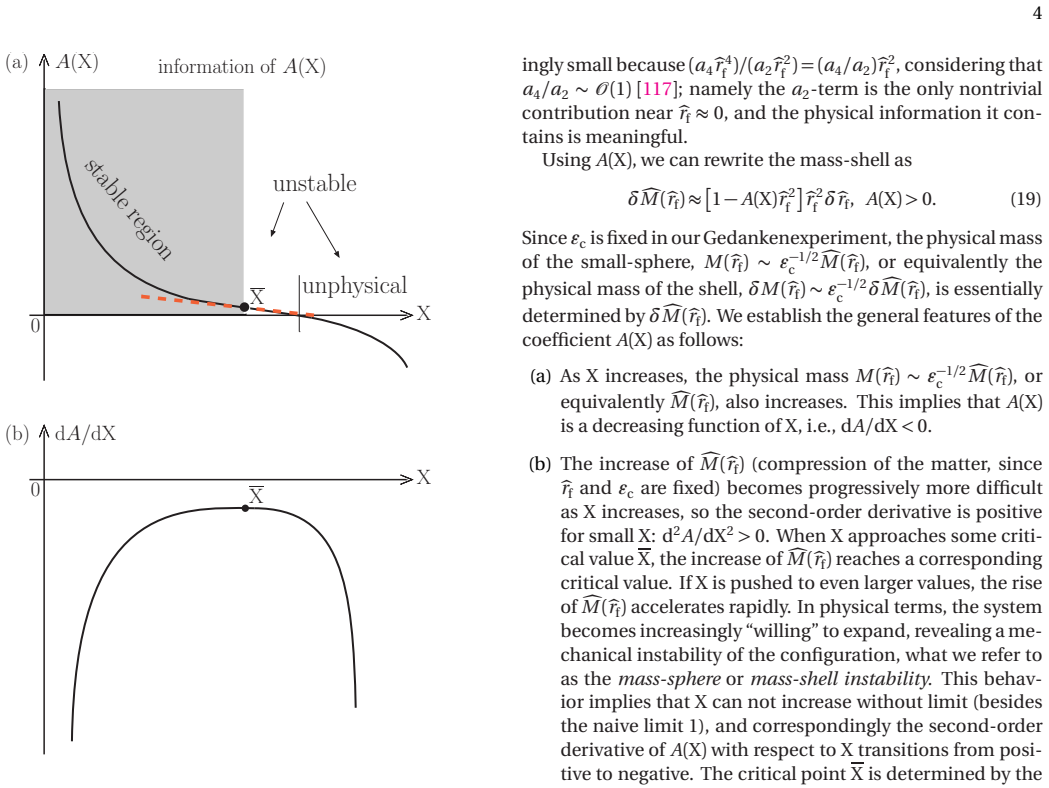
The central object is the coefficient A(X) = -a2(X) appearing in the central expansion of the reduced energy density, epsilon_hat(r) about 1 - a2 r^2 + ... . Through the small-sphere mass, A controls the response of a fixed-radius mass shell to compression, and its inflection point d^2 A/dX^2 = 0 defines the 'mass-sphere instability' that sets the new upper limit X. The argument is carried by the identity A = B/s_c^2, where B = -b2(X), and by an effective renormalization of the pressure profile, f(r) = -sigma X B r^2, whose parameter sigma is fixed by demanding the stability bound and the causality bound s_c^2 = 1 coincide. This consistency condition is the mechanism that turns two nearby bu
Load-bearing premise
The load-bearing premise is that the onset of the proposed 'mass-sphere instability' is exactly the point where the second derivative of the expansion coefficient A(X) changes sign; this is motivated by a thought experiment rather than derived from the standard radial-stability equations, and if that criterion is misplaced the combined bound collapses to the weaker causality-only limit.
What would settle it
Find or construct a stable, causal neutron-star solution of the exact TOV equations with central X = Pc/epsilon_c greater than 0.385, or run a radial-oscillation stability analysis on the 284 equations of state and show that the first unstable configuration occurs at an X significantly different from about 0.385. Either result would refute the proposed universal bound.
If this is right
- The central pressure-to-energy-density ratio in any stable neutron star with causal sound speed is bounded by X less than about 0.385, a universal ceiling for cold visible matter.
- The dimensionless trace anomaly at the star's center satisfies Delta_c = 1/3 - X greater than about -0.051, tightening the allowed deviation from conformal matter.
- Maximum neutron-star compactness follows xi_max about X/(1+3X)+0.1, giving xi_max less than about 0.276 for X = 0.385; this scaling is robust across 284 equations of state, including phase transitions and quark matter.
- The earlier causality-only bound X less than about 0.374 is slightly relaxed but not contradicted, showing that the two independent criteria are mutually consistent and supporting the low-order perturbative description.
- The bound translates directly into a lower limit on the trace anomaly, providing a bridge between the central equation-of-state parameter and observables such as the mass-radius relation and tidal deformability.
Where Pith is reading between the lines
- If the bound is truly universal, then a precise measurement of the compactness of the most massive known neutron star could indirectly measure X at the center, turning a theoretical ceiling into an observable central equation-of-state parameter.
- The same 'make two independent bounds coincide' consistency criterion could be applied to higher-order coefficients to estimate the size of the next correction term, providing a convergence check that the paper leaves for future work.
- The bound is derived for cold neutron stars; extending the argument to proto-neutron stars or finite-temperature matter would test whether the ceiling is a property of gravity and cold dense matter specifically, or a more general feature of general-relativistic stellar structure.
Editorial analysis
A structured set of objections, weighed in public.
Referee Report
Summary. The paper combines the causality constraint s_c^2 <= 1 with a postulated 'mass-sphere stability' condition d^2A/dX^2 = 0 (Eq. 20) and an effective higher-order correction f(r) = -sigma X B r^2 (Eq. 31) to obtain an upper bound X = P_c/eps_c <~ 0.385 for cold dense matter at the centers of neutron stars. The authors also derive a compactness scaling relation xi ~ X/(1+3X) + 0.1, validate it on 284 realistic EOSs, and translate the bound into a trace-anomaly lower bound Delta >~ -0.051. The Taylor-expansion algebra in Sections II-IV is internally consistent, but the central claim is not established: the new bound is numerically weaker than the authors' previously published causality-only bound 0.374, and it is selected by tuning a free parameter after imposing an ad hoc consistency condition.
Significance. If the mass-sphere stability criterion and the consistency requirement were rigorous, X <~ 0.385 would be a compact, EOS-insensitive prediction with implications for the trace anomaly and NS compactness. The IPAD-TOV framework is original, and a simple scaling xi ~ X/(1+3X) supported by a wide EOS survey (including phase transitions and quark matter) would be a useful empirical result, although the data are not yet released. However, the central claim fails as stated: the new bound is not an improvement over the existing causality bound, the stability criterion is a heuristic postulate rather than a derived theorem, and the headline number is obtained by tuning sigma to force two approximate bounds to coincide. The empirical compactness fit does not discriminate among the possible correction schemes.
major comments (4)
- [Abstract and Sec. IV, Eq. (27)] The claimed 'improved bound' X <~ 0.385 is not an improvement: it is larger than the authors' previously published causality-only bound X <~ 0.374 (text after Eq. (13); abstract). For a genuine upper bound, combining two constraints should give the lower envelope, min(X+, Xbar), which for sigma=0 is min(0.381,0.368)=0.368, not 0.385. Enforcing Eq. (27) as an equality fixes sigma and produces a value that exceeds both original estimates. This represents a relaxation, not a refinement, of the existing bound, and contradicts the paper's central claim.
- [Sec. III, Eq. (20)] The onset condition d^2A/dX^2=0 is not derived. The paper lists 'general features' (a)-(b) as assumptions and motivates them by the Gedankenexperiment of Fig. 2, but no connection is made to the TOV radial-oscillation (Chandrasekhar) equations or to the zero of the fundamental mode. Thus 'mass-sphere instability' is an ad hoc definition, not a theorem. The proximity of X+ and Xbar in the uncorrected case (0.381 vs 0.368) is a feature of that particular truncation and does not validate the criterion. A direct check on the fundamental radial mode for a set of EOSs is needed before the combined-constraint construction can be accepted.
- [Sec. IV, Eq. (31) and Table I] The parameter sigma is free. sigma = -0.253 is obtained by imposing X_eff+ = X_eff (Eq. 27), which is a fitting condition, not a predictive derivation. Table I shows the result is ansatz-dependent: the phi-correction gives X ~ 0.375, and sigma in [-0.4,0.3] gives X in [0.366,0.391], bracketing the old causal bound 0.374. The compactness fit does not resolve the ambiguity: the r-value changes from 0.933 (sigma=0) to 0.935 (sigma~-0.253), a 0.2% difference that is not statistically significant. The headline value is therefore selected, not determined.
- [Sec. III, Fig. 2] The Gedankenexperiment is not a controlled physical process: for a given EOS, X=P_c/eps_c is fixed once eps_c is fixed, and applying an external pressure while holding eps_c fixed does not independently vary X. This weakens the interpretation of A(X) as a function whose second derivative signals instability. The argument needs to be reformulated as a sequence of equilibrium TOV configurations with varying central density, or the criterion needs a direct derivation from the perturbation equations.
minor comments (5)
- [Data Availability] The 284-EOS data are not yet released (Data Availability section, Ref. [153]); the reproducibility of the empirical compactness claim is currently unverifiable.
- [Fig. 7] The quoted improvement in r-value from 0.933 to 0.935 is much smaller than the typical scatter of such fits; a bootstrap or similar significance test is needed before claiming that Theta ~ 0.927 is the optimal choice.
- [Eq. (50)] The trace-anomaly bound Delta >~ -0.051 is a trivial reformulation of X <~ 0.385; presenting it as a separate result is somewhat misleading.
- [Notation] There are numerous rendering/notation artifacts in the text (e.g., '/hatwide1', '/radicalbig', '/parenleftbig'); a careful proofread is needed.
- [Table I] The combination Theta = 18/25 - 41sigma/50 - phi/10 should be defined explicitly in the caption; as written, the relation between columns is not immediately clear.
Circularity Check
The headline bound 0.385 is selected by tuning an ad hoc correction parameter σ so that two criteria coincide; the paper's own Table I shows the bound depends on the parametrization.
specific steps
-
fitted input called prediction
[Section IV, Eqs. (27), (31), and text after Eq. (44)]
"we therefore introduce a dimensionless parameter σ and adopt the effective parametrization f(r̂) = −σXB r̂², where σ is to be determined self-consistently ... By requiring consistency, i.e., Xeff+=Xeff, we obtain the correction parameter σ≈−0.253 and simultaneously Xeff+≈Xeff≈0.385"
The free parameter σ absorbs all higher-order corrections, and the advertised bound is the common root of the two criteria after imposing the physical requirement X+≈X (Eq. 27). The value is thus a solution of the consistency condition, not an independent prediction. Section V shows that changing the correction ansatz to f∝(B r̂²)² gives X≈0.375, and Table I lists X between 0.366 and 0.391 as σ varies; hence 0.385 is determined by the chosen ansatz plus the imposed equality, not by the theory alone.
full rationale
The central refinement from the causal-only bound 0.374 to the headline 0.385 is not derived from an independent stability theorem. The mass-sphere criterion d²A/dX²=0 (Eq. 20) is motivated by a Gedankenexperiment and monotonicity assumptions (a)-(b), not by TOV radial-oscillation analysis; and the correction parameter σ (Eq. 31) is tuned by enforcing Xeff+=Xeff. The paper's own Table I and Section V demonstrate that different allowed correction forms move the bound over 0.366–0.391, confirming that the headline value is an output of the parametrization plus the consistency constraint. The empirical 284-EOS compactness fit is not circular (it is an external check), but it is not discriminating: the r-value changes only from 0.933 (σ=0) to 0.935 (σ≈−0.253), and the data are not yet released (Data Availability, Ref. [153]). Self-citations to the IPAD-TOV framework are present but are not the primary source of circularity; the main issue is the fitted/consistency-selected nature of the advertised bound.
Axiom & Free-Parameter Ledger
free parameters (4)
- σ (effective correction) =
≈ -0.253
- ϕ (alternative quartic correction) =
0.96 (Section V); scanned -0.58 to 1.92 in Table I
- Θ (compactness scaling parameter) =
≈0.927 (optimal; ≈1 used for Eq. (49))
- α, β (empirical compactness coefficients) =
α≈1.54, β≈0.09
axioms (6)
- standard math TOV equations with c=G=1 describe static spherical NS equilibrium
- domain assumption Causality s_c²≤1 bounds X via Eq. (21)
- ad hoc to paper Mass-sphere stability onset is d²A/dX²=0
- ad hoc to paper A(X) is monotonically decreasing with d²A/dX²>0 for small X
- ad hoc to paper Higher-order pressure terms can be represented as f(r̅)=-σXB r̅² with a single constant σ
- ad hoc to paper Physical requirement X+≈X
read the original abstract
The equation-of-state (EOS) parameter $\phi \equiv P/\varepsilon$, defined as the ratio of pressure to energy density, encapsulates the fundamental response of matter under extreme compression. Its value at the center of the most massive neutron star (NS), $\x \equiv P_{\rm c}/\varepsilon_{\rm c}$, provides an upper bound on the maximum attainable central EOS parameter of cold visible matter. Remarkably, owing to the intrinsically nonlinear structure of the EOS in General Relativity (GR), this bound lies far below the naive Special Relativity (SR) limit of unity. In this work, we refine the theoretical upper bound on $\x$ in a self-consistent manner by incorporating, in addition to the causality constraint from SR, the mass-sphere stability condition associated with the mass evolution pattern in the vicinity of the NS center. This condition is formulated within the intrinsic and perturbative analysis of the dimensionless Tolman--Oppenheimer--Volkoff equations (IPAD-TOV) framework. The combined constraints yield an improved bound, $\x \lesssim 0.385$, which is slightly above but fully consistent with the previously derived causal-only limit, $\x \lesssim 0.374$. We further derive an improved scaling relation for NS compactness and demonstrate its robustness across a broad set of 284 realistic EOSs, including models with first-order phase transitions, exotic degrees of freedom, continuous crossover behavior, and deconfined quark cores. Within the IPAD-TOV framework, the resulting bound on $\x$ provides a new EOS-insensitive probe of the microphysics of cold superdense matter compressed by strong-field gravity in GR.
Figures




Forward citations
Cited by 2 Pith papers
-
A New Scaling of Neutron Star Tidal Deformability for Directly Probing the Core Equation of State
A perturbative analysis yields an EOS-insensitive scaling relation between tidal deformability Λ and central EOS parameter X = P_c/ε_c that enables direct inference of neutron-star core properties from inspiral GW obs...
-
Trace Anomaly of Cold Dense Matter Constrained by Collective Flow
Trace anomaly of cold dense matter extracted from heavy-ion flow observables matches neutron-star posterior bands, establishing a composition-insensitive bridge between the two environments.
Reference graph
Works this paper leans on
-
[1]
Shapiro and S
S. Shapiro and S. Teukolsky,Black Holes, White Dwarfs and Neu- tron Stars, Wiley-VCH, 1983
1983
-
[2]
Walecka, Ann
J. Walecka, Ann. Phys. 83, 491 (1974)
1974
-
[3]
Collins and M
J. Collins and M. Perry, Phys. Rev. Lett. 34, 1353 (1975)
1975
-
[4]
Chin, Ann
S. Chin, Ann. Phys. 108, 301 (1976)
1976
-
[5]
Freedman and L
B. Freedman and L. McLerran,Phys. Rev. D16, 1130 (1977); 1147 (1977); 1169 (1977)
1977
-
[6]
Akmal, V
A. Akmal, V . Pandharipande, and D. Ravenhall,Phys. Rev. C 58, 1804 (1998)
1998
-
[7]
Lattimer and M
J. Lattimer and M. Prakash, Astrophys. J. 550, 426 (2001)
2001
-
[8]
Lattimer and M
J. Lattimer and M. Prakash, Phys. Rep. 442, 109 (2007)
2007
-
[9]
Alford et al., Rev
M. Alford et al., Rev. Mod. Phys. 80, 1455 (2008)
2008
-
[10]
B.A. Li, L.W . Chen, and C.M. Ko,Phys. Rep. 464, 113 (2008)
2008
-
[11]
Li et al., Universe 7, 182 (2021)
B.A. Li et al., Universe 7, 182 (2021)
2021
-
[12]
Lattimer, Ann
J. Lattimer, Ann. Rev. Nucl. Part. Sci. 71, 433 (2021)
2021
-
[13]
Chen et al., Nucl
J.H. Chen et al., Nucl. Sci. Tech. 35, 214 (2024)
2024
-
[14]
Baym et al., Rep
G. Baym et al., Rep. Prog. Phys. 81, 056902 (2018)
2018
-
[15]
Vida/tildewide1na, Proc
I. Vida/tildewide1na, Proc. Roy. Soc. Lond. A 474, 0145 (2018)
2018
-
[16]
Drischler, J
C. Drischler, J. Holt, and C. Wellenhofer, Annu. Rev. Nucl. Part. Sci. 71, 403 (2021)
2021
-
[17]
Oertel et al., Rev
M. Oertel et al., Rev. Mod. Phys. 89, 015007 (2017)
2017
-
[18]
Baiotti, Prog
L. Baiotti, Prog. Part. Nucl. Phys. 109, 103714 (2019)
2019
-
[19]
Lovato et al., arXiv:2211.02224 (2022)
A. Lovato et al., arXiv:2211.02224 (2022)
Pith/arXiv arXiv 2022
-
[20]
Sorensen et al., Prog
A. Sorensen et al., Prog. Part. Nucl. Phys. 134, 104080 (2024)
2024
-
[21]
Watts et al., Rev
A. Watts et al., Rev. Mod. Phys. 88, 021001 (2016)
2016
-
[22]
Li et al.,SCIENCE CHINA Physics, Mechanics and Astronomy 68, 119503 (2025)
A. Li et al.,SCIENCE CHINA Physics, Mechanics and Astronomy 68, 119503 (2025)
2025
-
[23]
Chatziioannou et al., Rev
K. Chatziioannou et al., Rev. Mod. Phys. 97, 045007 (2025)
2025
- [24]
-
[25]
Wei and Z.Q
S.N. Wei and Z.Q. Feng, Nucl. Sci. Tech. 35, 15 (2024)
2024
-
[26]
Zhao et al., Nucl
J. Zhao et al., Nucl. Sci. Tech. 35, 20 (2024)
2024
-
[27]
Shou et al., Nucl
Q.Y. Shou et al., Nucl. Sci. Tech. 35, 219 (2024)
2024
-
[28]
Chen et al., Nucl
J.H. Chen et al., Nucl. Sci. Tech. 36, 55 (2025)
2025
-
[29]
Liu et al., Nucl
Y.Y. Liu et al., Nucl. Sci. Tech. 36, 45 (2025)
2025
-
[30]
Bender, P
M. Bender, P . Heenen, and P . Reinhard,Rev. Mod. Phys. 75, 121 (2003)
2003
-
[31]
Stone and P
J. Stone and P . Reinhard,Prog. Part. Nucl. Phys. 58, 587 (2007)
2007
-
[32]
Ding, D.Q
M.Q. Ding, D.Q. Fang, and Y.G. Ma, Nucl. Sci. Tech., 35, 211 (2024)
2024
-
[33]
Xu et al., Nucl
X.Y. Xu et al., Nucl. Sci. Tech. 35, 215 (2024)
2024
-
[34]
Wei, Y.L
K. Wei, Y.L. Ye, and Z.H. Hong,Nucl. Sci. Tech. 35, 216 (2024)
2024
-
[35]
Qin et al.,Nucl
P .P . Qin et al.,Nucl. Sci. Tech. 36, 29 (2025)
2025
-
[36]
An et al., Nucl
R. An et al., Nucl. Sci. Tech. 35, 182 (2024)
2024
-
[37]
Tews et al., Astrophys
I. Tews et al., Astrophys. J. 860, 149 (2018)
2018
-
[38]
McLerran and S
L. McLerran and S. Reddy, Phys. Rev. Lett. 122, 122701 (2019)
2019
-
[39]
Baym et al., Astrophys
G. Baym et al., Astrophys. J. 885, 42 (2019)
2019
-
[40]
Zhao and J
T .Q. Zhao and J. Lattimer,Phys. Rev. D 102, 023021 (2020)
2020
-
[41]
Tan et al., Phys
H. Tan et al., Phys. Rev. Lett. 128, 161101 (2022)
2022
-
[42]
Tan et al., Phys
H. Tan et al., Phys. Rev. D 105, 023018 (2022)
2022
-
[43]
Altiparmak, C
S. Altiparmak, C. Ecker, and L. Rezzolla, Astrophys. J. Lett. 939, L34 (2022)
2022
-
[44]
Drischler, S
C. Drischler, S. Han, and S. Reddy, Phys. Rev. C 105, 035808 (2022)
2022
-
[45]
Huang et al., Phys
Y.J. Huang et al., Phys. Rev. Lett. 129, 181101 (2022)
2022
-
[46]
Ecker and L
C. Ecker and L. Rezzolla, Astrophys. J. Lett. 939, L35 (2022)
2022
-
[47]
Ecker and L
C. Ecker and L. Rezzolla, Mon. Not. Roy. Astron. Soc. 519, 2615 (2023)
2023
-
[48]
Somasundaram, I
R. Somasundaram, I. Tews, and J. Margueron, Phys. Rev. C 107, 025801 (2023)
2023
-
[49]
Providˆencia et al., Chapter 5 in the Book, Benhar, O., Lovato, A., Maselli, A., & Pannarale, F
C. Providˆencia et al., Chapter 5 in the Book, Benhar, O., Lovato, A., Maselli, A., & Pannarale, F . (Eds.). (2024). Nuclear Theory in the Age of Multimessenger Astronomy (1st ed.). CRC Press
2024
-
[50]
Annala et al., Phys
E. Annala et al., Phys. Rev. Lett. 120, 172703 (2018)
2018
-
[51]
Annala et al., Nat
E. Annala et al., Nat. Comm. 14, 8451 (2023)
2023
-
[52]
Essick et al., Phys
R. Essick et al., Phys. Rev. Lett. 127, 192701 (2021)
2021
-
[53]
Brandes, W
L. Brandes, W . Weise, and N. Kaiser, Phys. Rev. D 107, 014011 (2023)
2023
-
[54]
Brandes, W
L. Brandes, W . Weise, and N. Kaiser, Phys. Rev. D 108, 094014 (2023)
2023
-
[55]
Takatsy et al., Phys
J. Takatsy et al., Phys. Rev. D 108, 043002 (2023)
2023
-
[56]
Pang et al.,Phys
P . Pang et al.,Phys. Rev. C 109, 025807 (2024)
2024
-
[57]
Fan et al., Phys
Y.Z. Fan et al., Phys. Rev. D 109, 043502 (2024)
2024
-
[58]
Bedaque and A
P . Bedaque and A. Steiner,Phys. Rev. Lett. 114, 031103 (2015)
2015
-
[59]
Oliinychenko et al., Phys
D. Oliinychenko et al., Phys. Rev. C 108, 034908 (2023)
2023
-
[60]
Komoltsev et al., Phys.Rev.D109, 094030 (2024)
O. Komoltsev et al., Phys.Rev.D109, 094030 (2024)
2024
-
[61]
Marczenko et al., Phys
M. Marczenko et al., Phys. Rev. C 107, 025802 (2023)
2023
-
[62]
Jimenez, L
J. Jimenez, L. Lazzari, and V . Goncalves,Phys. Rev. D110, 114014 (2024)
2024
-
[63]
Li et al., Phys
B.A. Li et al., Phys. Rev. D 110, 103040 (2024)
2024
-
[64]
Zhang and B.A
N.B. Zhang and B.A. Li, Eur. Phys. J. A 61, 31 (2025)
2025
-
[65]
Zhang et al., Symmetry 17, 1669 (2025)
N.B. Zhang et al., Symmetry 17, 1669 (2025)
2025
-
[66]
Grundler and B.A
X. Grundler and B.A. Li, Phys. Rev. D 112, 103012 (2025)
2025
- [67]
-
[68]
Ecker et al., Nat
C. Ecker et al., Nat. Comm. 16, 1320 (2025)
2025
-
[69]
Huang and S
C. Huang and S. Sourav, Astrophys. J. 983, 17 (2025)
2025
-
[70]
Patra et al., Phys
N. Patra et al., Phys. Lett. B865, 139470 (2025)
2025
-
[71]
Ng et al., Class
S. Ng et al., Class. Quant. Grav. 42, 205008 (2025)
2025
-
[72]
Biswas and S
B. Biswas and S. Rosswog, Phys. Rev. D 112, 023045 (2025)
2025
- [73]
-
[74]
Passarella, J
L. Passarella, J. Margueron, and G. Pagliara, Phys. Rev. C 112, 035805 (2025)
2025
-
[75]
Wouters et al.,Phys
T . Wouters et al.,Phys. Rev. D 112, 043037 (2025). 12
2025
- [76]
-
[77]
Tang, Y.J
S.P . Tang, Y.J. Huang, and Y.Z. Fan, Phys. Rev. D 112, 083009 (2025)
2025
-
[78]
Marczenko, Phys
M. Marczenko, Phys. Rev. C 110, 04581 (2024)
2024
-
[79]
Zhang and B.A
N.B. Zhang and B.A. Li, Eur. Phys. J. A 59, 86 (2023)
2023
- [80]
discussion (0)
Sign in with ORCID, Apple, or X to comment. Anyone can read and Pith papers without signing in.