Recognition: 2 theorem links
· Lean TheoremScaling Reasoning Hop Exposes Weaknesses: Demystifying and Improving Hop Generalization in Large Language Models
Pith reviewed 2026-05-16 10:21 UTC · model grok-4.3
The pith
Certain attention heads amplify wrong reasoning paths and cause LLMs to fail when chains exceed training lengths.
A machine-rendered reading of the paper's core claim, the machinery that carries it, and where it could break.
Core claim
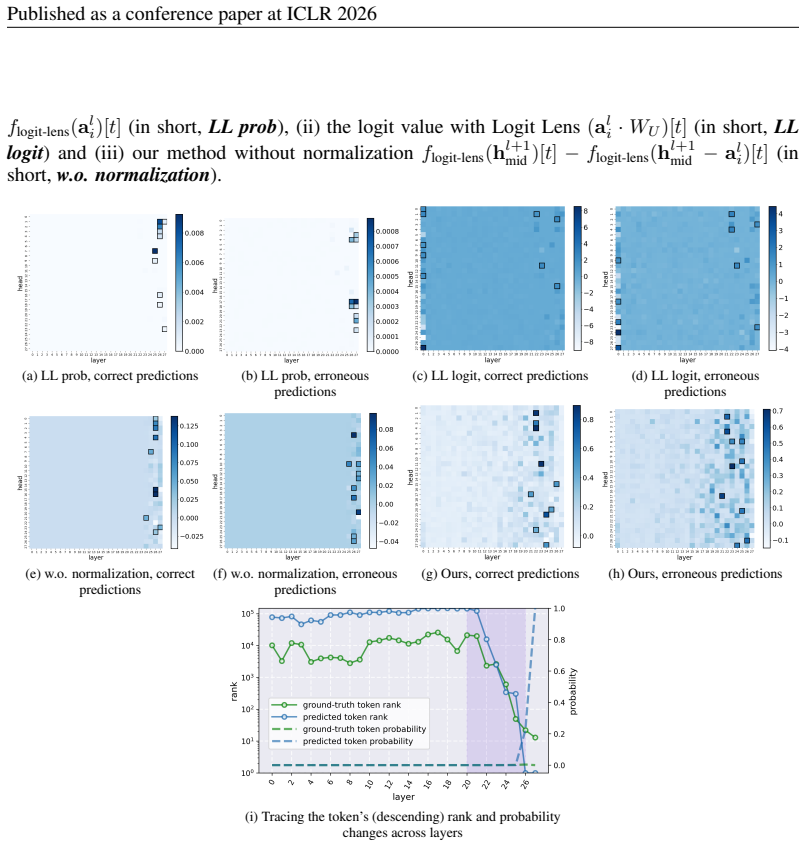
Errors in reasoning hop generalization concentrate at particular token positions due to internal competition among attention heads. A subset of these heads, termed erroneous processing heads, tip the balance toward incorrect reasoning paths. Selectively removing these heads at inference time restores correct predictions, and a dynamic test-time correction procedure that identifies and deactivates them improves generalization without retraining.
What carries the argument
Erroneous processing heads (ep heads): specific attention heads that amplify incorrect reasoning trajectories while suppressing correct ones during multi-hop inference.
If this is right
- Errors concentrate at token positions of a few critical types rather than spreading uniformly across the sequence.
- Individual removal of erroneous processing heads during inference often restores correct predictions.
- Dynamic identification and deactivation of these heads at test time improves hop generalization across multiple domains and models.
- The intervention requires no retraining or changes to model architecture.
Where Pith is reading between the lines
- Hop generalization failures may stem from specific internal mechanisms rather than a broad limit on the model's ability to handle longer chains.
- Similar head-level interventions could apply to other out-of-distribution scenarios in language models.
- Training procedures might be adjusted to reduce specialization of heads on particular hop lengths.
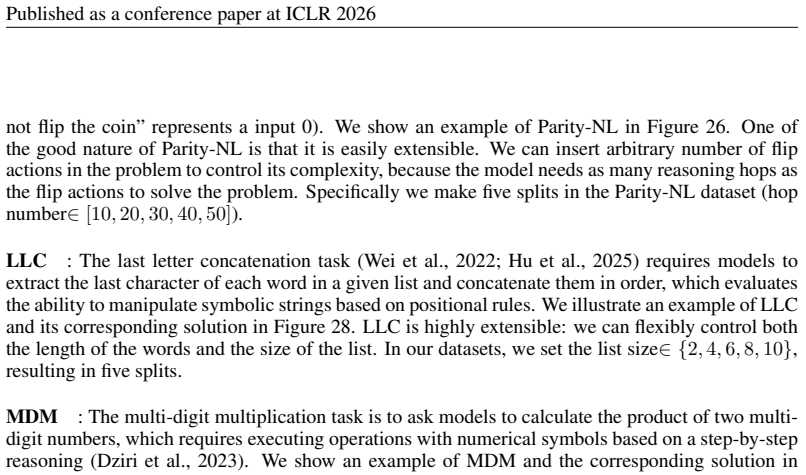
- These heads may play roles in other tasks, so selective deactivation requires care to avoid side effects.
Load-bearing premise
The identified erroneous processing heads are causally responsible for the generalization failures and can be accurately detected and deactivated at test time without harming other capabilities.
What would settle it
An experiment showing that deactivating the identified heads fails to restore correct predictions on out-of-distribution hops or reduces accuracy on standard in-distribution reasoning tasks would falsify the claim.
Figures










read the original abstract
Chain-of-thought (CoT) reasoning has become the standard paradigm for enabling Large Language Models (LLMs) to solve complex problems. However, recent studies reveal a sharp performance drop in reasoning hop generalization scenarios, where the required number of reasoning steps exceeds training distributions while the underlying algorithm remains unchanged. The internal mechanisms driving this failure remain poorly understood. In this work, we conduct a systematic study on tasks from multiple domains, and find that errors concentrate at token positions of a few critical error types, rather than being uniformly distributed. Closer inspection reveals that these token-level erroneous predictions stem from internal competition mechanisms: certain attention heads, termed erroneous processing heads (ep heads), tip the balance by amplifying incorrect reasoning trajectories while suppressing correct ones. Notably, removing individual ep heads during inference can often restore the correct predictions. Motivated by these insights, we propose test-time correction of reasoning, a lightweight intervention method that dynamically identifies and deactivates ep heads in the reasoning process. Extensive experiments across different tasks and LLMs show that it consistently improves reasoning hop generalization, highlighting both its effectiveness and potential.
Editorial analysis
A structured set of objections, weighed in public.
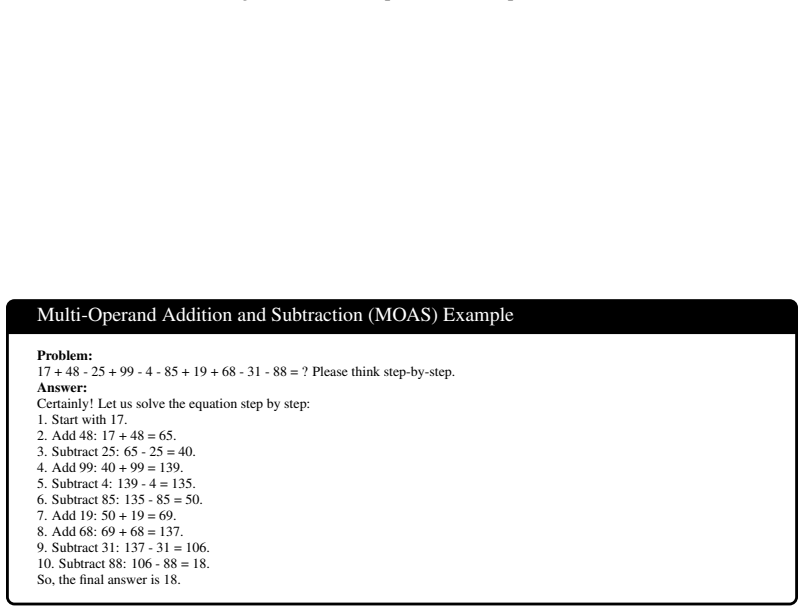
Referee Report
Summary. The paper claims that LLM failures in chain-of-thought reasoning hop generalization arise because errors concentrate at specific token positions due to a small set of erroneous processing heads (ep heads) that amplify incorrect trajectories while suppressing correct ones. It shows that removing individual ep heads at inference often restores correct predictions and proposes a lightweight test-time correction method that dynamically identifies and deactivates these heads, reporting consistent gains across multiple tasks and models.
Significance. If the causal role of the identified ep heads holds after proper controls, the work supplies a mechanistic account of a well-documented limitation in CoT reasoning and a practical, training-free intervention that could improve out-of-distribution hop performance. The systematic experiments across tasks and models constitute a strength, though the absence of isolating controls limits the strength of the causal interpretation.
major comments (2)
- [Experimental results] Experimental results (as summarized in the abstract): the central claim that ep-head deactivation specifically corrects hop-generalization failures is not isolated from generic intervention effects. No ablation results are reported for an equal number of randomly selected heads or non-ep heads, nor are in-distribution task degradations or unrelated capability impacts quantified, leaving the causality correlational rather than demonstrated.
- [Method] Head-identification procedure (abstract and method description): the criteria used to designate ep heads, including any thresholds, token-position error concentration metrics, or statistical tests, are not specified in sufficient detail. This detail is load-bearing for both the mechanistic interpretation and the reproducibility of the proposed test-time correction.
minor comments (1)
- [Abstract] The abstract introduces 'reasoning hop generalization' without a concise definition; adding one sentence would improve accessibility.
Simulated Author's Rebuttal
We thank the referee for the constructive feedback. We agree that stronger controls and more precise methodological details are needed to support the causal claims and ensure reproducibility. We will revise the manuscript accordingly.
read point-by-point responses
-
Referee: [Experimental results] Experimental results (as summarized in the abstract): the central claim that ep-head deactivation specifically corrects hop-generalization failures is not isolated from generic intervention effects. No ablation results are reported for an equal number of randomly selected heads or non-ep heads, nor are in-distribution task degradations or unrelated capability impacts quantified, leaving the causality correlational rather than demonstrated.
Authors: We acknowledge that the current experiments leave the specificity of ep-head deactivation correlational. In the revised version we will add controlled ablations that deactivate an equal number of randomly chosen heads and non-ep heads, and we will report performance on in-distribution versions of the tasks plus unrelated capabilities to quantify any generic degradation. These results will be presented in a new subsection of the experiments. revision: yes
-
Referee: [Method] Head-identification procedure (abstract and method description): the criteria used to designate ep heads, including any thresholds, token-position error concentration metrics, or statistical tests, are not specified in sufficient detail. This detail is load-bearing for both the mechanistic interpretation and the reproducibility of the proposed test-time correction.
Authors: We agree that the identification criteria must be stated explicitly. The revision will expand the Methods section to define the precise token-position error concentration metric, the numerical thresholds applied to select ep heads, and the statistical tests used to validate their significance. These details will also be accompanied by pseudocode for the dynamic deactivation procedure. revision: yes
Circularity Check
No circularity: empirical intervention study on LLM attention heads
full rationale
The paper performs systematic empirical analysis of token-level errors in chain-of-thought reasoning across multiple domains and models. It identifies patterns in attention heads through direct observation and ablation experiments, then proposes a test-time deactivation method. No mathematical derivations, equations, or parameter-fitting steps are described that would reduce any claimed prediction or result to its own inputs by construction. The central claims rest on experimental outcomes rather than self-definitional mappings, fitted inputs renamed as predictions, or load-bearing self-citations. This is a standard non-circular empirical investigation.
Axiom & Free-Parameter Ledger
free parameters (1)
- ep-head identification threshold or criterion
axioms (1)
- domain assumption Individual attention heads can be deactivated at inference time without collapsing overall model capability
invented entities (1)
-
erroneous processing heads (ep heads)
no independent evidence
Lean theorems connected to this paper
-
IndisputableMonolith/Cost/FunctionalEquation.leanwashburn_uniqueness_aczel unclear?
unclearRelation between the paper passage and the cited Recognition theorem.
certain attention heads, termed erroneous processing heads (ep heads), tip the balance by amplifying incorrect reasoning trajectories while suppressing correct ones. Notably, removing individual ep heads during inference can often restore the correct predictions.
-
IndisputableMonolith/Foundation/ArithmeticFromLogic.leanLogicNat recovery theorem unclear?
unclearRelation between the paper passage and the cited Recognition theorem.
we propose test-time correction of reasoning, a lightweight intervention method that dynamically identifies and deactivates ep heads
What do these tags mean?
- matches
- The paper's claim is directly supported by a theorem in the formal canon.
- supports
- The theorem supports part of the paper's argument, but the paper may add assumptions or extra steps.
- extends
- The paper goes beyond the formal theorem; the theorem is a base layer rather than the whole result.
- uses
- The paper appears to rely on the theorem as machinery.
- contradicts
- The paper's claim conflicts with a theorem or certificate in the canon.
- unclear
- Pith found a possible connection, but the passage is too broad, indirect, or ambiguous to say the theorem truly supports the claim.
Reference graph
Works this paper leans on
-
[1]
DeepSeek-R1: Incentivizing Reasoning Capability in LLMs via Reinforcement Learning
URLhttps://arxiv.org/abs/2501.12948. Ronald B. Dekker, Fabian Otto, and Christopher Summerfield. Curriculum learning for hu- man compositional generalization.Proceedings of the National Academy of Sciences, 119(41): e2205582119, 2022. doi: 10.1073/pnas.2205582119. URLhttps://www.pnas.org/doi/ abs/10.1073/pnas.2205582119. Subhabrata Dutta, Joykirat Singh, ...
work page internal anchor Pith review Pith/arXiv arXiv doi:10.1073/pnas.2205582119 2022
-
[2]
https://transformer-circuits.pub/2021/framework/index.html. Ekaterina Fadeeva, Aleksandr Rubashevskii, Artem Shelmanov, Sergey Petrakov, Haonan Li, Hamdy Mubarak, Evgenii Tsymbalov, Gleb Kuzmin, Alexander Panchenko, Timothy Baldwin, Preslav Nakov, and Maxim Panov. Fact-checking the output of large language models via token- level uncertainty quantificatio...
-
[3]
URLhttps://openreview.net/forum?id=AjXkRZIvjB. nostalgebraist. interpreting gpt: the logit lens.https://www.lesswrong.com/posts/ AcKRB8wDpdaN6v6ru/interpreting-gpt-the-logit-lens, 2020. Oscar Obeso, Andy Arditi, Javier Ferrando, Joshua Freeman, Cameron Holmes, and Neel Nanda. Real-time detection of hallucinated entities in long-form generation, 2025. URLh...
-
[4]
URLhttps://proceedings.neurips.cc/paper_files/paper/2022/ file/9d5609613524ecf4f15af0f7b31abca4-Paper-Conference.pdf. Changnan Xiao and Bing Liu. Generalizing reasoning problems to longer lengths. InThe Thirteenth International Conference on Learning Representations, 2025. Shaotian Yan, Chen Shen, Wenxiao Wang, Liang Xie, Junjie Liu, and Jieping Ye. Don’t...
-
[5]
doi: 10.18653/v1/2024.acl-long.550
Association for Computational Linguistics. doi: 10.18653/v1/2024.acl-long.550. URL https://aclanthology.org/2024.acl-long.550/. Xinhao Yao, Ruifeng Ren, Yun Liao, and Yong Liu. Unveiling the mechanisms of explicit cot train- ing: How chain-of-thought enhances reasoning generalization.arXiv preprint arXiv:2502.04667, 2025. Tian Ye, Zicheng Xu, Yuanzhi Li, ...
-
[6]
TokUR: Token-Level Uncertainty Estimation for Large Language Model Reasoning
URLhttps://aclanthology.org/2024.emnlp-main.191/. Tunyu Zhang, Haizhou Shi, Yibin Wang, Hengyi Wang, Xiaoxiao He, Zhuowei Li, Haoxian Chen, Ligong Han, Kai Xu, Huan Zhang, Dimitris Metaxas, and Hao Wang. Tokur: Token-level un- certainty estimation for large language model reasoning, 2025a. URLhttps://arxiv.org/ abs/2505.11737. 16 Published as a conference...
work page internal anchor Pith review Pith/arXiv arXiv doi:10.18653/v1/2025.acl-long.880 2024
-
[7]
in the Qwen2.5-7B- Instruct model on the predictions at the token positions of Parity-NL error type 2. We show the results of10originally erroneously predictedsamples accompanied with the inspecting results after intervention the model (i.e., knocking out an erroneous processing heada 0
-
[8]
in Figure 14, Figure 20 and Figure 21. F.4 ADDITIONALRESULTS ABOUTLOCATING ANDANALYZINGPROCESSINGHEADS We show the locating results of erroneous processing heads (i.e.,ep heads) and the effects of knock- ing out individual heads on correcting the erroneous prediction (i.e., the probabilities of predicting ground-truth tokens) with four models and all seve...
work page 2026
-
[9]
The coin starts heads up
- [10]
- [11]
- [12]
- [13]
- [14]
- [15]
- [16]
- [17]
- [18]
-
[19]
garden sound valid potato numb write tiger truth sound hotel
Ethan flips the coin. (Coin becomes heads up.) After going through each step, we see that the coin ends up heads up after the last flip by Ethan. Therefore, the coin is heads up. Figure 26: An example of the Parity-NL problem. Multi-Digit Multiplication (MDM) Example Problem: 326 * 3589 =? please think step-by-step. Answer: Let’s break down the multiplica...
work page 2026
-
[20]
The current concatenating result is ‘n’
The last letter of ‘garden’ is ‘n’. The current concatenating result is ‘n’
-
[21]
The current concatenating result is ‘nd’
The last letter of ‘sound’ is ‘d’. The current concatenating result is ‘nd’
-
[22]
The current concatenating result is ‘ndd’
The last letter of ‘valid’ is ‘d’. The current concatenating result is ‘ndd’
-
[23]
The current concatenating result is ‘nddo’
The last letter of ‘potato’ is ‘o’. The current concatenating result is ‘nddo’
-
[24]
The current concatenating result is ‘nddob’
The last letter of ‘numb’ is ‘b’. The current concatenating result is ‘nddob’
-
[25]
The current concatenating result is ‘nddobe’
The last letter of ‘write’ is ‘e’. The current concatenating result is ‘nddobe’
-
[26]
The current concatenating result is ‘nddober’
The last letter of ‘tiger’ is ‘r’. The current concatenating result is ‘nddober’
-
[27]
The current concatenating result is ‘nddoberh’
The last letter of ‘truth’ is ‘h’. The current concatenating result is ‘nddoberh’
-
[28]
The current concatenating result is ‘nddoberhd’
The last letter of ‘sound’ is ‘d’. The current concatenating result is ‘nddoberhd’
-
[29]
The current concatenating result is ‘nddoberhdl’
The last letter of ‘hotel’ is ‘l’. The current concatenating result is ‘nddoberhdl’. Therefore, the answer is ‘nddoberhdl’. Figure 28: An example of the LLC problem. Multi-Operand Addition and Subtraction (MOAS) Example Problem: 17 + 48 - 25 + 99 - 4 - 85 + 19 + 68 - 31 - 88 = ? Please think step-by-step. Answer: Certainly! Let us solve the equation step by step:
-
[30]
Add 48: 17 + 48 = 65
-
[31]
Subtract 25: 65 - 25 = 40
-
[32]
Add 99: 40 + 99 = 139
-
[33]
Subtract 4: 139 - 4 = 135
-
[34]
Subtract 85: 135 - 85 = 50
-
[35]
Add 19: 50 + 19 = 69
-
[36]
Add 68: 69 + 68 = 137
-
[37]
Subtract 31: 137 - 31 = 106
-
[38]
logs = [‘d1/’, ‘d2/’, ‘../’, ‘d2/’, ‘d3/’, ‘./’, ‘../’, ‘d3/’, ‘d4/’, ‘./’]
Subtract 88: 106 - 88 = 18. So, the final answer is 18. Figure 29: An example of the MOAS problem. 48 Published as a conference paper at ICLR 2026 Crawler Log Folder (CLF) Example Python code: def min operations(logs): folder depth = 0 for operation in logs: if operation == ‘../’: folder depth = max(0, folder depth - 1) elif operation != ‘./’: folder dept...
work page 2026
-
[40]
**Operation ‘d1/’**: folder depth = folder depth + 1 = 0 + 1 = 1
-
[43]
**Operation ‘d2/’**: folder depth = folder depth + 1 = 1 + 1 = 2
- [45]
-
[46]
**Operation ‘../’**: folder depth = max(0, folder depth - 1) = max(0, 2) = 2
-
[47]
**Operation ‘d3/’**: folder depth = folder depth + 1 = 2 + 1 = 3
-
[48]
**Operation ‘d4’**: folder depth = folder depth + 1 = 3 + 1 = 4
-
[49]
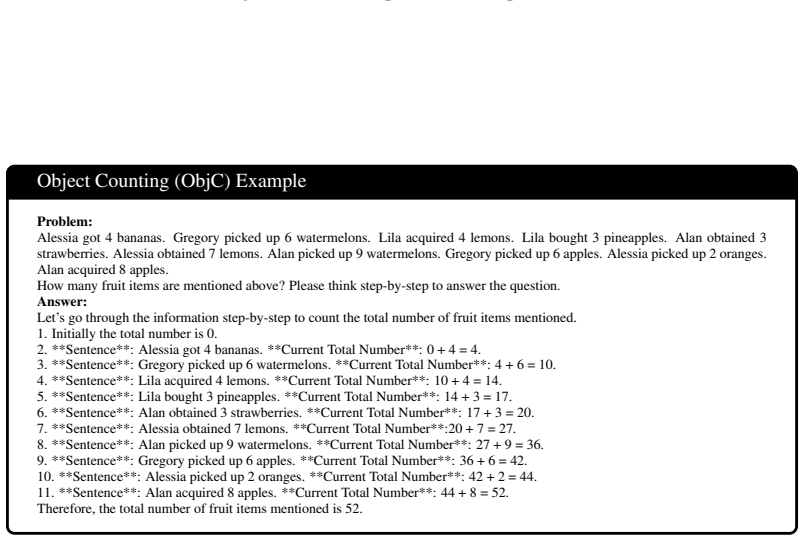
**Operation ‘./’**: folder depth = 4. (no change) Therefore, the final return value (folder depth) for the “min operation()” function with the input “logs” is 4. So the answer is 4. Figure 30: An example of the CLF problem. Object Counting (ObjC) Example Problem: Alessia got 4 bananas. Gregory picked up 6 watermelons. Lila acquired 4 lemons. Lila bought 3...
-
[51]
**Current Total Number**: 0 + 4 = 4
**Sentence**: Alessia got 4 bananas. **Current Total Number**: 0 + 4 = 4
-
[52]
**Current Total Number**: 4 + 6 = 10
**Sentence**: Gregory picked up 6 watermelons. **Current Total Number**: 4 + 6 = 10
-
[53]
**Current Total Number**: 10 + 4 = 14
**Sentence**: Lila acquired 4 lemons. **Current Total Number**: 10 + 4 = 14
-
[54]
**Current Total Number**: 14 + 3 = 17
**Sentence**: Lila bought 3 pineapples. **Current Total Number**: 14 + 3 = 17
-
[55]
**Current Total Number**: 17 + 3 = 20
**Sentence**: Alan obtained 3 strawberries. **Current Total Number**: 17 + 3 = 20
-
[56]
**Current Total Number**:20 + 7 = 27
**Sentence**: Alessia obtained 7 lemons. **Current Total Number**:20 + 7 = 27
-
[57]
**Current Total Number**: 27 + 9 = 36
**Sentence**: Alan picked up 9 watermelons. **Current Total Number**: 27 + 9 = 36
-
[58]
**Current Total Number**: 36 + 6 = 42
**Sentence**: Gregory picked up 6 apples. **Current Total Number**: 36 + 6 = 42
-
[59]
**Current Total Number**: 42 + 2 = 44
**Sentence**: Alessia picked up 2 oranges. **Current Total Number**: 42 + 2 = 44
-
[60]
**Current Total Number**: 44 + 8 = 52
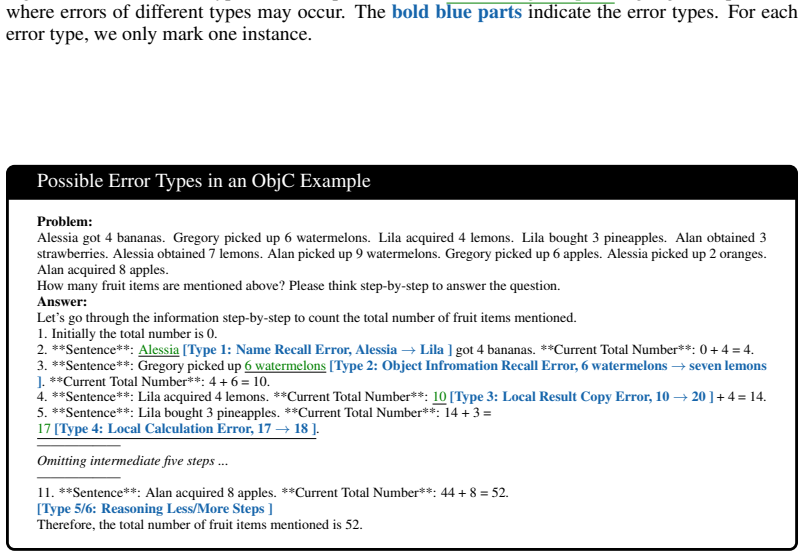
**Sentence**: Alan acquired 8 apples. **Current Total Number**: 44 + 8 = 52. Therefore, the total number of fruit items mentioned is 52. Figure 31: An example of the ObjC problem. 49 Published as a conference paper at ICLR 2026 Number Student (NumS) Example Python code: def solution(startTime: List[int], endTime: List[int], queryTime: int): count = 0 for ...
work page 2026
-
[61]
**range**: [1, 4], 4 is within this range
startTime[0] = 1, endTime[0] = 4. **range**: [1, 4], 4 is within this range. **count**: 0 + 1 = 1
-
[62]
**range**: [2, 8], 4 is within this range
startTime[1] = 2, endTime[1] = 8. **range**: [2, 8], 4 is within this range. **count**: 1 + 1 = 2
-
[63]
**range**: [3, 5], 4 is within this range
startTime[2] = 3, endTime[2] = 5. **range**: [3, 5], 4 is within this range. **count**: 2 + 1 = 3
-
[64]
**range**: [4, 5], 4 is within this range
startTime[3] = 4, endTime[3] = 5. **range**: [4, 5], 4 is within this range. **count**: 3 + 1 = 4
-
[65]
**range**: [6, 9,] 4 is not within this range
startTime[4] = 6, endTime[4] = 9. **range**: [6, 9,] 4 is not within this range. **count**: 4
-
[66]
**range**: [2, 5], 4 is within this range
startTime[5] = 2, endTime[5] = 5. **range**: [2, 5], 4 is within this range. **count**: 4 + 1 = 5
-
[67]
**range**: [5, 7], 4 is not within this range
startTime[6] = 5, endTime[6] = 7. **range**: [5, 7], 4 is not within this range. **count**: 5
-
[68]
**range**: [1, 3], 4 is not within this range
startTime[7] = 1, endTime[7] = 3. **range**: [1, 3], 4 is not within this range. **count**: 5
-
[69]
**range**: [2, 4], 4 is within this range
startTime[8] = 2, endTime[8] = 4. **range**: [2, 4], 4 is within this range. **count**: 5 + 1 = 6
-
[70]
garden sound valid potato numb write tiger truth sound hotel
startTime[9] = 4, endTime[9] = 9. **range**: [4, 9], 4 is within this range. **count**: 6 + 1 = 7. After checking all events, the function returns the final count, which is 7. Figure 32: An example of the NumS problem. Possible Error Types in a LLC Example Problem: Take the last letters of the words in “garden sound valid potato numb write tiger truth sou...
-
[71]
The current concatenating result is ‘n’
The last letter of ‘garden’[Type 1: Word Recall Error, ‘garden’→‘valid’ ]is ‘n’. The current concatenating result is ‘n’
-
[72]
The current concatenating result is ‘nd’
The last letter of ‘sound’ is ‘d’[Type 2: Letter Error, ‘d’→‘n’ ]. The current concatenating result is ‘nd’
-
[73]
The current concatenating result is ‘ndd’[Type 3: Concatenation Error, ‘ndd’→‘dnd’ ]
The last letter of ‘valid’ is ‘d’. The current concatenating result is ‘ndd’[Type 3: Concatenation Error, ‘ndd’→‘dnd’ ]. —————— Omitting intermediate six steps ... ——————
-
[74]
The current concatenating result is ‘nddoberhdl’
The last letter of ‘hotel’ is ‘l’. The current concatenating result is ‘nddoberhdl’. [Type 4/5: Reasoning Less/More Steps ] Therefore, the answer is ‘nddoberhdl’. Figure 33: Possible error types in a LLC problem. The underline green parts highlight the positions where errors of different types may occur. Thebold blue partsindicate the error types. For eac...
-
[75]
Start with 17 [Type 1: Operand Recall Error, 17→48 ]
-
[76]
Add 48 [Type 2: Operation Recall Error, Add 48→Subtract 31 ]: 17 + 48 = 65
-
[77]
Subtract 25: 65 [Type 3: Local Result Copy Error, 65→35 ]- [Type 4: Operand Interpretation Error, -→+ ]25 = 40
-
[78]
—————— Omitting intermediate five steps
Add 99: 40 + 99 = 139 [Type 5: Local Calculation Error, 139→129 ]. —————— Omitting intermediate five steps ... ——————
-
[79]
logs = [‘d1/’, ‘d2/’, ‘../’, ‘d2/’, ‘d3/’, ‘./’, ‘../’, ‘d3/’, ‘d4/’, ‘./’]
Subtract 88: 106 - 88 = 18. [Type 6/7: Reasoning Less/More Steps ] So, the final answer is 18. Figure 34: Possible error types in a MOAS problem. The underline green parts highlight the posi- tions where errors of different types may occur. Thebold blue partsindicate the error types. For each error type, we only mark one instance. 50 Published as a confer...
work page 2026
-
[80]
**Initial state:** folder depth = 0
-
[81]
**Operation ‘d1/’[Type 1: Operation Recall Error, ‘d1/’→‘d2/’ ]**: folder depth = folder depth + 1 = 0 + 1 = 1
-
[82]
**Operation ‘d2/’**: folder depth = folder depth + 1 = 1 [Type 2: Depth Copy Error, 1→0 ]+ 1 = 2
-
[83]
**Operation ‘../’**: folder depth = max(0, folder depth - 1) = max(0, 1) = 1
-
[84]
—————— Omitting intermediate five steps
**Operation ‘d2/’**: folder depth = folder depth + 1 = 1 + 1 = 2 [Type 3: Local Calculation Error, 2→1 ]. —————— Omitting intermediate five steps ... ——————
-
[85]
**Operation ‘./’**: folder depth = 4. (no change) [Type 4/5: Reasoning Less/More Steps ] Therefore, the final return value (folder depth) for the “min operation()” function with the input “logs” is 4 [Type 6: Final Depth Copy Error, 4→3 ]. So the answer is 4. Figure 35: Possible error types in a CLF problem. The underline green parts highlight the positio...
discussion (0)
Sign in with ORCID, Apple, or X to comment. Anyone can read and Pith papers without signing in.