REVIEW 4 major objections 6 minor 2 cited by
PCBSchemaGen turns a frozen LLM into a PCB schematic designer by pairing it with a datasheet-derived knowledge graph verifier, lifting Gemini-3-Flash's Pass@1 to 88.1% on a 23-task benchmark.
Reviewed by Pith at T0; open to challenge. T0 means a machine referee read the full paper against a public rubric. the ladder, T0–T4 →
T0 review · deepseek-v4-flash
2026-08-03 05:59 UTC pith:FETJ565M
load-bearing objection The body is a plausible new LLM+KG+subgraph-isomorphism framework for PCB schematic generation, but the submitted abstract describes a different paper and the verifier's completeness/tightness is unproven — reconcile versions before review. the 4 major comments →
PCBSchemaGen: Reward-Guided LLM Code Synthesis for Printed Circuit Boards (PCB) Schematic Design with Structured Verification
The pith
A machine-rendered reading of the paper's core claim, the machinery that carries it, and where it could break.
Core claim
The paper claims that PCB schematic generation from natural language can be automated without fine-tuning when LLM proposals are grounded in a Knowledge Graph extracted from IC datasheets and verified through a multi-stage pipeline of syntax/ERC checks, pin-role constraints, and subgraph-isomorphism topology matching. The key asymmetric finding is that the open-weight 31B model stays competitive when the same framework is moved to a held-out benchmark with frozen verifier and prompts, while an inference-time prompting baseline 'collapses.' The verifier's job is to provide interpretable, pin-level error messages that the LLM uses to repair its own code over up to three retry rounds.
What carries the argument
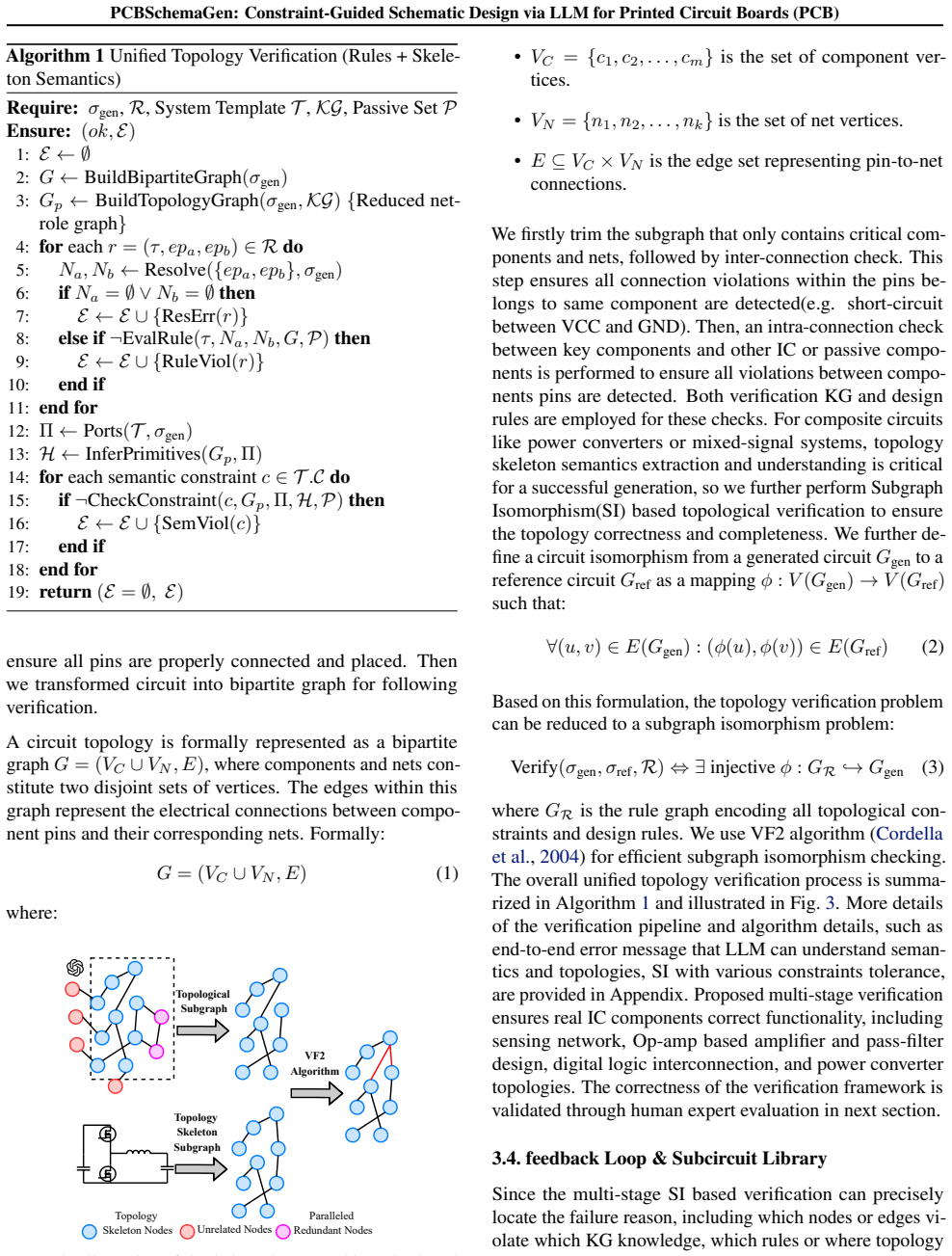
The central object is the unified topology verifier combining a datasheet-derived Knowledge Graph (KG) of 36 pin-role types and four constraint types with a Subgraph Isomorphism (SI) check (Algorithm 1 and Eq. (3)). The KG compresses a ~16k-token datasheet to ~300 tokens, maps vendor pin names to semantic roles, and encodes rules like 'supply pair not shorted.' The SI step compares the generated circuit's reduced net-role graph against expert-defined topology skeletons using the VF2 algorithm, allowing tolerance for redundant components while preserving core structure. This verifier returns pin-level failure messages that drive the Thompson-Sampling bandit (in the abstract) and a three-retry
Load-bearing premise
The entire evaluation rests on the assumption that the expert-authored rule graphs and topology skeletons are both complete and tight for every task: every correct design satisfies them, and every design that satisfies them is electrically correct. If a skeleton is too permissive, the verifier will certify wrong schematics and inflate Pass@1; if too strict, valid design variants are rejected.
What would settle it
Run a blind study with several independent PCB engineers (not the authors) on a broader set of designs—including designs the verifier marks PASS that were generated with deliberately seeded subtle errors (e.g., swapped sense inputs, missing bootstrap capacitor, wrong Kelvin-source net)—and measure whether the verifier's PASS/FAIL decisions still match expert judgment at kappa > 0.89. A single PASS design that an expert calls electrically wrong would falsify the completeness assumption.
If this is right
- If the central claim holds, PCB schematic entry could shift from months-long manual iteration to LLM proposal plus deterministic verification, cutting a representative task from ~1.5 hours of expert time to ~2.4 minutes and ~$0.07 in tokens.
- A deterministic structural verifier, not a simulator or unit test, can serve as the reward oracle for reference-free code synthesis in domains where correctness is defined by physical constraints.
- The framework's transfer across two benchmarks with zero verifier code changes suggests the KG/SI verifier is domain-general across board-level analog, digital, and power design, rather than tuned to a single task set.
- Interpretable error localization—not just pass/fail or error category—is the key to iterative self-repair, with Full feedback lifting overall Pass@1 from 64.9% (binary) to 88.1%.
- Because the framework is training-free, new ICs can be added to the library by encoding their datasheet into the KG, avoiding the cold-start data collection that fine-tuning would require.
Where Pith is reading between the lines
- Editorial inference: The verifier's agreement with experts is only as good as the rule graphs and topology skeletons it encodes; the paper's human-evaluation protocol itself is the only direct probe of that completeness. A larger, non-balanced sample across a wider range of design variants would be a natural next test.
- Editorial inference: The framework's claim that structural verification is a general recipe could be tested by applying the same KG+SI + feedback loop to adjacent domains without unit-test oracles, such as analog filter design, wiring harness design, or even fluid/pneumatic schematics.
- Editorial inference: The negative transfer result for semantic-embedding subcircuit retrieval (reported in the appendix) suggests an implicit design principle: for circuit synthesis, retrievers should match on topology, not on natural-language similarity. This is a lesson the authors state only via the ablation, not as a headline claim.
- Editorial inference: The 'first training-free framework' claim depends on how one reads prior LLM Verilog or analog work; the more durable contribution is the verifier-as-oracle pattern, which stands even if the 'first' is challenged.
Editorial analysis
A structured set of objections, weighed in public.
Referee Report
Summary. The body of this submission presents PCBSchemaGen, a training-free inference-time framework that asks a frozen LLM to generate SKiDL code for PCB schematics and then verifies that code with a multi-stage pipeline: syntax/ERC checks, a datasheet-derived Knowledge Graph over pin roles and constraints, and subgraph-isomorphism checks against expert-authored topology skeletons (Algorithm 1, Eq. 3). Iterative feedback from the verifier is fed back to the LLM at three granularities. On a new author-created benchmark of 23 tasks spanning sensing, drivers, power stages, and converters, the authors report Pass@1 values across nine LLMs, with Gemini-3-Flash best at 88.1%, and a human-expert blind agreement study (N=460, kappa=0.913). They claim the first training-free framework for PCB schematic automation and significant gains over baselines. The submitted abstract, however, describes a different framework/verifier, a different benchmark scale, and different headline numbers (Gemma-4-31B passing 81.3% of 227 tasks on two benchmarks).
Significance. If the body's claims hold, the contribution is notable: a frozen LLM plus deterministic structural verification plus localized feedback can synthesize PCB schematics at a level that human experts largely endorse, without per-task golden netlists. The KG/SI verifier, the 23-task benchmark, and the open-source release are useful community assets, and the interpretable feedback loop is a practical idea. The main qualifications are that the verifier is not proven complete or tight, and the manuscript as submitted is internally split between two different narratives; the empirical evaluation therefore cannot yet be taken at face value.
major comments (4)
- [Abstract vs. Sections 3–4] The submitted abstract and title describe a 'reward-guided' framework with a 5-layer continuous-reward verifier, Thompson sampling, 227 tasks across two benchmarks, Gemma-4-31B at 81.3%, and a held-out PCBBench generalization test. The body (Sections 3.2–3.4, Tables 1–2) implements a deterministic KG+SI verifier, evaluates 23 tasks on nine LLMs, and reports 88.1% for Gemini-3-Flash. These are irreconcilable versions of the same paper. Because the claims as submitted cannot be verified against the presented experiments, the authors must align title, abstract, and body to a single consistent framework and artifact before the paper can be evaluated.
- [Section 3.3 / Eq. (3) / Appendix A.11] Algorithm 1 and Eq. (3) reduce correctness to subgraph isomorphism against expert-authored rule graphs and topology skeletons, but no formal argument establishes that these rules are complete (every correct design satisfies them) or tight (every satisfying design is electrically correct). The only direct evidence, Appendix A.11, is a balanced 10-pass/10-fail per-task human review; it measures agreement with the verifier's own partition and does not probe boundary cases or validate electrical behavior. A wrong resistor value or a missing decoupling capacitor tolerated by the skeleton could therefore pass, inflating every Pass@1 in Tables 2, 4, 5, and 17. Please provide an external validity check on both verifier-positive and verifier-negative designs (e.g., expert review or SPICE where applicable), with per-task error rates.
- [Section 3.4 vs. Appendix A.12] Section 3.4 states that a subcircuit library 'enables the reuse of validated sub-circuits' and that abdominal studies confirm that this retrieval mechanism significantly enhances success rates. Appendix A.12, Table 14 reports the opposite on the Hard subset: retrieval lowers overall Pass@1 from 93.3% to 83.8% (Delta = -9.5%), with negative transfer on P18 and P23. The main text and appendix cannot both be true. This is a central contribution claim and must be reconciled, either by removing the claim or by reporting the conditions under which retrieval helps.
- [Section 4.1–4.2 / Appendix A.10] All Pass@1 numbers are computed from n=15 trials per task, but no per-task confidence intervals are reported; A.10's Wilson-interval justification is not applied to the tables. Consequently, small headline differences such as Gemini-3-Flash at 88.1% vs Gemini-3-Pro at 86.1% are within sampling noise, and many per-task zeros (e.g., Task 21) are reported without uncertainty. Additionally, Table 3 compares baselines only on Easy tasks and reports N/A for Medium and Hard, so the broad claim of outperforming CircuitLM/GNN is under-supported. Add per-task confidence intervals and evaluate baselines on the same task distribution.
minor comments (6)
- [Section 3.2 vs. Appendix A.6] The Knowledge Graph definition states 36 pin role types, while A.6 and Table 8 list 34 roles. Please make the count consistent.
- [Table 1 vs. Table 6] Task 9 is labeled 'TO-247-3 MOSFET half-bridge power stage' in Table 1 but 'TO-247-4 SiC MOSFET half-bridge stage' in Table 6. Clarify the package.
- [Page 1] There are typos: 'efficiency. efficiency.' is duplicated and 'deign' should be 'design'.
- [Figure 2] The caption/legend repeats 'Max Retry: 3' twice. Clean up the duplicate.
- [Appendix A.10] Eq. (4) should explicitly define p-hat and state that z=1.645 corresponds to a 90% confidence level; the text currently mentions this only informally.
- [Appendices A.2–A.3] The same prompt text is repeated over several pages. Consolidate to a single prompt template and note the placeholders.
Circularity Check
No significant circularity; verifier is internally defined but independently checked against human experts.
full rationale
The paper's derivation chain is: (1) LLMs propose SKiDL code; (2) a multi-stage verifier checks syntax/ERC, KG pin-role constraints, and subgraph isomorphism against expert-authored rule graphs (Eq. 3, Algorithm 1); (3) Pass@k is computed from verifier decisions; (4) the verifier itself is validated against three blinded human experts (Section 4.4, Appendix A.11, κ=0.913, N=460). This structure is not circular in the prohibited sense. The verifier is part of the system under test, so Pass@1 numbers would be self-referential if the verifier's judgment were the only evidence of correctness. But the blind expert agreement study provides independent evidence that the verifier's pass/fail matches expert judgment, breaking the circle. The KG is derived from external IC datasheets rather than from the benchmark answer keys, and apart from the fixed ICL exemplar (which happens to coincide with Task 2), the LLM is not given the per-task golden reference. No fitted parameter is renamed as a prediction, and no load-bearing claim is justified by self-citation or by an imported uniqueness theorem. The abstract/body divergence (Thompson Sampling, PCBBench, 227 tasks vs. the body's 23-task benchmark) is a serious consistency problem but not a circularity step. The human-validation sample design (balanced 10-pass/10-fail per task) is a limitation of the evidence for verifier soundness, not a circularity of the derivation. Therefore no specific reduction to inputs by construction can be exhibited, and the appropriate circularity finding is low.
Axiom & Free-Parameter Ledger
free parameters (3)
- Maximum retry rounds =
3
- Number of trials n =
15
- Sampling temperature =
0.5
axioms (6)
- domain assumption SKiDL code that passes syntax + ERC + KG constraints + SI skeleton checks is a correct PCB schematic.
- ad hoc to paper The expert-authored reference patterns (rule graphs/topology skeletons) cover all acceptable designs for the 23 tasks.
- ad hoc to paper The pin-role ontology (34/36 roles) captures all electrical constraints that matter for these ICs.
- domain assumption Human expert judgment is ground truth for verifier agreement.
- domain assumption n=15 trials with Wilson 90% CI yields significant comparisons.
- domain assumption The LLM samples are independent across trials.
read the original abstract
Most LLM code-synthesis benchmarks rely on unit tests as the reward oracle, but PCB schematic design has none: correctness is defined by structured physical constraints over real IC packages and pin-level assignments, per-task golden references are unavailable, and SPICE simulation does not validate schematic-level correctness. We introduce PCBSchemaGen, a training-free inference-time framework that turns a frozen LLM into a verifiable, repairable PCB schematic generator. The framework induces a domain schema from IC datasheets to ground LLM decoding, pairs it with a deterministic 5-layer continuous-reward verifier with pin-level error localization, and refines candidates through a Thompson Sampling arm-acquiring bandit. We evaluate on 2 PCB benchmarks covering 227 real-IC tasks across 22 unified circuit domains, including a public-schematic-derived suite that serves as a fully held-out generalization test (verifier, KG library, and prompts frozen before any evaluation). Under our framework, an open-weight 31B model (Gemma-4-31B) passes 81.3% of PCBBench tasks on average, and the same framework transfers across both benchmarks with zero verifier code changes; a Circuitron-style inference-time prompting baseline on the same Gemma-4-31B backbone collapses on hard system-level designs. This suggests inference-time refinement under a deterministic structural verifier is a general recipe for reference-free LLM code synthesis in domains without unit-test oracles. Our benchmarks and deterministic verifier are publicly available at https://github.com/HZou9/PCBSchemaGen_v2.
Figures




Forward citations
Cited by 2 Pith papers
-
PCBWorld: A Benchmark Environment for Engine-Grounded PCB Design Automation
An open-source KiCad-grounded PCB routing environment and benchmark where agents interactively route boards via engine-native operations, with a PPO policy trained on synthetic boards achieving zero-shot transfer to r...
-
PCBWorld: A Benchmark Environment for Engine-Grounded PCB Design Automation
Agents that route PCBs through KiCad's native API with design-rule feedback outperform grid-action RL and open-loop LLM baselines, and a synthetic-trained PPO transfers zero-shot to real boards.
Reference graph
Works this paper leans on
-
[5]
Gao, J., Cao, W., and Zhang, X
doi: 10.1109/ICCAD57390.2023.10323953. Gao, J., Cao, W., and Zhang, X. Analoggenie-lite: Enhanc- ing scalability and precision in circuit topology discovery through lightweight graph modeling. InForty-second International Conference on Machine Learning. Gao, J., Cao, W., Yang, J., and Zhang, X. Analoggenie: A generative engine for automatic discovery of a...
arXiv 2023
-
[11]
VIN") outp = Net(
Safety: High voltage ground (GND1) and Low voltage ground (GND2) must be separate. 14 PCBSchemaGen: Constraint-Guided Schematic Design via LLM for Printed Circuit Boards (PCB) Assistant Prompt (For Non-hard tasks only) Continued Step 2 ···python from skidl import * # 1. Define Nets vin = Net("VIN") outp = Net("OUTP") outn = Net("OUTN") vdd1 = Net("VDD1") ...
-
[18]
16 PCBSchemaGen: Constraint-Guided Schematic Design via LLM for Printed Circuit Boards (PCB) A.3
Safety: High voltage ground (GND1) and Low voltage ground (GND2) must be separate. 16 PCBSchemaGen: Constraint-Guided Schematic Design via LLM for Printed Circuit Boards (PCB) A.3. Complete Prompts for Hard Level Tasks User Prompt You aim to design a PCB schematic using SKiDL (Python) for a given circuit described in the text. Please ensure your designed ...
-
[25]
Safety: High voltage ground (GND1) and Low voltage ground (GND2) must be separate. 17 PCBSchemaGen: Constraint-Guided Schematic Design via LLM for Printed Circuit Boards (PCB) User Prompt You aim to design a PCB schematic using SKiDL (Python) for a given circuit described in the text. Please ensure your designed circuit works properly, satisfies the requi...
-
[32]
Safety: High voltage ground (GND1) and Low voltage ground (GND2) must be separate. 18 PCBSchemaGen: Constraint-Guided Schematic Design via LLM for Printed Circuit Boards (PCB) User Prompt You aim to design a PCB schematic using SKiDL (Python) for a given circuit described in the text. Please ensure your designed circuit works properly, satisfies the requi...
-
[39]
Safety: High voltage ground (GND1) and Low voltage ground (GND2) must be separate. 19 PCBSchemaGen: Constraint-Guided Schematic Design via LLM for Printed Circuit Boards (PCB) User Prompt You aim to design a PCB schematic using SKiDL (Python) for a given circuit described in the text. Please ensure your designed circuit works properly, satisfies the requi...
-
[40]
We use a string of resistors (e.g., 3x 100k) and a bottom shunt resistor to form a divider
Divider Network: The 400V input needs to be scaled down. We use a string of resistors (e.g., 3x 100k) and a bottom shunt resistor to form a divider
-
[41]
AMC1350 Connections:
-
[42]
INP/INN: Connect across the bottom shunt resistor
-
[43]
Needs decoupling
VDD1/GND1: High-side floating power. Needs decoupling
-
[44]
Needs decoupling
VDD2/GND2: Low-side system power. Needs decoupling
-
[45]
OUTP/OUTN: Differential output
-
[46]
test", "R
Safety: High voltage ground (GND1) and Low voltage ground (GND2) must be separate. In the basic prompts, we utilize placeholders for the design task, input/output specifications, and component information, which are dynamically populated based on the specific requirements of each task. The component information is provided via JSON files that detail compo...
2026
-
[47]
• Intermediate Format vs
CircuitLM (Multi-Agent LLM Generation)CircuitLM represents the state-of-the-art in using generic LLMs for circuit design, employing RAG and multi-agent collaboration to generate CircuitJSON schematics. • Intermediate Format vs. Engineering Code:CircuitLM generates CircuitJSON, a format primarily designed for web-based visualization rather than industrial ...
-
[48]
• Task Scope Restriction:This method performslink predictionrather than generation
GNN-Optimization (Graph Neural Networks)The GNN baseline (Plettenberg et al., 2025) utilizes supervised learning to predict optimizing components (e.g., decoupling capacitors) in existing graphs. • Task Scope Restriction:This method performslink predictionrather than generation. It relies on a pre-existing partial schematic and cannot synthesize designsta...
2025
-
[2026]
Fu, Y ., Zhang, Y ., Yu, Z., Li, S., Ye, Z., Li, C., Wan, C., and Lin, Y
Accessed: 2026-01-27. Fu, Y ., Zhang, Y ., Yu, Z., Li, S., Ye, Z., Li, C., Wan, C., and Lin, Y . C. Gpt4aigchip: Towards next-generation ai accelerator design automation via large language models. In2023 IEEE/ACM International Conference on Com- puter Aided Design (ICCAD), pp. 1–9, San Francisco, CA, USA, October 2023. IEEE. ISBN 979-8-3503-2225-
2026
-
[2391]
URL https://www.sciencedirect.com/ science/article/pii/S1879239125000566
doi: https://doi.org/10.1016/j.mejo.2025.106607. URL https://www.sciencedirect.com/ science/article/pii/S1879239125000566. Kim, D.-H., Lu, N., Ma, R., Kim, Y .-S., Kim, R.-H., Wang, S., Wu, J., Won, S. M., Tao, H., Islam, A., et al. Epidermal electronics.science, 333(6044):838–843, 2011. Kumar Jha, S., Jha, S., Haq Rashed, M. R., Ewetz, R., and Velasquez,...
arXiv 2025
-
[7309]
Thakur, S., Blocklove, J., Pearce, H., Tan, B., Garg, S., and Karri, R
doi: 10.1145/3736166. Thakur, S., Blocklove, J., Pearce, H., Tan, B., Garg, S., and Karri, R. Autochip: Automating hdl generation using llm feedback, 2023. Thakur, S., Ahmad, B., Pearce, H., Tan, B., Dolan-Gavitt, B., Karri, R., and Garg, S. Verigen: A large language model for verilog code generation.ACM Transactions on Design Automation of Electronic Sys...
Pith/arXiv arXiv 2023
discussion (0)
Sign in with ORCID, Apple, or X to comment. Anyone can read and Pith papers without signing in.