REVIEW 3 major objections 7 minor 98 references
PCBWorld: Agents Route Real Circuit Boards Through KiCad's Native Engine
Reviewed by Pith at T0; open to challenge. T0 means a machine referee read the full paper against a public rubric. the ladder, T0–T4 →
T0 review · glm-5.2
2026-07-08 20:42 UTC pith:OUMEFHAK
load-bearing objection PCBWorld: Environment is the real contribution; headline transfer claim needs CP@1 to be interpretable the 3 major comments →
PCBWorld: A Benchmark Environment for Engine-Grounded PCB Design Automation
The pith
A machine-rendered reading of the paper's core claim, the machinery that carries it, and where it could break.
Core claim
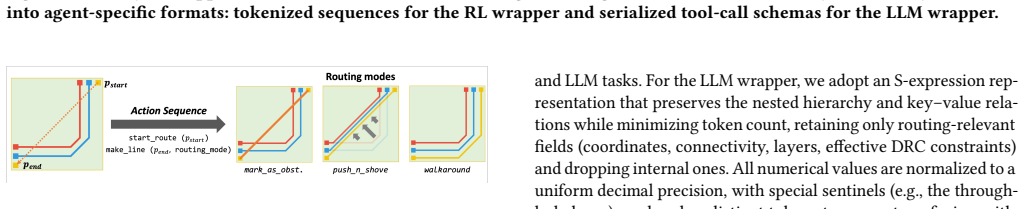
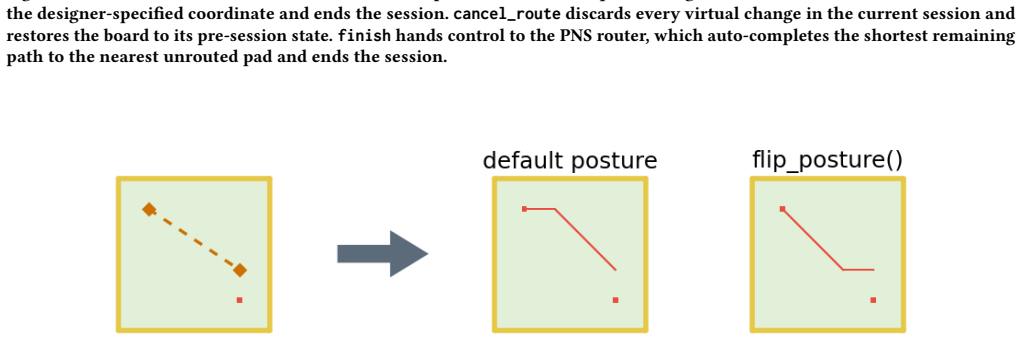
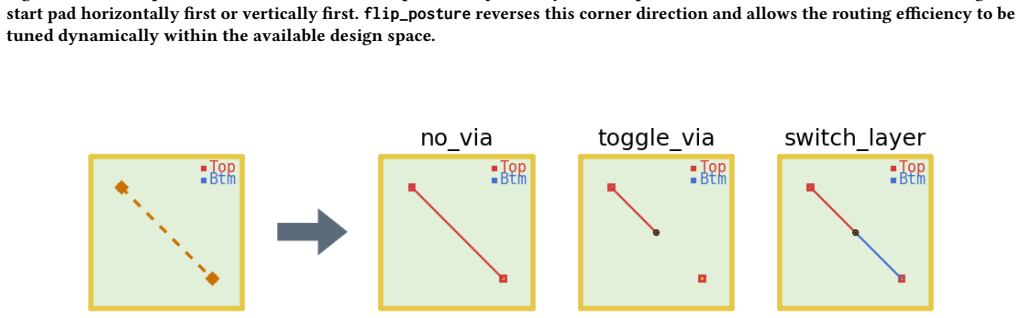
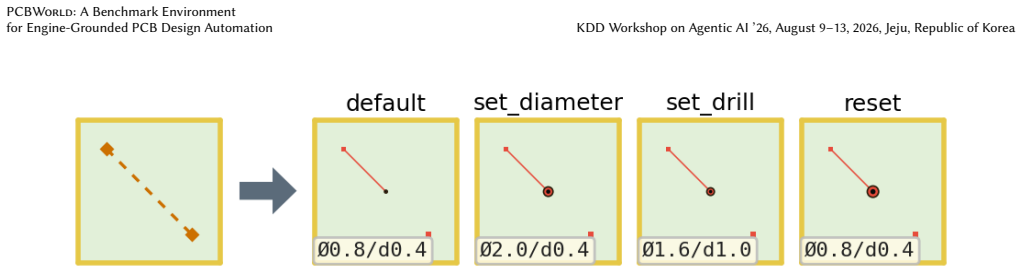
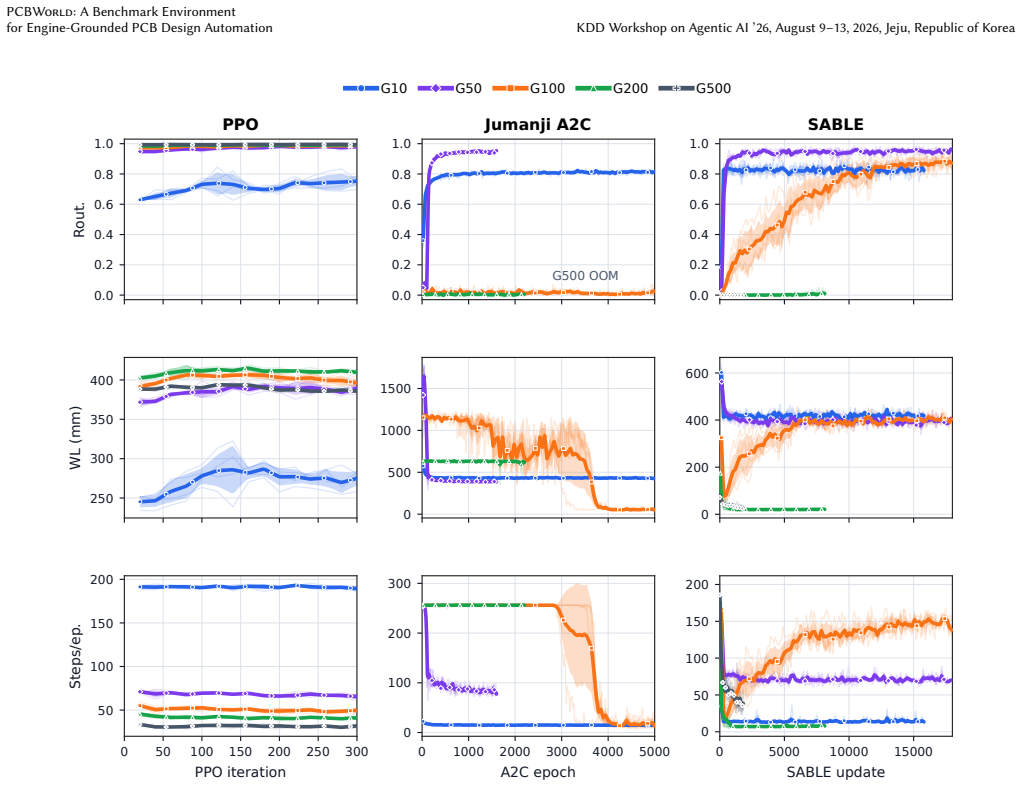
The paper's central object is the engine-grounded interactive routing loop: an agent invokes KiCad's native routing operations (start_route, make_line, make_via, finish), observes the engine-updated board state and DRC feedback, and routes one operation at a time. This loop replaces two prior abstractions—grid-cell movement, whose decision horizon grows with grid resolution and breaks credit assignment, and open-loop generation, which cannot guarantee design-rule compliance. By tying the action granularity to routed segments rather than grid cells, the PPO policy's decision horizon stays constant as grids grow finer, which is why it maintains perfect routability from grid 50 through grid 500
What carries the argument
KiCad's Push-and-Shove (PNS) router and Design Rule Check engine, exposed as 58 Python APIs; a Markov Decision Process with a nested-dictionary board state, six action types, and a terminal reward based on a potential function combining design-rule violations, wirelength, and via count; two wrappers (a tokenized RL interface and a serialized tool-call LLM interface) over the same MDP; a log-concave per-net DRC penalty that concentrates the learning signal on closing the last violations.
Load-bearing premise
The zero-shot transfer claim rests on the D3-A evaluation set being representative of real boards, but D3-A contains only the 100 smallest boards from a 679-board corpus (2–13 nets, 6–31 pads), which overlaps heavily with the synthetic training distribution (4–6 nets, 8–21 pads). On medium boards (5–42 nets, 31–100 pads), the PPO policy's Clean Pass drops to 0.45 versus Freerouting's 0.78, and no results are reported for the largest boards. Additionally, the best-of-5 rollout
What would settle it
Train a grid-action RL policy whose action granularity scales with routed segments rather than grid cells, and show it matches PCBWorld's PPO on the D1 grid-scalability benchmark—this would isolate action abstraction rather than engine grounding as the causal factor. Alternatively, show that a plan-only LLM agent with access to a high-fidelity board simulator for mental rehearsal matches the interactive agent's Clean Pass, which would weaken the claim that per-step engine feedback is essential.
If this is right
- If engine-grounded interactive routing is the right abstraction, then the path to competitive learning-based PCB routing runs through native EDA APIs rather than through grid discretization or end-to-end file generation, redirecting both RL and LLM agent design.
- The finding that a policy trained on 4–6 net synthetic boards generalizes to small real boards suggests that synthetic board generators with controllable difficulty could serve as scalable training curricula, though the performance drop on medium boards (CP 0.45 vs Freerouting's 0.78) indicates the curriculum must extend well beyond current parameters.
- The sharp gap between interactive and open-loop LLM routing (CP 0.96 vs 0.55 vs 0.00) provides a concrete test bed for the broader hypothesis that iterative tool-use with state feedback is necessary for tasks requiring hard geometric constraints, extending the interactive-agent paradigm into spatial reasoning domains.
- The released benchmark, with 679 real boards spanning up to 451 nets and 2,103 pads, establishes difficulty tiers that current methods cannot solve, creating a measurable frontier for tracking progress in automated PCB routing.
- The pluggable reward potential allows routing objectives to be swapped (e.g., prioritizing signal integrity or thermal constraints instead of just wirelength and via count), opening the environment to multi-objective optimization once those signals are integrated into the engine.
Editorial analysis
A structured set of objections, weighed in public.
Referee Report
Summary. The paper introduces PCBWorld, an open-source engine-grounded PCB routing environment built on the KiCad EDA engine. The environment exposes 58 Python APIs wrapping KiCad's native routing and design-rule-check (DRC) operations, formulates PCB routing as an MDP, and provides wrappers for both RL policies and tool-using LLM agents. Alongside the environment, the authors release PCBWorld-Bench, comprising synthetic grid-based (D1) and gridless (D2) boards plus 679 real open-source boards (D3) in KiCad's native format. Evaluation is method-agnostic: any completed .kicad_pcb file is scored by the same eight engine-checked metrics. Experiments show that (i) segment-level KiCad-API actions scale to fine grid resolutions where grid-action RL baselines collapse, (ii) a compact PPO Transformer trained on synthetic D2 boards transfers zero-shot to small real boards (D3-A), approaching or exceeding rule-based routers, and (iii) interactive engine-grounded routing substantially outperforms open-loop LLM generation.
Significance. The paper makes a solid infrastructure contribution: wrapping KiCad's C++ routing engine as a vectorized Gym environment with a well-documented API-to-MDP mapping is non-trivial and useful to the community. The method-agnostic evaluation protocol—scoring any .kicad_pcb file identically regardless of how it was produced—is a genuine strength that enables fair comparison across heterogeneous routing methods. The reward design, including the log-concave DRC penalty with breadth/depth decomposition, is well-motivated. The interactive-vs-open-loop LLM comparison provides a clear, falsifiable result. The code and datasets are promised as open source. The work is positioned as a foundation rather than a final solution, which is appropriate given the limitations the authors themselves acknowledge.
major comments (3)
- §4.3 and Table 3: The best-of-5 rollout selection protocol (selecting the rollout with highest potential gain) is applied to all stochastic methods, but its effect is asymmetric across method types. PPO is a stochastic neural policy whose 5 rollouts produce diverse routings, so best-of-5 selection can substantially inflate CP: if single-rollout success probability is p, then CP@5 >= 1-(1-p)^5. For example, CP@1=0.50 yields CP@5>=0.97. Freerouting, while stochastic across seeds, is a deterministic rip-up-and-reroute algorithm whose 5 rollouts within a single seed may be near-identical, giving CP@5 approx CP@1. The paper reports CP@5 in Table 3 but does not report CP@1 for the main comparison, making it impossible to assess whether PPO's 0.86 vs Freerouting's 0.80 on D3-A reflects genuine routing quality or selection advantage. The paper does report single-rollout Rout.@1 for D1 (Figure 6,
- §4.2 and Table 2: The zero-shot transfer claim rests on D3-A being representative of 'real boards.' D3-A contains only the 100 smallest boards from the 679-board D3 corpus (2-13 nets, 6-31 pads), while the PPO policy was trained on D2 boards with 4-6 nets and 8-21 pads. The distribution overlap between D2-train and D3-A is substantial, and the transfer is not as out-of-distribution as the 'zero-shot to real boards' framing suggests. On D3-B (5-42 nets, 31-100 pads), PPO's CP drops to 0.45 versus Freerouting's 0.78, and on D3-C no results are reported. The claim that the policy 'approaches rule-based routers' is supported only on the smallest, most D2-like subset of real boards. The authors should temper the zero-shot transfer framing or report results on D3-C to substantiate the generalization claim.
- §5.3, Table 3: The D3-A evaluation uses 99 boards (one 73-net board excluded), while D3-B uses only 10 boards. With 4 seeds, D3-B CP for PPO is 0.45 +/- 0.10, meaning the 95% confidence interval is roughly [0.25, 0.65]. The comparison to Freerouting's 0.78 +/- 0.05 on D3-B is based on only 10 boards x 4 seeds = 40 data points. The paper should report the board-level variance (not just seed-level variance) or acknowledge that the D3-B comparison is underpowered.
minor comments (7)
- §5.3, Table 3: The paper states 'deterministic methods are run once, as selection does not apply.' However, Freerouting is listed as a stochastic method reporting mean over 4 seeds. The distinction between Freerouting's stochasticity (across seeds) and the within-seed determinism of its 5 rollouts should be clarified in the table caption or methodology.
- Table 2: D3-A is described as '100 boards' in the text but Table 3 reports '99 Boards' for D3-A. The discrepancy (one excluded board) is mentioned only in Appendix L. A footnote in the main table would help.
- Figure 7: The y-axis label for the DRV subplot in Figure 7a shows values around 0-30 but the axis label is unclear about whether these are per-board averages or totals. Clarifying the aggregation would help interpretation.
- §3.2, Eq. (2): The potential function uses lambda_w and lambda_v 'reused from Equation (1),' but Equation (1) presents these as user-specified weights for the constrained optimization. The relationship between the optimization weights and the reward weights could be stated more precisely—are they always identical, or can they differ for training vs. evaluation?
- Appendix G, Eq. (5): The DRC penalty hyperparameters (s_agg, s_pn, o) = (3, 1, 2) are stated without justification. A brief sensitivity analysis or rationale for these specific values would strengthen the reproducibility of the reward design.
- The paper uses 'GPT-5.4' and 'Qwen3.5-397B' as model names. If these are anonymized or renamed versions of specific models, the actual model identifiers should be provided for reproducibility.
- §7 (Discussion): The paragraph on 'explainable, reasoning-based routing' is cut off mid-sentence ('we identify several key observations, which are presented in Appendix N'). While Appendix N does contain the case studies, the main text discussion would benefit from a brief summary of the key findings rather than only deferring to the appendix.
Simulated Author's Rebuttal
We thank the referee for a careful and constructive review. The three major comments all identify legitimate gaps in our experimental reporting: (1) the best-of-5 selection protocol's asymmetric effect on PPO vs. Freerouting is not controlled for, (2) the zero-shot transfer claim is overstated for D3-A given its distributional overlap with D2-train, and (3) the D3-B comparison is underpowered. We agree with all three points and will revise accordingly—adding CP@1 results, tempering the transfer framing, and reporting board-level variance. No standing objections remain.
read point-by-point responses
-
Referee: §4.3 and Table 3: The best-of-5 rollout selection protocol is applied to all stochastic methods, but its effect is asymmetric across method types. PPO is a stochastic neural policy whose 5 rollouts produce diverse routings, so best-of-5 selection can substantially inflate CP... Freerouting, while stochastic across seeds, is a deterministic rip-up-and-reroute algorithm whose 5 rollouts within a single seed may be near-identical... The paper reports CP@5 in Table 3 but does not report CP@1 for the main comparison...
Authors: The referee is correct that the best-of-5 selection protocol can asymmetrically inflate CP for PPO relative to Freerouting, and that reporting only CP@5 makes it impossible to assess the magnitude of this effect. This is a fair and important concern. We will add CP@1 (single-rollout, no selection) alongside CP@5 in Table 3 for all stochastic methods on D2, D3-A, and D3-B. This will allow readers to directly assess the selection effect. We note that Figure 6 already reports single-rollout Rout.@1 for D1, but the main D2/D3 comparison table does not include the analogous CP@1, which is an oversight we will correct. We will also add a paragraph in §4.3 explicitly discussing the selection effect, including the referee's observation that Freerouting's within-seed rollouts may be near-identical due to its deterministic rip-up-and-reroute structure, so CP@5 ≈ CP@1 for Freerouting while PPO benefits from selection. If the CP@1 gap between PPO and Freerouting on D3-A narrows substantially, we will adjust the framing of the D3-A comparison accordingly. revision: yes
-
Referee: §4.2 and Table 2: The zero-shot transfer claim rests on D3-A being representative of 'real boards.' D3-A contains only the 100 smallest boards from the 679-board D3 corpus (2-13 nets, 6-31 pads), while the PPO policy was trained on D2 boards with 4-6 nets and 8-21 pads. The distribution overlap between D2-train and D3-A is substantial, and the transfer is not as out-of-distribution as the 'zero-shot to real boards' framing suggests...
Authors: The referee is correct that D3-A's net and pad counts (2–13 nets, 6–31 pads) substantially overlap with the D2 training distribution (4–6 nets, 8–21 pads), which weakens the 'zero-shot to real boards' framing. We agree that the current language overstates the generalization. We will revise the manuscript in two ways: (1) We will temper the transfer claim throughout the paper, including the abstract, introduction, and §5.3, to explicitly acknowledge that D3-A boards are the smallest real boards and that their complexity distribution overlaps with D2-train. The claim will be reframed as 'zero-shot transfer to small real boards' rather than 'zero-shot transfer to real boards' without qualification. (2) We will add explicit discussion of the D3-A/D2-train distributional overlap in §4.2 and §5.3, noting that D3-A is the subset where transfer is most plausible precisely because the complexity is closest to the training distribution. Regarding D3-C: we did not report D3-C results because PPO and the LLM agents do not complete routing within the step budget on boards with 100+ pads, and Freerouting itself has low completion rates on the largest boards. We will state this explicitly in the revision rather than leaving D3-C results absent without explanation. The D3-B results (CP 0.45 vs. 0.78) already show the limits of generalization, and we will foreground this as the honest boundary of what the current policy achieves. revision: yes
-
Referee: §5.3, Table 3: The D3-A evaluation uses 99 boards (one 73-net board excluded), while D3-B uses only 10 boards. With 4 seeds, D3-B CP for PPO is 0.45 +/- 0.10, meaning the 95% confidence interval is roughly [0.25, 0.65]. The comparison to Freerouting's 0.78 +/- 0.05 on D3-B is based on only 10 boards x 4 seeds = 40 data points. The paper should report the board-level variance (not just seed-level variance) or acknowledge that the D3-B comparison is underpowered.
Authors: The referee is correct that the current D3-B comparison is underpowered: 10 boards × 4 seeds = 40 data points, and the reported standard deviations are seed-level (across 4 seeds), not board-level. The 95% CI for PPO's D3-B CP is indeed wide enough that the gap to Freerouting may not be as large as the point estimates suggest. We will make two changes: (1) We will report board-level variance in addition to seed-level variance for D3-B (and D3-A), so that the reader can assess the uncertainty at the appropriate granularity. This means reporting per-board CP averaged over seeds, then computing the standard deviation across boards. (2) We will add an explicit acknowledgment in §5.3 that the D3-B comparison is based on only 10 boards and is therefore underpowered, and that the D3-B gap between PPO and Freerouting should be interpreted with caution. We chose 10 D3-B boards because of the high per-board evaluation cost for LLM agents (Appendix L documents that GPT-5.4 takes ~866 seconds per D3-B board), but we should have stated this limitation more prominently. If feasible before the camera-ready deadline, we will expand the D3-B evaluation set to include more boards for the RL and rule-based methods (which are much cheaper to run than LLM agents), though we cannot guarantee this will be complete in time. revision: yes
Circularity Check
No significant circularity found; the derivation is self-contained against external benchmarks.
full rationale
The paper's central claims rest on an external engine (KiCad) for both training signal and evaluation, not on a self-defined proxy. The reward potential Φ(s) = -(f_d(n_drv(s)) + λ_w ℓ(s) + λ_v n_via(s)) uses KiCad's DRC API for n_drv, and the evaluation metric CP checks DRV=0 via the same KiCad DRC. While the training reward and evaluation metric both reference the same external checker, this is analogous to using the same physics engine for simulation and scoring — the checker is independent of the authors' method. The best-of-5 selection protocol (selecting the rollout with highest potential gain) is applied uniformly to all methods including external baselines (Freerouting, OrthoRoute, KRT), so it does not asymmetrically define the authors' method into success. The selection criterion (maximize ΔΦ, which heavily weights DRV=0) is approximately aligned with the evaluation criterion (CP requires DRV=0), but this alignment is a property of the evaluation protocol, not a circular derivation: the selection does not guarantee CP=1, and the paper reports CP < 1 for most methods. No self-citation chain is load-bearing for the central claims — the paper cites external tools (KiCad, Freerouting, Jumanji, Sable, PCBench) and evaluates against external baselines under a shared protocol. The one minor concern is that the potential function used for both training and sample selection shares terms with the evaluation metric, but this is standard practice in RL benchmarks (train on shaped reward, evaluate on true objective) and does not constitute circularity.
Axiom & Free-Parameter Ledger
free parameters (13)
- lambda_w (wirelength weight) =
0.002
- lambda_v (via weight) =
0.1
- s_agg (aggregate DRC penalty scale) =
3
- s_pn (per-net DRC penalty scale) =
1
- o (log-curve knee offset) =
2
- gamma (discount) =
0.995
- learning rate =
1e-4
- d_model / layers / heads =
128 / 4 / 8
- n_freq (Fourier feature frequencies) =
32
- candidate pool size =
64
- directional grid offset =
0.5mm
- episode step limit =
256
- k (rollouts per board) =
5
axioms (5)
- domain assumption KiCad's PNS router and DRC engine faithfully implement PCB design rules and routing physics
- ad hoc to paper Segment-level engine operations are a sufficient action space for PCB routing without rip-up-and-reroute
- domain assumption The 35 stock error-level DRC checks are a sufficient proxy for manufacturability
- ad hoc to paper D3-A boards (2-13 nets, 6-31 pads) are representative of 'real boards' for the zero-shot transfer claim
- ad hoc to paper Best-of-5 rollout selection by potential gain is a fair evaluation protocol
read the original abstract
PCB routing is the task of connecting the nets of a board with copper traces under strict design rules, yet learning-based methods still lag behind rule-based routers. We introduce PCBWorld, an open-source engine-grounded PCB routing environment built on the KiCad EDA engine. As a human engineer does, agents in PCBWorld interactively route a board through the engine's native operations, using its Design Rule Check (DRC) feedback to keep the routing within the design rules. The environment supports both RL policies and tool-using LLM agents. Alongside the environment, PCBWorld-Bench provides three dataset families in KiCad's native board format (.kicad_pcb), covering two types of controllable synthetic instances and 679 real open-source boards. It scores any completed board with eight engine-checked evaluation metrics, regardless of the routing method. In our experiments, agents in PCBWorld consistently outperformed grid-action RL policies and open-loop LLM baselines, and an RL policy trained only on synthetic boards transferred zero-shot to real boards, approaching rule-based routers. These results position the engine-grounded, interactive approach of PCBWorld as a promising foundation for advancing the routing ability of both RL and LLM agents.
Figures










Reference graph
Works this paper leans on
-
[1]
Altium. 2026. Altium Designer: The Industry’s Leading PCB Design Software. https://www.altium.com/altium-designer Accessed: 2026-06-11
work page 2026
-
[2]
Akshay Badagabettu, Sai Sravan Yarlagadda, and Amir Barati Farimani. 2024. Query2CAD: Generating CAD models using natural language queries. arXiv preprint arXiv:2406.00144. doi:10.48550/arXiv.2406.00144
work page internal anchor Pith review Pith/arXiv arXiv doi:10.48550/arxiv.2406.00144 2024
-
[3]
Brian Benchoff. 2025. OrthoRoute: A GPU-accelerated PCB autorouter for KiCad. https://github.com/bbenchoff/OrthoRoute
work page 2025
-
[4]
Jason Blocklove, Shailja Thakur, Benjamin Tan, Hammond Pearce, Siddharth Garg, and Ramesh Karri. 2025. Automatically Improving LLM-based Verilog Generation using EDA Tool Feedback.ACM Transactions on Design Automation of Electronic Systems30, 6 (2025), 1–26. doi:10.1145/3723876 arXiv:2411.11856
work page internal anchor Pith review Pith/arXiv arXiv doi:10.1145/3723876 2025
-
[5]
Clément Bonnet, Daniel Luo, Donal John Byrne, Shikha Surana, Sasha Abramowitz, Paul Duckworth, Vincent Coyette, Laurence Illing Midgley, Elshadai Tegegn, Tristan Kalloniatis, Omayma Mahjoub, Matthew Macfarlane, An- dries Petrus Smit, Nathan Grinsztajn, Raphael Boige, Cemlyn Neil Waters, Mo- hamed Ali Ali Mimouni, Ulrich Armel Mbou Sob, Ruan John de Kock, ...
-
[6]
Jumanji: a Diverse Suite of Scalable Reinforcement Learning Environments in JAX
Jumanji: A Diverse Suite of Scalable Reinforcement Learning Environ- ments in JAX. InInternational Conference on Learning Representations (ICLR). arXiv:2306.09884
work page internal anchor Pith review Pith/arXiv arXiv
-
[7]
Cadence Design Systems. 2026. Allegro X Design Platform: PCB and System Design. https://www.cadence.com/en_US/home/tools/pcb-design-and-analysis/ allegro-x-design-platform.html Accessed: 2026-06-11
work page 2026
-
[8]
CERN BE-CO-HT. 2026. CERN BE-CO-HT contribution to KiCad. https://ohwr. org/projects/cern-kicad/
work page 2026
-
[9]
Turner, Po-Hsuan Wei, Keren Zhu, David Z
Hao Chen, Kai-Chieh Hsu, Walker J. Turner, Po-Hsuan Wei, Keren Zhu, David Z. Pan, and Haoxing Ren. 2023. Reinforcement Learning Guided Detailed Routing for Custom Circuits. InProceedings of the 2023 International Symposium on Physical Design (ISPD). 26–34. doi:10.1145/3569052.3571874
-
[10]
Jiarui Chen, Yujing Zhou, Qinghai Liu, and Xinhong Zhang. 2023. A Novel Global Routing Algorithm for Printed Circuit Boards Based on Triangular Grid. Electronics12, 24 (2023), 4942. doi:10.3390/electronics12244942
-
[11]
Kanzhi Cheng, Qiushi Sun, Yougang Chu, Fangzhi Xu, Li YanTao, Jianbing Zhang, and Zhiyong Wu. 2024. SeeClick: Harnessing GUI Grounding for Advanced Visual GUI Agents. InProceedings of the 62nd Annual Meeting of the Association for Computational Linguistics (Volume 1: Long Papers). Association for Computational Linguistics, Bangkok, Thailand, 9313–9332. do...
work page internal anchor Pith review Pith/arXiv arXiv doi:10.18653/v1/2024.acl-long.505 2024
-
[12]
Clyde F. Coombs, Jr. and Happy T. Holden (Eds.). 2016.Printed Circuits Handbook (7 ed.). McGraw Hill. https://www.mheducation.com/highered/mhp/product/ printed-circuits-handbook-seventh-edition.html
work page 2016
- [13]
- [14]
- [15]
-
[16]
Freerouting Contributors. 2026. Freerouting: Open-source PCB Autorouter. https: //github.com/freerouting/freerouting
work page 2026
-
[17]
Timnit Gebru, Jamie Morgenstern, Briana Vecchione, Jennifer Wortman Vaughan, Hanna Wallach, Hal Daumé III, and Kate Crawford. 2021. Datasheets for datasets. Commun. ACM64, 12 (2021), 86–92. doi:10.1145/3458723
-
[18]
Kahng, Sayak Kundu, and Zhiang Wang
Amur Ghose, Andrew B. Kahng, Sayak Kundu, and Zhiang Wang. 2025. ORFS- agent: Tool-Using Agents for Chip Design Optimization. In2025 ACM/IEEE 7th Symposium on Machine Learning for CAD (MLCAD). 1–13. doi:10.1109/ MLCAD65511.2025.11189204 arXiv:2506.08332
-
[19]
Yandong Guan, Xilin Wang, XiMing Xing, Jing Zhang, Dong Xu, and Qian Yu
-
[20]
CAD-Coder: Text-to-CAD Generation with Chain-of-Thought and Geometric Reward
CAD-Coder: Text-to-CAD Generation with Chain-of-Thought and Geo- metric Reward. InAdvances in Neural Information Processing Systems, Vol. 38. 59765–59789. arXiv:2505.19713
work page internal anchor Pith review Pith/arXiv arXiv
-
[21]
Andy Haas. 2026. KiCad Routing Tools. https://github.com/drandyhaas/ KiCadRoutingTools
work page 2026
-
[22]
Stephen H. Hall and Howard L. Heck. 2009.Advanced Signal Integrity for High- Speed Digital Designs. Wiley-IEEE Press. doi:10.1002/9780470423899
-
[23]
2024.Towards Automated PCB Routing: Leveraging Machine Learning and Heuristic Techniques
Youbiao He. 2024.Towards Automated PCB Routing: Leveraging Machine Learning and Heuristic Techniques. Ph. D. Dissertation. Iowa State University. doi:10.31274/ td-20240617-74
work page 2024
-
[24]
Youbiao He, Jacob Frieden, Hebi Li, Roba Abbajabal, Ge Luo, and Forrest Sheng Bao. 2024. PCBench: A Dataset for Printed Circuit Board Routing. https://github. com/PCBench/PCBench DAC 2024 work-in-progress poster
work page 2024
-
[25]
Youbiao He, Hebi Li, Jin Tian, and Forrest Sheng Bao. 2022. Circuit Routing Using Monte Carlo Tree Search and Deep Reinforcement Learning. In2022 International Symposium on VLSI Design, Automation and Test (VLSI-DAT). 1–5. doi:10.1109/VLSI-DAT54769.2022.9768074
-
[26]
Chia-Tung Ho, Haoxing Ren, and Brucek Khailany. 2025. VerilogCoder: Au- tonomous Verilog Coding Agents with Graph-based Planning and Abstract Syn- tax Tree (AST)-based Waveform Tracing Tool. InProceedings of the AAAI Confer- ence on Artificial Intelligence (AAAI), Vol. 39. 300–307. doi:10.1609/aaai.v39i1.32007 arXiv:2408.08927
work page internal anchor Pith review Pith/arXiv arXiv doi:10.1609/aaai.v39i1.32007 2025
-
[27]
Wenyi Hong, Weihan Wang, Qingsong Lv, Jiazheng Xu, Wenmeng Yu, Junhui Ji, Yan Wang, Zihan Wang, Yuxiao Dong, Ming Ding, and Jie Tang. 2024. CogA- gent: A Visual Language Model for GUI Agents. InProceedings of the IEEE/CVF Conference on Computer Vision and Pattern Recognition (CVPR). 14281–14290. doi:10.1109/CVPR52733.2024.01354 arXiv:2312.08914
-
[28]
InstaDeep. 2026. Connector Environment — Jumanji Documentation. https: //instadeepai.github.io/jumanji/environments/connector/ Last updated: 2026-06- 02
work page 2026
-
[29]
IPC. 2003. IPC-2221A-2003: Generic Standard on Printed Board Design. https: //webstore.ansi.org/standards/ipc/ipc2221a2003 Association Connecting Elec- tronics Industries
work page 2003
-
[30]
Jimenez, John Yang, Alexander Wettig, Shunyu Yao, Kexin Pei, Ofir Press, and Karthik R
Carlos E. Jimenez, John Yang, Alexander Wettig, Shunyu Yao, Kexin Pei, Ofir Press, and Karthik R. Narasimhan. 2024. SWE-bench: Can Language Models Resolve Real-world Github Issues?. InICLR. https://openreview.net/forum?id= VTF8yNQM66
work page 2024
- [31]
-
[32]
KiCad Project. 2024. KiCad Developer Documentation: APIs and Bindings. https: //dev-docs.kicad.org/en/apis-and-binding/
work page 2024
-
[33]
KiCad Project. 2026. KiCad API Python Bindings. https://docs.kicad.org/kicad- python-main/
work page 2026
-
[34]
KiCad Project. 2026. KiCad EDA Suite. https://www.kicad.org Accessed: 2026- 06-11
work page 2026
-
[35]
KiCad Project. 2026. KiCad PCB Editor Documentation. https://docs.kicad. org/9.0/en/pcbnew/pcbnew.html Documentation revision 152cd19e; accessed: 2026-06-11
work page 2026
-
[36]
Pradeep Lall, Michael G. Pecht, and Edward B. Hakim. 1997.Influence of Temper- ature on Microelectronics and System Reliability: A Physics of Failure Approach(1 ed.). CRC Press
work page 1997
-
[37]
C. Y. Lee. 1961. An Algorithm for Path Connections and Its Applications.IRE Transactions on Electronic ComputersEC-10, 3 (1961), 346–365. doi:10.1109/TEC. 1961.5219222
work page doi:10.1109/tec 1961
-
[38]
Haiyun Li, Jixin Zhang, Ning Xu, and Mingyu Liu. 2023. FanoutNet: A Neu- ralized PCB Fanout Automation Method Using Deep Reinforcement Learning. InProceedings of the AAAI Conference on Artificial Intelligence (AAAI), Vol. 37. 8554–8561. doi:10.1609/aaai.v37i7.26030
-
[39]
Jindong Li, Lianrong Chen, Bin Yang, Jiadong Zhu, Ying Wang, Yuzhe Ma, and Menglin Yang. 2026. PCB-Bench: Benchmarking LLMs for Printed Circuit Board Placement and Routing. InThe Fourteenth International Conference on Learning Representations. https://openreview.net/forum?id=Q5QLu7XTWx
work page 2026
-
[40]
Jiahao Li, Yusheng Luo, Yunzhong Lou, and Xiangdong Zhou. 2026. ReCAD: Reinforcement Learning Enhanced Parametric CAD Model Generation with Vision-Language Models. InProceedings of the AAAI Conference on Artificial Intel- ligence (AAAI), Vol. 40. 6190–6198. doi:10.1609/aaai.v40i8.37544 arXiv:2512.06328
-
[41]
Xingang Li, Yuewan Sun, and Zhenghui Sha. 2025. LLM4CAD: Multimodal Large Language Models for Three-Dimensional Computer-Aided Design Generation. Journal of Computing and Information Science in Engineering25, 2 (2025), 021005. doi:10.1115/1.4067085
-
[42]
Haiguang Liao, Qingyi Dong, Xuliang Dong, Wentai Zhang, Wangyang Zhang, Weiyi Qi, Elias Fallon, and Levent Burak Kara. 2020. Attention Routing: Track- Assignment Detailed Routing Using Attention-Based Reinforcement Learning. arXiv preprint arXiv:2004.09473. doi:10.48550/arXiv.2004.09473
work page internal anchor Pith review Pith/arXiv arXiv doi:10.48550/arxiv.2004.09473 2020
-
[43]
Haiguang Liao, Wentai Zhang, Xuliang Dong, Barnabás Póczos, Kenji Shimada, and Levent Burak Kara. 2020. A Deep Reinforcement Learning Approach for Global Routing.Journal of Mechanical Design142, 6 (2020), 061701. doi:10.1115/1. 4045044 arXiv:1906.08809
work page internal anchor Pith review Pith/arXiv arXiv doi:10.1115/1 2020
-
[44]
Yin-Chi Liao, Sheng-Xin Pan, and Po-Jui Chiang. 2026. Automation of PCB Au- torouting via World-Model Reinforcement Learning and Freerouting Integration. Expert Systems with Applications311 (2026), 131424. doi:10.1016/j.eswa.2026. 131424
-
[45]
Ting-Chou Lin, Devon Merrill, Yen-Yi Wu, Chester Holtz, and Chung-Kuan Cheng
-
[46]
InProceedings of the 26th Asia and South Pacific Design Automation Conference (ASP-DAC)
A Unified Printed Circuit Board Routing Algorithm With Complicated Constraints and Differential Pairs. InProceedings of the 26th Asia and South Pacific Design Automation Conference (ASP-DAC). 170–175. doi:10.1145/3394885.3431568
-
[47]
Ralph Linsker. 1984. An iterative-improvement penalty-function-driven wire routing system.IBM Journal of Research and Development28, 5 (sep 1984), 613–624. doi:10.1147/RD.285.0613
-
[48]
ChipNeMo: Domain-Adapted LLMs for Chip Design
Mingjie Liu, Teodor-Dumitru Ene, Robert Kirby, Chris Cheng, Nathaniel Pinck- ney, Rongjian Liang, Jonah Alben, Himyanshu Anand, Sanmitra Banerjee, Ismet Bayraktaroglu, Bonita Bhaskaran, Bryan Catanzaro, Arjun Chaudhuri, Sharon Clay, Bill Dally, Laura Dang, Parikshit Deshpande, Siddhanth Dhodhi, Sameer Halepete, Eric Hill, Jiashang Hu, Sumit Jain, Ankit Ji...
work page internal anchor Pith review Pith/arXiv arXiv doi:10.48550/arxiv.2311.00176 2026
-
[49]
Mingjie Liu, Nathaniel Pinckney, Brucek Khailany, and Haoxing Ren. 2023. In- vited Paper: VerilogEval: Evaluating Large Language Models for Verilog Code Generation. In2023 IEEE/ACM International Conference on Computer Aided Design (ICCAD). 1–8. doi:10.1109/ICCAD57390.2023.10323812 arXiv:2309.07544
-
[50]
Omayma Mahjoub, Sasha Abramowitz, Ruan John De Kock, Wiem Khlifi, Si- mon Verster Du Toit, Jemma Daniel, Louay Ben Nessir, Louise Beyers, Juan Claude Formanek, Liam Clark, and Arnu Pretorius. 2025. Sable: A Performant, Efficient and Scalable Sequence Model for MARL. InProceedings of the 42nd International Conference on Machine Learning (ICML) (Proceedings...
work page internal anchor Pith review Pith/arXiv arXiv 2025
-
[51]
Larry McMurchie and Carl Ebeling. 1995. PathFinder: a negotiation-based performance-driven router for FPGAs. InProceedings of the 1995 ACM Third International Symposium on Field-Programmable Gate Arrays (FPGA95). ACM, 111–117. doi:10.1145/201310.201328
-
[52]
Ng, Daishi Harada, and Stuart Russell
Andrew Y. Ng, Daishi Harada, and Stuart Russell. 1999. Policy invariance under reward transformations: Theory and application to reward shaping. InProceedings of the Sixteenth International Conference on Machine Learning (ICML). 278–287. https://dl.acm.org/doi/10.5555/645528.657613
-
[53]
Ke Niu, Haiyang Yu, Zhuofan Chen, Mengyang Zhao, Teng Fu, Bin Li, and Xiangyang Xue. 2026. From Intent to Execution: Multimodal Chain-of-Thought Reinforcement Learning for Precise CAD Code Generation. InProceedings of the AAAI Conference on Artificial Intelligence (AAAI), Vol. 40. 8160–8167. doi:10.1609/ aaai.v40i10.37763 arXiv:2508.10118
work page internal anchor Pith review Pith/arXiv arXiv 2026
-
[54]
OpenAI. 2026. Introducing GPT-5.4. https://openai.com/index/introducing-gpt- 5-4/ Accessed: 2026-06-11
work page 2026
-
[55]
OpenAI. 2026. Introducing GPT-5.4 mini and nano. https://openai.com/index/ introducing-gpt-5-4-mini-and-nano/ Accessed: 2026-06-11
work page 2026
-
[56]
Patil, Huanzhi Mao, Fanjia Yan, Charlie Cheng-Jie Ji, Vishnu Suresh, Ion Stoica, and Joseph E
Shishir G. Patil, Huanzhi Mao, Fanjia Yan, Charlie Cheng-Jie Ji, Vishnu Suresh, Ion Stoica, and Joseph E. Gonzalez. 2025. The Berkeley Function Calling Leaderboard (BFCL): From Tool Use to Agentic Evaluation of Large Language Models. In Proceedings of the 42nd International Conference on Machine Learning (Proceedings of Machine Learning Research, Vol. 267...
work page 2025
-
[57]
Clayton R. Paul. 2006.Introduction to Electromagnetic Compatibility(2 ed.). Wiley- Interscience. doi:10.1002/0471758159
-
[58]
Dacheng Qi, Chenyu Wang, Jingwei Xu, Tianzhe Chu, Zibo Zhao, Wen Liu, Wenrui Ding, Yi Ma, and Shenghua Gao. 2026. Pointer-CAD: Unifying B-Rep and Command Sequences via Pointer-based Edges & Faces Selection. arXiv preprint arXiv:2603.04337. doi:10.48550/arXiv.2603.04337 Accepted by CVPR 2026
work page internal anchor Pith review Pith/arXiv arXiv doi:10.48550/arxiv.2603.04337 2026
-
[59]
Yujia Qin, Shihao Liang, Yining Ye, Kunlun Zhu, Lan Yan, Yaxi Lu, Yankai Lin, Xin Cong, Xiangru Tang, Bill Qian, Sihan Zhao, Lauren Hong, Runchu Tian, Ruobing Xie, Jie Zhou, Mark Gerstein, Dahai Li, Zhiyuan Liu, and Maosong Sun. 2024. ToolLLM: Facilitating Large Language Models to Master 16000+ Real-world APIs. InInternational Conference on Learning Repre...
work page 2024
-
[60]
Qwen Team. 2026. Qwen3.5: Towards Native Multimodal Agents. https://qwen. ai/blog?id=qwen3.5
work page 2026
-
[61]
John Schulman, Filip Wolski, Prafulla Dhariwal, Alec Radford, and Oleg Klimov
-
[62]
Proximal Policy Optimization Algorithms
Proximal Policy Optimization Algorithms. arXiv preprint arXiv:1707.06347. doi:10.48550/arXiv.1707.06347
work page internal anchor Pith review Pith/arXiv arXiv doi:10.48550/arxiv.1707.06347
-
[63]
Zhihong Shao, Peiyi Wang, Qihao Zhu, Runxin Xu, Junxiao Song, Xiao Bi, Haowei Zhang, Mingchuan Zhang, Y. K. Li, Y. Wu, and Daya Guo. 2024. DeepSeekMath: Pushing the Limits of Mathematical Reasoning in Open Language Models. arXiv preprint arXiv:2402.03300. doi:10.48550/arXiv.2402.03300
work page internal anchor Pith review Pith/arXiv arXiv doi:10.48550/arxiv.2402.03300 2024
-
[64]
Utsav Sharma, Bing-Yue Wu, Sai Rahul Dhanvi Kankipati, Vidya A. Chhabria, and Austin Rovinski. 2024. OpenROAD-Assistant: An Open-Source Large Lan- guage Model for Physical Design Tasks. InProceedings of the 2024 ACM/IEEE International Symposium on Machine Learning for CAD (MLCAD). 1–7. doi:10. 1145/3670474.3685960
-
[65]
Naveed A. Sherwani. 1999.Algorithms for VLSI Physical Design Automation(3rd ed.). Kluwer Academic Publishers. doi:10.1007/b116436
-
[66]
The Linux Foundation. 2019. KiCad Joins Linux Foundation to Advance Electronic Design Automation. https://www.linuxfoundation.org/press/press-release/ kicad-joins-linux-foundation-to-advance-electronic-design-automation Press release, 2019-11-22
work page 2019
-
[67]
Yunda Tsai, Mingjie Liu, and Haoxing Ren. 2024. RTLFixer: Automatically Fixing RTL Syntax Errors with Large Language Model. InProceedings of the 61st ACM/IEEE Design Automation Conference (DAC). 1–6. doi:10.1145/3649329. 3657353 arXiv:2311.16543
work page internal anchor Pith review Pith/arXiv arXiv doi:10.1145/3649329 2024
-
[68]
Liang Wang, Heng Meng, Zekai Xiang, Jin Liu, Pingyi Zhou, Litao Chen, and Yongqiang Tang. 2026. Text2CAD-Bench: A Benchmark for LLM-based Text- to-Parametric CAD Generation. arXiv preprint arXiv:2605.18430. doi:10.48550/ arXiv.2605.18430
work page internal anchor Pith review Pith/arXiv arXiv 2026
-
[69]
Siyu Wang, Cailian Chen, Xinyi Le, Qimin Xu, Lei Xu, Yanzhou Zhang, and Jie Yang. 2025. CAD-GPT: Synthesising CAD Construction Sequence with Spatial Reasoning-Enhanced Multimodal LLMs. InProceedings of the AAAI Conference on Artificial Intelligence (AAAI), Vol. 39. 7880–7888. doi:10.1609/aaai.v39i8.32849 arXiv:2412.19663
work page internal anchor Pith review Pith/arXiv arXiv doi:10.1609/aaai.v39i8.32849 2025
-
[70]
Haoyuan Wu, Zhuolun He, Xinyun Zhang, Xufeng Yao, Su Zheng, Haisheng Zheng, and Bei Yu. 2024. ChatEDA: A Large Language Model Powered Au- tonomous Agent for EDA.IEEE Transactions on Computer-Aided Design of In- tegrated Circuits and Systems43, 10 (2024), 3184–3197. doi:10.1109/TCAD.2024. 3383347 arXiv:2308.10204
work page internal anchor Pith review Pith/arXiv arXiv doi:10.1109/tcad.2024 2024
- [71]
-
[72]
Tianbao Xie, Danyang Zhang, Jixuan Chen, Xiaochuan Li, Siheng Zhao, Ruisheng Cao, Toh J. Hua, Zhoujun Cheng, Dongchan Shin, Fangyu Lei, Yitao Liu, Yiheng Xu, Shuyan Zhou, Silvio Savarese, Caiming Xiong, Victor Zhong, and Tao Yu
-
[73]
OSWorld: Benchmarking Multimodal Agents for Open-Ended Tasks in Real Computer Environments
OSWorld: Benchmarking Multimodal Agents for Open-Ended Tasks in Real Computer Environments. InAdvances in Neural Information Processing Systems 37, Vol. 37. 52040–52094. doi:10.52202/079017-1650 arXiv:2404.07972
work page internal anchor Pith review Pith/arXiv arXiv doi:10.52202/079017-1650
-
[74]
Ke Xu, Jialin Sun, Yuchen Hu, Xinwei Fang, Weiwei Shan, Xi Wang, and Zhe Jiang
-
[75]
InProceedings of the 43rd IEEE/ACM International Conference on Computer-Aided Design (ICCAD)
MEIC: Re-thinking RTL Debug Automation Using LLMs. InProceedings of the 43rd IEEE/ACM International Conference on Computer-Aided Design (ICCAD). 1–9. doi:10.1145/3676536.3676801 arXiv:2405.06840
-
[76]
SWE-agent: Agent-Computer Interfaces Enable Automated Software Engineering
John Yang, Carlos E. Jimenez, Alexander Wettig, Kilian Lieret, Shunyu Yao, Karthik Narasimhan, and Ofir Press. 2024. SWE-agent: Agent-Computer Inter- faces Enable Automated Software Engineering. InAdvances in Neural Information Processing Systems (NeurIPS), Vol. 37. 50528–50652. doi:10.52202/079017-1601 arXiv:2405.15793
work page internal anchor Pith review Pith/arXiv arXiv doi:10.52202/079017-1601 2024
-
[77]
$\tau$-bench: A Benchmark for Tool-Agent-User Interaction in Real-World Domains
Shunyu Yao, Noah Shinn, Pedram Razavi, and Karthik R. Narasimhan. 2025. 𝜏-bench: A Benchmark for Tool-Agent-User Interaction in Real-World Do- mains. InThe Thirteenth International Conference on Learning Representations. arXiv:2406.12045
work page internal anchor Pith review Pith/arXiv arXiv 2025
-
[78]
Shunyu Yao, Jeffrey Zhao, Dian Yu, Nan Du, Izhak Shafran, Karthik R. Narasimhan, and Yuan Cao. 2023. ReAct: Synergizing Reasoning and Acting in Language Models. InICLR. https://openreview.net/forum?id=WE_vluYUL-X
work page 2023
-
[79]
Zhanwen Zhou, Hankz Hankui Zhuo, Xiaowu Zhang, and Qiyuan Deng. 2023. XRoute Environment: A Novel Reinforcement Learning Environment for Routing. arXiv preprint arXiv:2305.13823. doi:10.48550/arXiv.2305.13823
work page internal anchor Pith review Pith/arXiv arXiv doi:10.48550/arxiv.2305.13823 2023
-
[80]
Zhanwen Zhou, Hankz Hankui Zhuo, Jinghua Zhou, and Wushao Wen. 2025. Transformer-based Reinforcement Learning for Net Ordering in Detailed Routing. InProceedings of the Thirty-Fourth International Joint Conference on Artificial Intelligence (IJCAI). 9492–9500. doi:10.24963/ijcai.2025/1055
discussion (0)
Sign in with ORCID, Apple, or X to comment. Anyone can read and Pith papers without signing in.