REVIEW 3 major objections 4 minor 7 cited by
This paper constructs far-field gravitational backgrounds for R7-branes as Alice vortices in axio-dilaton gravity, showing that the brane's tension and dipole moment are fixed by the axion's anti-periodic monodromy.
Reviewed by Pith at T0; open to challenge. T0 means a machine referee read the full paper against a public rubric. the ladder, T0–T4 →
T0 review · deepseek-v4-flash
2026-08-02 23:32 UTC pith:OHVIGG2E
load-bearing objection The far-field τ→-τ̄ monodromy solutions are new and carefully derived, but the Gauss-law identification of the free parameter a with a physical dipole moment is not justified: the warp factor is singular on a circle, not a point. the 3 major comments →
Gravitational Background of Alice-Vortices and R7-Branes
The pith
A machine-rendered reading of the paper's core claim, the machinery that carries it, and where it could break.
Core claim
The paper constructs a class of asymptotic Alice-vortex solutions to axio-dilaton gravity satisfying τ(r,θ+2π) = -τ̄(r,θ). For these solutions the worldvolume warp factor is f = (1/4)log(1 + a/z + ā/z̄), the transverse warp factor behaves as h = -μ log(z z̄) + ..., and τ approaches iλ at infinity. Matching a multipole-expanded stress-energy tensor via Gauss's law identifies μ with the brane tension and a with a transverse dipole moment. The solution yields a conical deficit angle δ = 2πμ and requires μ < 1 for asymptotic flatness. The unavoidable dipole breaks the transverse rotational symmetry, indicating non-trivial worldvolume dynamics.
What carries the argument
The engine of the construction is the harmonic warp factor F(z,z̄) = e^{4f} = 1 + a/z + ā/z̄, which reduces part of the Einstein equations to a two-dimensional Laplace equation. Around this seed, the remaining Einstein equations are solved as power series in half-integer powers, with the free coefficients fixed by the monodromy and reality conditions. The physical interpretation of those coefficients is extracted through a Gauss-law matching that treats the brane as a distributional source with monopole and dipole delta functions. Finally, the coefficient μ is converted into a conical deficit angle by computing the holonomy of the spin connection around the brane, avoiding any need to know t
Load-bearing premise
The load-bearing premise is that the unknown near-core stress-energy of the brane can be represented by delta-function monopole and dipole sources; if the core is extended or carries different multipole structure, the matching of a and μ to physical charges breaks down.
What would settle it
Construct a finite-core completion of the equation system with the same τ(r,θ+2π) = -τ̄(r,θ) monodromy and compare the coefficient b of the logarithmic term in the transverse warp factor with the actual brane tension, and the coefficient a with the dipole moment; if they do not match, or if no such completion exists, the central identification is false.
If this is right
- R7-branes acquire explicit asymptotic backgrounds in type IIB supergravity, strengthening the case that they are real objects rather than formal topological constructions.
- The brane necessarily carries a non-zero transverse dipole moment (or higher multipole) whenever the axion monodromy is non-trivial, implying a negative-tension-like source.
- The conical deficit angle δ = 2πμ, with the bound μ < 1, is a concrete gravitational signature that links the brane tension to the geometry of the surrounding spacetime.
- Scattering of scalar, pseudo-scalar, and axio-dilaton probes produces characteristic angular-mode mixing; measuring these amplitudes could determine the ratio |q/μ|.
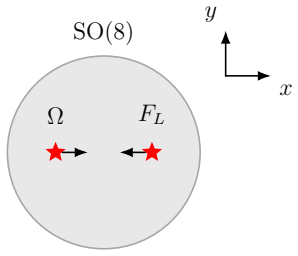
- The dipole moment and the binding structure of the FL and Ω R7-branes indicate that the 8D worldvolume theory is not free fields but an interacting non-supersymmetric QFT.
Where Pith is reading between the lines
- If the near-core stress-energy is not accurately captured by delta-function monopole and dipole terms, the identifications μ = b and q = a, and hence the deficit angle formula, could shift; a direct test would be an exact or numerical completion of the core.
- The anti-periodic monodromy and intrinsic dipole are reminiscent of other charge-conjugation defects, suggesting that similar gravitational backgrounds could be constructed for other reflection-type branes in type IIB and related theories.
- The AdS9 limit found in Appendix D hints that a suitably modified version of these solutions could serve as a holographic model for symmetry operators, though the paper itself notes that the conformal boundary is not directly accessible.
- The scattering amplitudes provide an in-principle observable signature: if R7-branes were produced or probed, the dipole-to-tension ratio could be measured from the relative strength of the monopole and dipole channels.
Editorial analysis
A structured set of objections, weighed in public.
Referee Report
Summary. The paper constructs a class of asymptotic, codimension-two solutions of ten-dimensional axio-dilaton gravity with the anti-periodic monodromy τ(r,θ+2π)=-τ̄(r,θ). The authors propose these as far-field gravitational backgrounds for R7-branes of type IIB supergravity. Working with the metric ansatz ds²=e^f η_ab dx^a dx^b+e^h dzdz̄, they solve the equations of motion as power series in the transverse coordinates. The warp factor is f=(1/4)log(1+a/z+ā/z̄); h contains a logarithmic term -μ log(z z̄); and τ has the prescribed monodromy. The coefficients a and μ are identified, via a Gauss's-law/divergence-theorem argument, as the transverse dipole moment and the tension of the brane, yielding a conical deficit δ=2πμ. The paper also computes Born-approximation Green's functions for scalar, pseudo-scalar, and axio-dilaton probes and uses the results to argue that the R7-brane worldvolume is an interacting 8D QFT.
Significance. If the identifications are correct, the paper would supply the first explicit asymptotic gravitational backgrounds for R7-branes, with a conical deficit and a generic intrinsic dipole, and would provide concrete scattering observables. The formal construction is explicit: the field equations are reduced to a tractable system, the monodromy condition is imposed from the outset, and the Born-approximation Green's functions are derived in closed asymptotic form with detailed series. These are genuine strengths. However, the central physical interpretation depends on an unproven distributional model of the source. The stress-test concern about the singular circle is substantial and must be addressed before the identification of a as a pointlike brane dipole is accepted.
major comments (3)
- [Sec. 3.1 / Eq. (3.4) and App. B] The explicit warp factor F=1+2a cosθ/r vanishes on the circle (x+a)²+y²=a². Therefore log F, and hence f, is singular on this entire circle, not just at z=0. The metric is real only in the exterior of this circle, and the disk D_R used in App. B contains the singular curve. The divergence theorem then has an uncomputed inner-boundary flux from the curve F=0, and equating the outer flux to a delta function at the origin is invalid. This does not disprove the asymptotic solution, but it invalidates the derivation of Eq. (3.20). To identify a with the dipole moment of a pointlike brane, the authors must either provide an interior solution with a matching on F=0, or regulate the source so that its singular support is a point. This is load-bearing because the intrinsic dipole and the scattering observables in Sec. 4 are interpreted through this identification.
- [Sec. 3.2 / Eqs. (3.15)-(3.16), (3.19)-(3.20)] The ansatz T^(brane)_μν = delta functions and derivatives at r=0 is an assumption, not a consequence of the constructed solution. Since the actual singular support of the explicit solution is a circle, the multipole moments extracted by Gauss's law are not necessarily those of a codimension-two point source. The text should state clearly that the solution is an exterior far-field solution and that q=a is a matching condition to an unknown core, rather than a derived equality. As written, the paper uses (3.19)-(3.20) as established identities in the abstract and in Secs. 4-5, so this gap affects the main claim.
- [Sec. 4 / Eqs. (4.6)-(4.7), (4.21)-(4.22)] The Green's function amplitudes depend on q through the metric. These are valid predictions for the background if q is treated as a free parameter. However, the physical interpretation of q as the R7-brane dipole, and the claimed measurability of |q/μ|, only make sense once the source identification is established. Without a fix to the Gauss's-law issue, these results are asymptotic solutions for a family of metrics, not necessarily backgrounds of a single R7-brane.
minor comments (4)
- [Sec. 3.1, after Eq. (3.4)] The statement 'this solution is only valid in the region r>2a' is imprecise. The real domain is the exterior of the circle F=0, which includes points with r<2a when cosθ>0. Please specify the exact domain of validity and the branch of the logarithm.
- [Sec. 3.1 / Eqs. (3.12)-(3.14)] The series involve half-integer powers of z and z̄. Please state the choice of branch cut on the exterior domain and clarify that the monodromy condition (3.10) is compatible with that branch choice.
- [App. C] The Born-approximation Green's function calculation integrates over r>r0, citing ignorance of the core. This is fine, but the dependence on the core cutoff r0 should be acknowledged in the final amplitudes; as written it is implicit.
- [General] There are occasional wording errors ('largerregime' in Sec. 3.2, 'the the' in the Acknowledgments) that should be corrected in a final version.
Circularity Check
No significant circularity: the PDE construction is self-contained; mild circularity only in the interpretive labeling of free asymptotic coefficients as brane multipole moments, plus a heavy but non-derivation self-citation layer.
specific steps
-
self definitional
[Sec. 3.1–3.2, Eqs. (3.3)–(3.4) and (3.20); App. B, Eq. (B.9)]
"F(r, θ) = 1 + 2a cos θ/r, f(r, θ) = 1/4 log(1 + 2a cos θ/r). ... The transverse dipole moments are given by the arbitrary constant appearing in the solution for f, q_x = a, q_y = 0."
The coefficient a is introduced by hand as the first subleading harmonic in the harmonic ansatz for F, chosen because it is the simplest far-field solution. The source ansatz (3.15)–(3.16) already contains a dipole term q·∇δ, and the Gauss-law computation in App. B equates the boundary flux of this f to that source, giving q = a. Thus the 'intrinsic dipole moment' attributed to the R7-brane is the same free parameter inserted into the seed solution, relabeled as a physical dipole. This does not invalidate the power-series solution of the PDEs, but the dipole 'prediction' is true by construction rather than independently derived.
full rationale
The central derivation is a self-contained PDE exercise. The paper imposes the monodromy condition τ(r, θ+2π) = −τ̄(r, θ) as an input, writes the codimension-two metric ansatz, reduces Einstein's equations to Laplace's equation for F = e^{4f}, and then solves the remaining equations in a power series. The free parameters a, b, λ, and c_i are not fitted to any external data; they are integration/freedom parameters of the asymptotic solution. The identification μ = b and q = a is a standard Gauss-law matching between asymptotic coefficients and a chosen distributional source ansatz, not a prediction of the values of those coefficients. No equation in the chain is constructed so that its output equals its input in a way that would make the solution trivial. The self-citations to [15, 23, 32] and [31] are used for the existence, stability, and worldvolume interpretation of R7-branes, and for the conjecture that the worldvolume is an interacting 8D QFT, but the gravitational solution itself does not depend on a uniqueness theorem or an ansatz imported from those papers. The paper also explicitly limits its own claims: the solutions are 'only valid away from the brane (r ≳ a)', and it says 'we cannot fully determine the tension of this brane solution'. The skeptical concern about the solution's singularity on the circle F = 0 and the resulting uncomputed inner boundary contribution in App. B is a mathematical-validity objection to the point-source identification, not a circularity; it would affect whether q = a is rigorously established, but it does not make the derivation equivalent to its inputs. Overall, the only mild circular element is the interpretive step that calls the pre-selected harmonic coefficient a the brane's intrinsic dipole moment, which is a labeling rather than a load-bearing derivation. Hence score 2.
Axiom & Free-Parameter Ledger
free parameters (5)
- q = a =
a (real, arbitrary)
- μ = b =
b, with 0<μ<1
- λ =
λ>0
- c_2,c_3,... =
unfixed complex constants at each order
- σ =
σ=0
axioms (8)
- domain assumption The low-energy dynamics is axio-dilaton gravity (2.4) with κ²=1, with all p-form potentials switched off.
- domain assumption The metric admits the warped product ansatz ds²=e^f η_ab dx^a dx^b + e^h δ_ij dx^i dx^j with 8D Lorentz invariance and no angular momentum (2.10).
- domain assumption Spacetime is asymptotically locally flat and τ satisfies the anti-periodic monodromy τ(r,θ+2π)=-τ̄(r,θ) (2.8).
- ad hoc to paper The brane source can be represented as a distributional sum of delta functions and derivatives (3.15)-(3.16), truncated at dipole order.
- domain assumption The core is purely absorbing for probe scattering, σ=0 in the interior Green's function.
- ad hoc to paper The elementary constituents conjecture bound 0≤δ<4π and the stronger asymptotic-flatness bound μ<1 restrict the tension (3.28)-(3.30).
- ad hoc to paper A nonzero intrinsic dipole implies spontaneous breaking of transverse U(1)_⊥ and a worldvolume operator expectation value ⟨O_dipole⟩≠0 (Sec. 5).
- standard math Solutions to Laplace's equation on the transverse plane admit the harmonic decomposition and large-z series used in §3.1; the radial Green's function uses modified Bessel functions.
read the original abstract
Codimension-two vortex solutions are important solitonic objects in both quantum field theory and gravity. In this paper, we construct a class of codimension-two Alice-vortex solutions in axio-dilaton gravity, in which monodromy around the vortex enacts the axion transformation $C_0 \mapsto -C_0$. In IIB supergravity, this furnishes a class of R7-brane backgrounds of the sort predicted by the Swampland Cobordism Conjecture. Such configurations generically carry an intrinsic dipole moment. We extract additional properties of such branes from scattering probes. These results provide further evidence that the worldvolume theory of an R7-brane is an 8D non-supersymmetric interacting quantum field theory.
Figures


Forward citations
Cited by 7 Pith papers
-
$\text{AdS}_D\times I$ solutions in axio-dilaton gravity
The authors reformulate the equations of motion for AdS_D × I solutions in axio-dilaton gravity as a first-order autonomous dynamical system, identify fixed points and analytic solutions for arbitrary D including in t...
-
Sharpened Dynamical Cobordism
Sharpened Dynamical Cobordism ties the allowed range of critical exponent δ to theory structure ξ, flagging obstructions from non-trivial cobordism charges that require new degrees of freedom.
-
AdS$_9$ solutions in type II supergravities
New analytic AdS9 solutions in type IIB with finite action and central charge, numerical massive IIA solutions with diverging action, and perturbative dS9 solutions are constructed in type II supergravities.
-
Bordisms between 9d type IIB supergravities and commutator widths of duality groups
Proposes a refinement of the Swampland Cobordism Conjecture for duality groups, arguing that diverging commutator widths necessitate infinitely many duality defects to realize monodromies in 9d supergravity bordisms.
-
Bordisms between 9d type IIB supergravities and commutator widths of duality groups
Proposes a refinement of the Swampland Cobordism Conjecture for Ω1(BG) with duality bundle G, where diverging commutator width of G requires infinitely many duality defects to realize monodromies via gravitational solitons.
-
A Matrix Theory Construction of the IIA/IIB Wall
A lightlike IIA/IIB domain wall is constructed at zero string coupling by gauging (−1)^{F_L} in matrix string theory, turning BPS IIA D0-branes into non-BPS IIB D0-branes.
-
A Casimir obstruction to asymptotically flat black-brane completions of non-supersymmetric 7-branes
Casimir backreaction obstructs asymptotically locally flat black-brane completions of naked singularities in non-supersymmetric 7-brane solutions within the studied ansatz.
Reference graph
Works this paper leans on
-
[1]
Black Strings and P-Branes,
G. T. Horowitz and A. Strominger, “Black Strings and P-Branes,”Nucl. Phys. B360 (1991) 197–209
1991
-
[2]
Dirichlet Branes and Ramond-Ramond charges,
J. Polchinski, “Dirichlet Branes and Ramond-Ramond charges,”Phys. Rev. Lett.75 (1995) 4724–4727,arXiv:hep-th/9510017
Pith/arXiv arXiv 1995
-
[3]
Some comments on string dynamics,
E. Witten, “Some comments on string dynamics,” inSTRINGS 95: Future Perspectives in String Theory, pp. 501–523. 7, 1995.arXiv:hep-th/9507121
Pith/arXiv arXiv 1995
-
[4]
A. Strominger, “Open P-Branes,”Phys. Lett. B383(1996) 44–47, arXiv:hep-th/9512059
Pith/arXiv arXiv 1996
-
[5]
The LargeNlimit of superconformal field theories and supergravity,
J. M. Maldacena, “The LargeNlimit of superconformal field theories and supergravity,”Adv. Theor. Math. Phys.2(1998) 231–252,arXiv:hep-th/9711200
Pith/arXiv arXiv 1998
-
[6]
Tachyon dynamics in open string theory,
A. Sen, “Tachyon dynamics in open string theory,”Int. J. Mod. Phys. A20(2005) 5513–5656,arXiv:hep-th/0410103
Pith/arXiv arXiv 2005
-
[7]
Cobordism Classes and the Swampland,
J. McNamara and C. Vafa, “Cobordism Classes and the Swampland,” arXiv:1909.10355 [hep-th]
Pith/arXiv arXiv 1909
-
[8]
Cobordism Conjecture, Anomalies, and the String Lamppost Principle,
M. Montero and C. Vafa, “Cobordism Conjecture, Anomalies, and the String Lamppost Principle,”JHEP01(2021) 063,arXiv:2008.11729 [hep-th]
Pith/arXiv arXiv 2021
-
[9]
Swampland Cobordism Conjecture and Non-Abelian Duality Groups,
M. Dierigl and J. J. Heckman, “Swampland Cobordism Conjecture and Non-Abelian Duality Groups,”Phys. Rev. D103no. 6, (2021) 066006,arXiv:2012.00013 [hep-th]
Pith/arXiv arXiv 2021
-
[10]
Gravitational Solitons and Completeness,
J. McNamara, “Gravitational Solitons and Completeness,”arXiv:2108.02228 [hep-th]
-
[11]
Open-closed correspondence of K-theory and cobordism,
R. Blumenhagen and N. Cribiori, “Open-closed correspondence of K-theory and cobordism,”JHEP08(2022) 037,arXiv:2112.07678 [hep-th]
Pith/arXiv arXiv 2022
-
[12]
Dynamical tadpoles, stringy cobordism, and the SM from spontaneous compactification,
G. Buratti, M. Delgado, and A. M. Uranga, “Dynamical tadpoles, stringy cobordism, and the SM from spontaneous compactification,”JHEP06(2021) 170, arXiv:2104.02091 [hep-th]
Pith/arXiv arXiv 2021
-
[13]
The anomaly that was not meant IIB,
A. Debray, M. Dierigl, J. J. Heckman, and M. Montero, “The anomaly that was not meant IIB,”Fortsch. Phys.70no. 1, (2022) 2100168,arXiv:2107.14227 [hep-th]
Pith/arXiv arXiv 2022
-
[14]
Looking for Structure in the Cobordism Conjecture,
D. Andriot, N. Carqueville, and N. Cribiori, “Looking for Structure in the Cobordism Conjecture,”SciPost Phys.13no. 3, (2022) 071,arXiv:2204.00021 [hep-th]. 43
Pith/arXiv arXiv 2022
-
[15]
IIB string theory explored: Reflection 7-branes,
M. Dierigl, J. J. Heckman, M. Montero, and E. Torres, “IIB string theory explored: Reflection 7-branes,”Phys. Rev. D107no. 8, (2023) 086015,arXiv:2212.05077 [hep-th]
Pith/arXiv arXiv 2023
-
[16]
Dimensional Reduction of Cobordism and K-theory,
R. Blumenhagen, N. Cribiori, C. Kneißl, and A. Makridou, “Dimensional Reduction of Cobordism and K-theory,”JHEP03(2023) 181,arXiv:2208.01656 [hep-th]
Pith/arXiv arXiv 2023
-
[17]
Cobordism, singularities and the Ricci flow conjecture,
D. M. Vel´ azquez, D. De Biasio, and D. L¨ ust, “Cobordism, singularities and the Ricci flow conjecture,”JHEP01(2023) 126,arXiv:2209.10297 [hep-th]
Pith/arXiv arXiv 2023
-
[18]
At the end of the world: Local Dynamical Cobordism,
R. Angius, J. Calder´ on-Infante, M. Delgado, J. Huertas, and A. M. Uranga, “At the end of the world: Local Dynamical Cobordism,”JHEP06(2022) 142, arXiv:2203.11240 [hep-th]
Pith/arXiv arXiv 2022
-
[19]
Dynamical cobordism of a domain wall and its companion defect 7-brane,
R. Blumenhagen, N. Cribiori, C. Kneißl, and A. Makridou, “Dynamical cobordism of a domain wall and its companion defect 7-brane,”JHEP08(2022) 204, arXiv:2205.09782 [hep-th]
Pith/arXiv arXiv 2022
-
[20]
Dynamical Cobordism and the beginning of time: supercritical strings and tachyon condensation,
R. Angius, M. Delgado, and A. M. Uranga, “Dynamical Cobordism and the beginning of time: supercritical strings and tachyon condensation,”JHEP08(2022) 285, arXiv:2207.13108 [hep-th]
Pith/arXiv arXiv 2022
-
[21]
Dynamical Cobordism Conjecture: solutions for end-of-the-world branes,
R. Blumenhagen, C. Kneißl, and C. Wang, “Dynamical Cobordism Conjecture: solutions for end-of-the-world branes,”JHEP05(2023) 123,arXiv:2303.03423 [hep-th]
Pith/arXiv arXiv 2023
-
[22]
The Chronicles of IIBordia: Dualities, Bordisms, and the Swampland,
A. Debray, M. Dierigl, J. J. Heckman, and M. Montero, “The Chronicles of IIBordia: Dualities, Bordisms, and the Swampland,”arXiv:2302.00007 [hep-th]
-
[23]
R7-branes as charge conjugation operators,
M. Dierigl, J. J. Heckman, M. Montero, and E. Torres, “R7-branes as charge conjugation operators,”Phys. Rev. D109no. 4, (2024) 046004,arXiv:2305.05689 [hep-th]
Pith/arXiv arXiv 2024
-
[24]
Nonsupersymmetric Heterotic Branes,
J. Kaidi, K. Ohmori, Y. Tachikawa, and K. Yonekura, “Nonsupersymmetric Heterotic Branes,”Phys. Rev. Lett.131no. 12, (2023) 121601,arXiv:2303.17623 [hep-th]
Pith/arXiv arXiv 2023
-
[25]
Aspects of dynamical cobordism in AdS/CFT,
J. Huertas and A. M. Uranga, “Aspects of dynamical cobordism in AdS/CFT,”JHEP 08(2023) 140,arXiv:2306.07335 [hep-th]
Pith/arXiv arXiv 2023
-
[26]
Intersecting end of the world branes,
R. Angius, A. Makridou, and A. M. Uranga, “Intersecting end of the world branes,” JHEP03(2024) 110,arXiv:2312.16286 [hep-th]
Pith/arXiv arXiv 2024
-
[27]
On non-supersymmetric heterotic branes,
J. Kaidi, Y. Tachikawa, and K. Yonekura, “On non-supersymmetric heterotic branes,” JHEP03(2025) 211,arXiv:2411.04344 [hep-th]. 44
Pith/arXiv arXiv 2025
-
[28]
End of the world boundaries for chiral quantum gravity theories,
R. Angius, A. M. Uranga, and C. Wang, “End of the world boundaries for chiral quantum gravity theories,”JHEP03(2025) 064,arXiv:2410.07322 [hep-th]
Pith/arXiv arXiv 2025
-
[29]
Blackp-Branes in Heterotic String Theory,
M. Fukuda, S. K. Kobayashi, K. Watanabe, and K. Yonekura, “Blackp-Branes in Heterotic String Theory,”arXiv:2412.02277 [hep-th]
-
[30]
Cobordism Utopia: U-Dualities, Bordisms, and the Swampland,
N. Braeger, A. Debray, M. Dierigl, J. J. Heckman, and M. Montero, “Cobordism Utopia: U-Dualities, Bordisms, and the Swampland,”arXiv:2505.15885 [hep-th]
-
[31]
GSO Defects: IIA/IIB Walls and the Surprisingly Stable R7-Brane,
J. J. Heckman, J. McNamara, J. Parra-Martinez, and E. Torres, “GSO Defects: IIA/IIB Walls and the Surprisingly Stable R7-Brane,”arXiv:2507.21210 [hep-th]
-
[32]
Exploring Pintopia: Reflection Branes, Bordisms, and U-Dualities,
V. Chakrabhavi, A. Debray, M. Dierigl, and J. J. Heckman, “Exploring Pintopia: Reflection Branes, Bordisms, and U-Dualities,”arXiv:2509.03573 [hep-th]
-
[33]
Elementary Constituents Conjecture,
V. Nevoa, S. Raman, and C. Vafa, “Elementary Constituents Conjecture,” arXiv:2511.13813 [hep-th]
-
[34]
Exotic Branes and Symmetries of String Theory,
A. Sen, “Exotic Branes and Symmetries of String Theory,”arXiv:2512.19068 [hep-th]
-
[35]
Duality group actions on fermions,
T. Pantev and E. Sharpe, “Duality group actions on fermions,”JHEP11(2016) 171, arXiv:1609.00011 [hep-th]
Pith/arXiv arXiv 2016
-
[36]
Why are fractional charges of orientifolds compatible with Dirac quantization?,
Y. Tachikawa and K. Yonekura, “Why are fractional charges of orientifolds compatible with Dirac quantization?,”SciPost Phys.7no. 5, (2019) 058,arXiv:1805.02772 [hep-th]
Pith/arXiv arXiv 2019
-
[37]
FIELD THEORIES WITH NO LOCAL CONSER V ATION OF THE ELECTRIC CHARGE,
A. S. Schwarz, “FIELD THEORIES WITH NO LOCAL CONSER V ATION OF THE ELECTRIC CHARGE,”Nucl. Phys. B208(1982) 141–158
1982
-
[38]
Topological approach to Alice electrodynamics,
M. Bucher, H.-K. Lo, and J. Preskill, “Topological approach to Alice electrodynamics,”Nucl. Phys. B386(1992) 3–26,arXiv:hep-th/9112039
Pith/arXiv arXiv 1992
-
[39]
On detecting discrete Cheshire charge,
M. Bucher, K.-M. Lee, and J. Preskill, “On detecting discrete Cheshire charge,”Nucl. Phys. B386(1992) 27–42,arXiv:hep-th/9112040
Pith/arXiv arXiv 1992
-
[40]
Metric isometries, holography, and continuous symmetry operators,
M. Cvetiˇ c, J. J. Heckman, M. H¨ ubner, and C. Murdia, “Metric isometries, holography, and continuous symmetry operators,”Phys. Rev. D112no. 10, (2025) 106020, arXiv:2501.17911 [hep-th]
Pith/arXiv arXiv 2025
-
[41]
On the holographic dual of a symmetry operator at finite temperature,
J. J. Heckman, M. H¨ ubner, and C. Murdia, “On the holographic dual of a symmetry operator at finite temperature,”Phys. Rev. D112no. 12, (2025) 126010, arXiv:2503.16427 [hep-th]
arXiv 2025
-
[42]
Symmetries beyond branes: geometric engineering and isometries,
M. De Marco and S. N. Meynet, “Symmetries beyond branes: geometric engineering and isometries,”JHEP08(2025) 082,arXiv:2503.19022 [hep-th]. 45
Pith/arXiv arXiv 2025
-
[43]
R-symmetries, anomalies and non-invertible defects from non-BPS branes,
H. Calvo, F. Mignosa, and D. Rodriguez-Gomez, “R-symmetries, anomalies and non-invertible defects from non-BPS branes,”JHEP10(2025) 107, arXiv:2506.13859 [hep-th]
Pith/arXiv arXiv 2025
-
[44]
Non-Abelian Symmetry Operators from Hanging Branes inAdS 5 ×S 5,
I. Bah, F. Bonetti, M. Chitoto, and E. Leung, “Non-Abelian Symmetry Operators from Hanging Branes inAdS 5 ×S 5,”arXiv:2510.19812 [hep-th]
-
[45]
C. Vafa, “Evidence for F theory,”Nucl. Phys. B469(1996) 403–418, arXiv:hep-th/9602022
Pith/arXiv arXiv 1996
-
[46]
Stringy Cosmic Strings and Noncompact Calabi-Yau Manifolds,
B. R. Greene, A. D. Shapere, C. Vafa, and S.-T. Yau, “Stringy Cosmic Strings and Noncompact Calabi-Yau Manifolds,”Nucl. Phys. B337(1990) 1–36
1990
-
[47]
Supersymmetries and Their Representations,
W. Nahm, “Supersymmetries and Their Representations,”Nucl. Phys. B135(1978) 149
1978
-
[48]
A. Sen, “F theory and orientifolds,”Nucl. Phys. B475(1996) 562–578, arXiv:hep-th/9605150
Pith/arXiv arXiv 1996
-
[49]
S. Cecotti, C. Cordova, J. J. Heckman, and C. Vafa, “T-Branes and Monodromy,” JHEP07(2011) 030,arXiv:1010.5780 [hep-th]
Pith/arXiv arXiv 2011
-
[50]
L. B. Anderson, J. J. Heckman, and S. Katz, “T-Branes and Geometry,”JHEP05 (2014) 080,arXiv:1310.1931 [hep-th]
Pith/arXiv arXiv 2014
-
[51]
T-Branes at the Limits of Geometry,
L. B. Anderson, J. J. Heckman, S. Katz, and L. P. Schaposnik, “T-Branes at the Limits of Geometry,”JHEP10(2017) 058,arXiv:1702.06137 [hep-th]
Pith/arXiv arXiv 2017
-
[52]
Radiative Corrections as the Origin of Spontaneous Symmetry Breaking,
S. R. Coleman and E. J. Weinberg, “Radiative Corrections as the Origin of Spontaneous Symmetry Breaking,”Phys. Rev. D7(1973) 1888–1910
1973
-
[53]
On the Holographic Dual of a Topological Symmetry Operator,
J. J. Heckman, M. H¨ ubner, and C. Murdia, “On the Holographic Dual of a Topological Symmetry Operator,”Phys. Rev. D110no. 4, (2024) 046007, arXiv:2401.09538 [hep-th]
Pith/arXiv arXiv 2024
-
[54]
The Topological Equivalence Principle: On Decoupling TFTs from Gravity,
C. Cummings and J. J. Heckman, “The Topological Equivalence Principle: On Decoupling TFTs from Gravity,”arXiv:2601.09781 [hep-th]. 46
discussion (0)
Sign in with ORCID, Apple, or X to comment. Anyone can read and Pith papers without signing in.