Recognition: no theorem link
Calibrating Photometric Mid-Infrared Star Formation Rates for JWST
Pith reviewed 2026-05-13 21:56 UTC · model grok-4.3
The pith
Rest-frame 6-8 micron MIRI photometry tracks star formation rates reliably in galaxies above 10^9 solar masses up to redshift 3.
A machine-rendered reading of the paper's core claim, the machinery that carries it, and where it could break.
Core claim
By comparing rest-frame 6-8um MIRI photometry to Pa-alpha SFRs, the paper derives broken power-law single-band indicators with 0.2-0.3 dex scatter and a UV+IR composite with 0.15 dex scatter, showing that mid-IR luminosity primarily tracks the global dust-obscuration fraction that drops rapidly below log M* ~10.
What carries the argument
The broken power-law calibration of rest-frame 6-8um luminosity to SFR(Pa-alpha) using a single representative dust SED template.
Load-bearing premise
A single dust SED template adequately represents the mid-infrared emission for all galaxies across the mass and luminosity range studied.
What would settle it
A sample of log M* ~9 galaxies at z~2 where average MIRI-based SFRs differ from Pa-alpha SFRs by more than 0.4 dex after applying the broken power-law calibration.
Figures




read the original abstract
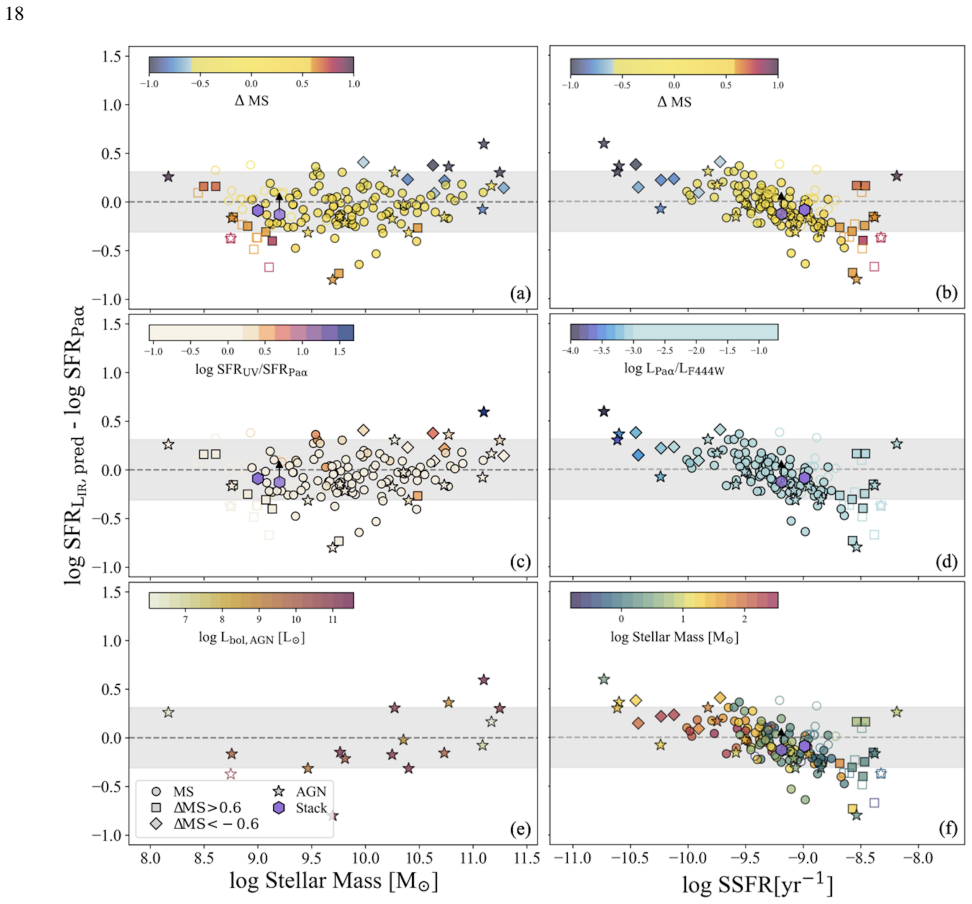
The mid-infrared (IR) spectrum of galaxies has a long history as a valuable proxy for the dust-obscured star formation rate (SFR) in massive galaxies. Now, with JWST, we can explore the mid-IR's full potential as a SFR tracer over four orders of magnitude in total infrared luminosity (9<~log LIR/Lo<~13). First, combining the SMILES and FRESCO surveys, we evaluate MIRI photometry against the Pa-alpha emission line - a gold standard SFR indicator - in Main Sequence (MS) galaxies at cosmic noon. We find the rest-frame 6-8um luminosity has a steeply superlinear relation with SFR(Pa-alpha) below ~8 Mo/yr, in contrast with the unity slope seen in coeval massive galaxies. We derive broken power-law SFR indicators from single-band MIRI photometry plus a representative dust template, with a scatter typical of IR SFRs (~0.2-0.3 dex). Despite the break in the mid-IR behavior and our simplifying assumption of a single dust SED, we next successfully formulate a UV+IR composite relation (scatter ~0.15 dex) under the usual assumption of energy balance. This implies that the rest-frame 6-8um primarily tracks the global dust-obscuration fraction - which decreases rapidly at log M*/Mo<~10 - rather than reflecting a deficit in PAH abundances at low mass. Our results thus support MIRI photometry as a robust SFR proxy at log M*/Mo>~9 up to z~3. Finally, extending to local and z>~1 ultraluminous infrared galaxies not represented in SMILES, we examine when Pa-alpha and the IR reliably track SFR in the bright regime.
Editorial analysis
A structured set of objections, weighed in public.
Referee Report
Summary. The paper calibrates rest-frame 6-8μm MIRI photometry as an SFR indicator by direct comparison to Pa-α in main-sequence galaxies at cosmic noon from the SMILES and FRESCO surveys. It reports a superlinear 6-8μm–SFR(Pa-α) relation below ~8 M⊙ yr⁻¹ (contrasting with unity slope at higher masses), derives broken power-law indicators using single-band MIRI plus one representative dust template (scatter 0.2-0.3 dex), and constructs a UV+IR composite under energy balance (scatter ~0.15 dex). The work concludes that 6-8μm primarily traces the global dust-obscuration fraction (which drops at log M*/M⊙ ≲10) rather than a PAH deficit, supporting MIRI photometry as a robust SFR proxy for log M*/M⊙ ≳9 up to z~3, with additional checks on local and high-z ULIRGs.
Significance. If the results hold, the empirical Pa-α comparisons and reported scatters provide a valuable, observationally grounded calibration for JWST MIRI single-band SFR proxies over a wide luminosity range, directly useful for galaxy evolution studies at cosmic noon. The low-scatter UV+IR composite and the physical interpretation linking mid-IR to obscuration fraction are strengths that could improve SFR estimates where UV or far-IR data are limited.
major comments (2)
- [Abstract and calibration section] Abstract and calibration section: The UV+IR composite relation and the claim that 6-8μm tracks global obscuration fraction (rather than PAH deficit) rest on the single representative dust SED template. Systematic variations in PAH strength, temperature, or continuum slope with stellar mass or sSFR in the log M*~9-10 regime sampled by SMILES/FRESCO would bias the luminosity-to-SFR conversion factors and the reported ~0.15 dex scatter; the manuscript should quantify this sensitivity (e.g., via multiple templates) to support the robustness conclusion.
- [Broken power-law derivation] Broken power-law derivation: The superlinear slope below the ~8 M⊙ yr⁻¹ break is central to the low-mass behavior and the overall proxy claim, yet the exact fitting procedure, error propagation from Pa-α and MIRI photometry, and justification for the break threshold are not shown to be robust against sample selection or template choice; this directly affects whether the indicators remain reliable at log M*/M⊙ ≳9.
minor comments (2)
- [Methods] Clarify in the methods how the Main Sequence sample is defined and whether any post-hoc exclusions were applied, to allow verification of the reported scatters.
- [Figures] Figures showing the 6-8μm vs. SFR(Pa-α) relations should explicitly mark the break point, include the fitted lines with uncertainties, and report the number of galaxies per bin.
Simulated Author's Rebuttal
We thank the referee for their careful reading and constructive comments, which have helped us strengthen the robustness of our analysis. We address each major comment below and have incorporated additional checks into the revised manuscript.
read point-by-point responses
-
Referee: [Abstract and calibration section] Abstract and calibration section: The UV+IR composite relation and the claim that 6-8μm tracks global obscuration fraction (rather than PAH deficit) rest on the single representative dust SED template. Systematic variations in PAH strength, temperature, or continuum slope with stellar mass or sSFR in the log M*~9-10 regime sampled by SMILES/FRESCO would bias the luminosity-to-SFR conversion factors and the reported ~0.15 dex scatter; the manuscript should quantify this sensitivity (e.g., via multiple templates) to support the robustness conclusion.
Authors: We agree that reliance on a single representative dust SED is a simplifying assumption that warrants explicit sensitivity testing. The core L_{6-8μm}–SFR(Pa-α) relation itself is empirical and independent of template choice. However, the UV+IR composite and the obscuration-fraction interpretation do depend on the total-IR conversion. In the revised manuscript we have added a new subsection (Section 4.3) that repeats the UV+IR analysis using two alternative templates (Chary & Elbaz 2001 and Dale et al. 2014, normalized to the observed 6–8 μm luminosity). The resulting scatter increases by ≤0.05 dex and the mass-dependent decline in obscuration fraction remains unchanged. We have updated the abstract and discussion to report these results and to justify the original template as the median SED of the SMILES/FRESCO sample. revision: yes
-
Referee: [Broken power-law derivation] Broken power-law derivation: The superlinear slope below the ~8 M⊙ yr⁻¹ break is central to the low-mass behavior and the overall proxy claim, yet the exact fitting procedure, error propagation from Pa-α and MIRI photometry, and justification for the break threshold are not shown to be robust against sample selection or template choice; this directly affects whether the indicators remain reliable at log M*/M⊙ ≳9.
Authors: The fitting details are provided in Section 3.2: we employ orthogonal distance regression that propagates uncertainties from both Pa-α equivalent-width measurements and MIRI photometry, with the break location determined by minimizing the Bayesian information criterion for a two-segment model. To address robustness, the revised manuscript now includes explicit tests: (i) repeating the fit after removing the lowest-mass quartile (log M* < 9.5) leaves the superlinear slope and break point unchanged within 1σ; (ii) substituting an alternative dust template shifts only the normalization, not the slope or break. These checks are shown in a new supplementary figure and confirm that the broken power-law indicators remain reliable for log M* ≳ 9. revision: yes
Circularity Check
No circularity: empirical calibration against independent Paα with explicit assumptions
full rationale
The paper's chain begins with direct empirical comparison of MIRI photometry to Pa-alpha luminosities (a gold-standard, independent SFR tracer) in MS galaxies from SMILES/FRESCO. Broken power-law indicators are fitted to these observed data using a single representative dust template, explicitly labeled a simplifying assumption. The UV+IR composite is constructed under the standard energy-balance assumption, with reported scatter of ~0.15 dex. No step reduces by the paper's equations to a fitted parameter renamed as prediction, self-definition, or load-bearing self-citation; the robustness claim follows from the measured scatter and the contrast with ULIRGs. The single-SED choice is flagged rather than smuggled, keeping the derivation self-contained against external benchmarks.
Axiom & Free-Parameter Ledger
free parameters (2)
- break SFR threshold =
~8
- broken power-law slopes
axioms (2)
- domain assumption A single representative dust SED template applies across the sample
- domain assumption Energy balance holds between absorbed UV and re-emitted IR
Reference graph
Works this paper leans on
-
[1]
2020, ApJ, 901, 168, doi: 10.3847/1538-4357/abb1a0
Nyland, K. 2020, ApJ, 901, 168, doi: 10.3847/1538-4357/abb1a0
-
[2]
2024, ApJ, 976, 224, doi: 10.3847/1538-4357/ad7396
Alberts, S., Lyu, J., Shivaei, I., et al. 2024, ApJ, 976, 224, doi: 10.3847/1538-4357/ad7396
-
[3]
Alonso-Herrero, A., Rieke, G. H., Rieke, M. J., et al. 2006, ApJ, 650, 835, doi: 10.1086/506958
-
[4]
Alonso-Herrero, A., Takagi, T., Baker, A. J., et al. 2004, ApJ, 612, 222, doi: 10.1086/422448
-
[5]
Aniano, G., Draine, B. T., Hunt, L. K., et al. 2020, ApJ, 889, 150, doi: 10.3847/1538-4357/ab5fdb
-
[6]
2007, ApJ, 656, 148, doi: 10.1086/510107 Astropy Collaboration, Robitaille, T
Armus, L., Charmandaris, V ., Bernard-Salas, J., et al. 2007, ApJ, 656, 148, doi: 10.1086/510107 Astropy Collaboration, Robitaille, T. P., Tollerud, E. J., et al. 2013, A&A, 558, A33, doi: 10.1051/0004-6361/201322068 Astropy Collaboration, Price-Whelan, A. M., Sip˝ocz, B. M., et al. 2018, AJ, 156, 123, doi: 10.3847/1538-3881/aabc4f Astropy Collaboration, ...
-
[7]
Atek, H., Furtak, L. J., Oesch, P., et al. 2022, MNRAS, 511, 4464, doi: 10.1093/mnras/stac360
-
[8]
2023, A&A, 670, A4, doi: 10.1051/0004-6361/202244187
Bacon, R., Brinchmann, J., Conseil, S., et al. 2023, A&A, 670, A4, doi: 10.1051/0004-6361/202244187
-
[9]
Bakes, E. L. O., & Tielens, A. G. G. M. 1994, ApJ, 427, 822, doi: 10.1086/174188
-
[10]
The Journal of Open Source Software , year = 2016, month = oct, volume =
Barbary, K. 2016, Journal of Open Source Software, 1, 58, doi: 10.21105/joss.00058
-
[11]
Baron, D., Sandstrom, K. M., Sutter, J., et al. 2025, ApJ, 978, 135, doi: 10.3847/1538-4357/ad972a
-
[12]
F., Fuentealba, P., Mu˜noz, F., G´omez, T., & C´ardenas, C
Barrera, N. F., Fuentealba, P., Mu˜noz, F., G´omez, T., & C´ardenas, C. 2023, MNRAS, 524, 3741, doi: 10.1093/mnras/stad2106
-
[13]
Bauschlicher, Jr., C. W. 1998, ApJ, 509, L125, doi: 10.1086/311782
-
[14]
F., Papovich, C., Wolf, C., et al
Bell, E. F., Papovich, C., Wolf, C., et al. 2005, ApJ, 625, 23, doi: 10.1086/429552 25
-
[15]
Bertin, E., & Arnouts, S. 1996, A&AS, 117, 393, doi: 10.1051/aas:1996164
-
[16]
Bian, F., Kewley, L. J., & Dopita, M. A. 2018, ApJ, 859, 175, doi: 10.3847/1538-4357/aabd74 B¨oker, T., Beck, T. L., Birkmann, S. M., et al. 2023, PASP, 135, 038001, doi: 10.1088/1538-3873/acb846
-
[17]
2021, A&A, 653, A149, doi: 10.1051/0004-6361/202140992
Boquien, M., & Salim, S. 2021, A&A, 653, A149, doi: 10.1051/0004-6361/202140992
-
[18]
J., Aravena, M., Decarli, R., et al
Bouwens, R. J., Aravena, M., Decarli, R., et al. 2016, ApJ, 833, 72, doi: 10.3847/1538-4357/833/1/72
-
[19]
2025,, 2.2.0 Zenodo, doi: 10.5281/zenodo.14889440
Bradley, L., Sip˝ocz, B., Robitaille, T., et al. 2025, doi: 10.5281/zenodo.14889440
-
[20]
2021, Zenodo, doi: 10.5281/zenodo.5012699
Brammer, G., & Matharu, J. 2021, Zenodo, doi: 10.5281/zenodo.5012699
-
[21]
Bunker, A. J., Cameron, A. J., Curtis-Lake, E., et al. 2024, A&A, 690, A288, doi: 10.1051/0004-6361/202347094
-
[22]
2023, Zenodo, doi: 10.5281/zenodo.10022973
Bushouse, H., Eisenhamer, J., Dencheva, N., et al. 2023, Zenodo, doi: 10.5281/zenodo.10022973
-
[23]
Byler, N., Dalcanton, J. J., Conroy, C., & Johnson, B. D. 2017, ApJ, 840, 44, doi: 10.3847/1538-4357/aa6c66
-
[24]
Calapa, M. D., Calzetti, D., Draine, B. T., et al. 2014, ApJ, 784, 130, doi: 10.1088/0004-637X/784/2/130
-
[25]
Star Formation Rate Indicators
Calzetti, D. 2013, in Secular Evolution of Galaxies, 419, doi: 10.48550/arXiv.1208.2997
-
[26]
Calzetti, D., Armus, L., Bohlin, R. C., et al. 2000, ApJ, 533, 682, doi: 10.1086/308692
work page internal anchor Pith review doi:10.1086/308692 2000
-
[27]
Calzetti, D., Kennicutt, R. C., Engelbracht, C. W., et al. 2007, ApJ, 666, 870, doi: 10.1086/520082
-
[28]
Calzetti, D., Wu, S. Y ., Hong, S., et al. 2010, ApJ, 714, 1256, doi: 10.1088/0004-637X/714/2/1256
-
[29]
Calzetti, D., Kennicutt, R. C., Adamo, A., et al. 2025, ApJ, 991, 198, doi: 10.3847/1538-4357/adfbe0
-
[30]
Cardelli, J. A., Clayton, G. C., & Mathis, J. S. 1989, ApJ, 345, 245, doi: 10.1086/167900
-
[31]
Charlot, S., & Fall, S. M. 2000, ApJ, 539, 718, doi: 10.1086/309250
-
[32]
2019, ApJ, 876, 62, doi: 10.3847/1538-4357/ab16cf
Chastenet, J., Sandstrom, K., Chiang, I.-D., et al. 2019, ApJ, 876, 62, doi: 10.3847/1538-4357/ab16cf
-
[33]
Chastenet, J., Sandstrom, K., Leroy, A. K., et al. 2025, ApJSuppl. Ser., 276, 2, doi: 10.3847/1538-4365/ad8a5c
-
[34]
Chisholm, J., Rigby, J. R., Bayliss, M., et al. 2019, ApJ, 882, 182, doi: 10.3847/1538-4357/ab3104
-
[35]
Cleri, N. J., Trump, J. R., Backhaus, B. E., et al. 2022, ApJ, 929, 3, doi: 10.3847/1538-4357/ac5a4c
-
[36]
Cluver, M. E., Jarrett, T. H., Dale, D. A., et al. 2017, ApJ, 850, 68, doi: 10.3847/1538-4357/aa92c7
-
[37]
Conroy, C., & Gunn, J. E. 2010, ApJ, 712, 833, doi: 10.1088/0004-637X/712/2/833
-
[38]
Conroy, C., Gunn, J. E., & White, M. 2009, ApJ, 699, 486, doi: 10.1088/0004-637X/699/1/486
work page internal anchor Pith review doi:10.1088/0004-637x/699/1/486 2009
-
[39]
and Calzetti, Daniela and Thilker, David A
Crocker, A. F., Calzetti, D., Thilker, D. A., et al. 2013, ApJ, 762, 79, doi: 10.1088/0004-637X/762/2/79
-
[40]
Dale, D. A., & Helou, G. 2002, ApJ, 576, 159, doi: 10.1086/341632
-
[41]
2005, A&A, 441, 999, doi: 10.1051/0004-6361:20052812
Dannerbauer, H., Rigopoulou, D., Lutz, D., et al. 2005, A&A, 441, 999, doi: 10.1051/0004-6361:20052812
-
[42]
Dasyra, K. M., Yan, L., Helou, G., et al. 2009, ApJ, 701, 1123, doi: 10.1088/0004-637X/701/2/1123 De Rossi, M. E., Rieke, G. H., Shivaei, I., Bromm, V ., & Lyu, J. 2018, ApJ, 869, 4, doi: 10.3847/1538-4357/aaebf8 D’Eugenio, F., Cameron, A. J., Scholtz, J., et al. 2025, ApJS, 277, 4, doi: 10.3847/1538-4365/ada148
-
[43]
Diamond-Stanic, A. M., & Rieke, G. H. 2010, ApJ, 724, 140, doi: 10.1088/0004-637X/724/1/140 D´ıaz-Santos, T., Alonso-Herrero, A., Colina, L., et al. 2008, ApJ, 685, 211, doi: 10.1086/588276
-
[44]
Dole, H., Rieke, G. H., Lagache, G., et al. 2004, ApJS, 154, 93, doi: 10.1086/422690
-
[45]
2006, A&A, 451, 417, doi: 10.1051/0004-6361:20054446 Dom´ınguez, A., Siana, B., Brooks, A
Dole, H., Lagache, G., Puget, J.-L., et al. 2006, A&A, 451, 417, doi: 10.1051/0004-6361:20054446 Dom´ınguez, A., Siana, B., Brooks, A. M., et al. 2015, MNRAS, 451, 839, doi: 10.1093/mnras/stv1001
-
[46]
R., Garc´ıa-Bernete, I., Rigopoulou, D., et al
Donnan, F. R., Garc´ıa-Bernete, I., Rigopoulou, D., et al. 2024, MNRAS, 529, 1386, doi: 10.1093/mnras/stae612
-
[47]
Dopita, M. A., Groves, B. A., Sutherland, R. S., & Kewley, L. J. 2003, ApJ, 583, 727, doi: 10.1086/345448
-
[48]
Draine, B. T., & Li, A. 2007, ApJ, 657, 810, doi: 10.1086/511055
-
[49]
Draine, B. T., Li, A., Hensley, B. S., et al. 2021, ApJ, 917, 3, doi: 10.3847/1538-4357/abff51
-
[50]
and Kreckel, Kathryn and Sandstrom, Karin M
Egorov, O. V ., Kreckel, K., Sandstrom, K. M., et al. 2023, ApJ, 944, L16, doi: 10.3847/2041-8213/acac92
-
[51]
Egorov, O. V ., Leroy, A. K., Sandstrom, K., et al. 2025, A&A, 703, A103, doi: 10.1051/0004-6361/202556427
-
[52]
J., Willott, C., Alberts, S., et al
Eisenstein, D. J., Willott, C., Alberts, S., et al. 2026, ApJS, 283, 6, doi: 10.3847/1538-4365/ae3163
-
[53]
2005, A&A, 434, L1, doi: 10.1051/0004-6361:200500095
Elbaz, D., Le Floc’h, E., Dole, H., & Marcillac, D. 2005, A&A, 434, L1, doi: 10.1051/0004-6361:200500095
-
[54]
Elbaz, D., Hwang, H. S., Magnelli, B., et al. 2010, A&A, 518, L29, doi: 10.1051/0004-6361/201014687
-
[55]
Elbaz, D., Dickinson, M., Hwang, H. S., et al. 2011, A&A, 533, A119, doi: 10.1051/0004-6361/201117239
-
[56]
Emami, N., Siana, B., Weisz, D. R., et al. 2019, ApJ, 881, 71, doi: 10.3847/1538-4357/ab211a
-
[57]
Engelbracht, C. W., Gordon, K. D., Rieke, G. H., et al. 2005, ApJ, 628, L29, doi: 10.1086/432613
-
[58]
Engelbracht, C. W., Rieke, G. H., Gordon, K. D., et al. 2008, ApJ, 678, 804, doi: 10.1086/529513
-
[59]
Farrah, D., Bernard-Salas, J., Spoon, H. W. W., et al. 2007, ApJ, 667, 149, doi: 10.1086/520834 26
-
[60]
2010, A&A, 524, A33, doi: 10.1051/0004-6361/201015504 Flores Vel´azquez, J
Fiolet, N., Omont, A., Lagache, G., et al. 2010, A&A, 524, A33, doi: 10.1051/0004-6361/201015504 Flores Vel´azquez, J. A., Gurvich, A. B., Faucher-Gigu`ere, C.-A., et al. 2021, MNRAS, 501, 4812, doi: 10.1093/mnras/staa3893
-
[61]
Florian, M. K., Rieke, G. H., Alberts, S., et al. 2025, ApJ, 990, 102, doi: 10.3847/1538-4357/adee1d
-
[62]
2018, MNRAS, 479, 649, doi: 10.1093/mnras/sty1528
Foley, N., Cazaux, S., Egorov, D., et al. 2018, MNRAS, 479, 649, doi: 10.1093/mnras/sty1528
-
[63]
Fumagalli, M., Labb´e, I., Patel, S. G., et al. 2014, ApJ, 796, 35, doi: 10.1088/0004-637X/796/1/35
-
[64]
Galliano, F., Dwek, E., & Chanial, P. 2008, ApJ, 672, 214, doi: 10.1086/523621 Garc´ıa-Bernete, I., Rigopoulou, D., Alonso-Herrero, A., et al. 2022, A&A, 666, L5, doi: 10.1051/0004-6361/202244806
-
[65]
Gardner, J. P., Mather, J. C., Abbott, R., et al. 2023, PASP, 135, 068001, doi: 10.1088/1538-3873/acd1b5 Gim´enez-Arteaga, C., Brammer, G. B., Marchesini, D., et al. 2022, ApJSuppl. Ser., 263, 17, doi: 10.3847/1538-4365/ac958c
-
[66]
Goldberg, C. E., Buiten, V . A., Rieke, G. H., et al. 2024, ApJ, 977, 55, doi: 10.3847/1538-4357/ad7eb0
-
[67]
Gordon, K. D., Calzetti, D., & Witt, A. N. 1997, ApJ, 487, 625, doi: 10.1086/304654
-
[68]
Gordon, K. D., Misselt, K. A., Bouwman, J., et al. 2021, ApJ, 916, 33, doi: 10.3847/1538-4357/ac00b7
-
[69]
Gordon, K. D., Fitzpatrick, E. L., Massa, D., et al. 2024, ApJ, 970, 51, doi: 10.3847/1538-4357/ad4be1
-
[70]
Guo, Y ., Rafelski, M., Faber, S. M., et al. 2016, ApJ, 833, 37, doi: 10.3847/1538-4357/833/1/37
-
[71]
Hao, C.-N., Kennicutt, R. C., Johnson, B. D., et al. 2011, ApJ, 741, 124, doi: 10.1088/0004-637X/741/2/124
-
[72]
Hayward, C. C., Lanz, L., Ashby, M. L. N., et al. 2014, MNRAS, 445, 1598, doi: 10.1093/mnras/stu1843
-
[73]
2001, ApJ, 548, L73, doi: 10.1086/318916
Contursi, A. 2001, ApJ, 548, L73, doi: 10.1086/318916
-
[74]
Huang, J. S., Faber, S. M., Daddi, E., et al. 2009, ApJ, 700, 183, doi: 10.1088/0004-637X/700/1/183
-
[75]
Hummer, D. G., & Storey, P. J. 1987, MNRAS, 224, 801, doi: 10.1093/mnras/224.3.801
-
[76]
Hunt, L. K., Thuan, T. X., Izotov, Y . I., & Sauvage, M. 2010, ApJ, 712, 164, doi: 10.1088/0004-637X/712/1/164
-
[77]
Hunter, J. D. 2007, Computing in Science & Engineering, 9, 90, doi: 10.1109/MCSE.2007.55
-
[78]
Illingworth, G., Magee, D., Bouwens, R., et al. 2016, The Hubble Legacy Fields (HLF-GOODS-S) v1.5 Data Products: Combining 2442 Orbits of GOODS-S/CDF-S Region ACS and WFC3/IR Images, doi: 10.48550/arXiv.1606.00841
-
[79]
2018, A&A, 617, A130, doi: 10.1051/0004-6361/201833053
Inami, H., Armus, L., Matsuhara, H., et al. 2018, A&A, 617, A130, doi: 10.1051/0004-6361/201833053
-
[80]
K., Hirashita, H., & Kamaya, H
Inoue, A. K., Hirashita, H., & Kamaya, H. 2001, ApJ, 555, 613, doi: 10.1086/321499
discussion (0)
Sign in with ORCID, Apple, or X to comment. Anyone can read and Pith papers without signing in.