Generative Chemical Language Models for Energetic Materials Discovery
Pith reviewed 2026-05-14 00:05 UTC · model grok-4.3
The pith
Pretrained chemical language models fine-tuned on energetic materials datasets generate synthetically accessible candidate molecules.
A machine-rendered reading of the paper's core claim, the machinery that carries it, and where it could break.
Core claim
Generative molecular language models pretrained on extensive chemical data and fine-tuned with curated energetic materials datasets extend chemical language model capabilities beyond the pharmacological space, offering a framework applicable to other data-sparse discovery problems; fragment-based molecular encodings further aid in constructing synthetically accessible structures.
What carries the argument
The transfer-learning strategy in chemical language models using fragment-based molecular encodings, which generates structures that are chemically valid and synthetically accessible for energetic materials.
If this is right
- Accelerates design of next-generation energetic materials meeting demanding performance requirements.
- Supplies a reusable framework for data-sparse molecular discovery in other domains.
- Enhances generation of synthetically accessible structures through fragment-based encodings.
- Reduces dependence on exhaustive experimental screening for initial candidate selection.
Where Pith is reading between the lines
- The method could be paired with physics-based simulations to prioritize generated candidates for synthesis.
- Transfer learning of this type may apply to other chemistry areas with sparse data, such as specialized catalysts or high-performance polymers.
- Over time the approach might shorten development cycles and lower costs for creating improved energetic materials.
Load-bearing premise
That fine-tuning on the curated energetic materials datasets will produce chemically valid, synthetically accessible, and performance-competitive molecules without requiring extensive additional experimental validation or post-generation filtering.
What would settle it
Synthesizing and testing several generated molecules and observing that most lack the targeted energetic performance metrics such as detonation velocity or are not feasible to produce in the lab.
Figures


read the original abstract
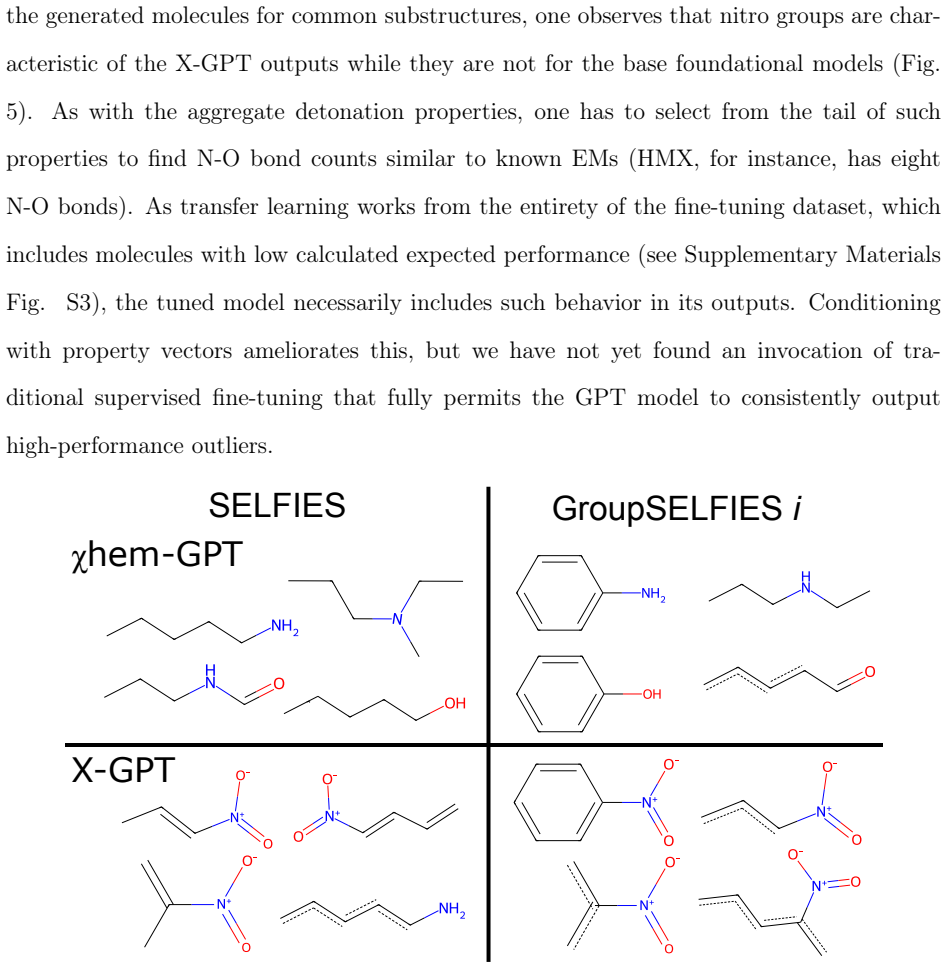
The discovery of new energetic materials remains a pressing challenge hindered by limited availability of high-quality data. To address this, we have developed generative molecular language models that have been pretrained on extensive chemical data and then fine-tuned with curated energetic materials datasets. This transfer-learning strategy extends the chemical language model capabilities beyond the pharmacological space in which they have been predominantly developed, offering a framework applicable to other data-spare discovery problems. Furthermore, we discuss the benefits of fragment-based molecular encodings for chemical language models, in particular in constructing synthetically accessible structures. Together, these advances provide a foundation for accelerating the design of next-generation energetic materials with demanding performance requirements.
Editorial analysis
A structured set of objections, weighed in public.
Referee Report
Summary. The manuscript proposes a transfer-learning framework for generative chemical language models: pretraining on large general chemical corpora followed by fine-tuning on curated energetic-materials datasets, together with a discussion of fragment-based encodings intended to improve synthetic accessibility of generated structures. The central claim is that this strategy extends language-model capabilities beyond the pharmacological domain and supplies a practical foundation for data-sparse energetic-materials discovery.
Significance. If the fine-tuned models demonstrably generate chemically valid, novel, and synthetically accessible energetic molecules whose predicted performance matches or exceeds known benchmarks, the work would offer a reusable template for other data-limited chemical domains and could meaningfully accelerate candidate generation in energetic-materials research.
major comments (2)
- [Results / Experimental validation] The manuscript states that models “have been pretrained … and then fine-tuned” yet reports no quantitative metrics (validity, uniqueness, novelty, or property-prediction accuracy) nor any baseline comparisons; without these data the central claim that the transfer-learning strategy successfully extends the models to energetic materials remains unsupported.
- [§4] §4 (Fragment-based encodings): the assertion that fragment encodings “construct synthetically accessible structures” is presented without any post-generation filtering statistics, retrosynthetic accessibility scores, or comparison to SMILES-based generation; this step is load-bearing for the accessibility claim but lacks empirical grounding.
minor comments (2)
- [Abstract] The abstract would be strengthened by a single sentence summarizing the scale of the pretraining corpus and the size of the energetic-materials fine-tuning set.
- [Methods] Notation for the language-model architecture (e.g., vocabulary size, embedding dimension) should be defined once at first use rather than assumed from prior literature.
Simulated Author's Rebuttal
We thank the referee for their thorough review and constructive comments on our manuscript. We have carefully considered the major concerns raised regarding the lack of quantitative metrics and empirical validation for the fragment-based encodings. In response, we have revised the manuscript to include the necessary data and comparisons to strengthen our claims.
read point-by-point responses
-
Referee: [Results / Experimental validation] The manuscript states that models “have been pretrained … and then fine-tuned” yet reports no quantitative metrics (validity, uniqueness, novelty, or property-prediction accuracy) nor any baseline comparisons; without these data the central claim that the transfer-learning strategy successfully extends the models to energetic materials remains unsupported.
Authors: We agree that quantitative metrics are essential to support the central claims. The original submission focused on the methodological framework and conceptual discussion, but we acknowledge the need for empirical validation. In the revised manuscript, we have added a dedicated results section (new §3.2) reporting validity, uniqueness, novelty scores for the fine-tuned models, along with property-prediction accuracy using established benchmarks for energetic materials. We also include baseline comparisons against models trained from scratch and non-transfer learning approaches, demonstrating improvements in generation quality and relevance to the energetic materials domain. revision: yes
-
Referee: [§4] §4 (Fragment-based encodings): the assertion that fragment encodings “construct synthetically accessible structures” is presented without any post-generation filtering statistics, retrosynthetic accessibility scores, or comparison to SMILES-based generation; this step is load-bearing for the accessibility claim but lacks empirical grounding.
Authors: We appreciate this point and recognize that the discussion in §4 would benefit from empirical support. In the revised version, we have incorporated post-generation analysis including the percentage of generated structures passing basic validity filters, average retrosynthetic accessibility scores computed via established tools (e.g., RAscore), and direct comparisons showing that fragment-based encodings yield higher accessibility scores and fewer invalid structures compared to standard SMILES generation. These additions provide the necessary grounding for the accessibility claims. revision: yes
Circularity Check
No significant circularity detected
full rationale
The paper presents a standard transfer-learning methodology for generative chemical language models: pretraining on broad chemical data followed by fine-tuning on curated energetic materials datasets, with discussion of fragment-based encodings. No equations, derivations, or predictions are described that reduce by construction to fitted inputs or self-referential definitions. The approach relies on established machine-learning practices without load-bearing self-citations, uniqueness theorems, or ansatzes that collapse the central claim into its own assumptions. The derivation chain is self-contained and externally falsifiable via generated molecule validation.
Axiom & Free-Parameter Ledger
Lean theorems connected to this paper
-
IndisputableMonolith/Cost/FunctionalEquationwashburn_uniqueness_aczel unclear?
unclearRelation between the paper passage and the cited Recognition theorem.
we have developed generative molecular language models that have been pretrained on extensive chemical data and then fine-tuned with curated energetic materials datasets
What do these tags mean?
- matches
- The paper's claim is directly supported by a theorem in the formal canon.
- supports
- The theorem supports part of the paper's argument, but the paper may add assumptions or extra steps.
- extends
- The paper goes beyond the formal theorem; the theorem is a base layer rather than the whole result.
- uses
- The paper appears to rely on the theorem as machinery.
- contradicts
- The paper's claim conflicts with a theorem or certificate in the canon.
- unclear
- Pith found a possible connection, but the passage is too broad, indirect, or ambiguous to say the theorem truly supports the claim.
Reference graph
Works this paper leans on
-
[1]
(7) Li, C.; Wang, C.; Sun, M.; Zeng, Y.; Yuan, Y.; Gou, Q.; Wang, G.; Guo, Y.; Pu, X. Correlated RNN framework to quickly generate molecules with desired properties for energetic materials in the low data regime.Journal of Chemical Information and Mod- eling2022,62, 4873–4887. (8) Barnes, B. C.; Elton, D. C.; Boukouvalas, Z.; Taylor, D. E.; Mattson, W. D....
-
[2]
(21) Krenn, M.; Häse, F.; Nigam, A.; Friederich, P.; Aspuru-Guzik, A
Introduction to methodology and encoding rules.Journal of Chemical Information and Computer Sciences1988,28, 31–36. (21) Krenn, M.; Häse, F.; Nigam, A.; Friederich, P.; Aspuru-Guzik, A. Self-referencing em- bedded strings (SELFIES): A 100% robust molecular string representation.Machine Learning: Science and Technology2020,1, 045024. (22) Radford, A.; Nara...
work page 2018
-
[3]
(25) Xue, D.; Gong, Y.; Yang, Z.; Chuai, G.; Qu, S.; Shen, A.; Yu, J.; Liu, Q. Advances and 42 challenges in deep generative models for de novo molecule generation.Wiley Interdis- ciplinary Reviews: Computational Molecular Science2019,9, e1395. (26) Meyers, J.; Fabian, B.; Brown, N. De novo molecular design and generative models. Drug discovery today2021,...
-
[4]
Byte pair encoding: A text compression scheme that accelerates pattern matching.1999, (48) Allen, F
(47) Shibata, Y.; Kida, T.; Fukamachi, S.; Takeda, M.; Shinohara, A.; Shinohara, T.; Arikawa, S. Byte pair encoding: A text compression scheme that accelerates pattern matching.1999, (48) Allen, F. H. The Cambridge Structural Database: a quarter of a million crystal struc- tures and rising.Structural Science2002,58, 380–388. (49) Fried, L. E.Cheetah 1.0 u...
work page 1999
-
[5]
Adam: A Method for Stochastic Optimization
(50) Chai, J.-D.; Head-Gordon, M. Long-range corrected hybrid density functionals with damped atom–atom dispersion corrections.Physical Chemistry Chemical Physics2008, 10, 6615–6620. 45 (51) Mathieu, D. Accurate or fast prediction of solid-state formation enthalpies using stan- dard sublimation enthalpies derived from geometrical fragments.Industrial & En...
work page internal anchor Pith review Pith/arXiv arXiv 2017
-
[6]
H.; Kolehmainen, J.; Shivakumar, P
(57) Yu, Y.; Yang, C.-H. H.; Kolehmainen, J.; Shivakumar, P. G.; Gu, Y.; Ren, S. R. R.; Luo, Q.; Gourav, A.; Chen, I.-F.; Liu, Y.-C.; others Low-rank adaptation of large lan- guage model rescoring for parameter-efficient speech recognition. 2023 IEEE Automatic Speech Recognition and Understanding Workshop (ASRU). 2023; pp 1–8. (58) Wang, L.; Pulugurta, R....
-
[7]
(73) Mok, D. H.; Back, S. Generative Pretrained Transformer for Heterogeneous Catalysts. Journal of the American Chemical Society2024,146, 33712–33722, PMID: 39576215. (74) Soares, E.; Sharma, V.; Brazil, E. V.; Cerqueira, R.; Na, Y.-H. Capturing formulation design of battery electrolytes with chemical large language model. AI for Accelerated Materials De...
work page 2023
-
[8]
(76) PyTorch development team PyTorch (v 2.6.0)
(75) Paszke, A.; Gross, S.; Massa, F.; Lerer, A.; Bradbury, J.; Chanan, G.; Killeen, T.; Lin, Z.; Gimelshein, N.; Antiga, L.; others Pytorch: An imperative style, high- performance deep learning library.Advances in Neural Information Processing Systems 2019,32. (76) PyTorch development team PyTorch (v 2.6.0). 2025;https://github.com/pytorch/ pytorch. 48 (...
work page 2019
discussion (0)
Sign in with ORCID, Apple, or X to comment. Anyone can read and Pith papers without signing in.