Probing Electrostatic Disorder via g-Tensor Geometry
Pith reviewed 2026-05-10 17:10 UTC · model grok-4.3
The pith
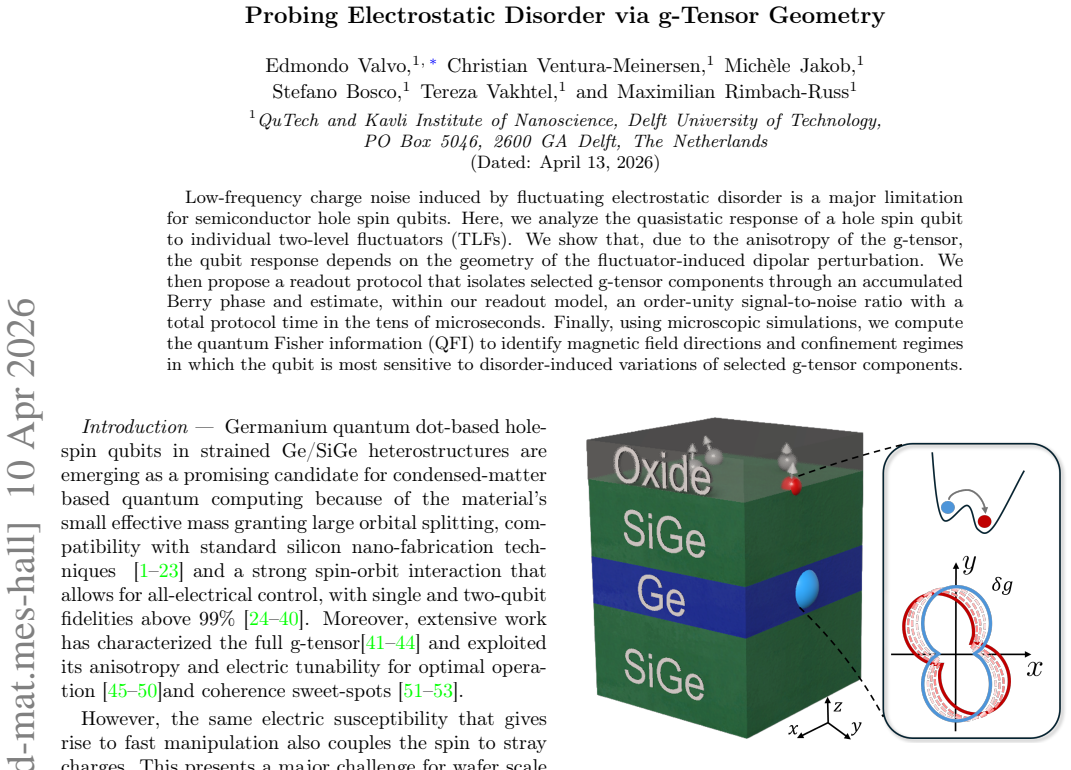
Due to g-tensor anisotropy, a hole spin qubit's response to individual charge fluctuators depends on the geometry of their dipolar fields.
A machine-rendered reading of the paper's core claim, the machinery that carries it, and where it could break.
Core claim
The quasistatic response of a hole spin qubit to individual two-level fluctuators depends on the geometry of the fluctuator-induced dipolar perturbation because of the anisotropy of the g-tensor. A readout protocol is proposed that isolates selected g-tensor components through an accumulated Berry phase, with an estimated order-unity signal-to-noise ratio in a total protocol time of tens of microseconds. Microscopic simulations compute the quantum Fisher information to find magnetic field directions and confinement regimes where the qubit is most sensitive to variations in selected g-tensor components induced by disorder.
What carries the argument
The anisotropic g-tensor, which sets how the electric dipole field of a nearby fluctuator produces a position-dependent effective magnetic-field shift on the qubit spin.
Load-bearing premise
The qubit response to each fluctuator remains quasistatic and the g-tensor anisotropy is correctly described by the microscopic model of hole confinement used in the simulations.
What would settle it
Measure the qubit's accumulated phase or frequency shift while systematically changing the in-plane magnetic-field angle or the dot confinement and check whether the variation matches the geometry dependence predicted for a fixed fluctuator location.
Figures


read the original abstract
Low-frequency charge noise induced by fluctuating electrostatic disorder is a major limitation for semiconductor hole spin qubits. Here, we analyze the quasistatic response of a hole spin qubit to individual two-level fluctuators (TLFs). We show that, due to the anisotropy of the g-tensor, the qubit response depends on the geometry of the fluctuator-induced dipolar perturbation. We then propose a readout protocol that isolates selected g-tensor components through an accumulated Berry phase and estimate, within our readout model, an order-unity signal-to-noise ratio with a total protocol time in the tens of microseconds. Finally, using microscopic simulations, we compute the quantum Fisher information (QFI) to identify magnetic field directions and confinement regimes in which the qubit is most sensitive to disorder-induced variations of selected g-tensor components.
Editorial analysis
A structured set of objections, weighed in public.
Referee Report
Summary. The manuscript analyzes the quasistatic response of hole spin qubits to individual two-level fluctuators (TLFs) inducing electrostatic disorder. It shows that, due to g-tensor anisotropy, the qubit response depends on the geometry of the fluctuator-induced dipolar perturbation. A readout protocol is proposed that isolates selected g-tensor components via accumulated Berry phase, with an estimated order-unity SNR for total protocol times in the tens of microseconds. Microscopic simulations are used to compute the quantum Fisher information (QFI) and identify magnetic field directions and confinement regimes maximizing sensitivity to disorder-induced g-tensor variations.
Significance. If the central claims hold, the work provides a geometry-based method to probe electrostatic disorder in hole spin qubits, potentially aiding noise mitigation strategies. The combination of Berry-phase isolation with QFI optimization from microscopic confinement simulations offers concrete, falsifiable guidance for device design and field orientation. Strengths include the parameter-free aspects of the geometric derivation from the standard anisotropic g-tensor Hamiltonian and the explicit SNR estimate within the readout model.
major comments (3)
- [Readout protocol and SNR estimation sections] The order-unity SNR estimate and the isolation of g-tensor components via Berry phase both rest on the quasistatic TLF approximation (TLFs treated as fixed dipolar shifts during the accumulation window). The manuscript does not bound typical TLF switching rates against the stated protocol duration of tens of µs; when rates become comparable, the phase accumulation reverts to a stochastic random walk, undermining both the geometric isolation and the SNR prediction. This assumption is load-bearing for the readout protocol claim.
- [Microscopic simulations and QFI computation section] The QFI optima for B-field directions and confinement regimes are obtained from microscopic simulations of the confinement potential and g-tensor anisotropy, but the manuscript summarizes these details without providing the explicit model Hamiltonian, parameter values, or convergence checks. Without these, it is impossible to assess whether the reported optima are robust or artifacts of the specific simulation choices.
- [Geometry dependence derivation] The geometry dependence of the qubit response is derived from the anisotropic g-tensor Hamiltonian plus Berry-phase accumulation. The manuscript should explicitly demonstrate (e.g., via an equation for the accumulated phase) that the protocol isolates individual g-tensor components independently of the precise dipolar geometry, or state the additional assumptions required.
minor comments (2)
- Define all acronyms (TLF, QFI, SNR, Berry phase) at first use in the main text.
- [SNR estimation] Clarify the precise definition of the 'total protocol time' used for the SNR estimate, including any overhead from initialization or readout.
Simulated Author's Rebuttal
We thank the referee for the careful reading and constructive comments. The recognition of the parameter-free geometric aspects and the concrete guidance from QFI optimization is appreciated. We address each major comment below and have revised the manuscript accordingly.
read point-by-point responses
-
Referee: [Readout protocol and SNR estimation sections] The order-unity SNR estimate and the isolation of g-tensor components via Berry phase both rest on the quasistatic TLF approximation (TLFs treated as fixed dipolar shifts during the accumulation window). The manuscript does not bound typical TLF switching rates against the stated protocol duration of tens of µs; when rates become comparable, the phase accumulation reverts to a stochastic random walk, undermining both the geometric isolation and the SNR prediction. This assumption is load-bearing for the readout protocol claim.
Authors: We agree that the quasistatic approximation is central to the protocol. In the revised manuscript we have added a dedicated paragraph in Section IV that cites experimental literature on TLF switching rates in hole spin devices (typically 1 Hz–few kHz). For protocol durations of tens of µs this places the relevant rates well below the inverse protocol time, preserving the fixed-shift assumption. We also include a short estimate showing that rates above ~10 kHz would degrade the SNR, but such fast fluctuators lie outside the low-frequency noise regime targeted by the method. The assumption is now explicitly bounded rather than implicit. revision: yes
-
Referee: [Microscopic simulations and QFI computation section] The QFI optima for B-field directions and confinement regimes are obtained from microscopic simulations of the confinement potential and g-tensor anisotropy, but the manuscript summarizes these details without providing the explicit model Hamiltonian, parameter values, or convergence checks. Without these, it is impossible to assess whether the reported optima are robust or artifacts of the specific simulation choices.
Authors: We acknowledge the summary was too terse. The revised manuscript now includes a new Appendix C that states the full model Hamiltonian (including the explicit form of the electrostatic confinement potential and the position-dependent g-tensor), lists all numerical parameters (well widths, effective masses, strain values, electric-field strengths), and reports convergence tests with respect to basis size and spatial discretization. The QFI optima remain stable to within 5 % under these checks, confirming they are not artifacts. revision: yes
-
Referee: [Geometry dependence derivation] The geometry dependence of the qubit response is derived from the anisotropic g-tensor Hamiltonian plus Berry-phase accumulation. The manuscript should explicitly demonstrate (e.g., via an equation for the accumulated phase) that the protocol isolates individual g-tensor components independently of the precise dipolar geometry, or state the additional assumptions required.
Authors: We have expanded Section III with an explicit derivation of the accumulated phase. The protocol sequence produces a Berry phase whose first-order shift is δφ = (1/2) n̂ · δg · n̂ Δt, where n̂ is the unit vector along the instantaneous effective field set by the pulse sequence. By aligning the static field along principal g-tensor axes and using orthogonal pulse rotations, the phase isolates individual diagonal components of δg. The dipolar geometry enters only through the overall magnitude of the perturbation vector; the directional selectivity is provided by the g-tensor anisotropy and the chosen pulse sequence, independent of the precise dipole orientation. The additional assumptions (quasistatic limit and linear-response regime) are now stated immediately after the equation. revision: yes
Circularity Check
No significant circularity; derivation self-contained from standard Hamiltonian and Berry phase
full rationale
The paper derives the geometry-dependent qubit response directly from the anisotropic g-tensor Hamiltonian under the stated quasistatic approximation for TLFs. The proposed Berry-phase readout protocol follows from standard geometric phase accumulation formulas applied to the time-dependent effective field. QFI optima are obtained by numerical simulation of the microscopic confinement model and g-tensor variations; these are forward computations, not fits renamed as predictions. No self-definitional loops, fitted-input predictions, or load-bearing self-citations appear in the derivation chain. All load-bearing steps rest on externally verifiable assumptions (quasistatic limit, g-tensor anisotropy) rather than reducing to the target results by construction.
Axiom & Free-Parameter Ledger
axioms (2)
- domain assumption Quasistatic response of the hole spin qubit to individual two-level fluctuators
- domain assumption Anisotropy of the g-tensor in semiconductor hole systems
Reference graph
Works this paper leans on
-
[1]
For a palindromic sweepϕTilt(t), the dynamical phase cancels exactly, while the geometric phase adds over the two halves of the sequence. 4 The final state after one full cycle is therefore |ψf ⟩= 1√ 2 ei2˜γ1 |−⟩0 +e −i2˜γ1 |+⟩0 .(6) After applying a secondXgate and measuring in the localybasis, we obtain ⟨Y⟩= sin(4n˜γ1)(7) afternrepetitionsofthecycle. Th...
- [2]
-
[3]
G. Burkard, T. D. Ladd, A. Pan, J. M. Nichol, and J. R. Petta, Reviews of Modern Physics95, 025003 (2023)
work page 2023
- [4]
-
[5]
L. M. K. Vandersypen, H. Bluhm, J. S. Clarke, A. S. Dzurak, R. Ishihara, A. Morello, D. J. Reilly, L. R. Schreiber, and M. Veldhorst, npj Quantum Informa- tion3, 34 (2017)
work page 2017
-
[6]
S. G. J. Philips, M. T. Mądzik, S. V. Amitonov, S. L. de Snoo, M. Russ, N. Kalhor, C. Volk, W. I. L. Lawrie, D. Brousse, L. Tryputen, B. P. Wuetz, A. Sammak, M. Veldhorst, G. Scappucci, and L. M. K. Vander- sypen, Nature609, 919 (2022)
work page 2022
-
[7]
X. Xue, M. Russ, N. Samkharadze, B. Undseth, A. Sammak, G. Scappucci, and L. M. K. Vandersypen, Nature601, 343 (2022)
work page 2022
-
[8]
A. R. Mills, C. R. Guinn, M. J. Gullans, A. J. Sigillito, M. M. Feldman, E. Nielsen, and J. R. Petta, Science Advances8, eabn5130 (2022)
work page 2022
-
[9]
A. Zwerver, S. Amitonov, S. De Snoo, M. Mądzik, M. Rimbach-Russ, A. Sammak, G. Scappucci, and L. Vandersypen, PRX Quantum4, 030303 (2023)
work page 2023
-
[10]
M. De Smet, Y. Matsumoto, A.-M. J. Zwerver, L. Try- puten, S. L. de Snoo, S. V. Amitonov, S. R. Katiraee- Far, A. Sammak, N. Samkharadze, Ö. Gül, R. N. M. Wasserman, E. Greplová, M. Rimbach-Russ, G. Scap- pucci, and L. M. K. Vandersypen, Nature Nanotech- nology20, 866 (2025)
work page 2025
- [11]
- [12]
-
[13]
URL https://arxiv.org/abs/2507.11918
Y.-H. Wu, L. C. Camenzind, P. Bütler, I. K. Jin, A. Noiri, K. Takeda, T. Nakajima, T. Kobayashi, G. Scappucci, H.-S. Goan, and S. Tarucha, “Simulta- neous High-Fidelity Single-Qubit Gates in a Spin Qubit Array,” (2025), 2507.11918
-
[14]
P. Steinacker, N. Dumoulin Stuyck, W. H. Lim, T. Tanttu, M. Feng, S. Serrano, A. Nickl, M. Candido, J. D. Cifuentes, E. Vahapoglu, S. K. Bartee, F. E. Hud- son, K. W. Chan, S. Kubicek, J. Jussot, Y. Canvel, S. Beyne, Y. Shimura, R. Loo, C. Godfrin, B. Raes, S. Baudot, D. Wan, A. Laucht, C. H. Yang, A. Saraiva, C. C. Escott, K. De Greve, and A. S. Dzurak, ...
-
[15]
M. F. Gonzalez-Zalba, S. de Franceschi, E. Charbon, T. Meunier, M. Vinet, and A. S. Dzurak, Nature Elec- tronics4, 872 (2021)
work page 2021
- [16]
- [17]
- [18]
-
[19]
D. Svastits, B. Hetényi, G. Széchenyi, J. Wootton, D. Loss, S. Bosco, and A. Pályi, Physical Review Let- ters136, 117001 (2026)
work page 2026
-
[20]
R. Li, N. I. D. Stuyck, S. Kubicek, J. Jussot, B. T. 6 Chan, F. A. Mohiyaddin, A. Elsayed, M. Shehata, G. Simion, C. Godfrin, Y. Canvel, Ts. Ivanov, L. Goux, B. Govoreanu, and I. P. Radu, in2020 IEEE Inter- national Electron Devices Meeting (IEDM)(2020) pp. 38.3.1–38.3.4
work page 2020
-
[21]
C. Kloeffel and D. Loss, Annual Review of Condensed Matter Physics4, 51 (2013)
work page 2013
-
[22]
Y. Fang, P. Philippopoulos, D. Culcer, W. A. Coish, and S. Chesi, Materials for Quantum Technology3, 012003 (2023)
work page 2023
-
[23]
R. Maurand, X. Jehl, D. Kotekar-Patil, A. Corna, H. Bohuslavskyi, R. Laviéville, L. Hutin, S. Barraud, M. Vinet, M. Sanquer, and S. De Franceschi, Nature Communications7, 13575 (2016)
work page 2016
-
[24]
A Three-Dimensional Array of Quantum Dots,
H. Tidjani, D. Denora, M. Chan, J. H. Ungerer, B. van Straaten, S. D. Oosterhout, L. Stehouwer, G. Scap- pucci, and M. Veldhorst, “A Three-Dimensional Array of Quantum Dots,” (2025), 2512.01634
- [25]
-
[26]
F. van Riggelen, W. I. L. Lawrie, M. Russ, N. W. Hen- drickx, A. Sammak, M. Rispler, B. M. Terhal, G. Scap- pucci, and M. Veldhorst, npj Quantum Information8, 124 (2022)
work page 2022
-
[27]
C.-A. Wang, V. John, H. Tidjani, C. X. Yu, A. S. Ivlev, C. Déprez, F. van Riggelen-Doelman, B. D. Woods, N. W. Hendrickx, W. I. L. Lawrie, L. E. A. Stehouwer, S. D. Oosterhout, A. Sammak, M. Friesen, G. Scap- pucci, S. L. de Snoo, M. Rimbach-Russ, F. Borsoi, and M. Veldhorst, Science385, 447–452 (2024)
work page 2024
-
[28]
N. W. Hendrickx, W. I. L. Lawrie, M. Russ, F. Van Riggelen, S. L. De Snoo, R. N. Schouten, A. Sammak, G. Scappucci, and M. Veldhorst, Nature 591, 580 (2021)
work page 2021
-
[29]
D. Jirovec, A. Hofmann, A. Ballabio, P. M. Mutter, G. Tavani, M. Botifoll, A. Crippa, J. Kukucka, O. Sagi, F. Martins, J. Saez-Mollejo, I. Prieto, M. Borovkov, J. Arbiol, D. Chrastina, G. Isella, and G. Katsaros, Nature Materials20, 1106 (2021)
work page 2021
- [30]
-
[31]
H. Liu, K. Wang, F. Gao, J. Leng, Y. Liu, Y.-C. Zhou, G. Cao, T. Wang, J. Zhang, P. Huang, H.-O. Li, and G.-P. Guo, Nano Letters23, 3810 (2023)
work page 2023
-
[32]
W. I. L. Lawrie, M. Rimbach-Russ, F. van Riggelen, N. W. Hendrickx, S. L. de Snoo, A. Sammak, G. Scap- pucci, J. Helsen, and M. Veldhorst, Nature Communi- cations14, 3617 (2023)
work page 2023
-
[33]
G. Scappucci, C. Kloeffel, F. A. Zwanenburg, D. Loss, M. Myronov, J.-J. Zhang, S. De Franceschi, G. Kat- saros, and M. Veldhorst, Nature Reviews Materials6, 926 (2020)
work page 2020
-
[34]
L. E. A. Stehouwer, C. X. Yu, B. van Straaten, A. Tosato, V. John, D. Degli Esposti, A. Elsayed, D. Costa, S. D. Oosterhout, N. W. Hendrickx, M. Veld- horst, F. Borsoi, and G. Scappucci, Nature Materials (2025), 10.1038/s41563-025-02276-w
-
[35]
I. Vorreiter, J. Y. Huang, S. D. Liles, J. Hillier, R. Li, B. Raes, S. Kubicek, J. Jussot, S. Beyne, C. Godfrin, S. Sharma, D. Wan, N. D. Stuyck, W. Gilbert, C. H. Yang, A. S. Dzurak, K. D. Greve, and A. R. Hamilton, “Precision high-speed quantum logic with holes on a natural silicon foundry platform,” (2025), 2508.00446
-
[36]
D. Jirovec, S. Reale, P. Cova Fariña, C. Ventura- Meinersen, M. P. Nguyen, X. Zhang, S. D. Oosterhout, G. Scapucci, M. Veldhorst, M. Rimbach-Russ, S. Bosco, and L. M. K. Vandersypen, Science392, 183 (2026)
work page 2026
-
[37]
J. Saez-Mollejo, D. Jirovec, Y. Schell, J. Kukucka, S. Calcaterra, D. Chrastina, G. Isella, M. Rimbach- Russ, S. Bosco, and G. Katsaros, Nature Communi- cations16, 3862 (2025)
work page 2025
-
[38]
V. John, C. X. Yu, B. van Straaten, E. A. Rodríguez- Mena, M. Rodríguez, S. D. Oosterhout, L. E. A. Ste- houwer, G. Scappucci, M. Rimbach-Russ, S. Bosco, F. Borsoi, Y.-M. Niquet, and M. Veldhorst, Nature Communications16, 10560 (2025)
work page 2025
-
[39]
D. Jirovec, P. C. Fariña, S. Reale, S. D. Oosterhout, X. Zhang, S. De Snoo, A. Sammak, G. Scappucci, M. Veldhorst, and L. M. K. Vandersypen, Physical Review Applied24, 034051 (2025)
work page 2025
-
[40]
A. S. Ivlev, D. R. Crielaard, M. Meyer, W. I. L. Lawrie, N. W. Hendrickx, A. Sammak, Y. Matsumoto, L. M. K. Vandersypen, G. Scappucci, C. Déprez, and M. Veld- horst, Physical Review X15, 031042 (2025)
work page 2025
-
[41]
P. C. Fariña, D. Jirovec, X. Zhang, E. Morozova, S. D. Oosterhout, S. Reale, T.-K. Hsiao, G. Scap- pucci, M. Veldhorst, and L. M. K. Vandersypen, “Site-resolved magnon and triplon dynamics on a programmable quantum dot spin ladder,” (2025), 2506.08663
-
[42]
L. A. Terrazos, E. Marcellina, Z. Wang, S. N. Copper- smith, M. Friesen, A. R. Hamilton, X. Hu, B. Koiller, A. L. Saraiva, D. Culcer, and R. B. Capaz, Physical Review B103(2021), 10.1103/physrevb.103.125201
-
[43]
C. Adelsberger, M. Benito, S. Bosco, J. Klinovaja, and D. Loss, Physical Review B105, 075308 (2022)
work page 2022
-
[44]
I. Seidler, B. Hetényi, L. Sommer, L. Massai, K. Tsoukalas, E. G. Kelly, A. Orekhov, M. Aldeghi, S. W. Bedell, S. Paredes, F. J. Schupp, M. Mer- genthaler, G. Salis, A. Fuhrer, and P. Harvey- Collard, “Spatial uniformity of g-tensor and spin-orbit interaction in germanium hole spin qubits,” (2025), 2510.03125
-
[45]
C.-A. Wang, H. E. Ercan, M. F. Gyure, G. Scappucci, M. Veldhorst, and M. Rimbach-Russ, npj Quantum Information10(2024), 10.1038/s41534-024-00897-8
-
[46]
Z. Wang, E. Marcellina, A. R. Hamilton, J. H. Cullen, S. Rogge, J. Salfi, and D. Culcer, npj Quantum Infor- mation7, 1 (2021)
work page 2021
- [47]
- [48]
-
[49]
M. Rimbach-Russ, V. John, B. Van Straaten, and S. Bosco, Physical Review Letters135, 197001 (2025)
work page 2025
-
[50]
S. Bosco and M. Rimbach-Russ, Physical Review Ap- plied25, L021002 (2026)
work page 2026
- [51]
-
[52]
N. W. Hendrickx, L. Massai, M. Mergenthaler, F. J. Schupp, S. Paredes, S. W. Bedell, G. Salis, and A. Fuhrer, Nature Materials23, 920–927 (2024)
work page 2024
-
[53]
Niquet, Physical Review B109, 155406 (2024)
L.Mauro, E.A.Rodríguez-Mena, M.Bassi, V.Schmitt, and Y.-M. Niquet, Physical Review B109, 155406 (2024)
work page 2024
-
[54]
Z. Wang, S. Gholizadeh, X. Hu, S. Das Sarma, and D. Culcer, Physical Review B111, 155403 (2025). 7
work page 2025
-
[55]
B. Martinez and Y.-M. Niquet, Physical Review Ap- plied17(2022), 10.1103/physrevapplied.17.024022
-
[56]
B. Martinez and Y.-M. Niquet, Physical Review Ap- plied25, 014018 (2026)
work page 2026
-
[57]
E. Valvo, M. Jakob, P. D. Vecchio, M. Rimbach-Russ, and S. Bosco, (2025), 10.48550/arXiv.2512.12702, 2512.12702 [cond-mat]
-
[58]
S. J. Glaser, U. Boscain, T. Calarco, C. P. Koch, W. Köckenberger, R. Kosloff, I. Kuprov, B. Luy, S. Schirmer, T. Schulte-Herbrüggen, D. Sugny, and F. K. Wilhelm, The European Physical Journal D69, 279 (2015)
work page 2015
-
[59]
L. S. Theis, F. Motzoi, S. Machnes, and F. K. Wilhelm, EPL (Europhysics Letters)123, 60001 (2018)
work page 2018
-
[60]
C. P. Koch, U. Boscain, T. Calarco, G. Dirr, S. Filipp, S. J. Glaser, R. Kosloff, S. Montangero, T. Schulte- Herbrüggen, D. Sugny, and F. K. Wilhelm, EPJ Quan- tum Technology9, 1 (2022)
work page 2022
- [61]
-
[62]
M. Rimbach-Russ, S. G. J. Philips, X. Xue, and L. M. K. Vandersypen, Quantum Science and Technol- ogy8, 045025 (2023)
work page 2023
-
[63]
C. Ventura-Meinersen, S. Bosco, and M. Rimbach- Russ, EPJ Quantum Technology12, 125 (2025)
work page 2025
-
[64]
Unifying adiabatic state- transfer protocols with (α,β)-hypergeometries,
C. V. Meinersen, D. Fernandez-Fernandez, G. Platero, and M. Rimbach-Russ, “Unifying adiabatic state- transfer protocols with (α,β)-hypergeometries,” (2025), 2504.08031
-
[65]
Multi-level spectral navigation with geometric diabatic-adiabatic control,
C. Ventura-Meinersen, E. Valvo, S. Bosco, and M. Rimbach-Russ, “Multi-level spectral navigation with geometric diabatic-adiabatic control,” (2026), 2602.14756
-
[66]
L. E. A. Stehouwer, A. Tosato, D. Degli Esposti, D. Costa, M. Veldhorst, A. Sammak, and G. Scap- pucci, Applied Physics Letters123, 092101 (2023)
work page 2023
-
[67]
N. Sangwan, E. Jutzi, C. Olsen, S. Vogel, A. Nigro, I. Zardo, and A. Hofmann, ACS Applied Electronic Materials7, 8844 (2025)
work page 2025
-
[68]
B. Paquelet Wuetz, D. Degli Esposti, A.-M. J. Zwerver, S. V. Amitonov, M. Botifoll, J. Arbiol, A. Sammak, L. M. K. Vandersypen, M. Russ, and G. Scappucci, Nature Communications14, 1385 (2023)
work page 2023
-
[69]
A. Elsayed, M. M. K. Shehata, C. Godfrin, S. Ku- bicek, S. Massar, Y. Canvel, J. Jussot, G. Simion, M. Mongillo, D. Wan, B. Govoreanu, I. P. Radu, R. Li, P. Van Dorpe, and K. De Greve, npj Quantum Infor- mation10, 70 (2024)
work page 2024
-
[70]
E. G. Kelly, L. Massai, B. Hetényi, M. Pita-Vidal, A. Orekhov, C. Carlsson, I. Seidler, K. Tsoukalas, L. Sommer, M. Aldeghi, S. W. Bedell, S. Paredes, F. J. Schupp, M. Mergenthaler, A. Fuhrer, G. Salis, and P. Harvey-Collard, (2025), 10.48550/arXiv.2504.06898, 2504.06898
-
[71]
F. van Riggelen-Doelman, C.-A. Wang, S. L. de Snoo, W. I. L. Lawrie, N. W. Hendrickx, M. Rimbach-Russ, A. Sammak, G. Scappucci, C. Déprez, and M. Veld- horst, Nature Communications15, 5716 (2024)
work page 2024
- [72]
-
[73]
Y. Choi, S. N. Coppersmith, and R. Joynt, Phys. Rev. A110, 052408 (2024)
work page 2024
-
[74]
F. Berritta, J. A. Krzywda, J. Benestad, J. van der Heijden, F. Fedele, S. Fallahi, G. C. Gardner, M. J. Manfra, E. van Nieuwenburg, J. Danon, A. Chatterjee, andF.Kuemmeth,PhysicalReviewApplied22,014033 (2024)
work page 2024
-
[75]
J. Park, H. Jang, H. Sohn, J. Yun, Y. Song, B. Kang, L. E. A. Stehouwer, D. D. Esposti, G. Scappucci, and D. Kim, Nature Communications16(2025), 10.1038/s41467-024-55338-z
-
[76]
J. Benestad, T. Rasmussen, B. Brovang, O. Krause, S. Fallahi, G. C. Gardner, M. J. Manfra, C. M. Mar- cus, J. Danon, F. Kuemmeth, A. Chatterjee, and E. Van Nieuwenburg, Physical Review Letters135, 216301 (2025)
work page 2025
-
[77]
F. Berritta, J. Benestad, L. Pahl, M. Mathews, J. A. Krzywda, R. Assouly, Y. Sung, D. K. Kim, B. M. Niedzielski, K. Serniak, M. E. Schwartz, J. L. Yoder, A. Chatterjee, J. A. Grover, J. Danon, W. D. Oliver, and F. Kuemmeth, PRX Quantum6, 030335 (2025)
work page 2025
-
[78]
S. M. Patomäki, J. Williams, F. Berritta, C. Lainé, M. A. Fogarty, R. C. C. Leon, J. Jussot, S. Kubicek, A. Chatterjee, B. Govoreanu, F. Kuemmeth, J. J. L. Morton, and M. F. Gonzalez-Zalba, Physical Review Applied21, 054042 (2024)
work page 2024
-
[79]
Fast charge noise sensing using a spectator valley state in a singlet-triplet qubit,
D.W.Kanaar, Y.Oda, M.F.Gyure, andJ.P.Kestner, “Fast charge noise sensing using a spectator valley state in a singlet-triplet qubit,” (2025), arXiv:2507.14108
-
[80]
S. D. Liles, F. Martins, D. S. Miserev, A. A. Kiselev, I. D. Thorvaldson, M. J. Rendell, I. K. Jin, F. E. Hud- son, M. Veldhorst, K. M. Itoh, O. P. Sushkov, T. D. Ladd, A. S. Dzurak, and A. R. Hamilton, Physical Review B104, 235303 (2021)
work page 2021
discussion (0)
Sign in with ORCID, Apple, or X to comment. Anyone can read and Pith papers without signing in.