Towards Proactive Information Probing: Customer Service Chatbots Harvesting Value from Conversation
Pith reviewed 2026-05-10 15:32 UTC · model grok-4.3
The pith
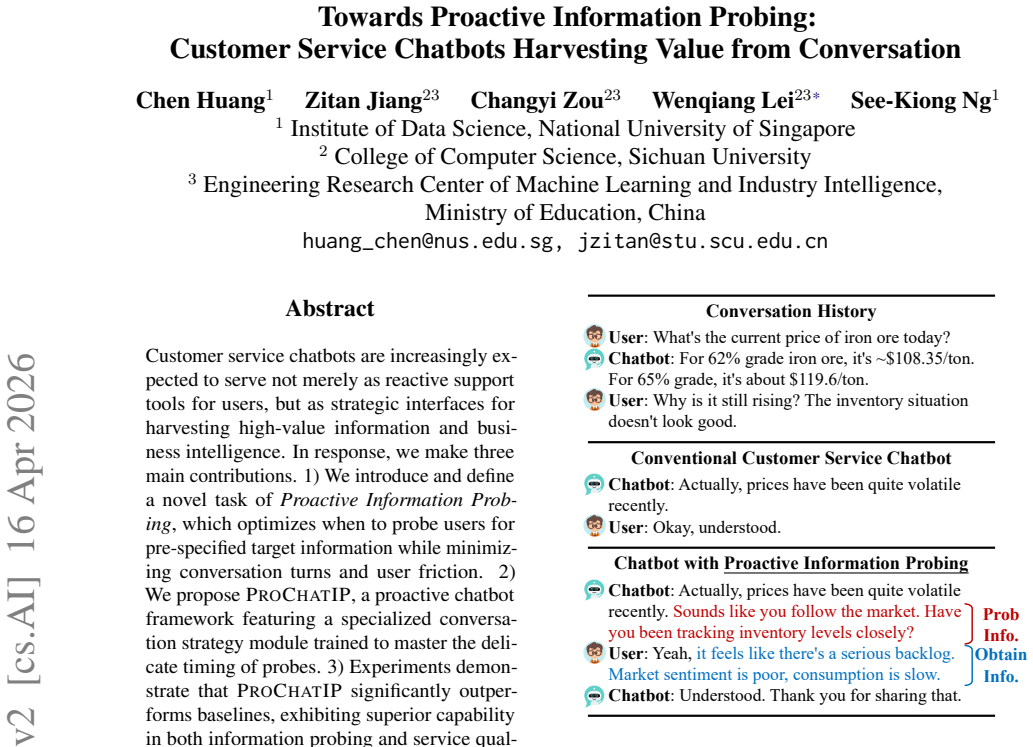
Customer service chatbots can be trained to time proactive probes for target information while keeping conversations short and helpful.
A machine-rendered reading of the paper's core claim, the machinery that carries it, and where it could break.
Core claim
We introduce and define the task of Proactive Information Probing, which optimizes when to probe users for pre-specified target information while minimizing conversation turns and user friction. We propose PROCHATIP, a proactive chatbot framework featuring a specialized conversation strategy module trained to master the delicate timing of probes. Experiments demonstrate that PROCHATIP significantly outperforms baselines, exhibiting superior capability in both information probing and service quality. We believe that our work effectively redefines the commercial utility of chatbots, positioning them as scalable, cost-effective engines for proactive business intelligence.
What carries the argument
PROCHATIP's specialized conversation strategy module, which is trained to decide the timing of probes for target information.
If this is right
- Chatbots shift from reactive support tools to strategic interfaces that harvest high-value information during normal interactions.
- Businesses obtain proactive business intelligence at lower cost through existing customer service channels.
- Service quality stays high or improves even while the system actively gathers data.
- Fewer conversation turns are needed to reach both user support goals and information collection goals.
Where Pith is reading between the lines
- The same timing module could be adapted to other conversational settings where gathering specific data during routine exchanges would be useful.
- Chatbot development pipelines may need to treat conversation management strategy as a first-class training objective alongside response generation.
- Real-world use would require checks that the learned probe timing generalizes across different user populations and service domains.
Load-bearing premise
The specialized conversation strategy module can be trained to master the delicate timing of probes for pre-specified target information while minimizing conversation turns and user friction, based on the training and evaluation data used.
What would settle it
A side-by-side test in which PROCHATIP collects no more target information than reactive baselines or produces measurably higher user friction and longer average conversation length.
Figures


read the original abstract
Customer service chatbots are increasingly expected to serve not merely as reactive support tools for users, but as strategic interfaces for harvesting high-value information and business intelligence. In response, we make three main contributions. 1) We introduce and define a novel task of Proactive Information Probing, which optimizes when to probe users for pre-specified target information while minimizing conversation turns and user friction. 2) We propose PROCHATIP, a proactive chatbot framework featuring a specialized conversation strategy module trained to master the delicate timing of probes. 3) Experiments demonstrate that PROCHATIP significantly outperforms baselines, exhibiting superior capability in both information probing and service quality. We believe that our work effectively redefines the commercial utility of chatbots, positioning them as scalable, cost-effective engines for proactive business intelligence. Our code is available at https://github.com/SCUNLP/PROCHATIP.
Editorial analysis
A structured set of objections, weighed in public.
Referee Report
Summary. The manuscript defines the task of Proactive Information Probing, in which customer service chatbots must decide when to solicit pre-specified target information while minimizing conversation turns and user friction. It presents the PROCHATIP framework whose core is a conversation strategy module trained first by supervised fine-tuning and then by reinforcement learning with a composite reward (probing success minus turn penalty minus friction proxy). Experiments on synthetic and real customer-service dialogue corpora compare PROCHATIP against reactive chatbots and heuristic schedulers, reporting statistically significant gains in probing success rate and service-quality metrics together with ablation studies that isolate the strategy module; the code is released publicly.
Significance. If the reported gains hold under broader conditions, the work could meaningfully shift commercial chatbot design from purely reactive support toward scalable, low-cost business-intelligence collection. The explicit modeling of user friction inside the RL reward, the use of both synthetic and real corpora, the ablation studies, and the open-source release constitute concrete strengths that support reproducibility and incremental follow-up research.
minor comments (3)
- Abstract: the performance claims would be easier to evaluate if the abstract briefly stated the primary quantitative improvements (e.g., absolute or relative gains in probing success rate) rather than only qualitative superiority.
- §3.2: the precise state representation fed to the strategy module and the RL algorithm (PPO, A2C, etc.) together with the main hyper-parameters should be stated explicitly so that the training procedure can be reproduced from the text alone.
- §4.2, Table 2: the service-quality metric should be defined in a single paragraph or equation; it is currently referenced only by name and is central to the second half of the main claim.
Simulated Author's Rebuttal
We thank the referee for their thoughtful summary and positive evaluation of our work on the Proactive Information Probing task and the PROCHATIP framework. We are encouraged by the recognition of our contributions, including the explicit modeling of user friction, use of both synthetic and real corpora, ablation studies, and public code release. The recommendation for minor revision is noted, and we address the report below.
Circularity Check
No significant circularity identified
full rationale
The paper defines a new task of Proactive Information Probing, proposes the PROCHATIP framework with a strategy module trained via supervised fine-tuning and RL on a composite reward, and reports experimental outperformance against baselines on synthetic and real dialogue corpora. No equations, self-definitional reductions, fitted parameters renamed as predictions, or load-bearing self-citations appear in the derivation or claims. The central results rest on independent empirical evaluation with ablations, rendering the chain self-contained against external benchmarks.
Axiom & Free-Parameter Ledger
invented entities (1)
-
PROCHATIP framework
no independent evidence
Reference graph
Works this paper leans on
-
[1]
Akshay Agarwal, Shashank Maiya, and Sonu Aggarwal
Ai-based chatbots in customer service and their effects on user compliance.Electronic markets, 31(2):427–445. Akshay Agarwal, Shashank Maiya, and Sonu Aggarwal
-
[2]
Dorothée Behr, Lars Kaczmirek, Wolfgang Bandilla, and Michael Braun
Evaluating empathetic chatbots in customer service settings.arXiv preprint arXiv:2101.01334. Dorothée Behr, Lars Kaczmirek, Wolfgang Bandilla, and Michael Braun. 2012. Asking probing questions in web surveys: which factors have an impact on the quality of responses?Social Science Computer Review, 30(4):487–498. Norman M Bradburn, Seymour Sudman, and Brian...
-
[3]
Improving language model negotiation with self-play and in-context learning from ai feedback. Preprint, arXiv:2305.10142. Ruiling Guo, Xinwei Yang, Chen Huang, Tong Zhang, and Yong Hu. 2025. CANDY: Benchmarking LLMs’ limitations and assistive potential in Chinese misin- formation fact-checking. InFindings of the Associ- ation for Computational Linguistics...
-
[4]
Wenwen Li, Kangwei Shi, and Yidong Chai
Cognitive burden of survey questions and re- sponse times: A psycholinguistic experiment.Ap- plied cognitive psychology, 24(7):1003–1020. Wenwen Li, Kangwei Shi, and Yidong Chai. 2025. AI chatbots as professional service agents: Develop- ing a professional identity. InProceedings of the 2025 Conference on Empirical Methods in Natural Language Processing, ...
-
[5]
Human-computer interaction in customer ser- vice: the experience with ai chatbots—a systematic literature review.Electronics, 11(10):1579. Marije Oudejans. 2018. Using interactive features to motivate and probe responses to open-ended ques- tions. InSocial and behavioral research and the internet, pages 215–244. Routledge. Nurhadhinah Nadiah Ridzuan, Masa...
work page 2018
-
[6]
“was this answer helpful?”–a taxonomy for feedback mechanisms in customer service chatbots. Wirtschaftsinformatik 2024 Proceedings, page 71. Sonam Singh and Anthony Rios. 2022. Linguistic ele- ments of engaging customer service discourse on so- cial media. InProceedings of the Fifth Workshop on Natural Language Processing and Computational So- cial Scienc...
-
[7]
When the expert asks a question relevant to your interests or helpful to understanding the market, respond naturally and concisely, using data, affirmations, negations, or choices. Do not answer with a question
-
[8]
I do not want to answer right now
If any of the following situations occur, you must not respond: [Behavioral instructions] When you choose not to respond, clearly reply with “I do not want to answer right now.” and then ask a new, previously unasked question relevant to the conversation
-
[9]
I do not want to answer right now
You may not say that you do not know, because it is assumed that you possess the relevant information. Interaction Rules - Each reply should be one or two short, natural, conversational sentences, and must include a question. - Always remember that you are the user, not the expert. I am the expert. You are prohibited from continuously answering the expert...
-
[10]
Choose the dialogue strategy you believe is best at the current turn: Ask or Answer
-
[11]
Do NOT ask any questions or provide guidance
Based on the strategy you choose, reply as follows: - Ask: First answer the user’s current message, then provide a complete transitional sentence, and finally ask the question to be probed: [target information]; - Answer: ONLY respond to the user’s current message. Do NOT ask any questions or provide guidance. Focus solely on delivering an accurate, profe...
-
[12]
Each suggestion should be one sentence, start with a verb, and contain only one idea
Step 1 — Suggest: Based on the conversation history, analyze why you have not yet obtained the desired information from the user, and provide three short suggestions for the strategy of your next reply to probe the target information. Each suggestion should be one sentence, start with a verb, and contain only one idea
-
[13]
Step 2 — Response: Based on the suggestions generated in Step 1, produce a single, coherent reply to the user’s current question. User’s message: [ut] Output format exactly as follows (no extra text): Suggestions: suggestion_line_1 suggestion_line_2 suggestion_line_3 Response: Table 17: Prompt for Implementing ICL-AIF Strategy Prompt Construction for Our ...
discussion (0)
Sign in with ORCID, Apple, or X to comment. Anyone can read and Pith papers without signing in.