Recognition: unknown
Unveiling the Surprising Efficacy of Navigation Understanding in End-to-End Autonomous Driving
Pith reviewed 2026-05-10 16:25 UTC · model grok-4.3
The pith
End-to-end autonomous driving improves when global navigation is modeled precisely as sequential guidance rather than ignored in favor of local scenes.
A machine-rendered reading of the paper's core claim, the machinery that carries it, and where it could break.
Core claim
By representing global navigation as Sequential Navigation Guidance that includes paths for long-term constraints and turn-by-turn details for immediate choices, the SNG-VLA model fuses it with local planning to achieve state-of-the-art performance in end-to-end autonomous driving, overcoming the weak correlation between planning and navigation seen in prior systems.
What carries the argument
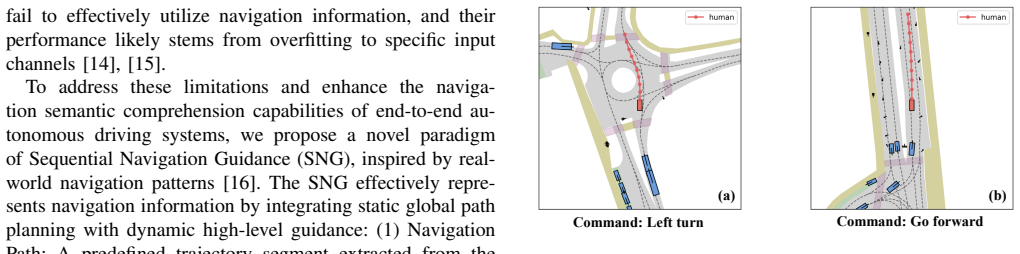
The Sequential Navigation Guidance (SNG) framework, an efficient encoding of global navigation information based on real-world patterns that provides both navigation paths and turn-by-turn information to guide the fusion model.
If this is right
- End-to-end models become better at navigation-following in complex driving scenarios.
- State-of-the-art results are reached without relying on auxiliary loss functions from perception tasks.
- The SNG-QA dataset enables training that aligns global navigation with local scene understanding.
- Planning capabilities strengthen directly through improved navigation input modeling.
Where Pith is reading between the lines
- Similar sequential representations could improve navigation in other autonomous systems like delivery robots or drones.
- Emphasizing navigation data quality might reduce the need for ever-larger models in driving tasks.
- Integrating this approach with real-time mapping services could lead to more robust route adherence in changing environments.
Load-bearing premise
That the weak correlation between planning and navigation input in existing end-to-end systems is a common issue that the SNG representation will consistently resolve when incorporated.
What would settle it
Evaluating the proposed model against baselines on a modified test set where navigation inputs are altered or removed to check if the performance advantage disappears.
Figures



read the original abstract
Global navigation information and local scene understanding are two crucial components of autonomous driving systems. However, our experimental results indicate that many end-to-end autonomous driving systems tend to over-rely on local scene understanding while failing to utilize global navigation information. These systems exhibit weak correlation between their planning capabilities and navigation input, and struggle to perform navigation-following in complex scenarios. To overcome this limitation, we propose the Sequential Navigation Guidance (SNG) framework, an efficient representation of global navigation information based on real-world navigation patterns. The SNG encompasses both navigation paths for constraining long-term trajectories and turn-by-turn (TBT) information for real-time decision-making logic. We constructed the SNG-QA dataset, a visual question answering (VQA) dataset based on SNG that aligns global and local planning. Additionally, we introduce an efficient model SNG-VLA that fuses local planning with global planning. The SNG-VLA achieves state-of-the-art performance through precise navigation information modeling without requiring auxiliary loss functions from perception tasks. Project page: SNG-VLA
Editorial analysis
A structured set of objections, weighed in public.
Referee Report
Summary. The manuscript argues that end-to-end autonomous driving models over-rely on local scene understanding and exhibit weak correlation with global navigation inputs, impairing navigation-following. It introduces Sequential Navigation Guidance (SNG) as a compact representation of paths and turn-by-turn instructions derived from real-world patterns, the SNG-QA VQA dataset to align global and local planning, and the SNG-VLA model that fuses these elements to achieve state-of-the-art performance without auxiliary perception losses.
Significance. If the empirical claims hold, the work would highlight a previously under-addressed limitation in end-to-end driving and provide a reusable navigation representation plus dataset that could improve long-horizon trajectory consistency. The absence of auxiliary losses is a practical advantage if demonstrated.
major comments (2)
- [Abstract] Abstract: the assertion of state-of-the-art performance and that gains arise specifically from 'precise navigation information modeling' is unsupported by any quantitative metrics, baselines, ablation tables, or experimental protocol, which is load-bearing for the central efficacy claim.
- The manuscript provides no ablation or control experiment that isolates SNG fusion (e.g., null/randomized navigation input with all other factors fixed) or reports post-hoc planning-navigation correlation on the trained model, leaving open whether observed performance stems from SNG, dataset scale, or architecture size.
minor comments (1)
- [Abstract] The project page is referenced but no URL or access instructions are supplied.
Simulated Author's Rebuttal
We thank the referee for their insightful comments, which have helped us identify areas where the manuscript can be strengthened in terms of clarity and experimental rigor. We address each major comment below and have incorporated revisions to better support the central claims.
read point-by-point responses
-
Referee: [Abstract] Abstract: the assertion of state-of-the-art performance and that gains arise specifically from 'precise navigation information modeling' is unsupported by any quantitative metrics, baselines, ablation tables, or experimental protocol, which is load-bearing for the central efficacy claim.
Authors: We agree that the abstract would benefit from more explicit references to the supporting evidence. In the revised manuscript, we have updated the abstract to reference the quantitative results, baseline comparisons, and ablation studies detailed in Section 4, along with a brief outline of the experimental protocol. This ensures the efficacy claims are directly tied to the presented metrics without altering the core findings. revision: yes
-
Referee: The manuscript provides no ablation or control experiment that isolates SNG fusion (e.g., null/randomized navigation input with all other factors fixed) or reports post-hoc planning-navigation correlation on the trained model, leaving open whether observed performance stems from SNG, dataset scale, or architecture size.
Authors: This observation is correct and highlights a gap in the original presentation. While the manuscript included component ablations in Section 4.2, it lacked a direct isolation of the SNG fusion mechanism. We have added a new control experiment in the revised Section 4.3 that fixes all other factors and compares performance with null/randomized navigation inputs. We have also included post-hoc correlation analysis between planning outputs and navigation inputs. These additions demonstrate that the gains are attributable to SNG rather than dataset scale or model size. revision: yes
Circularity Check
No significant circularity; claims rest on new empirical elements
full rationale
The paper introduces independent constructs (SNG representation derived from real-world patterns, SNG-QA dataset, and SNG-VLA fusion model) and reports their performance as experimental outcomes rather than definitional restatements. No equations, fitted parameters renamed as predictions, or self-citation chains are present in the provided text that would reduce the SOTA claim or navigation-modeling efficacy to inputs by construction. The derivation chain remains self-contained with external validation via dataset construction and model evaluation.
Axiom & Free-Parameter Ledger
axioms (1)
- domain assumption End-to-end autonomous driving models exhibit weak utilization of global navigation information and can be improved by explicit structured fusion with local planning.
invented entities (3)
-
Sequential Navigation Guidance (SNG)
no independent evidence
-
SNG-QA dataset
no independent evidence
-
SNG-VLA model
no independent evidence
Reference graph
Works this paper leans on
-
[1]
End-to-end driving model for steering control of autonomous vehicles with future spatiotemporal features,
T. Wu, A. Luo, R. Huang, H. Cheng, and Y . Zhao, “End-to-end driving model for steering control of autonomous vehicles with future spatiotemporal features,” in2019 IEEE/RSJ International Conference on Intelligent Robots and Systems (IROS). IEEE, 2019, pp. 950–955
2019
-
[2]
Multimodal end-to-end autonomous driving,
Y . Xiao, F. Codevilla, A. Gurram, O. Urfalioglu, and A. M. L ´opez, “Multimodal end-to-end autonomous driving,”IEEE Transactions on Intelligent Transportation Systems, vol. 23, no. 1, pp. 537–547, 2022
2022
-
[3]
End-to-end autonomous driving: Challenges and frontiers,
L. Chen, P. Wu, K. Chitta, B. Jaeger, A. Geiger, and H. Li, “End-to-end autonomous driving: Challenges and frontiers,”IEEE Transactions on Pattern Analysis and Machine Intelligence, vol. 46, no. 12, pp. 10 164– 10 183, 2024
2024
-
[4]
Towards fully autonomous driving: Systems and algorithms,
J. Levinson, J. Askeland, J. Becker, J. Dolson, D. Held, S. Kammel, J. Z. Kolter, D. Langer, O. Pink, V . Pratt, M. Sokolsky, G. Stanek, D. Stavens, A. Teichman, M. Werling, and S. Thrun, “Towards fully autonomous driving: Systems and algorithms,” in2011 IEEE Intelligent V ehicles Symposium (IV), 2011, pp. 163–168
2011
-
[5]
Multimodal trajectory predictions for autonomous driving using deep convolutional networks,
H. Cui, V . Radosavljevic, F.-C. Chou, T.-H. Lin, T. Nguyen, T.-K. Huang, J. Schneider, and N. Djuric, “Multimodal trajectory predictions for autonomous driving using deep convolutional networks,” in2019 International Conference on Robotics and Automation (ICRA), 2019, pp. 2090–2096
2019
-
[6]
Vad: Vectorized scene representation for efficient autonomous driving,
B. Jiang, S. Chen, Q. Xu, B. Liao, J. Chen, H. Zhou, Q. Zhang, W. Liu, C. Huang, and X. Wang, “Vad: Vectorized scene representation for efficient autonomous driving,” inProceedings of the IEEE/CVF International Conference on Computer Vision, 2023, pp. 8340–8350
2023
-
[7]
St-p3: End- to-end vision-based autonomous driving via spatial-temporal feature learning,
S. Hu, L. Chen, P. Wu, H. Li, J. Yan, and D. Tao, “St-p3: End- to-end vision-based autonomous driving via spatial-temporal feature learning,” inEuropean Conference on Computer Vision. Springer, 2022, pp. 533–549
2022
-
[8]
Transfuser: Imitation with transformer-based sensor fusion for au- tonomous driving,
K. Chitta, A. Prakash, B. Jaeger, Z. Yu, K. Renz, and A. Geiger, “Transfuser: Imitation with transformer-based sensor fusion for au- tonomous driving,”IEEE Transactions on Pattern Analysis and Ma- chine Intelligence, vol. 45, no. 11, pp. 12 878–12 895, 2023
2023
-
[9]
Navsim: Data-driven non-reactive autonomous vehicle simulation and benchmarking,
D. Dauner, M. Hallgarten, T. Li, X. Weng, Z. Huang, Z. Yang, H. Li, I. Gilitschenski, B. Ivanovic, M. Pavone, A. Geiger, and K. Chitta, “Navsim: Data-driven non-reactive autonomous vehicle simulation and benchmarking,” inAdvances in Neural Information Processing Systems (NeurIPS), 2024
2024
-
[10]
Para- drive: Parallelized architecture for real-time autonomous driving,
X. Weng, B. Ivanovic, Y . Wang, Y . Wang, and M. Pavone, “Para- drive: Parallelized architecture for real-time autonomous driving,” in Proceedings of the IEEE/CVF Conference on Computer Vision and Pattern Recognition (CVPR), June 2024, pp. 15 449–15 458
2024
-
[11]
Drivelm: Driving with graph visual question answering,
C. Sima, K. Renz, K. Chitta, L. Chen, H. Zhang, C. Xie, J. Beißwenger, P. Luo, A. Geiger, and H. Li, “Drivelm: Driving with graph visual question answering,” inProceedings of the European Conference on Computer Vision (ECCV), 2024, pp. 256–274
2024
-
[12]
Genad: Generative end-to-end autonomous driving,
W. Zheng, R. Song, X. Guo, C. Zhang, and L. Chen, “Genad: Generative end-to-end autonomous driving,” inProceedings of the European Conference on Computer Vision (ECCV), A. Leonardis, E. Ricci, S. Roth, O. Russakovsky, T. Sattler, and G. Varol, Eds., 2024, pp. 87–104
2024
-
[13]
Q. Peng, C. Bai, G. Zhang, B. Xu, X. Liu, X. Zheng, C. Chen, and C. Lu, “Navigscene: Bridging local perception and global nav- igation for beyond-visual-range autonomous driving,”arXiv preprint arXiv:2507.05227, 2025
-
[14]
J.-T. Zhai, Z. Feng, J. Du, Y . Mao, J.-J. Liu, Z. Tan, Y . Zhang, X. Ye, and J. Wang, “Rethinking the open-loop evaluation of end-to-end autonomous driving in nuscenes,”arXiv preprint arXiv:2305.10430, 2023
-
[15]
Is ego status all you need for open-loop end-to-end autonomous driving?
Z. Li, Z. Yu, S. Lan, J. Li, J. Kautz, T. Lu, and J. M. Alvarez, “Is ego status all you need for open-loop end-to-end autonomous driving?” inProceedings of the IEEE/CVF Conference on Computer Vision and Pattern Recognition, 2024, pp. 14 864–14 873
2024
-
[16]
Svennerberg,Beginning google maps API 3
G. Svennerberg,Beginning google maps API 3. Apress, 2010
2010
-
[17]
Bench2drive: Towards multi-ability benchmarking of closed-loop end-to-end autonomous driving,
X. Jia, Z. Yang, Q. Li, Z. Zhang, and J. Yan, “Bench2drive: Towards multi-ability benchmarking of closed-loop end-to-end autonomous driving,” inNeurIPS 2024 Datasets and Benchmarks Track, 2024
2024
-
[18]
Carla: An open urban driving simulator,
A. Dosovitskiy, G. Ros, F. Codevilla, A. Lopez, and V . Koltun, “Carla: An open urban driving simulator,” inConference on robot learning. PMLR, 2017, pp. 1–16
2017
-
[19]
Bev- former: learning bird’s-eye-view representation from lidar-camera via spatiotemporal transformers,
Z. Li, W. Wang, H. Li, E. Xie, C. Sima, T. Lu, Q. Yu, and J. Dai, “Bev- former: learning bird’s-eye-view representation from lidar-camera via spatiotemporal transformers,”IEEE Transactions on Pattern Analysis and Machine Intelligence, 2024
2024
-
[20]
Aib-mdp: Continuous probabilistic mo- tion planning for automated vehicles by leveraging action independent belief spaces,
M. Naumann and C. Stiller, “Aib-mdp: Continuous probabilistic mo- tion planning for automated vehicles by leveraging action independent belief spaces,” in2022 IEEE/RSJ International Conference on Intelli- gent Robots and Systems (IROS), 2022, pp. 6373–6380
2022
-
[21]
Planning-oriented autonomous driving,
Y . Hu, J. Yang, L. Chen, K. Li, C. Sima, X. Zhu, S. Chai, S. Du, T. Lin, W. Wanget al., “Planning-oriented autonomous driving,” in Proceedings of the IEEE/CVF Conference on Computer Vision and Pattern Recognition, 2023, pp. 17 853–17 862
2023
-
[22]
Mp3: A unified model to map, perceive, predict and plan,
S. Casas, A. Sadat, and R. Urtasun, “Mp3: A unified model to map, perceive, predict and plan,” inProceedings of the IEEE/CVF Conference on Computer Vision and Pattern Recognition, 2021, pp. 14 403–14 412
2021
-
[23]
Trajectory-guided control prediction for end-to-end autonomous driving: A simple yet strong baseline,
P. Wu, X. Jia, L. Chen, J. Yan, H. Li, and Y . Qiao, “Trajectory-guided control prediction for end-to-end autonomous driving: A simple yet strong baseline,”Advances in Neural Information Processing Systems, vol. 35, pp. 6119–6132, 2022
2022
-
[24]
Driveadapter: Breaking the coupling barrier of perception and planning in end-to-end autonomous driving,
X. Jia, Y . Gao, L. Chen, J. Yan, P. L. Liu, and H. Li, “Driveadapter: Breaking the coupling barrier of perception and planning in end-to-end autonomous driving,” inProceedings of the IEEE/CVF International Conference on Computer Vision (ICCV), October 2023, pp. 7953– 7963
2023
-
[25]
nuscenes: A multimodal dataset for autonomous driving,
H. Caesar, V . Bankiti, A. H. Lang, S. V ora, V . E. Liong, Q. Xu, A. Krishnan, Y . Pan, G. Baldan, and O. Beijbom, “nuscenes: A multimodal dataset for autonomous driving,” inProceedings of the IEEE/CVF conference on computer vision and pattern recognition, 2020, pp. 11 621–11 631
2020
-
[26]
J. Achiam, S. Adler, S. Agarwal, L. Ahmad, I. Akkaya, F. L. Aleman, D. Almeida, J. Altenschmidt, S. Altman, S. Anadkatet al., “Gpt-4 technical report,”arXiv preprint arXiv:2303.08774, 2023
work page internal anchor Pith review Pith/arXiv arXiv 2023
-
[27]
Drivegpt4: Interpretable end-to-end autonomous driving via large language model,
Z. Xu, Y . Zhang, E. Xie, Z. Zhao, Y . Guo, K.-Y . K. Wong, Z. Li, and H. Zhao, “Drivegpt4: Interpretable end-to-end autonomous driving via large language model,”IEEE Robotics and Automation Letters, vol. 9, no. 10, pp. 8186–8193, 2024
2024
-
[28]
Lmdrive: Closed-loop end-to-end driving with large language models,
H. Shao, Y . Hu, L. Wang, G. Song, S. L. Waslander, Y . Liu, and H. Li, “Lmdrive: Closed-loop end-to-end driving with large language models,” inProceedings of the IEEE/CVF Conference on Computer Vision and Pattern Recognition (CVPR), June 2024, pp. 15 120–15 130
2024
-
[29]
Nuplan: A closed-loop ml- based planning benchmark for autonomous vehicles,
K. T. e. a. H. Caesar, J. Kabzan, “Nuplan: A closed-loop ml- based planning benchmark for autonomous vehicles,” inCVPR ADP3 workshop, 2021
2021
-
[30]
Scalability in perception for autonomous driving: Waymo open dataset,
P. Sun, H. Kretzschmar, X. Dotiwalla, A. Chouard, V . Patnaik, P. Tsui, J. Guo, Y . Zhou, Y . Chai, B. Caineet al., “Scalability in perception for autonomous driving: Waymo open dataset,” inProceedings of the IEEE/CVF conference on computer vision and pattern recognition, 2020, pp. 2446–2454
2020
-
[31]
A. Yang, B. Yang, B. Zhang, B. Hui, B. Zheng, B. Yu, C. Li, D. Liu, F. Huang, H. Weiet al., “Qwen2. 5 technical report,”arXiv preprint arXiv:2412.15115, 2024
work page internal anchor Pith review Pith/arXiv arXiv 2024
-
[32]
Z. Zhou, T. Cai, S. Z. Zhao, Y . Zhang, Z. Huang, B. Zhou, and J. Ma, “Autovla: A vision-language-action model for end-to-end autonomous driving with adaptive reasoning and reinforcement fine-tuning,”arXiv preprint arXiv:2506.13757, 2025
work page internal anchor Pith review arXiv 2025
-
[33]
Simlingo: Vision- only closed-loop autonomous driving with language-action alignment,
K. Renz, L. Chen, E. Arani, and O. Sinavski, “Simlingo: Vision- only closed-loop autonomous driving with language-action alignment,” inProceedings of the Computer Vision and Pattern Recognition Conference, 2025, pp. 11 993–12 003
2025
-
[34]
C. Yuan, Z. Zhang, J. Sun, S. Sun, Z. Huang, C. D. W. Lee, D. Li, Y . Han, A. Wong, K. P. Teeet al., “Drama: An efficient end-to-end motion planner for autonomous driving with mamba,”arXiv preprint arXiv:2408.03601, 2024
-
[35]
Hydra-MDP: End-to-end Multimodal Planning with Multi-target Hydra-Distillation
Z. Li, K. Li, S. Wang, S. Lan, Z. Yu, Y . Ji, Z. Li, Z. Zhu, J. Kautz, Z. Wuet al., “Hydra-mdp: End-to-end multimodal planning with multi-target hydra-distillation,”arXiv preprint arXiv:2406.06978, 2024
work page internal anchor Pith review arXiv 2024
-
[36]
B. Liao, S. Chen, H. Yin, B. Jiang, C. Wang, S. Yan, X. Zhang, X. Li, Y . Zhang, Q. Zhang, and X. Wang, “Diffusiondrive: Truncated diffusion model for end-to-end autonomous driving,”arXiv preprint arXiv:2411.15139, 2024
-
[37]
X. Jia, J. You, Z. Zhang, and J. Yan, “Drivetransformer: Unified trans- former for scalable end-to-end autonomous driving,”arXiv preprint arXiv:2503.07656, 2025
-
[38]
Think twice before driving: Towards scalable decoders for end-to-end autonomous driving,
X. Jia, P. Wu, L. Chen, J. Xie, C. He, J. Yan, and H. Li, “Think twice before driving: Towards scalable decoders for end-to-end autonomous driving,” inProceedings of the IEEE/CVF Conference on Computer Vision and Pattern Recognition (CVPR), June 2023, pp. 21 983–21 994
2023
-
[39]
LLaVA-OneVision: Easy Visual Task Transfer
B. Li, Y . Zhang, D. Guo, R. Zhang, F. Li, H. Zhang, K. Zhang, P. Zhang, Y . Li, Z. Liuet al., “Llava-onevision: Easy visual task transfer,”arXiv preprint arXiv:2408.03326, 2024
work page internal anchor Pith review Pith/arXiv arXiv 2024
-
[40]
Sigmoid loss for language image pre-training,
X. Zhai, B. Mustafa, A. Kolesnikov, and L. Beyer, “Sigmoid loss for language image pre-training,” inProceedings of the IEEE/CVF international conference on computer vision, 2023, pp. 11 975–11 986
2023
-
[41]
Blip-2: Bootstrapping language- image pre-training with frozen image encoders and large language models,
J. Li, D. Li, S. Savarese, and S. Hoi, “Blip-2: Bootstrapping language- image pre-training with frozen image encoders and large language models,” inInternational conference on machine learning. PMLR, 2023, pp. 19 730–19 742
2023
-
[42]
Rethinking imitation-based planners for autonomous driving,
J. Cheng, Y . Chen, X. Mei, B. Yang, B. Li, and M. Liu, “Rethinking imitation-based planners for autonomous driving,” in2024 IEEE International Conference on Robotics and Automation (ICRA). IEEE, 2024, pp. 14 123–14 130
2024
discussion (0)
Sign in with ORCID, Apple, or X to comment. Anyone can read and Pith papers without signing in.