Spin Qubit Leapfrogging: Dynamics of shuttling electrons on top of another
Pith reviewed 2026-05-10 12:42 UTC · model grok-4.3
The pith
Spin qubits can leapfrog over occupied quantum dots in silicon by using the valley degree of freedom.
A machine-rendered reading of the paper's core claim, the machinery that carries it, and where it could break.
Core claim
By utilizing the valley degree of freedom, mobile spin qubits can be shuttled through an occupied stationary quantum dot, leapfrogging over the stationary electron. This grants enriched mobility by opening new routing paths and enables an entangling SWAP^γ gate operation. Simulations confirm feasibility for different parameter sets.
What carries the argument
Leapfrogging shuttling, the process of moving a mobile electron through an occupied dot via valley states to perform transport and gate functions simultaneously.
If this is right
- It opens new possible routing paths for shuttled electrons.
- It enables implementation of an entangling SWAP^γ two-qubit gate during shuttling.
- It offers a use case for regions of low valley splitting on the chip.
- It extends the set of possible operations for silicon spin qubit devices.
Where Pith is reading between the lines
- This could reduce the complexity of avoiding certain areas in qubit routing designs.
- It may support denser integration of quantum dots by allowing over-the-dot movement.
- Testing could focus on coherence preservation in low valley splitting regimes during shuttling.
Load-bearing premise
The valley degree of freedom remains sufficiently controllable and coherent during shuttling through an occupied dot without unacceptable errors or decoherence, especially at low valley splitting.
What would settle it
Observing significant decoherence or gate errors in simulations or experiments when shuttling through an occupied dot at low valley splitting would falsify the proposed feasibility.
Figures




read the original abstract
Spin shuttling has crystalized as a powerful and promising tool for establishing intermediate-range connectivity in semiconductor spin-qubit devices. Although experimental demonstrations have performed exceptionally well on different materials platforms, the question of how to handle areas of low valley splitting in silicon during shuttling remains unresolved. In this work, we explore the possibility of utilizing the valley degree of freedom, particularly in regions of low valley splitting, to allow mobile spin qubits to be shuttled through an occupied stationary quantum dot, thereby leapfrogging over the stationary electron. This not only grants a more enriched mobility for shuttled electrons, as it opens new possible routing paths, but also enables the implementation of an entangling SWAP$^\gamma$ two-qubit gate operation in the process. Simulating this process for different sets of parameters, we demonstrate the feasibility of such an operation and offer a unique use case for otherwise precarious regions of a quantum processor chip and propose a possible extension to the set of possible operations for silicon spin qubit devices.
Editorial analysis
A structured set of objections, weighed in public.
Referee Report
Summary. The manuscript proposes 'spin qubit leapfrogging' as a method to shuttle a mobile spin qubit through an occupied stationary quantum dot in silicon devices by exploiting the valley degree of freedom, especially in low valley-splitting regions. This enables bypassing stationary electrons for richer routing paths and implements an entangling SWAP^γ two-qubit gate during the process. Feasibility is asserted via numerical simulations over varied parameter sets.
Significance. If the simulations accurately capture valley-mediated dynamics without excessive decoherence or leakage, the approach would convert low valley-splitting regions from liabilities into assets for connectivity and add a new native entangling operation to the silicon spin-qubit toolbox, directly addressing a known scalability bottleneck in semiconductor quantum processors.
major comments (2)
- [Numerical simulations section] The central feasibility claim rests on simulations demonstrating acceptable errors during leapfrogging in the low-splitting regime, yet the manuscript provides no quantitative fidelity thresholds, error budgets, or direct comparison against typical spin coherence times and valley-orbit coupling strengths. Without these, it is impossible to verify that valley mixing and electron-electron interactions remain below the threshold needed to preserve spin coherence.
- [Theoretical model and Hamiltonian] The model appears to omit realistic disorder, finite valley-orbit coupling, and the precise time-dependent confining potential during dot overlap. These omissions are load-bearing because they can induce rapid oscillations or leakage channels precisely in the low valley-splitting regime that the paper seeks to exploit; the current parameter sweeps therefore do not yet constitute a robust test of the weakest assumption.
minor comments (2)
- [Abstract] The abstract states that simulations 'demonstrate the feasibility' but supplies no numerical outcomes; the results section should include at least one table or figure summarizing fidelity versus valley splitting, tunnel coupling, and shuttling speed.
- Notation for the SWAP^γ gate should be defined explicitly (e.g., the value of γ and its relation to the valley-mediated exchange) at first use.
Simulated Author's Rebuttal
We thank the referee for their detailed and constructive report. Their comments highlight important aspects of the numerical evidence and model assumptions that we address point-by-point below. We have revised the manuscript to strengthen the presentation of quantitative benchmarks and to clarify the scope of the theoretical model.
read point-by-point responses
-
Referee: [Numerical simulations section] The central feasibility claim rests on simulations demonstrating acceptable errors during leapfrogging in the low-splitting regime, yet the manuscript provides no quantitative fidelity thresholds, error budgets, or direct comparison against typical spin coherence times and valley-orbit coupling strengths. Without these, it is impossible to verify that valley mixing and electron-electron interactions remain below the threshold needed to preserve spin coherence.
Authors: We agree that explicit quantitative benchmarks are necessary to substantiate the feasibility claim. In the revised manuscript we have added a dedicated paragraph and accompanying table in the numerical simulations section. This table reports the simulated leakage and phase-error rates for the explored parameter sets, compares them directly to representative silicon spin-qubit coherence times (T2* ≈ 1–10 ms) and valley-orbit energies (10–100 µeV), and provides an error-budget breakdown showing that valley-mediated mixing remains below 0.1 % for the majority of the low-splitting regime. These additions allow a reader to verify that the accumulated errors lie well within the limits set by current experimental coherence times. revision: yes
-
Referee: [Theoretical model and Hamiltonian] The model appears to omit realistic disorder, finite valley-orbit coupling, and the precise time-dependent confining potential during dot overlap. These omissions are load-bearing because they can induce rapid oscillations or leakage channels precisely in the low valley-splitting regime that the paper seeks to exploit; the current parameter sweeps therefore do not yet constitute a robust test of the weakest assumption.
Authors: We acknowledge that the Hamiltonian employed is a minimal model focused on the valley degree of freedom and inter-dot tunneling. To address the concern we have expanded the theoretical-model section with a perturbative estimate showing that finite valley-orbit coupling does not open additional leakage channels at the level of accuracy of our simulations, provided the valley splitting remains the dominant energy scale. We have also added a brief discussion of the time-dependent confining potential, noting that the adiabaticity condition used in the sweeps already bounds the non-adiabatic transitions. Full inclusion of realistic electrostatic disorder would require device-specific electrostatic modeling beyond the present scope; we have therefore inserted a forward-looking statement in the conclusions identifying this as an important direction for subsequent work. The existing parameter sweeps still demonstrate the core mechanism under the stated assumptions. revision: partial
Circularity Check
No circularity: feasibility shown via independent forward simulations
full rationale
The paper proposes leapfrogging via valley-mediated shuttling of a mobile spin qubit through an occupied dot and demonstrates feasibility through numerical simulations of the time-dependent Schrödinger dynamics for varying parameters (valley splitting, interaction strengths, etc.). No load-bearing step reduces by construction to a fitted input, self-definition, or self-citation chain; the central claim rests on explicit forward modeling of the Hamiltonian evolution rather than tautological re-derivation of the target result. The derivation chain is self-contained against standard quantum-dot models and does not invoke uniqueness theorems or ansatzes justified only by the authors' prior work.
Axiom & Free-Parameter Ledger
axioms (1)
- standard math Established quantum dot models for spin and valley degrees of freedom govern the shuttling dynamics.
Reference graph
Works this paper leans on
-
[1]
The error scales linearly with the tunneling energy and strongly depends on the singlet-triplet coupling ratioα
Linear sweep Evaluating these integrals for a linear sweepϵ(t) =vt, we obtain, δφϵ = δϵ 2v "r (ϵ− Em 2 )2 + (αte)2 − r (ϵ+ Em 2 )2 + (te)2 #ϵend ϵstart ,(B7) δφtc =δt e 2te v ln 1 2te ΩS −ϵ− Em 2 −α 2 ln 1 2αte ΩT −ϵ+ Em 2 ϵend ϵstart .(B8) For most realistic parameter ranges, the error caused by noise in the tunneling coefficient will be reasonably small...
-
[2]
T wo-speed-sweep A method to reduce the impact of detuning noise onto dephasing is by choosing a velocity profile such that the integrals in equation (B15) vanish. As the noise in the tunneling parameter is significantly weaker than the de- tuning noise and essentially does not scale with the valley splitting, we will focus on minimizing the integral corr...
-
[3]
Stano and D
P. Stano and D. Loss, Review of performance metrics of spin qubits in gated semiconducting nanostructures, Nat. Rev. Phys.4, 672 (2022)
2022
-
[4]
Veldhorst, J
M. Veldhorst, J. C. C. Hwang, C. H. Yang, A. W. Leen- stra, B. de Ronde, J. P. Dehollain, J. T. Muhonen, F. E. Hudson, K. M. Itoh, A. Morello, and A. S. Dzurak, An addressable quantum dot qubit with fault-tolerant control-fidelity, Nat. Nanotechnol.9, 981 (2014)
2014
-
[5]
X. Xue, M. Russ, N. Samkharadze, B. Undseth, A. Sam- mak, G. Scappucci, and L. M. K. Vandersypen, Quantum logic with spin qubits crossing the surface code threshold, Nature601, 343 (2022)
2022
-
[6]
Scappucci, and S
A.Noiri, K.Takeda, T.Nakajima, T.Kobayashi, A.Sam- mak, G. Scappucci, and S. Tarucha, Fast universal quan- tum gate above the fault-tolerance threshold in silicon, Nature601, 338 (2022)
2022
-
[7]
N. D. Stuyck, A. Saraiva, W. Gilbert, J. C. Pardo, R. Li, C. C. Escott, K. D. Greve, S. Voinigescu, D. J. Reilly, and A. S.Dzurak, CMOS compatibility of semiconductorspin qubits (2024), arXiv:2409.03993 [cond-mat.mes-hall]
work page internal anchor Pith review Pith/arXiv arXiv 2024
-
[8]
Elsayed, M
A. Elsayed, M. M. K. Shehata, C. Godfrin, S. Kubicek, S. Massar, Y. Canvel, J. Jussot, G. Simion, M. Mongillo, D. Wan, B. Govoreanu, I. P. Radu, R. Li, P. Van Dorpe, and K. De Greve, Low charge noise quantum dots with industrial CMOS manufacturing, Npj Quantum Inf.10 (2024)
2024
-
[9]
Ishihara, A
L.M.K.Vandersypen, H.Bluhm, J.S.Clarke, A.S.Dzu- rak, R. Ishihara, A. Morello, D. J. Reilly, L. R. Schreiber, and M. Veldhorst, Interfacing spin qubits in quantum dots and donors—hot, dense, and coherent, Npj Quan- tum Inf.3(2017)
2017
-
[10]
Künne, A
M. Künne, A. Willmes, M. Oberländer, C. Gorjaew, J. D. Teske, H. Bhardwaj, M. Beer, E. Kammerloher, R. Ot- ten, I. Seidler, R. Xue, L. R. Schreiber, and H. Bluhm, The SpinBus architecture for scaling spin qubits with electron shuttling, Nat. Commun.15, 4977 (2024)
2024
-
[11]
Langrock, J
V. Langrock, J. A. Krzywda, N. Focke, I. Seidler, L. R. Schreiber, and L. Cywiński, Blueprint of a scalable spin qubit shuttle device for coherent mid-range qubit trans- fer in disordered si/sige/sio2, PRX Quantum4, 020305 (2023)
2023
-
[12]
Seidler, T
I. Seidler, T. Struck, R. Xue, N. Focke, S. Trellenkamp, H. Bluhm, and L. R. Schreiber, Conveyor-mode single- electron shuttling in Si/SiGe for a scalable quantum com- puting architecture, Npj Quantum Inf.8(2022)
2022
-
[13]
Struck, M
T. Struck, M. Volmer, L. Visser, T. Offermann, R. Xue, J.-S. Tu, S. Trellenkamp, Ł. Cywiński, H. Bluhm, and L. R. Schreiber, Spin-EPR-pair separation by conveyor- mode single electron shuttling in Si/SiGe, Nat. Commun. 15, 1325 (2024)
2024
- [14]
-
[15]
Zwerver, S
A. Zwerver, S. Amitonov, S. de Snoo, M. Mądzik, M. Rimbach-Russ, A. Sammak, G. Scappucci, and L. Vandersypen, Shuttling an electron spin through a sili- con quantum dot array, PRX Quantum4, 030303 (2023)
2023
-
[16]
R. Xue, M. Beer, I. Seidler, S. Humpohl, J.-S. Tu, S. Trel- lenkamp, T. Struck, H. Bluhm, and L. R. Schreiber, Si/SiGe QuBus for single electron information-processing devices with memory and micron-scale connectivity func- tion, Nat. Commun.15, 2296 (2024)
2024
-
[17]
Y. Matsumoto, M. D. Smet, L. Tryputen, S. L. de Snoo, S.V.Amitonov, A.Sammak, M.Rimbach-Russ, G.Scap- pucci, and L. M. K. Vandersypen, Two-qubit logic and teleportation with mobile spin qubits in silicon (2025), arXiv:2503.15434 [quant-ph]
-
[18]
L. E. A. Stehouwer, M. P. Losert, M. Rigot, D. Degli Es- posti, S. Martí-Sánchez, M. Rimbach-Russ, J. Arbiol, M. Friesen, and G. Scappucci, Engineering Ge profiles in Si/SiGe heterostructures for increased valley split- ting, Nano Letters25, 12892 (2025), pMID: 40796514, https://doi.org/10.1021/acs.nanolett.5c02848
-
[19]
Volmer, T
M. Volmer, T. Struck, A. Sala, B. Chen, M. Ober- länder, T. Offermann, R. Xue, L. Visser, J.-S. Tu, S. Trellenkamp, Ł. Cywiński, H. Bluhm, and L. R. 18 Schreiber, Mapping of valley splitting by conveyor-mode spin-coherent electron shuttling, Npj Quantum Inf.10 (2024)
2024
- [20]
- [21]
-
[22]
M. P. Losert, M. Oberländer, J. D. Teske, M. Volmer, L. R. Schreiber, H. Bluhm, S. Coppersmith, and M. Friesen, Strategies for enhancing spin-shuttling fideli- ties inSi/SiGequantum wells with random-alloy disor- der, PRX Quantum5, 040322 (2024)
2024
- [23]
-
[24]
Johansson, P
J. Johansson, P. Nation, and F. Nori, QuTiP: An open- source python framework for the dynamics of open quan- tum systems, Computer Physics Communications183, 1760 (2012)
2012
-
[25]
Araya Day, S
I. Araya Day, S. Miles, H. K. Kerstens, D. Varjas, and A. R. Akhmerov, Pymablock: An algorithm and a pack- age for quasi-degenerate perturbation theory, SciPost Phys. Codebases , 50 (2025)
2025
-
[26]
M. Russ, F. Ginzel, and G. Burkard, Coupling of three- spin qubits to their electric environment, Phys. Rev. B 94, 165411 (2016)
2016
-
[27]
Medford, J
J. Medford, J. Beil, J. M. Taylor, E. I. Rashba, H. Lu, A. C. Gossard, and C. M. Marcus, Quantum-dot-based resonant exchange qubit, Phys. Rev. Lett.111, 050501 (2013)
2013
-
[28]
E. J. Connors, J. Nelson, L. F. Edge, and J. M. Nichol, Charge-noise spectroscopy of Si/SiGe quantum dots via dynamically-decoupled exchange oscillations, Nat. Com- mun.13, 940 (2022)
2022
-
[29]
Weight-four parity checks with silicon spin qubits,
B. Undseth, N. Meggiato, Y.-H. Wu, S. R. Katiraee- Far, L. Tryputen, S. L. de Snoo, D. D. Esposti, G. Scappucci, E. Greplová, and L. M. K. Vandersypen, Weight-four parity checks with silicon spin qubits (2026), arXiv:2601.23267 [cond-mat.mes-hall]
-
[30]
C. B. Simmons, J. R. Prance, B. J. Van Bael, T. S. Koh, Z. Shi, D. E. Savage, M. G. Lagally, R. Joynt, M. Friesen, S. N. Coppersmith, and M. A. Eriksson, Tunable spin loading andT1 of a silicon spin qubit measured by single- shot readout, Phys. Rev. Lett.106, 156804 (2011)
2011
-
[31]
N. E. Penthorn, J. S. Schoenfield, L. F. Edge, and H. Jiang, Direct measurement of electron intervalley re- laxation in aSi/Si-Gequantum dot, Phys. Rev. Appl. 14, 054015 (2020)
2020
-
[32]
J. C. Marcks, E. Eagen, E. C. Brann, M. P. Losert, T. Oh, J. Reily, C. S. Wang, D. Keith, F. A. Mo- hiyaddin, F. Luthi, M. J. Curry, J. Zhang, F. J. Here- mans, M. Friesen, and M. A. Eriksson, Valley splitting correlations across a silicon quantum well containing ger- manium, Nat. Commun.16, 11381 (2025)
2025
- [33]
-
[34]
Ventura-Meinersen, S
C. Ventura-Meinersen, S. Bosco, and M. Rimbach-Russ, Quantum geometric protocols for fast high-fidelity adia- batic state transfer, EPJ Quantum Technol.12(2025)
2025
-
[35]
Khaneja, T
N. Khaneja, T. Reiss, C. Kehlet, T. Schulte-Herbrüggen, and S. J. Glaser, Optimal control of coupled spin dy- namics: design of NMR pulse sequences by gradient as- cent algorithms, Journal of Magnetic Resonance172, 296 (2005)
2005
-
[36]
Siegel, Z
A. Siegel, Z. Cai, H. Jnane, B. Koczor, S. Pexton, A. Strikis, and S. Benjamin, Quantum snakes on a plane: Mobile, low-dimensional logical qubits on a 2D surface, PRX Quantum7, 010339 (2026)
2026
-
[37]
Burkard and J
G. Burkard and J. R. Petta, Dispersive readout of valley splittings in cavity-coupled silicon quantum dots, Phys. Rev. B94, 195305 (2016)
2016
-
[38]
M. Russ, C. G. Péterfalvi, and G. Burkard, Theory of valley-resolved spectroscopy of a Si triple quantum dot coupled to a microwave resonator, J. Phys. Condens. Matter32, 165301 (2020)
2020
- [39]
-
[40]
L. H. Pedersen, N. M. Møller, and K. Mølmer, Fidelity of quantum operations, Physics Letters A367, 47 (2007)
2007
-
[41]
O. V. Ivakhnenko, S. N. Shevchenko, and F. Nori, Nonadiabatic Landau-Zener-Stückelberg-Majorana tran- sitions, dynamics, and interference, Physics Reports995, 1 (2023)
2023
-
[42]
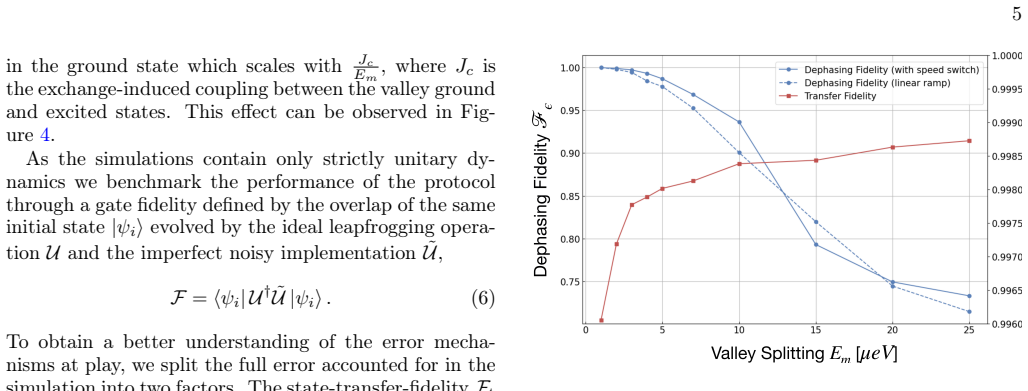
Additionally, a faster detuning speed will also reduce the gate time, which is not only preferable from an opera- tional point of view, but also minimizes errors from un- accounted for dephasing and spin-flip processes
discussion (0)
Sign in with ORCID, Apple, or X to comment. Anyone can read and Pith papers without signing in.