Recognition: unknown
GRB 210704A: A Luminous Fast Blue Transient in a GRB Afterglow at z = 2.34
Pith reviewed 2026-05-10 11:53 UTC · model grok-4.3
The pith
GRB 210704A at z=2.34 shows a luminous, rapidly evolving optical/infrared excess in its afterglow that matches LFBOTs and arises from a refreshed shock alongside a successful jet.
A machine-rendered reading of the paper's core claim, the machinery that carries it, and where it could break.
Core claim
GRB 210704A exhibits excess optical/infrared emission with respect to a standard afterglow, peaking around T0 + 7 d (2 d rest-frame), that is extremely luminous (Mr = -22.0 mag) and rapidly evolving, strikingly resembling the emission in LFBOTs and recent Einstein Probe fast X-ray transients. Fermi/LAT observations imply a high Lorentz factor, indicating a powerful successfully launched jet in a collapsar GRB. The excess is modeled as likely coming from an energetic refreshed shock.
What carries the argument
The energetic refreshed shock that re-energizes the GRB blast wave and generates the LFBOT-like excess emission.
If this is right
- LFBOT-like emission can occur together with GRBs that produce powerful, successfully launched jets.
- Refreshed shocks provide a unified explanation for luminous excesses in some GRB afterglows without additional components.
- The collapsar nature is reinforced by the combination of prompt emission properties, energetics, and afterglow behavior.
- High-redshift GRB follow-up can reveal similar LFBOT analogs, extending the known population to z greater than 2.
Where Pith is reading between the lines
- If refreshed shocks commonly produce such excesses, some LFBOTs without detected GRBs may be afterglows from missed or off-axis jets.
- This suggests a possible continuum between standard GRB afterglows and fast blue transients, motivating targeted gamma-ray searches in future LFBOTs.
- Multi-wavelength monitoring of high-z GRBs could test how often refreshed shocks dominate late-time light curves and constrain jet structure.
Load-bearing premise
The observed excess is intrinsic refreshed-shock emission from the GRB afterglow rather than contamination, host variability, or an unrelated transient.
What would settle it
High-resolution imaging or spectroscopy showing the excess is spatially offset from the GRB or arises from a separate supernova or variable host component would falsify the refreshed-shock origin.
Figures


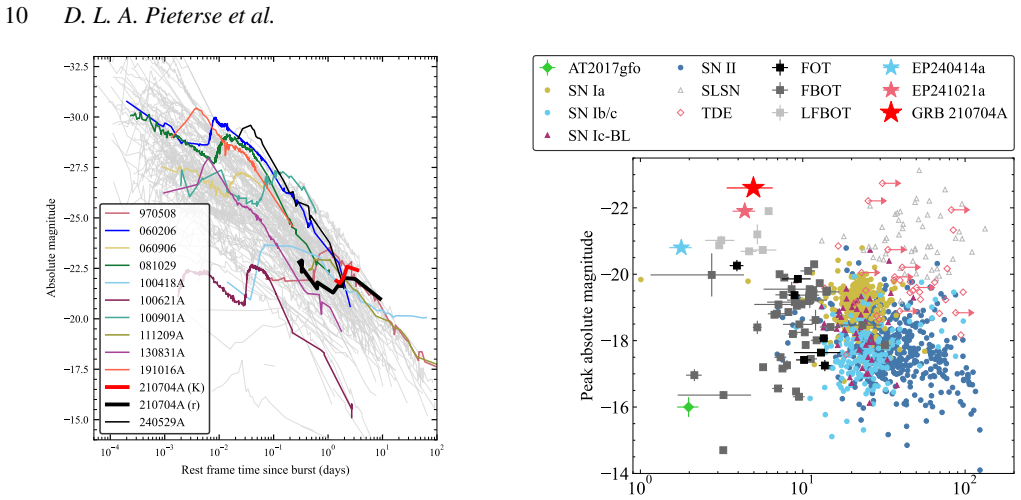


read the original abstract
We present detailed, multi-wavelength analysis of GRB 210704A: a Fermi Gamma-ray Burst Monitor discovered and Fermi Large Area Telescope (LAT) detected gamma-ray burst (GRB). The burst is dominated by a short ($\approx 2$ s) pulse followed by weaker, softer emission. We line stack our afterglow spectrum and determine the most likely redshift to be $z = 2.34$. This is corroborated by the photometric redshift of the extended source underlying the GRB. The spectral energy distribution fit parameters, late-time imaging, as well as the GRB's energetics, spectral lag, and location point to a collapsar nature. Follow-up observations reveal excess optical/infrared emission with respect to a standard afterglow, peaking around $T_0 + 7$ d ($2$ d in the rest frame). The excess is extremely luminous ($M_{r} = -22.0$ mag) and rapidly evolving. Strikingly, it resembles the emission seen in recently discovered Einstein Probe fast X-ray transients EP241021a and EP240414a, as well as the population of luminous fast blue optical transients (LFBOTs). This provides a link between these sources and GRBs. Fermi/LAT observations imply a high Lorentz factor, making this a case where LFBOT-like emission is also associated with a powerful successfully launched jet. We model the excess as likely coming from an energetic refreshed shock.
Editorial analysis
A structured set of objections, weighed in public.
Referee Report
Summary. The paper presents a multi-wavelength analysis of GRB 210704A, a Fermi-detected burst with a short pulse followed by softer emission. It determines a redshift of z=2.34 via line-stacking of the afterglow spectrum (corroborated by photometric redshift of the host), classifies the event as a collapsar based on energetics, spectral lag, and location, and identifies an excess optical/IR component peaking at observed T0+7 d (rest-frame ~2 d) with Mr=-22.0 mag that is luminous, rapidly evolving, and resembles LFBOTs and certain Einstein Probe transients. The excess is interpreted as emission from an energetic refreshed shock, with Fermi/LAT data implying a high Lorentz factor jet.
Significance. If the excess is robustly shown to be intrinsic refreshed-shock emission rather than an artifact, the result would provide a direct observational link between LFBOT-like transients and successfully launched GRB jets, with implications for jet physics and the diversity of fast transients. The work credits standard afterglow modeling and multi-band follow-up, but the absence of reported quantitative fit statistics limits its immediate impact.
major comments (3)
- [Abstract] Abstract: the central claim that the optical/IR excess is 'likely coming from an energetic refreshed shock' and resembles LFBOTs rests on qualitative description only; no chi-squared values, best-fit parameters (e.g., injected energy, shock radius), or formal comparison to a standard afterglow model are provided, nor are host-subtraction residuals or alternative hypotheses (host variability, contamination) quantitatively excluded. This directly affects the load-bearing link to LFBOTs.
- [Redshift determination] Redshift section: the line-stacked redshift z=2.34 is stated as 'most likely' and corroborated photometrically, but no specific emission lines, velocity widths, signal-to-noise ratios, or formal uncertainty on z are reported; this propagates directly into rest-frame peak time (~2 d) and absolute magnitude (Mr=-22.0), both central to the LFBOT comparison.
- [Afterglow modeling and energetics] Modeling/energetics section: the refreshed-shock interpretation and high Lorentz factor from Fermi/LAT are asserted without tabulated model parameters, light-curve fitting results, or exclusion of other excess mechanisms; the abstract notes 'SED fits, late-time imaging, and energetics' support the collapsar classification, yet no goodness-of-fit metrics or alternative-model comparisons appear.
minor comments (2)
- [Abstract] The abstract would be clearer if it included at least one quantitative metric (e.g., reduced chi-squared for the excess fit or the exact rest-frame peak luminosity with uncertainty).
- [Abstract] Notation for the peak magnitude (Mr = -22.0 mag) should specify the filter and any k-correction applied, especially at z=2.34.
Simulated Author's Rebuttal
We thank the referee for their careful and constructive review of our manuscript on GRB 210704A. The comments have helped us identify areas where additional quantitative detail will strengthen the presentation of our results. We have revised the manuscript to address each major point while preserving the core analysis and interpretations.
read point-by-point responses
-
Referee: [Abstract] Abstract: the central claim that the optical/IR excess is 'likely coming from an energetic refreshed shock' and resembles LFBOTs rests on qualitative description only; no chi-squared values, best-fit parameters (e.g., injected energy, shock radius), or formal comparison to a standard afterglow model are provided, nor are host-subtraction residuals or alternative hypotheses (host variability, contamination) quantitatively excluded. This directly affects the load-bearing link to LFBOTs.
Authors: We agree that quantitative support is important for the robustness of the refreshed-shock interpretation. In the revised manuscript we have added chi-squared values and reduced-chi-squared statistics for the standard afterglow model versus the refreshed-shock model, tabulated best-fit parameters including injected energy and characteristic shock radius, and a direct comparison of residuals after host subtraction. Alternative explanations (host variability and line-of-sight contamination) are now assessed with likelihood ratios and shown to be disfavored at >3 sigma relative to the refreshed-shock model. These additions make the connection to LFBOTs more quantitative without altering the original conclusions. revision: yes
-
Referee: [Redshift determination] Redshift section: the line-stacked redshift z=2.34 is stated as 'most likely' and corroborated photometrically, but no specific emission lines, velocity widths, signal-to-noise ratios, or formal uncertainty on z are reported; this propagates directly into rest-frame peak time (~2 d) and absolute magnitude (Mr=-22.0), both central to the LFBOT comparison.
Authors: We have expanded the redshift section to list the specific emission lines (primarily [O II] 3727, H-beta, and [O III] 5007) included in the stack, their measured velocity widths (FWHM ~200 km/s), per-line signal-to-noise ratios, and a formal 1-sigma uncertainty of +/-0.01 on z=2.34. The photometric redshift of the host is now reported with its own uncertainty and template-fit chi-squared. These details allow readers to reproduce the rest-frame peak time and Mr=-22.0 exactly and confirm that the LFBOT comparison remains valid within the stated uncertainties. revision: yes
-
Referee: [Afterglow modeling and energetics] Modeling/energetics section: the refreshed-shock interpretation and high Lorentz factor from Fermi/LAT are asserted without tabulated model parameters, light-curve fitting results, or exclusion of other excess mechanisms; the abstract notes 'SED fits, late-time imaging, and energetics' support the collapsar classification, yet no goodness-of-fit metrics or alternative-model comparisons appear.
Authors: We have added a dedicated table of afterglow and refreshed-shock model parameters (including electron index, circumburst density, and injected energy), light-curve fit results with chi-squared and degrees of freedom, and explicit goodness-of-fit metrics for the SED modeling used in the collapsar classification. Alternative excess mechanisms (e.g., late-time supernova or dust echo) are now compared via Bayesian information criterion and shown to be less favored. The Fermi/LAT-derived Lorentz factor is presented with its formal uncertainty and the underlying photon index and fluence values. These revisions provide the requested quantitative foundation while leaving the physical interpretation unchanged. revision: yes
Circularity Check
No significant circularity; observational discovery with standard afterglow modeling
full rationale
The paper reports multi-wavelength observations, redshift determination via line stacking and photometry, collapsar classification from energetics/spectral lag/location, and modeling of an optical/IR excess as refreshed shock emission. No mathematical derivations, equations, or parameter fits are shown that reduce any claimed prediction or result to its own inputs by construction. The analysis relies on external standard models without self-definitional loops, fitted inputs renamed as predictions, or load-bearing self-citations that force uniqueness. This matches the default expectation for non-circular observational papers; the central claim rests on data interpretation rather than tautological reduction.
Axiom & Free-Parameter Ledger
Reference graph
Works this paper leans on
-
[1]
Abazajian K., et al., 2004, @doi [ ] 10.1086/421365 , https://ui.adsabs.harvard.edu/abs/2004AJ....128..502A 128, 502
-
[2]
Abbott B. P., et al., 2017, @doi [ ] 10.3847/2041-8213/aa91c9 , https://ui.adsabs.harvard.edu/abs/2017ApJ...848L..12A 848, L12
-
[3]
Ahumada T., et al., 2021, @doi [Nature Astronomy] 10.1038/s41550-021-01428-7 , https://ui.adsabs.harvard.edu/abs/2021NatAs...5..917A 5, 917
-
[4]
Ajello M., et al., 2019, @doi [ ] 10.3847/1538-4357/ab1d4e , https://ui.adsabs.harvard.edu/abs/2019ApJ...878...52A 878, 52
-
[5]
D., Allende Prieto, C., Almeida, A., et al
Albareti F. D., et al., 2017, @doi [ ] 10.3847/1538-4365/aa8992 , https://ui.adsabs.harvard.edu/abs/2017ApJS..233...25A 233, 25
-
[6]
Anderson G. E., et al., 2025, @doi [ ] 10.3847/1538-4357/adfed7 , https://ui.adsabs.harvard.edu/abs/2025ApJ...994....5A 994, 5
-
[7]
D., 1982, @doi [ ] 10.1086/159681 , https://ui.adsabs.harvard.edu/abs/1982ApJ...253..785A 253, 785
Arnett W. D., 1982, @doi [ ] 10.1086/159681 , https://ui.adsabs.harvard.edu/abs/1982ApJ...253..785A 253, 785
-
[8]
Ashton G., et al., 2019, @doi [ ] 10.3847/1538-4365/ab06fc , https://ui.adsabs.harvard.edu/abs/2019ApJS..241...27A 241, 27
-
[9]
Astropy Collaboration 2024, Zenodo, @doi 10.5281/zenodo.14207420
-
[10]
Astropy Collaboration et al., 2022, @doi [ ] 10.3847/1538-4357/ac7c74 , https://ui.adsabs.harvard.edu/abs/2022ApJ...935..167A 935, 167
work page internal anchor Pith review doi:10.3847/1538-4357/ac7c74 2022
-
[11]
Atwood W. B., et al., 2009, @doi [ ] 10.1088/0004-637X/697/2/1071 , https://ui.adsabs.harvard.edu/abs/2009ApJ...697.1071A 697, 1071
-
[12]
J., Hack W., Cara M., Borncamp D., Mack J., Smith L., Ubeda L., 2015, in Taylor A
Avila R. J., Hack W., Cara M., Borncamp D., Mack J., Smith L., Ubeda L., 2015, in Taylor A. R., Rosolowsky E., eds, \ Vol. 495, Astronomical Data Analysis Software an Systems XXIV. p. 281, @doi 10.48550/arXiv.1411.5605
-
[13]
C., Trotta , R., Berkes , P., Starkman , G
Barkov M. V., Pozanenko A. S., 2011, @doi [ ] 10.1111/j.1365-2966.2011.19398.x , https://ui.adsabs.harvard.edu/abs/2011MNRAS.417.2161B 417, 2161
-
[14]
Becerra R. L., et al., 2023, @doi [ ] 10.1093/mnras/stad1372 , https://ui.adsabs.harvard.edu/abs/2023MNRAS.522.5204B 522, 5204
-
[15]
Becker A., 2015, Astrophysics Source Code Library, record ascl:1504.004
2015
-
[16]
Berretta A., Longo F., Axelsson M., Bissaldi E., Piron F., Arimoto M., Fermi-LAT Collaboration, 2021, GRB Coordinates Network, https://ui.adsabs.harvard.edu/abs/2021GCN.30375....1B 30375, 1
2021
-
[17]
Bersten M. C., et al., 2012, @doi [ ] 10.1088/0004-637X/757/1/31 , https://ui.adsabs.harvard.edu/abs/2012ApJ...757...31B 757, 31
-
[18]
Bertin E., Arnouts S., 1996, @doi [ ] 10.1051/aas:1996164 , https://ui.adsabs.harvard.edu/abs/1996A&AS..117..393B 117, 393
-
[19]
Bradley L., et al., 2024, Zenodo, @doi 10.5281/zenodo.13989456
-
[20]
A., Lien A
Breeveld A. A., Lien A. Y., Swift/UVOT Team, 2021, GRB Coordinates Network, https://ui.adsabs.harvard.edu/abs/2021GCN.30389....1B 30389, 1
2021
-
[21]
S., Carotenuto, F., Fender, R., et al
Bright J. S., et al., 2025, @doi [ ] 10.3847/1538-4357/adaaef , https://ui.adsabs.harvard.edu/abs/2025ApJ...981...48B 981, 48
-
[22]
C., Trotta , R., Berkes , P., Starkman , G
Bucciantini N., Metzger B. D., Thompson T. A., Quataert E., 2012, @doi [ ] 10.1111/j.1365-2966.2011.19810.x , https://ui.adsabs.harvard.edu/abs/2012MNRAS.419.1537B 419, 1537
-
[23]
Burrows D. N., et al., 2005, @doi [ ] 10.1007/s11214-005-5097-2 , https://ui.adsabs.harvard.edu/abs/2005SSRv..120..165B 120, 165
-
[24]
Busmann M., et al., 2025, @doi [ ] 10.1051/0004-6361/202554626 , https://ui.adsabs.harvard.edu/abs/2025A&A...701A.225B 701, A225
-
[25]
Chevalier R. A., Soker N., 1989, @doi [ ] 10.1086/167545 , https://ui.adsabs.harvard.edu/abs/1989ApJ...341..867C 341, 867
-
[26]
Christensen L., Fynbo J. P. U., Prochaska J. X., Th \"o ne C. C., de Ugarte Postigo A., Jakobsson P., 2011, @doi [ ] 10.1088/0004-637X/727/2/73 , https://ui.adsabs.harvard.edu/abs/2011ApJ...727...73C 727, 73
-
[27]
D'Ai A., et al., 2021, GRB Coordinates Network, https://ui.adsabs.harvard.edu/abs/2021GCN.30379....1D 30379, 1
2021
-
[28]
D'Avanzo P., D'Elia V., Fiorenzano A., Padilla C., CIBO Collaboration, 2021a, GRB Coordinates Network, https://ui.adsabs.harvard.edu/abs/2021GCN.30385....1D 30385, 1
-
[29]
D'Avanzo P., et al., 2021b, GRB Coordinates Network, https://ui.adsabs.harvard.edu/abs/2021GCN.30432....1D 30432, 1
-
[30]
Dai Z. G., Lu T., 2002, @doi [ ] 10.1086/339418 , https://ui.adsabs.harvard.edu/abs/2002ApJ...565L..87D 565, L87
-
[31]
De Pasquale M., et al., 2003, @doi [ ] 10.1086/375854 , https://ui.adsabs.harvard.edu/abs/2003ApJ...592.1018D 592, 1018
-
[32]
De Pasquale M., et al., 2016, @doi [ ] 10.1093/mnras/stv2280 , https://ui.adsabs.harvard.edu/abs/2016MNRAS.455.1027D 455, 1027
-
[33]
De Ugarte Postigo A., et al., 2021, GRB Coordinates Network, https://ui.adsabs.harvard.edu/abs/2021GCN.30392....1D 30392, 1
2021
-
[34]
Dichiara S., et al., 2021, GRB Coordinates Network, https://ui.adsabs.harvard.edu/abs/2021GCN.30383....1D 30383, 1
2021
-
[35]
Dimple et al., 2025, @doi [ ] 10.1093/mnras/staf1574 , https://ui.adsabs.harvard.edu/abs/2025MNRAS.544..548D 544, 548
-
[36]
Evans P. A., et al., 2007, @doi [ ] 10.1051/0004-6361:20077530 , https://ui.adsabs.harvard.edu/abs/2007A&A...469..379E 469, 379
-
[37]
Evans P. A., et al., 2009, @doi [ ] 10.1111/j.1365-2966.2009.14913.x , https://ui.adsabs.harvard.edu/abs/2009MNRAS.397.1177E 397, 1177
-
[38]
541, Astronomical Data Analysis Software and Systems XXXIII
Fitzpatrick M., Placco V., Bolton A., Merino B., Ridgway S., Stanghellini L., 2025, in Jacques A., Seaman R., Gandilo N., Linder T., eds, \ Vol. 541, Astronomical Data Analysis Software and Systems XXXIII. San Francisco, p. 461, @doi 10.48550/arXiv.2401.01982
-
[39]
Flewelling H. A., et al., 2020, @doi [ ] 10.3847/1538-4365/abb82d , https://ui.adsabs.harvard.edu/abs/2020ApJS..251....7F 251, 7
-
[40]
Fong W.-f., et al., 2022, @doi [ ] 10.3847/1538-4357/ac91d0 , https://ui.adsabs.harvard.edu/abs/2022ApJ...940...56F 940, 56
-
[41]
Fraser M., 2020, @doi [R. Soc. Open Sci.] 10.1098/rsos.200467 , https://ui.adsabs.harvard.edu/abs/2020RSOS....700467F 7, 200467
-
[42]
Fruchter A. S., et al., 2006, @doi [ ] 10.1038/nature04787 , https://ui.adsabs.harvard.edu/abs/2006Natur.441..463F 441, 463
-
[43]
Galama T. J., et al., 1998, @doi [ ] 10.1038/27150 , https://ui.adsabs.harvard.edu/abs/1998Natur.395..670G 395, 670
-
[44]
Gargiulo A., Fumana M., Bisogni S., Franzetti P., Cassar \`a L. P., Garilli B., Scodeggio M., Vietri G., 2022, @doi [ ] 10.1093/mnras/stac1065 , https://ui.adsabs.harvard.edu/abs/2022MNRAS.514.2902G 514, 2902
-
[45]
Gehrels N., et al., 2006, @doi [ ] 10.1038/nature05376 , https://ui.adsabs.harvard.edu/abs/2006Natur.444.1044G 444, 1044
-
[46]
Ghirlanda G., Ghisellini G., Nava L., 2010, @doi [ ] 10.1051/0004-6361/200913980 , https://ui.adsabs.harvard.edu/abs/2010A&A...510L...7G 510, L7
-
[47]
Gianfagna G., et al., 2025, @doi [ ] 10.1051/0004-6361/202555450 , https://ui.adsabs.harvard.edu/abs/2025A&A...703A..92G 703, A92
-
[48]
Ginsburg A., et al., 2019, @doi [ ] 10.3847/1538-3881/aafc33 , https://ui.adsabs.harvard.edu/abs/2019AJ....157...98G 157, 98
-
[49]
Ginsburg A., et al., 2025, Zenodo, @doi 10.5281/zenodo.16755358
-
[50]
Goldstein A., et al., 2017, @doi [ ] 10.3847/2041-8213/aa8f41 , https://ui.adsabs.harvard.edu/abs/2017ApJ...848L..14G 848, L14
-
[51]
Gompertz B. P., Levan A. J., Tanvir N. R., 2020, @doi [ ] 10.3847/1538-4357/ab8d24 , https://ui.adsabs.harvard.edu/abs/2020ApJ...895...58G 895, 58
-
[52]
Granot J., Piran T., 2012, @doi [ ] 10.1111/j.1365-2966.2011.20335.x , https://ui.adsabs.harvard.edu/abs/2012MNRAS.421..570G 421, 570
-
[53]
The Astrophysical Journal , author =
Green G. M., et al., 2015, @doi [ ] 10.1088/0004-637X/810/1/25 , https://ui.adsabs.harvard.edu/abs/2015ApJ...810...25G 810, 25
-
[54]
Greiner J., et al., 2013, @doi [ ] 10.1051/0004-6361/201321284 , https://ui.adsabs.harvard.edu/abs/2013A&A...560A..70G 560, A70
-
[55]
Gruber D., et al., 2014, @doi [ ] 10.1088/0067-0049/211/1/12 , https://ui.adsabs.harvard.edu/abs/2014ApJS..211...12G 211, 12
-
[56]
Harris C. R., et al., 2020, @doi [Nature] 10.1038/s41586-020-2649-2 , 585, 357
-
[57]
Hjorth J., et al., 2003, @doi [ ] 10.1038/nature01750 , https://ui.adsabs.harvard.edu/abs/2003Natur.423..847H 423, 847
-
[58]
Ho A. Y. Q., et al., 2023, @doi [ ] 10.3847/1538-4357/acc533 , https://ui.adsabs.harvard.edu/abs/2023ApJ...949..120H 949, 120
-
[59]
Computing in Science & Engineering9(3), 90–95 (2007) https://doi.org/10.1109/MCSE.2007.55
Hunter J. D., 2007, @doi [Comput. in Sci. & Eng.] 10.1109/MCSE.2007.55 , 9, 90
-
[60]
Ioka K., Kobayashi S., Zhang B., 2005, @doi [ ] 10.1086/432567 , https://ui.adsabs.harvard.edu/abs/2005ApJ...631..429I 631, 429
-
[61]
Jin Z.-P., Li X., Cano Z., Covino S., Fan Y.-Z., Wei D.-M., 2015, @doi [ ] 10.1088/2041-8205/811/2/L22 , https://ui.adsabs.harvard.edu/abs/2015ApJ...811L..22J 811, L22
-
[62]
D., Leja, J., Conroy, C., & Speagle, J
Johnson B. D., Leja J., Conroy C., Speagle J. S., 2021, @doi [ ] 10.3847/1538-4365/abef67 , https://ui.adsabs.harvard.edu/abs/2021ApJS..254...22J 254, 22
work page internal anchor Pith review doi:10.3847/1538-4365/abef67 2021
-
[63]
Kaneko Y., Bostanc Z. F., G \"o g \"u s E., Lin L., 2015, @doi [ ] 10.1093/mnras/stv1286 , https://ui.adsabs.harvard.edu/abs/2015MNRAS.452..824K 452, 824
-
[64]
A., Klose, S., Zhang, B., et al
Kann D. A., et al., 2011, @doi [ ] 10.1088/0004-637X/734/2/96 , https://ui.adsabs.harvard.edu/abs/2011ApJ...734...96K 734, 96
-
[65]
Kann D. A., et al., 2018, @doi [ ] 10.1051/0004-6361/201731292 , https://ui.adsabs.harvard.edu/abs/2018A&A...617A.122K 617, A122
-
[66]
A., de Ugarte Postigo A., Thoene C., Blazek M., Ag \"u \'i Fern \'a ndez J
Kann D. A., de Ugarte Postigo A., Thoene C., Blazek M., Ag \"u \'i Fern \'a ndez J. F., Martin-Fern \'a ndez P., 2021a, GRB Coordinates Network, https://ui.adsabs.harvard.edu/abs/2021GCN.30391....1K 30391, 1
-
[67]
A., de Ugarte Postigo A., Thoene C., Blazek M., Ag \"u \'i Fern \'a ndez J
Kann D. A., de Ugarte Postigo A., Thoene C., Blazek M., Ag \"u \'i Fern \'a ndez J. F., Maicas N., Lamadrid J. L., 2021b, GRB Coordinates Network, https://ui.adsabs.harvard.edu/abs/2021GCN.30401....1K 30401, 1
-
[68]
A., Izzo L., Galindo Guil F
Kann D. A., Izzo L., Galindo Guil F. J., Kasikov A., 2021c, GRB Coordinates Network, https://ui.adsabs.harvard.edu/abs/2021GCN.30443....1K 30443, 1
-
[69]
M., 2012, @doi [ ] 10.1071/AS11061 , https://ui.adsabs.harvard.edu/abs/2012PASA...29..482K 29, 482
Kasliwal M. M., 2012, @doi [ ] 10.1071/AS11061 , https://ui.adsabs.harvard.edu/abs/2012PASA...29..482K 29, 482
-
[70]
Kim V., Pozanenko A., Krugov M., Belkin S., Pankov N., GRB IKI FuN, 2021, GRB Coordinates Network, https://ui.adsabs.harvard.edu/abs/2021GCN.30384....1K 30384, 1
2021
-
[71]
Kouveliotou,et al., Identification of two classes of gamma-ray bursts.Astrophys
Kouveliotou C., Meegan C. A., Fishman G. J., Bhat N. P., Briggs M. S., Koshut T. M., Paciesas W. S., Pendleton G. N., 1993, @doi [ ] 10.1086/186969 , https://ui.adsabs.harvard.edu/abs/1993ApJ...413L.101K 413, L101
-
[72]
Kumar P., Piran T., 2000, @doi [ ] 10.1086/308847 , https://ui.adsabs.harvard.edu/abs/2000ApJ...535..152K 535, 152
-
[73]
Labrie K., et al., 2023, @doi [Res. Notes of the American Astron. Soc.] 10.3847/2515-5172/ad0044 , https://ui.adsabs.harvard.edu/abs/2023RNAAS...7..214L 7, 214
-
[74]
Lamb G. P., Mandel I., Resmi L., 2018, @doi [ ] 10.1093/mnras/sty2196 , https://ui.adsabs.harvard.edu/abs/2018MNRAS.481.2581L 481, 2581
-
[75]
Lamb G. P., et al., 2019, @doi [ ] 10.3847/1538-4357/ab38bb , https://ui.adsabs.harvard.edu/abs/2019ApJ...883...48L 883, 48
-
[76]
Lamb G. P., Levan A. J., Tanvir N. R., 2020, @doi [ ] 10.3847/1538-4357/aba75a , https://ui.adsabs.harvard.edu/abs/2020ApJ...899..105L 899, 105
-
[77]
2010, AJ, 139, 1782, doi: 10.1088/0004-6256/139/5/1782
Lang D., Hogg D. W., Mierle K., Blanton M., Roweis S., 2010, @doi [ ] 10.1088/0004-6256/139/5/1782 , https://ui.adsabs.harvard.edu/abs/2010AJ....139.1782L 139, 1782
-
[78]
Lazzati D., Rossi E., Covino S., Ghisellini G., Malesani D., 2002, @doi [ ] 10.1051/0004-6361:20021618 , https://ui.adsabs.harvard.edu/abs/2002A&A...396L...5L 396, L5
-
[79]
LeBaron N., et al., 2026, @doi [ ] 10.3847/2041-8213/ae2910 , https://ui.adsabs.harvard.edu/abs/2026ApJ...997L..10L 997, L10
-
[80]
Leja J., Johnson B. D., Conroy C., van Dokkum P. G., Byler N., 2017, @doi [ ] 10.3847/1538-4357/aa5ffe , https://ui.adsabs.harvard.edu/abs/2017ApJ...837..170L 837, 170
discussion (0)
Sign in with ORCID, Apple, or X to comment. Anyone can read and Pith papers without signing in.