Recognition: unknown
Uniform Reinterpretation of Rocky Exoplanet Secondary Eclipse Observations and the Impact of Stellar and Orbital Uncertainties
Pith reviewed 2026-05-10 09:29 UTC · model grok-4.3
The pith
Uncertainties in stellar and orbital parameters create a precision limit on interpreting secondary eclipses of rocky exoplanets.
A machine-rendered reading of the paper's core claim, the machinery that carries it, and where it could break.
Core claim
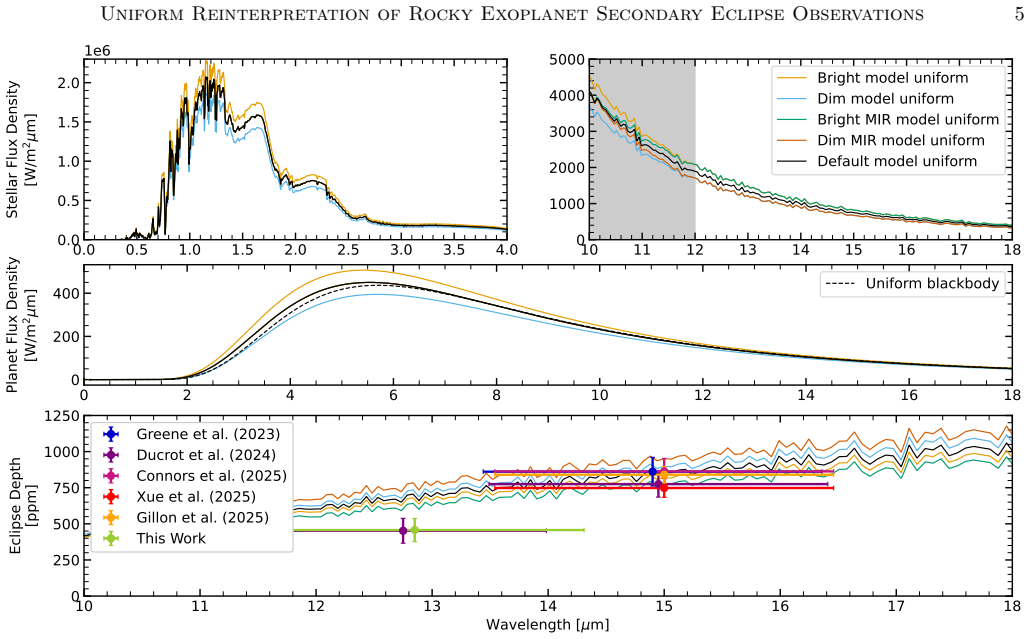
Reanalysis of published secondary-eclipse observations shows that finite precision in stellar temperature, Rp/R*, and a/R* produces a model uncertainty in the predicted bare-rock eclipse depth that is often comparable to the observational uncertainty; this model uncertainty correlates linearly with the input parameter errors and therefore sets a fundamental floor on how strongly surface composition can be inferred from eclipse data.
What carries the argument
A framework that propagates uncertainties in T*, Rp/R*, and a/R* linearly into eclipse-depth predictions for bare-rock models, yielding a quantitative model-error envelope.
If this is right
- Model uncertainty must be reported alongside observational error when claiming atmospheric or bare-rock interpretations.
- The derived linear correlation allows future studies to estimate the required stellar-parameter precision before strong compositional constraints are possible.
- Ignoring model uncertainty risks misclassifying planets as having or lacking atmospheres.
- Improved stellar characterization directly tightens the limit on surface analyses from eclipse observations.
Where Pith is reading between the lines
- Applying the same propagation framework to phase-curve or transmission data could reveal similar hidden floors on atmospheric retrievals.
- Target selection for future eclipse programs should prioritize systems with the smallest fractional errors in Rp/R* and T*.
- If the linear scaling holds across a larger sample, it supplies a simple scaling law that observers can use to forecast the value of improved stellar parameters.
Load-bearing premise
That uncertainties in stellar temperature, radius ratio, and orbital separation dominate the model error budget and propagate linearly into eclipse depth without significant additional systematics from atmospheric or surface models.
What would settle it
A new secondary-eclipse measurement whose depth lies outside the model uncertainty range predicted for a dark bare-rock surface once the published errors on T*, Rp/R*, and a/R* are included.
Figures



read the original abstract
Secondary eclipse observations are a powerful way to investigate whether or not a rocky exoplanet hosts an atmosphere, as an atmospheric presence would transport heat to the nightside and render the dayside colder than anticipated. The interpretation of the secondary eclipse observations relies, however, on models based on imperfect knowledge of the host star properties and the system parameters. Any uncertainties in such astrophysical variables will propagate into both atmospheric and bare-rock models, potentially leading to poorly constrained results and erroneous conclusions. In this work, we introduce a framework to efficiently account for the stellar and orbital uncertainties when modeling the emission spectra of rocky exoplanets, and demonstrate its use by reanalyzing the current suite of rocky exoplanets with published eclipse observations. Our analysis reveals notable uncertainty in the predicted eclipse depth even for a simple dark ($A_{\mathrm{B}}=0$) bare rock as a result of the finite precision of the system's parameters and treatment of the host star's flux. In some cases, the model uncertainty is comparable to the observational uncertainty, further complicating our capability to constrain an atmospheric presence from secondary-eclipse observations. From our modeling schematic, we derive a linear correlation between the model uncertainty and the error in $R_{\mathrm{p}}/R_{\mathrm{*}}$, $ a_{\mathrm{p}}/R_{\mathrm{*}}$, and $T_{\mathrm{*}}$, therefore enabling a more robust compositional analysis in future studies. The model uncertainty serves as a fundamental precision limit to surface analyses, and must be mitigated to strongly constrain the composition of exoplanets in future eclipse observations.
Editorial analysis
A structured set of objections, weighed in public.
Referee Report
Summary. The paper introduces a framework to efficiently propagate uncertainties in stellar properties (T*, R*/Rp) and orbital parameters (a/R*) into models of rocky exoplanet secondary eclipse depths. Reanalysis of the current suite of published eclipse observations reveals notable model uncertainty in predicted depths even for a simple dark (AB=0) bare-rock case, with this uncertainty comparable to observational errors in some instances. From the modeling approach, the authors derive a linear correlation between model uncertainty and errors in Rp/R*, a/R*, and T*, concluding that model uncertainty represents a fundamental precision limit that must be mitigated to strongly constrain exoplanet composition from future observations.
Significance. If the derived linear correlation proves robust and the framework accurately captures uncertainty propagation, the work would be significant for exoplanet characterization by highlighting an underappreciated systematic that affects the ability to distinguish bare-rock from atmospheric scenarios. It offers a practical tool for estimating this limit and could inform target selection and observational strategies by emphasizing the need for high-precision stellar and orbital parameters.
major comments (2)
- [Modeling schematic] Modeling schematic (as referenced in the abstract): The central claim rests on deriving a linear correlation between model uncertainty and errors in Rp/R*, a/R*, and T*. This linearity is presented as enabling robust future analyses, yet the abstract provides no explicit derivation, functional form, or tests of its validity range (e.g., against higher-order terms, wavelength-dependent stellar spectra, or non-zero albedo). If the correlation is obtained via first-order propagation under blackbody assumptions, it may fail outside the tested regime and weaken the mitigation strategy.
- [Reanalysis results] Reanalysis results (abstract): The statement that model uncertainty is comparable to observational uncertainty in some cases, complicating atmospheric constraints, is load-bearing for the overall conclusion. The manuscript should specify which planets exhibit this comparability and report quantitative values (e.g., model vs. observational uncertainty ratios) to allow assessment of how frequently and severely this occurs.
minor comments (2)
- [Abstract] Abstract: While the summary is clear, the lack of any equations, specific numerical examples, or validation steps makes it hard to evaluate the strength of the linear correlation or the reanalysis findings without the full methods and results sections.
- [Notation] Notation and presentation: Ensure all symbols (e.g., AB, Rp/R*, a/R*, T*) are defined consistently at first use, and clarify whether the framework assumes blackbody emission or includes more detailed stellar spectra.
Simulated Author's Rebuttal
We thank the referee for their constructive and detailed comments, which have helped clarify several aspects of our presentation. We address each major comment below and have revised the manuscript accordingly to improve transparency and specificity.
read point-by-point responses
-
Referee: [Modeling schematic] Modeling schematic (as referenced in the abstract): The central claim rests on deriving a linear correlation between model uncertainty and errors in Rp/R*, a/R*, and T*. This linearity is presented as enabling robust future analyses, yet the abstract provides no explicit derivation, functional form, or tests of its validity range (e.g., against higher-order terms, wavelength-dependent stellar spectra, or non-zero albedo). If the correlation is obtained via first-order propagation under blackbody assumptions, it may fail outside the tested regime and weaken the mitigation strategy.
Authors: The linear correlation is obtained in the main text via first-order error propagation applied to the secondary eclipse depth formula under the blackbody assumption for the AB=0 bare-rock case. We agree that the abstract lacks the explicit form and validity discussion. In the revision we will (i) insert the functional form into the abstract, (ii) add a dedicated paragraph in the methods section showing the partial-derivative derivation, and (iii) include a short numerical validation comparing the linear approximation to Monte-Carlo sampling over the observed range of parameter uncertainties. We note that the framework is presented as a baseline for the dark bare-rock model; extensions to non-zero albedo or full stellar spectra are identified as future work and do not affect the current conclusions. revision: yes
-
Referee: [Reanalysis results] Reanalysis results (abstract): The statement that model uncertainty is comparable to observational uncertainty in some cases, complicating atmospheric constraints, is load-bearing for the overall conclusion. The manuscript should specify which planets exhibit this comparability and report quantitative values (e.g., model vs. observational uncertainty ratios) to allow assessment of how frequently and severely this occurs.
Authors: We concur that the abstract claim would be strengthened by explicit quantification. The revised manuscript will include a new table (or expanded figure caption) that lists every reanalyzed planet together with its model uncertainty, observational uncertainty, and their ratio. This will make clear both the subset of targets for which the ratio approaches or exceeds unity and the overall distribution across the sample, allowing readers to judge frequency and severity directly. revision: yes
Circularity Check
No significant circularity; uncertainty propagation uses external inputs
full rationale
The paper's framework propagates uncertainties from externally measured stellar parameters (T*, R*/Rp) and orbital parameters (a/R*) into eclipse depth predictions for bare-rock models. The derived linear correlation between model uncertainty and parameter errors is presented as an output of this propagation under blackbody assumptions, not as a quantity defined in terms of itself or obtained by fitting the target eclipse depths. No load-bearing step reduces by construction to the authors' own fitted values or prior self-citations; the central claim that model uncertainty acts as a precision limit follows from the input error budgets rather than presupposing the result.
Axiom & Free-Parameter Ledger
axioms (1)
- domain assumption Bare-rock emission can be modeled as a simple dark body with albedo AB=0 whose dayside temperature follows from stellar irradiation and orbital geometry.
Reference graph
Works this paper leans on
-
[1]
thebibliography [1] 20pt to REFERENCES 6pt =0pt 10pt plus 3pt =0pt =0pt =1pt plus 1pt =0pt =0pt -12pt =13pt plus 1pt =20pt =13pt plus 1pt \@M =10000 =-1.0em =0pt =0pt 0pt =0pt =1.0em @enumiv\@empty 10000 10000 `\.\@m \@noitemerr \@latex@warning Empty `thebibliography' environment \@ifnextchar \@reference \@latexerr Missing key on reference command Each re...
- [2]
-
[3]
2020, Astronomy & Astrophysics, 640, A134, 10.1051/0004-6361/202038080
Alexoudi, X., Mallonn, M., Keles, E., et al. 2020, Astronomy & Astrophysics, 640, A134, 10.1051/0004-6361/202038080
-
[4]
H., Espinoza, N., Diamond-Lowe, H., et al
Allen, N. H., Espinoza, N., Diamond-Lowe, H., et al. 2025, 10.48550/arXiv.2508.14210
-
[5]
2018, in Handbook of Exoplanets, ed
Alonso , R. 2018, in Handbook of Exoplanets, ed. H. J. Deeg & J. A. Belmonte , 40, 10.1007/978-3-319-55333-7_40
-
[6]
Astropy Collaboration , Robitaille , T. P., Tollerud , E. J., et al. 2013, , 558, A33, 10.1051/0004-6361/201322068
-
[7]
The Astronomical Journal , author =
Astropy Collaboration , Price-Whelan , A. M., Sip o cz , B. M., et al. 2018, , 156, 123, 10.3847/1538-3881/aabc4f
-
[8]
Astropy Collaboration , Price-Whelan , A. M., Lim , P. L., et al. 2022, , 935, 167, 10.3847/1538-4357/ac7c74
work page internal anchor Pith review doi:10.3847/1538-4357/ac7c74 2022
-
[9]
August, P. C., Buchhave, L. A., Diamond-Lowe, H., et al. 2024, Hot Rocks Survey I : A shallow eclipse for LHS 1478 b. 2410.11048
-
[10]
Baumeister , P., Tosi , N., Brachmann , C., Grenfell , J. L., & Noack , L. 2023, , 675, A122, 10.1051/0004-6361/202245791
-
[11]
2022, The Journal of Open Source Software, 7, 4503, doi: 10.21105/joss.04503
Bell, T. J., Ahrer, E.-M., Brande, J., et al. 2022, Journal of Open Source Software, 7, 4503, 10.21105/joss.04503
-
[12]
Bell, T. J., Kreidberg, L., Kendrew, S., et al. 2023, A First Look at the JWST MIRI/LRS Phase Curve of WASP-43b. 2301.06350
-
[13]
K., Wachiraphan, P., & Murray, C
Berta-Thompson, Z. K., Wachiraphan, P., & Murray, C. 2025, The 3D Cosmic Shoreline for Nurturing Planetary Atmospheres. 2507.02136
-
[14]
Bonfanti , A., Brady , M., Wilson , T. G., et al. 2024, , 682, A66, 10.1051/0004-6361/202348180
-
[15]
No excess of cold Jupiters in small planet systems
Bonomo, A. S., Dumusque, X., Massa, A., et al. 2023, Astronomy & Astrophysics, 677, A33, 10.1051/0004-6361/202346211
-
[16]
J., Nesvorn \'y , D., Sasaki , S., & Strazzulla , G
Brunetto , R., Loeffler , M. J., Nesvorn \'y , D., Sasaki , S., & Strazzulla , G. 2015, in Asteroids IV, ed. P. Michel , F. E. DeMeo , & W. F. Bottke , 597--616, 10.2458/azu_uapress_9780816532131-ch031
-
[17]
Burt , J. A., Hooton , M. J., Mamajek , E. E., et al. 2024, , 971, L12, 10.3847/2041-8213/ad5b52
-
[18]
2024, , 960, L3, 10.3847/2041-8213/ad1691
Cadieux , C., Plotnykov , M., Doyon , R., et al. 2024, , 960, L3, 10.3847/2041-8213/ad1691
-
[19]
2011, The Astrophysical Journal, 743, L36, 10.1088/2041-8205/743/2/l36
Castan, T., & Menou, K. 2011, The Astrophysical Journal, 743, L36, 10.1088/2041-8205/743/2/l36
-
[20]
J., Monaghan, C., Benneke, B., & Dang, L
Connors, N. J., Monaghan, C., Benneke, B., & Dang, L. 2025, The Astrophysical Journal Letters, 989, L11, 10.3847/2041-8213/adee0d
-
[21]
Correia , A. C. M., & Laskar , J. 2010, in Exoplanets, ed. S. Seager , 239--266, 10.48550/arXiv.1009.1352
-
[22]
Cowan , N. B., & Agol , E. 2011, , 726, 82, 10.1088/0004-637X/726/2/82
-
[23]
Coy, B. P., Ih, J., Kite, E. S., et al. 2025, The Astrophysical Journal, 987, 22, 10.3847/1538-4357/add3f7
-
[24]
Crossfield, I. J. M. 2012, Astronomy and Astrophysics, 545, A97, 10.1051/0004-6361/201219826
-
[25]
Crossfield, I. J. M., Malik, M., Hill, M. L., et al. 2022, The Astrophysical Journal Letters, 937, L17, 10.3847/2041-8213/ac886b
-
[26]
2019, PASP, 131, 013001, doi: 10.1088/1538-3873/aae5c5
Deming, D., Louie, D., & Sheets, H. 2018, Publications of the Astronomical Society of the Pacific, 131, 013001, 10.1088/1538-3873/aae5c5
-
[27]
M., Akin , C
Diamond-Lowe , H., Mendonca , J. M., Akin , C. J., et al. 2023, The Hot Rocks Survey: Testing 9 Irradiated Terrestrial Exoplanets for Atmospheres , JWST Proposal. Cycle 2, ID. \#3730
2023
-
[28]
F., Kouach, D., Moutou, C., et al
Donati , J. F., Kouach , D., Moutou , C., et al. 2020, , 498, 5684, 10.1093/mnras/staa2569
-
[29]
Dorn, C., Noack, L., & Rozel, A. B. 2018, Astronomy & Astrophysics, 614, A18, 10.1051/0004-6361/201731513
-
[30]
2025, Nature Astronomy, 9, 358, doi: 10.1038/s41550-024-02428-z
Ducrot, E., Lagage, P.-O., Min, M., et al. 2025, Nature Astronomy, 9, 358–369, 10.1038/s41550-024-02428-z
-
[31]
2019, , 627, A43, 10.1051/0004-6361/201935457
Dumusque , X., Turner , O., Dorn , C., et al. 2019, , 627, A43, 10.1051/0004-6361/201935457
-
[32]
2024, Astronomy & Astrophysics, 683, A212, 10.1051/0004-6361/202347127
Dyrek, A., Ducrot, E., Lagage, P.-O., et al. 2024, Astronomy & Astrophysics, 683, A212, 10.1051/0004-6361/202347127
-
[33]
2020, The Astrophysical Journal, 898, 160, 10.3847/1538-4357/ab9cba
Essack, Z., Seager, S., & Pajusalu, M. 2020, The Astrophysical Journal, 898, 160, 10.3847/1538-4357/ab9cba
-
[34]
Fauchez, T. J., Ducrot, E., Rackham, B. V., et al. 2025, The Astrophysical Journal, 989, 170, 10.3847/1538-4357/adf068
-
[35]
2020, Earth and Planetary Science Letters, 534, 116089, 10.1016/j.epsl.2020.116089
Ferrari , S., Maturilli , A., Carli , C., et al. 2020, Earth and Planetary Science Letters, 534, 116089, 10.1016/j.epsl.2020.116089
-
[36]
C., Mishra, I., Gazel, E., et al
First, E. C., Mishra, I., Gazel, E., et al. 2025, Nature Astronomy, 9, 370–379, 10.1038/s41550-024-02412-7
-
[37]
Fortune , M., Gibson , N. P., Diamond-Lowe , H., et al. 2025, arXiv e-prints, arXiv:2505.22186, 10.48550/arXiv.2505.22186
- [38]
-
[39]
Goffo , E., Gandolfi , D., Egger , J. A., et al. 2023, , 955, L3, 10.3847/2041-8213/ace0c7
-
[40]
Greene, T. P., Bell, T. J., Ducrot, E., et al. 2023, Nature, 618, 39–42, 10.1038/s41586-023-05951-7
-
[41]
Hammond, M., Guimond, C. M., Lichtenberg, T., et al. 2024. http://arxiv.org/abs/2409.04386
-
[42]
Han, T., Robertson, P., Brandt, T. D., et al. 2025, 10.48550/arXiv.2506.19985
-
[43]
Hansen , B. M. S. 2008, , 179, 484, 10.1086/591964
-
[44]
2001, , 106, 10039, 10.1029/2000JE001338
Hapke , B. 2001, , 106, 10039, 10.1029/2000JE001338
-
[45]
2012, Theory of Reflectance and Emittance Spectroscopy, 2nd edn
Hapke, B. 2012, Theory of Reflectance and Emittance Spectroscopy, 2nd edn. (Cambridge University Press)
2012
-
[46]
Harris, C. R., Millman, K. J., van der Walt, S. J., et al. 2020, Nature, 585, 357, 10.1038/s41586-020-2649-2
-
[47]
2013, Earth and Planetary Science Letters, 371, 252, 10.1016/j.epsl.2013.03.038
Helbert , J., Nestola , F., Ferrari , S., et al. 2013, Earth and Planetary Science Letters, 371, 252, 10.1016/j.epsl.2013.03.038
-
[48]
2019, Astronomy & Astrophysics, 623, A137, 10.1051/0004-6361/201834620
Heller, R. 2019, Astronomy & Astrophysics, 623, A137, 10.1051/0004-6361/201834620
-
[49]
Hu, R., Ehlmann, B. L., & Seager, S. 2012, The Astrophysical Journal, 752, 7, 10.1088/0004-637X/752/1/7
-
[50]
2024, Nature, 10.1038/s41586-024-07432-x
Hu, R., Bello-Arufe, A., Zhang, M., et al. 2024, Nature, 10.1038/s41586-024-07432-x
-
[51]
Hunter, J. D. 2007, Computing in Science & Engineering, 9, 90, 10.1109/MCSE.2007.55
-
[52]
2013, A&A, 553, A6, doi: 10.1051/0004-6361/201219058
Husser , T. O., Wende-von Berg , S., Dreizler , S., et al. 2013, , 553, A6, 10.1051/0004-6361/201219058
-
[53]
2024, in , 631.03
Iyer, A., Line, M., Muirhead, P., Fortney, J., & Gharib-Nezhad, E. 2024, in , 631.03. https://ui.adsabs.harvard.edu/abs/2024ESS.....563103I
2024
-
[54]
Iyer, A. R., Line, M. R., Muirhead, P. S., Fortney, J. J., & Gharib-Nezhad, E. 2023, The Astrophysical Journal, 944, 41, 10.3847/1538-4357/acabc2
-
[55]
2025, The Astrophysical Journal, 978, 154, 10.3847/1538-4357/ad91a0
Jahandar, F., Doyon, R., Artigau, E., et al. 2025, The Astrophysical Journal, 978, 154, 10.3847/1538-4357/ad91a0
-
[56]
Ji, X., Chatterjee, R. D., Coy, B. P., & Kite, E. S. 2025, 10.48550/arXiv.2504.19872
-
[57]
Kislyakova, K. G., Fossati, L., Johnstone, C. P., et al. 2018, The Astrophysical Journal, 858, 105, 10.3847/1538-4357/aabae4
-
[58]
S., Fegley, Bruce, J., Schaefer, L., & Gaidos, E
Kite, E. S., Fegley, Bruce, J., Schaefer, L., & Gaidos, E. 2016, The Astrophysical Journal, 828, 80, 10.3847/0004-637X/828/2/80
-
[59]
Koll, D. D. B., Malik, M., Mansfield, M., et al. 2019, The Astrophysical Journal, 886, 140, 10.3847/1538-4357/ab4c91
-
[60]
Kreidberg, L. 2018, Exoplanet Atmosphere Measurements from Transmission Spectroscopy and Other Planet Star Combined Light Observations (Springer, Cham), 2083–2105, 10.1007/978-3-319-55333-7_100
- [61]
-
[62]
Kreidberg, L., Koll, D. D. B., Morley, C., et al. 2019, Nature, 573, 87–90, 10.1038/s41586-019-1497-4
-
[63]
2024, High-precision astrometry and photometry with the JWST/MIRI imager
Libralato, M., Argyriou, I., Dicken, D., et al. 2024, High-precision astrometry and photometry with the JWST/MIRI imager. 2311.12145
-
[64]
2026, 10.48550/arXiv.2601.00412
Lin, Z., & Daylan, T. 2026, 10.48550/arXiv.2601.00412
-
[65]
Luque, R., Coy, B. P., Xue, Q., et al. 2024, 10.48550/arXiv.2412.03411
-
[66]
K., Tarbuck, E
Lutgens, F. K., Tarbuck, E. J., & Tasa, D. 2017, Essentials of Geology, 13th edition (Pearson)
2017
- [67]
- [68]
-
[69]
Mackwell , S. J., Simon-Miller , A. A., Harder , J. W., & Bullock , M. A. 2013, Comparative Climatology of Terrestrial Planets (University of Arizona Press), 10.2458/azu_uapress_9780816530595
-
[70]
Mahajan, A. S., Eastman, J. D., & Kirk, J. 2024, The Astrophysical Journal Letters, 963, L37, 10.3847/2041-8213/ad29f3
-
[71]
Mansfield, M., Kite, E. S., Hu, R., et al. 2019, The Astrophysical Journal, 886, 141, 10.3847/1538-4357/ab4c90
-
[72]
Mansfield, M. W., Xue, Q., Zhang, M., et al. 2024. http://arxiv.org/abs/2408.15123
-
[73]
Meier Valdés, E. A., Demory, B.-O., Diamond-Lowe, H., et al. 2025, Astronomy & Astrophysics, 698, A68, 10.1051/0004-6361/202453449
-
[74]
2025, An empirical determination of the Cosmic Shoreline
Meni-Gallardo, P., & Pallé, E. 2025, An empirical determination of the Cosmic Shoreline. 2508.12865
-
[75]
2011, , 742, L19, 10.1088/2041-8205/742/2/L19
Miguel , Y., Kaltenegger , L., Fegley , B., & Schaefer , L. 2011, , 742, L19, 10.1088/2041-8205/742/2/L19
-
[76]
Miles, B. E., Biller, B. A., Patapis, P., et al. 2023, The Astrophysical Journal Letters, 946, L6, 10.3847/2041-8213/acb04a
-
[77]
2025, The Astronomical Journal, 169, 239, 10.3847/1538-3881/adbe75
Monaghan, C., Roy, P.-A., Benneke, B., et al. 2025, The Astronomical Journal, 169, 239, 10.3847/1538-3881/adbe75
-
[78]
Morris, B. M., Bobra, M. G., Agol, E., Lee, Y. J., & Hawley, S. L. 2020, Monthly Notices of the Royal Astronomical Society, 493, 5489–5498, 10.1093/mnras/staa618
-
[79]
E., Dicken, D., Argyriou, I., et al
Morrison, J. E., Dicken, D., Argyriou, I., et al. 2023, Publications of the Astronomical Society of the Pacific, 135, 075004, 10.1088/1538-3873/acdea6
-
[80]
2016, The Astrophysical Journal, 830, 159, 10.3847/0004-637X/830/2/159
Nakajima, T., & Sorahana, S. 2016, The Astrophysical Journal, 830, 159, 10.3847/0004-637X/830/2/159
discussion (0)
Sign in with ORCID, Apple, or X to comment. Anyone can read and Pith papers without signing in.