Recognition: unknown
Dark ages bounds on non-accreting massive compact halo objects
Pith reviewed 2026-05-10 06:22 UTC · model grok-4.3
The pith
Dynamical friction from non-accreting MACHOs distorts the global 21-cm signal enough to set tight upper bounds on their dark matter fraction.
A machine-rendered reading of the paper's core claim, the machinery that carries it, and where it could break.
Core claim
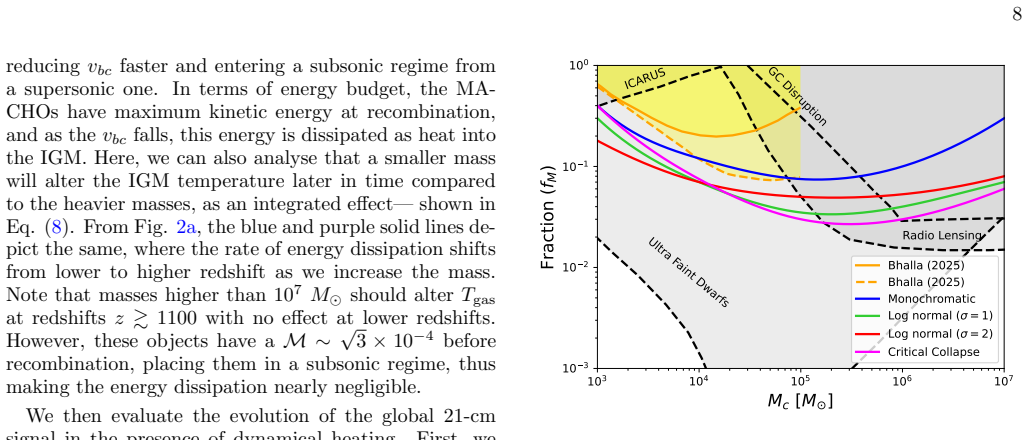
We derive a complementary cosmological upper bound on the fraction of dark matter residing inside massive compact halo objects using the cosmic dawn and dark ages global 21-cm signal. MACHOs of masses above 10^3 solar masses moving through the post-recombination baryonic fluid transfer kinetic energy via dynamical friction, raising the gas temperature and distorting the 21-cm signal from the Lambda CDM prediction. Imposing that the deviation Delta T_21 does not exceed 50 mK at z approximately 17 or 15 mK at z approximately 89, and that no emission signal appears at z greater than or equal to 300, yields upper bounds on the MACHO fraction f_M across 10^3 to 10^7 solar masses for both a single
What carries the argument
Dynamical friction drag exerted by non-accreting MACHOs on the surrounding baryonic fluid, which deposits kinetic energy as heat and thereby reduces the depth of the 21-cm absorption trough.
If this is right
- The dark-ages bound at z approximately 89 is both tighter and free of astrophysical uncertainties associated with star formation.
- Extended MACHO mass distributions produce generally more stringent constraints than monochromatic populations.
- Critical-collapse mass functions yield the strongest limits at intermediate masses.
- The conditions also forbid any 21-cm emission feature at redshifts greater than or equal to 300 for the allowed MACHO fractions.
Where Pith is reading between the lines
- Future instruments that measure the 21-cm signal with smaller error bars at multiple high redshifts could translate directly into proportionally tighter MACHO fraction limits.
- The method isolates the effect of non-accreting compact objects and therefore supplies a test that is orthogonal to accretion or lensing searches for the same objects.
- If independent evidence later shows a significant MACHO fraction, the absence of the predicted heating would indicate either efficient cooling channels or a breakdown of the dynamical-friction calculation at those redshifts.
Load-bearing premise
The only cause of deviation in the global 21-cm signal from the Lambda CDM prediction is dynamical friction heating by non-accreting MACHOs, with no other astrophysical or cosmological effects contributing at the chosen deviation thresholds.
What would settle it
A measurement of the global 21-cm absorption amplitude at redshift approximately 89 that deviates from the standard prediction by more than 15 mK after all other heating sources have been independently ruled out would require the MACHO fraction to exceed the derived upper limit.
Figures


read the original abstract
We derive a complementary cosmological upper bound on the fraction of dark matter residing inside massive compact halo objects (MACHOs) using the cosmic dawn and dark ages global 21-cm signal $(T_{21})$. MACHOs of masses $M\gtrsim 10^3~M_\odot$ moving through the post-recombination baryonic fluid transfer kinetic energy to the intergalactic medium via dynamical friction, raising the gas temperature and distorting the 21-cm signal from the $\Lambda$CDM prediction. We consider both a monochromatic and two extended MACHO mass distributions: log normal and critical collapse. Imposing the conditions that the deviation in the global 21-cm signal $\Delta T_{21}$ does not exceed $50~\rm mK$ at $z\sim 17$ or $15~\rm mK$ at $z\sim 89$, and that no emission signal appears at $z \gtrsim 300$, we derive upper bounds on the MACHO fraction $f_M$ across the mass range $10^3 \lesssim M_c/M_\odot \lesssim 10^7$. The dark ages criterion yields constraints that are both tighter and free from astrophysical uncertainties associated with star formation, providing a complementary cosmological window. Extended distributions produce bounds that are generally more stringent than their monochromatic counterpart, with the critical collapse models yielding the strongest constraints at intermediate masses.
Editorial analysis
A structured set of objections, weighed in public.
Referee Report
Summary. The manuscript claims to derive upper limits on the MACHO dark matter fraction f_M by computing the IGM heating from dynamical friction of non-accreting MACHOs with masses above 10^3 solar masses and mapping the resulting gas temperature increase to deviations in the global 21-cm signal. Specifically, it requires that Delta T_21 remains below 50 mK at z~17 and 15 mK at z~89, and that there is no emission at z>300, for both monochromatic and extended (log-normal, critical collapse) mass distributions. The dark ages bound is highlighted as being free from star-formation uncertainties.
Significance. This approach offers a new window on MACHOs using the dark ages 21-cm signal, which is less affected by astrophysical modeling than cosmic dawn signals. The consideration of different mass distributions adds robustness. If the dynamical friction heating calculation holds and the thresholds are accepted as prospective, it provides complementary constraints to existing bounds from microlensing and other probes.
major comments (2)
- [Abstract] Abstract: The specific numerical thresholds for Delta T_21 (50 mK at z~17 and 15 mK at z~89) and the no-emission condition at z>300 are imposed without derivation from the underlying model or from existing data. These choices are load-bearing for the quantitative f_M bounds, and the manuscript should include an analysis of how the limits vary with different threshold values to demonstrate robustness.
- [21-cm response derivation] The section deriving the 21-cm response: The mapping from the gas temperature rise (computed via the adapted Chandrasekhar dynamical friction formula) to Delta T_21 assumes that dynamical friction heating is the dominant or sole contributor at the level of the chosen thresholds. Potential contributions from other cosmological effects should be estimated to support this isolation.
minor comments (2)
- [Mass distribution section] The notation and parameters for the extended mass distributions (log-normal and critical collapse) should be defined more explicitly, including any normalization or cutoff choices, to facilitate reproducibility of the f_M limits.
- [Results figures] Any figures comparing bounds across mass distributions would benefit from including error bands or sensitivity to the heating rate assumptions.
Simulated Author's Rebuttal
We thank the referee for the constructive review and positive assessment of the novelty of using the dark ages 21-cm signal for MACHO constraints. We address each major comment below with specific revisions planned for the manuscript.
read point-by-point responses
-
Referee: [Abstract] Abstract: The specific numerical thresholds for Delta T_21 (50 mK at z~17 and 15 mK at z~89) and the no-emission condition at z>300 are imposed without derivation from the underlying model or from existing data. These choices are load-bearing for the quantitative f_M bounds, and the manuscript should include an analysis of how the limits vary with different threshold values to demonstrate robustness.
Authors: We agree that explicit justification and robustness tests for the thresholds are warranted, as they directly set the scale of the reported f_M bounds. These values are chosen as conservative, prospective limits informed by the anticipated precision of global 21-cm measurements (drawing from EDGES results at cosmic dawn and the expected performance of proposed dark-ages experiments). The no-emission condition at z>300 enforces consistency with the standard absorption-only prediction in the absence of additional heating. In the revised manuscript we will expand the abstract slightly for context and add a new subsection (or appendix) with a sensitivity analysis: we will recompute the f_M limits for threshold variations of factors 0.5, 2, and 5, demonstrating that the order-of-magnitude constraints remain stable across this range. A supplementary figure will illustrate the scaling. revision: yes
-
Referee: [21-cm response derivation] The section deriving the 21-cm response: The mapping from the gas temperature rise (computed via the adapted Chandrasekhar dynamical friction formula) to Delta T_21 assumes that dynamical friction heating is the dominant or sole contributor at the level of the chosen thresholds. Potential contributions from other cosmological effects should be estimated to support this isolation.
Authors: We appreciate the referee's emphasis on isolating the dynamical-friction contribution. In the dark-ages regime (z ≳ 300) the IGM is expected to be free of astrophysical heating sources, so the only relevant processes are adiabatic cooling and the relative baryon-dark-matter velocity; we will add a short paragraph quantifying that the latter contributes negligibly below our thresholds. At cosmic dawn (z ~ 17) we acknowledge that early star formation could in principle add heating, but our bounds are presented as upper limits on the MACHO fraction under the assumption that any observed deviation is attributable to MACHOs. To address the comment directly, the revised manuscript will include an order-of-magnitude estimate of competing effects (e.g., variations in the baryon-dark-matter streaming velocity and minimal X-ray pre-heating from Population III stars) showing they remain sub-dominant at the 15–50 mK level for the f_M values of interest. This discussion will be placed in the 21-cm response section. revision: yes
Circularity Check
No significant circularity; derivation is first-principles plus external thresholds
full rationale
The paper computes IGM heating via the standard Chandrasekhar dynamical friction formula in an expanding background, integrates over monochromatic/log-normal/critical-collapse mass functions, solves the resulting T_gas(z) evolution, and maps the temperature rise to Delta T_21 using the usual 21-cm brightness-temperature expression. Upper limits on f_M are then obtained by imposing externally chosen conservative thresholds (Delta T_21 <= 50 mK at z~17, <=15 mK at z~89, no emission at z>300). These thresholds are not derived from the model itself but are imposed as prospective observational limits; the heating calculation contains no fitted parameters that are later renamed as predictions, no self-citations that carry the central claim, and no self-definitional loops. The result is therefore independent of its own inputs.
Axiom & Free-Parameter Ledger
free parameters (3)
- 50 mK deviation threshold at z~17
- 15 mK deviation threshold at z~89
- No-emission condition at z>300
axioms (2)
- standard math Standard Lambda-CDM expansion history and baryon temperature evolution after recombination
- domain assumption Dynamical friction is the dominant energy-transfer mechanism between MACHOs and baryonic gas
Reference graph
Works this paper leans on
-
[1]
During this era, the motion enters the hy- personic regime withM ∼5
How- ever, soon after the recombination, the baryonic sound speed attains a value of∼6 km s −1, while the dark mat- ter velocity (vbc) remains unaffected and scales as (1 +z) [70, 72, 73]. During this era, the motion enters the hy- personic regime withM ∼5. The relative velocityv bc follows a Boltzmann distribution with an rms value of ∼30 km s −1, and re...
2025
-
[2]
9 In Fig
suggest the dark ages absorption amplitude peaks atz∼85 after simultaneously analysing Planck and the Wilkinson Microwave Anisotropy Probe (WMAP), and two late time probes, Dark Energy Survey galaxy lensing and clustering and baryon acoustic oscillations, and (3) as the ΛCDM framework suggests a strong thermal cou- pling between baryon and CMB atz≳300, we...
-
[3]
[40], the authors use the discovery of MACS J1149 Lensed Star 1 (LS1), also known as “ICARUS”, as the primary observational evi- dence to constrain the fraction of MACHOs
In Ref. [40], the authors use the discovery of MACS J1149 Lensed Star 1 (LS1), also known as “ICARUS”, as the primary observational evi- dence to constrain the fraction of MACHOs. Here, they argued the non-detection of possible micro- caustics in the presence of compact dark matter objects suggests that dark matter in the mass range 10−5 ≲M/M ⊙ ≲10 2 is s...
-
[4]
[126], the authors establish an upper bound on the mass of compact dark matter objects based on the survival of globular clusters (GCs) in the Milky Way halo
In Ref. [126], the authors establish an upper bound on the mass of compact dark matter objects based on the survival of globular clusters (GCs) in the Milky Way halo. Massive compact objects transfer energy to stars through gravitational interaction, increasing the stellar velocity and driving the clus- ter toward disruption. Here, they argued that if com...
-
[5]
[125] constrain the abundance of supermassive compact objects through the non- detection of milli-lensing events in compact radio sources
The author in Ref. [125] constrain the abundance of supermassive compact objects through the non- detection of milli-lensing events in compact radio sources. Considering such objects as possible pro- genitors of the supermassive black holes observed at redshiftsz≳6, the absence of any confirmed lensing signatures places constraints on compact objects in t...
-
[6]
[34] used the observed half-light radius stars in the Segue-I ultrafaint dwarf (UFD) galaxy
Authors in Ref. [34] used the observed half-light radius stars in the Segue-I ultrafaint dwarf (UFD) galaxy. A half-light radius refers to the radius within which half of an object’s total luminosity is emitted. Here, the authors consider gravitational interaction between the MACHOs and stars, where they have considered the gas within MACHOs to be typical...
2024
-
[7]
M. J. Geller and J. P. Huchra, Science246, 897 (1989)
1989
-
[8]
M. Collesset al.(2DFGRS), Mon. Not. Roy. Astron. Soc.328, 1039 (2001), arXiv:astro-ph/0106498
-
[9]
D. G. Yorket al.(SDSS), Astron. J.120, 1579 (2000), arXiv:astro-ph/0006396
work page Pith review arXiv 2000
-
[10]
Springelet al., Nature435, 629 (2005), arXiv:astro- ph/0504097
V. Springelet al., Nature435, 629 (2005), arXiv:astro- ph/0504097
-
[11]
T. Matos and F. S. Guzman, Class. Quant. Grav.17, L9 (2000), arXiv:gr-qc/9810028
-
[12]
W. Hu, R. Barkana, and A. Gruzinov, Phys. Rev. Lett. 85, 1158 (2000), arXiv:astro-ph/0003365
work page Pith review arXiv 2000
- [13]
-
[14]
L. Hui, J. P. Ostriker, S. Tremaine, and E. Wit- ten, Phys. Rev. D95, 043541 (2017), arXiv:1610.08297 [astro-ph.CO]
work page Pith review arXiv 2017
- [15]
-
[16]
A. Chatterjee, P. Dayal, T. R. Choudhury, and A. Hut- ter, Mon. Not. Roy. Astron. Soc.487, 3560 (2019), 11 arXiv:1902.09562 [astro-ph.CO]
-
[17]
E. D. Carlson, M. E. Machacek, and L. J. Hall, Astro- phys. J.398, 43 (1992)
1992
- [18]
- [19]
-
[20]
A. M. Green and B. J. Kavanagh, J. Phys. G48, 043001 (2021), arXiv:2007.10722 [astro-ph.CO]
work page internal anchor Pith review arXiv 2021
- [21]
-
[22]
E. Pajer and M. Peloso, Class. Quant. Grav.30, 214002 (2013), arXiv:1305.3557 [hep-th]
-
[23]
M. P. Hertzberg and M. Yamada, Phys. Rev. D97, 083509 (2018), arXiv:1712.09750 [astro-ph.CO]
work page Pith review arXiv 2018
- [24]
-
[25]
K. Inomata, E. McDonough, and W. Hu, JCAP02, 031 (2022), arXiv:2110.14641 [astro-ph.CO]
- [26]
- [27]
- [28]
- [29]
- [30]
-
[31]
Witten, Phys
E. Witten, Phys. Rev. D30, 272 (1984)
1984
-
[32]
Ruffini and S
R. Ruffini and S. Bonazzola, Phys. Rev.187, 1767 (1969)
1969
- [33]
- [34]
- [35]
-
[36]
S. R. Coleman, Nucl. Phys. B262, 263 (1985), [Adden- dum: Nucl.Phys.B 269, 744 (1986)]
1985
-
[37]
T. D. Lee and Y. Pang, Phys. Rept.221, 251 (1992)
1992
- [38]
-
[39]
B. Carr and F. Kuhnel, Ann. Rev. Nucl. Part. Sci.70, 355 (2020), arXiv:2006.02838 [astro-ph.CO]
- [40]
-
[41]
R. A. Allsmanet al.(Macho), Astrophys. J. Lett.550, L169 (2001), arXiv:astro-ph/0011506
work page Pith review arXiv 2001
-
[42]
Limits on the Macho Content of the Galactic Halo from the EROS-2 Survey of the Magellanic Clouds
P. Tisserandet al.(EROS-2), Astron. Astrophys.469, 387 (2007), arXiv:astro-ph/0607207
work page Pith review arXiv 2007
-
[43]
Udalski, M
A. Udalski, M. K. Szyma’nski, and G. Szyma’nski, arXiv: Solar and Stellar Astrophysics (2015)
2015
-
[44]
T. Blaineauet al., Astron. Astrophys.664, A106 (2022), arXiv:2202.13819 [astro-ph.GA]
-
[45]
Constraints on Earth-mass primordial black holes from OGLE 5-year microlensing events
H. Niikura, M. Takada, S. Yokoyama, T. Sumi, and S. Masaki, Phys. Rev. D99, 083503 (2019), arXiv:1901.07120 [astro-ph.CO]
work page Pith review arXiv 2019
-
[46]
M. Oguri, J. M. Diego, N. Kaiser, P. L. Kelly, and T. Broadhurst, Phys. Rev. D97, 023518 (2018), arXiv:1710.00148 [astro-ph.CO]
work page Pith review arXiv 2018
-
[47]
P. N. Wilkinson, D. R. Henstock, I. W. A. Browne, A. G. Polatidis, P. Augusto, A. C. S. Readhead, T. J. Pearson, W. Xu, G. B. Taylor, and R. C. Vermeulen, Phys. Rev. Lett.86, 584 (2001), arXiv:astro-ph/0101328
work page Pith review arXiv 2001
- [48]
-
[49]
V. Takhistov, P. Lu, G. B. Gelmini, K. Hayashi, Y. Inoue, and A. Kusenko, JCAP03, 017 (2022), arXiv:2105.06099 [astro-ph.GA]
-
[50]
T. D. Brandt, Astrophys. J. Lett.824, L31 (2016), arXiv:1605.03665 [astro-ph.GA]
work page Pith review arXiv 2016
-
[51]
D. Wadekar and Z. Wang, Phys. Rev. D107, 083011 (2023), arXiv:2211.07668 [hep-ph]
- [52]
- [53]
- [55]
-
[56]
B. Carr, K. Kohri, Y. Sendouda, and J. Yokoyama, Rept. Prog. Phys.84, 116902 (2021), arXiv:2002.12778 [astro-ph.CO]
work page internal anchor Pith review arXiv 2021
- [57]
-
[58]
M. Ricotti, J. P. Ostriker, and K. J. Mack, Astrophys. J.680, 829 (2008), arXiv:0709.0524 [astro-ph]
work page Pith review arXiv 2008
-
[59]
Cosmic microwave background limits on accreting primordial black holes
Y. Ali-Ha¨ ımoud and M. Kamionkowski, Phys. Rev. D 95, 043534 (2017), arXiv:1612.05644 [astro-ph.CO]
work page Pith review arXiv 2017
- [60]
-
[61]
J. R. Pritchard and A. Loeb, Rept. Prog. Phys.75, 086901 (2012), arXiv:1109.6012 [astro-ph.CO]
work page Pith review arXiv 2012
-
[62]
Cosmology at Low Frequencies: The 21 cm Transition and the High-Redshift Universe
S. Furlanetto, S. P. Oh, and F. Briggs, Phys. Rept. 433, 181 (2006), arXiv:astro-ph/0608032
work page Pith review arXiv 2006
-
[63]
Furlanetto, The Global 21 Centimeter Background from High Redshifts, Mon
S. Furlanetto, Mon. Not. Roy. Astron. Soc.371, 867 (2006), arXiv:astro-ph/0604040
-
[64]
J. D. Bowman, A. E. E. Rogers, R. A. Monsalve, T. J. Mozdzen, and N. Mahesh, Nature555, 67 (2018), arXiv:1810.05912 [astro-ph.CO]
work page Pith review arXiv 2018
-
[65]
S. Singh, J. Nambissan T., R. Subrahmanyan, N. Udaya Shankar, B. S. Girish, A. Raghunathan, R. So- mashekar, K. S. Srivani, and M. Sathyanarayana Rao, Nature Astron.6, 607 (2022), arXiv:2112.06778 [astro- ph.CO]
-
[66]
E. de Lera Acedoet al., Nature Astron.6, 998 (2022), arXiv:2210.07409 [astro-ph.CO]
- [67]
-
[68]
Borade, G
R. Borade, G. N. George, and D. C. Gharpure, AIP Conference Proceedings2335, 030005 (2021)
2021
-
[69]
M. Sathyanarayana Rao, S. Singh, S. K. S., G. B. S., K. Sathish, R. Somashekar, R. Agaram, K. Kavitha, G. Vishwapriya, A. Anand, N. Udaya Shankar, and S. Seetha, Experimental Astronomy56, 741 (2023), 12 arXiv:2507.05654 [astro-ph.IM]
-
[70]
S. D. Bale, N. Bassett, J. O. Burns, J. Dorigo Jones, K. Goetz, C. Hellum-Bye, S. Hermann, J. Hibbard, M. Maksimovic, R. McLean, R. Monsalve, P. O’Connor, A. Parsons, M. Pulupa, R. Pund, D. Rapetti, K. M. Rotermund, B. Saliwanchik, A. Slosar, D. Sundkvist, and A. Suzuki, arXiv e-prints , arXiv:2301.10345 (2023), arXiv:2301.10345 [astro-ph.IM]
-
[71]
S. D. Bale, J. W. Bonnell, J. O. Burns, T. D. De Wit, A. Fahs, K. Goetz, C. Hellum-Bye, S. Herrmann, J. Hibbard, Z. Li, M. Maksimovic, D. Malaspina, R. McLean, R. Monsalve, P. O’Connor, B. Page, A. Par- sons, M. Pulupa, R. Pund, D. Rapetti, K. M. Roter- mund, B. Saliwanchik, D. Sheppard, A. Slosar, D. Sund- kvist, A. Suzuki, and F. Yousuf, in2025 United S...
2025
-
[72]
J. O. Burns, Philosophical Transactions of the Royal Society A: Mathematical, Physical and Engi- neering Sciences379(2020), 10.1098/rsta.2019.0564, arXiv:2003.06881 [astro-ph.IM]
-
[73]
D. Rapetti, K. Tauscher, J. Mirocha, and J. O. Burns, Astrophys. J.897, 174 (2020), arXiv:1912.02205 [astro- ph.CO]
-
[74]
B. Bhalla, A. Ireland, H. Liu, H. Xiao, and T. Xu, “Dy- namical heating from dark compact objects and axion minihalos: Implications for the 21-cm signal,” (2025), arXiv:2512.00169 [astro-ph.CO]
- [75]
-
[76]
Relative velocity of dark matter and baryonic fluids and the formation of the first structures
D. Tseliakhovich and C. Hirata, Phys. Rev. D82, 083520 (2010), arXiv:1005.2416 [astro-ph.CO]
work page Pith review arXiv 2010
-
[77]
Schecket al., J
M. Schecket al., J. Phys. Conf. Ser.533, 012007 (2014)
2014
- [78]
-
[79]
Cosmological Perturbation Theory in the Synchronous and Conformal Newtonian Gauges
C.-P. Ma and E. Bertschinger, Astrophys. J.455, 7 (1995), arXiv:astro-ph/9506072
work page Pith review arXiv 1995
-
[80]
Silk, Astrophys
J. Silk, Astrophys. J.151, 459 (1968)
1968
-
[81]
R. Barkana and A. Loeb, Mon. Not. Roy. Astron. Soc. 415, 3113 (2011), arXiv:1009.1393 [astro-ph.CO]
discussion (0)
Sign in with ORCID, Apple, or X to comment. Anyone can read and Pith papers without signing in.