Recognition: unknown
Coupled-channel study of the three-body DDK and D^{*}D^{*}K
Pith reviewed 2026-05-08 07:49 UTC · model grok-4.3
The pith
The DDK three-body system forms a deeply bound state while coupled-channel effects from D*D*K remain negligible.
A machine-rendered reading of the paper's core claim, the machinery that carries it, and where it could break.
Core claim
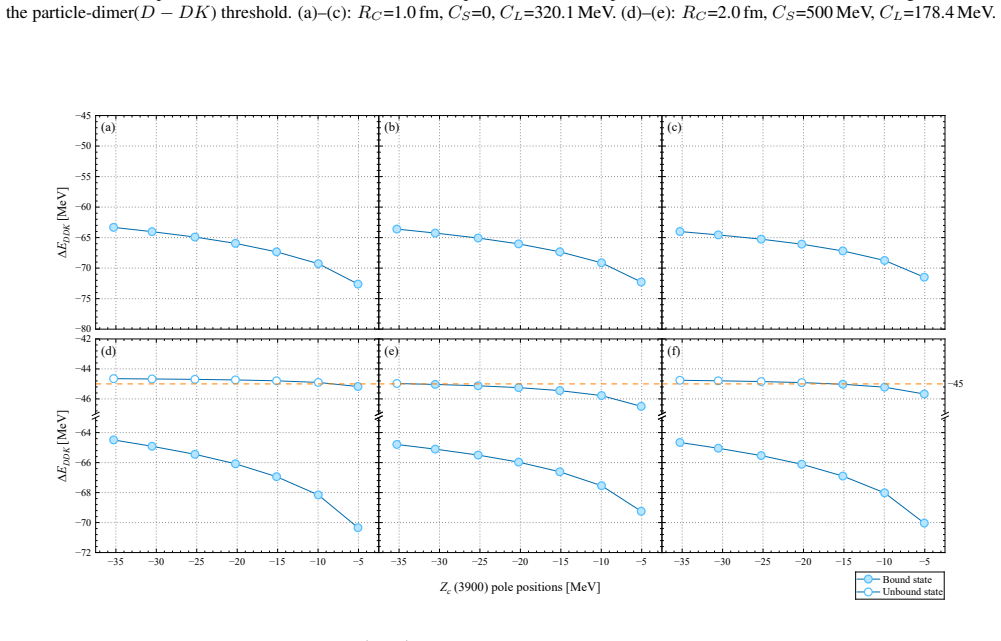
Within the coupled-channel model the DDK system supports a deeply bound state across a wide range of parameters; depending on the long-range part of the DK interaction an additional shallow state can appear near the particle-dimer threshold. Coupled-channel effects from D*D*K are negligible, the deep state is compact while the shallow state shows halo features, and no resonance poles are found. Similar bound states appear in the D*D*K system.
What carries the argument
Coupled-channel three-body equations for DDK and D*D*K configurations, with D(*)D(*) forces from one-boson exchange and D(*)K forces from chiral effective theory, solved by the Gaussian expansion method and complex scaling.
If this is right
- The deeply bound state has a compact three-body structure.
- Any shallow state exhibits the spatial features of a three-body halo.
- No resonance poles appear inside the scanned parameter region.
- The D*D*K system produces analogous bound states.
- The findings supply concrete predictions for few-body dynamics in charmed-meson plus kaon systems.
Where Pith is reading between the lines
- More precise lattice determinations of the DK scattering length at low momentum would decide whether the shallow state exists.
- Decay channels of the predicted states could be searched in B-meson or heavy-ion collision data.
- The same framework could be applied to related three-body systems such as DD pi to map out additional molecular candidates.
Load-bearing premise
The two-body potentials fitted to known states and lattice data remain accurate when inserted into the three-body problem without large higher-order corrections or omitted channels.
What would settle it
A lattice QCD calculation of the DDK system at I=1/2, J^P=0^- that finds no bound states below the three-body threshold would refute the central result.
Figures




read the original abstract
We investigate the three-body $DDK$ system with quantum numbers $I(J^P) = \frac{1}{2}(0^-)$ within a coupled-channel framework that incorporates both $DDK$ and $D^{*}D^{*}K$ configurations. The $D^{(*)}D^{(*)}$ interactions are described using the one-boson-exchange model constrained by the heavy-quark symmetry and fitted to the pole positions of $X(3872)$, $T_{cc}^+$, and $Z_c(3900)$. The $D^{(*)}K$ interaction is from the chiral effective theory, motivated by the molecular interpretation of $D_{s0}^*(2317)$, and is further constrained by lattice-QCD results for the $DK$ scattering lengths. The resulting three-body problem is solved using the Gaussian expansion method, while the complex scaling method is employed to search for possible resonant states. We find that coupled-channel effects from $D^{*}D^{*}K$ are negligible, and the $DDK$ system supports a deeply bound state across a wide range of parameters. Depending on the long-range behavior of the $DK$ interaction, an additional shallow state may emerge near the particle-dimer ($D$-$DK$) threshold. The deeply bound state exhibits a compact three-body structure, whereas the shallow state displays characteristic features of a three-body halo configuration. No clear resonance poles are identified within the explored parameter region. Similar results are obtained for the $D^{*}D^{*}K$ system. These findings may provide new insight into few-body dynamics in systems involving charmed mesons and kaons.
Editorial analysis
A structured set of objections, weighed in public.
Referee Report
Summary. The paper investigates the three-body DDK and D^*D^*K systems with I(J^P)=1/2(0^-) in a coupled-channel framework. D^{(*)}D^{(*)} interactions are modeled via one-boson-exchange potentials constrained by heavy-quark symmetry and fitted to the poles of X(3872), T_{cc}^+, and Z_c(3900); D^{(*)}K interactions use chiral effective theory motivated by the molecular picture of D_{s0}^*(2317) and lattice DK scattering lengths. The three-body problem is solved with the Gaussian expansion method and resonances are searched via the complex scaling method. The authors report that D^*D^*K coupled-channel effects are negligible, the DDK system supports a robust deeply bound state across parameter variations, and an additional shallow halo-like state may appear near the D-DK threshold depending on the long-range DK behavior, with analogous results for D^*D^*K and no clear resonances.
Significance. If the bound-state claims hold under further scrutiny, the work would contribute to understanding few-body molecular dynamics in the charm sector, offering potential insights into exotic hadron spectroscopy and the role of long-range interactions in halo configurations. The technical approach using established Gaussian expansion and complex scaling methods is a strength, though the direct embedding of two-body potentials limits the novelty to the specific three-body application.
major comments (2)
- The central claim of a deeply bound DDK state robust across parameters and negligible D^*D^*K coupling rests on direct use of two-body potentials fitted to X(3872), T_{cc}^+, Z_c(3900), D_{s0}^*(2317), and lattice DK lengths. However, the manuscript provides no quantitative assessment of how omitted three-body forces, higher-order chiral corrections to the DK interaction, or relativistic effects would shift the binding energies, particularly for the shallow state whose existence depends on the DK long-range tail (see abstract and results description).
- No numerical tables, explicit binding-energy values, error estimates, or cutoff-variation studies in the three-body sector are reported, despite varying parameters. This absence prevents evaluation of the quantitative support for 'deeply bound' versus 'shallow' states and the statement that coupled-channel effects are negligible (abstract and numerical results).
minor comments (2)
- The abstract states 'similar results are obtained for the D^*D^*K system' without providing even a brief quantitative comparison of binding energies or structures between the two systems; adding a short table or paragraph would improve clarity.
- Notation for the quantum numbers I(J^P) and particle-dimer thresholds is clear in the abstract but should be consistently defined in the methods section with explicit reference to the Gaussian expansion basis parameters.
Simulated Author's Rebuttal
We thank the referee for the careful reading of our manuscript and the constructive comments. We address each major comment below and will revise the manuscript to improve clarity and address the concerns where feasible.
read point-by-point responses
-
Referee: The central claim of a deeply bound DDK state robust across parameters and negligible D^*D^*K coupling rests on direct use of two-body potentials fitted to X(3872), T_{cc}^+, Z_c(3900), D_{s0}^*(2317), and lattice DK lengths. However, the manuscript provides no quantitative assessment of how omitted three-body forces, higher-order chiral corrections to the DK interaction, or relativistic effects would shift the binding energies, particularly for the shallow state whose existence depends on the DK long-range tail (see abstract and results description).
Authors: We agree that the present study relies on two-body potentials constrained by the listed data and does not provide a quantitative evaluation of three-body forces, higher-order chiral corrections, or relativistic effects. These omissions represent a limitation of the effective two-body approach, and such contributions could shift the binding energies, particularly for the shallow state sensitive to the long-range DK tail. The robustness of the deep compact state is demonstrated through variations of the two-body parameters within ranges allowed by the two-body constraints. We will add a paragraph in the revised manuscript discussing these model limitations and their possible implications for the results. revision: partial
-
Referee: No numerical tables, explicit binding-energy values, error estimates, or cutoff-variation studies in the three-body sector are reported, despite varying parameters. This absence prevents evaluation of the quantitative support for 'deeply bound' versus 'shallow' states and the statement that coupled-channel effects are negligible (abstract and numerical results).
Authors: We accept that the original manuscript lacks explicit numerical tables and detailed error estimates, which hinders quantitative assessment. Although parameter variations were performed in the three-body calculations, the results were presented only qualitatively. In the revised version we will include tables with explicit binding energies for both the DDK and D^*D^*K systems across the explored parameter sets, together with estimates of uncertainties from cutoff variations and quantitative measures of the coupled-channel effects. This will allow readers to evaluate the support for the deeply bound and shallow states. revision: yes
- A quantitative assessment of the shifts in binding energies due to omitted three-body forces, higher-order chiral corrections to the DK interaction, or relativistic effects.
Circularity Check
No significant circularity: three-body results are genuine outputs of solving the Schrödinger equation with fitted two-body inputs
full rationale
The derivation begins with standard two-body potentials (OBE model fitted to X(3872), Tcc+, Zc(3900) poles; chiral EFT for DK constrained by Ds0*(2317) and lattice scattering lengths). These are then inserted as fixed inputs into the three-body coupled-channel equations, which are solved numerically via the Gaussian expansion method to obtain bound-state energies and wave functions. This is a forward calculation with no self-definitional loop, no renaming of fitted parameters as three-body predictions, and no load-bearing self-citation that reduces the central claim to a tautology. The existence of the deeply bound state and possible shallow state follows directly from the numerical solution rather than from re-expressing the two-body fits. The paper's parameter variations and coupled-channel checks further demonstrate that the three-body outputs are not forced by construction. The skeptic concern about higher-order corrections or three-body forces is a question of model accuracy, not circularity in the derivation chain.
Axiom & Free-Parameter Ledger
free parameters (2)
- OBE model parameters for D(*)D(*)
- DK interaction strength and range parameters
axioms (2)
- domain assumption Heavy-quark symmetry governs the D(*)D(*) interactions
- domain assumption Chiral effective theory describes the D(*)K interaction
Reference graph
Works this paper leans on
-
[1]
In the expression, we have already set the total isospin toT= 1 2
Due to Bose-Einstein statistics, the isospin for the subsystem of two identityDmesons can be ony 1. In the expression, we have already set the total isospin toT= 1 2. Considering the spin quantum numbers:J(D) = 0and J(K) = 0, the spin partS JM of theDDKsystem is trivial. ForJ(D ∗) = 1, the spin partS JM of theD ∗D∗Ksystem can be expressed as SJM =S 00 = 1...
-
[2]
H.-X. Chen, W. Chen, X. Liu, and S.-L. Zhu, Phys. Rept.639, 1 (2016), arXiv:1601.02092 [hep-ph]
work page Pith review arXiv 2016
- [3]
- [4]
-
[5]
Pentaquark and Tetraquark states
Y .-R. Liu, H.-X. Chen, W. Chen, X. Liu, and S.-L. Zhu, Prog. Part. Nucl. Phys.107, 237 (2019), arXiv:1903.11976 [hep-ph]. 12 FIG. 9. Complex-energy results ofDDK(upper panel) andD ∗D∗K(lower panel) as theDKinteraction is determined from the lattice- calculated scattering length ofDK,a DK =−1.87fm andR C = 2.00fm. Bound states are marked by circles
work page Pith review arXiv 2019
-
[6]
H.-X. Chen, W. Chen, X. Liu, Y .-R. Liu, and S.-L. Zhu, Rept. Prog. Phys.80, 076201 (2017), arXiv:1609.08928 [hep-ph]
work page Pith review arXiv 2017
- [7]
- [8]
-
[9]
Review of the QCD sum rules for exotic states arXiv:2502.11351
Z.-G. Wang, Front. Phys. (Beijing)21, 016300 (2026), arXiv:2502.11351 [hep-ph]
-
[10]
N. Brambilla, S. Eidelman, C. Hanhart, A. Nefediev, C.-P. Shen, C. E. Thomas, A. Vairo, and C.-Z. Yuan, Phys. Rept.873, 1 (2020), arXiv:1907.07583 [hep-ex]
- [11]
-
[12]
A. Espositoet al., Phys.Rept.668, 1 (2017), arXiv:1611.07920
work page Pith review arXiv 2017
-
[13]
R. Lebedet al., Prog.Part.Nucl.Phys.93, 143 (2017), arXiv:1610.04528
work page Pith review arXiv 2017
-
[14]
Yan, H.-Y
T.-M. Yan, H.-Y . Cheng, C.-Y . Cheung, G.-L. Lin, Y . C. Lin, and H.-L. Yu, Phys. Rev. D46, 1148 (1992), [Erratum: Phys.Rev.D 55, 5851 (1997)]
1992
-
[15]
Casalbuoniet al., Phys.Rept.281, 145 (1997), arXiv:hep- ph/9605342
R. Casalbuoniet al., Phys.Rept.281, 145 (1997), arXiv:hep- ph/9605342
-
[16]
Georgi, Phys
H. Georgi, Phys. Lett. B240, 447 (1990)
1990
-
[17]
A. V . Manohar and M. B. Wise, Camb.Monogr.Part.Phys.Nucl.Phys.Cosmol.10(2000)
2000
-
[18]
S. K. Choiet al.(Belle), Phys. Rev. Lett.91, 262001 (2003), arXiv:hep-ex/0309032
work page Pith review arXiv 2003
-
[19]
M. Ablikimet al.(BESIII), Phys. Rev. Lett.110, 252001 (2013), arXiv:1303.5949 [hep-ex]
-
[20]
Z. Q. Liuet al.(Belle), Phys. Rev. Lett.110, 252002 (2013), erratum: Phys. Rev. Lett. 111, 019901 (2013)
2013
-
[21]
Aaijet al.(LHCb), Nature Phys.18, 751 (2022), arXiv:2109.01038 [hep-ex]
R. Aaijet al.(LHCb), Nature Phys.18, 751 (2022), 2109.01038
-
[22]
Aaijet al.(LHCb), Nature Communications13, 3351 (2022)
R. Aaijet al.(LHCb), Nature Communications13, 3351 (2022)
2022
-
[23]
R. Aaijet al.(LHCb), Phys. Rev. Lett.115, 072001 (2015), arXiv:1507.03414 [hep-ex]
work page Pith review arXiv 2015
-
[24]
R. Aaijet al.(LHCb), Phys. Rev. Lett.122, 222001 (2019), arXiv:1904.03947 [hep-ex]
work page Pith review arXiv 2019
- [25]
- [26]
-
[27]
N. Brambillaet al., Eur. Phys. J. C71, 1534 (2011), arXiv:1010.5827 [hep-ph]
-
[28]
QCD and strongly coupled gauge theories: challenges and perspectives
N. Brambillaet al., Eur. Phys. J. C74, 2981 (2014), arXiv:1404.3723 [hep-ph]
work page Pith review arXiv 2014
- [29]
-
[30]
A. Ali, J. S. Lange, and S. Stone, Prog. Part. Nucl. Phys.97, 123 (2017), arXiv:1706.00610 [hep-ph]
work page Pith review arXiv 2017
- [31]
-
[32]
B. Aubertet al.(BaBar), Phys. Rev. Lett.90, 242001 (2003), arXiv:hep-ex/0304021
-
[33]
D. Bessonet al.(CLEO), Phys. Rev. D68, 032002 (2003), [Er- ratum: Phys.Rev.D 75, 119908 (2007)], arXiv:hep-ex/0305100
-
[34]
P. Krokovnyet al.(Belle), Phys. Rev. Lett.91, 262002 (2003), arXiv:hep-ex/0308019
-
[35]
E. E. Kolomeitsev and M. F. M. Lutz, Phys.Lett.B582, 39 (2004), hep-ph/0307133
work page Pith review arXiv 2004
-
[36]
Dynamically generated 0^+ heavy mesons in a heavy chiral unitary approach
F.-K. Guo, P.-N. Shen, H.-C. Chiang, R.-G. Ping, and B.-S. Zou, Phys. Lett. B641, 278 (2006), arXiv:hep-ph/0603072
work page Pith review arXiv 2006
-
[37]
Implications of a DK Molecule at 2.32 GeV
T. Barnes, F. E. Close, and H. J. Lipkin, Phys. Rev. D68, 054006 (2003), arXiv:hep-ph/0305025 [hep-ph]. 13
work page Pith review arXiv 2003
-
[38]
van Beveren and G
E. van Beveren and G. Rupp, Phys. Rev. Lett.91, 012003 (2003)
2003
-
[39]
Hofmann and M
J. Hofmann and M. F. M. Lutz, Nucl. Phys. A733, 142 (2004)
2004
-
[40]
Gamermann, O
D. Gamermann, O. Romanets, R. Molina, E. Oset, and M. J. Vicente Vacas, Phys. Rev. D76, 074016 (2007)
2007
-
[41]
Aubert, R
B. Aubert, R. Barate, D. Boutigny, J.-M. Gaillard, A. Hicheur, Y . Karyotakis, J. Lees, P. Robbe, V . Tisserand, A. Zghiche, et al., Physical Review D69, 031101 (2004)
2004
-
[42]
R. Aaij, A. Abdelmotteleb,et al., Science Bulletin70, 1432 (2025)
2025
-
[43]
A. Faessler, T. Gutsche, V . E. Lyubovitskij, and Y .-L. Ma, Phys. Rev. D76, 114008 (2007), arXiv:0709.3946 [hep-ph]
-
[44]
Albaladejo, P
M. Albaladejo, P. Fernandez-Soler, J. Nieves, and P. G. Ortega, Eur. Phys. J. C78, 722 (2018)
2018
-
[45]
c.-J. Xiao, D.-Y . Chen, and Y .-L. Ma, Phys. Rev. D93, 094011 (2016), arXiv:1601.06399 [hep-ph]
-
[46]
H.-L. Fu, H. W. Grießhammer, F.-K. Guo, C. Hanhart, and U.- G. Meißner, Eur. Phys. J. A58, 70 (2022)
2022
- [47]
- [48]
- [49]
-
[50]
Z.-H. Guo, L. Liu, U.-G. Meißner, J. A. Oller, and A. Rusetsky, The European Physical Journal C79, 13 (2019)
2019
-
[51]
G. S. Bali, S. Collins, A. Cox, and A. Sch ¨afer (RQCD Collabo- ration), Phys. Rev. D96, 074501 (2017)
2017
-
[52]
J. D. E. Yeo, C. E. Thomas, and D. J. Wilson, Journal of High Energy Physics2024, 1 (2024)
2024
-
[53]
Alexandrou, J
C. Alexandrou, J. Berlin, J. Finkenrath, T. Leontiou, and M. Wagner, Phys. Rev. D101, 034502 (2020)
2020
- [54]
-
[55]
C. B. Lang, L. Leskovec, D. Mohler, and S. Prelovsek, Phys. Rev. D90, 034510 (2014)
2014
-
[56]
Yang, Z.-F
Z.-Y . Yang, Z.-F. Wang, L.-S. Guo, J.-J. Wang, F.-K. Guo, and A. V . Nefediev, Phys. Rev. Lett.129, 112001 (2022)
2022
- [57]
- [58]
-
[59]
A. Martinez Torres, K. P. Khemchandani, and L. S. Geng, Phys. Rev. D99, 076017 (2019), arXiv:1809.01059 [nucl-th]
-
[60]
A. Martinez Torres, K. P. Khemchandani, L. Roca, and E. Oset, Few Body Syst.61, 35 (2020), arXiv:2005.14357 [nucl-th]
- [61]
-
[62]
Z. Zhang, X.-Y . Hu, G. He, J. Liu, J.-A. Shi, B.-N. Lu, and Q. Wang, Phys. Rev. D111, 036002 (2025), arXiv:2409.01325 [hep-ph]
- [63]
- [64]
-
[65]
¨Ozdem, arXiv preprint arXiv:2510.17477 (2025)
U. ¨Ozdem, arXiv preprint arXiv:2510.17477 (2025)
-
[66]
Z. Zhou, G.-L. Yu, Z.-G. Wang, and J. Lu, arXiv preprint arXiv:2510.13706 (2025)
-
[67]
Xiao and D.-Y
C.-J. Xiao and D.-Y . Chen, The European Physical Journal A 53, 127 (2017)
2017
- [68]
-
[69]
Chenet al., Phys
S.-Y . Chenet al., Phys. Lett. B830, 137391 (2022)
2022
-
[70]
Padmanath and S
M. Padmanath and S. Prelovsek, Phys. Rev. Lett.129, 032002 (2022)
2022
-
[71]
M. L. Du, M. Albaladejo, and F. K. Guo, Phys. Lett. B833, 137290 (2022)
2022
-
[72]
Lyuet al., Phys
Y . Lyuet al., Phys. Rev. Lett.131, 161901 (2023)
2023
-
[73]
Whyteet al., Phys
T. Whyteet al., Phys. Rev. D111, 034511 (2025)
2025
- [74]
- [75]
-
[76]
S.-Y . Chen, F.-Y . Chen, X.-L. Chen, L. Meng, N. Li, and W. Chen, arXiv preprint arXiv:2602.19504 (2026)
-
[77]
Hiyama, Y
E. Hiyama, Y . Kino, and M. Kamimura, Prog. Part. Nucl. Phys. 51, 223 (2003)
2003
-
[78]
Aguilar and J
J. Aguilar and J. M. Combes, Commun. Math. Phys.22, 269 (1971)
1971
-
[79]
Balslev and J
E. Balslev and J. M. Combes, Commun. Math. Phys.22, 280 (1971)
1971
-
[80]
Liu, Z.-G
X. Liu, Z.-G. Luo, Y .-R. Liu, and S.-L. Zhu, The European Physical Journal C61, 411 (2009)
2009
discussion (0)
Sign in with ORCID, Apple, or X to comment. Anyone can read and Pith papers without signing in.