Recognition: unknown
Spin-Induced Nonlinear Scalarization of Kerr Black Holes in Einstein-scalar-Gauss-Bonnet Gravity
Pith reviewed 2026-05-07 06:02 UTC · model grok-4.3
The pith
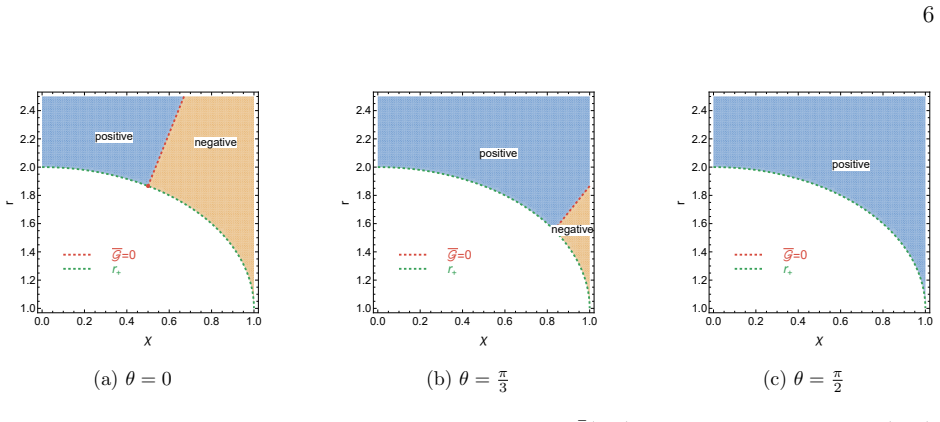
Rapid spin creates a negative Gauss-Bonnet region near the poles of Kerr black holes that triggers nonlinear scalar growth in Einstein-scalar-Gauss-Bonnet gravity.
A machine-rendered reading of the paper's core claim, the machinery that carries it, and where it could break.
Core claim
In an EsGB model that admits no linear tachyonic instability of the scalar-free solution, the decoupled scalar equation on a fixed Kerr background reveals that spins above χ = 0.5 generate a negative near-horizon Gauss-Bonnet region localized near the poles. This negative pocket functions as a geometric trap that permits nonlinear scalar growth. Stationary, fully backreacted scalarized black-hole solutions exist throughout a finite wedge in the mass-spin plane; the wedge is bounded below in spin by χ = 0.5 and extends to low masses at high spins. Within the wedge the scalar hair strengthens with increasing spin and the solutions approach a near-extremal regime, while the hair is suppressed,,
What carries the argument
The negative near-horizon Gauss-Bonnet invariant localized near the poles of Kerr black holes with χ > 0.5, which supplies the geometric trapping that enables nonlinear scalar growth.
If this is right
- Scalarized solutions exist only above the spin threshold χ = 0.5 and occupy a wedge-shaped domain rather than the narrow band found in spontaneous scalarization.
- Toward the high-spin edge the solutions become near-extremal with increasingly strong scalar hair.
- Toward the χ = 0.5 boundary the scalar field is strongly suppressed and the solutions approach the scalar-free Kerr limit.
- The mechanism is effective only for sufficiently low masses at given spin, producing a sharp cutoff in the existence domain.
Where Pith is reading between the lines
- The same curvature-trapping idea could operate in other higher-curvature theories that lack linear instabilities but possess spin-dependent invariants.
- Gravitational-wave signals from highly spinning black-hole mergers might carry imprints of scalar hair if the masses and spins fall inside the predicted wedge.
- The wedge shape implies a mass-dependent upper limit on scalarization strength that could be confronted with future X-ray or gravitational-wave catalogs of stellar-mass black holes.
- Similar numerical constructions of backreacted solutions could be repeated for other axisymmetric backgrounds to test whether spin-induced nonlinear scalarization is generic.
Load-bearing premise
The Einstein-scalar-Gauss-Bonnet model has no linear tachyonic instability for the scalar-free Kerr solution, so any scalarization must be driven purely by the nonlinear trapping effect of the spin-modified geometry.
What would settle it
A numerical evolution of the scalar field on a fixed Kerr background with χ > 0.5 that shows the field decaying to zero instead of growing, or the absence of any stationary backreacted scalarized solution in the predicted high-spin low-mass wedge.
Figures


read the original abstract
We investigate spin-induced scalarization of Kerr black holes in an Einstein-scalar-Gauss-Bonnet (EsGB) model that does not admit a linear tachyonic instability of the scalar-free solution. The scalarization mechanism is therefore genuinely nonlinear. We first analyze the decoupled scalar dynamics on fixed Kerr backgrounds and show that sufficiently rapid rotation modifies the Gauss-Bonnet invariant such that a negative near-horizon region develops near the poles. This region provides a geometric trapping mechanism for nonlinear scalar growth, which becomes effective above a threshold spin $\chi=0.5$. We then construct stationary scalarized black hole solutions with full backreaction and determine their domain of existence. We find that the solutions occupy a finite low-mass high-spin wedge in the spin-mass plane. This is in contrast to spin-induced spontaneous scalarization, where the scalarized solutions form a narrow band. In this wedge, toward the high-spin end, the scalar hair becomes stronger, and the solutions approach a near-extremal regime, while toward the low-spin boundary, the scalar field is strongly suppressed and approaches a weak-hair limit as $\chi \to 0.5$.
Editorial analysis
A structured set of objections, weighed in public.
Referee Report
Summary. The paper investigates genuinely nonlinear spin-induced scalarization of Kerr black holes in an Einstein-scalar-Gauss-Bonnet model with coupling function satisfying f(0)=f'(0)=0, which precludes linear tachyonic instabilities. Analysis of the decoupled scalar on fixed Kerr backgrounds shows that for χ>0.5 a negative near-horizon Gauss-Bonnet region develops near the poles, providing a geometric trapping mechanism for nonlinear scalar growth. Fully backreacted stationary scalarized solutions are constructed numerically and shown to occupy a finite low-mass high-spin wedge in the spin-mass plane, with scalar hair strengthening toward higher spins and approaching a weak-hair limit as χ→0.5.
Significance. If the numerical results hold, the work demonstrates a novel geometric mechanism for nonlinear scalarization without linear instabilities, driven by the spin dependence of the Gauss-Bonnet invariant. The explicit construction of the domain of existence as a wedge (rather than a band) and the identification of the high-spin near-extremal and low-spin weak-hair limits provide concrete, testable predictions. The numerical backreaction treatment is a clear strength, as is the internal consistency between the decoupled analysis and the fully coupled solutions.
major comments (2)
- [Decoupled scalar dynamics section] The threshold χ=0.5 for the onset of the negative GB region is central to the trapping mechanism; the manuscript should provide the explicit expression for the GB invariant on the Kerr background (likely in the section analyzing decoupled scalar dynamics) together with the numerical or analytic procedure that locates the sign change near the poles.
- [Numerical construction of backreacted solutions] The reported domain of existence is a low-mass high-spin wedge; the boundaries of this region are load-bearing for the central claim, so the numerical construction section must include convergence tests, resolution studies, and error estimates (especially in the high-spin regime) to rule out artifacts.
minor comments (2)
- [Abstract] The abstract states the threshold as χ=0.5 without indicating whether it is approximate; a parenthetical reference to the relevant equation or figure would improve clarity.
- [Throughout] Notation for the dimensionless spin χ and the coupling constant should be defined once at first use and used consistently in all figures and tables describing the domain.
Simulated Author's Rebuttal
We thank the referee for their positive assessment of our work and for the constructive major comments. We address each point below and have revised the manuscript to incorporate the requested clarifications and tests.
read point-by-point responses
-
Referee: [Decoupled scalar dynamics section] The threshold χ=0.5 for the onset of the negative GB region is central to the trapping mechanism; the manuscript should provide the explicit expression for the GB invariant on the Kerr background (likely in the section analyzing decoupled scalar dynamics) together with the numerical or analytic procedure that locates the sign change near the poles.
Authors: We agree that an explicit presentation of the Gauss-Bonnet invariant on the Kerr background will strengthen the discussion of the trapping mechanism. In the revised manuscript we have inserted the full analytic expression for the Gauss-Bonnet invariant evaluated on the Kerr metric (in Boyer-Lindquist coordinates) into the decoupled scalar dynamics section. We have also added a concise description of the procedure: the invariant is evaluated on a dense numerical grid covering the near-horizon region near the poles, its minimum value is tracked as a function of spin, and the threshold χ=0.5 is identified as the point at which this minimum crosses from positive to negative. revision: yes
-
Referee: [Numerical construction of backreacted solutions] The reported domain of existence is a low-mass high-spin wedge; the boundaries of this region are load-bearing for the central claim, so the numerical construction section must include convergence tests, resolution studies, and error estimates (especially in the high-spin regime) to rule out artifacts.
Authors: We appreciate the referee’s emphasis on numerical robustness. We have expanded the numerical construction section with a dedicated subsection that reports resolution studies performed at three different grid resolutions, convergence tests for the scalar field amplitude and metric functions, and quantitative error estimates on the location of the domain boundaries. Particular attention is given to the high-spin regime, where we demonstrate that the wedge boundaries remain stable under refinement and that the reported domain is not an artifact of the chosen discretization. revision: yes
Circularity Check
Derivation is self-contained with no circular reductions
full rationale
The paper's chain starts from the independent Kerr metric and the standard Gauss-Bonnet invariant computed on it; the sign change to negative values near the poles for χ>0.5 is a geometric property verifiable without reference to the scalarized solutions. The model is defined with f(0)=f'(0)=0 so the linear scalar equation reduces exactly to the massless wave equation (no tachyonic modes by construction). Nonlinear growth is then driven by the f'(φ)GB term when the negative patch is present, and backreacted stationary solutions are obtained by direct numerical integration. No load-bearing self-citations, fitted inputs renamed as predictions, or ansatze smuggled via prior work appear; the reported low-mass high-spin wedge follows from the coupling scale and the requirement that |GB| exceed the nonlinear threshold. The derivation therefore remains independent of its own outputs.
Axiom & Free-Parameter Ledger
free parameters (1)
- Coupling function parameters in EsGB model
axioms (2)
- domain assumption The background Kerr metric is a valid solution in the scalar-free limit of the EsGB theory.
- domain assumption Numerical methods can converge to stationary solutions with backreaction.
invented entities (1)
-
Nonlinear scalar field configuration on Kerr background
no independent evidence
Reference graph
Works this paper leans on
-
[1]
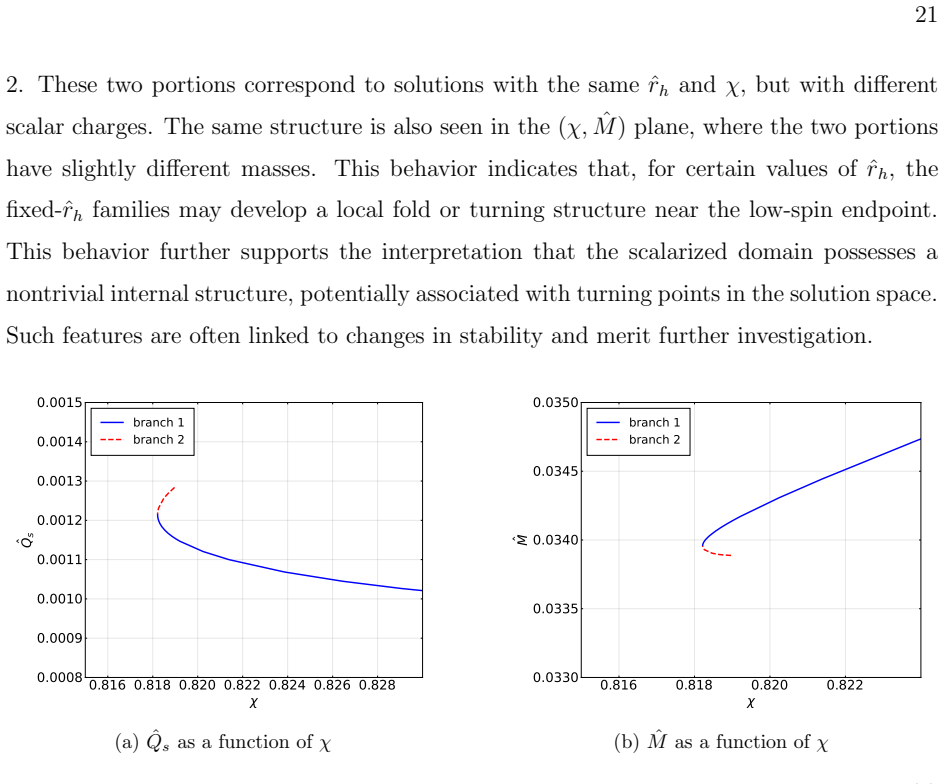
The same structure is also seen in the (χ, ˆM) plane, where the two portions have slightly different masses
These two portions correspond to solutions with the same ˆr h andχ, but with different scalar charges. The same structure is also seen in the (χ, ˆM) plane, where the two portions have slightly different masses. This behavior indicates that, for certain values of ˆr h, the fixed-ˆrh families may develop a local fold or turning structure near the low-spin ...
-
[2]
B. P. Abbottet al.(LIGO Scientific, Virgo), Phys. Rev. Lett.116, 061102 (2016), arXiv:1602.03837 [gr-qc]
work page internal anchor Pith review arXiv 2016
- [3]
-
[4]
First M87 Event Horizon Telescope Results. I. The Shadow of the Supermassive Black Hole
K. Akiyamaet al.(Event Horizon Telescope), Astrophys. J. Lett.875, L1 (2019), arXiv:1906.11238 [astro-ph.GA]
work page internal anchor Pith review arXiv 2019
-
[5]
K. Akiyamaet al.(Event Horizon Telescope), Astrophys. J. Lett.930, L12 (2022), arXiv:2311.08680 [astro-ph.HE]
work page internal anchor Pith review arXiv 2022
-
[6]
Israel, Phys
W. Israel, Phys. Rev.164, 1776 (1967)
1967
-
[7]
Carter, Phys
B. Carter, Phys. Rev. Lett.26, 331 (1971)
1971
-
[8]
D. C. Robinson, Phys. Rev. Lett.34, 905 (1975)
1975
-
[9]
J. D. Bekenstein, Phys. Rev. D51, R6608 (1995)
1995
- [10]
-
[11]
C. A. R. Herdeiro and E. Radu, Int. J. Mod. Phys. D24, 1542014 (2015), arXiv:1504.08209 [gr-qc]
work page Pith review arXiv 2015
- [12]
-
[13]
T. P. Sotiriou and S.-Y. Zhou, Phys. Rev. Lett.112, 251102 (2014), arXiv:1312.3622 [gr-qc]
work page Pith review arXiv 2014
-
[14]
Evasion of No-Hair Theorems and Novel Black-Hole Solutions in Gauss-Bonnet Theories
G. Antoniou, A. Bakopoulos, and P. Kanti, Phys. Rev. Lett.120, 131102 (2018), arXiv:1711.03390 [hep-th]
work page Pith review arXiv 2018
-
[15]
D. D. Doneva and S. S. Yazadjiev, Phys. Rev. Lett.120, 131103 (2018), arXiv:1711.01187 [gr-qc]
work page Pith review arXiv 2018
-
[16]
H. O. Silva, J. Sakstein, L. Gualtieri, T. P. Sotiriou, and E. Berti, Phys. Rev. Lett.120, 131104 (2018), arXiv:1711.02080 [gr-qc]
work page Pith review arXiv 2018
- [17]
- [18]
- [19]
- [20]
- [21]
-
[22]
C. A. R. Herdeiro, E. Radu, N. Sanchis-Gual, and J. A. Font, Phys. Rev. Lett.121, 101102 (2018), arXiv:1806.05190 [gr-qc]
work page Pith review arXiv 2018
- [23]
- [24]
- [25]
-
[26]
D. Astefanesei, C. Herdeiro, A. Pombo, and E. Radu, JHEP10, 078 (2019), arXiv:1905.08304 [hep-th]
- [27]
- [28]
- [29]
- [30]
- [31]
- [32]
- [33]
- [34]
- [35]
- [36]
-
[37]
D.-C. Zou, X. Yang, M.-Y. Lai, H. Huang, B. Liu, J. Kunz, Y. S. Myung, and R.-H. Yue, 24 (2024), arXiv:2404.19521 [gr-qc]
work page internal anchor Pith review arXiv 2024
- [38]
- [39]
- [40]
- [41]
-
[42]
C. Herdeiro, H. Huang, J. Kunz, M.-Y. Lai, E. Radu, and D.-C. Zou, (2026), arXiv:2603.24164 [gr-qc]
discussion (0)
Sign in with ORCID, Apple, or X to comment. Anyone can read and Pith papers without signing in.