Recognition: 4 theorem links
· Lean TheoremTesting an anisotropic spinor field--based Modified Chaplygin Gas model in Kantowski--Sachs spacetime with observational constraints
Pith reviewed 2026-05-08 18:33 UTC · model grok-4.3
The pith
The spinor field Modified Chaplygin Gas model in Kantowski-Sachs spacetime fits current observations while naturally incorporating early anisotropy that vanishes today.
A machine-rendered reading of the paper's core claim, the machinery that carries it, and where it could break.
Core claim
The spinor field-based Modified Chaplygin Gas model in Kantowski-Sachs spacetime offers a viable framework that naturally incorporates anisotropy and a unified description of dark matter and dark energy, consistent with current observations, with the shear parameter becoming negligible at late times.
What carries the argument
The coupling of a massless nonlinear spinor field to the Modified Chaplygin Gas equation of state inside the Kantowski-Sachs metric, which evolves the anisotropy and the unified dark sector simultaneously.
If this is right
- The model reproduces late-time acceleration with a present-day deceleration parameter near -0.49.
- The shear parameter is driven to zero at late times, recovering an effectively isotropic universe.
- The model yields a Hubble constant of 67-68 km/s/Mpc while fitting the combined supernova, chronometer, and baryon acoustic oscillation data.
- It returns a lower minimum chi-squared and is favored by the Akaike Information Criterion over Lambda CDM.
- The Modified Chaplygin Gas component supplies a single fluid description of both dark matter and dark energy.
Where Pith is reading between the lines
- High-precision future surveys sensitive to shear at intermediate redshifts could directly test whether early anisotropy decays exactly as the spinor-MCG dynamics predict.
- The same spinor coupling might be applied to other anisotropic metrics to explore whether the isotropization mechanism is generic or specific to Kantowski-Sachs geometry.
- Because the model prefers a lower H0 value, it could be combined with additional early-universe physics to explore solutions to the Hubble tension without reintroducing large late-time anisotropy.
Load-bearing premise
The assumption that a massless nonlinear spinor field can be consistently coupled to the Modified Chaplygin Gas in Kantowski-Sachs spacetime to produce a physically motivated unified dark sector whose parameters remain stable under observational constraints.
What would settle it
A future measurement showing a statistically significant non-zero shear parameter at low redshift, or a Hubble constant firmly outside the 67-68 km/s/Mpc range from independent probes, would falsify the model's viability.
Figures


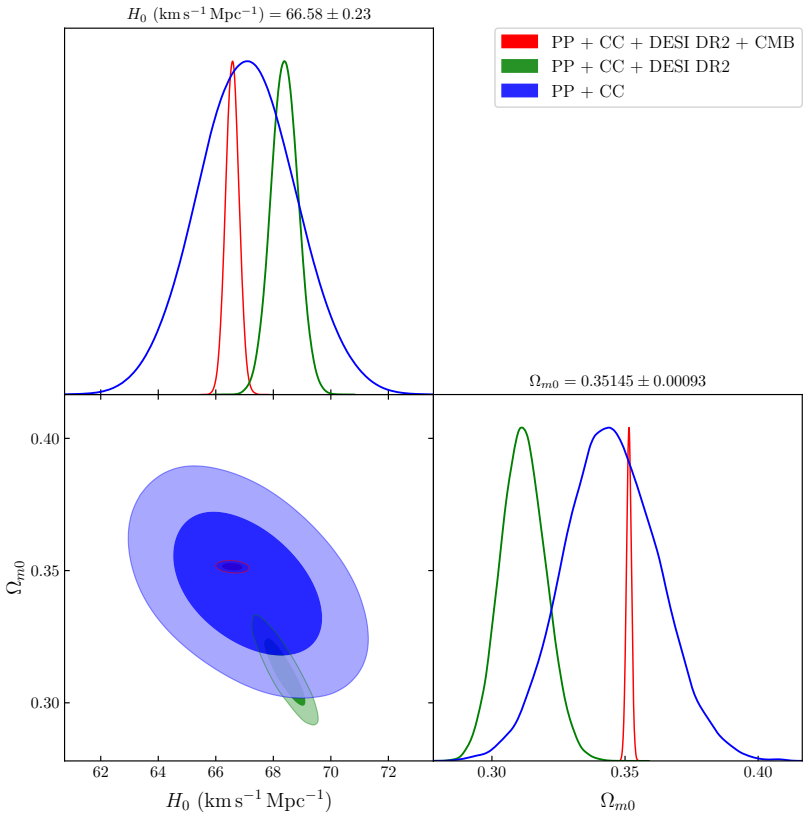


read the original abstract
We investigate a cosmological model based on a massless nonlinear spinor field coupled to a Modified Chaplygin Gas (MCG) in the Kantowski--Sachs spacetime, aiming to probe anisotropies and unified dark sector dynamics. The model parameters are constrained using recent observational data, including Pantheon+, cosmic chronometers, DESI DR2, and CMB distance priors, via a Markov Chain Monte Carlo analysis. We find $H_0 \sim 67$--$68~\mathrm{km\,s^{-1}\,Mpc^{-1}}$, while the shear parameter is consistent with zero, indicating an effectively isotropic Universe at late times. The model reproduces late-time cosmic acceleration with a present-day deceleration parameter $q_0 \sim -0.49$, and provides a good fit to the data, yielding a lower minimum $\chi^2$ than $\Lambda$CDM, and is favored by the Akaike Information Criterion. Overall, the spinor field MCG model in Kantowski--Sachs spacetime offers a viable framework that naturally incorporates anisotropy and a unified description of dark matter and dark energy, consistent with current observations.
Editorial analysis
A structured set of objections, weighed in public.
Referee Report
Summary. The manuscript investigates a cosmological model based on a massless nonlinear spinor field coupled to Modified Chaplygin Gas in Kantowski-Sachs spacetime. It performs MCMC constraints on the free parameters (MCG parameters A, B, alpha; spinor coupling; initial shear/anisotropy) using Pantheon+, cosmic chronometers, DESI DR2, and CMB distance priors. The reported results include H0 ~67-68 km/s/Mpc, shear consistent with zero at late times, q0 ~ -0.49, lower minimum chi^2 than LambdaCDM, and AIC preference for the model, leading to the claim that the framework naturally incorporates anisotropy and provides a unified dark sector description consistent with observations.
Significance. If the central claims hold after addressing the issues below, the work would demonstrate an observationally viable unified DM+DE model in an anisotropic background, with standard MCMC methodology applied to recent datasets. However, the reported consistency of shear with zero limits the demonstrated advantage of the Kantowski-Sachs choice over isotropic MCG models, reducing the novelty of the anisotropic incorporation.
major comments (2)
- [Abstract and MCMC analysis section] Abstract and results on MCMC constraints: the finding that the shear parameter is consistent with zero at late times directly undermines the central claim that the model 'naturally incorporates anisotropy' in a physically meaningful way. The Kantowski-Sachs metric introduces two independent scale factors, yet the data (Pantheon+, chronometers, DESI DR2, CMB priors) force the anisotropic degrees of freedom to vanish, reducing the dynamics to the isotropic limit without shown advantage for the unified spinor-MCG description.
- [Abstract and observational constraints section] MCMC analysis and abstract: no error budgets, covariance matrices, or explicit checks for parameter degeneracies are supplied. This leaves the claims of a 'good fit' and 'lower chi^2' only partially verifiable, as the circularity burden (all reported H0, q0, shear values obtained by direct fitting to the same datasets) cannot be fully assessed without these diagnostics.
Simulated Author's Rebuttal
We thank the referee for the constructive and detailed comments on our manuscript. We have carefully addressed each major point below, providing clarifications and indicating revisions where the manuscript requires strengthening for verifiability and precision.
read point-by-point responses
-
Referee: [Abstract and MCMC analysis section] Abstract and results on MCMC constraints: the finding that the shear parameter is consistent with zero at late times directly undermines the central claim that the model 'naturally incorporates anisotropy' in a physically meaningful way. The Kantowski-Sachs metric introduces two independent scale factors, yet the data (Pantheon+, chronometers, DESI DR2, CMB priors) force the anisotropic degrees of freedom to vanish, reducing the dynamics to the isotropic limit without shown advantage for the unified spinor-MCG description.
Authors: We acknowledge that the posterior on the shear parameter being consistent with zero at late times indicates the model evolves toward an effectively isotropic state, in line with observational expectations. The Kantowski-Sachs setup nevertheless provides a general anisotropic background in which the spinor-MCG dynamics are solved; the MCMC results demonstrate that non-zero initial shear is allowed by the parameter space and decays naturally due to the field equations. This constitutes a built-in mechanism for anisotropy that is absent in purely isotropic MCG models. We have revised the abstract and the discussion section to qualify the claim as 'permits a natural incorporation of anisotropy that is consistent with late-time isotropy,' and we have added a brief comparison of the shear evolution against the corresponding isotropic MCG case to illustrate the dynamical distinction, even though the late-time limit coincides. revision: partial
-
Referee: [Abstract and observational constraints section] MCMC analysis and abstract: no error budgets, covariance matrices, or explicit checks for parameter degeneracies are supplied. This leaves the claims of a 'good fit' and 'lower chi^2' only partially verifiable, as the circularity burden (all reported H0, q0, shear values obtained by direct fitting to the same datasets) cannot be fully assessed without these diagnostics.
Authors: We agree that the absence of these diagnostics limits the transparency of the fit-quality claims. In the revised manuscript we now supply the full covariance matrix of the MCMC chains, one-sigma error budgets on all parameters (including A, B, α, the spinor coupling, and initial shear), and explicit degeneracy plots together with a short discussion of the principal correlations. While any cosmological parameter estimation is performed on the same datasets by construction, we have added a note on the use of independent data subsets (e.g., Pantheon+ alone versus the full combination) to assess robustness and reduce circularity concerns. revision: yes
Circularity Check
Fitted parameters to Pantheon+ and other datasets presented as model 'predictions' and 'findings' of anisotropy incorporation
specific steps
-
fitted input called prediction
[Abstract]
"We find H_0 ∼ 67--68 km s^{-1} Mpc^{-1}, while the shear parameter is consistent with zero, indicating an effectively isotropic Universe at late times. The model reproduces late-time cosmic acceleration with a present-day deceleration parameter q_0 ∼ -0.49, and provides a good fit to the data, yielding a lower minimum χ² than ΛCDM, and is favored by the Akaike Information Criterion."
H0, shear, q0 and χ² values are the direct output of MCMC parameter fitting to Pantheon+, cosmic chronometers, DESI DR2 and CMB priors. Reporting them as 'findings' and 'reproduces' makes the quoted results equivalent to the fitted inputs by construction rather than independent predictions from the spinor-MCG-KS dynamics.
full rationale
The paper derives the field equations for the massless nonlinear spinor coupled to MCG in Kantowski-Sachs metric independently. However, the central results (H0, q0, shear~0, χ² comparison) are obtained by MCMC fitting of free parameters directly to the same observational datasets used for constraints. These are then reported as 'we find' and 'reproduces' without independent verification, reducing the viability claims to the input data by construction. The anisotropy claim is further undercut as data force shear to zero, but no separate circularity in the metric setup itself.
Axiom & Free-Parameter Ledger
free parameters (3)
- MCG parameters (A, B, alpha)
- spinor coupling constant
- initial shear and anisotropy parameters
axioms (2)
- domain assumption The spinor field is massless and nonlinear.
- domain assumption Kantowski-Sachs metric is an appropriate background for late-time cosmology.
Lean theorems connected to this paper
-
IndisputableMonolith.Cost.FunctionalEquation (washburn_uniqueness_aczel)washburn_uniqueness_aczel unclear?
unclearRelation between the paper passage and the cited Recognition theorem.
We consider the case with modified Chaplygin gas (MCG)... p = Wρ − A/ρ^α, W>0, A>0, 0≤α≤1
-
IndisputableMonolith.Foundation.RealityFromDistinctionreality_from_one_distinction unclear?
unclearRelation between the paper passage and the cited Recognition theorem.
We explore the six-dimensional parameter space; params = H₀, Ωk0, Δ₀, A, α, W
-
IndisputableMonolith.Foundation.AlexanderDuality (D=3 forcing)alexander_duality_circle_linking unclear?
unclearRelation between the paper passage and the cited Recognition theorem.
the shear parameter is consistent with zero, indicating an effectively isotropic Universe at late times
What do these tags mean?
- matches
- The paper's claim is directly supported by a theorem in the formal canon.
- supports
- The theorem supports part of the paper's argument, but the paper may add assumptions or extra steps.
- extends
- The paper goes beyond the formal theorem; the theorem is a base layer rather than the whole result.
- uses
- The paper appears to rely on the theorem as machinery.
- contradicts
- The paper's claim conflicts with a theorem or certificate in the canon.
- unclear
- Pith found a possible connection, but the passage is too broad, indirect, or ambiguous to say the theorem truly supports the claim.
Reference graph
Works this paper leans on
-
[1]
Heavens, The Cosmological Model: an overview and an outlook, J
A. Heavens, The Cosmological Model: an overview and an outlook, J. Phys. Conf. Ser.120, 022001 (2008), doi:10.1088/1742-6596/120/2/022001
-
[2]
Weinberg,Cosmology(Oxford University Press, Oxford, 2008)
S. Weinberg,Cosmology(Oxford University Press, Oxford, 2008)
2008
-
[3]
Dodelson,Modern Cosmology(Academic Press, San Diego, 2003)
S. Dodelson,Modern Cosmology(Academic Press, San Diego, 2003)
2003
-
[4]
N. Aghanimet al.(Planck Collaboration), Astron. Astrophys.641, A6 (2020), doi:10.1051/0004-6361/201833910, arXiv:1807.06209
-
[5]
P. J. E. Peebles and B. Ratra, Rev. Mod. Phys.75, 559 (2003), doi:10.1103/RevModPhys.75.559, arXiv:astro-ph/0207347
-
[6]
Heavens,Statistical Techniques in Cosmology(Springer, 2009)
A. Heavens,Statistical Techniques in Cosmology(Springer, 2009)
2009
-
[7]
A. G. Riesset al., Astron. J.116, 1009 (1998), doi:10.1086/300499, arXiv:astro-ph/9805201
-
[8]
1999, apj, 517, 565, doi: 10.1086/307221
S. Perlmutteret al., Astrophys. J.517, 565 (1999), doi:10.1086/307221, arXiv:astro- ph/9812133
work page internal anchor Pith review doi:10.1086/307221 1999
-
[9]
D.M. Scolnic et al., Astrophys. J.859, 101 (2018), doi:10.3847/1538-4357/aab9bb, arXiv:1710.00845. 15
-
[10]
and Carr, Anthony and Zuntz, Joe and Kessler, Rick and Davis, Tamara M
D. Brout et al., Astrophys. J.938, 110 (2022), doi:10.3847/1538-4357/ac8e04, arXiv:2202.04077
-
[11]
Planck Collaboration, Astron. Astrophys.571, A16 (2014), doi:10.1051/0004- 6361/201321591, arXiv:1303.5076
-
[12]
M. Tegmarket al., Phys. Rev. D69, 103501 (2004), doi:10.1103/PhysRevD.69.103501, arXiv:astro-ph/0310723
-
[13]
S. Coleet al., Mon. Not. R. Astron. Soc.362, 505 (2005), doi:10.1111/j.1365- 2966.2005.09318.x, arXiv:astro-ph/0501174
-
[14]
M. Bartelmann and P. Schneider, Phys. Rept.340, 291 (2001), doi:10.1016/S0370- 1573(00)00082-X, arXiv:astro-ph/9912508
-
[15]
Cosmology with Cosmic Shear Observations: A Review , shorttitle =
M. Kilbinger, Rept. Prog. Phys.78, 086901 (2015), doi:10.1088/0034-4885/78/8/086901, arXiv:1411.0115
-
[16]
2021, prd, 103, 083533, doi: 10.1103/PhysRevD.103.083533
S. Alamet al., Phys. Rev. D103, 083533 (2021), doi:10.1103/PhysRevD.103.083533, arXiv:2007.08991
-
[17]
J.947, 85 (2023), doi:10.3847/1538-4357/acbfb8, arXiv:2208.08512
DESI Collaboration, Astrophys. J.947, 85 (2023), doi:10.3847/1538-4357/acbfb8, arXiv:2208.08512
-
[18]
DESI Collaboration, Mon. Not. R. Astron. Soc.522, 2038 (2023), doi:10.1093/mnras/stad1136, arXiv:2306.06308
-
[19]
DESI Collaboration et al.,(2025), https://doi.org/10.48550/arXiv.2503.14745
work page internal anchor Pith review doi:10.48550/arxiv.2503.14745 2025
-
[20]
DESI Collaboration et al., Phys. Rev. D112, 083515 (2025), https://doi.org/10.1103/tr6y- kpc6, arXiv:2404.03000
-
[21]
1989, Reviews of Modern Physics, 61, 1, doi: 10.1103/RevModPhys.61.1
S. Weinberg, Rev. Mod. Phys.61, 1 (1989), doi:10.1103/RevModPhys.61.1
-
[22]
S. M. Carroll, Living Rev. Relativ.4, 1 (2001), doi:10.12942/lrr-2001-1, arXiv:astro- ph/0004075
-
[23]
A. G. Riesset al., Astrophys. J.876, 85 (2019), doi:10.3847/1538-4357/ab1422, arXiv:1903.07603
-
[24]
L. Verde, T. Treu and A. G. Riess, Nature Astron.3, 891 (2019), doi:10.1038/s41550-019- 0902-0, arXiv:1907.10625
-
[25]
E. J. Copeland, M. Sami and S. Tsujikawa, Int. J. Mod. Phys. D15, 1753 (2006), doi:10.1142/S021827180600942X, arXiv:hep-th/0603057
-
[26]
C. W. Misner, Astrophys. J.151, 431 (1968), doi:10.1086/149448
-
[27]
G. F. R. Ellis and M. A. H. MacCallum, Commun. Math. Phys.12, 108 (1969), doi:10.1007/BF01645908
-
[28]
B. Saha, Phys. Rev. D64, 123501 (2001), doi:10.1103/PhysRevD.64.123501, arXiv:gr- qc/0107013
-
[29]
P. A. R. Adeet al.(Planck Collaboration), Astron. Astrophys.594, A16 (2016), doi:10.1051/0004-6361/201526681, arXiv:1506.07135
-
[30]
D. Saadehet al., Phys. Rev. Lett.117, 131302 (2016), doi:10.1103/PhysRevLett.117.131302, arXiv:1605.07178. 16
-
[31]
R. Kantowski and R. K. Sachs, J. Math. Phys.7, 443 (1966), doi:10.1063/1.1704952
-
[32]
M. P. Ryan and L. C. Shepley,Homogeneous Relativistic Cosmologies(Princeton University Press, 1975)
1975
-
[33]
Saha, Spinor field nonlinearity and space-time geometry, Phys
B. Saha, Spinor field nonlinearity and space-time geometry, Phys. Part. Nucl.49, 146 (2018)
2018
-
[35]
On consistency of the interacting (anti)holomorphic higher-spin sector
M. Goray and B. Saha, Eur. Phys. J. C86, 19 (2026), https://doi.org/10.1140/epjc/s10052- 025-15230-6
-
[36]
Saha, Nonlinear Spinor Fields in Bianchi type-Ispacetime: Problems and Possibilities, Astrophys
B. Saha, Nonlinear Spinor Fields in Bianchi type-Ispacetime: Problems and Possibilities, Astrophys. Space Sci.357, 28 (2015), doi:10.1007/s10509-015-2271-9
-
[37]
Fabbri, Conformal gravity with the most general ELKO matter, Phys
L. Fabbri, Conformal gravity with the most general ELKO matter, Phys. Rev. D85, 047502 (2012), doi:10.1103/PhysRevD.85.047502, arXiv:1112.2404
-
[38]
N. J. Pop lawski, Nonsingular, big-bounce cosmology from spinor-torsion coupling, Phys. Rev. D85, 107502 (2012), doi:10.1103/PhysRevD.85.107502, arXiv:1111.4595
-
[39]
R. G. Torrence and W. E. Couch, Note on Kantowski-Sachs space-times, Gen. Relativ. Gravit. 20, 603 (1988), doi:10.1007/BF00758910
-
[40]
M. Krasnov, O. Trivedi, and M. Khlopov, Kantowski-Sachs cosmological model with axion-like scalar field and dark energy, arXiv:2410.09571
-
[41]
T. Vinutha, K. Niharika, and K. Sri Kavya, The study of Kantowski-Sachs perfect fluid cosmological model in modified gravity, arXiv:2301.01163
-
[42]
B. Saha, Spinor field in Kantowski-Sachs cosmology, inProceedings of the LXI All-Russian Conference on Problems in Dynamics, Particle Physics, Plasma Physics and Optoelectronics, RUDN University, Moscow, Russia, May 19–23 (2025), pp. 66–74
2025
-
[43]
B. Ratra and P. J. E. Peebles, Phys. Rev. D37, 3406 (1988), doi:10.1103/PhysRevD.37.3406
-
[44]
R. R. Caldwell, R. Dave and P. J. Steinhardt, Phys. Rev. Lett.80, 1582 (1998), doi:10.1103/PhysRevLett.80.1582, arXiv:astro-ph/9708069
-
[45]
A. Y. Kamenshchik, U. Moschella and V. Pasquier, Phys. Lett. B511, 265 (2001), doi:10.1016/S0370-2693(01)00571-8, arXiv:gr-qc/0103004
-
[46]
M. C. Bento, O. Bertolami and A. A. Sen, Phys. Rev. D66, 043507 (2002), doi:10.1103/PhysRevD.66.043507, arXiv:gr-qc/0202064
- [47]
-
[48]
U. Debnath, A. Banerjee and S. Chakraborty, Class. Quant. Grav.21, 5609 (2004), doi:10.1088/0264-9381/21/23/019, arXiv:gr-qc/0411015
-
[49]
J. Lu, Y. Gui and X. Zhang, Eur. Phys. J. C63, 349 (2009), doi:10.1140/epjc/s10052-009- 1102-6, arXiv:0806.0676
-
[52]
M. Morescoet al., J. Cosmol. Astropart. Phys.05, 014 (2016), doi:10.1088/1475- 7516/2016/05/014, arXiv:1601.01701
-
[53]
C. Zhanget al., Res. Astron. Astrophys.14, 1221 (2014), doi:10.1088/1674-4527/14/10/002, arXiv:1207.4541
-
[54]
Constraints on the redshift dependence of the dark energy potential
J. Simon, L. Verde and R. Jimenez, Phys. Rev. D71, 123001 (2005), doi:10.1103/PhysRevD.71.123001, arXiv:astro-ph/0412269
-
[55]
Baryon acoustic oscillations in the Ly forest of BOSS DR11 quasars
T. Delubacet al., Astron. Astrophys.574, A59 (2015), doi:10.1051/0004-6361/201423969, arXiv:1404.1801
-
[56]
DESI Collaboration, Phys. Rev. D112, 083516 (2025)
2025
- [57]
discussion (0)
Sign in with ORCID, Apple, or X to comment. Anyone can read and Pith papers without signing in.