Recognition: unknown
Kinematic Stratification in Extremely Red Quasars Revealed by JWST
Pith reviewed 2026-05-08 16:03 UTC · model grok-4.3
The pith
Modeling of JWST spectra separates emission lines in extremely red quasars into distinct kinematic components that indicate velocity- and density-stratified gas on multiple scales.
A machine-rendered reading of the paper's core claim, the machinery that carries it, and where it could break.
Core claim
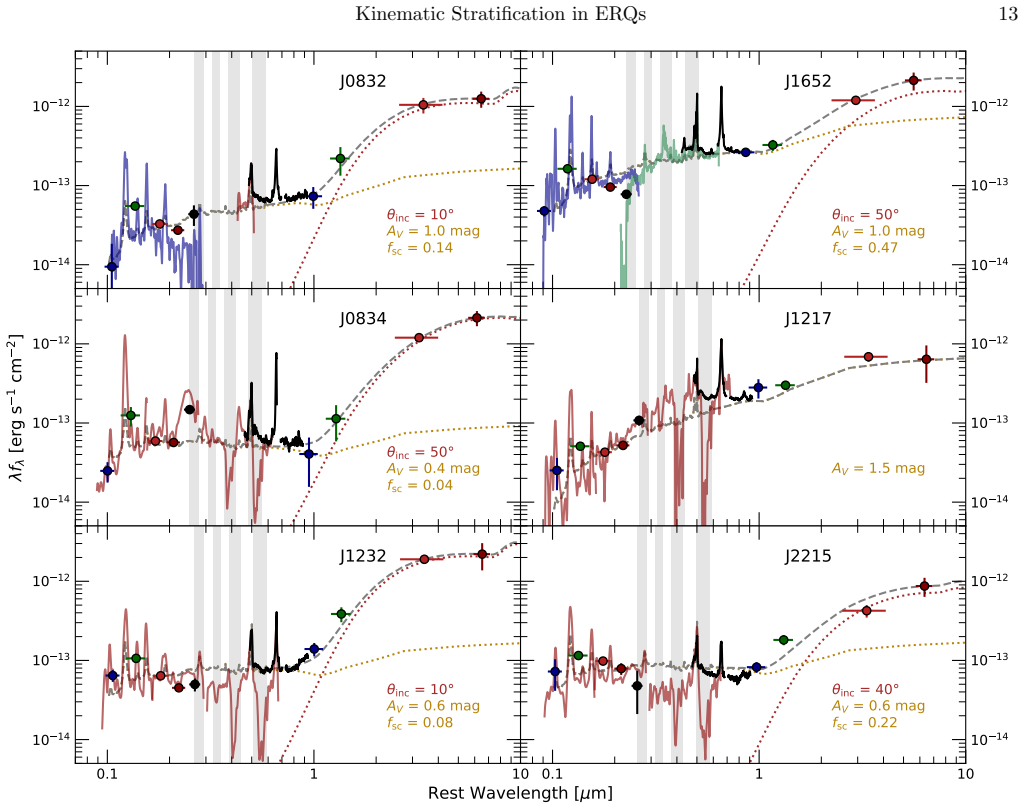
Our modeling allows us to deblend the lines and separate the emission into distinct kinematic components that imply velocity- and density-stratified gas structures on a range of physical scales within the ERQs. The kinematics of the UV and optical emission lines largely agree, but the UV lines are dominated by scattered light while the optical emission-line ratios indicate a combination of scattered and obscured emission. The spectral energy distributions are consistent with a significantly dust-obscured central source with a small amount of relatively-unobscured UV/optical flux scattered into our line-of-sight.
What carries the argument
Kinematic deblending of rest-frame optical emission lines into separate velocity components that trace stratified gas.
If this is right
- Gas around these quasars is organized into layers that differ in speed and density across scales from the broad-line region outward.
- UV light reaches us mostly by scattering while optical lines include both scattered and direct but obscured contributions.
- The overall energy output is dominated by a central source hidden behind large amounts of dust.
- Kinematic agreement between UV and optical lines suggests the scattering occurs in a region that shares the same bulk motion as the emitting gas.
Where Pith is reading between the lines
- The same deblending technique could be applied to other dust-obscured active galaxies to test whether stratification is common.
- If the layers correspond to distinct physical radii, future multi-wavelength monitoring could measure time delays between components and map the geometry.
- The scattered-light fraction may set the observed redness of these objects and could be used to estimate the covering factor of the obscuring material.
Load-bearing premise
The different kinematic components seen in the line profiles correspond to physically separate gas regions rather than being produced by projection effects, unresolved multiple sources, or fitting degeneracies.
What would settle it
High-resolution integral-field spectroscopy or adaptive-optics imaging that shows all kinematic components arising from the same spatial location or from a single unresolved structure would undermine the stratified-gas interpretation.
Figures




read the original abstract
We analyze the spectra of the central nuclei of extremely red quasars (ERQs) observed as part of the JWST ERS Q3D program. We focus on the complex kinematic structures of the prominent rest-frame optical emission lines. Our modeling allows us to deblend the lines and separate the emission into distinct kinematic components that imply velocity- and density-stratified gas structures on a range of physical scales within the ERQs. Supplementing the JWST data with archival data, we analyze the spectral energy distributions (SEDs) of the ERQs and find they are consistent with a significantly dust-obscured central source with a small amount of relatively-unobscured UV/optical flux that is scattered into our line-of-sight. While the kinematics of the UV and optical emission lines largely agree, the UV lines are dominated by scattered light. In contrast, the optical emission-line ratios indicate a combination of scattered and obscured emission. Our analysis focuses on one ERQ, J0834, because its distinct spectroscopic features allow the emission to be easily decomposed into separate kinematic components.
Editorial analysis
A structured set of objections, weighed in public.
Referee Report
Summary. The manuscript analyzes JWST ERS Q3D spectra of extremely red quasars (ERQs), focusing on the object J0834 whose distinct features permit straightforward deblending of rest-frame optical emission lines into multiple kinematic components. These components are interpreted as evidence for velocity- and density-stratified gas structures on a range of physical scales. Archival data are used to construct SEDs consistent with a heavily dust-obscured central engine plus a small scattered UV/optical component; UV and optical kinematics largely agree, but the UV lines are dominated by scattered light while optical ratios indicate mixed scattered and obscured emission.
Significance. If the kinematic decomposition is shown to be robust and physically unique, the work would supply new, spatially unresolved but kinematically resolved constraints on the multi-scale gas flows and obscuration geometry in ERQs, directly informing AGN unification and feedback models. The JWST data provide the first high-S/N rest-optical spectroscopy capable of separating these components in this population.
major comments (2)
- [Spectral line deblending and kinematic analysis of J0834] The central claim that the adopted multi-component decomposition corresponds to physically distinct, stratified gas structures (rather than projection effects, unresolved sources, or non-unique fits) is load-bearing. In the spectral modeling of J0834, quantitative model-comparison statistics (e.g., ΔBIC or ΔAIC between single- and multi-Gaussian models for [O III] and Hβ) and explicit tests of alternative geometries are required to exclude degeneracies.
- [Emission-line ratio analysis and physical interpretation] The interpretation of density stratification from optical line ratios assumes the components are physically distinct and that ionization and density can be uniquely assigned. The manuscript should report the full error budget on the derived densities and velocities, including covariance between components, and test whether a single stratified structure viewed at different optical depths can reproduce the observed UV/optical agreement.
minor comments (2)
- [Throughout] Clarify the exact velocity ranges and line-ratio criteria used to label each kinematic component (broad, intermediate, narrow) so that the stratification claim can be reproduced from the tabulated fits.
- [Abstract and introduction] The abstract states that decomposition is 'easy' for J0834; add a brief quantitative comparison (e.g., number of components needed and reduced χ²) with the other ERQs in the Q3D sample to justify the focus.
Simulated Author's Rebuttal
We thank the referee for their constructive and detailed comments on our manuscript. We appreciate the recognition of the potential significance of our JWST-based kinematic analysis of ERQs. We address each major comment below, providing the strongest honest defense of our approach while agreeing to incorporate additional quantitative tests and error analyses in a revised version.
read point-by-point responses
-
Referee: [Spectral line deblending and kinematic analysis of J0834] The central claim that the adopted multi-component decomposition corresponds to physically distinct, stratified gas structures (rather than projection effects, unresolved sources, or non-unique fits) is load-bearing. In the spectral modeling of J0834, quantitative model-comparison statistics (e.g., ΔBIC or ΔAIC between single- and multi-Gaussian models for [O III] and Hβ) and explicit tests of alternative geometries are required to exclude degeneracies.
Authors: We agree that quantitative model comparison is important for supporting the robustness of the decomposition. In the revised manuscript we will add explicit ΔBIC and ΔAIC values comparing single-Gaussian versus multi-Gaussian models for [O III] and Hβ, which will demonstrate the statistical preference for the adopted multi-component fit. We will also expand the discussion of alternative geometries (projection effects, unresolved sources) and explain why the distinct, well-separated kinematic features in J0834—combined with consistency between the optical decomposition and the independently derived SED—favor a stratified interpretation over degeneracies. Full radiative-transfer modeling of every alternative is beyond the scope of this observational paper, but the added statistics and targeted discussion will address the concern directly. revision: yes
-
Referee: [Emission-line ratio analysis and physical interpretation] The interpretation of density stratification from optical line ratios assumes the components are physically distinct and that ionization and density can be uniquely assigned. The manuscript should report the full error budget on the derived densities and velocities, including covariance between components, and test whether a single stratified structure viewed at different optical depths can reproduce the observed UV/optical agreement.
Authors: We will revise the manuscript to include a complete error budget on the derived densities and velocities, explicitly reporting covariances between the kinematic components. We will also add a targeted test and discussion of whether a single stratified structure viewed at varying optical depths could reproduce the observed UV/optical kinematic agreement. Our current analysis indicates that the component-specific line ratios require a mix of scattered and obscured emission, but we will quantify this comparison in the revision to strengthen the physical interpretation. revision: yes
Circularity Check
No circularity: observational deblending and interpretation are self-contained
full rationale
The paper reports new JWST spectra of ERQs, applies standard multi-component Gaussian modeling to deblend rest-frame optical lines, and interprets the resulting kinematic components as evidence for velocity- and density-stratified gas. No equations, fitted parameters, or self-citations are shown that reduce the central claim to its own inputs by construction. The analysis draws on archival SED data and conventional AGN line-ratio diagnostics without self-referential loops or uniqueness theorems imported from prior author work. The interpretation that deblending implies physical stratification is presented as a reading of the data rather than a mathematical necessity.
Axiom & Free-Parameter Ledger
free parameters (1)
- kinematic component velocities and densities
axioms (2)
- domain assumption Emission lines in AGN can be decomposed into physically distinct kinematic components corresponding to stratified gas.
- domain assumption SEDs of ERQs can be modeled as dust-obscured central sources with scattered UV/optical flux.
Reference graph
Works this paper leans on
-
[1]
The Intermediate-line Region in Active Galactic Nuclei. , keywords =. doi:10.3847/0004-637X/831/1/68 , archivePrefix =. 1606.00284 , primaryClass =
-
[2]
arXiv , author =:1912.02905 , journal =
The 16th Data Release of the Sloan Digital Sky Surveys: First Release from the APOGEE-2 Southern Survey and Full Release of eBOSS Spectra. , keywords =. doi:10.3847/1538-4365/ab929e , archivePrefix =. 1912.02905 , primaryClass =
-
[3]
arXiv e-prints , keywords =
The Wide Field Infrared Survey Telescope: 100 Hubbles for the 2020s. arXiv e-prints , keywords =
-
[4]
The NANOGrav 12.5 yr Data Set: Wideband Timing of 47 Millisecond Pulsars. , keywords =. doi:10.3847/1538-4365/abc6a1 , archivePrefix =. 2005.06495 , primaryClass =
-
[5]
Spectropolarimetry of high-redshift obscured and red quasars. , keywords =. doi:10.1093/mnras/sty1685 , archivePrefix =. 1806.10138 , primaryClass =
-
[6]
1986, ApJ, 308, 23, doi: 10.1086/164475
Recurrent Outbursts in the Broad-Line Region of NGC 1566. , keywords =. doi:10.1086/164475 , adsurl =
-
[7]
New quasar lenses from double component fitting
The STRong lensing Insights into the Dark Energy Survey (STRIDES) 2016 follow-up campaign - II. New quasar lenses from double component fitting. , keywords =. doi:10.1093/mnras/sty2172 , archivePrefix =. 1805.12151 , primaryClass =
-
[8]
Unified models for active galactic nuclei and quasars. , keywords =. doi:10.1146/annurev.aa.31.090193.002353 , adsurl =
-
[9]
2018, , 616, A17, 10.1051/0004-6361/201833234
Gaia Data Release 2. Catalogue validation. , keywords =. doi:10.1051/0004-6361/201833234 , archivePrefix =. 1804.09375 , primaryClass =
-
[10]
JWST MIRI flight performance: The Medium-Resolution Spectrometer. , keywords =. doi:10.1051/0004-6361/202346489 , archivePrefix =. 2303.13469 , primaryClass =
-
[11]
Detection of the Buried Active Galactic Nucleus in NGC 6240 with the Infrared Spectrograph on the Spitzer Space Telescope. , keywords =. doi:10.1086/500040 , archivePrefix =. astro-ph/0511381 , primaryClass =
-
[12]
, year =. arXiv , doi =:1801.02617 , keywords =
-
[13]
Mid-infrared Selection of Active Galactic Nuclei with the Wide-field Infrared Survey Explorer. II. Properties of WISE-selected Active Galactic Nuclei in the NDWFS Bo \"o tes Field. , archivePrefix = "arXiv", eprint =. doi:10.1088/0004-637X/772/1/26 , adsurl =
-
[14]
Half of the Most Luminous Quasars May Be Obscured: Investigating the Nature of WISE-Selected Hot Dust-Obscured Galaxies. , keywords =. doi:10.1088/0004-637X/804/1/27 , archivePrefix =. 1408.1092 , primaryClass =
-
[15]
National Academies of Sciences, Engineering, and Medicine. Pathways to Discovery in Astronomy and Astrophysics for the 2020s. doi:10.17226/26141
-
[16]
Astropy: A community Python package for astronomy. , keywords =. doi:10.1051/0004-6361/201322068 , archivePrefix =. 1307.6212 , primaryClass =
-
[17]
The Astronomical Journal , author =
The Astropy Project: Building an Open-science Project and Status of the v2.0 Core Package. , keywords =. doi:10.3847/1538-3881/aabc4f , archivePrefix =. 1801.02634 , primaryClass =
-
[18]
The Astropy Project: Sustaining and Growing a Community-oriented Open-source Project and the Latest Major Release (v5.0) of the Core Package. , keywords =. doi:10.3847/1538-4357/ac7c74 , archivePrefix =. 2206.14220 , primaryClass =
-
[19]
The Astronomer's Telegram , keywords =
ASAS-SN Discovery of a Large Outburst From NGC5273 and SCAT Classification as a Likely Optical Changing-Look AGN. The Astronomer's Telegram , keywords =
-
[20]
The Small Sizes and High Implied Densities of ``Little Red Dots'' with Balmer Breaks Could Explain Their Broad Emission Lines without an Active Galactic Nucleus. , keywords =. doi:10.3847/2041-8213/ad90b8 , archivePrefix =. 2408.07745 , primaryClass =
-
[21]
, year = 1977, month = jun, volume = 214, pages =
Luminosity Indicators in the Spectra of Quasi-Stellar Objects. , year = 1977, month = jun, volume =. doi:10.1086/155294 , adsurl =
-
[22]
Classification parameters for the emission-line spectra of extragalactic objects. , keywords =. doi:10.1086/130766 , adsurl =
-
[23]
Strong Gravitational Lensing as a Tool to Investigate the Structure of Jets at High Energies. , keywords =. doi:10.1088/0004-637X/788/2/139 , archivePrefix =. 1403.5316 , primaryClass =
-
[24]
R., Nelemans, G., & Steeghs, D
Shock-induced star formation in a model of the Mice. , keywords =. doi:10.1111/j.1365-2966.2004.07725.x , archivePrefix =. astro-ph/0402248 , primaryClass =
-
[25]
Dynamics of interacting galaxies. , keywords =. doi:10.1146/annurev.aa.30.090192.003421 , adsurl =
-
[26]
The Lick AGN Monitoring Project 2011: Spectroscopic Campaign and Emission-line Light Curves. , keywords =. doi:10.1088/0067-0049/217/2/2610.48550/arXiv.1503.01146 , archivePrefix =. 1503.01146 , primaryClass =
work page doi:10.1088/0067-0049/217/2/2610.48550/arxiv.1503.01146 2011
-
[27]
What controls the [OIII] 5007 line strength in active galactic nuclei?. , keywords =. doi:10.1111/j.1365-2966.2005.08841.x , archivePrefix =. astro-ph/0501436 , primaryClass =
-
[28]
The FIRST Survey: Faint Images of the Radio Sky at Twenty Centimeters. , keywords =. doi:10.1086/176166 , adsurl =
- [29]
-
[30]
Theory of extragalactic radio sources. Reviews of Modern Physics , year = 1984, month = apr, volume =. doi:10.1103/RevModPhys.56.255 , adsurl =
-
[31]
Estimating Star Formation Rates from Infrared and Radio Luminosities: The Origin of the Radio-Infrared Correlation. , keywords =. doi:10.1086/367829 , archivePrefix =. astro-ph/0212121 , primaryClass =
-
[32]
A Local Baseline of the Black Hole Mass Scaling Relations for Active Galaxies. I. Methodology and Results of Pilot Study. , keywords =. doi:10.1088/0004-637X/726/2/59 , archivePrefix =. 1008.4602 , primaryClass =
-
[33]
A Local Baseline of the Black Hole Mass Scaling Relations for Active Galaxies. IV. Correlations Between M _ BH and Host Galaxy , Stellar Mass, and Luminosity. , keywords =. doi:10.3847/1538-4357/ac151a , archivePrefix =. 2101.10355 , primaryClass =
-
[34]
The Mass of the Central Black Hole in the Nearby Seyfert Galaxy NGC 5273. , keywords =. doi:10.1088/0004-637X/796/1/8 , archivePrefix =. 1409.5794 , primaryClass =
-
[35]
Modeling the X-Ray-Ultraviolet Correlations in NGC 7469. , keywords =. doi:10.1086/308880 , archivePrefix =. astro-ph/0001239 , primaryClass =
-
[36]
JWST ERS Program Q3D: The pitfalls of virial black hole mass constraints shown for a z 3 quasar with an ultramassive host. , keywords =. doi:10.1051/0004-6361/202450451 , archivePrefix =. 2404.14475 , primaryClass =
-
[37]
The Eddington Ratios in Seyfert 2 Galaxies with and without Hidden Broad-Line Regions. , keywords =. doi:10.1086/510708 , archivePrefix =. astro-ph/0611199 , primaryClass =
-
[38]
Chandra unveils a binary active galactic nucleus in Mrk 463. , keywords =. doi:10.1111/j.1365-2966.2008.13078.x , archivePrefix =. 0802.0825 , primaryClass =
-
[39]
How Complex is the Obscuration in Active Galactic Nuclei? New Clues from the Suzaku Monitoring of the X-Ray Absorbers in NGC 7582. , keywords =. doi:10.1088/0004-637X/695/1/781 , archivePrefix =. 0901.1973 , primaryClass =
-
[40]
CAIXA: a catalogue of AGN in the XMM-Newton archive. I. Spectral analysis. , keywords =. doi:10.1051/0004-6361:200810620 , archivePrefix =. 0811.1126 , primaryClass =
-
[41]
Simultaneous X-ray and optical observations of true type 2 Seyfert galaxies. , keywords =. doi:10.1111/j.1365-2966.2012.21959.x , archivePrefix =. 1209.0274 , primaryClass =
-
[42]
The Kozai Mechanism and the Evolution of Binary Supermassive Black Holes. , keywords =. doi:10.1086/34265510.48550/arXiv.astro-ph/0203370 , archivePrefix =. astro-ph/0203370 , primaryClass =
-
[43]
PS16dtm: A Tidal Disruption Event in a Narrow-line Seyfert 1 Galaxy. , keywords =. doi:10.3847/1538-4357/aa77f7 , archivePrefix =. 1703.07816 , primaryClass =
-
[44]
Reverberation mapping of the emission line regions of Seyfert galaxies and quasars. , keywords =. doi:10.1086/159843 , adsurl =
-
[45]
Effects of gravitational-wave recoil on the dynamics and growth of supermassive black holes. , keywords =. doi:10.1111/j.1365-2966.2008.13790.x , archivePrefix =. 0805.1420 , primaryClass =
-
[46]
Electromagnetic counterparts to massive black-hole mergers. Living Rev. Relativ. , keywords =. doi:10.1007/s41114-022-00037-8 , archivePrefix =. , primaryClass =
-
[47]
The Near-Infrared Spectrograph (NIRSpec) on the James Webb Space Telescope. III. Integral-field spectroscopy. , keywords =. doi:10.1051/0004-6361/202142589 , archivePrefix =. 2202.03308 , primaryClass =
-
[48]
and Wolfire, Mark and Leroy, Adam K
The CO-to-H _ 2 Conversion Factor. , keywords =. doi:10.1146/annurev-astro-082812-140944 , archivePrefix =. 1301.3498 , primaryClass =
work page Pith review doi:10.1146/annurev-astro-082812-140944
-
[49]
Evidence for Periodicity in 43 year-long Monitoring of NGC 5548. , keywords =. doi:10.3847/0067-0049/225/2/29 , archivePrefix =. 1606.04606 , primaryClass =
-
[50]
The Emission-Line Properties of Low-Redshift Quasi-stellar Objects. , keywords =. doi:10.1086/191661 , adsurl =
-
[51]
The Wasilewski Sample of Emission-Line Galaxies: Follow-up CCD Imaging and Spectroscopic and IRAS Observations. , keywords =. doi:10.1086/191341 , adsurl =
-
[52]
The cosmological evolution of the QSO luminosity density and of the star formation rate. , keywords =. doi:10.1046/j.1365-8711.1998.01264.x , archivePrefix =. astro-ph/9710134 , primaryClass =
-
[53]
Further calibration of the Swift ultraviolet/optical telescope. , archivePrefix = "arXiv", eprint =. doi:10.1111/j.1365-2966.2010.16832.x , adsurl =
-
[54]
The Intermediate Line Region of QSOs. , keywords =. doi:10.1086/174425 , adsurl =
-
[55]
Discovery of a Radio-loud/Radio-quiet Binary Quasar. , keywords =. doi:10.1086/311956 , archivePrefix =. astro-ph/9901387 , primaryClass =
-
[56]
An Atlas of Galaxy Spectral Energy Distributions from the Ultraviolet to the Mid-infrared. , keywords =. doi:10.1088/0067-0049/212/2/18 , archivePrefix =. 1312.3029 , primaryClass =
-
[57]
Molecular outflow and feedback in the obscured quasar XID2028 revealed by ALMA. , keywords =. doi:10.1051/0004-6361/201731641 , archivePrefix =. 1712.04505 , primaryClass =
-
[58]
2003, MNRAS, 340, 1214, doi: 10.1046/j.1365-8711.2003.06380.x
Stellar population synthesis at the resolution of 2003. , keywords =. doi:10.1046/j.1365-8711.2003.06897.x , archivePrefix =. astro-ph/0309134 , primaryClass =
-
[59]
, title =. 2011 , month = feb, pages =. arXiv , doi =:1008.4382 , file =
-
[60]
J., Shen, Y., Blaes, O., et al
A characteristic optical variability time scale in astrophysical accretion disks. Science , keywords =. doi:10.1126/science.abg9933 , archivePrefix =. 2108.05389 , primaryClass =
-
[61]
J., Stone, Z., Shen, Y ., & Jiang, Y .-F
Too Quiet for Comfort: Local Little Red Dots Lack Variability over Decades. arXiv e-prints , keywords =. doi:10.48550/arXiv.2511.16082 , archivePrefix =. 2511.16082 , primaryClass =
-
[62]
The Swift X-Ray Telescope. , keywords =. doi:10.1007/s11214-005-5097-2 , archivePrefix =. astro-ph/0508071 , primaryClass =
-
[63]
doi:10.5281/zenodo.6984365 , version =
JWST Calibration Pipeline. doi:10.5281/zenodo.6984365 , version =
-
[64]
Testing thermal reprocessing in active galactic nuclei accretion discs. , keywords =. doi:10.1111/j.1365-2966.2007.12098.x , archivePrefix =. 0706.1464 , primaryClass =
-
[65]
Pairing of Supermassive Black Holes in Unequal-Mass Galaxy Mergers. , keywords =. doi:10.1088/0004-637X/696/1/L89 , archivePrefix =. 0811.0615 , primaryClass =
-
[66]
The Dust Content and Opacity of Actively Star-forming Galaxies. , keywords =. doi:10.1086/308692 , archivePrefix =. astro-ph/9911459 , primaryClass =
-
[67]
Observational evidence of quasar feedback quenching star formation at high redshift. , keywords =. doi:10.1051/0004-6361/201118358 , archivePrefix =. 1112.3071 , primaryClass =
-
[68]
2004, PASP, 116, 138, doi: 10.1086/381875
Parametric Recovery of Line-of-Sight Velocity Distributions from Absorption-Line Spectra of Galaxies via Penalized Likelihood. , keywords =. doi:10.1086/381875 , archivePrefix =. astro-ph/0312201 , primaryClass =
-
[69]
Dynamical Masses of Early-Type Galaxies at z -0.5ex 2: Are they Truly Superdense?. , keywords =. doi:10.1088/0004-637X/704/1/L34 , archivePrefix =. 0906.3648 , primaryClass =
-
[70]
2017, MNRAS, 466, 798, doi: 10.1093/mnras/stw3020
Improving the full spectrum fitting method: accurate convolution with Gauss-Hermite functions. , keywords =. doi:10.1093/mnras/stw3020 , archivePrefix =. 1607.08538 , primaryClass =
work page internal anchor Pith review doi:10.1093/mnras/stw3020
-
[71]
MNRAS , eprint =
Full spectrum fitting with photometry in PPXF: stellar population versus dynamical masses, non-parametric star formation history and metallicity for 3200 LEGA-C galaxies at redshift z 0.8. MNRAS , eprint =
-
[72]
The Relationship between Infrared, Optical, and Ultraviolet Extinction. , keywords =. doi:10.1086/167900 , adsurl =
-
[73]
Cool Gas in High-Redshift Galaxies. , keywords =. doi:10.1146/annurev-astro-082812-140953 , archivePrefix =. 1301.0371 , primaryClass =
-
[74]
2022, , 134, 114501, 10.1088/1538-3873/ac9642
CASA, the Common Astronomy Software Applications for Radio Astronomy. , keywords =. doi:10.1088/1538-3873/ac9642 , archivePrefix =. 2210.02276 , primaryClass =
-
[75]
A Quasar-based Supermassive Black Hole Binary Population Model: Implications for the Gravitational Wave Background. , keywords =. doi:10.3847/1538-4357/ac32de , archivePrefix =. 2107.11390 , primaryClass =
- [76]
-
[77]
arXiv e-prints , keywords =
The Pan-STARRS1 Surveys. arXiv e-prints , keywords =
-
[78]
2016, MNRAS, 463, 2145, doi:10.1093/mnras/stw1838
A population of short-period variable quasars from PTF as supermassive black hole binary candidates. , keywords =. doi:10.1093/mnras/stw1838 , archivePrefix =. 1604.01020 , primaryClass =
-
[79]
Candidate periodically variable quasars from the Dark Energy Survey and the Sloan Digital Sky Survey. , keywords =. doi:10.1093/mnras/staa2957 , archivePrefix =. 2008.12329 , primaryClass =
-
[80]
arXiv e-prints , keywords =
Small-scale double quasars discovered in the DECam Legacy Survey. arXiv e-prints , keywords =
discussion (0)
Sign in with ORCID, Apple, or X to comment. Anyone can read and Pith papers without signing in.