Forbidden Formation Histories: The Binary Black Hole Merger Rate Disfavors Long Delay Times
Pith reviewed 2026-06-30 22:01 UTC · model grok-4.3
The pith
The observed binary black hole merger rate evolution forbids delay time distributions with long tails.
A machine-rendered reading of the paper's core claim, the machinery that carries it, and where it could break.
Core claim
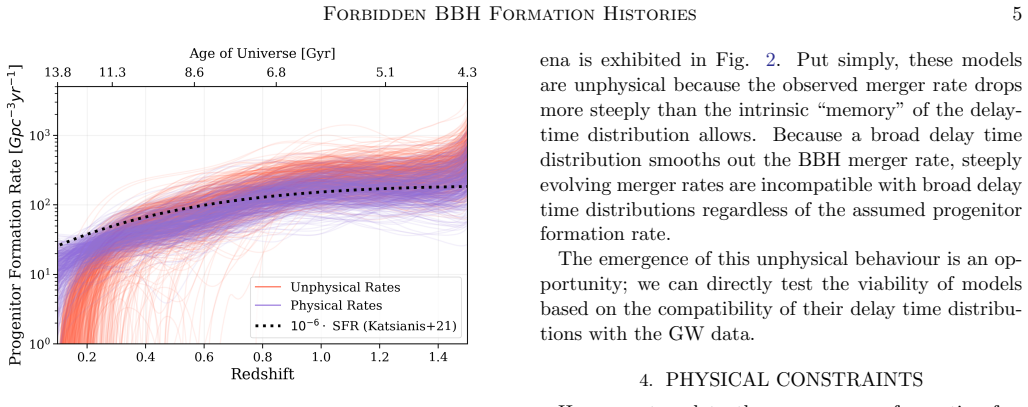
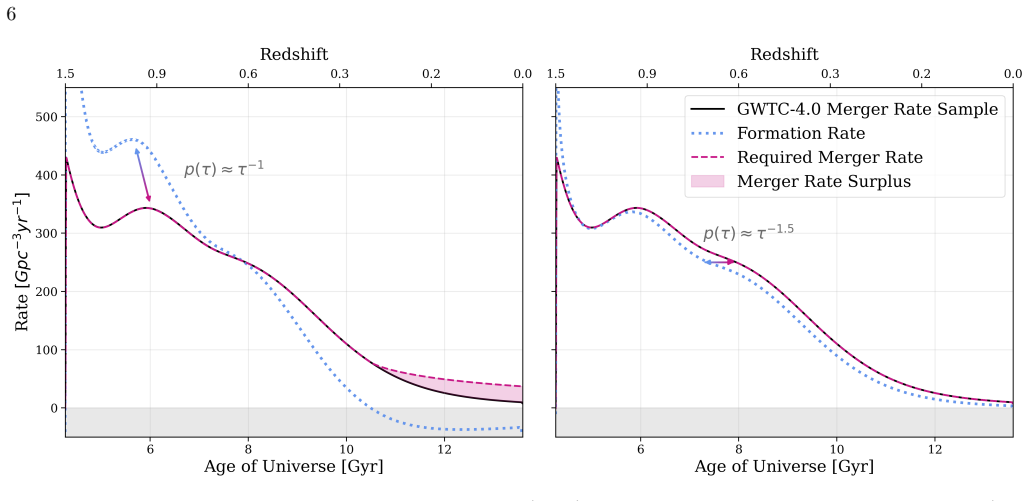
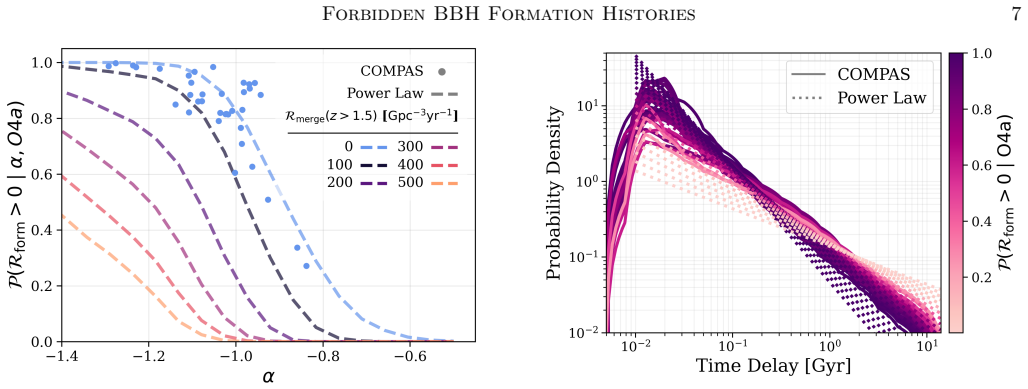
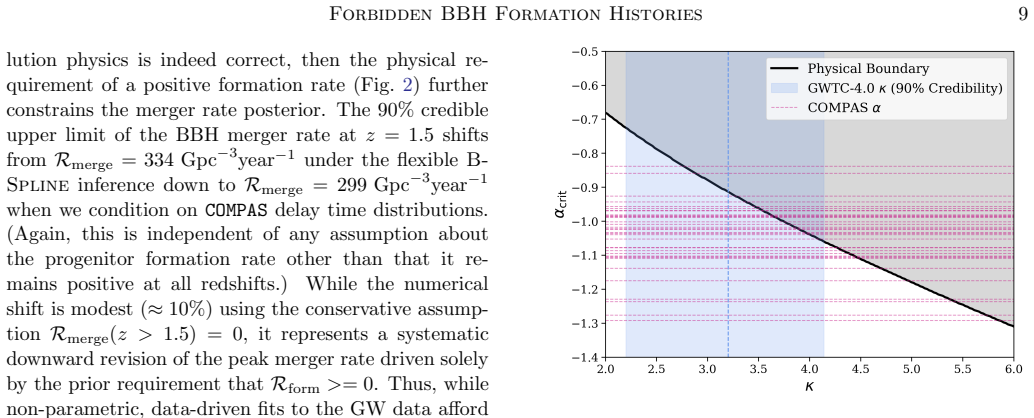
For a given evolution of the binary black hole merger rate, certain delay time distributions are forbidden because their long-delay tails overpredict low redshift mergers independently of any assumption about the progenitor formation rate. Using delay-time distributions derived from the COMPAS population synthesis code in combination with the BBH merger rate inferred from GWTC-4.0, the permitted progenitor formation histories decline more steeply toward low redshift than the global star formation rate, and the data are in tension with formation channels that predict shallow power-law delay-time distributions with indices α ≳ -0.7.
What carries the argument
Deconvolution of the observed merger rate evolution into a delay time distribution and progenitor formation rate, identifying delay time distributions whose long tails force unphysical (negative) formation rates at low redshift.
If this is right
- Permitted progenitor formation histories decline more steeply at low redshift than the global star formation rate.
- Delay time distributions with power-law indices α ≳ -0.7 are incompatible with the observed merger rate evolution.
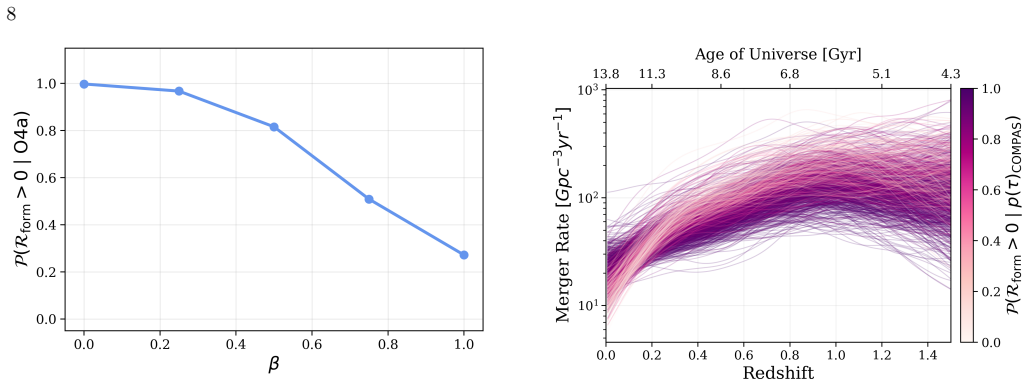
- Imposing COMPAS delay time distributions as a prior reduces the median inferred merger rate by 10 percent at redshift 1.5.
- The method directly evaluates compatibility of specific population synthesis parameters with gravitational wave data.
Where Pith is reading between the lines
- The same deconvolution approach could be applied to neutron star merger rates to test whether similar delay time restrictions appear.
- Improved merger rate measurements at redshifts above 2 could further narrow the range of allowed delay time distributions.
- Tension with stable mass transfer channels implies that other binary evolution pathways must dominate the observed population.
Load-bearing premise
The shape of the binary black hole merger rate versus redshift from GWTC-4.0 is taken as a fixed input whose uncertainties do not affect the identification of forbidden delay time distributions.
What would settle it
A measurement of the binary black hole merger rate at redshift 0.5 that lies substantially above the GWTC-4.0 inference, which would allow long-delay tails without requiring negative formation rates.
Figures
read the original abstract
The redshift evolution of the binary black hole (BBH) merger rate can be expressed as the convolution of the progenitor formation rate with the distribution of time delays between formation and merger. We show that starting with data-driven fits to the BBH merger rate as a function of redshift, deconvolving the inferred BBH merger rate into a delay time distribution and progenitor formation rate exposes physically incompatible delay time distributions. For a given evolution of the merger rate, certain delay time distributions are forbidden because their long-delay tails overpredict low redshift mergers independently of any assumption about the progenitor formation rate. Using delay-time distributions derived from the COMPAS population synthesis code in combination with the BBH merger rate inferred from GWTC-4.0, we reconstruct the physically permitted progenitor formation histories and find a steeper decline toward low redshift than the global star formation rate. We also find that the GWTC-4.0 data are in tension with formation channels that predict shallow power-law delay-time distributions ($\alpha \gtrsim -0.7$), such as stable mass transfer. Conversely, imposing the COMPAS predictions for the delay time distribution as a prior reduces the median merger rate inferred in GWTC-4.0 by 10% at $z=1.5$, favoring a shallower merger rate evolution than the standard GWTC-4.0 inference. Additionally, we demonstrate that our method can constrain binary evolution physics by directly evaluating the compatibility of population synthesis parameters with gravitational wave observations. Our framework provides a model-independent avenue for ruling out regions of binary evolution and merger rate parameter space.
Editorial analysis
A structured set of objections, weighed in public.
Referee Report
Summary. The paper claims that deconvolving data-driven fits to the BBH merger rate R(z) from GWTC-4.0 into a delay-time distribution (DTD) and progenitor formation rate reveals certain DTDs to be 'forbidden' because their long-delay tails overpredict low-redshift mergers for any non-negative formation-rate history. Using COMPAS-derived DTDs, the permitted formation histories decline more steeply at low redshift than the global star-formation rate; the GWTC-4.0 data are in tension with shallow power-law DTDs (α ≳ -0.7); imposing COMPAS DTDs as a prior lowers the median inferred merger rate by 10% at z=1.5; and the framework can directly constrain binary-evolution parameters.
Significance. If the central claim survives the noted robustness checks, the approach supplies a model-independent route to exclude regions of binary-evolution parameter space (e.g., stable mass-transfer channels) directly from the shape of R(z), independent of any specific star-formation-rate assumption. The quantitative 10% shift in the inferred merger rate when a COMPAS DTD prior is imposed illustrates the method's practical effect on existing GWTC inferences.
major comments (1)
- [Abstract] Abstract and the deconvolution procedure: the claim that certain DTDs are 'forbidden' is established by deconvolving a single (median) data-driven fit to R(z) from GWTC-4.0. The GWTC-4.0 posterior on R(z) has substantial width at z ≳ 1; a DTD ruled out by the median may still admit a non-negative formation-rate solution for other posterior draws. The manuscript does not demonstrate that the forbidden region is stable across the full posterior, which is load-bearing for the central claim that these DTDs are physically incompatible independent of progenitor assumptions.
minor comments (1)
- The manuscript does not indicate whether code or posterior samples used for the deconvolution are made available; releasing them would facilitate independent verification of the compatibility checks.
Simulated Author's Rebuttal
We thank the referee for their constructive and insightful comments. We address the major comment below and will revise the manuscript to strengthen the robustness of the central claim.
read point-by-point responses
-
Referee: [Abstract] Abstract and the deconvolution procedure: the claim that certain DTDs are 'forbidden' is established by deconvolving a single (median) data-driven fit to R(z) from GWTC-4.0. The GWTC-4.0 posterior on R(z) has substantial width at z ≳ 1; a DTD ruled out by the median may still admit a non-negative formation-rate solution for other posterior draws. The manuscript does not demonstrate that the forbidden region is stable across the full posterior, which is load-bearing for the central claim that these DTDs are physically incompatible independent of progenitor assumptions.
Authors: We agree that the current analysis relies on the median R(z) fit and that demonstrating stability across the full GWTC-4.0 posterior is important for the claim. In the revised manuscript we will sample multiple posterior draws of R(z), repeat the deconvolution for each, and show that the excluded DTD regions (including shallow power laws with α ≳ -0.7) remain forbidden for the large majority of draws. This will confirm that the incompatibility is robust rather than an artifact of the median. revision: yes
Circularity Check
No significant circularity; derivation uses external GWTC-4.0 input via direct deconvolution
full rationale
The paper's central claim follows from taking the GWTC-4.0 data-driven R(z) fit as an external input, then applying mathematical deconvolution with an assumed DTD to solve for the required progenitor formation rate. A DTD is declared forbidden only when no non-negative formation-rate solution exists for that fixed R(z). This is a direct computation from the input, not a self-definitional loop, fitted parameter renamed as prediction, or self-citation chain. The text contains no load-bearing self-citations or ansatzes smuggled via prior work. The result is conditional on the external benchmark and does not reduce to its own inputs by construction.
Axiom & Free-Parameter Ledger
axioms (1)
- domain assumption The observed BBH merger rate versus redshift can be expressed as the convolution of progenitor formation rate and delay time distribution.
Forward citations
Cited by 1 Pith paper
-
Joint population and strong-lensing inference for resolved gravitational-wave events probes the black-hole merger rate beyond the peak of star formation
Joint strong-lensing and population inference on resolved gravitational-wave events finds no lensed events and tightens constraints on the black-hole merger rate peak redshift and high-redshift tail.
Reference graph
Works this paper leans on
-
[1]
Abbott, B. P., Abbott, R., Abbott, T. D., et al. 2018, Living Reviews in Relativity, 21, 3, doi: 10.1007/s41114-018-0012-9
-
[2]
2015, Classical and Quantum Gravity, 32, 024001, doi: 10.1088/0264-9381/32/2/024001
Acernese, F., Agathos, M., Agatsuma, K., et al. 2015, Classical and Quantum Gravity, 32, 024001, doi: 10.1088/0264-9381/32/2/024001
-
[3]
2025, arXiv e-prints, arXiv:2510.06352, doi: 10.48550/arXiv.2510.06352
Afroz, S., Navdha, & Mukherjee, S. 2025, arXiv e-prints, arXiv:2510.06352, doi: 10.48550/arXiv.2510.06352
-
[4]
Akutsu, T., Ando, M., Arai, K., et al. 2021, Progress of Theoretical and Experimental Physics, 2021, 05A101, doi: 10.1093/ptep/ptaa125
-
[5]
Andrews, J. J., Zezas, A., & Fragos, T. 2018, ApJS, 237, 1, doi: 10.3847/1538-4365/aaca30
-
[6]
Antonini, F., & Rasio, F. A. 2016, ApJ, 831, 187, doi: 10.3847/0004-637X/831/2/187
-
[7]
Antonini, F., Toonen, S., & Hamers, A. S. 2017, ApJ, 841, 77, doi: 10.3847/1538-4357/aa6f5e
-
[8]
2018, MNRAS, 477, 4423, doi: 10.1093/mnras/sty922
Arca-Sedda, M., & Gualandris, A. 2018, MNRAS, 477, 4423, doi: 10.1093/mnras/sty922
-
[9]
Arfken, G. B. 1985, Mathematical Methods for Physicists, 3rd edn. (Orlando, FL: Academic Press) Astropy Collaboration, Robitaille, T. P., Tollerud, E. J., et al. 2013, Astronomy & Astrophysics, 558, A33, doi: 10.1051/0004-6361/201322068 Astropy Collaboration, Price-Whelan, A. M., Sip˝ ocz, B. M., et al. 2018, The Astronomical Journal, 156, 123, doi: 10.38...
-
[10]
Barrett, J. W., Gaebel, S. M., Neijssel, C. J., et al. 2018, MNRAS, 477, 4685, doi: 10.1093/mnras/sty908
-
[11]
2017, ApJ, 835, 165, doi: 10.3847/1538-4357/835/2/165
Bartos, I., Kocsis, B., Haiman, Z., & M´ arka, S. 2017, ApJ, 835, 165, doi: 10.3847/1538-4357/835/2/165
-
[12]
S., Fragos, T., Zevin, M., et al
Bavera, S. S., Fragos, T., Zevin, M., et al. 2021, A&A, 647, A153, doi: 10.1051/0004-6361/202039804
-
[13]
2010, The Astrophysical Journal, 715, L138, doi: 10.1088/2041-8205/715/2/L138
Belczynski, K., Dominik, M., Bulik, T., et al. 2010, The Astrophysical Journal, 715, L138, doi: 10.1088/2041-8205/715/2/L138
-
[14]
2026, in prep
Blanchet, E., Schiebelbein-Zwack, A., & Fishbach, M. 2026, in prep. 12
2026
-
[15]
Boesky, A., Broekgaarden, F. S., & Berger, E. 2024, The Binary Black Hole Merger Rate Deviates From the Cosmic Star Formation Rate: A Tug of War Between Metallicity and Delay Times, arXiv. http://arxiv.org/abs/2405.01623
-
[16]
2018, JAX: composable transformations of Python+NumPy programs, 0.3.13
Bradbury, J., Frostig, R., Hawkins, P., et al. 2018, JAX: composable transformations of Python+NumPy programs, 0.3.13. http://github.com/google/jax
2018
-
[17]
S., Berger, E., Stevenson, S., et al
Broekgaarden, F. S., Berger, E., Stevenson, S., et al. 2022, MNRAS, 516, 5737, doi: 10.1093/mnras/stac1677
-
[18]
Callister, T. A., & Farr, W. M. 2023, A Parameter-Free Tour of the Binary Black Hole Population, arXiv. http://arxiv.org/abs/2302.07289
-
[19]
2019, MNRAS, 482, 5012, doi: 10.1093/mnras/sty3087 Chru´ sli´ nska, M
Chruslinska, M., Nelemans, G., & Belczynski, K. 2019, MNRAS, 482, 5012, doi: 10.1093/mnras/sty3087 Chru´ sli´ nska, M. 2022, Chemical evolution of the Universe and its consequences for gravitational-wave astrophysics, arXiv. http://arxiv.org/abs/2206.10622 de Mink, S. E., & Mandel, I. 2016, MNRAS, 460, 3545, doi: 10.1093/mnras/stw1219 Di Carlo, U. N., Gia...
-
[20]
2023, The Astrophysical Journal, 946, 16, doi: 10.3847/1538-4357/acb5ed
Edelman, B., Farr, B., & Doctor, Z. 2023, The Astrophysical Journal, 946, 16, doi: 10.3847/1538-4357/acb5ed
-
[21]
Eldridge, J. J., Stanway, E. R., & Tang, P. N. 2019, MNRAS, 482, 870, doi: 10.1093/mnras/sty2714
-
[22]
M., Edelman, B., Zevin, M., et al
Farah, A. M., Edelman, B., Zevin, M., et al. 2023, The Astrophysical Journal, 955, 107, doi: 10.3847/1538-4357/aced02
-
[23]
M., Vijaykumar, A., & Fishbach, M
Farah, A. M., Vijaykumar, A., & Fishbach, M. 2026, The Astrophysical Journal Letters, 1001, L40, doi: 10.3847/2041-8213/ae4e19
-
[24]
2025, Classical and Quantum Gravity, 42, 055009, doi: 10.1088/1361-6382/adaf70
Fishbach, M. 2025, Classical and Quantum Gravity, 42, 055009, doi: 10.1088/1361-6382/adaf70
-
[25]
Fishbach, M., Holz, D. E., & Farr, W. M. 2018, ApJL, 863, L41, doi: 10.3847/2041-8213/aad800
-
[26]
2021, The Astrophysical Journal Letters, 914, L30, doi: 10.3847/2041-8213/ac05c4
Fishbach, M., & Kalogera, V. 2021, The Astrophysical Journal Letters, 914, L30, doi: 10.3847/2041-8213/ac05c4
-
[27]
Fishbach, M., & van Son, L. 2023a, LIGO-Virgo-KAGRA’s Oldest Black Holes: Probing star formation at cosmic noon with GWTC-3, arXiv. http://arxiv.org/abs/2307.15824 —. 2023b, Data Release: ”LIGO-Virgo-KAGRA’s Oldest Black Holes: Probing star formation at cosmic noon with GWTC-3”, 2.0.0, Zenodo, doi: 10.5281/zenodo.10019887
-
[28]
Foreman-Mackey, D. 2016, The Journal of Open Source Software, 1, 24, doi: 10.21105/joss.00024
-
[29]
Kalogera, V. 2021, The Astrophysical Journal, 922, 110, doi: 10.3847/1538-4357/ac2610 Gr¨ obner, M., Ishibashi, W., Tiwari, S., Haney, M., &
-
[30]
2020, A&A, 638, A119, doi: 10.1051/0004-6361/202037681
Jetzer, P. 2020, A&A, 638, A119, doi: 10.1051/0004-6361/202037681
-
[31]
Gupta, I., Afle, C., Arun, K. G., et al. 2024, Classical and Quantum Gravity, 41, 245001, doi: 10.1088/1361-6382/ad7b99
-
[32]
R., et al., 2020, @doi [Nature] 10.1038/s41586-020-2649-2 , 585, 357
Harris, C. R., Millman, K. J., van der Walt, S. J., et al. 2020, Nature, 585, 357, doi: 10.1038/s41586-020-2649-2
-
[33]
Hunter, J. D. 2007, Computing in Science & Engineering, 9, 90, doi: 10.1109/MCSE.2007.55
-
[34]
2023, MNRAS, 523, 4539, doi: 10.1093/mnras/stad1373
Karathanasis, C., Mukherjee, S., & Mastrogiovanni, S. 2023, MNRAS, 523, 4539, doi: 10.1093/mnras/stad1373
-
[35]
2021, The Astrophysical Journal, 919, 88, doi: 10.3847/1538-4357/ac11f2
Katsianis, A., Yang, X., & Zheng, X. 2021, The Astrophysical Journal, 919, 88, doi: 10.3847/1538-4357/ac11f2
-
[36]
2026, A&A, 706, A296, doi: 10.1051/0004-6361/202555500
Klencki, J., Podsiadlowski, P., Langer, N., et al. 2026, A&A, 706, A296, doi: 10.1051/0004-6361/202555500
-
[37]
Levina, S., Broekgaarden, F., van Son, L., et al. 2026, arXiv e-prints, arXiv:2601.20202, doi: 10.48550/arXiv.2601.20202 LIGO Scientific Collaboration, Aasi, J., Abbott, B. P., et al. 2015, Classical and Quantum Gravity, 32, 074001, doi: 10.1088/0264-9381/32/7/074001
-
[38]
2020, JCAP, 2020, 050, doi: 10.1088/1475-7516/2020/03/050
Maggiore, M., Van Den Broeck, C., Bartolo, N., et al. 2020, JCAP, 2020, 050, doi: 10.1088/1475-7516/2020/03/050
-
[39]
Mandel, I., & de Mink, S. E. 2016, MNRAS, 458, 2634, doi: 10.1093/mnras/stw379
-
[40]
2022, Physics Reports, 955, 1, doi: 10.1016/j.physrep.2022.01.003
Mandel, I., & Farmer, A. 2022, Physics Reports, 955, 1, doi: 10.1016/j.physrep.2022.01.003
-
[41]
2021, in Handbook of Gravitational Wave Astronomy, ed
Mapelli, M. 2021, in Handbook of Gravitational Wave Astronomy, ed. C. Bambi, S. Katsanevas, & K. D. Kokkotas, 16, doi: 10.1007/978-981-15-4702-7 16-1
-
[42]
Marchant, P., Langer, N., Podsiadlowski, P., Tauris, T. M., & Moriya, T. J. 2016, A&A, 588, A50, doi: 10.1051/0004-6361/201628133
-
[43]
2010, in Proceedings of the 9th Python in Science Conference, Vol
McKinney, W. 2010, in Proceedings of the 9th Python in Science Conference, Vol. 445, 51–56
2010
-
[44]
2007, PhR, 442, 166, doi: 10.1016/j.physrep.2007.02.005
Nakar, E. 2007, PhR, 442, 166, doi: 10.1016/j.physrep.2007.02.005
-
[45]
J., Vigna-G´ omez, A., Stevenson, S., et al
Neijssel, C. J., Vigna-G´ omez, A., Stevenson, S., et al. 2019, MNRAS, 490, 3740, doi: 10.1093/mnras/stz2840 O’Shaughnessy, R., Kalogera, V., & Belczynski, K. 2010, ApJ, 716, 615, doi: 10.1088/0004-637X/716/1/615
-
[46]
Peters, P. C. 1964, PhD thesis, California Institute of Technology
1964
-
[47]
Composable Effects for Flexible and Accelerated Probabilistic Programming in NumPyro
Phan, D., Pradhan, N., & Wang, M. 2019, arXiv preprint arXiv:1912.11554 Forbidden BBH Formation Histories13 Planck Collaboration, Aghanim, N., Akrami, Y., et al. 2020, A&A, 641, A6, doi: 10.1051/0004-6361/201833910
work page internal anchor Pith review Pith/arXiv arXiv doi:10.1051/0004-6361/201833910 2019
-
[48]
Flannery, B. P. 2007, Numerical Recipes 3rd Edition: The Art of Scientific Computing (New York, NY, USA: Cambridge University Press)
2007
-
[49]
2010, Classical and Quantum Gravity, 27, 194002, doi: 10.1088/0264-9381/27/19/194002
Punturo, M., Abernathy, M., Acernese, F., et al. 2010, Classical and Quantum Gravity, 27, 194002, doi: 10.1088/0264-9381/27/19/194002
-
[50]
Cosmic Explorer: The U.S. Contribution to Gravitational-Wave Astronomy beyond LIGO
Reitze, D., Adhikari, R. X., Ballmer, S., et al. 2019, in Bulletin of the American Astronomical Society, Vol. 51, 35, doi: 10.48550/arXiv.1907.04833
work page internal anchor Pith review Pith/arXiv arXiv doi:10.48550/arxiv.1907.04833 2019
-
[51]
2021, MNRAS, 505, 663, doi: 10.1093/mnras/stab1291
Riley, J., Mandel, I., Marchant, P., et al. 2021, MNRAS, 505, 663, doi: 10.1093/mnras/stab1291
-
[52]
Riley, J., Agrawal, P., Barrett, J. W., et al. 2022, ApJS, 258, 34, doi: 10.3847/1538-4365/ac416c
-
[53]
L., Chatterjee, S., & Rasio, F
Rodriguez, C. L., Chatterjee, S., & Rasio, F. A. 2016, PhRvD, 93, 084029, doi: 10.1103/PhysRevD.93.084029
-
[54]
2012, Classical and Quantum Gravity, 29, 124013, doi: 10.1088/0264-9381/29/12/124013
Sathyaprakash, B., Abernathy, M., Acernese, F., et al. 2012, Classical and Quantum Gravity, 29, 124013, doi: 10.1088/0264-9381/29/12/124013
-
[55]
2024, ApJ, 970, 128, doi: 10.3847/1538-4357/ad5353
Schiebelbein-Zwack, A., & Fishbach, M. 2024, ApJ, 970, 128, doi: 10.3847/1538-4357/ad5353
-
[56]
2024, A&A, 681, A56, doi: 10.1051/0004-6361/202346588
Singh, N., Bulik, T., Belczynski, K., Cieslar, M., & Calore, F. 2024, A&A, 681, A56, doi: 10.1051/0004-6361/202346588
-
[57]
2026, ApJL, 1000, L59, doi: 10.3847/2041-8213/ae52ec
Stegmann, J., Antonini, F., Olejak, A., et al. 2026, ApJL, 1000, L59, doi: 10.3847/2041-8213/ae52ec
-
[58]
Stone, N. C., Metzger, B. D., & Haiman, Z. 2017, MNRAS, 464, 946, doi: 10.1093/mnras/stw2260
-
[59]
Tang, P. N., Eldridge, J. J., Stanway, E. R., & Bray, J. C. 2020, MNRAS, 493, L6, doi: 10.1093/mnrasl/slz183 Team COMPAS: Mandel, I., Riley, J., Boesky, A., et al. 2025, ApJS, 280, 43, doi: 10.3847/1538-4365/adf8d0 The LIGO Scientific Collaboration, the Virgo Collaboration, the KAGRA Collaboration, et al. 2025a, arXiv e-prints, arXiv:2508.18082, doi: 10.4...
work page internal anchor Pith review Pith/arXiv arXiv doi:10.1093/mnrasl/slz183 2020
-
[60]
Remortel, N. 2023, The metallicity dependence and evolutionary times of merging binary black holes: Combined constraints from individual gravitational-wave detections and the stochastic background, arXiv. http://arxiv.org/abs/2310.17625 Van Son, L. A. C., De Mink, S. E., Callister, T., et al. 2022a, The Astrophysical Journal, 931, 17, doi: 10.3847/1538-43...
- [61]
-
[62]
doi:10.1038/s41592-019-0686-2 , eprint =
Virtanen, P., Gommers, R., Oliphant, T. E., et al. 2020, Nature Methods, 17, 261, doi: 10.1038/s41592-019-0686-2
-
[63]
Vitale, S., Farr, W. M., Ng, K. K. Y., & Rodriguez, C. L. 2019, The Astrophysical Journal Letters, 886, L1, doi: 10.3847/2041-8213/ab50c0
-
[64]
Waskom, M. L. 2021, Journal of Open Source Software, 6, 3021, doi: 10.21105/joss.03021
-
[65]
Wong, K. W. K., Breivik, K., Farr, W. M., & Luger, R. 2023, ApJ, 950, 181, doi: 10.3847/1538-4357/acc863
-
[66]
Ye, C. S., & Fishbach, M. 2024, The Redshift Evolution of the Binary Black Hole Mass Distribution from Dense Star Clusters, arXiv. http://arxiv.org/abs/2402.12444
discussion (0)
Sign in with ORCID, Apple, or X to comment. Anyone can read and Pith papers without signing in.