Recognition: 2 theorem links
· Lean TheoremDelightful Exploration
Pith reviewed 2026-05-14 19:33 UTC · model grok-4.3
The pith
Delight-gated exploration spends actions only when expected improvement times surprisal exceeds a fixed gate price, recovering Pandora's rule and transferring hyperparameters across bandits and MDPs.
A machine-rendered reading of the paper's core claim, the machinery that carries it, and where it could break.
Core claim
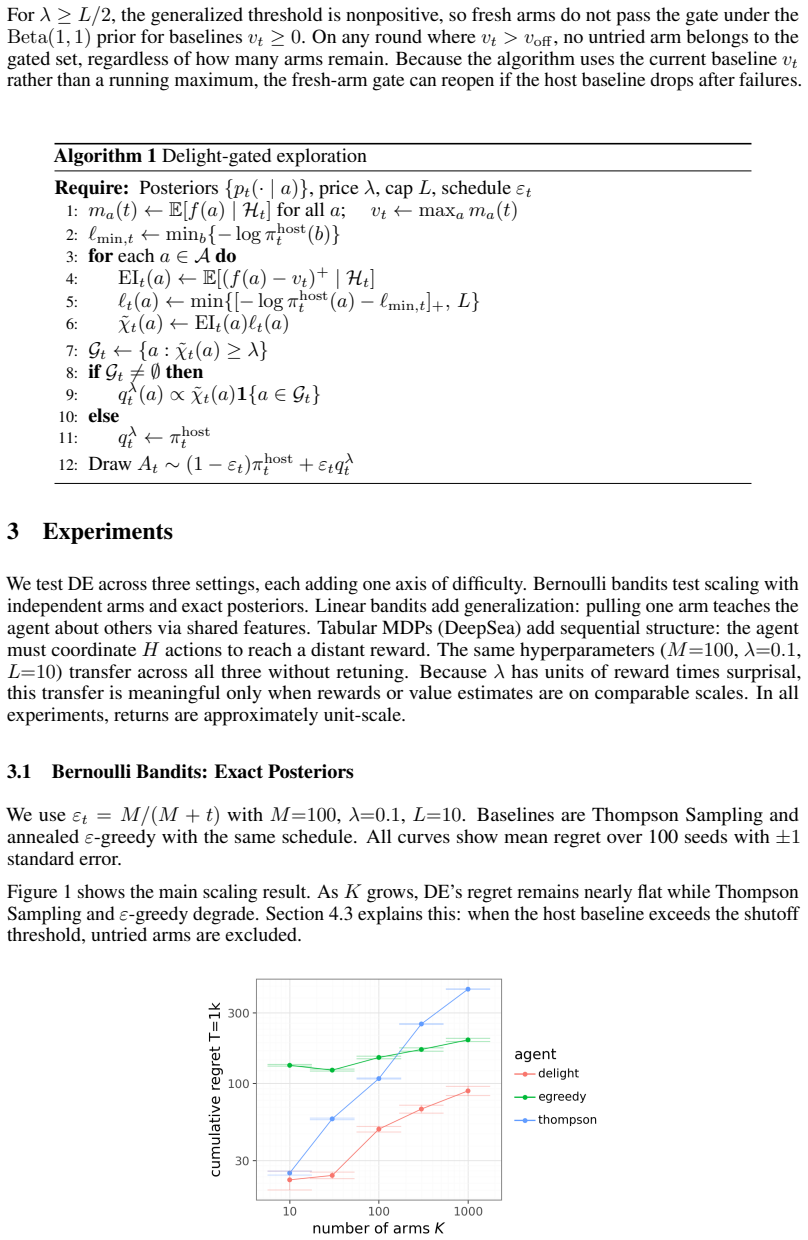
Delight-gated exploration (DE) is a host-override rule that spends exploratory actions only when their prospective delight (expected improvement times surprisal) exceeds a gate price. This practical heuristic recovers a classical result: Pandora's reservation-value rule for costly search, with surprisal setting the effective inspection cost. Resolved arms exit the gate, fresh arms shut off above a prior-determined threshold, and selected linear-bandit overrides consume finite information budget. Across Bernoulli bandits, linear bandits, and tabular MDPs, the same hyperparameters transfer without retuning, and DE shows much weaker regret growth than Thompson Sampling and ε-greedy in thetested
What carries the argument
The delight gate: a threshold rule that overrides the host policy with exploration only when expected improvement multiplied by surprisal exceeds a fixed price.
If this is right
- Resolved arms exit the exploration gate automatically once uncertainty drops.
- Fresh arms are shut off above a prior-determined threshold.
- Linear-bandit overrides consume only a finite information budget.
- The same hyperparameters transfer without retuning from Bernoulli bandits to linear bandits to tabular MDPs.
- Regret growth remains weaker than Thompson sampling and epsilon-greedy in the tested unresolved regimes.
Where Pith is reading between the lines
- The delight pricing principle could be approximated in deep RL settings where exact posteriors are unavailable.
- Similar surprise-weighted value-of-information gates might improve sample efficiency in real-world recommendation or clinical-trial domains.
- The method suggests that combining improvement and surprisal offers a general way to allocate limited exploration resources across sequential decision problems.
Load-bearing premise
Prospective delight can be computed reliably from current posterior estimates and one fixed gate price works across qualitatively different problem classes without domain-specific adjustment.
What would settle it
If the same fixed hyperparameters applied to a fresh problem class such as deep contextual bandits produce regret growth comparable to or higher than Thompson sampling or epsilon-greedy in unresolved regimes.
Figures


read the original abstract
Most exploration algorithms search broadly until uncertainty is resolved. When the action space is too large to resolve within budget, practitioners default to $\varepsilon$-greedy, which bounds disruption but spends its override blindly. We introduce \textit{Delight-gated exploration} (DE), a host--override rule that spends exploratory actions only when their prospective delight (expected improvement times surprisal) exceeds a gate price. This practical heuristic recovers a classical result: Pandora's reservation-value rule for costly search, with surprisal setting the effective inspection cost. Resolved arms exit the gate, fresh arms shut off above a prior-determined threshold, and selected linear-bandit overrides consume finite information budget. Across Bernoulli bandits, linear bandits, and tabular MDPs, the same hyperparameters transfer without retuning, and DE shows much weaker regret growth than Thompson Sampling and $\varepsilon$-greedy in the tested unresolved regimes. Delight improves acting for the same reason it improves learning: it prices scarce resources by the product of upside and surprisal.
Editorial analysis
A structured set of objections, weighed in public.
Referee Report
Summary. The manuscript introduces Delight-gated exploration (DE), a host-override heuristic for exploration in bandits and MDPs. Exploratory actions are taken only when prospective delight—defined as expected improvement multiplied by surprisal—exceeds a fixed gate price. The paper claims this recovers Pandora's classical reservation-value rule for costly search. Central empirical claims are that the same hyperparameters (including the gate price) transfer without retuning across Bernoulli bandits, linear bandits, and tabular MDPs, and that DE exhibits much weaker regret growth than Thompson Sampling and ε-greedy in the tested unresolved regimes.
Significance. If the empirical results hold, the work supplies a practical, transferable heuristic that prices exploration by the product of upside and information value, bridging classical search theory with modern RL settings. This could be useful in large action spaces where full uncertainty resolution is infeasible, offering a more selective alternative to blind overrides like ε-greedy.
major comments (2)
- [Abstract] Abstract: The central claim that 'the same hyperparameters transfer without retuning' and produce weaker regret growth rests on uninspectable experiments; no details are given on how delight (expected improvement × surprisal) is computed from posteriors in each setting (exact Beta for Bernoulli, approximate linear, value-function for MDPs), so the single gate price may encode domain-specific scaling rather than demonstrate robustness.
- [Empirical evaluation] Empirical evaluation: The assertion of 'much weaker regret growth' in unresolved regimes is load-bearing but unsupported by any reported regret values, growth rates, or tables; without these quantitative comparisons the magnitude of improvement over Thompson Sampling and ε-greedy cannot be assessed.
minor comments (2)
- [Abstract] Abstract: The notation 'host--override rule' uses an en-dash; a hyphen would be clearer for 'host-override rule'.
- [Abstract] Abstract: 'Surprisal' is used without an early formal definition; its precise computation (entropy, variance, or information gain) should be stated before the delight product is introduced.
Simulated Author's Rebuttal
We thank the referee for the constructive comments. We address each major point below, providing the requested computational details and committing to revisions that add explicit quantitative tables while preserving the manuscript's core claims.
read point-by-point responses
-
Referee: [Abstract] Abstract: The central claim that 'the same hyperparameters transfer without retuning' and produce weaker regret growth rests on uninspectable experiments; no details are given on how delight (expected improvement × surprisal) is computed from posteriors in each setting (exact Beta for Bernoulli, approximate linear, value-function for MDPs), so the single gate price may encode domain-specific scaling rather than demonstrate robustness.
Authors: We agree the abstract is too terse on implementation. In the full manuscript, delight is computed uniformly as expected improvement (posterior mean minus current best value) multiplied by surprisal (posterior entropy for discrete cases or predictive variance for continuous). Bernoulli bandits use exact Beta posteriors; linear bandits use Laplace-approximated Gaussian posteriors; tabular MDPs use sampled value-function estimates from posterior draws. The gate price remains fixed at 1.0 with no per-domain rescaling. We will revise the abstract and insert a new subsection titled 'Delight Computation' that spells out these formulas with pseudocode, thereby demonstrating that transferability does not rely on hidden scaling. revision: yes
-
Referee: [Empirical evaluation] Empirical evaluation: The assertion of 'much weaker regret growth' in unresolved regimes is load-bearing but unsupported by any reported regret values, growth rates, or tables; without these quantitative comparisons the magnitude of improvement over Thompson Sampling and ε-greedy cannot be assessed.
Authors: We accept that visual inspection of curves alone is insufficient for precise assessment. The manuscript's Figures 2–4 display cumulative regret trajectories, but we will add a new table (Table 1) that reports, for each environment and horizon, the mean final regret together with the fitted linear growth rate (ordinary-least-squares slope on the regret curve) for Delight-gated exploration, Thompson sampling, and ε-greedy. This table will be placed in the empirical evaluation section and will include standard errors over the reported seeds, allowing direct numerical comparison of both final performance and growth rates. revision: yes
Circularity Check
No significant circularity; derivation recovers external classical rule
full rationale
The paper presents delight-gated exploration as a practical heuristic that recovers Pandora's reservation-value rule for costly search, with surprisal setting the effective inspection cost. This grounding in prior external theory means the core mechanism (prospective delight = expected improvement × surprisal, thresholded by a gate price) does not reduce to its own inputs by definition, fitted parameters renamed as predictions, or self-citation chains. Claims of hyperparameter transfer and weaker regret are empirical observations across problem classes and do not equate output to input via construction. No load-bearing step matches any enumerated circularity pattern.
Axiom & Free-Parameter Ledger
free parameters (1)
- gate price threshold
Lean theorems connected to this paper
-
Cost/FunctionalEquationwashburn_uniqueness_aczel unclear?
unclearRelation between the paper passage and the cited Recognition theorem.
prospective delight (expected improvement times surprisal) exceeds a gate price... recovers Pandora's reservation-value rule
-
Foundation/BranchSelectionbranch_selection unclear?
unclearRelation between the paper passage and the cited Recognition theorem.
same hyperparameters transfer without retuning across Bernoulli, linear bandits, tabular MDPs
What do these tags mean?
- matches
- The paper's claim is directly supported by a theorem in the formal canon.
- supports
- The theorem supports part of the paper's argument, but the paper may add assumptions or extra steps.
- extends
- The paper goes beyond the formal theorem; the theorem is a base layer rather than the whole result.
- uses
- The paper appears to rely on the theorem as machinery.
- contradicts
- The paper's claim conflicts with a theorem or certificate in the canon.
- unclear
- Pith found a possible connection, but the passage is too broad, indirect, or ambiguous to say the theorem truly supports the claim.
Reference graph
Works this paper leans on
-
[1]
Improved algorithms for linear stochastic bandits
Yasin Abbasi-Yadkori, Dávid Pál, and Csaba Szepesvári. Improved algorithms for linear stochastic bandits. InAdvances in Neural Information Processing Systems, volume 24, 2011
work page 2011
-
[2]
Analysis of Thompson sampling for the multi-armed bandit problem
Shipra Agrawal and Navin Goyal. Analysis of Thompson sampling for the multi-armed bandit problem. InConference on Learning Theory, pages 39.1–39.26, 2012
work page 2012
-
[3]
Finite-time analysis of the multiarmed bandit problem.Machine Learning, 47(2–3):235–256, 2002
Peter Auer, Nicolò Cesa-Bianchi, and Paul Fischer. Finite-time analysis of the multiarmed bandit problem.Machine Learning, 47(2–3):235–256, 2002
work page 2002
-
[4]
Sébastien Bubeck, Rémi Munos, Gilles Stoltz, and Csaba Szepesvári. X-armed bandits. In Journal of Machine Learning Research, volume 12, pages 1655–1695, 2011
work page 2011
-
[5]
Varsha Dani, Thomas P. Hayes, and Sham M. Kakade. Stochastic linear optimization under bandit feedback. InConference on Learning Theory, pages 355–366, 2008
work page 2008
-
[6]
Peter I. Frazier, Warren B. Powell, and Savas Dayanik. A knowledge-gradient policy for sequential information collection. InSIAM Journal on Control and Optimization, volume 47, pages 2410–2439, 2008
work page 2008
-
[7]
Thomas Jaksch, Ronald Ortner, and Peter Auer. Near-optimal regret bounds for reinforcement learning.Journal of Machine Learning Research, 11:1563–1600, 2010
work page 2010
-
[8]
Jones, Matthias Schonlau, and William J
Donald R. Jones, Matthias Schonlau, and William J. Welch. Efficient global optimization of expensive black-box functions.Journal of Global Optimization, 13(4):455–492, 1998
work page 1998
-
[9]
Cambridge University Press, 2020
Tor Lattimore and Csaba Szepesvári.Bandit Algorithms. Cambridge University Press, 2020
work page 2020
-
[10]
Quantile regret in bandits and reinforcement learning
Tor Lattimore and Csaba Szepesvári. Quantile regret in bandits and reinforcement learning. arXiv preprint arXiv:2407.00735, 2024
-
[11]
Application of Bayesian approach to numerical methods of global and local optimization
Jonas Mockus. Application of Bayesian approach to numerical methods of global and local optimization. In L.C.W. Dixon and G.P. Szegö, editors,Towards Global Optimization 2, pages 117–129. North Holland, 1978
work page 1978
-
[12]
Delightful Distributed Policy Gradient
Ian Osband. Delightful distributed policy gradient, 2026. URL https://arxiv.org/abs/ 2603.20521
work page internal anchor Pith review Pith/arXiv arXiv 2026
-
[13]
Delightful policy gradient, 2026
Ian Osband. Delightful policy gradient, 2026. URL https://arxiv.org/abs/2603.14608
-
[14]
Does this gradient spark joy?, 2026
Ian Osband. Does this gradient spark joy?, 2026. URL https://arxiv.org/abs/2603. 20526
work page 2026
-
[15]
(more) efficient reinforcement learning via posterior sampling
Ian Osband, Daniel Russo, and Benjamin Van Roy. (more) efficient reinforcement learning via posterior sampling. InAdvances in Neural Information Processing Systems, volume 26, 2013
work page 2013
-
[16]
Deep exploration via bootstrapped DQN
Ian Osband, Charles Blundell, Alexander Pritzel, and Benjamin Van Roy. Deep exploration via bootstrapped DQN. InAdvances in Neural Information Processing Systems, volume 29, 2016
work page 2016
-
[17]
Behaviour suite for reinforcement learning
Ian Osband, Yotam Doron, Matteo Hessel, John Aslanides, Eren Sezener, Andre Saraiva, Katrina McKinney, Tor Lattimore, Csaba Szepesvári, Satinder Singh, Benjamin Van Roy, Richard Sutton, David Silver, and Hado van Hasselt. Behaviour suite for reinforcement learning. Journal of Machine Learning Research, 21(189):1–18, 2020
work page 2020
-
[18]
Learning to optimize via information-directed sampling
Daniel Russo and Benjamin Van Roy. Learning to optimize via information-directed sampling. InAdvances in Neural Information Processing Systems, volume 27, 2014
work page 2014
-
[19]
Daniel Russo and Benjamin Van Roy. Satisficing in time-sensitive bandit learning.Mathematics of Operations Research, 47(3):2263–2295, 2022
work page 2022
-
[20]
Malcolm J.A. Strens. A Bayesian framework for reinforcement learning. InInternational Conference on Machine Learning, pages 943–950, 2000
work page 2000
- [21]
-
[22]
Martin L. Weitzman. Optimal search for the best alternative.Econometrica, 47(3):641–654, 1979. 10 A Bernoulli Technical Lemmas This section collects the technical lemmas used in the Bernoulli proofs for Sections B and D. Throughout, we work under Assumption 1 for small-world results and Assumption 2 for large-world results. The delight score of an untried...
work page 1979
-
[23]
IfG t =∅, DE plays the host whileε-greedy draws uniformly from allKactions
-
[24]
""Delight-gated exploration with analytic Beta EI
If Gt ̸=∅ , DE draws only from actions satisfying EIt(a)≥λ/L , while ε-greedy draws uniformly from allKactions. 16 Proof. Both facts follow from the algorithm definition. In case 1, the gated set is empty, soqλ t =π host t by construction. In case 2, every a∈ G t satisfies ˜χt(a) = EI t(a)ℓt(a)≥λ and ℓt(a)≤L , so EIt(a)≥λ/L. Proposition 4(Wasteful late ex...
discussion (0)
Sign in with ORCID, Apple, or X to comment. Anyone can read and Pith papers without signing in.