Recognition: no theorem link
The Hunt for Red Dual AGNs I: Spatially-Resolved Mid-IR Dual AGNs in the DeCam Legacy Survey
Pith reviewed 2026-05-15 02:46 UTC · model grok-4.3
The pith
Mid-infrared colors select 13 confirmed dual AGNs in galaxy mergers at separations of 14.5 to 129 kiloparsecs.
A machine-rendered reading of the paper's core claim, the machinery that carries it, and where it could break.
Core claim
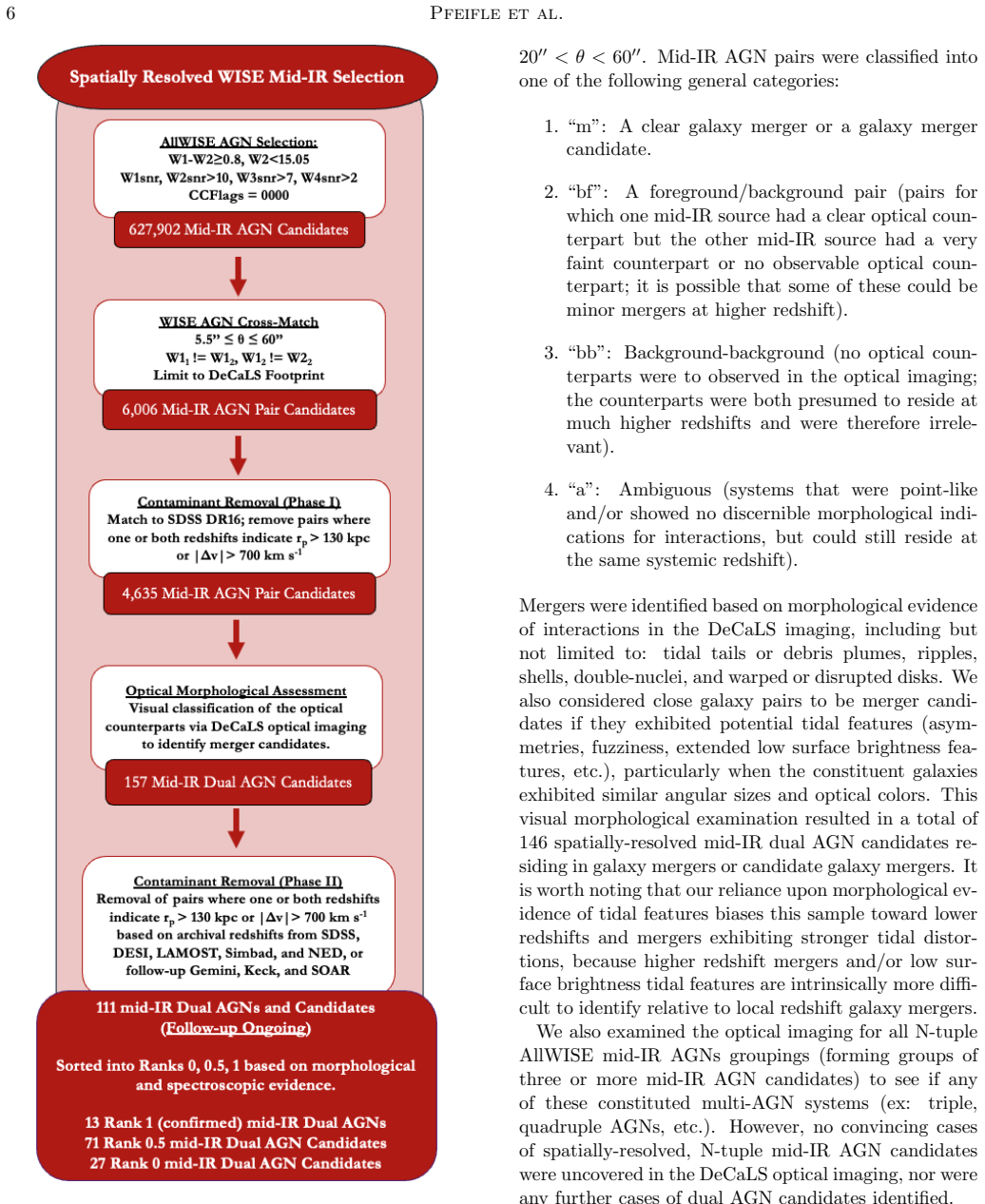
A mid-IR color-selected search combined with optical merger classification yields 157 spatially resolved dual AGN candidates; spectroscopic verification establishes 13 bona fide mid-IR dual AGNs at separations 14.5-129 kpc together with 63 additional strong candidates, many residing at separations greater than 50 kpc and showing diverse nuclear optical spectral types.
What carries the argument
The W1-W2 mid-infrared color cut from WISE photometry that isolates AGN-heated dust, applied to optically identified galaxy merger candidates from DeCam Legacy Survey imaging, followed by spectroscopic confirmation.
Load-bearing premise
Mid-infrared W1-W2 colors cleanly isolate AGN activity without significant contamination from star formation in merging galaxies, and optical imaging reliably distinguishes true physical mergers from chance projections.
What would settle it
High-resolution spectroscopy or X-ray observations showing that the mid-IR excess in the majority of candidates arises from star formation rather than accretion, or integral-field spectroscopy revealing that apparent wide pairs are unrelated foreground and background objects.
Figures


read the original abstract
Theoretical studies predict that dual AGNs are a critical stage of galaxy merger-driven supermassive black hole growth. Systematic searches for dual AGNs typically target late-stage mergers ($\leq10$ kpc nuclear separations) and select AGNs based on optical diagnostics. Yet, simulations predict that obscuration can occur early in the merger sequence, and that a significant fraction of dual AGNs can be found beyond $10$ kpc. Here, we report on a new sample of 157 spatially resolved mid-IR dual AGNs candidates selected based upon their mid-IR $W1-W2$ colors from the Wide-Field Infrared Survey Explorer and optically classified as galaxy merger candidates using imaging from the Dark Energy Camera Legacy Survey. Spectroscopic results are presented for approximately 2/3 of the sample. 76 candidates have been confirmed to reside in galaxy mergers; among these, 13 have been confirmed as bona fide mid-IR dual AGNs, while 63 represent strong dual AGN candidates that require further examination. 46 candidates have been rejected as non-merger contaminants (foreground-background AGNs, separations inconsistent with interacting galaxies, etc.). 35 candidates still await spectroscopic coverage. The confirmed and high confidence dual AGN candidates exhibit separations of 14.5-129 kpc; $>50$% reside at separations $>50$ kpc. Confirmed and high confidence candidates also exhibit a diversity of nuclear optical BPT classes. Seyfert-Seyferts and Seyfert-HIIs dominate the overall BPT pairs sample. 31% of confirmed mid-IR dual AGNs reside in multi-mergers involving three or more galaxies. The diversity in AGN properties and environments identified in this work highlights the importance of multiwavelength selection strategies and analyses in the quest to holistically understand dual AGNs as a population.
Editorial analysis
A structured set of objections, weighed in public.
Referee Report
Summary. The manuscript reports the discovery of a sample of 157 spatially resolved mid-IR dual AGN candidates selected via WISE W1-W2 colors and classified as galaxy mergers using DeCam Legacy Survey imaging. Spectroscopic follow-up on approximately two-thirds of the sample confirms 13 bona fide dual AGNs with projected separations ranging from 14.5 to 129 kpc, along with 63 strong candidates, while rejecting 46 as contaminants and leaving 35 for future observation. The work emphasizes the prevalence of dual AGNs at large separations (>50 kpc for over half the confirmed sample) and their diverse optical BPT classifications.
Significance. If the selection criteria prove robust against contaminants, this study would be significant for demonstrating that dual AGNs can be found at much larger separations than the late-stage mergers typically targeted, aligning with theoretical predictions of obscuration in early merger phases. It also highlights the utility of mid-IR selection combined with optical imaging for identifying such systems, potentially increasing the known population of dual AGNs and informing models of supermassive black hole growth during galaxy mergers. The provision of specific counts and separation statistics strengthens the observational basis for these claims.
major comments (3)
- [Abstract and sample selection] The central claim of 13 confirmed dual AGNs from 157 candidates depends on the reliability of the W1-W2 color cut for isolating AGNs in merging galaxies. However, no quantitative assessment of contamination from star-forming regions or PAH emission in mergers is provided, nor is a control sample of non-merging galaxies analyzed to establish the purity of the selection. This is critical because the post-selection rejection of 46 objects does not retroactively validate the initial sample purity.
- [Spectroscopic results] The distinction between the 13 'bona fide' dual AGNs and the 63 'strong dual AGN candidates' needs explicit criteria, particularly how BPT classifications and line ratios are used to confirm dual activity versus single AGN or star formation. Without this, the claim of 13 confirmed systems is difficult to evaluate independently.
- [Discussion of separations] The statement that >50% of confirmed and high-confidence candidates reside at >50 kpc separations is central to the paper's novelty, but the potential for line-of-sight projections in DeCam visual classifications is not quantitatively addressed, which could inflate the number of wide pairs.
minor comments (2)
- [Abstract] Grammatical correction needed: 'mid-IR dual AGNs candidates' should read 'mid-IR dual AGN candidates'.
- [Abstract] The abstract mentions 'optically classified as galaxy merger candidates' but does not specify the exact morphological criteria used in DeCam imaging, which would aid clarity.
Simulated Author's Rebuttal
We thank the referee for their constructive comments, which have helped clarify several aspects of our work. We address each major point below and will revise the manuscript accordingly where feasible.
read point-by-point responses
-
Referee: [Abstract and sample selection] The central claim of 13 confirmed dual AGNs from 157 candidates depends on the reliability of the W1-W2 color cut for isolating AGNs in merging galaxies. However, no quantitative assessment of contamination from star-forming regions or PAH emission in mergers is provided, nor is a control sample of non-merging galaxies analyzed to establish the purity of the selection. This is critical because the post-selection rejection of 46 objects does not retroactively validate the initial sample purity.
Authors: We agree that a dedicated control sample would provide stronger validation of the W1-W2 selection purity. The W1-W2 > 0.8 criterion is standard in the literature with documented contamination levels from star-forming galaxies and PAH emission. Our spectroscopic follow-up empirically rejected 46 contaminants from the observed subset. In revision, we will add a new subsection estimating contamination rates using published WISE color distributions for star-forming mergers and a brief comparison to a literature control sample of non-merging galaxies. A full new control sample observation is beyond the current scope. revision: partial
-
Referee: [Spectroscopic results] The distinction between the 13 'bona fide' dual AGNs and the 63 'strong dual AGN candidates' needs explicit criteria, particularly how BPT classifications and line ratios are used to confirm dual activity versus single AGN or star formation. Without this, the claim of 13 confirmed systems is difficult to evaluate independently.
Authors: We apologize for the insufficient detail in the original text. Bona fide dual AGNs require both nuclei to show AGN-like BPT classifications (Seyfert or LINER) with S/N > 5 on key lines and line ratios exceeding standard demarcation curves. Strong candidates have one confirmed AGN nucleus and the second with composite or ambiguous ratios needing deeper data. We will add an explicit methods subsection and a supplementary table listing the precise BPT criteria, line ratio thresholds, and classifications for all objects. revision: yes
-
Referee: [Discussion of separations] The statement that >50% of confirmed and high-confidence candidates reside at >50 kpc separations is central to the paper's novelty, but the potential for line-of-sight projections in DeCam visual classifications is not quantitatively addressed, which could inflate the number of wide pairs.
Authors: We acknowledge this concern. Our visual classifications require clear tidal features and morphological disturbances in DeCam imaging, which strongly favor physical interactions. In the revised manuscript, we will add a quantitative estimate of random alignment probability in the discussion, calculated from the galaxy surface density in the DeCam Legacy Survey and the observed separation range, demonstrating that the chance superposition rate is low (<5%) for systems with interaction signatures. revision: yes
Circularity Check
No circularity: purely observational catalog from external surveys with independent spectroscopic confirmation
full rationale
The paper reports a sample of dual AGN candidates selected via established W1-W2 color cuts from public WISE data and visual merger classification from public DeCam Legacy Survey imaging, followed by external spectroscopic follow-up on ~2/3 of the objects. No equations, derivations, fitted parameters, or self-referential definitions appear in the provided text. Selection criteria are applied directly to survey catalogs without reduction to prior results by the same authors. The 13 confirmed dual AGNs and 63 high-confidence candidates are outcomes of this pipeline, not inputs renamed as predictions. Self-citations, if present, are not load-bearing for any central claim. This is a standard observational catalog paper whose results are externally falsifiable via the cited surveys and spectra.
Axiom & Free-Parameter Ledger
axioms (2)
- domain assumption Mid-IR W1-W2 colors reliably select AGNs with limited contamination from star-forming galaxies
- domain assumption DeCam Legacy Survey imaging can be used to classify galaxy mergers via morphology
Reference graph
Works this paper leans on
-
[1]
Abazajian, K. N., Adelman-McCarthy, J. K., Ag¨ ueros, M. A., et al. 2009, ApJS, 182, 543, doi: 10.1088/0067-0049/182/2/543
-
[2]
Agazie, G., Anumarlapudi, A., Archibald, A. M., et al. 2023a, ApJL, 951, L8, doi: 10.3847/2041-8213/acdac6 —. 2023b, ApJL, 952, L37, doi: 10.3847/2041-8213/ace18b
-
[3]
2020, ApJS, 249, 3, doi: 10.3847/1538-4365/ab929e
Ahumada, R., Allende Prieto, C., Almeida, A., et al. 2020, ApJS, 249, 3, doi: 10.3847/1538-4365/ab929e
-
[4]
L., Wu, X.-B., Yang, J., et al
Ai, Y. L., Wu, X.-B., Yang, J., et al. 2016, AJ, 151, 24, doi: 10.3847/0004-6256/151/2/24
-
[5]
2011, ApJS, 193, 29, doi: 10.1088/0067-0049/193/2/29
Aihara, H., Allende Prieto, C., An, D., et al. 2011, ApJS, 193, 29, doi: 10.1088/0067-0049/193/2/29
-
[6]
Allen, M. G., Groves, B. A., Dopita, M. A., Sutherland, R. S., & Kewley, L. J. 2008, ApJS, 178, 20, doi: 10.1086/589652
-
[7]
F., Argudo-Fern´ andez, M., et al
Almeida, A., Anderson, S. F., Argudo-Fern´ andez, M., et al. 2023, ApJS, 267, 44, doi: 10.3847/1538-4365/acda98
-
[8]
2023, Living Reviews in Relativity, 26, 2, doi: 10.1007/s41114-022-00041-y
Amaro-Seoane, P., Andrews, J., Arca Sedda, M., et al. 2023, Living Reviews in Relativity, 26, 2, doi: 10.1007/s41114-022-00041-y
-
[9]
Asmus, D., Greenwell, C. L., Gandhi, P., et al. 2020, MNRAS, 494, 1784, doi: 10.1093/mnras/staa766
-
[10]
J., Stern, D., Noirot, G., et al
Assef, R. J., Stern, D., Noirot, G., et al. 2018, ApJS, 234, 23, doi: 10.3847/1538-4365/aaa00a
-
[11]
Baldwin, J. A., Phillips, M. M., & Terlevich, R. 1981, PASP, 93, 5, doi: 10.1086/130766
-
[12]
Barnes, J. E. 2016, MNRAS, 455, 1957, doi: 10.1093/mnras/stv2381
-
[13]
Barnes, J. E., & Hernquist, L. 1996, ApJ, 471, 115, doi: 10.1086/177957
-
[14]
Barrows, R. S., Comerford, J. M., Stern, D., & Assef, R. J. 2021, ApJ, 922, 179, doi: 10.3847/1538-4357/ac1352 —. 2023, ApJ, 951, 92, doi: 10.3847/1538-4357/acd2d3
-
[15]
Begelman, M. C., Blandford, R. D., & Rees, M. J. 1980, Nature, 287, 307, doi: 10.1038/287307a0
-
[16]
Matt, G. 2008, MNRAS, 386, 105, doi: 10.1111/j.1365-2966.2008.13078.x
-
[17]
F., Satyapal, S., & Ellison, S
Blecha, L., Snyder, G. F., Satyapal, S., & Ellison, S. L. 2018, MNRAS, 478, 3056, doi: 10.1093/mnras/sty1274
-
[18]
Blumenthal, K. A., & Barnes, J. E. 2018, MNRAS, 479, 3952, doi: 10.1093/mnras/sty1605
-
[19]
2011, ApJ, 729, 85, doi: 10.1088/0004-637X/729/2/85
Callegari, S., Kazantzidis, S., Mayer, L., et al. 2011, ApJ, 729, 85, doi: 10.1088/0004-637X/729/2/85
-
[20]
R., Dotti, M., Volonteri, M., et al
Capelo, P. R., Dotti, M., Volonteri, M., et al. 2017, MNRAS, 469, 4437, doi: 10.1093/mnras/stx1067
-
[21]
R., Volonteri, M., Dotti, M., et al
Capelo, P. R., Volonteri, M., Dotti, M., et al. 2015, MNRAS, 447, 2123, doi: 10.1093/mnras/stu2500
-
[22]
Chambers, K. C., Magnier, E. A., Metcalfe, N., et al. 2016, arXiv e-prints, arXiv:1612.05560, doi: 10.48550/arXiv.1612.05560
work page internal anchor Pith review Pith/arXiv arXiv doi:10.48550/arxiv.1612.05560 2016
-
[23]
2024, The Open Journal of Astrophysics, 7, 28, doi: 10.33232/001c.116179
Chen, N., Mukherjee, D., Di Matteo, T., et al. 2024, The Open Journal of Astrophysics, 7, 28, doi: 10.33232/001c.116179
-
[24]
2023, MNRAS, 522, 1895, doi: 10.1093/mnras/stad834
Chen, N., Di Matteo, T., Ni, Y., et al. 2023, MNRAS, 522, 1895, doi: 10.1093/mnras/stad834
-
[25]
Chen, Y.-C., Hwang, H.-C., Shen, Y., et al. 2022, ApJ, 925, 162, doi: 10.3847/1538-4357/ac401b Cid Fernandes, R., Stasi´ nska, G., Mateus, A., & Vale Asari, N. 2011, MNRAS, 413, 1687, doi: 10.1111/j.1365-2966.2011.18244.x Cid Fernandes, R., Stasi´ nska, G., Schlickmann, M. S., et al. 2010, MNRAS, 403, 1036, doi: 10.1111/j.1365-2966.2009.16185.x
-
[26]
Comerford, J. M., Pooley, D., Barrows, R. S., et al. 2015, ApJ, 806, 219, doi: 10.1088/0004-637X/806/2/219
-
[27]
Dekel, A. 2008, MNRAS, 384, 386, doi: 10.1111/j.1365-2966.2007.12730.x 36Pfeifle et al
-
[28]
2012, Research in Astronomy and Astrophysics, 12, 1197, doi: 10.1088/1674-4527/12/9/003
Cui, X.-Q., Zhao, Y.-H., Chu, Y.-Q., et al. 2012, Research in Astronomy and Astrophysics, 12, 1197, doi: 10.1088/1674-4527/12/9/003
-
[29]
Cutri, R. M., Wright, E. L., Conrow, T., et al. 2021 De Rosa, A., Vignali, C., Husemann, B., et al. 2018, MNRAS, 480, 1639, doi: 10.1093/mnras/sty1867 De Rosa, A., Vignali, C., Bogdanovi´ c, T., et al. 2019, NewAR, 86, 101525, doi: 10.1016/j.newar.2020.101525 De Rosa, A., Vignali, C., Severgnini, P., et al. 2023, MNRAS, 519, 5149, doi: 10.1093/mnras/stac3...
-
[30]
Dey, A., Schlegel, D. J., Lang, D., et al. 2019, AJ, 157, 168, doi: 10.3847/1538-3881/ab089d Di Matteo, P., Combes, F., Melchior, A.-L., & Semelin, B. 2007, A&A, 468, 61, doi: 10.1051/0004-6361:20066959
-
[31]
Dubinski, J., Mihos, J. C., & Hernquist, L. 1996, ApJ, 462, 576, doi: 10.1086/177174
-
[32]
2017, MNRAS, 470, L49, doi: 10.1093/mnrasl/slx076
Simard, L. 2017, MNRAS, 470, L49, doi: 10.1093/mnrasl/slx076
-
[33]
L., Viswanathan, A., Patton, D
Ellison, S. L., Viswanathan, A., Patton, D. R., et al. 2019, MNRAS, 487, 2491, doi: 10.1093/mnras/stz1431
-
[34]
Faber, S. M., Phillips, A. C., Kibrick, R. I., et al. 2003, in Society of Photo-Optical Instrumentation Engineers (SPIE) Conference Series, Vol. 4841, Instrument Design and Performance for Optical/Infrared Ground-based Telescopes, ed. M. Iye & A. F. M. Moorwood, 1657–1669, doi: 10.1117/12.460346
-
[35]
2000, ApJL, 539, L9, doi: 10.1086/312838
Ferrarese, L., & Merritt, D. 2000, ApJL, 539, L9, doi: 10.1086/312838
-
[36]
2024, Universe, 10, 237, doi: 10.3390/universe10060237
Foord, A., Cappelluti, N., Liu, T., et al. 2024, Universe, 10, 237, doi: 10.3390/universe10060237
-
[37]
Fu, H., Myers, A. D., Djorgovski, S. G., et al. 2015a, ApJ, 799, 72, doi: 10.1088/0004-637X/799/1/72
-
[38]
2015b, ApJL, 815, L6, doi: 10.1088/2041-8205/815/1/L6
Yan, L. 2015b, ApJL, 815, L6, doi: 10.1088/2041-8205/815/1/L6
-
[39]
Fu, H., Yan, L., Myers, A. D., et al. 2012, ApJ, 745, 67, doi: 10.1088/0004-637X/745/1/67
-
[40]
Fu, H., Zhang, Z.-Y., Assef, R. J., et al. 2011, ApJL, 740, L44, doi: 10.1088/2041-8205/740/2/L44
-
[41]
Fu, H., Steffen, J. L., Gross, A. C., et al. 2018, ApJ, 856, 93, doi: 10.3847/1538-4357/aab364
-
[42]
2012, ApJS, 201, 31, doi: 10.1088/0067-0049/201/2/31
Ge, J.-Q., Hu, C., Wang, J.-M., Bai, J.-M., & Zhang, S. 2012, ApJS, 201, 31, doi: 10.1088/0067-0049/201/2/31
-
[43]
2000, ApJL, 539, L13, doi: 10.1086/312840
Gebhardt, K., Bender, R., Bower, G., et al. 2000, ApJL, 539, L13, doi: 10.1086/312840
-
[44]
2021, MNRAS, 504, 393, doi: 10.1093/mnras/stab808 G¨ ultekin, K., Richstone, D
Guainazzi, M., De Rosa, A., Bianchi, S., et al. 2021, MNRAS, 504, 393, doi: 10.1093/mnras/stab808 G¨ ultekin, K., Richstone, D. O., Gebhardt, K., et al. 2009, ApJ, 698, 198, doi: 10.1088/0004-637X/698/1/198
-
[45]
2023, ApJ, 949, 49, doi: 10.3847/1538-4357/acc5e1
He, L., Hou, M., Li, Z., Feng, S., & Liu, X. 2023, ApJ, 949, 49, doi: 10.3847/1538-4357/acc5e1
-
[46]
Helou, G., Madore, B. F., Schmitz, M., et al. 1991, in Astrophysics and Space Science Library, Vol. 171, Databases and On-line Data in Astronomy, ed. M. A. Albrecht & D. Egret, 89–106, doi: 10.1007/978-94-011-3250-3 10
-
[47]
2020, ApJ, 900, 79, doi: 10.3847/1538-4357/aba4a7
Hou, M., Li, Z., & Liu, X. 2020, ApJ, 900, 79, doi: 10.3847/1538-4357/aba4a7
-
[48]
2023, ApJ, 943, 50, doi: 10.3847/1538-4357/acaaf9
Hou, M., Li, Z., Liu, X., et al. 2023, ApJ, 943, 50, doi: 10.3847/1538-4357/acaaf9
-
[49]
2019, ApJ, 882, 41, doi: 10.3847/1538-4357/ab3225
Hou, M., Liu, X., Guo, H., et al. 2019, ApJ, 882, 41, doi: 10.3847/1538-4357/ab3225
-
[50]
2020, ApJ, 891, 140, doi: 10.3847/1538-4357/ab733e
Saito, Y. 2020, ApJ, 891, 140, doi: 10.3847/1538-4357/ab733e
-
[51]
2014, ApJ, 780, 106, doi: 10.1088/0004-637X/780/1/106
Imanishi, M., & Saito, Y. 2014, ApJ, 780, 106, doi: 10.1088/0004-637X/780/1/106
-
[52]
2010, AJ, 140, 403, doi: 10.1088/0004-6256/140/2/403
Inada, N., Oguri, M., Shin, M.-S., et al. 2010, AJ, 140, 403, doi: 10.1088/0004-6256/140/2/403
-
[53]
H., Cohen, M., Masci, F., et al
Jarrett, T. H., Cohen, M., Masci, F., et al. 2011, ApJ, 735, 112, doi: 10.1088/0004-637X/735/2/112
-
[54]
2023, ApJS, 265, 25, doi: 10.3847/1538-4365/acaf89
Jin, J.-J., Wu, X.-B., Fu, Y., et al. 2023, ApJS, 265, 25, doi: 10.3847/1538-4365/acaf89
-
[55]
Kauffmann, G., Heckman, T. M., Tremonti, C., et al. 2003, MNRAS, 346, 1055, doi: 10.1111/j.1365-2966.2003.07154.x
-
[56]
Kewley, L. J., Dopita, M. A., Sutherland, R. S., Heisler, C. A., & Trevena, J. 2001, ApJ, 556, 121, doi: 10.1086/321545
work page internal anchor Pith review doi:10.1086/321545 2001
-
[57]
Ram Pressure Stripping of Disc Galaxies: The Role of the Inclination Angle , shorttitle =
Kewley, L. J., Groves, B., Kauffmann, G., & Heckman, T. 2006, MNRAS, 372, 961, doi: 10.1111/j.1365-2966.2006.10859.x
-
[58]
2003, ApJL, 582, L15, doi: 10.1086/346145
Komossa, S., Burwitz, V., Hasinger, G., et al. 2003, ApJL, 582, L15, doi: 10.1086/346145
-
[59]
Kormendy, J., & Ho, L. C. 2013, ARA&A, 51, 511, doi: 10.1146/annurev-astro-082708-101811
work page internal anchor Pith review doi:10.1146/annurev-astro-082708-101811 2013
-
[60]
1995, ARA&A, 33, 581, doi: 10.1146/annurev.aa.33.090195.003053
Kormendy, J., & Richstone, D. 1995, ARA&A, 33, 581, doi: 10.1146/annurev.aa.33.090195.003053
-
[61]
2012, ApJL, 746, L22, doi: 10.1088/2041-8205/746/2/L22
Koss, M., Mushotzky, R., Treister, E., et al. 2012, ApJL, 746, L22, doi: 10.1088/2041-8205/746/2/L22
-
[62]
J., Blecha, L., Bernhard, P., et al
Koss, M. J., Blecha, L., Bernhard, P., et al. 2018, Nature, 563, 214, doi: 10.1038/s41586-018-0652-7
-
[63]
Labrie, K., Simpson, C., Cardenes, R., et al. 2023, Research Notes of the American Astronomical Society, 7, 214, doi: 10.3847/2515-5172/ad0044 Spatially-Resolved Mid-IR Dual AGNs in DeCaLs37
-
[64]
Lang, D., Hogg, D. W., & Schlegel, D. J. 2016, AJ, 151, 36, doi: 10.3847/0004-6256/151/2/36
-
[65]
Lintott, C., Schawinski, K., Bamford, S., et al. 2011, MNRAS, 410, 166, doi: 10.1111/j.1365-2966.2010.17432.x
-
[66]
Lintott, C. J., Schawinski, K., Slosar, A., et al. 2008, MNRAS, 389, 1179, doi: 10.1111/j.1365-2966.2008.13689.x
-
[67]
2013, ApJ, 762, 110, doi: 10.1088/0004-637X/762/2/110
Liu, X., Civano, F., Shen, Y., et al. 2013, ApJ, 762, 110, doi: 10.1088/0004-637X/762/2/110
-
[68]
Liu, X., Greene, J. E., Shen, Y., & Strauss, M. A. 2010a, ApJL, 715, L30, doi: 10.1088/2041-8205/715/1/L30
-
[69]
Liu, X., Lazio, T. J. W., Shen, Y., & Strauss, M. A. 2018, ApJ, 854, 169, doi: 10.3847/1538-4357/aaab47
-
[70]
Liu, X., Shen, Y., & Strauss, M. A. 2012, ApJ, 745, 94, doi: 10.1088/0004-637X/745/1/94
-
[71]
Liu, X., Shen, Y., Strauss, M. A., & Greene, J. E. 2010b, ApJ, 708, 427, doi: 10.1088/0004-637X/708/1/427
-
[72]
Liu, X., Shen, Y., Strauss, M. A., & Hao, L. 2011, ApJ, 737, 101, doi: 10.1088/0004-637X/737/2/101
-
[73]
2019, ApJ, 887, 90, doi: 10.3847/1538-4357/ab54c3
Liu, X., Hou, M., Li, Z., et al. 2019, ApJ, 887, 90, doi: 10.3847/1538-4357/ab54c3
-
[74]
Wisotzki, L. 2012, MNRAS, 424, 2876, doi: 10.1111/j.1365-2966.2012.21427.x
-
[75]
Mateos, S., Alonso-Herrero, A., Carrera, F. J., et al. 2012, MNRAS, 426, 3271, doi: 10.1111/j.1365-2966.2012.21843.x
-
[76]
McGurk, R. C., Max, C. E., Medling, A. M., Shields, G. A., & Comerford, J. M. 2015, ApJ, 811, 14, doi: 10.1088/0004-637X/811/1/14
-
[77]
McGurk, R. C., Max, C. E., Rosario, D. J., et al. 2011, ApJL, 738, L2, doi: 10.1088/2041-8205/738/1/L2
-
[78]
C., Dubinski, J., & Hernquist, L
Mihos, J. C., Dubinski, J., & Hernquist, L. 1998, ApJ, 494, 183, doi: 10.1086/305179 Milosavljevi´ c, M., & Merritt, D. 2001, ApJ, 563, 34, doi: 10.1086/323830 M¨ uller-S´ anchez, F., Comerford, J. M., Nevin, R., et al. 2015, ApJ, 813, 103, doi: 10.1088/0004-637X/813/2/103
-
[79]
Oke, J. B., & Gunn, J. E. 1982, PASP, 94, 586, doi: 10.1086/131027
-
[80]
Patton, D. R., Faria, L., Hani, M. H., et al. 2024, MNRAS, 529, 1493, doi: 10.1093/mnras/stae608
discussion (0)
Sign in with ORCID, Apple, or X to comment. Anyone can read and Pith papers without signing in.