How Much Can Gravitons Be Squeezed?
Pith reviewed 2026-06-30 20:22 UTC · model grok-4.3
The pith
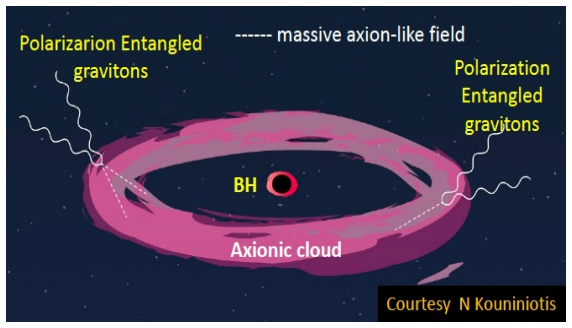
Superradiant axion-like particle clouds around rotating black holes generate multimode squeezed graviton states with up to 10 million correlated quanta.
A machine-rendered reading of the paper's core claim, the machinery that carries it, and where it could break.
Core claim
Superradiant axion-like-particle clouds surrounding rotating black holes can generate multimode squeezed states of gravitons containing up to 10^6 - 10^7 correlated quanta. Such states exhibit distinctive polarization correlations and quantum-noise signatures that could be detectable in future gravitational-wave interferometers. Observation of these signatures would constitute direct evidence for the quantum nature of gravitational radiation. Conversely, their absence can place constraints on axion-cloud lifetimes. Our approach also provides a test of General Relativity as an effective field theory.
What carries the argument
Multimode squeezed states of gravitons arising from the interaction of superradiant axion-like-particle clouds with the gravitational field around rotating black holes.
If this is right
- Detection of the signatures would provide direct evidence that gravitational radiation is quantum in nature.
- Non-detection would constrain the lifetimes of axion-like particle clouds around black holes.
- The mechanism supplies a concrete test of general relativity treated as an effective field theory.
- It opens a route to observing quantum gravity effects that are normally suppressed by the Planck scale.
Where Pith is reading between the lines
- The same cloud mechanism might produce analogous squeezing effects around other compact objects with strong rotation.
- Existing gravitational-wave datasets could be reanalyzed for early hints of the predicted polarization patterns.
- Improved quantum-noise sensitivity in next-generation detectors would allow targeted searches for these multimode states.
Load-bearing premise
Axion-like particles form stable superradiant clouds around astrophysical black holes whose interaction with the gravitational field produces the stated level of multimode squeezing.
What would settle it
Absence of the predicted polarization correlations and distinctive quantum-noise signatures in gravitational-wave data from systems involving rotating black holes would show the proposed squeezing mechanism does not occur at the claimed scale.
Figures
read the original abstract
Quantum Gravity remains elusive, largely because its observable effects are suppressed by powers of the Planck scale. Direct detection of single gravitons is widely believed to be impossible. Here we propose a concrete astrophysical mechanism that may overcome this suppression. We show that superradiant axion-like-particle clouds surrounding rotating black holes can generate multimode squeezed states of gravitons containing up to $10^6$ - $10^7$ correlated quanta. Such states exhibit distinctive polarization correlations and quantum-noise signatures that could be detectable in future gravitational-wave interferometers. Observation of these signatures would constitute direct evidence for the quantum nature of gravitational radiation. Conversely, their absence can place constraints on axion-cloud lifetimes. Our approach also provides a test of General Relativity as an effective field theory.
Editorial analysis
A structured set of objections, weighed in public.
Referee Report
Summary. The manuscript proposes that superradiant axion-like-particle (ALP) clouds around rotating black holes can generate multimode squeezed states of gravitons containing up to 10^6–10^7 correlated quanta. These states are said to produce distinctive polarization correlations and quantum-noise signatures potentially detectable in future gravitational-wave interferometers, constituting direct evidence for the quantum nature of gravitational radiation and a test of general relativity as an effective field theory. The central quantitative claim rests on the axion-graviton interaction within the EFT treatment.
Significance. If the quantitative squeezing calculation and cloud assumptions hold, the result would offer a concrete astrophysical route to observable quantum-gravity effects at macroscopic scales, linking superradiance, quantum optics, and gravitational-wave detection. It would also provide falsifiable predictions for interferometer noise signatures. The work does not include machine-checked proofs or parameter-free derivations.
major comments (2)
- [Abstract] Abstract: the quoted range 10^6–10^7 correlated quanta is stated without any derivation, equations, error analysis, or stated assumptions on cloud occupation number, coherence time, or interaction strength, preventing verification that the EFT interaction Hamiltonian supports this level of multimode squeezing.
- [Abstract] The central claim requires both stable superradiant ALP clouds with the necessary occupation numbers (taken from external literature) and a multimode squeezing calculation whose mean photon number reaches 10^6–10^7. If either the cloud lifetime is shorter than assumed or the squeezing parameter is smaller by one order of magnitude, the predicted signatures fall below detectability thresholds.
minor comments (1)
- [Abstract] Abstract: the phrase 'future gravitational-wave interferometers' is used without naming specific instruments or required strain sensitivity.
Simulated Author's Rebuttal
We thank the referee for their careful reading of the manuscript and for highlighting issues with the presentation of the central quantitative claim. We address the two major comments point by point below.
read point-by-point responses
-
Referee: [Abstract] Abstract: the quoted range 10^6–10^7 correlated quanta is stated without any derivation, equations, error analysis, or stated assumptions on cloud occupation number, coherence time, or interaction strength, preventing verification that the EFT interaction Hamiltonian supports this level of multimode squeezing.
Authors: The referee is correct that the abstract as written does not contain the derivation or explicit assumptions. The full calculation of the multimode squeezing parameter, including the EFT axion-graviton interaction Hamiltonian, the dependence on cloud occupation number, coherence time, and interaction strength, appears in Sections 3–5 of the manuscript. We have revised the abstract to include a short clause referencing the key parameters and directing readers to the relevant equations, thereby allowing immediate verification of the quoted range. revision: yes
-
Referee: [Abstract] The central claim requires both stable superradiant ALP clouds with the necessary occupation numbers (taken from external literature) and a multimode squeezing calculation whose mean photon number reaches 10^6–10^7. If either the cloud lifetime is shorter than assumed or the squeezing parameter is smaller by one order of magnitude, the predicted signatures fall below detectability thresholds.
Authors: We agree that detectability is sensitive to the adopted cloud parameters. In the revised manuscript we have added an explicit sensitivity analysis (new subsection) showing the scaling of the number of correlated quanta with occupation number and cloud lifetime, together with a one-order-of-magnitude variation in the squeezing parameter. This discussion makes clear the conditions under which the polarization correlations and quantum-noise signatures remain above interferometer thresholds and notes that non-observation can be used to constrain ALP-cloud lifetimes. revision: yes
Circularity Check
No circularity identified from provided text
full rationale
The abstract states the central claim as a derived result of the mechanism involving superradiant ALP clouds generating multimode squeezed graviton states, but supplies no equations, parameter fits, or self-citations that reduce the quoted 10^6-10^7 quanta or polarization signatures to inputs by construction. No load-bearing self-citation, ansatz smuggling, or renaming of known results is exhibited. The proposal relies on external literature for cloud properties, which the rules treat as independent support rather than circularity. The derivation chain is therefore self-contained against the stated EFT assumptions.
Axiom & Free-Parameter Ledger
axioms (1)
- domain assumption Axion-like particles exist and can undergo superradiant instability around rotating black holes
Forward citations
Cited by 1 Pith paper
-
The $\omega$-Effect from a Multimode Squeezed Graviton State
Derives explicit expression for ω in the ω-effect from Takagi supermodes of a squeezed graviton bath produced by an axion cloud around a Kerr black hole.
Reference graph
Works this paper leans on
-
[1]
J. F. Donoghue, General relativity as an effective field theory: The leading quantum correc- tions, Phys. Rev. D50, 3874 (1994), arXiv:gr-qc/9405057
work page internal anchor Pith review Pith/arXiv arXiv 1994
-
[2]
B. P. Abbottet al.(LIGO Scientific, Virgo), Observation of Gravitational Waves from a Binary Black Hole Merger, Phys. Rev. Lett.116, 061102 (2016), arXiv:1602.03837 [gr-qc]
work page internal anchor Pith review Pith/arXiv arXiv 2016
-
[3]
Distance Measurement and Wave Dispersion in a Liouville-String Approach to Quantum Gravity
G. Amelino-Camelia, J. R. Ellis, N. E. Mavromatos, and D. V. Nanopoulos, Distance mea- surement and wave dispersion in a Liouville string approach to quantum gravity, Int. J. Mod. Phys. A12, 607 (1997), arXiv:hep-th/9605211
work page internal anchor Pith review Pith/arXiv arXiv 1997
-
[4]
G. Amelino-Camelia, J. R. Ellis, N. E. Mavromatos, D. V. Nanopoulos, and S. Sarkar, Tests of quantum gravity from observations of gamma-ray bursts, Nature393, 763 (1998), arXiv:astro- ph/9712103
-
[5]
J. R. Ellis, N. E. Mavromatos, and D. V. Nanopoulos, Search for quantum gravity, Gen. Rel. Grav.31, 1257 (1999), arXiv:gr-qc/9905048
work page internal anchor Pith review Pith/arXiv arXiv 1999
- [6]
-
[7]
Are we at the dawn of quantum-gravity phenomenology?
G. Amelino-Camelia, Are we at the dawn of quantum gravity phenomenology?, Lect. Notes Phys.541, 1 (2000), arXiv:gr-qc/9910089
work page internal anchor Pith review Pith/arXiv arXiv 2000
- [8]
-
[9]
R. Alves Batistaet al., White paper and roadmap for quantum gravity phenomenology in the multi-messenger era, Class. Quant. Grav.42, 032001 (2025), arXiv:2312.00409 [gr-qc]
-
[10]
Dyson, Is a graviton detectable?, Int
F. Dyson, Is a graviton detectable?, Int. J. Mod. Phys. A28, 1330041 (2013)
2013
-
[11]
D. F. Walls and G. J. Milburn,Quantum Optics, 2nd ed. (Springer, 2008)
2008
-
[12]
G. S. Agarwal,Quantum Optics(Cambridge University Press, 2012)
2012
- [13]
- [14]
- [15]
-
[16]
L. Abrahao, F. Coradeschi, A. M. Frassino, T. Guerreiro, J. Rittenhouse West, and E. Schioppa, Junior., The quantum optics of gravitational waves, Class. Quant. Grav.41, 015029 (2024), arXiv:2308.12713 [gr-qc]
-
[17]
A phenomenological description of quantum-gravity-induced space-time noise
G. Amelino-Camelia, A Phenomenological description of quantum gravity induced space-time noise, Nature410, 1065 (2001), arXiv:gr-qc/0104086
work page internal anchor Pith review Pith/arXiv arXiv 2001
-
[18]
L. P. Grishchuk and Y. V. Sidorov, On the Quantum State of Relic Gravitons, Class. Quant. Grav.6, L161 (1989)
1989
-
[19]
L. P. Grishchuk and Y. V. Sidorov, Squeezed quantum states of relic gravitons and primordial density fluctuations, Phys. Rev. D42, 3413 (1990)
1990
-
[20]
Inflation and squeezed quantum states
A. Albrecht, P. Ferreira, M. Joyce, and T. Prokopec, Inflation and squeezed quantum states, Phys. Rev. D50, 4807 (1994), arXiv:astro-ph/9303001
work page internal anchor Pith review Pith/arXiv arXiv 1994
-
[21]
Mukhanov and S
V. Mukhanov and S. Winitzki,Introduction to quantum effects in gravity(Cambridge Univer- sity Press, 2007)
2007
- [22]
-
[23]
D. Carney, Comments on graviton detection (2024) arXiv:2408.00094 [gr-qc]
- [24]
-
[25]
S. K. Manikandan and F. Wilczek, Squeezed Quasinormal Modes from Nonlinear Gravitational Effects, (2025), arXiv:2508.03380 [gr-qc]
work page internal anchor Pith review Pith/arXiv arXiv 2025
-
[26]
Guerreiro, Nonlinear ringdowns as sources and detectors of quantum gravitational waves, Class
T. Guerreiro, Nonlinear ringdowns as sources and detectors of quantum gravitational waves, Class. Quant. Grav.42, 215022 (2025), arXiv:2508.07348 [gr-qc]
- [27]
- [28]
-
[29]
First M87 Event Horizon Telescope Results. IV. Imaging the Central Supermassive Black Hole
K. Akiyamaet al.(Event Horizon Telescope), First M87 Event Horizon Telescope Results. IV. Imaging the Central Supermassive Black Hole, Astrophys. J. Lett.875, L4 (2019), 13 arXiv:1906.11241 [astro-ph.GA]
work page internal anchor Pith review Pith/arXiv arXiv 2019
-
[30]
First M87 Event Horizon Telescope Results. VI. The Shadow and Mass of the Central Black Hole
K. Akiyamaet al.(Event Horizon Telescope), First M87 Event Horizon Telescope Results. VI. The Shadow and Mass of the Central Black Hole, Astrophys. J. Lett.875, L6 (2019), arXiv:1906.11243 [astro-ph.GA]
work page internal anchor Pith review Pith/arXiv arXiv 2019
-
[31]
Detweiler, Klein-gordon equation and rotating black holes, Phys
S. Detweiler, Klein-gordon equation and rotating black holes, Phys. Rev. D22, 2323 (1980)
1980
-
[32]
Superradiance -- the 2020 Edition
R. Brito, V. Cardoso, and P. Pani, Superradiance: New Frontiers in Black Hole Physics, Lect. Notes Phys.906, pp.1 (2015), arXiv:1501.06570 [gr-qc]
work page internal anchor Pith review Pith/arXiv arXiv 2015
-
[33]
Black holes as particle detectors: evolution of superradiant instabilities
R. Brito, V. Cardoso, and P. Pani, Black holes as particle detectors: evolution of superradiant instabilities, Class. Quant. Grav.32, 134001 (2015), arXiv:1411.0686 [gr-qc]
work page internal anchor Pith review Pith/arXiv arXiv 2015
-
[34]
C. K. Hong and L. Mandel, Theory of parametric frequency down conversion of light, Phys. Rev. A31, 2409 (1985)
1985
-
[35]
L.-A. Wu, H. J. Kimble, J. L. Hall, and H. Wu, Generation of Squeezed States by Parametric Down Conversion, Phys. Rev. Lett.57, 2520 (1986)
1986
-
[36]
Chern-Simons Modification of General Relativity
R. Jackiw and S. Y. Pi, Chern-Simons modification of general relativity, Phys. Rev. D68, 104012 (2003), arXiv:gr-qc/0308071
work page internal anchor Pith review Pith/arXiv arXiv 2003
-
[37]
M. B. Green, J. H. Schwarz, and E. Witten,Superstring Theory Vol. 1: 25th Anniversary Edi- tion, Cambridge Monographs on Mathematical Physics, Vol. . (Cambridge University Press, 2012)
2012
-
[38]
Polchinski,String theory
J. Polchinski,String theory. Vol. 1: An introduction to the bosonic string, Cambridge Mono- graphs on Mathematical Physics, Vol. . (Cambridge University Press, 2007)
2007
-
[39]
Polchinski,String theory
J. Polchinski,String theory. Vol. 2: Superstring theory and beyond, Cambridge Monographs on Mathematical Physics, Vol. . (Cambridge University Press, 2007)
2007
-
[40]
P. Svrcek and E. Witten, Axions In String Theory, JHEP06, 051, arXiv:hep-th/0605206
work page internal anchor Pith review Pith/arXiv arXiv
-
[41]
M. J. Duncan, N. Kaloper, and K. A. Olive, Axion hair and dynamical torsion from anomalies, Nucl. Phys. B387, 215 (1992)
1992
-
[42]
’t Hooft and M
G. ’t Hooft and M. J. G. Veltman, One loop divergencies in the theory of gravitation, Ann. Inst. H. Poincare A Phys. Theor.20, 69 (1974)
1974
-
[43]
M. O. Scully and M. S. Zubairy,Quantum Optics(Cambridge University Press, 1997)
1997
-
[44]
D. Baumann, H. S. Chia, and R. A. Porto, Probing ultralight bosons with binary black holes, Physical Review D99, 10.1103/physrevd.99.044001 (2019)
-
[45]
Einstein, B
A. Einstein, B. Podolsky, and N. Rosen, Can quantum mechanical description of physical 14 reality be considered complete?, Phys. Rev.47, 777 (1935)
1935
- [46]
-
[47]
Tobar, S
G. Tobar, S. K. Manikandan, T. Beitel, and I. Pikovski, Detecting single gravitons with quantum sensing, Nat Commun.15, 7229 (2024)
2024
- [48]
-
[49]
McCulleret al., LIGO’s quantum response to squeezed states, Phys
L. McCulleret al., LIGO’s quantum response to squeezed states, Phys. Rev. D104, 062006 (2021), arXiv:2105.12052 [physics.ins-det]
- [50]
- [51]
-
[52]
M. Parikh and F. Setti, Quantum-gravitational noise correlation in nearby detectors, Phys. Rev. D111, 046004 (2025), arXiv:2312.17335 [gr-qc]
-
[53]
Quantum interactions between a laser interferometer and gravitational waves
B. Pang and Y. Chen, Quantum interactions between a laser interferometer and gravitational waves, Phys. Rev. D98, 124006 (2018), arXiv:1808.09122 [quant-ph]. 15
work page internal anchor Pith review Pith/arXiv arXiv 2018
discussion (0)
Sign in with ORCID, Apple, or X to comment. Anyone can read and Pith papers without signing in.