Unified dark sector and Hubble-tension alleviation in scalar-vector-tensor gravity
Pith reviewed 2026-06-30 20:05 UTC · model grok-4.3
The pith
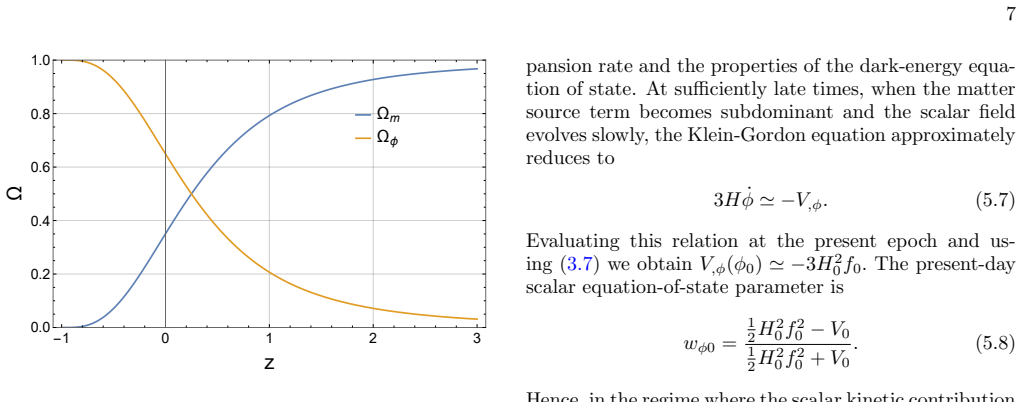
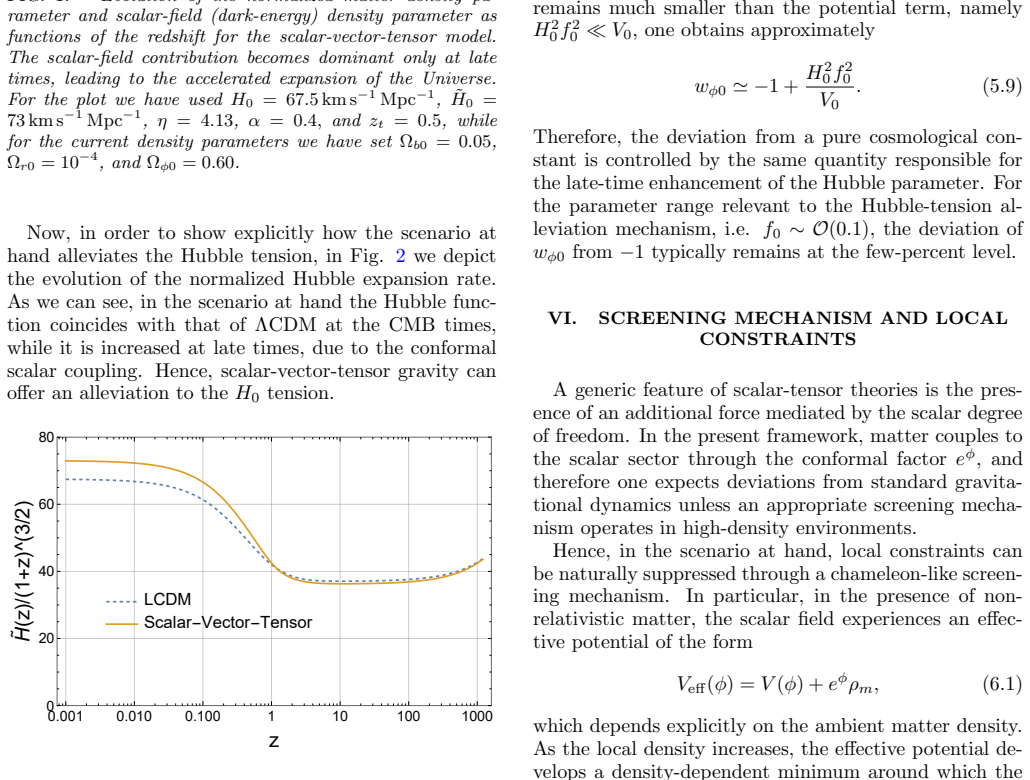
A conformal scalar coupling in scalar-vector-tensor gravity raises the effective Hubble constant at late times through a low-redshift-only scalar evolution.
A machine-rendered reading of the paper's core claim, the machinery that carries it, and where it could break.
Core claim
In this scalar-vector-tensor theory, the conformal scalar coupling modifies the physical expansion rate measured by matter observers, leading to a late-time enhancement of the effective Hubble constant. By constructing a phenomenological scalar evolution that becomes relevant only at low redshifts, the model provides a purely late-time mechanism for alleviating the Hubble tension without significantly affecting early-universe cosmology. The scalar potential naturally acts as a dynamical dark-energy sector, while the vector contribution behaves effectively as a pressureless component at cosmological scales through a density-dependent vector mass.
What carries the argument
The conformal scalar coupling to the Jordan-frame metric, which alters the expansion rate perceived by matter observers when combined with a low-redshift-only phenomenological scalar evolution.
If this is right
- The Hubble tension can be addressed without any modification to early-universe physics or the sound horizon.
- Dynamical dark energy emerges directly from the scalar potential rather than being added by hand.
- The vector sector supplies an effective pressureless component on cosmological scales without separate dark-matter fields.
- Local gravitational constraints remain satisfied through chameleon screening while cosmological effects persist.
Where Pith is reading between the lines
- The same late-time activation strategy could be applied to other modified-gravity models to isolate effects to the Hubble-tension epoch.
- Future surveys that map the Hubble parameter across a range of redshifts could directly test whether any enhancement is confined to low z.
- The density-dependent vector mass offers a new way to link vector fields to structure formation without additional parameters.
Load-bearing premise
A scalar field evolution can be arranged to activate only at low redshifts while leaving early-universe cosmology and local gravity tests unaffected.
What would settle it
A direct measurement of the Hubble constant at intermediate redshifts that shows no late-time enhancement relative to the early-universe value, or an observation that violates Solar-System constraints despite the chameleon mechanism.
Figures
read the original abstract
We investigate a scalar-vector-tensor theory in which matter is minimally coupled to a Jordan-frame metric, while a massive vector sector interacts with the baryonic current. We show that the conformal scalar coupling modifies the physical expansion rate measured by matter observers, leading to a late-time enhancement of the effective Hubble constant. By constructing a phenomenological scalar evolution that becomes relevant only at low redshifts, the model provides a purely late-time mechanism for alleviating the Hubble tension without significantly affecting early-universe cosmology. The scalar potential naturally acts as a dynamical dark-energy sector, while the vector contribution behaves effectively as a pressureless component at cosmological scales through a density-dependent vector mass. Hence, the framework connects late-time scalar dynamics, effective dark-energy evolution, and Hubble-tension alleviation within a unified setup. Finally, local gravitational constraints can be suppressed through a chameleon-type screening mechanism, allowing the theory to remain compatible with Solar-System tests while retaining nontrivial cosmological effects.
Editorial analysis
A structured set of objections, weighed in public.
Referee Report
Summary. The manuscript proposes a scalar-vector-tensor theory of gravity in which matter couples minimally to the Jordan frame metric, while a massive vector field interacts with the baryonic current. The conformal scalar coupling is claimed to modify the physical expansion rate, and through a phenomenologically constructed scalar evolution that activates only at low redshifts, the model is said to provide a late-time enhancement of the Hubble constant, alleviating the Hubble tension without affecting early-universe cosmology. The scalar potential serves as dynamical dark energy, the vector field behaves as pressureless matter at large scales due to density-dependent mass, and chameleon screening is invoked to satisfy local gravity tests.
Significance. Should the explicit construction of the scalar evolution, its stability analysis, and fits to cosmological data be provided and verified, this work could represent a significant contribution by offering a unified modified-gravity framework that addresses both the dark sector and the Hubble tension through late-time dynamics alone.
major comments (3)
- [Abstract] Abstract: The central mechanism relies on 'constructing a phenomenological scalar evolution' that becomes relevant only at low redshifts; without the explicit form of this evolution, the potential, and the resulting background equations in the main text, it is impossible to assess whether the construction is free of fine-tuning or circularity in achieving the desired Hubble enhancement.
- [Abstract] Abstract: The claim that the vector contribution 'behaves effectively as a pressureless component at cosmological scales through a density-dependent vector mass' requires the explicit expression for the mass dependence and the derivation of the effective equation of state to confirm it does not introduce unwanted pressure or instabilities.
- [Abstract] Abstract: The chameleon-type screening is stated to suppress local constraints while retaining cosmological effects; the specific form of the scalar potential or coupling that enables this screening, along with quantitative estimates of the screening scale, must be provided to substantiate compatibility with Solar-System tests.
minor comments (1)
- The abstract is well-written but the manuscript should include a dedicated section on the background cosmology and perturbation equations to support the claims.
Simulated Author's Rebuttal
We thank the referee for the careful review and constructive suggestions. We address each major comment below, agreeing that greater explicitness will strengthen the manuscript. We will incorporate the requested details and derivations into the revised version.
read point-by-point responses
-
Referee: [Abstract] Abstract: The central mechanism relies on 'constructing a phenomenological scalar evolution' that becomes relevant only at low redshifts; without the explicit form of this evolution, the potential, and the resulting background equations in the main text, it is impossible to assess whether the construction is free of fine-tuning or circularity in achieving the desired Hubble enhancement.
Authors: The main text (Section 3) already introduces the phenomenological scalar evolution that activates only below z ≈ 1, together with the scalar potential and the modified background equations. However, to directly address the concern about fine-tuning and circularity, we will expand this section with the explicit functional form of the evolution, the full expression for the potential, and the resulting Friedmann equations, including a brief discussion of parameter selection. revision: yes
-
Referee: [Abstract] Abstract: The claim that the vector contribution 'behaves effectively as a pressureless component at cosmological scales through a density-dependent vector mass' requires the explicit expression for the mass dependence and the derivation of the effective equation of state to confirm it does not introduce unwanted pressure or instabilities.
Authors: Section 4 defines the density-dependent vector mass and derives the effective equation of state. To make the derivation fully transparent, the revised manuscript will include the explicit mass function m(ρ) and the step-by-step calculation of w_eff, together with a short stability analysis confirming the absence of unwanted pressure or instabilities on cosmological scales. revision: yes
-
Referee: [Abstract] Abstract: The chameleon-type screening is stated to suppress local constraints while retaining cosmological effects; the specific form of the scalar potential or coupling that enables this screening, along with quantitative estimates of the screening scale, must be provided to substantiate compatibility with Solar-System tests.
Authors: The chameleon mechanism is outlined in Section 5. In the revision we will specify the exact form of the scalar potential and conformal coupling that realize the screening, and we will add quantitative estimates of the screening scale for Solar-System densities to demonstrate compatibility with local tests while preserving the cosmological effects. revision: yes
Circularity Check
Hubble alleviation reduces to explicit phenomenological construction of scalar evolution
specific steps
-
fitted input called prediction
[Abstract]
"By constructing a phenomenological scalar evolution that becomes relevant only at low redshifts, the model provides a purely late-time mechanism for alleviating the Hubble tension without significantly affecting early-universe cosmology."
The alleviation is not derived but obtained by constructing the scalar evolution specifically to become relevant at low redshifts and produce the late-time Hubble enhancement; the claimed 'prediction' is therefore the direct output of the phenomenological input choice.
full rationale
The paper's central claim of a late-time Hubble-tension alleviation mechanism is achieved by explicitly constructing a phenomenological scalar evolution tuned to activate only at low redshifts. This construction is presented as the means to produce the desired effect while leaving early cosmology unaffected, making the alleviation equivalent to the input choice by design rather than an independent derivation. The abstract directly states the construction, with no equations or further steps in the provided text showing an independent first-principles derivation. No self-citation chains or other patterns identified.
Axiom & Free-Parameter Ledger
free parameters (1)
- scalar evolution parameters
axioms (1)
- domain assumption Matter is minimally coupled to a Jordan-frame metric while the massive vector sector interacts with the baryonic current
invented entities (2)
-
density-dependent vector mass
no independent evidence
-
chameleon-type screening mechanism
no independent evidence
Forward citations
Cited by 1 Pith paper
-
Running into tension: primordial black holes from ultra-slow-roll inflation, spectral running, and the Hubble tension
EDE models increase inferred α_s from CMB data, strengthening tension with USR PBH models that predict negative running.
Reference graph
Works this paper leans on
-
[1]
P. J. E. Peebles and B. Ratra, Rev. Mod. Phys.75, 559 (2003)
2003
-
[2]
E. J. Copeland, M. Sami, and S. Tsujikawa, Int. J. Mod. Phys. D15, 1753 (2006)
2006
-
[3]
Weinberg, Rev
S. Weinberg, Rev. Mod. Phys.61, 1 (1989)
1989
-
[4]
E. Di Valentino, L. A. Anchordoqui, O. Akarsu, Y. Ali- Haimoud, L. Amendola, N. Arendse, M. Asgari, M. Bal- lardini, S. Basilakos and E. Battistelli,et al.As- tropart. Phys.131, 102605 (2021) [arXiv:2008.11284 [astro-ph.CO]]
-
[5]
Challenges for $\Lambda$CDM: An update
L. Perivolaropoulos and F. Skara, New Astron. Rev.95, 101659 (2022) [arXiv:2105.05208 [astro-ph.CO]]
work page internal anchor Pith review Pith/arXiv arXiv 2022
-
[6]
A. G. Riess et al., Astrophys. J.908, L6 (2021)
2021
-
[7]
Aghanim et al., Astron
Planck Collaboration, N. Aghanim et al., Astron. Astro- phys.641, A6 (2020)
2020
-
[8]
E. Abdalla, G. Franco Abell´ an, A. Aboubrahim, A. Ag- nello, O. Akarsu, Y. Akrami, G. Alestas, D. Aloni, L. Amendola and L. A. Anchordoqui,et al.JHEAp34, 49-211 (2022) [arXiv:2203.06142 [astro-ph.CO]]
work page internal anchor Pith review Pith/arXiv arXiv 2022
-
[9]
Verde, T
L. Verde, T. Treu, and A. G. Riess, Nat. Astron.3, 891 (2019)
2019
-
[10]
Early Dark Energy Can Resolve The Hubble Tension
V. Poulin, T. L. Smith, T. Karwal and M. Kamionkowski, Phys. Rev. Lett.122, no.22, 221301 (2019) [arXiv:1811.04083 [astro-ph.CO]]
work page internal anchor Pith review Pith/arXiv arXiv 2019
-
[11]
J. Sakstein and M. Trodden, Phys. Rev. Lett.124, no.16, 161301 (2020) [arXiv:1911.11760 [astro-ph.CO]]
- [12]
-
[13]
F. Niedermann and M. S. Sloth, Phys. Rev. D102, no.6, 063527 (2020) [arXiv:2006.06686 [astro-ph.CO]]
- [14]
-
[15]
A. Chudaykin, D. Gorbunov and N. Nedelko, and Phys. Rev. D103, no.4, 043529 (2021) [arXiv:2011.04682 [astro-ph.CO]]
-
[16]
O. Seto and Y. Toda, Phys. Rev. D103, no.12, 123501 (2021) [arXiv:2101.03740 [astro-ph.CO]]
-
[17]
K. Freese and M. W. Winkler, Phys. Rev. D104, no.8, 083533 (2021) [arXiv:2102.13655 [astro-ph.CO]]
- [18]
-
[19]
L. Herold and E. G. M. Ferreira, Phys. Rev. D108, no.4, 043513 (2023) [arXiv:2210.16296 [astro-ph.CO]]
-
[20]
Can interacting dark energy solve the $H_0$ tension?
E. Di Valentino, A. Melchiorri and O. Mena, Phys. Rev. D96, no.4, 043503 (2017) [arXiv:1704.08342 [astro- ph.CO]]
work page internal anchor Pith review Pith/arXiv arXiv 2017
-
[21]
R. An, C. Feng and B. Wang, JCAP02, 038 (2018) [arXiv:1711.06799 [astro-ph.CO]]
work page internal anchor Pith review Pith/arXiv arXiv 2018
-
[22]
W. Yang, S. Pan, E. Di Valentino, E. N. Saridakis and S. Chakraborty, Phys. Rev. D99, no.4, 043543 (2019) [arXiv:1810.05141 [astro-ph.CO]]
work page internal anchor Pith review Pith/arXiv arXiv 2019
-
[23]
W. Yang, A. Mukherjee, E. Di Valentino and S. Pan, Phys. Rev. D98, no.12, 123527 (2018) [arXiv:1809.06883 [astro-ph.CO]]
work page internal anchor Pith review Pith/arXiv arXiv 2018
- [24]
- [25]
-
[26]
H. Amirhashchi, A. K. Yadav, N. Ahmad and V. Yadav, Phys. Dark Univ.36, 101043 (2022) [arXiv:2001.03775 [astro-ph.CO]]
- [27]
- [28]
- [29]
- [30]
- [31]
-
[32]
T. Sekiguchi and T. Takahashi, Phys. Rev. D103, no.8, 083507 (2021) [arXiv:2007.03381 [astro-ph.CO]]
- [33]
-
[34]
M. Rashkovetskyi, J. B. Mu˜ noz, D. J. Eisenstein and C. Dvorkin, Phys. Rev. D104, no.10, 103517 (2021) [arXiv:2108.02747 [astro-ph.CO]]
- [35]
- [36]
- [37]
-
[38]
K. Jedamzik, L. Pogosian and T. Abel, the Nature As- tron.10, no.2, 317-324 (2026) [arXiv:2503.09599 [astro- ph.CO]]
-
[39]
Geometric Constraints on the Pre-Recombination Expansion History from the Hubble Tension
D. Pedrotti, [arXiv:2604.25813 [astro-ph.CO]]
work page internal anchor Pith review Pith/arXiv arXiv
-
[40]
S. Basilakos, A. Lymperis, M. Petronikolou and E. N. Saridakis, Eur. Phys. J. C84, no.3, 297 (2024) [arXiv:2308.01200 [gr-qc]]
-
[41]
M. Yarahmadi and A. Salehi, Eur. Phys. J. C84, no.4, 443 (2024) [arXiv:2501.07860 [astro-ph.CO]]
-
[42]
P. Adhikary, S. Das, S. D. Odintsov and T. Paul, Phys. Dark Univ.49, 102037 (2025) [arXiv:2507.15273 [gr-qc]]
-
[43]
Yarahmadi and A
M. Yarahmadi and A. Salehi, Phys. Dark Univ.48, 101923 (2025)
2025
-
[44]
Yarahmadi and A
M. Yarahmadi and A. Salehi, Mon. Not. Roy. Astron. Soc.534, no.4, 3055-3067 (2024)
2024
-
[45]
J. X. Li and S. Wang, Mon. Not. Roy. Astron. Soc.548, 1 (2026) [arXiv:2511.09467 [astro-ph.CO]]
work page internal anchor Pith review Pith/arXiv arXiv 2026
-
[46]
Observational constraints on Luciano-Saridakis entropic cosmology
M. Leizerovich, S. J. Landau, G. G. Luciano, A. Papatri- antafyllou and E. N. Saridakis, [arXiv:2603.03568 [astro- ph.CO]]
work page internal anchor Pith review Pith/arXiv arXiv
-
[47]
N. Khosravi, S. Baghram, N. Afshordi and N. Al- tamirano, Phys. Rev. D99, no.10, 103526 (2019) [arXiv:1710.09366 [astro-ph.CO]]
-
[48]
R. C. Nunes, JCAP05, 052 (2018) [arXiv:1802.02281 [gr-qc]]
work page internal anchor Pith review Pith/arXiv arXiv 2018
-
[49]
$H_0$ Tension and the Phantom Regime: A Case Study In Terms of an Infrared $f(T)$ Gravity
A. El-Zant, W. El Hanafy and S. Elgammal, Astrophys. J.871, no.2, 210 (2019) [arXiv:1809.09390 [gr-qc]]
work page internal anchor Pith review Pith/arXiv arXiv 2019
- [50]
- [51]
-
[52]
C. Escamilla-Rivera and J. Levi Said, Class. Quant. Grav.37, no.16, 165002 (2020) [arXiv:1909.10328 [gr- qc]]
-
[53]
F. Skara and L. Perivolaropoulos, Phys. Rev. D101, no.6, 063521 (2020) [arXiv:1911.10609 [astro-ph.CO]]
arXiv 2020
-
[54]
S. D. Odintsov, D. S´ aez-Chill´ on G´ omez and G. S. Sharov, Nucl. Phys. B966, 115377 (2021) [arXiv:2011.03957 [gr- qc]]
arXiv 2021
-
[55]
M. Ballardini, M. Braglia, F. Finelli, D. Paoletti, A. A. Starobinsky and C. Umilt` a, JCAP10, 044 (2020) [arXiv:2004.14349 [astro-ph.CO]]
- [56]
-
[57]
M. Braglia, M. Ballardini, F. Finelli and K. Koyama, Phys. Rev. D103, no.4, 043528 (2021) [arXiv:2011.12934 [astro-ph.CO]]
- [58]
-
[59]
M. Petronikolou, S. Basilakos and E. N. Saridakis, Phys. Rev. D106, no.12, 124051 (2022) [arXiv:2110.01338 [gr- qc]]
- [60]
- [61]
-
[62]
S. Banerjee, M. Petronikolou and E. N. Saridakis, Phys. Rev. D108, no.2, 024012 (2023) [arXiv:2209.02426 [gr- qc]]
-
[63]
T. Schiavone, G. Montani and F. Bombacigno, Mon. Not. Roy. Astron. Soc.522, no.1, L72-L77 (2023) [arXiv:2211.16737 [gr-qc]]
- [64]
-
[65]
G. Montani, M. De Angelis, F. Bombacigno and N. Carl- evaro, Mon. Not. Roy. Astron. Soc.527, no.1, L156-L161 (2023) [arXiv:2306.11101 [gr-qc]]
- [66]
-
[67]
M. Bouhmadi-L´ opez, C. G. Boiza, M. Petronikolou and E. N. Saridakis, Universe12, no.3, 81 (2026) [arXiv:2601.22225 [gr-qc]]
-
[68]
E. Di Valentinoet al.[CosmoVerse Network], Phys. Dark Univ.49, 101965 (2025) [arXiv:2504.01669 [astro- ph.CO]]
work page internal anchor Pith review Pith/arXiv arXiv 2025
-
[69]
A. G. Adame et al. (DESI Collaboration), Astron. J.168, 58 (2024)
2024
-
[70]
A. G. Adame et al. (DESI Collaboration), Astron. J.168, 59 (2024)
2024
- [71]
-
[72]
Unified cosmic history in modified gravity: from F(R) theory to Lorentz non-invariant models
S. Nojiri and S. D. Odintsov, Phys. Rept.505, 59-144 (2011) [arXiv:1011.0544 [gr-qc]]
work page internal anchor Pith review Pith/arXiv arXiv 2011
-
[73]
Modified Gravity and Cosmology
T. Clifton, P. G. Ferreira, A. Padilla and C. Skordis, Phys. Rept.513, 1-189 (2012) [arXiv:1106.2476 [astro- ph.CO]]
work page internal anchor Pith review Pith/arXiv arXiv 2012
-
[74]
S. Capozziello and M. De Laurentis, Phys. Rept.509, 167-321 (2011) [arXiv:1108.6266 [gr-qc]]
work page internal anchor Pith review Pith/arXiv arXiv 2011
-
[75]
A. I. Vainshtein, Phys. Lett. B39, 393-394 (1972) doi:10.1016/0370-2693(72)90147-5
-
[76]
J. Khoury and A. Weltman, Phys. Rev. D69, 044026 (2004) [arXiv:astro-ph/0309411 [astro-ph]]
work page internal anchor Pith review Pith/arXiv arXiv 2004
-
[77]
J. Khoury, Class. Quant. Grav.30, 214004 (2013) [arXiv:1306.4326 [astro-ph.CO]]
work page internal anchor Pith review Pith/arXiv arXiv 2013
-
[78]
Beyond the Cosmological Standard Model
A. Joyce, B. Jain, J. Khoury and M. Trodden, Phys. Rept.568, 1-98 (2015) [arXiv:1407.0059 [astro-ph.CO]]
work page internal anchor Pith review Pith/arXiv arXiv 2015
-
[79]
C. Burrage and J. Sakstein, Living Rev. Rel.21, no.1, 1 (2018) [arXiv:1709.09071 [astro-ph.CO]]
work page internal anchor Pith review Pith/arXiv arXiv 2018
-
[80]
A systematic approach to generalisations of General Relativity and their cosmological implications
L. Heisenberg, Phys. Rept.796, 1-113 (2019) [arXiv:1807.01725 [gr-qc]]
work page internal anchor Pith review Pith/arXiv arXiv 2019
discussion (0)
Sign in with ORCID, Apple, or X to comment. Anyone can read and Pith papers without signing in.