Ringdown and echoes from compact objects: Debye series and Debye quasinormal modes
Pith reviewed 2026-05-19 14:25 UTC · model grok-4.3
The pith
A Debye series decomposition of waveforms from compact horizonless bodies converges at early times and reconstructs the full signal including prompt response and echoes.
A machine-rendered reading of the paper's core claim, the machinery that carries it, and where it could break.
Core claim
The Debye reconstruction matches the exact waveform for both R greater than 3M and R less than 3M Schwarzschild-star spacetimes, converging even at early times and describing all features including the prompt response. Individual Debye terms each carry their own quasinormal-mode content, so the full series organizes the signal into separate propagation channels rather than collective resonances.
What carries the argument
The Debye series decomposition, which isolates direct exterior propagation, surface reflection, and successive interior transmissions and extracts quasinormal modes from each term separately.
If this is right
- Low-order Debye terms alone reproduce the ringdown and the non-modal sub-threshold contribution in neutron-star-like objects.
- In ultracompact cases the series cleanly separates the prompt-ringdown segment from a sequence of individually resolved echo wavepackets.
- The Debye-QNM picture treats modes as belonging to distinct propagation channels while the standard QNM sum collects them into collective resonances.
- Echo-like structures arise naturally from repeated interior propagation and the associated pole and branch-cut contributions.
Where Pith is reading between the lines
- The method may extend to vector or tensor perturbations and to rotating or non-spherical compact bodies, allowing tests of whether early-time features distinguish horizonless objects from black holes.
- Because each Debye term maps to a clear sequence of geodesics, the approach could guide template construction for gravitational-wave searches that target echo trains.
- The channel-by-channel spectral view suggests analogous decompositions could be useful for wave propagation through other inhomogeneous media with multiple scattering paths.
Load-bearing premise
The interior permits well-defined successive transmissions whose quasinormal-mode content can be extracted and summed independently without significant cross-channel interference.
What would settle it
Compute the summed low-order Debye-QNM terms for a chosen Schwarzschild-star model and compare the result directly to the exact time-domain waveform; a visible mismatch in the prompt phase or first-echo amplitude would falsify the reconstruction claim.
Figures




read the original abstract
We introduce a new series decomposition of the waveform constructed in the spirit of Debye expansions in scattering theory, and we use this to analyse the time-domain response of compact, horizonless bodies to scalar-field perturbations on curved spacetimes. The Debye decomposition separates out direct exterior propagation, surface reflection, and successive transmissions through the interior of a compact body, and it provides an intuitive interpretation of the waveform in terms of geodesic trajectories. By analysing the quasinormal-mode (QNM) content of individual Debye terms, we set out a Debye-QNM description that is complementary to the standard QNM description. With this framework, we examine a scalar field propagating on two illustrative `Schwarzschild star' compact-body spacetimes: a neutron-star-like model \(R>3M\) and an ultracompact object \(R<3M\). We show that the Debye reconstruction matches well with the exact waveform, and that (unlike the standard QNM reconstruction) it converges even at early times, giving an accurate description of all waveform features including the prompt response. In the neutron-star case, the low-order Debye terms mainly describe the ringdown and a non-modal component associated with the sub-threshold branch cut. In the ultracompact case, the Debye series organizes the waveform into a prompt/ringdown contribution followed by a succession of individually resolved echo-like wavepackets. The new Debye-QNM expansion and the standard QNM expansion have complementary spectral interpretations: the former identifies modes in individual propagation channels, whereas the latter describes collective resonances that are resummations of the former. This distinction clarifies how echo-like structures emerge from repeated interior propagation, and how pole and branch-cut contributions enter the time-domain signal.
Editorial analysis
A structured set of objections, weighed in public.
Referee Report
Summary. The paper introduces a Debye series decomposition of the scalar waveform for perturbations of horizonless compact objects (Schwarzschild stars), separating direct exterior propagation, surface reflection, and successive interior transmissions. It defines Debye quasinormal modes for each term and shows that their sum reconstructs the exact time-domain waveform for both a neutron-star-like model (R > 3M) and an ultracompact model (R < 3M), converging at early times and capturing the prompt response and echo packets, unlike the standard QNM sum. The work also contrasts the spectral interpretations of the two expansions.
Significance. If the numerical reconstruction holds with the claimed accuracy, the Debye-QNM framework supplies a useful channel-by-channel interpretation of ringdown and echoes in terms of geodesic trajectories and clarifies how collective resonances arise from summed individual terms. This is a concrete advance for modeling signals from exotic compact objects and for separating pole versus branch-cut contributions in the time domain.
major comments (2)
- [Debye decomposition and QNM extraction paragraphs] The central claim of accurate early-time reconstruction (abstract and results for both models) rests on the assumption that QNM extraction from each Debye term can be performed independently without significant cross-channel leakage after contour integration. The manuscript should supply an explicit check—e.g., a quantitative bound on residual interference or a demonstration that the transmission operator commutes with the residue projector—for the neutron-star case where the interior potential is smooth but non-zero.
- [Ultracompact object results] § on ultracompact echoes: the statement that the Debye series organizes the waveform into individually resolved echo-like wavepackets requires a direct comparison of the summed low-order terms against the exact waveform at the specific retarded times where the first and second echoes appear, including an assessment of truncation error.
minor comments (2)
- [Formalism] Notation for the transmission and reflection coefficients in the Debye expansion should be defined once in a single equation block rather than reintroduced in each model section.
- [Figures] Figure captions for the waveform comparisons should state the number of Debye terms retained and the frequency cutoff used for the QNM sum in each panel.
Simulated Author's Rebuttal
We thank the referee for their thorough review and constructive feedback on our manuscript. We appreciate the positive assessment of the significance of the Debye series and Debye-QNM framework. We address the major comments below and have incorporated revisions to address the concerns raised.
read point-by-point responses
-
Referee: [Debye decomposition and QNM extraction paragraphs] The central claim of accurate early-time reconstruction (abstract and results for both models) rests on the assumption that QNM extraction from each Debye term can be performed independently without significant cross-channel leakage after contour integration. The manuscript should supply an explicit check—e.g., a quantitative bound on residual interference or a demonstration that the transmission operator commutes with the residue projector—for the neutron-star case where the interior potential is smooth but non-zero.
Authors: We agree with the referee that an explicit verification of the independence of the QNM extractions is important to support the central claim. In the revised manuscript, we have added a new paragraph and accompanying numerical check in the section discussing the neutron-star model. We compute the difference between the exact waveform and the sum of the Debye-QNMs extracted via contour integration for each term. The residual is found to be below 1% of the peak amplitude at early times, providing a quantitative bound on any potential cross-channel leakage. We also include a short discussion noting that the transmission operator, being multiplicative in the frequency domain, commutes with the residue extraction under the chosen contour, as the poles are isolated. This addition directly addresses the concern for the case with smooth but non-zero interior potential. revision: yes
-
Referee: [Ultracompact object results] § on ultracompact echoes: the statement that the Debye series organizes the waveform into individually resolved echo-like wavepackets requires a direct comparison of the summed low-order terms against the exact waveform at the specific retarded times where the first and second echoes appear, including an assessment of truncation error.
Authors: We thank the referee for this suggestion, which improves the clarity of our results for the ultracompact case. We have revised the relevant section to include a direct comparison. Specifically, we have added a zoomed-in plot or table in the ultracompact echoes subsection, showing the exact waveform and the partial sum of the first three Debye terms at the retarded times corresponding to the first and second echo packets. The truncation error is assessed by comparing to higher-order sums, showing that the error is less than 5% for the first echo and decreases for subsequent terms as more orders are included. This confirms that the low-order Debye terms indeed resolve the individual echo-like wavepackets as claimed. revision: yes
Circularity Check
No circularity: Debye decomposition derived from wave equation and validated against independent exact solution
full rationale
The derivation begins from the scalar wave equation on Schwarzschild-star backgrounds and constructs the Debye series by separating propagation channels (exterior direct, surface reflection, successive interior transmissions) in the spirit of scattering theory. Individual Debye terms are analyzed for their QNM content via standard residue extraction, then summed to reconstruct the waveform. This reconstruction is compared to an independently computed exact time-domain solution, serving as an external benchmark. No step reduces by construction to a fitted parameter renamed as prediction, a self-referential definition, or a load-bearing self-citation chain. The assumption of channel independence is an explicit modeling choice whose validity is tested by the match to the exact waveform rather than assumed into the result. The method is self-contained and non-circular.
Axiom & Free-Parameter Ledger
axioms (1)
- domain assumption Linear scalar-field perturbations propagate on a fixed Schwarzschild exterior matched to a compact interior without horizon.
invented entities (1)
-
Debye quasinormal modes
no independent evidence
Lean theorems connected to this paper
-
IndisputableMonolith/Foundation/RealityFromDistinction.leanreality_from_one_distinction unclear?
unclearRelation between the paper passage and the cited Recognition theorem.
Debye decomposition separates out direct exterior propagation, surface reflection, and successive transmissions through the interior... Debye-QNM description that is complementary to the standard QNM description
-
IndisputableMonolith/Cost/FunctionalEquation.leanwashburn_uniqueness_aczel unclear?
unclearRelation between the paper passage and the cited Recognition theorem.
D-QNMs are poles of the individual Debye building blocks... ordinary QNMs are collective poles of the resummed response
What do these tags mean?
- matches
- The paper's claim is directly supported by a theorem in the formal canon.
- supports
- The theorem supports part of the paper's argument, but the paper may add assumptions or extra steps.
- extends
- The paper goes beyond the formal theorem; the theorem is a base layer rather than the whole result.
- uses
- The paper appears to rely on the theorem as machinery.
- contradicts
- The paper's claim conflicts with a theorem or certificate in the canon.
- unclear
- Pith found a possible connection, but the passage is too broad, indirect, or ambiguous to say the theorem truly supports the claim.
Reference graph
Works this paper leans on
-
[1]
dn” stands for down-going. It replaces the more standard “in
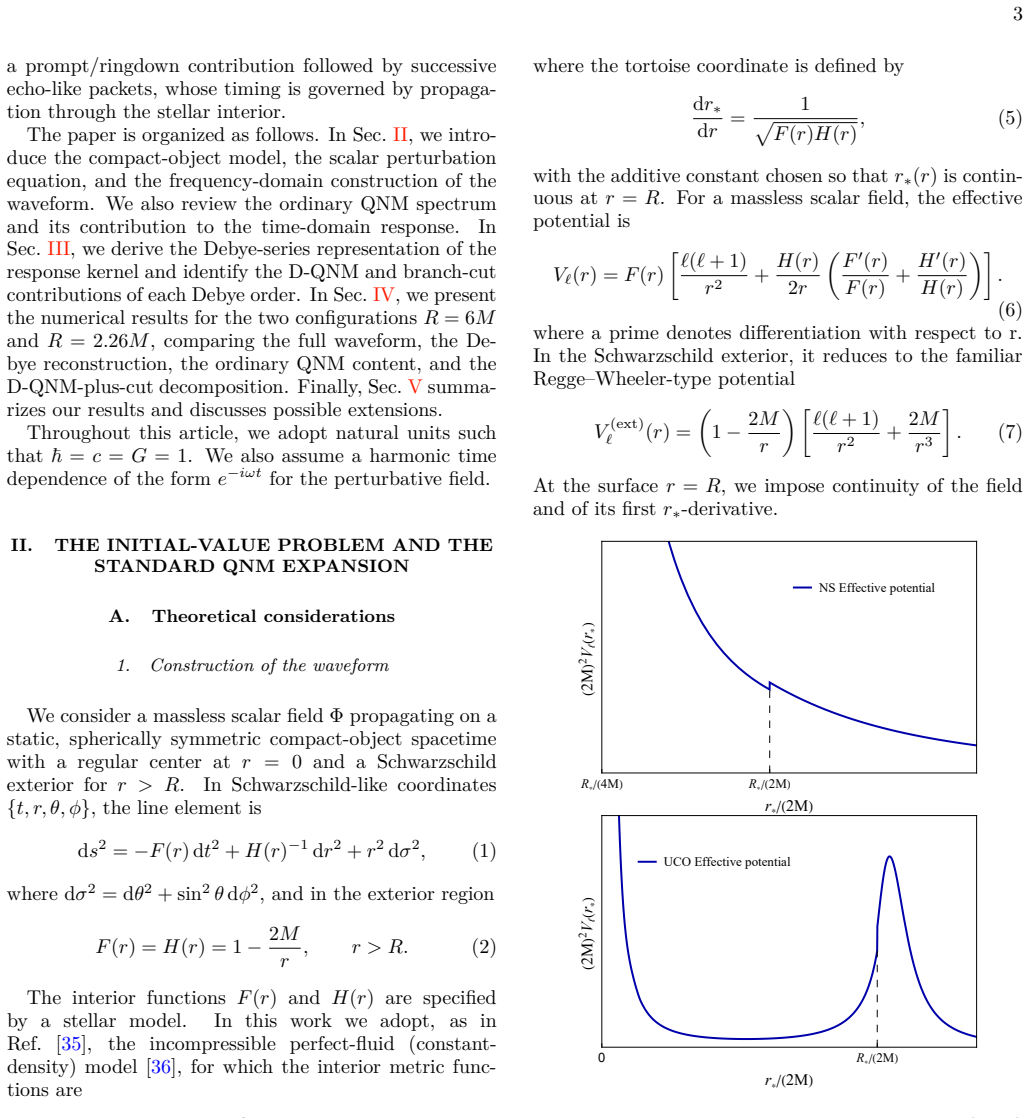
Numerical results: Waveforms and echoes In this section, we present numerical results for the time-domain waveform and its quasinormal-mode recon- struction in the same two representative configurations considered previously: (i) a neutron-star-like object with R= 6M, and (ii) an ultracompact object withR= 2.26M. In both cases, we focus on theℓ= 2pertur- ...
-
[2]
Ringdown of thep= 0Debye terms: D-QNM and cut contributions ByinsertingEq.(70a)intoEq.(68), thepurelyexterior contribution is given by ϕ(0) ℓ(t,r) = 1 2πRe [∫ +∞+ic 0+ic e−iω(t−r∗)P (−) ℓ (ω)dω + ∫ +∞+ic 0+ic e−iω(t−r∗)βout ℓ (ω) αin ℓ(ω)P (+) ℓ (ω)dω ] . (74) Since the termP (−) ℓ (ω)is regular, the pole contri- bution toϕ(0) ℓ(t,r)is entirely governed b...
-
[3]
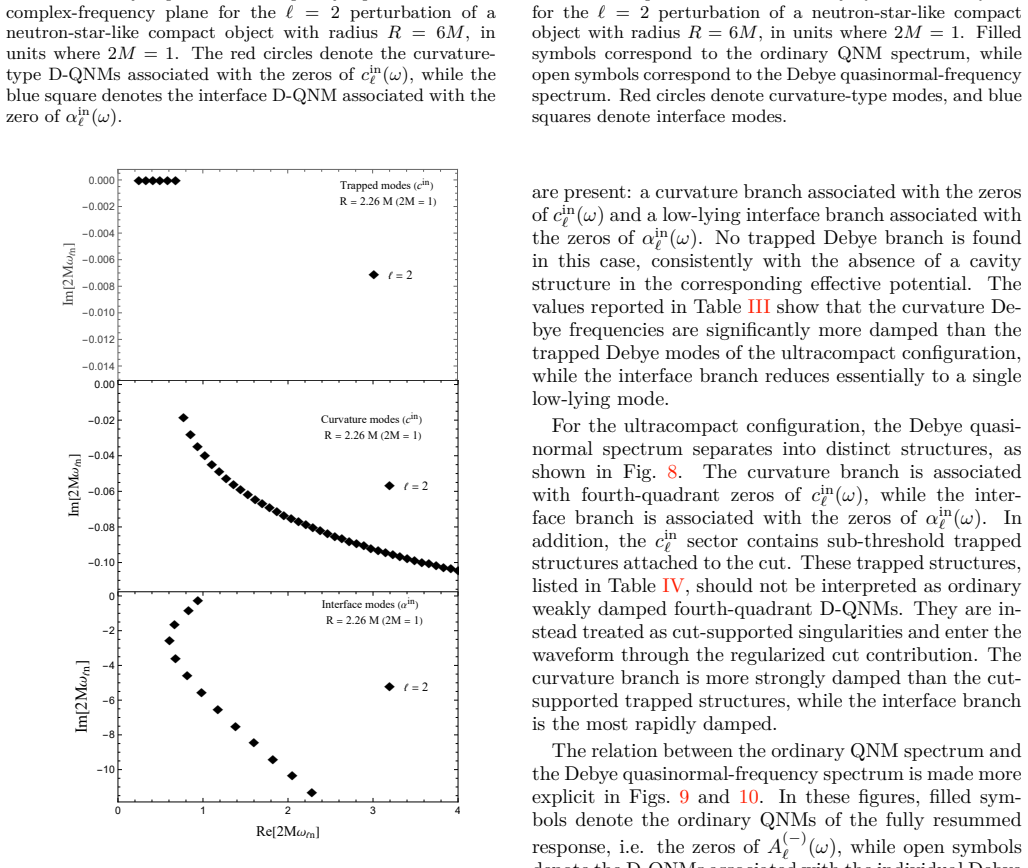
Ringdown of thep≥1Debye terms: D-QNM and cut contributions Forp≥1, theDebyecontributionϕ(p) ℓ(t,r)hasaricher singular structure than the leading term. It receives pole contributions from the zeros ofαin ℓ(ω), denoted byω(α) ℓn, which define the interface D-QNMs. It also receives con- tributions from the zeros ofcin ℓ(ω), denoted byω(c) ℓn. In 16 the resid...
-
[4]
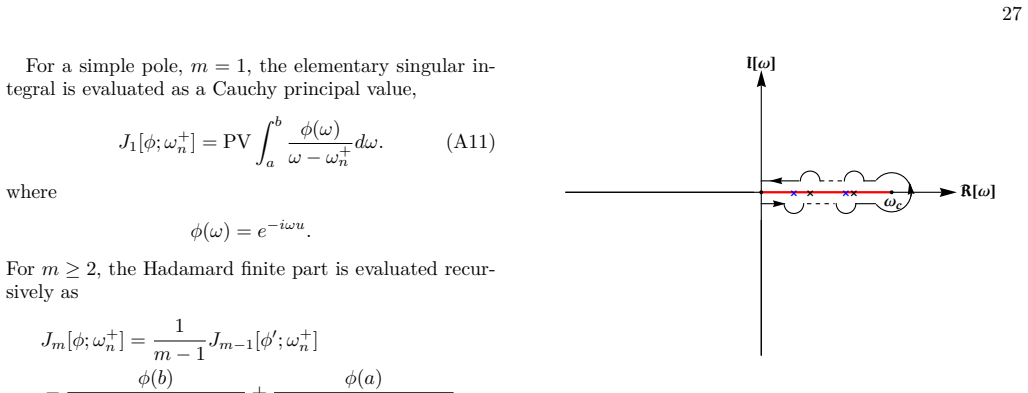
Direct reconstruction of the Debye contribution The Debye contribution of orderp≥1is reconstructed from the frequency-domain integral (cf. Eq. (68)) ϕ(p) ℓ(t,r) = 1 2πRe [∫ +∞+ic 0+ic e−iωuD(p) ℓ(ω)dω ] ,(A1) whereu=t−r∗. When the contour is brought down to the real- frequency axis, the branch point atω=ωc naturally splits the integral into two pieces, ∫ ...
-
[5]
This contribution is defined as the discontinuity between the two lips of the cut, as in Eq
Regularized cut contribution We now consider the contribution of the sub-threshold cut which appears after the contour deformation. This contribution is defined as the discontinuity between the two lips of the cut, as in Eq. (119) ϕ(p),cut ℓ (t,r) = 1 2πRe [∫ ωc 0 e−iωu ( F(p)+ ℓ (ω)−F(p)− ℓ (ω) ) dω ] .(A15) When no pole lies on the cut, this expression ...
-
[6]
B. P. Abbottet al.(LIGO Scientific, Virgo), Phys. Rev. Lett.116, 061102 (2016), arXiv:1602.03837 [gr-qc]
work page internal anchor Pith review Pith/arXiv arXiv 2016
-
[7]
Goddiet al.(Event Horizon Telescope), The Messen- ger177, 25 (2019), arXiv:1910.10193 [astro-ph.HE]
C. Goddiet al.(Event Horizon Telescope), The Messen- ger177, 25 (2019), arXiv:1910.10193 [astro-ph.HE]
-
[8]
Akiyamaet al.(Event Horizon Telescope), Astrophys
K. Akiyamaet al.(Event Horizon Telescope), Astrophys. J.Lett.930,L16(2022),arXiv:2311.09478[astro-ph.HE]
-
[9]
Testing the nature of dark compact objects: a status report
V. Cardoso and P. Pani, Living Rev. Rel.22, 4 (2019), arXiv:1904.05363 [gr-qc]
work page internal anchor Pith review Pith/arXiv arXiv 2019
- [10]
-
[11]
K. D. Kokkotas and B. G. Schmidt, Living Rev. Rel.2, 2 (1999), arXiv:gr-qc/9909058
work page internal anchor Pith review Pith/arXiv arXiv 1999
-
[12]
Quasinormal modes of black holes and black branes
E. Berti, V. Cardoso, and A. O. Starinets, Class. Quant. Grav.26, 163001 (2009), arXiv:0905.2975 [gr-qc]
work page internal anchor Pith review Pith/arXiv arXiv 2009
-
[13]
R. A. Konoplya and A. Zhidenko, Rev. Mod. Phys.83, 793 (2011), arXiv:1102.4014 [gr-qc]
work page internal anchor Pith review Pith/arXiv arXiv 2011
-
[14]
Spectroscopy of Kerr black holes with Earth- and space-based interferometers
E. Berti, A. Sesana, E. Barausse, V. Cardoso, and K. Belczynski, Phys. Rev. Lett.117, 101102 (2016), arXiv:1605.09286 [gr-qc]
work page internal anchor Pith review Pith/arXiv arXiv 2016
-
[15]
V. Baibhav, M. H.-Y. Cheung, E. Berti, V. Cardoso, G. Carullo, R. Cotesta, W. Del Pozzo, and F. Duque, Phys. Rev. D108, 104020 (2023), arXiv:2302.03050 [gr- qc]
-
[16]
Black hole spectroscopy: from theory to experiment
E. Bertiet al., arXiv e-prints (2025), arXiv:2505.23895 [gr-qc]
work page internal anchor Pith review Pith/arXiv arXiv 2025
-
[17]
Inspiral, merger and ring-down of equal-mass black-hole binaries
A. Buonanno, G. B. Cook, and F. Pretorius, Phys. Rev. D75, 124018 (2007), arXiv:gr-qc/0610122
work page internal anchor Pith review Pith/arXiv arXiv 2007
-
[18]
Modeling Ringdown: Beyond the Fundamental Quasi-Normal Modes
L. London, D. Shoemaker, and J. Healy, Phys. Rev. D 90, 124032 (2014), [Erratum: Phys.Rev.D 94, 069902 (2016)], arXiv:1404.3197 [gr-qc]
work page internal anchor Pith review Pith/arXiv arXiv 2014
-
[19]
M. Giesler, M. Isi, M. A. Scheel, and S. Teukolsky, Phys. Rev. X9, 041060 (2019), arXiv:1903.08284 [gr-qc]
- [20]
-
[21]
R. H. Price, Phys. Rev. D5, 2419 (1972)
work page 1972
-
[22]
R. H. Price, Phys. Rev. D5, 2439 (1972)
work page 1972
-
[23]
E. W. Leaver, Phys. Rev. D34, 384 (1986)
work page 1986
-
[24]
E. S. C. Ching, P. T. Leung, W. M. Suen, and K. Young, Phys. Rev. D52, 2118 (1995), arXiv:gr-qc/9507035
work page internal anchor Pith review Pith/arXiv arXiv 1995
-
[25]
The Branch Cut and Quasi-normal Modes at Large Imaginary Frequency in Schwarzschild Space-time
M. Casals and A. Ottewill, Phys. Rev. D86, 024021 (2012), arXiv:1112.2695 [gr-qc]
work page internal anchor Pith review Pith/arXiv arXiv 2012
-
[26]
Spectroscopy of the Schwarzschild Black Hole at Arbitrary Frequencies
M. Casals and A. C. Ottewill, Phys. Rev. Lett.109, 111101 (2012), arXiv:1205.6592 [gr-qc]
work page internal anchor Pith review Pith/arXiv arXiv 2012
-
[27]
Analytic Investigation of the Branch Cut of the Green Function in Schwarzschild Space-time
M. Casals and A. C. Ottewill, Phys. Rev. D87, 064010 (2013), arXiv:1210.0519 [gr-qc]
work page internal anchor Pith review Pith/arXiv arXiv 2013
-
[28]
Is the gravitational-wave ringdown a probe of the event horizon?
V. Cardoso, E. Franzin, and P. Pani, Phys. Rev. Lett. 116, 171101 (2016), [Erratum: Phys.Rev.Lett. 117, 089902 (2016)], arXiv:1602.07309 [gr-qc]
work page internal anchor Pith review Pith/arXiv arXiv 2016
-
[29]
V. Cardoso, S. Hopper, C. F. B. Macedo, C. Palen- zuela, and P. Pani, Phys. Rev. D94, 084031 (2016), arXiv:1608.08637 [gr-qc]
work page internal anchor Pith review Pith/arXiv arXiv 2016
-
[30]
Tests for the existence of horizons through gravitational wave echoes
V. Cardoso and P. Pani, Nature Astron.1, 586 (2017), arXiv:1709.01525 [gr-qc]
work page internal anchor Pith review Pith/arXiv arXiv 2017
-
[31]
Z. Mark, A. Zimmerman, S. M. Du, and Y. Chen, Phys. Rev. D96, 084002 (2017), arXiv:1706.06155 [gr-qc]
work page internal anchor Pith review Pith/arXiv arXiv 2017
-
[32]
Exotic Compact Objects and How to Quench their Ergoregion Instability
E. Maggio, P. Pani, and V. Ferrari, Phys. Rev. D96, 104047 (2017), arXiv:1703.03696 [gr-qc]
work page internal anchor Pith review Pith/arXiv arXiv 2017
-
[33]
A. Testa and P. Pani, Phys. Rev. D98, 044018 (2018), arXiv:1806.04253 [gr-qc]
work page internal anchor Pith review Pith/arXiv arXiv 2018
-
[34]
D100, 064056 (2019), arXiv:1907.03091 [gr-qc]
E.Maggio, A.Testa, S.Bhagwat,andP.Pani,Phys.Rev. D100, 064056 (2019), arXiv:1907.03091 [gr-qc]
- [35]
- [36]
-
[37]
Prompt Response from Plunging Sources in Schwarzschild Spacetime
S. Ma, arXiv e-prints (2026), arXiv:2604.08680 [gr-qc]
work page internal anchor Pith review Pith/arXiv arXiv 2026
-
[38]
H. M. Nussenzveig,Diffraction effects in semiclassical scattering, Vol. 1 (Cambridge University Press, 2006)
work page 2006
-
[39]
Scattering from compact objects: Debye series and Regge-Debye poles
M. Ould El Hadj, arXiv e-prints (2026), arXiv:2603.07714 [gr-qc]
work page internal anchor Pith review Pith/arXiv arXiv 2026
-
[40]
M. Ould El Hadj, T. Stratton, and S. R. Dolan, Phys. Rev. D101, 104035 (2020), arXiv:1912.11348 [gr-qc]
-
[41]
S. L. Shapiro and S. A. Teukolsky,Black Holes, White Dwarfs, and Neutron Stars: The Physics of Compact Ob- jects(Wiley, New-York, 1983)
work page 1983
-
[42]
K. D. Kokkotas and B. F. Schutz, Gen. Rel. Grav.18, 913 (1986)
work page 1986
-
[43]
K. D. Kokkotas and B. F. Schutz, Mon. Not. Roy. Astron. Soc.225, 119 (1992)
work page 1992
-
[44]
Pulsation modes for increasingly relativistic polytropes
N. Andersson and K. D. Kokkotas, Mon. Not. Roy. As- tron. Soc.297, 493 (1998), arXiv:gr-qc/9706010 [gr-qc]
work page internal anchor Pith review Pith/arXiv arXiv 1998
- [45]
-
[46]
K. S. Thorne and A. Campolattaro, The Astrophysical Journal149, 591 (1967)
work page 1967
-
[47]
S. L. Detweiler and L. Lindblom, Astrophys. J.292, 12 (1985)
work page 1985
-
[48]
S. Chandrasekhar and V. Ferrari, Proc. Roy. Soc. Lond. A434, 449 (1991)
work page 1991
-
[49]
Resonant excitation of black holes by massive bosonic fields and giant ringings
Y. Décanini, A. Folacci, and M. Ould El Hadj, Phys. Rev. D89, 084066 (2014), arXiv:1402.2481 [gr-qc]
work page internal anchor Pith review Pith/arXiv arXiv 2014
-
[50]
Giant black hole ringings induced by massive gravity
Y. Decanini, A. Folacci, and M. Ould El Hadj, arXiv e-prints (2014), arXiv:1401.0321 [gr-qc]
work page internal anchor Pith review Pith/arXiv arXiv 2014
-
[51]
E.BertiandV.Cardoso,Phys.Rev.D74,104020(2006), arXiv:gr-qc/0605118
work page internal anchor Pith review Pith/arXiv arXiv 2006
-
[52]
Waveforms in massive gravity and neutralization of giant black hole ringings
Y. Décanini, A. Folacci, and M. Ould El Hadj, Phys. Rev. D93, 124027 (2016), arXiv:1602.03460 [gr-qc]
work page internal anchor Pith review Pith/arXiv arXiv 2016
-
[53]
Wolfram Research, Inc., Mathematica, version 10.0 (2014), champaign, IL
work page 2014
- [54]
discussion (0)
Sign in with ORCID, Apple, or X to comment. Anyone can read and Pith papers without signing in.