A Rare Population of Intermediate-mass Helium Stars Between Hot Subdwarfs and Wolf-Rayet Stars
Pith reviewed 2026-05-19 20:17 UTC · model grok-4.3
The pith
Binary population synthesis predicts several thousand intermediate-mass helium stars in the Milky Way.
A machine-rendered reading of the paper's core claim, the machinery that carries it, and where it could break.
Core claim
Intermediate-mass helium stars in the 2-8 solar mass range form through binary interactions. Metallicity and common-envelope ejection efficiency are the dominant factors shaping the population. Several thousand IMHeS exist in the Milky Way and several hundred in the Magellanic Clouds, with the vast majority in binaries and fewer than 10 percent appearing as single stars. Among the binaries, more than half have main-sequence companions formed mainly through stable mass transfer, while the rest have compact companions arising predominantly from common-envelope evolution.
What carries the argument
Binary population synthesis tracking mass transfer stability and common-envelope ejection for stars in the 2-8 solar mass range at varying metallicities.
If this is right
- Metallicity variations across galaxies produce different total numbers and companion distributions for IMHeS.
- Over 50 percent of IMHeS binaries contain main-sequence companions formed via stable mass transfer.
- The remainder host compact companions such as white dwarfs, neutron stars, or black holes formed via common-envelope evolution.
- Fewer than 10 percent of all IMHeS appear as single stars.
Where Pith is reading between the lines
- Targeted spectroscopic searches of binary candidates could locate these stars more efficiently than blind surveys.
- The predicted population may link to observed rates of certain binary outcomes or stripped-star supernova progenitors.
- Varying common-envelope efficiency parameters in the models could be calibrated against future detections of the single-star fraction.
Load-bearing premise
The standard prescriptions for mass transfer stability and common-envelope ejection in binary population synthesis accurately represent the physics for stars in the 2-8 solar mass range across metallicities.
What would settle it
A galactic survey that finds a total number of 2-8 solar mass helium stars significantly different from several thousand, or a binary fraction far from 90 percent, would test the population predictions.
Figures


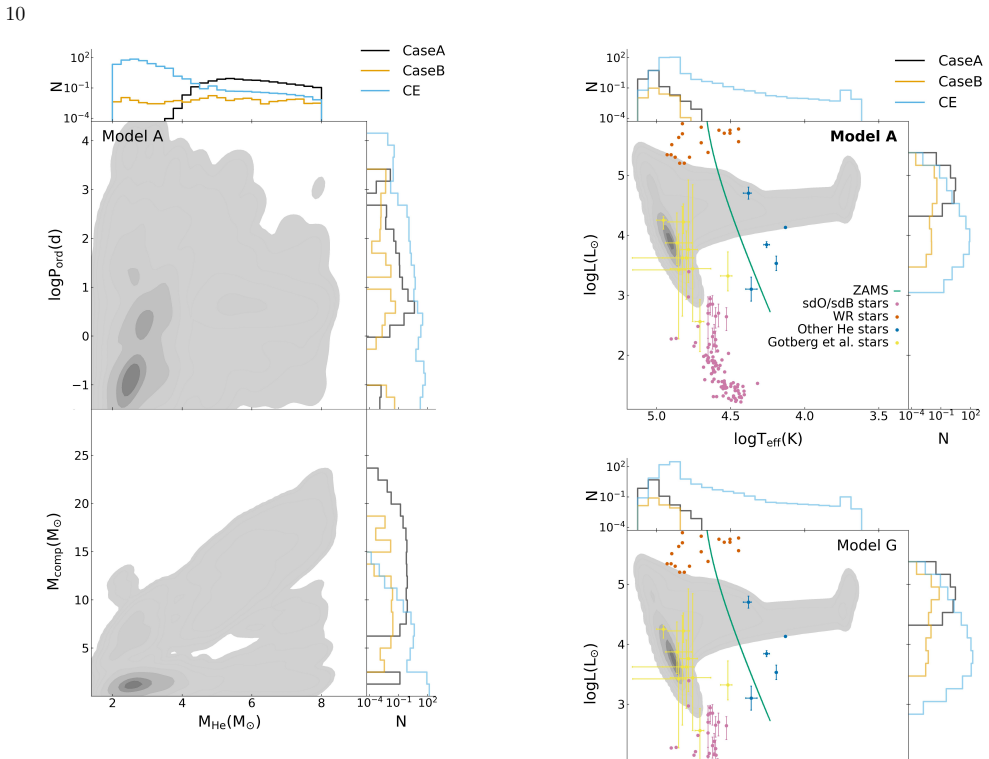


read the original abstract
Helium stars stripped of their hydrogen envelopes represent pivotal phases in binary evolution, yet their origins, particularly within the intermediate-mass range of $2-8\, M_{\odot}$, still remain poorly understood. This population bridges the gap between low-mass hot subdwarfs and massive Wolf-Rayet stars, but has remained largely unobserved. In this study, we employ binary population synthesis to systematically investigate the formation and properties of intermediate-mass helium stars (IMHeS) across various galactic metallicities. Our results indicate that metallicity and common-envelope ejection efficiency are the dominant factors shaping the IMHeS population. We estimate that several thousand IMHeS exist in the Milky Way, with several hundred more in the Magellanic Clouds. The vast majority of IMHeS reside in binaries, with fewer than $10\%$ appearing as single stars. Among IMHeS binaries, $\gtrsim 50\%$ are expected to have main-sequence companions, and the remainder host compact companions (including helium stars, white dwarfs, neutron stars, or black holes). The former systems form mainly through stable mass transfer, whereas the latter arise predominantly from common envelope evolution. Our work provides quantitative predictions for the populations of these elusive stars formed through binary interactions and offers guidance for future observational searches.
Editorial analysis
A structured set of objections, weighed in public.
Referee Report
Summary. The paper employs binary population synthesis to investigate the formation channels and galactic populations of intermediate-mass helium stars (IMHeS) in the 2–8 M⊙ range. It identifies metallicity and common-envelope ejection efficiency as the dominant parameters, estimates several thousand IMHeS in the Milky Way and several hundred in the Magellanic Clouds, and reports that the vast majority (>90%) reside in binaries, with ≥50% having main-sequence companions and the rest hosting compact objects; stable mass transfer and common-envelope evolution are the respective formation routes.
Significance. If the quantitative population estimates and binary fractions hold after validation, the work would supply useful order-of-magnitude predictions for an observationally elusive transitional population, thereby guiding targeted searches in the Milky Way and Magellanic Clouds and highlighting the role of binary interactions between the hot-subdwarf and Wolf-Rayet regimes. The explicit separation of formation channels by companion type is a constructive element.
major comments (2)
- [Abstract and Results] The population estimates (several thousand IMHeS in the Milky Way, <10% single) and the binary-companion breakdown rest on standard BPS prescriptions for mass-transfer stability and common-envelope ejection whose calibration is not demonstrated for the 2–8 M⊙ regime. Because the abstract itself states that common-envelope ejection efficiency is a dominant factor, the lack of a dedicated sensitivity study or comparison to observed systems in this mass range makes the headline numbers sensitive to untested assumptions about envelope binding energy and thermal response.
- [Methods and Results] No specific parameter grids, adopted values of α_CE, or error estimates on the birth rates are supplied, preventing assessment of whether the quoted numbers are robust predictions or largely set by the choice of the free parameter identified as dominant.
minor comments (2)
- [Abstract] The abstract would be clearer if it named the binary population synthesis code and briefly indicated the range of metallicities explored.
- Notation for solar masses is inconsistent in the provided text (M_⊙ vs. M⊙); a uniform style should be adopted throughout.
Simulated Author's Rebuttal
We thank the referee for the constructive and detailed comments. We address each major comment below and will revise the manuscript to improve the presentation of our methods and the robustness of the reported population estimates.
read point-by-point responses
-
Referee: [Abstract and Results] The population estimates (several thousand IMHeS in the Milky Way, <10% single) and the binary-companion breakdown rest on standard BPS prescriptions for mass-transfer stability and common-envelope ejection whose calibration is not demonstrated for the 2–8 M⊙ regime. Because the abstract itself states that common-envelope ejection efficiency is a dominant factor, the lack of a dedicated sensitivity study or comparison to observed systems in this mass range makes the headline numbers sensitive to untested assumptions about envelope binding energy and thermal response.
Authors: We agree that the headline population numbers are sensitive to the choice of BPS prescriptions, particularly for common-envelope ejection in the intermediate-mass regime. While our explorations across metallicities already indicated that CE efficiency is a dominant parameter, the current manuscript does not include an explicit sensitivity study or tabulated comparisons to observed systems. In the revised version we will add a dedicated subsection (or appendix) presenting results for a range of α_CE values, discuss the adopted envelope binding-energy prescriptions, and note any relevant observational constraints available for this mass range. revision: yes
-
Referee: [Methods and Results] No specific parameter grids, adopted values of α_CE, or error estimates on the birth rates are supplied, preventing assessment of whether the quoted numbers are robust predictions or largely set by the choice of the free parameter identified as dominant.
Authors: We acknowledge that the manuscript does not supply the detailed parameter grids or adopted α_CE values used in the population synthesis runs. In the revision we will include a table or section listing the initial parameter ranges, the specific α_CE values explored, and quantitative estimates (or ranges) for the birth rates that reflect the variation with the dominant parameters. revision: yes
Circularity Check
No significant circularity in derivation chain
full rationale
The paper applies binary population synthesis as a forward-modeling framework to explore IMHeS formation channels, identifying metallicity and common-envelope ejection efficiency as dominant parameters through variation in the simulations. The quoted population estimates (several thousand in the Milky Way) are presented as direct outputs of this computational synthesis rather than quantities fitted to the target population itself or defined in terms of the results. No self-citations, ansatzes, or uniqueness theorems are invoked in the abstract that would reduce the central claims to prior author work or to the inputs by construction. The derivation remains self-contained as standard BPS modeling with stated assumptions.
Axiom & Free-Parameter Ledger
free parameters (1)
- common-envelope ejection efficiency
axioms (1)
- domain assumption Standard binary population synthesis prescriptions for mass transfer and common-envelope evolution apply to the 2-8 solar mass range.
Reference graph
Works this paper leans on
-
[1]
G., Abbott, R., Abouelfettouh, I., et al
Abac, A. G., Abbott, R., Abouelfettouh, I., et al. 2024, Observation of Gravitational Waves from the Coalescence of a 2.5–4.5 M ⊙ Compact Object and a Neutron Star, ApJL, 970, L34, doi: 10.3847/2041-8213/ad5beb
-
[2]
Belczynski, K., Bulik, T., Fryer, C. L., et al. 2010, On the Maximum Mass of Stellar Black Holes, ApJ, 714, 1217, doi: 10.1088/0004-637X/714/2/1217
-
[3]
Blomberg, L., El-Badry, K., Ludwig, B., Drout, M. R., & G¨ otberg, Y. 2026, Intermediate-mass Stripped Stars in the Magellanic Clouds: Forward Modeling the Observed Population Discovered Via UV Excess, PASP, 138, 024202, doi: 10.1088/1538-3873/ae3a19
-
[4]
Breddels, M. A., & Veljanoski, J. 2018, Vaex: big data exploration in the era of Gaia, A&A, 618, A13, doi: 10.1051/0004-6361/201732493
-
[5]
Brown, G. E. 1995, Neutron Star Accretion and Binary Pulsar Formation, ApJ, 440, 270, doi: 10.1086/175268
-
[6]
Crowther, P. A. 2007, Physical Properties of Wolf-Rayet
work page 2007
-
[7]
Stars, Annual Review of Astronomy and Astrophysics, 45, 177, doi: 10.1146/annurev.astro.45.051806.110615
-
[8]
2022, A Study of Magnetized White Dwarf + Helium Star Binary Evolution to Type Ia
Cui, Z., & Li, X.-D. 2022, A Study of Magnetized White Dwarf + Helium Star Binary Evolution to Type Ia
work page 2022
-
[9]
Supernovae, Research in Astronomy and Astrophysics, 22, 025001, doi: 10.1088/1674-4527/ac3744
-
[10]
2022, The population of hot subdwarf stars studied with Gaia
Culpan, R., Geier, S., Reindl, N., et al. 2022, The population of hot subdwarf stars studied with Gaia. IV. Catalogues of hot subluminous stars based on Gaia EDR3, A&A, 662, A40, doi: 10.1051/0004-6361/202243337
-
[11]
Davis, P. J., Kolb, U., & Willems, B. 2010, A comprehensive population synthesis study of post-common envelope binaries, MNRAS, 403, 179, doi: 10.1111/j.1365-2966.2009.16138.x
-
[12]
De, K., Kasliwal, M. M., Ofek, E. O., et al. 2018, A hot and fast ultra-stripped supernova that likely formed a compact neutron star binary, Science, 362, 201, doi: 10.1126/science.aas8693
-
[13]
Deng, Z.-L., Li, X.-D., Shao, Y., & Xu, K. 2024, On the Formation of Double Neutron Stars in the Milky Way: Influence of Key Parameters, ApJ, 963, 80, doi: 10.3847/1538-4357/ad2357 14
-
[14]
Dionne, D., & Robert, C. 2006, Evolutionary Synthesis Models of Young Star-forming Regions: The Influence of Binary Stars, ApJ, 641, 252, doi: 10.1086/500380
-
[15]
Doughty, C., & Finlator, K. 2021, The effects of binary stars on galaxies and metal-enriched gas during reionization, MNRAS, 505, 2207, doi: 10.1093/mnras/stab1448
-
[16]
Drout, M. R., G¨ otberg, Y., Ludwig, B. A., et al. 2023, An observed population of intermediate-mass helium stars that have been stripped in binaries, Science, 382, 1287, doi: 10.1126/science.ade4970
-
[17]
Dutta, D., & Klencki, J. 2024, Evolutionary nature of puffed-up stripped star binaries and their occurrence in stellar populations, A&A, 687, A215, doi: 10.1051/0004-6361/202349065
-
[18]
Ercolino, A., Jin, H., Langer, N., et al. 2026, The demographics of core-collapse supernovae: The role of binary evolution and interaction with the circumstellar medium, A&A, 706, A169, doi: 10.1051/0004-6361/202557572
-
[19]
Fragos, T., Andrews, J. J., Ramirez-Ruiz, E., et al. 2019, The Complete Evolution of a Neutron-star Binary through a Common Envelope Phase Using 1D Hydrodynamic Simulations, ApJL, 883, L45, doi: 10.3847/2041-8213/ab40d1
-
[20]
L., Belczynski, K., Wiktorowicz, G., et al
Fryer, C. L., Belczynski, K., Wiktorowicz, G., et al. 2012, Compact Remnant Mass Function: Dependence on the Explosion Mechanism and Metallicity, ApJ, 749, 91, doi: 10.1088/0004-637X/749/1/91
-
[21]
2020, The population of hot subdwarf stars studied with Gaia
Geier, S. 2020, The population of hot subdwarf stars studied with Gaia. III. Catalogue of known hot subdwarf stars: Data Release 2, A&A, 635, A193, doi: 10.1051/0004-6361/202037526
-
[22]
Gilkis, A., & Shenar, T. 2023, Ups!... I did it again: unveiling the hidden companion in Upsilon Sagittarii, a unique binary system at a second mass transfer stage, MNRAS, 518, 3541, doi: 10.1093/mnras/stac3375 G¨ otberg, Y., de Mink, S. E., Groh, J. H., et al. 2018, Spectral models for binary products: Unifying subdwarfs and Wolf-Rayet stars as a sequenc...
-
[23]
Guo, Y.-L., Wang, B., Chen, W.-C., et al. 2024, Electron-capture supernovae in NS + He star systems and the double neutron star systems, MNRAS, 530, 4461, doi: 10.1093/mnras/stae1112
-
[24]
2014, The Wolf-Rayet stars in the Large Magellanic Cloud
Hainich, R., R¨ uhling, U., Todt, H., et al. 2014, The Wolf-Rayet stars in the Large Magellanic Cloud. A comprehensive analysis of the WN class, A&A, 565, A27, doi: 10.1051/0004-6361/201322696
-
[25]
Han, Z., Podsiadlowski, P., Maxted, P. F. L., Marsh, T. R., & Ivanova, N. 2002, The origin of subdwarf B stars - I. The formation channels, MNRAS, 336, 449, doi: 10.1046/j.1365-8711.2002.05752.x
-
[26]
R.et al.Array programming with NumPy.Nature585, 357–362, 10.1038/s41586-020-2649-2 (2020)
Harris, C. R., Millman, K. J., van der Walt, S. J., et al. 2020, Array programming with NumPy, Nature, 585, 357, doi: 10.1038/s41586-020-2649-2
-
[27]
Harris, J., & Zaritsky, D. 2009, The Star Formation History of the Large Magellanic Cloud, AJ, 138, 1243, doi: 10.1088/0004-6256/138/5/1243
-
[28]
2009, Hot Subdwarf Stars, ARA&A, 47, 211, doi: 10.1146/annurev-astro-082708-101836
Heber, U. 2009, Hot Subdwarf Stars, ARA&A, 47, 211, doi: 10.1146/annurev-astro-082708-101836
-
[29]
Hovis-Afflerbach, B., G¨ otberg, Y., Schootemeijer, A., et al. 2025, The mass distribution of stars stripped in binaries: The effect of metallicity, A&A, 697, A239, doi: 10.1051/0004-6361/202453185
-
[30]
Hunter, J. D. 2007, Matplotlib: A 2D Graphics
work page 2007
-
[31]
Environment, Computing in Science and Engineering, 9, 90, doi: 10.1109/MCSE.2007.55
-
[32]
Hurley, J. R., Tout, C. A., & Pols, O. R. 2002, Evolution of binary stars and the effect of tides on binary populations, Monthly Notices of the Royal Astronomical Society, 329, 897, doi: 10.1046/j.1365-8711.2002.05038.x
-
[33]
Irrgang, A., Przybilla, N., & Meynet, G. 2022,γColumbae as a recently stripped pulsating core of a massive star, Nature Astronomy, 6, 1414, doi: 10.1038/s41550-022-01809-6
-
[34]
Kiel, P. D., & Hurley, J. R. 2006, Populating the Galaxy with low-mass X-ray binaries, MNRAS, 369, 1152, doi: 10.1111/j.1365-2966.2006.10400.x
-
[35]
Kroupa, P. 2001, On the variation of the initial mass function, MNRAS, 322, 231, doi: 10.1046/j.1365-8711.2001.04022.x
-
[36]
Kroupa, P., Tout, C. A., & Gilmore, G. 1993, The Distribution of Low-Mass Stars in the Galactic Disc, MNRAS, 262, 545, doi: 10.1093/mnras/262.3.545
-
[37]
Li, L., Wang, B., Liu, D., et al. 2024, Ultraluminous X-ray sources with He star companions, MNRAS, 534, 3400, doi: 10.1093/mnras/stae2322
-
[38]
Licquia, T. C., & Newman, J. A. 2015, Improved Estimates of the Milky Way’s Stellar Mass and Star Formation Rate from Hierarchical Bayesian Meta-Analysis, ApJ, 806, 96, doi: 10.1088/0004-637X/806/1/96 15
-
[39]
2005, Hot subdwarfs from the ESO Supernova Ia Progenitor Survey
Lisker, T., Heber, U., Napiwotzki, R., et al. 2005, Hot subdwarfs from the ESO Supernova Ia Progenitor Survey. I. Atmospheric parameters and cool companions of sdB stars, A&A, 430, 223, doi: 10.1051/0004-6361:20040232
-
[40]
Laroche, A. 2026, The Stripped-star Ultraviolet Magellanic Cloud Survey (SUMS): The Ultraviolet Photometric Catalog and Stripped-star Candidate
work page 2026
-
[41]
Selection, ApJ, 999, 73, doi: 10.3847/1538-4357/ae2d13
-
[42]
Mandel, I., & M¨ uller, B. 2020, Simple recipes for compact remnant masses and natal kicks, MNRAS, 499, 3214, doi: 10.1093/mnras/staa3043
-
[43]
McEvoy, C. M., Dufton, P. L., Evans, C. J., et al. 2015, The VLT-FLAMES Tarantula Survey. XIX. B-type supergiants: Atmospheric parameters and nitrogen abundances to investigate the role of binarity and the width of the main sequence, A&A, 575, A70, doi: 10.1051/0004-6361/201425202
-
[44]
Nie, Y.-D., Shao, Y., He, J.-G., et al. 2025, Modeling High Mass X-Ray Binaries to Double Neutron Stars through Common Envelope Evolution, ApJ, 979, 112, doi: 10.3847/1538-4357/ad9a65
-
[45]
Offner, S. S. R., Moe, M., Kratter, K. M., et al. 2023, in Astronomical Society of the Pacific Conference Series, Vol. 534, Protostars and Planets VII, ed. S. Inutsuka, Y. Aikawa, T. Muto, K. Tomida, & M. Tamura, 275, doi: 10.48550/arXiv.2203.10066
work page internal anchor Pith review Pith/arXiv arXiv doi:10.48550/arxiv.2203.10066 2023
-
[46]
Paxton, B., Bildsten, L., Dotter, A., et al. 2011, Modules for Experiments in Stellar Astrophysics (MESA), ApJS, 192, 3, doi: 10.1088/0067-0049/192/1/3
-
[47]
Podsiadlowski, P., Langer, N., Poelarends, A. J. T., et al. 2004, The Effects of Binary Evolution on the Dynamics of Core Collapse and Neutron Star Kicks, ApJ, 612, 1044, doi: 10.1086/421713
-
[48]
Poelarends, A. J. T., Wurtz, S., Tarka, J., Cole Adams, L., & Hills, S. T. 2017, Electron Capture Supernovae from Close Binary Systems, ApJ, 850, 197, doi: 10.3847/1538-4357/aa988a
-
[49]
Pols, O. R. 1994, Case A evolution of massive close binaries: formation of contact systems and possible reversal of the supernova order, A&A, 290, 119
work page 1994
-
[50]
Ramachandran, V., Klencki, J., Sander, A. A. C., et al. 2023, A partially stripped massive star in a Be binary at low metallicity. A missing link towards Be X-ray binaries and double neutron star mergers, A&A, 674, L12, doi: 10.1051/0004-6361/202346818
-
[51]
Rubele, S., Girardi, L., Kerber, L., et al. 2015, The VMC survey - XIV. First results on the look-back time star formation rate tomography of the Small Magellanic
work page 2015
-
[52]
Cloud, MNRAS, 449, 639, doi: 10.1093/mnras/stv141
-
[53]
Salpeter, E. E. 1955, The Luminosity Function and Stellar Evolution., ApJ, 121, 161, doi: 10.1086/145971 Sch¨ urmann, C., Xu, X.-T., Langer, N., et al. 2025, Populations of evolved massive binary stars in the Small Magellanic Cloud: II. Predictions from rapid binary evolution, A&A, 704, A219, doi: 10.1051/0004-6361/202554874
-
[54]
Sen, K., Olejak, A., & Banerjee, S. 2025, X-ray emission from helium star–black hole binaries as probes of tidally induced spin-up of second-born black holes, A&A, 696, A54, doi: 10.1051/0004-6361/202553829
-
[55]
Shao, Y. 2022, On the Neutron Star/Black Hole Mass Gap and Black Hole Searches, Research in Astronomy and Astrophysics, 22, 122002, doi: 10.1088/1674-4527/ac995e
-
[56]
Shao, Y., & Li, X.-D. 2014, On the Formation of Be Stars through Binary Interaction, ApJ, 796, 37, doi: 10.1088/0004-637X/796/1/37
-
[57]
Shao, Y., & Li, X.-D. 2020, Population Synthesis of Black Hole X-Ray Binaries, ApJ, 898, 143, doi: 10.3847/1538-4357/aba118
-
[58]
Shao, Y., & Li, X.-D. 2021, Population Synthesis of Galactic Be-star Binaries with a Helium-star Companion, ApJ, 908, 67, doi: 10.3847/1538-4357/abd2b4
-
[59]
Shao, Y., & Li, X.-D. 2021, Population Synthesis of Black Hole Binaries with Compact Star Companions, ApJ, 920, 81, doi: 10.3847/1538-4357/ac173e
-
[60]
Shao, Y., Li, X.-D., & Dai, Z.-G. 2019, A Population of Neutron Star Ultraluminous X-Ray Sources with a Helium Star Companion, ApJ, 886, 118, doi: 10.3847/1538-4357/ab4d50
-
[61]
2024, Wolf-Rayet stars, https://arxiv.org/abs/2410.04436
Shenar, T. 2024, Wolf-Rayet stars, https://arxiv.org/abs/2410.04436
-
[62]
Shenar, T., Bodensteiner, J., Abdul-Masih, M., et al. 2020, The “hidden” companion in LB-1 unveiled by spectral disentangling, A&A, 639, L6, doi: 10.1051/0004-6361/202038275
-
[63]
Shenar, T., Wade, G. A., Marchant, P., et al. 2023, A massive helium star with a sufficiently strong magnetic field to form a magnetar, Science, 381, 761, doi: 10.1126/science.ade3293
-
[64]
2007, Hot subdwarfs from the ESO supernova Ia progenitor survey
Stroeer, A., Heber, U., Lisker, T., et al. 2007, Hot subdwarfs from the ESO supernova Ia progenitor survey. II. Atmospheric parameters of subdwarf O stars, A&A, 462, 269, doi: 10.1051/0004-6361:20065564
-
[65]
M., Langer, N., & Podsiadlowski, P
Tauris, T. M., Langer, N., & Podsiadlowski, P. 2015, Ultra-stripped supernovae: progenitors and fate, MNRAS, 451, 2123, doi: 10.1093/mnras/stv990
-
[66]
Tauris, T. M., Kramer, M., Freire, P. C. C., et al. 2017, Formation of Double Neutron Star Systems, ApJ, 846, 170, doi: 10.3847/1538-4357/aa7e89 16 The pandas development Team. 2025, pandas-dev/pandas: Pandas,, v2.3.1 Zenodo, doi: 10.5281/zenodo.3509134
-
[67]
Vallenari, A., Brown, A. G. A., Prusti, T., et al. 2023, GaiaData Release 3: Summary of the content and survey properties, Astronomy &; Astrophysics, 674, A1, doi: 10.1051/0004-6361/202243940
-
[68]
Valli, R., de Mink, S. E., Justham, S., et al. 2025, Evidence of polar and ultralow supernova kicks from the orbits of Be X-ray binaries, arXiv e-prints, arXiv:2505.08857, doi: 10.48550/arXiv.2505.08857 Villase˜ nor, J. I., Lennon, D. J., Picco, A., et al. 2023, The B-type Binaries Characterisation Programme - II. VFTS 291: a stripped star from a recent m...
-
[69]
Vink, J. S. 2017, Winds from stripped low-mass helium stars and Wolf-Rayet stars, A&A, 607, L8, doi: 10.1051/0004-6361/201731902
-
[70]
Wang, B., Meng, X., Chen, X., & Han, Z. 2009, The helium star donor channel for the progenitors of Type Ia supernovae, MNRAS, 395, 847, doi: 10.1111/j.1365-2966.2009.14545.x
-
[71]
Wang, C., Jia, K., & Li, X.-D. 2016, The binding energy parameter for common envelope evolution, Research in Astronomy and Astrophysics, 16, 126, doi: 10.1088/1674-4527/16/8/126
-
[72]
Wang, C., Bodensteiner, J., Xu, X.-T., et al. 2024, Stripped Helium Star and Compact Object Binaries in Coeval Populations: Predictions Based on Detailed Binary Evolution Models, ApJL, 975, L20, doi: 10.3847/2041-8213/ad86b7
-
[73]
Wang, G.-Y., Shao, Y., He, J.-G., Xu, X.-J., & Li, X.-D. 2024, IC 10 X-1: A Double Black Hole Progenitor Probably Formed through Stable Mass Transfer, ApJ, 974, 184, doi: 10.3847/1538-4357/ad701a
-
[74]
Wang, S., Zhao, X., Feng, F., et al. 2024, A potential mass-gap black hole in a wide binary with a circular orbit, Nature Astronomy, 8, 1583, doi: 10.1038/s41550-024-02359-9
-
[75]
2023, mwaskom/seaborn: v0.13.0 (September 2023),, v0.13.0 Zenodo, doi: 10.5281/zenodo.592845
Waskom, M., Gelbart, M., Botvinnik, O., et al. 2023, mwaskom/seaborn: v0.13.0 (September 2023),, v0.13.0 Zenodo, doi: 10.5281/zenodo.592845
-
[76]
Webbink, R. F. 1984, Double white dwarfs as progenitors of R Coronae Borealis stars and type I supernovae., ApJ, 277, 355, doi: 10.1086/161701
-
[77]
2010, ON THE BINDING ENERGY PARAMETERλOF COMMON ENVELOPE
Xu, X.-J., & Li, X.-D. 2010, ON THE BINDING ENERGY PARAMETERλOF COMMON ENVELOPE
work page 2010
-
[78]
EVOLUTION, The Astrophysical Journal, 716, 114, doi: 10.1088/0004-637X/716/1/114
-
[79]
2025, Populations of evolved massive binary stars in the Small Magellanic Cloud: I
Xu, X.-T., Sch¨ urmann, C., Langer, N., et al. 2025, Populations of evolved massive binary stars in the Small Magellanic Cloud: I. Predictions from detailed evolution models, A&A, 704, A218, doi: 10.1051/0004-6361/202554786
-
[80]
2024, Elusive hot stripped helium stars in the Galaxy
Yungelson, L., Kuranov, A., Postnov, K., et al. 2024, Elusive hot stripped helium stars in the Galaxy. I. Evolutionary stellar models in the gap between subdwarfs and Wolf-Rayet stars, A&A, 683, A37, doi: 10.1051/0004-6361/202347806
discussion (0)
Sign in with ORCID, Apple, or X to comment. Anyone can read and Pith papers without signing in.