A fast tree algorithm for multi-component coagulation equation
Pith reviewed 2026-05-19 23:41 UTC · model grok-4.3
pith:NQWMDLRV Add to your LaTeX paper
What is a Pith Number?\usepackage{pith}
\pithnumber{NQWMDLRV}
Prints a linked pith:NQWMDLRV badge after your title and writes the identifier into PDF metadata. Compiles on arXiv with no extra files. Learn more
The pith
A tree algorithm groups similar dust aggregates to cut multi-component coagulation costs from quadratic to near-linear scaling while matching direct-method results.
A machine-rendered reading of the paper's core claim, the machinery that carries it, and where it could break.
Core claim
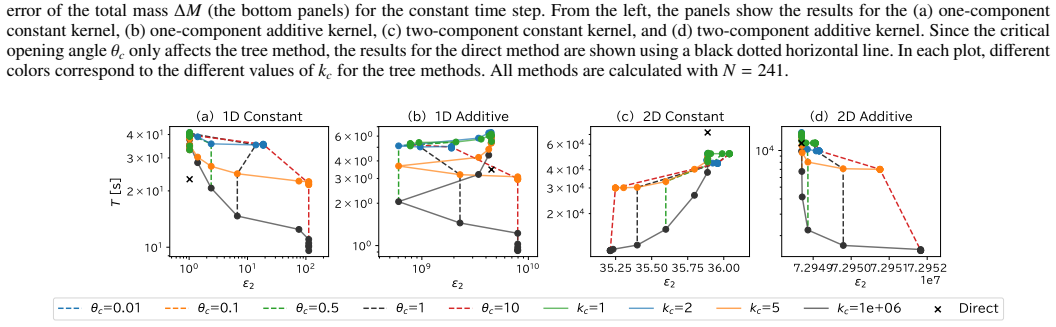
The central claim is that the similarity assumption in log-property space permits a tree algorithm to approximate the full coagulation equation by grouping and collectively evaluating interactions among distant bins. The resulting method reproduces the outcomes of the conventional direct summation method on test problems with analytic solutions, while lowering computational complexity from O(N^{2d}) to O(d N^d log N). Measured wall-clock time, L2 distribution error, and mass conservation error all respond predictably to changes in the number of bins, the opening angle, and the maximum distribution width after coagulation.
What carries the argument
The tree algorithm that groups distant bins according to logarithmic distance in multi-dimensional dust-property space and evaluates their collective coagulation interactions.
If this is right
- For one property the tree method becomes faster than direct summation only inside a limited range of parameters.
- For two properties the tree method is faster across every surveyed parameter combination and accelerates the calculation by tens of times.
- Raising the number of bins or tightening the opening angle or width parameter increases accuracy at the cost of speed.
- A small maximum distribution width after coagulation actually increases error relative to a larger width, indicating that the limit need not be imposed.
Where Pith is reading between the lines
- The approach could be inserted into longer planet-formation simulations that evolve dust porosity alongside mass.
- The same grouping logic might reduce cost in other multi-dimensional aggregation problems that currently rely on direct pairwise summation.
- Adding further dust properties such as charge or composition becomes feasible without an immediate explosion in runtime.
Load-bearing premise
Two pairs of colliding aggregates produce a similar outcome whenever their dust properties are close in logarithmic ratio space.
What would settle it
Run the tree algorithm and the direct method on the same two-component coagulation problem that has a known analytic solution; if the L2 error in the final distribution exceeds the values reported for the chosen opening angle and width parameter, the approximation fails.
Figures



read the original abstract
Dust properties, such as mass and porosity, impact planet formation directly. Understanding the time evolution of dust distribution across multiple properties requires numerical computation. However, available ways to calculate the multi-component coagulation-fragmentation are highly time-consuming. This study aims to develop a fast and accurate algorithm for multi-component coagulation. We assumed that two pairs of colliding aggregates reproduce a similar outcome if the dust properties are similar, and that the ratio of dust properties in logarithmic space gives the similarity as a "distance". These assumptions enable us to apply the tree algorithm, which groups distant bins and calculates interactions together, to coagulation. The algorithm reduces the computational complexity from $O (N^{2d})$ to $O (d N^d \log N)$, considering $N$ bins per $d$ components. We tested the algorithm by comparing it with the conventional direct method for cases where analytic solutions are known. We measured the dependencies of the wall-clock time, $L_2$ error in the distribution, and relative error of the total mass, on the $d, N$, opening angle $\theta_c$, and maximum dust distribution width after coagulation $k_c$. The algorithms are found to calculate coagulation consistently. For $d=1$, the tree method is faster than the direct method for a specific range of parameters. For $d=2$, however, the tree method is faster for all parameter regions surveyed, speeding it up by tens of times. Increasing $N$ and decreasing $\theta_c$ or $k_c$ made it slower and more accurate. Additionally, using a small $k_c$ performs worse than when using a large $k_c$, suggesting that limiting $k_c$ is unnecessary. We present a fast tree algorithm for the multi-component coagulation equation. It will enable us to evolve the multi-component dust distribution, such as in mass-porosity space, in protoplanetary disks.
Editorial analysis
A structured set of objections, weighed in public.
Referee Report
Summary. The manuscript presents a tree-based algorithm for the multi-component coagulation equation that groups collision interactions using a logarithmic-space similarity distance between dust properties. This yields a claimed complexity reduction from O(N^{2d}) to O(d N^d log N) for N bins per dimension d. The method is validated by direct comparison to analytic solutions and the conventional summation method, with reported measurements of L2 distribution error, total-mass conservation error, and wall-clock time as functions of d, N, opening angle θ_c, and maximum distribution width k_c. Results indicate consistency with the direct method, with speedups for d=2 across surveyed parameters and accuracy-speed trade-offs when varying θ_c and k_c.
Significance. If the reported accuracy and scaling hold under the stated similarity assumption, the algorithm would remove a major computational barrier to evolving dust distributions in multiple properties (e.g., mass and porosity) within protoplanetary-disk models. The explicit benchmarking against known analytic cases and the direct method, together with the parameter sweeps, supplies a reproducible basis for adoption; the observed tens-of-times speedup at d=2 is particularly enabling for higher-dimensional coagulation-fragmentation studies.
major comments (2)
- [§3] §3 (Algorithm Description): The central complexity claim O(d N^d log N) follows from the tree-grouping construction once the log-space similarity metric is accepted, but the manuscript does not quantify the overhead of distance calculations or the fraction of bins that remain ungrouped for realistic k_c values; a short scaling plot versus N for fixed d would strengthen the claim.
- [§4.3] §4.3 (Numerical Tests, d=2 results): The statement that the tree method is faster “for all parameter regions surveyed” is load-bearing for the practical utility claim, yet the text does not tabulate the exact wall-clock ratios or the L2-error values at the largest N and smallest θ_c; inclusion of these numbers (or an additional table) is needed to confirm the reported consistency does not degrade at the high-accuracy end of the parameter space.
minor comments (3)
- [Abstract] Abstract and §2: The phrase “maximum dust distribution width after coagulation k_c” is used without an explicit definition or formula; a one-sentence clarification of how k_c is computed from the post-coagulation distribution would remove ambiguity.
- [Figures] Figure captions (throughout): Several panels lack explicit labels for the direct-method reference curves; adding “solid lines: direct method” or equivalent would improve readability.
- [§5] §5 (Conclusions): The final sentence states the algorithm “will enable” multi-component evolution but does not mention the remaining free parameters (θ_c, k_c); a brief caveat on the accuracy-speed trade-off would be proportionate.
Simulated Author's Rebuttal
We thank the referee for the positive evaluation and the recommendation of minor revision. The two major comments identify specific places where additional quantitative detail would strengthen the presentation of the algorithm's complexity and performance; we address each below and will revise the manuscript accordingly.
read point-by-point responses
-
Referee: [§3] §3 (Algorithm Description): The central complexity claim O(d N^d log N) follows from the tree-grouping construction once the log-space similarity metric is accepted, but the manuscript does not quantify the overhead of distance calculations or the fraction of bins that remain ungrouped for realistic k_c values; a short scaling plot versus N for fixed d would strengthen the claim.
Authors: We agree that a direct demonstration of the scaling and an indication of grouping efficiency would make the complexity claim more robust. In the revised manuscript we will add a short log-log plot of wall-clock time versus N for fixed d=1 and d=2 (with the same k_c and θ_c used in the main tests) together with a brief paragraph quantifying the relative cost of the distance calculations and the typical fraction of bins that remain ungrouped at the k_c values employed. revision: yes
-
Referee: [§4.3] §4.3 (Numerical Tests, d=2 results): The statement that the tree method is faster “for all parameter regions surveyed” is load-bearing for the practical utility claim, yet the text does not tabulate the exact wall-clock ratios or the L2-error values at the largest N and smallest θ_c; inclusion of these numbers (or an additional table) is needed to confirm the reported consistency does not degrade at the high-accuracy end of the parameter space.
Authors: We accept that explicit numerical values at the high-accuracy corner of parameter space would remove any ambiguity. We will insert a compact table (or augmented text) reporting the exact wall-clock time ratios and L2 errors for d=2 at the largest N and smallest θ_c examined, confirming that consistency with the direct method is maintained while the speedup remains present. revision: yes
Circularity Check
No circularity in derivation chain
full rationale
The paper states an explicit similarity assumption (log-space distance between dust properties) that enables grouping in a tree algorithm for multi-component coagulation. The complexity claim O(N^{2d}) to O(d N^d log N) follows as a standard consequence of tree-based interaction grouping once that criterion is adopted; it is not obtained by re-expressing the input assumption or by fitting parameters that are then relabeled as predictions. Validation consists of direct numerical comparisons against the conventional method on analytic-solution test cases, measuring L2 error, mass conservation, and wall-clock time as functions of d, N, θ_c, and k_c. No load-bearing self-citations, uniqueness theorems, or ansatzes smuggled via prior work are invoked. The derivation is therefore self-contained and non-circular.
Axiom & Free-Parameter Ledger
free parameters (4)
- opening angle theta_c
- maximum dust distribution width k_c
- N
- d
axioms (2)
- domain assumption Two pairs of colliding aggregates reproduce a similar outcome if the dust properties are similar.
- domain assumption The ratio of dust properties in logarithmic space gives the similarity as a distance.
Lean theorems connected to this paper
-
IndisputableMonolith/Cost/FunctionalEquation.leanwashburn_uniqueness_aczel echoes?
echoesECHOES: this paper passage has the same mathematical shape or conceptual pattern as the Recognition theorem, but is not a direct formal dependency.
We assumed that two pairs of colliding aggregates reproduce a similar outcome if the dust properties are similar, and that the ratio of dust properties in logarithmic space gives the similarity as a 'distance'.
-
IndisputableMonolith/Foundation/ArithmeticFromLogic.leanembed_eq_pow echoes?
echoesECHOES: this paper passage has the same mathematical shape or conceptual pattern as the Recognition theorem, but is not a direct formal dependency.
The 'distance' between two dust property vectors X1 and X2 in the dust property space with logarithmic axes using the L2 norm, i.e., ||X1 − X2|| = sqrt(∑(log10 Xp1 − log10 Xp2)²).
What do these tags mean?
- matches
- The paper's claim is directly supported by a theorem in the formal canon.
- supports
- The theorem supports part of the paper's argument, but the paper may add assumptions or extra steps.
- extends
- The paper goes beyond the formal theorem; the theorem is a base layer rather than the whole result.
- uses
- The paper appears to rely on the theorem as machinery.
- contradicts
- The paper's claim conflicts with a theorem or certificate in the canon.
- unclear
- Pith found a possible connection, but the passage is too broad, indirect, or ambiguous to say the theorem truly supports the claim.
Reference graph
Works this paper leans on
-
[1]
Brogan, C. L. and P. The 2014. ApJL , volume =. doi:10.1088/2041-8205/808/1/L3 , url =
-
[2]
Challenges in Planet Formation , author =. J. Geophys. Res. Planets , volume =. doi:10.1002/2016JE005088 , url =
-
[3]
doi:10.3847/1538-4357/ac7d58 , url =
Stammler, Sebastian Markus and Birnstiel, Tilman , year = 2022, month = aug, journal =. doi:10.3847/1538-4357/ac7d58 , url =. arXiv , keywords =:2207.00322 , primaryclass =
-
[4]
Rapid Coagulation of Porous Dust Aggregates Outside the Snow Line:
Okuzumi, Satoshi and Tanaka, Hidekazu and Kobayashi, Hiroshi and Wada, Koji , year = 2012, journal =. Rapid Coagulation of Porous Dust Aggregates Outside the Snow Line:. doi:10.1088/0004-637X/752/2/106 , url =
-
[5]
Fluffy Dust Forms Icy Planetesimals by Static Compression , author =. A&A , volume =. doi:10.1051/0004-6361/201322151 , url =
-
[6]
Adachi, Isao and Hayashi, Chushiro and Nakazawa, Kiyoshi , year = 1976, month = dec, journal =. The. doi:10.1143/PTP.56.1756 , url =
-
[7]
Aerodynamics of Solid Bodies in the Solar Nebula , author =. MNRAS , volume =. doi:10.1093/mnras/180.2.57 , url =
-
[8]
Coagulation, Fragmentation and Radial Motion of Solid Particles in Protoplanetary Disks , author =. A&A , volume =. doi:10.1051/0004-6361:20077759 , url =
-
[9]
Lee, Man Hoi , year = 2000, month = jan, journal =. On the. doi:10.1006/icar.1999.6239 , url =
-
[10]
Youdin, Andrew N. and Goodman, Jeremy , year = 2005, month = feb, journal =. Streaming. doi:10.1086/426895 , url =
-
[11]
Gas- and Dust Evolution in Protoplanetary Disks , author =. A&A , volume =. doi:10.1051/0004-6361/200913731 , url =
-
[12]
Okuzumi, Satoshi and Tanaka, Hidekazu and Sakagami, Masa-aki , year = 2009, month = feb, journal =. Numerical. doi:10.1088/0004-637X/707/2/1247 , url =
-
[13]
and Silsbee, Kedron and Booth, Richard A
Rafikov, Roman R. and Silsbee, Kedron and Booth, Richard A. , year = 2020, month = apr, journal =. A. doi:10.3847/1538-4365/ab7b71 , url =
-
[14]
Zhang, Shangjia and Zhu, Zhaohuan and Ueda, Takahiro and Kataoka, Akimasa and Sierra, Anibal and. Porous. ApJ , volume =. doi:10.3847/1538-4357/acdb4e , url =
-
[15]
, year = 1993, month = dec, journal =
Ossenkopf, V. , year = 1993, month = dec, journal =. Dust Coagulation in Dense Molecular Clouds : The Formation of Fluffy Aggregates. , shorttitle =
work page 1993
-
[16]
Ormel, C. W. and Spaans, M. and Tielens, A. G. G. M. , year = 2007, month = jan, journal =. Dust Coagulation in Protoplanetary Disks: Porosity Matters , shorttitle =. doi:10.1051/0004-6361:20065949 , url =
-
[17]
Hayashi, Chushiro , year = 1981, month = jan, journal =. Structure of the. doi:10.1143/PTPS.70.35 , url =
-
[18]
Ice Lines, Planetesimal Composition and Solid Surface Density in the Solar Nebula , author =. Icarus , volume =. doi:10.1016/j.icarus.2008.11.023 , url =
-
[19]
The Evolution of the Water Distribution in a Viscous Protoplanetary Disk , author =. Icarus , volume =. doi:10.1016/j.icarus.2005.11.009 , url =
-
[20]
Evolution of the Protoplanetary Cloud and Formation of the Earth and Planets. , author =. Evolution of the protoplanetary cloud and formation of the earth and planets , publisher =
-
[21]
, year = 1973, month = aug, journal =
Goldreich, Peter and Ward, William R. , year = 1973, month = aug, journal =. The. doi:10.1086/152291 , url =
-
[22]
Sekiya, Minoru , year = 1998, month = jun, journal =. Quasi-. doi:10.1006/icar.1998.5933 , url =
-
[23]
Rapid Planetesimal Formation in Turbulent Circumstellar Disks , author =. Nat , volume =. doi:10.1038/nature06086 , url =
-
[24]
Barnes, Josh and Hut, Piet , year = 1986, month = dec, journal =. A Hierarchical. doi:10.1038/324446a0 , url =
-
[25]
Wada, Koji and Tanaka, Hidekazu and Suyama, Toru and Kimura, Hiroshi and Yamamoto, Tetsuo , year = 2009, month = sep, journal =. Collisional. doi:10.1088/0004-637X/702/2/1490 , url =
-
[26]
Tanaka, Hidekazu and Anayama, Ryoichi and Tazaki, Ryo , year = 2023, month = mar, journal =. Compression of. doi:10.3847/1538-4357/acb92b , url =
-
[27]
Drei Vortrage Uber Diffusion, Brownsche Molekularbewegung Und Koagulation von Kolloidteilchen , author =. Z Phys. , volume =
- [28]
-
[29]
and Tanaka, Hidekazu and Kobayashi, Hiroshi and Wada, Koji , year = 2021, month = jun, journal =
Hasegawa, Yukihiko and Suzuki, Takeru K. and Tanaka, Hidekazu and Kobayashi, Hiroshi and Wada, Koji , year = 2021, month = jun, journal =. Collisional. doi:10.3847/1538-4357/abf6cf , url =
-
[30]
Zsom, A. and Ormel, C. W. and G. The Outcome of Protoplanetary Dust Growth: Pebbles, Boulders, or Planetesimals? -. A&A , volume =. doi:10.1051/0004-6361/200912976 , url =
-
[31]
Blum, J. The. ARA&A , volume =. doi:10.1146/annurev.astro.46.060407.145152 , url =
-
[32]
Kinetics of Polymerization , author =. J. Stat. Phys. , volume =. doi:10.1007/BF01012594 , url =
-
[33]
Xu, Zuwei and Zhao, Haibo and Zheng, Chuguang , year = 2014, month = aug, journal =. Fast. doi:10.1016/j.jaerosci.2014.03.006 , url =
-
[34]
Matveev, Sergey A. and Zheltkov, Dmitry A. and Tyrtyshnikov, Eugene E. and Smirnov, Alexander P. , year = 2016, month = jul, journal =. Tensor Train versus. doi:10.1016/j.jcp.2016.04.025 , url =
-
[35]
Smirnov, Alexander P. and Matveev, Sergey A. and Zheltkov, Dmitry A. and Tyrtyshnikov, Euegene E. , year = 2016, month = jan, journal =. Fast and. doi:10.1016/j.procs.2016.05.533 , url =
-
[36]
Estrada, P. R. and Cuzzi, J. N. , year = 2008, month = jul, journal =. Solving the. doi:10.1086/589685 , url =
-
[37]
Banzatti, Andrea and Pontoppidan, Klaus M. and Carr, John S. and Jellison, Evan and Pascucci, Ilaria and Najita, Joan R. and. ApJL , volume =. doi:10.3847/2041-8213/acf5ec , url =
-
[38]
2012, A&A, 544, A32, doi: 10.1051/0004-6361/201219127
Rapid Growth of Gas-Giant Cores by Pebble Accretion , author =. A&A , volume =. doi:10.1051/0004-6361/201219127 , url =
-
[39]
Johansen, Anders and Lambrechts, Michiel , year = 2017, month = aug, journal =. Forming. doi:10.1146/annurev-earth-063016-020226 , url =
-
[40]
Youdin, Andrew N. and Shu, Frank H. , year = 2002, month = jan, journal =. Planetesimal. doi:10.1086/343109 , url =
-
[41]
doi:10.1088/0004-637X/731/2/95 , url =
Okuzumi, Satoshi and Tanaka, Hidekazu and Takeuchi, Taku and Sakagami, Masa-aki , year = 2011, month = mar, journal =. doi:10.1088/0004-637X/731/2/95 , url =
-
[42]
Krijt, Sebastiaan and Schwarz, Kamber R. and Bergin, Edwin A. and Ciesla, Fred J. , year = 2018, month = aug, journal =. Transport of. doi:10.3847/1538-4357/aad69b , url =
-
[43]
Trapping Dust Particles in the Outer Regions of Protoplanetary Disks , author =. A&A , volume =. doi:10.1051/0004-6361/201118204 , url =
-
[44]
, year = 2022, month = jan, journal =
Jiang, Haochang and Zhu, Wei and Ormel, Chris W. , year = 2022, month = jan, journal =. No. doi:10.3847/2041-8213/ac46fe , url =
-
[45]
doi:10.1088/0004-637X/737/1/36 , url =
Wada, Koji and Tanaka, Hidekazu and Suyama, Toru and Kimura, Hiroshi and Yamamoto, Tetsuo , year = 2011, month = jul, journal =. doi:10.1088/0004-637X/737/1/36 , url =
-
[46]
Evolutionary Description of Giant Molecular Cloud Mass Functions on Galactic Disks , author =. ApJ , volume =. doi:10.3847/1538-4357/836/2/175 , url =
-
[47]
On the Water Delivery to Terrestrial Embryos by Ice Pebble Accretion , author =. A&A , volume =. doi:10.1051/0004-6361/201527069 , url =
-
[48]
A Statistical Model for the Initial Stellar Mass Function , author =. ApJ , volume =. doi:10.1086/156949 , url =
-
[49]
Comparison of Analytical and Physical Modeling of Planetesimal Accumulation , author =. Icarus , volume =. doi:10.1016/0019-1035(90)90086-O , url =
-
[50]
Artificial Acceleration in Accumulation Due to Coarse Mass-Coordinate Divisions in Numerical Simulation , author =. Icarus , volume =. doi:10.1016/0019-1035(90)90015-2 , url =
-
[51]
Numerical Simulation of Dust Aggregate Collisions
Wada, Koji and Tanaka, Hidekazu and Suyama, Toru and Kimura, Hiroshi and Yamamoto, Tetsuo , year = 2008, journal =. Numerical Simulation of Dust Aggregate Collisions. doi:10.1086/529511 , url =
-
[52]
Okuzumi, Satoshi , year = 2009, month = jun, journal =. Electric. doi:10.1088/0004-637X/698/2/1122 , url =
-
[53]
Harris, Charles R. and Millman, K. Jarrod and. Array Programming with. Nat , volume =. doi:10.1038/s41586-020-2649-2 , url =
-
[54]
Hunter, J. D. , year = 2007, journal =. Matplotlib:. doi:10.1109/MCSE.2007.55 , abstract =
-
[55]
Modeling Dust Growth in Protoplanetary Disks:
Dr. Modeling Dust Growth in Protoplanetary Disks:. A&A , volume =. doi:10.1051/0004-6361/201423708 , url =
-
[56]
Mayor, Michel and Queloz, Didier , year = 1995, journal =. A. doi:10.1038/378355a0 , url =
-
[57]
How Efficient Is the Streaming Instability in Viscous Protoplanetary Disks? , author =. ApJ , volume =. doi:10.3847/1538-4357/ab76ca , url =
-
[58]
Two-fluid Instability of Dust and Gas in the Dust Layer of a Protoplanetary Disk
Ishitsu, Naoki and Inutsuka, Shu-ichiro and Sekiya, Minoru , year = 2009, month = may, journal =. Two-Fluid. doi:10.48550/arXiv.0905.4404 , url =
work page internal anchor Pith review Pith/arXiv arXiv doi:10.48550/arxiv.0905.4404 2009
-
[59]
Instabilities in Dusty Non-Isothermal Protoplanetary Discs , author =. MNRAS , volume =. doi:10.1093/mnras/stad1349 , url =
-
[60]
Streaming Instability with Multiple Dust Species --
Yang, Chao-Chin and Zhu, Zhaohuan , year = 2021, month = dec, journal =. Streaming Instability with Multiple Dust Species --. doi:10.1093/mnras/stab2959 , url =
-
[61]
The Growth of Super-Large Pre-Planetary Pebbles to an Impact Erosion Limit , author =. Nat Astron , pages =. doi:10.1038/s41550-024-02470-x , url =
-
[62]
Electrical Charging Overcomes the Bouncing Barrier in Planet Formation , author =. Nat. Phys. , volume =. doi:10.1038/s41567-019-0728-9 , url =
-
[63]
Dehnen, Walter , year = 2000, month = jun, journal =. A. doi:10.1086/312724 , url =
-
[64]
Grain Growth for Astrophysics with Discontinuous
Lombart, Maxime and Laibe, Guillaume , year = 2021, month = mar, journal =. Grain Growth for Astrophysics with Discontinuous. doi:10.1093/mnras/staa3682 , url =
-
[65]
Tanaka, Hidekazu and Inaba, Satoshi and Nakazawa, Kiyoshi , year = 1996, month = oct, journal =. Steady-. doi:10.1006/icar.1996.0170 , url =
-
[66]
Fragmentation with Discontinuous
Lombart, Maxime and Hutchison, Mark and Lee, Yueh-Ning , year = 2022, month = dec, journal =. Fragmentation with Discontinuous. doi:10.1093/mnras/stac2232 , url =
-
[67]
General Non-Linear Fragmentation with Discontinuous
Lombart, Maxime and Br. General Non-Linear Fragmentation with Discontinuous. MNRAS , volume =. doi:10.1093/mnras/stae2039 , url =
-
[68]
Laibe, Guillaume and Lombart, Maxime , year = 2022, month = mar, journal =. On the. doi:10.1093/mnras/stab3499 , url =
-
[69]
Liu, Hailiang and Gr. A. SIAM J. Sci. Comput. , volume =. doi:10.1137/17M1150360 , url =
-
[70]
Wei, J. and Kruis, F. E. , year = 2013, month = sep, journal =. doi:10.1016/j.jcp.2013.04.030 , url =
-
[71]
Virtanen, Pauli and Gommers, Ralf and Oliphant, Travis E. and Haberland, Matt and Reddy, Tyler and Cournapeau, David and Burovski, Evgeni and Peterson, Pearu and Weckesser, Warren and Bright, Jonathan and Van Der Walt, St. Nat Methods , volume =. doi:10.1038/s41592-019-0686-2 , url =
-
[72]
Kobayashi, Hiroshi and Tanaka, Hidekazu , year = 2021, month = jan, journal =. Rapid. doi:10.3847/1538-4357/ac289c , url =
-
[73]
and Kokubo, Eiichiro , year = 2001, month = jan, journal =
Inaba, Satoshi and Tanaka, Hidekazu and Nakazawa, Kiyoshi and Wetherill, George W. and Kokubo, Eiichiro , year = 2001, month = jan, journal =. High-. doi:10.1006/icar.2000.6533 , url =
-
[74]
Kolesnichenko, A. V. , year = 2020, month = may, journal =. Parametric. doi:10.1134/S0038094620030065 , url =
-
[75]
Hybrid Method of Moments with Interpolation Closure--
Yu, Mingzhou and Lin, Jianzhong , year = 2017, month = dec, journal =. Hybrid Method of Moments with Interpolation Closure--. doi:10.1016/j.apm.2017.07.052 , url =
-
[76]
A Bin Integral Method for Solving the Kinetic Collection Equation , author =. J. Comput. Phys. , volume =. doi:10.1016/j.jcp.2007.03.029 , url =
-
[77]
Einar and Zheng, Chuguang , year = 2010, month = sep, journal =
Zhao, Haibo and Kruis, F. Einar and Zheng, Chuguang , year = 2010, month = sep, journal =. A Differentially Weighted. doi:10.1016/j.jcp.2010.05.031 , url =
-
[78]
Seigneur, Christian and Hudischewskyj, A. Belle and Seinfeld, John H. and Whitby, Kenneth T. and Whitby, Evan R. and Brock, James R. and Barnes, Harold M. , year = 1986, month = jan, journal =. Simulation of. doi:10.1080/02786828608959088 , url =
-
[79]
, year = 1996, month = apr, journal =
Kumar, Sanjeev and Ramkrishna, D. , year = 1996, month = apr, journal =. On the Solution of Population Balance Equations by Discretization---. doi:10.1016/0009-2509(96)88489-2 , url =
-
[80]
High Resolution Algorithms for Multidimensional Population Balance Equations , author =. AIChE J , volume =. doi:10.1002/aic.10228 , url =
discussion (0)
Sign in with ORCID, Apple, or X to comment. Anyone can read and Pith papers without signing in.