Mat\'ern Noise for Triangulation-Agnostic Flow Matching on Meshes
Pith reviewed 2026-05-20 02:49 UTC · model grok-4.3
The pith
A discretization of the Matérn Gaussian random field supplies a triangulation-agnostic noise distribution for flow matching on meshes.
A machine-rendered reading of the paper's core claim, the machinery that carries it, and where it could break.
Core claim
Triangulation agnosticism is formalized as spectral invariance of the noise distribution; a discretization of the Matérn Gaussian random field meets this definition and yields an efficient sampling procedure that, when used inside flow matching with a PoissonNet denoiser, produces generative models whose outputs are independent of the particular triangulation chosen for any given mesh.
What carries the argument
The discretization of the Matérn Gaussian random field, which preserves the continuous spectrum across arbitrary triangulations and supplies direct sampling.
If this is right
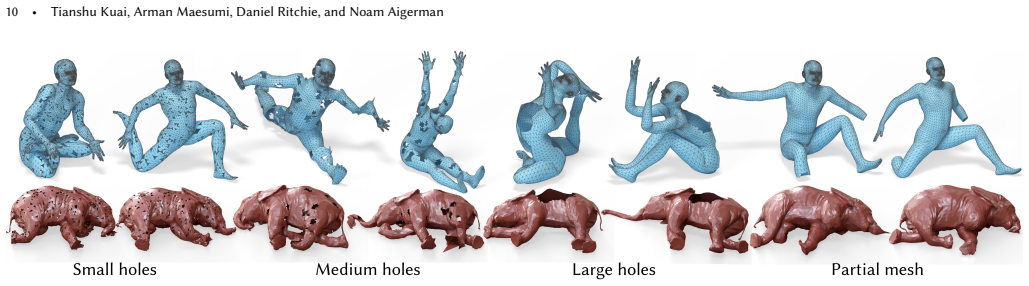
- A model trained once can be applied to any triangulation of a given mesh without retraining.
- Meshes containing more than one million triangles can be processed at practical cost.
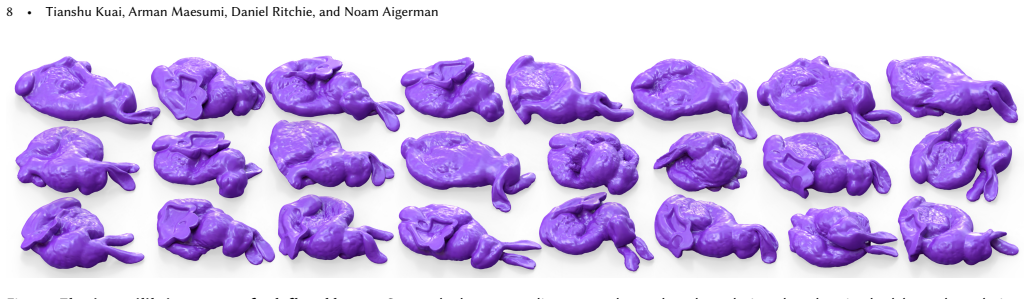
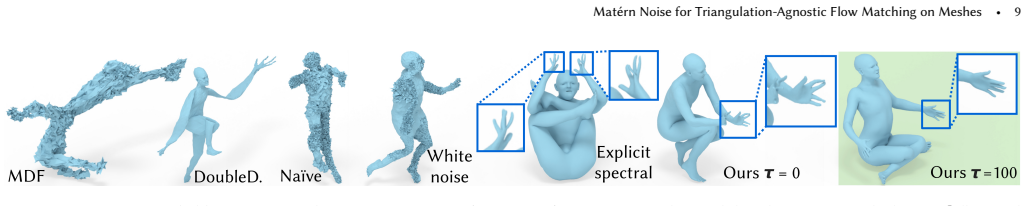
- Generation quality and diversity surpass prior mesh-based methods on elastic shapes and articulated poses.
Where Pith is reading between the lines
- The spectral test for agnosticism could be used to certify other noise models on irregular domains such as point clouds or graphs.
- Pre-training on one family of meshes and deployment on meshes with different connectivity becomes feasible without domain adaptation.
- The same noise construction may extend directly to generative models for time-dependent or dynamic mesh signals.
Load-bearing premise
That invariance of the distribution's spectrum under changes in triangulation supplies the right and sufficient criterion for triangulation agnosticism.
What would settle it
If samples drawn from the Matérn discretization exhibit measurably different spectra or statistics when computed on two distinct triangulations of the identical underlying surface, the claimed agnosticism fails.
Figures








read the original abstract
This paper tackles the task of learning to generate signals over triangle meshes in a triangulation-agnostic manner, meaning the trained model can be applied to different meshes and triangulations effectively. Practically, the paper adapts the flow matching (FM) paradigm to a mesh-based, triangulation-agnostic setting. Theoretically, it proposes a specific noise distribution which is triangulation agnostic, to be used inside the FM model's denoising process. While noise distributions are usually trivial to devise for, e.g., images, devising a triangulation-agnostic distribution proves to be a much more difficult task. We formulate a mathematical definition of triangulation agnosticism of distributions, via their spectrum. We then show that a discretization of a specific Gaussian random field called a Mat\'ern process holds these desired properties, and provides a simple and efficient sampling algorithm. We use it as our noise model, and adapt FM to the triangulation-agnostic setting by using a state-of-the-art approach for learning signals on meshes in the gradient domain -- PoissonNet -- as the denoiser. We conduct experiments on elaborate tasks such as sampling elastic rest states, and generating poses of humanoids. Our method is shown to be capable of producing highly realistic results for meshes of over one million triangles, significantly exceeding the state-of-the-art in quality and diversity.
Editorial analysis
A structured set of objections, weighed in public.
Referee Report
Summary. The manuscript proposes a triangulation-agnostic adaptation of flow matching for generating signals on triangle meshes. It defines triangulation agnosticism of a distribution via its spectrum, shows that a discretization of the Matérn Gaussian random field satisfies this definition and admits an efficient sampling procedure, and integrates the resulting noise model with PoissonNet (operating in the gradient domain) as the denoiser. Experiments are reported on sampling elastic rest states and generating humanoid poses, with claims of high realism and diversity on meshes exceeding one million triangles.
Significance. If the spectral definition is shown to be sufficient for full trajectory invariance and the experimental results are reproducible, the work would address a practically important limitation in mesh-based generative modeling by allowing a single trained model to be applied to meshes with arbitrary triangulations. The combination of Matérn noise with PoissonNet and flow matching is a targeted technical contribution that could influence downstream applications in geometry processing.
major comments (2)
- [Abstract] Abstract and theoretical sections: the claim that the Matérn discretization satisfies the spectrum-based definition of triangulation agnosticism is stated without derivation details, error bounds, or explicit verification that the discrete spectrum matches the continuous Matérn spectrum under arbitrary triangulations; this is load-bearing for the central claim that the noise model is triangulation-agnostic.
- [Theoretical contribution] The definition of triangulation agnosticism is restricted to spectral properties of the marginal noise distribution. It remains to be shown that this property propagates through the full flow-matching trajectory (iterative denoising with PoissonNet in the gradient domain), because the denoiser may couple to mesh-dependent discrete gradient and mass-matrix operators that are not controlled by the noise spectrum alone.
minor comments (1)
- The sampling algorithm for the Matérn discretization is described as simple and efficient; adding pseudocode or a short complexity analysis would improve reproducibility.
Simulated Author's Rebuttal
We are grateful to the referee for the careful reading and insightful comments. We address each major comment below and indicate the revisions we intend to make to strengthen the theoretical presentation while remaining faithful to the manuscript's contributions.
read point-by-point responses
-
Referee: [Abstract] Abstract and theoretical sections: the claim that the Matérn discretization satisfies the spectrum-based definition of triangulation agnosticism is stated without derivation details, error bounds, or explicit verification that the discrete spectrum matches the continuous Matérn spectrum under arbitrary triangulations; this is load-bearing for the central claim that the noise model is triangulation-agnostic.
Authors: We agree that additional derivation details and verification would improve clarity. The theoretical section derives the discrete Matérn field from the eigen-decomposition of the mesh Laplacian and shows spectral consistency in the continuum limit. In the revision we will expand this with explicit intermediate steps, include approximation error bounds from finite-element analysis of the Laplace-Beltrami operator, and add numerical plots comparing discrete and continuous spectra on multiple triangulations of the same geometry. revision: yes
-
Referee: [Theoretical contribution] The definition of triangulation agnosticism is restricted to spectral properties of the marginal noise distribution. It remains to be shown that this property propagates through the full flow-matching trajectory (iterative denoising with PoissonNet in the gradient domain), because the denoiser may couple to mesh-dependent discrete gradient and mass-matrix operators that are not controlled by the noise spectrum alone.
Authors: This observation correctly identifies the scope of our definition. The flow-matching construction transports the marginal noise distribution to the data distribution, and PoissonNet operates in the gradient domain to reduce sensitivity to specific discretizations. Our experiments, including successful transfer to meshes exceeding one million triangles with varying triangulations, provide empirical evidence that the learned model generalizes. A rigorous proof that the entire ODE trajectory remains invariant under arbitrary re-triangulations would require additional analysis of the learned vector field and is not fully established in the current work; we will add a dedicated discussion paragraph acknowledging this limitation and summarizing the supporting experiments. revision: partial
Circularity Check
No circularity: definition and verification of Matérn noise properties are independent
full rationale
The paper introduces an original mathematical definition of triangulation agnosticism based on the spectrum of the distribution. It then constructs and verifies that a discretization of the Matérn Gaussian random field satisfies this definition while also yielding an efficient sampling procedure. This constitutes a standard constructive argument rather than any reduction of the claimed result to a fitted parameter, renamed input, or self-referential equation. The flow-matching adaptation relies on the external PoissonNet denoiser operating in the gradient domain, which is treated as an independent component. No load-bearing derivation step collapses by construction to the paper's own prior equations or citations; the central claims retain independent mathematical content and are self-contained against external benchmarks.
Axiom & Free-Parameter Ledger
axioms (1)
- domain assumption Triangulation agnosticism of a noise distribution can be defined and checked via its spectrum.
Reference graph
Works this paper leans on
-
[1]
Advances in neural information processing systems , volume=
Denoising diffusion probabilistic models , author=. Advances in neural information processing systems , volume=
-
[2]
Proceedings of the IEEE/CVF conference on computer vision and pattern recognition , pages=
High-resolution image synthesis with latent diffusion models , author=. Proceedings of the IEEE/CVF conference on computer vision and pattern recognition , pages=
-
[3]
Flow Matching for Generative Modeling
Flow matching for generative modeling , author=. arXiv preprint arXiv:2210.02747 , year=
work page internal anchor Pith review Pith/arXiv arXiv
-
[4]
Building Normalizing Flows with Stochastic Interpolants
Building normalizing flows with stochastic interpolants , author=. arXiv preprint arXiv:2209.15571 , year=
work page internal anchor Pith review Pith/arXiv arXiv
-
[5]
Forty-first international conference on machine learning , year=
Scaling rectified flow transformers for high-resolution image synthesis , author=. Forty-first international conference on machine learning , year=
-
[6]
Flow matching on general geometries.arXiv preprint arXiv:2302.03660, 2023
Flow matching on general geometries , author=. arXiv preprint arXiv:2302.03660 , year=
-
[7]
Advances in neural information processing systems , volume=
Riemannian continuous normalizing flows , author=. Advances in neural information processing systems , volume=
-
[8]
Ahmed A. A. Elhag and Yuyang Wang and Joshua M. Susskind and Miguel. Manifold Diffusion Fields , booktitle =. 2024 , url =
work page 2024
-
[9]
arXiv preprint arXiv:2501.03397 , year=
DoubleDiffusion: Combining Heat Diffusion with Denoising Diffusion for Texture Generation on 3D Meshes , author=. arXiv preprint arXiv:2501.03397 , year=
-
[10]
ACM Transactions on Graphics (TOG) , volume=
HodgeNet: Learning spectral geometry on triangle meshes , author=. ACM Transactions on Graphics (TOG) , volume=. 2021 , publisher=
work page 2021
-
[11]
ACM Transactions on Graphics (TOG) , volume=
Deltaconv: anisotropic operators for geometric deep learning on point clouds , author=. ACM Transactions on Graphics (TOG) , volume=. 2022 , publisher=
work page 2022
-
[12]
ACM Transactions on Graphics (TOG) , volume=
Diffusionnet: Discretization agnostic learning on surfaces , author=. ACM Transactions on Graphics (TOG) , volume=. 2022 , publisher=
work page 2022
-
[13]
ACM Transactions on Graphics (TOG) , volume=
PoissonNet: A Local-Global Approach for Learning on Surfaces , author=. ACM Transactions on Graphics (TOG) , volume=. 2025 , publisher=
work page 2025
-
[14]
arXiv preprint arXiv:2106.07582 , year=
Non gaussian denoising diffusion models , author=. arXiv preprint arXiv:2106.07582 , year=
-
[15]
arXiv preprint arXiv:2304.05907 , year=
Diffusion models with location-scale noise , author=. arXiv preprint arXiv:2304.05907 , year=
-
[16]
ACM Transactions on Graphics (TOG) , volume=
Gaussian blue noise , author=. ACM Transactions on Graphics (TOG) , volume=. 2022 , publisher=
work page 2022
-
[17]
ACM SIGGRAPH 2024 conference papers , pages=
Blue noise for diffusion models , author=. ACM SIGGRAPH 2024 conference papers , pages=
work page 2024
-
[18]
ACM Transactions on Graphics (TOG) , volume=
Neural jacobian fields: learning intrinsic mappings of arbitrary meshes , author=. ACM Transactions on Graphics (TOG) , volume=. 2022 , publisher=
work page 2022
-
[19]
SIGGRAPH Asia 2023 Conference Papers , pages=
Explorable mesh deformation subspaces from unstructured 3d generative models , author=. SIGGRAPH Asia 2023 Conference Papers , pages=
work page 2023
-
[20]
ACM Transactions on Graphics (TOG) , volume=
Multi-chart generative surface modeling , author=. ACM Transactions on Graphics (TOG) , volume=. 2018 , publisher=
work page 2018
-
[21]
PixelDiT: Pixel Diffusion Transformers for Image Generation
PixelDiT: Pixel Diffusion Transformers for Image Generation , author=. arXiv preprint arXiv:2511.20645 , year=
work page internal anchor Pith review Pith/arXiv arXiv
-
[22]
Back to Basics: Let Denoising Generative Models Denoise
Back to basics: Let denoising generative models denoise , author=. arXiv preprint arXiv:2511.13720 , year=
work page internal anchor Pith review Pith/arXiv arXiv
-
[23]
arXiv preprint arXiv:2311.17932 , year=
Swallowing the bitter pill: Simplified scalable conformer generation , author=. arXiv preprint arXiv:2311.17932 , year=
-
[24]
Pavlakos, Georgios and Choutas, Vasileios and Ghorbani, Nima and Bolkart, Timo and Osman, Ahmed A. A. and Tzionas, Dimitrios and Black, Michael J. , booktitle =. Expressive Body Capture:
- [25]
-
[26]
Proceedings of the IEEE/CVF conference on computer vision and pattern recognition , pages=
3D human pose estimation via intuitive physics , author=. Proceedings of the IEEE/CVF conference on computer vision and pattern recognition , pages=
-
[27]
ACM Transactions on Graphics (TOG) , volume=
Large steps in inverse rendering of geometry , author=. ACM Transactions on Graphics (TOG) , volume=. 2021 , publisher=
work page 2021
-
[28]
Proceedings of the IEEE/CVF conference on computer vision and pattern recognition , pages=
Expressive body capture: 3d hands, face, and body from a single image , author=. Proceedings of the IEEE/CVF conference on computer vision and pattern recognition , pages=
- [29]
-
[30]
ACM Transactions on Graphics (ToG) , volume=
Fast tetrahedral meshing in the wild , author=. ACM Transactions on Graphics (ToG) , volume=. 2020 , publisher=
work page 2020
-
[31]
International conference on machine learning , pages=
Learning representations and generative models for 3d point clouds , author=. International conference on machine learning , pages=. 2018 , organization=
work page 2018
-
[32]
Journal of the Royal Statistical Society Series B: Statistical Methodology , volume=
An explicit link between Gaussian fields and Gaussian Markov random fields: the stochastic partial differential equation approach , author=. Journal of the Royal Statistical Society Series B: Statistical Methodology , volume=. 2011 , publisher=
work page 2011
-
[33]
Experimental mathematics , volume=
Computing discrete minimal surfaces and their conjugates , author=. Experimental mathematics , volume=. 1993 , publisher=
work page 1993
-
[34]
and Chen, Peter Yichen and Grinspun, Eitan , title =
Chang, Yue and Benchekroun, Otman and Chiaramonte, Maurizio M. and Chen, Peter Yichen and Grinspun, Eitan , title =. ACM Trans. Graph. , month = jul, articleno =. 2025 , issue_date =. doi:10.1145/3731148 , abstract =
-
[35]
Interpolation of spatial data: some theory for kriging , author=. 1999 , publisher=
work page 1999
-
[36]
ACM Transactions on Graphics (ToG) , volume=
Convolutional wasserstein distances: Efficient optimal transportation on geometric domains , author=. ACM Transactions on Graphics (ToG) , volume=. 2015 , publisher=
work page 2015
-
[37]
ACM SIGGRAPH 2010 Courses , pages=
Spectral mesh processing , author=. ACM SIGGRAPH 2010 Courses , pages=
work page 2010
-
[38]
International Journal on Interactive Design and Manufacturing (IJIDeM) , volume=
Spectral-based mesh segmentation , author=. International Journal on Interactive Design and Manufacturing (IJIDeM) , volume=. 2017 , publisher=
work page 2017
-
[39]
Computer Graphics Forum , volume=
Spectral mesh simplification , author=. Computer Graphics Forum , volume=. 2020 , organization=
work page 2020
-
[40]
ACM Transactions On Graphics (TOG) , volume=
Mesh saliency via spectral processing , author=. ACM Transactions On Graphics (TOG) , volume=. 2014 , publisher=
work page 2014
-
[41]
Computer Graphics Forum , volume=
Spectral geometry processing with manifold harmonics , author=. Computer Graphics Forum , volume=. 2008 , organization=
work page 2008
-
[42]
Computer graphics forum , volume=
Spectral mesh processing , author=. Computer graphics forum , volume=. 2010 , organization=
work page 2010
-
[43]
Computer graphics forum , volume=
A concise and provably informative multi-scale signature based on heat diffusion , author=. Computer graphics forum , volume=. 2009 , organization=
work page 2009
-
[44]
Computer Graphics Forum , volume=
A Dirac operator for extrinsic shape analysis , author=. Computer Graphics Forum , volume=. 2017 , organization=
work page 2017
-
[45]
Bulletin of the International Statistical Institute , volume=
Stochastic-processes in several dimensions , author=. Bulletin of the International Statistical Institute , volume=. 1963 , publisher=
work page 1963
-
[46]
Gaussian processes for machine learning , author=. 2006 , publisher=
work page 2006
-
[47]
arXiv preprint arXiv:2507.20024 , year=
Discrete Gaussian Vector Fields On Meshes , author=. arXiv preprint arXiv:2507.20024 , year=
-
[48]
Philosophical Transactions of the Royal Society A , volume=
Gaussian process manifold interpolation for probabilistic atrial activation maps and uncertain conduction velocity , author=. Philosophical Transactions of the Royal Society A , volume=. 2020 , publisher=
work page 2020
-
[49]
Borovitskiy, Viacheslav and Azangulov, Iskander and Terenin, Alexander and Mostowsky, Peter and Deisenroth, Marc and Durrande, Nicolas , booktitle=. Mat. 2021 , organization=
work page 2021
-
[50]
arXiv preprint arXiv:2201.00001 , year=
Modeling Advection on Directed Graphs using Mat 'ern Gaussian Processes for Traffic Flow , author=. arXiv preprint arXiv:2201.00001 , year=
-
[51]
arXiv preprint arXiv:2304.10372 , year=
Statistical inference for Gaussian Whittle-Mat 'ern fields on metric graphs , author=. arXiv preprint arXiv:2304.10372 , year=
-
[52]
Borovitskiy, Viacheslav and Terenin, Alexander and Mostowsky, Peter and others , journal=. Mat
-
[53]
Posterior contraction rates for Mat
Rosa, Paul and Borovitskiy, Slava and Terenin, Alexander and Rousseau, Judith , journal=. Posterior contraction rates for Mat
-
[54]
ACM Transactions on Graphics (ToG) , volume=
Functional maps: a flexible representation of maps between shapes , author=. ACM Transactions on Graphics (ToG) , volume=. 2012 , publisher=
work page 2012
-
[55]
Anytop: Character animation diffusion with any topology , author=. Proceedings of the Special Interest Group on Computer Graphics and Interactive Techniques Conference Conference Papers , pages=
-
[56]
The Eleventh International Conference on Learning Representations , year=
Human Motion Diffusion Model , author=. The Eleventh International Conference on Learning Representations , year=
-
[57]
Human Motion Diffusion as a Generative Prior , author=. 2024 , booktitle=
work page 2024
-
[58]
ACM Transactions on Graphics (TOG) , volume=
Sketch2anim: Towards transferring sketch storyboards into 3d animation , author=. ACM Transactions on Graphics (TOG) , volume=. 2025 , publisher=
work page 2025
-
[59]
arXiv preprint arXiv:2303.08133 , year=
Meshdiffusion: Score-based generative 3d mesh modeling , author=. arXiv preprint arXiv:2303.08133 , year=
-
[60]
Deep Marching Tetrahedra: a Hybrid Representation for High-Resolution 3D Shape Synthesis , author =. 2021 , booktitle =
work page 2021
-
[61]
The Twelfth International Conference on Learning Representations,
Yichun Shi and Peng Wang and Jianglong Ye and Long Mai and Kejie Li and Xiao Yang , title =. The Twelfth International Conference on Learning Representations,. 2024 , url =
work page 2024
-
[62]
Proceedings of the IEEE/CVF conference on computer vision and pattern recognition , pages=
Xcube: Large-scale 3d generative modeling using sparse voxel hierarchies , author=. Proceedings of the IEEE/CVF conference on computer vision and pattern recognition , pages=
-
[63]
DreamFusion: Text-to-3D using 2D Diffusion
Dreamfusion: Text-to-3d using 2d diffusion , author=. arXiv preprint arXiv:2209.14988 , year=
work page internal anchor Pith review Pith/arXiv arXiv
-
[64]
Proceedings of the Computer Vision and Pattern Recognition Conference , pages=
Structured 3d latents for scalable and versatile 3d generation , author=. Proceedings of the Computer Vision and Pattern Recognition Conference , pages=
-
[65]
ACM Transactions on Graphics (TOG) , volume=
Clay: A controllable large-scale generative model for creating high-quality 3d assets , author=. ACM Transactions on Graphics (TOG) , volume=. 2024 , publisher=
work page 2024
-
[66]
The Twelfth International Conference on Learning Representations (ICLR) , year=
Magic123: One Image to High-Quality 3D Object Generation Using Both 2D and 3D Diffusion Priors , author=. The Twelfth International Conference on Learning Representations (ICLR) , year=
-
[67]
Advances in Neural Information Processing Systems (NeurIPS) , year=
ProlificDreamer: High-Fidelity and Diverse Text-to-3D Generation with Variational Score Distillation , author=. Advances in Neural Information Processing Systems (NeurIPS) , year=
-
[68]
Proceedings of the IEEE conference on computer vision and pattern recognition , pages=
Variational autoencoders for deforming 3d mesh models , author=. Proceedings of the IEEE conference on computer vision and pattern recognition , pages=
-
[69]
Proceedings of the IEEE/CVF conference on computer vision and pattern recognition workshops , pages=
Mesh variational autoencoders with edge contraction pooling , author=. Proceedings of the IEEE/CVF conference on computer vision and pattern recognition workshops , pages=
-
[70]
IEEE Transactions on Pattern Analysis and Machine Intelligence , volume=
Variational autoencoders for localized mesh deformation component analysis , author=. IEEE Transactions on Pattern Analysis and Machine Intelligence , volume=. 2021 , publisher=
work page 2021
-
[71]
Proceedings of the IEEE/CVF Conference on Computer Vision and Pattern Recognition , pages=
Glass: Geometric latent augmentation for shape spaces , author=. Proceedings of the IEEE/CVF Conference on Computer Vision and Pattern Recognition , pages=
-
[72]
Proceedings of the IEEE/CVF international conference on computer vision , pages=
Arapreg: An as-rigid-as possible regularization loss for learning deformable shape generators , author=. Proceedings of the IEEE/CVF international conference on computer vision , pages=
-
[73]
Proceedings of the Computer Vision and Pattern Recognition Conference , pages=
Geometry in Style: 3D Stylization via Surface Normal Deformation , author=. Proceedings of the Computer Vision and Pattern Recognition Conference , pages=
-
[74]
2025 International Conference on 3D Vision (3DV) , pages=
Meshup: Multi-target mesh deformation via blended score distillation , author=. 2025 International Conference on 3D Vision (3DV) , pages=. 2025 , organization=
work page 2025
-
[75]
Proceedings of the IEEE/CVF conference on computer vision and pattern recognition , pages=
Text2mesh: Text-driven neural stylization for meshes , author=. Proceedings of the IEEE/CVF conference on computer vision and pattern recognition , pages=
-
[76]
ACM SIGGRAPH 2023 conference proceedings , pages=
Textdeformer: Geometry manipulation using text guidance , author=. ACM SIGGRAPH 2023 conference proceedings , pages=
work page 2023
-
[77]
ACM Transactions on Graphics (TOG) , volume=
Nonlinear spectral geometry processing via the TV transform , author=. ACM Transactions on Graphics (TOG) , volume=. 2020 , publisher=
work page 2020
-
[78]
2025 International Conference on 3D Vision (3DV) , pages=
Headevolver: Text to head avatars via expressive and attribute-preserving mesh deformation , author=. 2025 International Conference on 3D Vision (3DV) , pages=. 2025 , organization=
work page 2025
-
[79]
Ll3m: Large language 3d modelers.arXiv preprint arXiv:2508.08228, 2025
Ll3m: Large language 3d modelers , author=. arXiv preprint arXiv:2508.08228 , year=
-
[80]
2023.doi:10.48550/arXiv.2311.15475
MeshGPT: Generating Triangle Meshes with Decoder-Only Transformers , author=. arXiv preprint arXiv:2311.15475 , year=
discussion (0)
Sign in with ORCID, Apple, or X to comment. Anyone can read and Pith papers without signing in.