Optical Super-orbital Modulation of SMC X-1: Disk Precession and a Revised Pulsar Mass
Pith reviewed 2026-05-21 03:54 UTC · model grok-4.3
The pith
A precessing accretion disk explains synchronized optical and X-ray modulations in SMC X-1 and revises the pulsar mass to 1.35 solar masses.
A machine-rendered reading of the paper's core claim, the machinery that carries it, and where it could break.
Core claim
The central claim is that the super-orbital X-ray modulation of SMC X-1 is produced by a precessing accretion disk whose orientation changes the geometry of irradiation on the donor star and on the disk. This model fits the observed optical orbital light curves and their systematic evolution with super-orbital phase. The intense X-ray flux also shifts the center of optical emission on the donor star away from its center of mass, which biases radial-velocity measurements and leads to an underestimated pulsar mass; applying the correction gives a value of approximately 1.35 solar masses.
What carries the argument
A modified ellipsoidal light-curve model that includes a precessing accretion disk modulating irradiation geometry between the X-ray source, the donor star, and the disk.
If this is right
- The optical orbital light curve can be used to monitor the precession phase of the disk.
- The photocenter shift due to irradiation must be accounted for when deriving masses from radial velocities in X-ray binaries.
- The revised mass of 1.35 solar masses places the neutron star above the minimum mass expected from core-collapse supernova models.
- Similar precession-driven irradiation effects should appear in other systems that show super-orbital X-ray periods.
Where Pith is reading between the lines
- If the irradiation bias is common, published masses for other neutron stars in high-mass X-ray binaries may be systematically low.
- The model implies that the disk precession period can be determined from optical data alone in systems where X-ray coverage is sparse.
- Future multi-wavelength observations could test whether the predicted changes in light-curve shape occur at the expected super-orbital phases.
Load-bearing premise
The X-ray irradiation is assumed to displace the optical emission center on the donor star enough to reduce the measured radial velocity by about 20 percent.
What would settle it
A radial-velocity measurement using spectral lines formed on the unirradiated portion of the donor star that yields a pulsar mass inconsistent with 1.35 solar masses.
Figures




read the original abstract
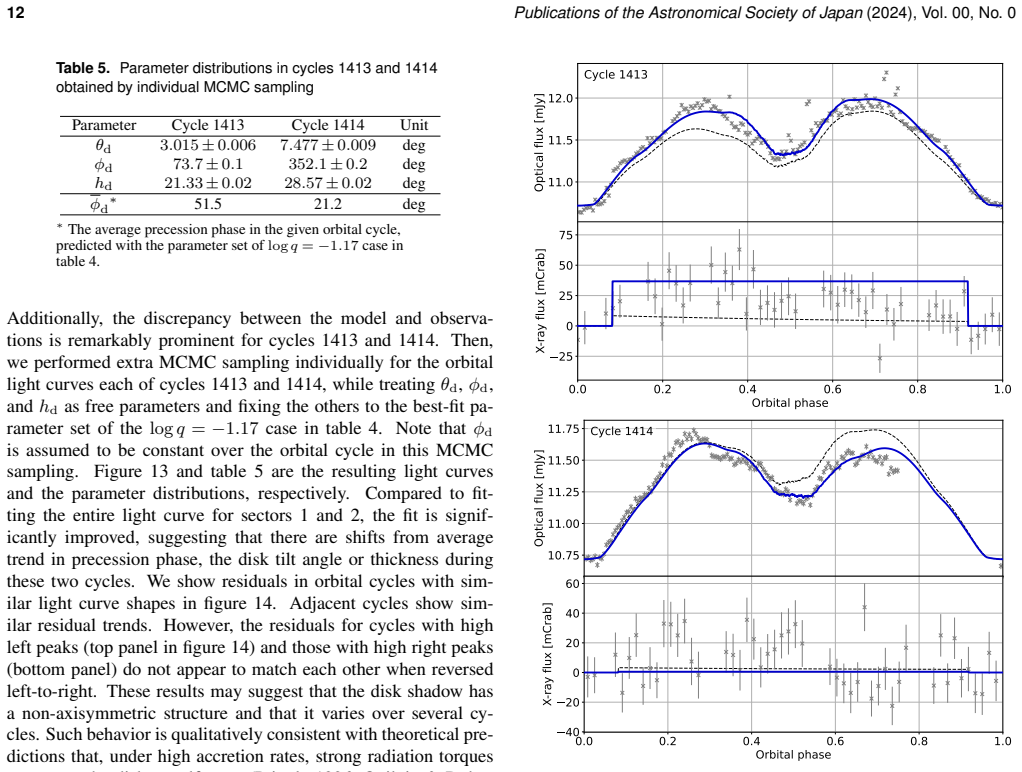
The observational determination of the lower limit of neutron star masses is crucial for the physics of core-collapse supernovae. In this light, SMC X-1 is an important object because of its estimated pulsar mass lying near or potentially below the theoretical lower limit. SMC X-1 exhibits a double peaked optical orbital light curve due to the tidal distortion of the donor star, and analysis of this allows us to constrain the binary parameters. In this study, we analyzed optical and X-ray light curves of SMC X-1 obtained by Transiting Exoplanet Survey Satellite and Monitor of All-sky X-ray Image. We found the systematic variations in the optical orbital light curves synchronized with the X-ray super-orbital modulation, regarding the following two aspects: the minimum at inferior conjunction and the double-peak asymmetry. To explain this behavior, we developed a modified ellipsoidal modulation model in which the precessing accretion disk changes the geometry of X-ray irradiation on the donor and that of optical irradiation on the disk. As a result, this model succeeded in reproducing the observed optical and X-ray light curves. Furthermore, we discovered that intense X-ray irradiation could cause the optical emission center to shift away from the gravitational center, potentially leading to an underestimation of the radial velocity of the donor by approximately 20%. Correcting for this effect yields an updated pulsar mass estimation of about $1.35\>M_\odot$.
Editorial analysis
A structured set of objections, weighed in public.
Referee Report
Summary. The paper analyzes TESS optical and MAXI X-ray light curves of SMC X-1 and develops a modified ellipsoidal modulation model incorporating a precessing accretion disk. This model accounts for time-varying X-ray irradiation on the donor and optical irradiation on the disk to reproduce the observed super-orbital changes in orbital minima depth and double-peak asymmetry. The authors conclude that intense X-ray irradiation shifts the optical emission center away from the center of mass, underestimating the donor radial-velocity semi-amplitude K_d by ~20%; correcting for this effect revises the pulsar mass to ~1.35 M_⊙.
Significance. If the mass revision is robust, the result would place the SMC X-1 pulsar above the theoretical lower mass limit for neutron stars from core-collapse models, with direct implications for supernova physics and the dense-matter equation of state. The precessing-disk irradiation framework also provides a reusable approach for interpreting super-orbital variability in other high-mass X-ray binaries when high-cadence photometry is available.
major comments (2)
- [Abstract] Abstract: The ~20% underestimation in donor radial velocity is presented as following from the irradiation geometry, yet the manuscript does not demonstrate that this specific factor is computed from the best-fit values of disk tilt angle, irradiation fraction, or emission-center offset. Because the mass function scales as K_d³, even a 10% uncertainty in the correction changes the inferred pulsar mass by several tenths of a solar mass, making this step load-bearing for the central claim.
- [Modeling and results sections] Modeling and results sections: No fit statistics (reduced χ², residual rms, or parameter uncertainties) or explicit comparison of model variants are reported for the simultaneous optical/X-ray light-curve fits. Without these, it is difficult to assess whether the precessing-disk geometry is uniquely required or whether the derived irradiation parameters can independently yield the stated 20% RV shift.
minor comments (2)
- [Modeling section] Clarify the exact definition of the emission-center offset parameter and show how it maps to the 20% RV correction in a dedicated equation or appendix.
- Add a brief sensitivity test showing how the revised mass changes when the correction factor is varied by ±5%.
Simulated Author's Rebuttal
We thank the referee for their careful reading of the manuscript and for the constructive comments. We address each major comment below and will revise the manuscript accordingly to improve clarity and rigor.
read point-by-point responses
-
Referee: [Abstract] Abstract: The ~20% underestimation in donor radial velocity is presented as following from the irradiation geometry, yet the manuscript does not demonstrate that this specific factor is computed from the best-fit values of disk tilt angle, irradiation fraction, or emission-center offset. Because the mass function scales as K_d³, even a 10% uncertainty in the correction changes the inferred pulsar mass by several tenths of a solar mass, making this step load-bearing for the central claim.
Authors: We appreciate the referee pointing out the need for explicit linkage between the model parameters and the RV correction. The 20% estimate arises from the modeled shift in the optical emission center due to asymmetric X-ray irradiation on the donor, computed using the best-fit disk tilt and irradiation fraction. In the revision we will add a dedicated subsection deriving the offset quantitatively from those fitted values, together with a propagated uncertainty on the correction factor and its effect on the final mass. revision: yes
-
Referee: [Modeling and results sections] Modeling and results sections: No fit statistics (reduced χ², residual rms, or parameter uncertainties) or explicit comparison of model variants are reported for the simultaneous optical/X-ray light-curve fits. Without these, it is difficult to assess whether the precessing-disk geometry is uniquely required or whether the derived irradiation parameters can independently yield the stated 20% RV shift.
Authors: We agree that quantitative goodness-of-fit metrics and model comparisons are essential. The revised manuscript will report reduced χ², residual rms, and 1σ uncertainties on all fitted parameters for the joint optical/X-ray modeling. We will also include explicit comparisons to simpler ellipsoidal models without the precessing-disk irradiation component, showing that only the full geometry reproduces the observed super-orbital changes in minima depth and peak asymmetry. revision: yes
Circularity Check
No significant circularity detected in the derivation chain.
full rationale
The paper fits a modified ellipsoidal modulation model incorporating a precessing accretion disk to TESS optical and MAXI X-ray light curves, reproducing the observed super-orbital variations in orbital minima and peak asymmetry via changes in irradiation geometry. From this geometry the authors estimate that X-ray irradiation shifts the optical emission center, leading to an approximate 20% underestimation in the donor radial-velocity semi-amplitude K_d; correcting the previously measured K_d then yields the revised pulsar mass of ~1.35 M_⊙. This sequence is self-contained: the photometric light-curve fit is independent of the spectroscopic K_d data, the 20% figure is presented as a consequence of the fitted irradiation parameters rather than a redefinition or statistical fit to the mass itself, and no equations reduce the mass result to the input light curves by construction. No self-citation load-bearing steps, uniqueness theorems, or ansatzes smuggled via prior work are required for the central claim.
Axiom & Free-Parameter Ledger
free parameters (2)
- disk precession geometry parameters
- irradiation-induced radial-velocity correction
axioms (2)
- domain assumption The double-peaked optical orbital light curve arises from tidal distortion of the donor star (ellipsoidal modulation).
- domain assumption The X-ray super-orbital modulation is produced by precession of the accretion disk.
Lean theorems connected to this paper
-
IndisputableMonolith.Foundation.RealityFromDistinctionreality_from_one_distinction unclear?
unclearRelation between the paper passage and the cited Recognition theorem.
we developed a modified ellipsoidal modulation model in which the precessing accretion disk changes the geometry of X-ray irradiation on the donor and that of optical irradiation on the disk... Correcting for this effect yields an updated pulsar mass estimation of about 1.35 M_⊙
-
IndisputableMonolith.Cost.FunctionalEquationwashburn_uniqueness_aczel unclear?
unclearRelation between the paper passage and the cited Recognition theorem.
The temperature of the donor surface was derived under the assumption of local thermal equilibrium, taking into account the two effects of gravity-darkening and X-ray irradiation
What do these tags mean?
- matches
- The paper's claim is directly supported by a theorem in the formal canon.
- supports
- The theorem supports part of the paper's argument, but the paper may add assumptions or extra steps.
- extends
- The paper goes beyond the formal theorem; the theorem is a base layer rather than the whole result.
- uses
- The paper appears to rely on the theorem as machinery.
- contradicts
- The paper's claim conflicts with a theorem or certificate in the canon.
- unclear
- Pith found a possible connection, but the passage is too broad, indirect, or ambiguous to say the theorem truly supports the claim.
Reference graph
Works this paper leans on
-
[1]
, year = 1972, month = jan, volume =
Identification of SMC X-1. , year = 1972, month = jan, volume =
work page 1972
-
[2]
Nature Physical Science , year = 1972, month = dec, volume =
Optical Candidate for SMC X-1. Nature Physical Science , year = 1972, month = dec, volume =. doi:10.1038/physci240183b0 , adsurl =
- [3]
-
[4]
, year = 1973, month = apr, volume =
Light Curve of HZ Herculis. , year = 1973, month = apr, volume =. doi:10.1086/181180 , adsurl =
-
[5]
, year = 1973, month = sep, volume =
Optical Observations of Sanduleak 160. , year = 1973, month = sep, volume =. doi:10.1086/181304 , adsurl =
-
[6]
Nature Physical Science , keywords =
Thirty-five-day Periodicity in Her X-1. Nature Physical Science , keywords =. doi:10.1038/physci246087a0 , adsurl =
-
[7]
Ellipsoidal light variations and masses of X-ray binaries. , keywords =. doi:10.1086/153558 , adsurl =
-
[8]
Hercules X-1: a neutron star with a twisted accretion disk?. , keywords =. doi:10.1086/181942 , adsurl =
-
[9]
Discovery of X-ray pulsations in SMC X-1. , keywords =. doi:10.1086/182125 , adsurl =
-
[10]
Optical clues to the nature of Hercules X-1 / HZ Herculis. , keywords =. doi:10.1086/154751 , adsurl =
- [11]
-
[12]
, year = 1981, month = mar, volume =
The Optical Light Curve of Large Magellanic CLOUD-X-4 and the 30-DAY X-Ray Period. , year = 1981, month = mar, volume =. doi:10.1007/BF01246055 , adsurl =
-
[13]
SS 433 : improved evidence for a persistent 160 day photometric period. , keywords =. doi:10.1086/161529 , adsurl =
-
[14]
SMC X-1 variability observed from HEAO 1. , keywords =. doi:10.1086/162338 , adsurl =
- [15]
-
[16]
Analysis of the optical light curve of the massive X-ray binary LMC X-4. , keywords =
- [17]
-
[18]
Neutron Star Accretion in a Stellar Envelope. , keywords =. doi:10.1086/186905 , adsurl =
-
[19]
Neutron Star Accretion and Binary Pulsar Formation. , keywords =. doi:10.1086/175268 , adsurl =
-
[20]
Self-induced warping of accretion discs. , keywords =. doi:10.1093/mnras/281.1.357 , adsurl =
-
[21]
Quasi-Periodic Occultation by a Precessing Accretion Disk and Other Variabilities of SMC X-1
Quasi-periodic Occultation by a Precessing Accretion Disk and Other Variabilities of SMC X-1. , keywords =. doi:10.1086/305893 , archivePrefix =. astro-ph/9801168 , primaryClass =
work page internal anchor Pith review Pith/arXiv arXiv doi:10.1086/305893
-
[22]
Evolution of Binary Compact Objects Which Merge
Evolution of Binary Compact Objects That Merge. , keywords =. doi:10.1086/306265 , archivePrefix =. astro-ph/9802084 , primaryClass =
work page internal anchor Pith review Pith/arXiv arXiv doi:10.1086/306265
-
[23]
Warped accretion discs and the long periods in X-ray binaries. , keywords =. doi:10.1046/j.1365-8711.1999.02720.x , archivePrefix =. astro-ph/9811056 , primaryClass =
-
[24]
Properties of non-rotating and rapidly rotating protoneutron stars
Properties of non-rotating and rapidly rotating protoneutron stars. , keywords =. doi:10.48550/arXiv.astro-ph/9908132 , archivePrefix =. astro-ph/9908132 , primaryClass =
work page internal anchor Pith review Pith/arXiv arXiv doi:10.48550/arxiv.astro-ph/9908132
-
[25]
Precessing warped accretion discs in X-ray binaries. , keywords =. doi:10.1046/j.1365-8711.2001.04011.x , archivePrefix =. astro-ph/0009264 , primaryClass =
-
[26]
A 2dF survey of the Small Magellanic Cloud. , keywords =. doi:10.1111/j.1365-2966.2004.08096.x , archivePrefix =. astro-ph/0406409 , primaryClass =
-
[27]
Supercritical Accretion Flows around Black Holes: Two-dimensional, Radiation Pressure-dominated Disks with Photon Trapping. , keywords =. doi:10.1086/430728 , archivePrefix =. astro-ph/0504168 , primaryClass =
work page internal anchor Pith review Pith/arXiv arXiv doi:10.1086/430728
-
[28]
Hunter, J. D. , Title =. Computing in Science & Engineering , Volume =
-
[29]
Determination of the mass of the neutron star in SMC X-1, LMC X-4 and Cen X-3 with VLT/UVES
Determination of the mass of the neutron star in <ASTROBJ>SMC X-1</ASTROBJ>, <ASTROBJ>LMC X-4</ASTROBJ>, and <ASTROBJ>Cen X-3</ASTROBJ> with VLT/UVES. , keywords =. doi:10.1051/0004-6361:20066025 , archivePrefix =. 0707.2802 , primaryClass =
work page internal anchor Pith review Pith/arXiv arXiv doi:10.1051/0004-6361:20066025
-
[30]
The MAXI Mission on the ISS: Science and Instruments for Monitoring All Sky X-Ray Images
The MAXI Mission on the ISS: Science and Instruments for Monitoring All-Sky X-Ray Images. , keywords =. doi:10.1093/pasj/61.5.999 , archivePrefix =. 0906.0631 , primaryClass =
work page internal anchor Pith review Pith/arXiv arXiv doi:10.1093/pasj/61.5.999
-
[31]
Communications in Applied Mathematics and Computational Science , keywords =
Ensemble samplers with affine invariance. Communications in Applied Mathematics and Computational Science , keywords =. doi:10.2140/camcos.2010.5.65 , adsurl =
-
[32]
2009, MNRAS, 394, 2255, doi: 10.1111/j.1365-2966.2009.14499.x 24
Effect of pulse profile variations on measurement of eccentricity in orbits of Cen X-3 and SMC X-1. , keywords =. doi:10.1111/j.1365-2966.2009.15778.x , archivePrefix =. 0909.4271 , primaryClass =
-
[33]
2009, MNRAS, 394, 2255, doi: 10.1111/j.1365-2966.2009.14499.x 24
Analysis of RXTE-PCA Observations of SMC X-1. , keywords =. doi:10.1111/j.1365-2966.2009.16121.x , archivePrefix =. 0910.1010 , primaryClass =
-
[34]
Behnel, Stefan and Bradshaw, Robert and Citro, Craig and Dalcin, Lisandro and Seljebotn, Dag Sverre and Smith, Kurt , title =. Computing in Science and Engg. , month = mar, pages =. 2011 , issue_date =. doi:10.1109/MCSE.2010.118 , abstract =
-
[35]
Refined Neutron-Star Mass Determinations for Six Eclipsing X-Ray Pulsar Binaries
Refined Neutron Star Mass Determinations for Six Eclipsing X-Ray Pulsar Binaries. , keywords =. doi:10.1088/0004-637X/730/1/25 , archivePrefix =. 1101.2465 , primaryClass =
work page internal anchor Pith review Pith/arXiv arXiv doi:10.1088/0004-637x/730/1/25
-
[36]
Global Structure of Three Distinct Accretion Flows and Outflows around Black Holes from Two-dimensional Radiation-magnetohydrodynamic Simulations. , keywords =. doi:10.1088/0004-637X/736/1/2 , archivePrefix =. 1105.5474 , primaryClass =
work page internal anchor Pith review Pith/arXiv arXiv doi:10.1088/0004-637x/736/1/2
-
[37]
A Spectral Study of the Black Hole Candidate XTE J1752-223 in the High/Soft State with MAXI, Suzaku, and Swift. , keywords =. doi:10.1093/pasj/64.1.13 , archivePrefix =. 1109.1378 , primaryClass =
work page internal anchor Pith review Pith/arXiv arXiv doi:10.1093/pasj/64.1.13
-
[38]
emcee: The MCMC Hammer. , keywords =. doi:10.1086/670067 , archivePrefix =. 1202.3665 , primaryClass =
work page internal anchor Pith review Pith/arXiv arXiv doi:10.1086/670067
-
[39]
A detailed study of the modulation of the optical light from Sk160/SMC X-1
A detailed study of the modulation of the optical light from Sk160/SMC X-1. , keywords =. doi:10.1093/mnras/stt766 , archivePrefix =. 1305.0439 , primaryClass =
work page internal anchor Pith review Pith/arXiv arXiv doi:10.1093/mnras/stt766
-
[40]
Intrinsic Colors, Temperatures, and Bolometric Corrections of Pre-Main Sequence Stars
Intrinsic Colors, Temperatures, and Bolometric Corrections of Pre-main-sequence Stars. , keywords =. doi:10.1088/0067-0049/208/1/9 , archivePrefix =. 1307.2657 , primaryClass =
work page internal anchor Pith review Pith/arXiv arXiv doi:10.1088/0067-0049/208/1/9
-
[41]
Astropy: A Community Python Package for Astronomy
Astropy: A community Python package for astronomy. , keywords =. doi:10.1051/0004-6361/201322068 , archivePrefix =. 1307.6212 , primaryClass =
work page internal anchor Pith review Pith/arXiv arXiv doi:10.1051/0004-6361/201322068
-
[42]
On the Formation of SMC X-1: the Effect of Mass and Orbital Angular Momentum Loss
On the Formation of SMC X-1: The Effect of Mass and Orbital Angular Momentum Loss. , keywords =. doi:10.1088/0004-637X/780/1/47 , archivePrefix =. 1311.1649 , primaryClass =
work page internal anchor Pith review Pith/arXiv arXiv doi:10.1088/0004-637x/780/1/47
-
[43]
Journal of Astronomical Telescopes, Instruments, and Systems , year = 2015, month = jan, volume =
Transiting Exoplanet Survey Satellite (TESS). Journal of Astronomical Telescopes, Instruments, and Systems , year = 2015, month = jan, volume =. doi:10.1117/1.JATIS.1.1.014003 , adsurl =
work page internal anchor Pith review doi:10.1117/1.jatis.1.1.014003 2015
-
[44]
A calculator for Roche lobe properties. Computational Astrophysics and Cosmology , keywords =. doi:10.1186/s40668-015-0008-8 , adsurl =
-
[45]
Asymmetric Accretion Flows within a Common Envelope
Asymmetric Accretion Flows within a Common Envelope. , keywords =. doi:10.1088/0004-637X/803/1/41 , archivePrefix =. 1410.3823 , primaryClass =
work page internal anchor Pith review Pith/arXiv arXiv doi:10.1088/0004-637x/803/1/41
-
[46]
The Runaways and Isolated O-Type Star Spectroscopic Survey of the SMC (RIOTS4)
The Runaways and Isolated O-Type Star Spectroscopic Survey of the SMC (RIOTS4). , keywords =. doi:10.3847/0004-637X/817/2/113 , archivePrefix =. 1512.01233 , primaryClass =
work page internal anchor Pith review Pith/arXiv arXiv doi:10.3847/0004-637x/817/2/113
-
[47]
A 78 Day X-ray Period Detected from NGC 5907 ULX1 by Swift
A 78 Day X-Ray Period Detected from NGC 5907 ULX1 by Swift. , keywords =. doi:10.3847/2041-8205/827/1/L13 , archivePrefix =. 1607.07448 , primaryClass =
work page internal anchor Pith review Pith/arXiv arXiv doi:10.3847/2041-8205/827/1/l13 2041
-
[48]
A Possible 55-day X-ray Period of the Ultraluminous Accreting Pulsar M82 X-2
A possible 55-d X-ray period of the ultraluminous accreting pulsar M82 X-2. , keywords =. doi:10.1093/mnras/stw1558 , archivePrefix =. 1606.08520 , primaryClass =
work page internal anchor Pith review Pith/arXiv arXiv doi:10.1093/mnras/stw1558
-
[49]
doi:10.26093/cds/vizier.36000030 , adsurl =
Limb and gravity-darkening coefficients for the TESS satellite at several metallicities, surface gravities and microturbulent velocities. doi:10.26093/cds/vizier.36000030 , adsurl =
-
[50]
CuPy: A NumPy-Compatible Library for NVIDIA GPU Calculations
Okuta, Ryosuke and Unno, Yuya and Nishino, Daisuke and Hido, Shohei and Loomis, Crissman. CuPy: A NumPy-Compatible Library for NVIDIA GPU Calculations. Proceedings of the 31st International Conference on Neural Information Processing Systems. 2017
work page 2017
-
[51]
Limb and gravity-darkening coefficients for the TESS satellite at several metallicities, surface gravities, and microturbulent velocities. , keywords =. doi:10.1051/0004-6361/201629705 , archivePrefix =. 1804.10295 , primaryClass =
work page internal anchor Pith review Pith/arXiv arXiv doi:10.1051/0004-6361/201629705
-
[52]
Accretion Disk Assembly During Common Envelope Evolution: Implications for Feedback and LIGO Binary Black Hole Formation. , keywords =. doi:10.3847/1538-4357/aa8140 , archivePrefix =. 1705.04698 , primaryClass =
work page internal anchor Pith review Pith/arXiv arXiv doi:10.3847/1538-4357/aa8140
-
[53]
Photometric metallicity map of the Small Magellanic Cloud
Photometric metallicity map of the Small Magellanic Cloud. , keywords =. doi:10.1093/mnras/sty087 , archivePrefix =. 1801.03403 , primaryClass =
work page internal anchor Pith review Pith/arXiv arXiv doi:10.1093/mnras/sty087
-
[54]
The Astropy Project: Building an inclusive, open-science project and status of the v2.0 core package
The Astropy Project: Building an Open-science Project and Status of the v2.0 Core Package. , keywords =. doi:10.3847/1538-3881/aabc4f , archivePrefix =. 1801.02634 , primaryClass =
work page internal anchor Pith review Pith/arXiv arXiv doi:10.3847/1538-3881/aabc4f
-
[55]
On the minimum mass of neutron stars
On the minimum mass of neutron stars. , keywords =. doi:10.1093/mnras/sty2460 , archivePrefix =. 1808.02328 , primaryClass =
work page internal anchor Pith review Pith/arXiv arXiv doi:10.1093/mnras/sty2460
-
[56]
Long-term properties of accretion discs in X-ray binaries - III. A search for spin-superorbital correlation in SMC X-1. , keywords =. doi:10.1093/mnras/sty2572 , archivePrefix =. 1809.07335 , primaryClass =
work page internal anchor Pith review Pith/arXiv arXiv doi:10.1093/mnras/sty2572
-
[57]
Observing the transient pulsations of SMC X-1 with NuSTAR
Observing the Transient Pulsations of SMC X-1 with NuSTAR. , keywords =. doi:10.3847/1538-4357/ab0f2b , archivePrefix =. 1903.06306 , primaryClass =
work page internal anchor Pith review Pith/arXiv arXiv doi:10.3847/1538-4357/ab0f2b 1903
-
[58]
Monitoring the Superorbital Period Variation and Spin Period Evolution of SMC X-1. , keywords =. doi:10.3847/1538-4357/ab48e4 , archivePrefix =. 1910.00200 , primaryClass =
-
[59]
M51 ULX-7: superorbital periodicity and constraints on the neutron star magnetic field. , keywords =. doi:10.1093/mnras/stz3298 , archivePrefix =. 1911.09670 , primaryClass =
-
[60]
SciPy 1.0--Fundamental Algorithms for Scientific Computing in Python
SciPy 1.0: fundamental algorithms for scientific computing in Python. Nature Methods , keywords =. doi:10.1038/s41592-019-0686-2 , archivePrefix =. 1907.10121 , primaryClass =
work page internal anchor Pith review Pith/arXiv arXiv doi:10.1038/s41592-019-0686-2 1907
-
[61]
Is Superorbital Modulation in SMC X-1 Caused by Absorption in a Warped Precessing Accretion Disk?. , keywords =. doi:10.3847/1538-4357/ab8224 , archivePrefix =. 2004.00664 , primaryClass =
-
[62]
Charles R. Harris and K. Jarrod Millman and St. Array programming with. 2020 , month = sep, journal =. doi:10.1038/s41586-020-2649-2 , publisher =
-
[63]
On the Maximum Stellar Rotation to form a Black Hole without an Accompanying Luminous Transient. , keywords =. doi:10.3847/2041-8213/abb818 , archivePrefix =. 2005.10212 , primaryClass =
-
[64]
A Distance Determination to the Small Magellanic Cloud with an Accuracy of Better than Two Percent Based on Late-type Eclipsing Binary Stars. , keywords =. doi:10.3847/1538-4357/abbb2b , archivePrefix =. 2010.08754 , primaryClass =
-
[65]
Early-time Light Curves of Type Ia Supernovae Observed with TESS. , keywords =. doi:10.3847/1538-4357/abcd42 , archivePrefix =. 1904.02171 , primaryClass =
-
[66]
The Astropy Project: Sustaining and Growing a Community-oriented Open-source Project and the Latest Major Release (v5.0) of the Core Package. , keywords =. doi:10.3847/1538-4357/ac7c74 , archivePrefix =. 2206.14220 , primaryClass =
work page internal anchor Pith review Pith/arXiv arXiv doi:10.3847/1538-4357/ac7c74
-
[67]
doi:10.26093/cds/vizier.51630228 , adsurl =
VizieR Online Data Catalog: Limb-darkening coefficients of 176 TESS exoplanets (Patel+, 2022). doi:10.26093/cds/vizier.51630228 , adsurl =
-
[68]
Summary of the content and survey properties
Gaia Data Release 3. Summary of the content and survey properties. , keywords =. doi:10.1051/0004-6361/202243940 , archivePrefix =. 2208.00211 , primaryClass =
-
[69]
Four Years of Type Ia Supernovae Observed by TESS: Early-time Light-curve Shapes and Constraints on Companion Interaction Models. , keywords =. doi:10.3847/1538-4357/aceaef , archivePrefix =. 2307.11815 , primaryClass =
-
[70]
Hydrodynamic evolution and protoneutron star properties
Three-dimensional magnetohydrodynamic simulations of core-collapse supernovae - I. Hydrodynamic evolution and protoneutron star properties. , keywords =. doi:10.1093/mnras/stae2611 , archivePrefix =. 2405.08367 , primaryClass =
-
[71]
Minimum Neutron Star Mass in Neutrino-Driven Supernova Explosions. , keywords =. doi:10.1103/PhysRevLett.134.071403 , archivePrefix =. 2407.08407 , primaryClass =
-
[72]
Unveiling the Nature of Superorbital Modulation of SMC X-1 Using NinjaSat. , keywords =. doi:10.3847/1538-4357/ae1ca6 , archivePrefix =. 2511.05016 , primaryClass =
-
[73]
doi:10.5281/zenodo.18328522 , url =
The pandas development team , title =. doi:10.5281/zenodo.18328522 , url =
discussion (0)
Sign in with ORCID, Apple, or X to comment. Anyone can read and Pith papers without signing in.